← Back to News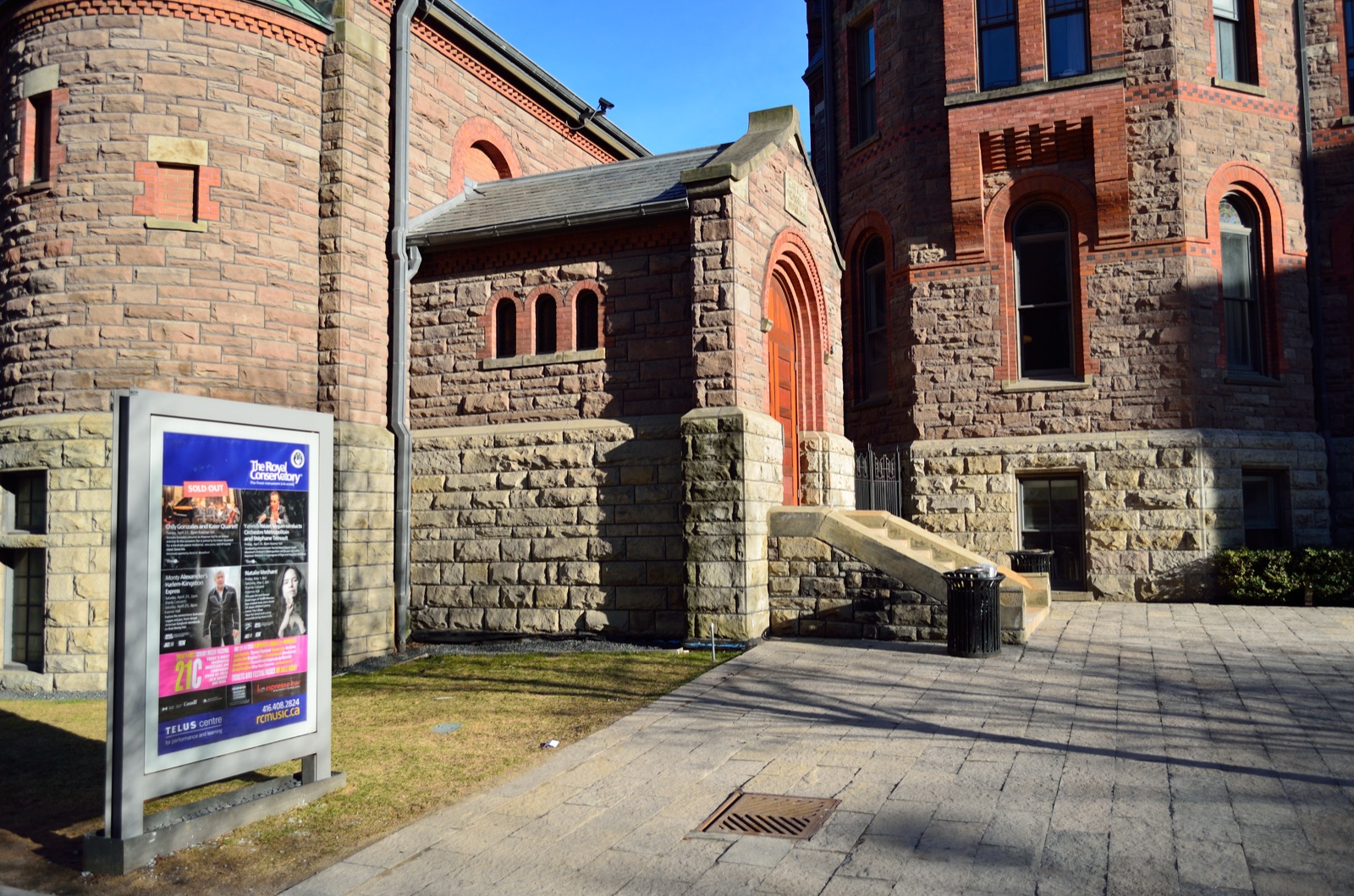

The Royal Conservatory of Music, 273 Bloor Street West, Toronto. Founded 1886. Affiliated with the University of Toronto until 1991, when it became an independent not-for-profit institution. Photo: Raysonho via Wikimedia Commons, CC0 public domain.
Investigation
Why Jonathan Biss Resigned From the Royal Conservatory of Music
When Jonathan Biss resigned from the Royal Conservatory's Glenn Gould School on April 28, 2026, he wrote in the Toronto Star that the institution's response had left him “feeling as if I had no other choice.” By that date, music teacher Lusiana Lukman had publicly alleged that the late RCM pedagogue Boris Berlin had sexually abused her in the 1980s when she was fifteen, a second family account had surfaced, and an independent external investigation had not yet been launched. Three days later, the RCM board announced one. This is the documented timeline of how one of North America's most prestigious conservatories responded when the cost of waiting became public.
Cadenza Editorial·May 2026·Sources: The Royal Conservatory of Music official statements (April 24, 2026; May 1, 2026); the Toronto Star (Lusiana Lukman essay, February 7, 2026; Jonathan Biss op-ed, April 28, 2026 — both partly accessed via secondary reporting); Katherine Needleman Substack open excerpts; The Violin Channel; Global News / Canadian Press; CBC News; CP24; Boston-area peer reporting; Curtis Institute of Music investigative report (September 22, 2020); WHYY; The Guardian / The Observer (March 9, 2025); Jordans Solicitors; Manhattan School of Music statement; Office of the Governor General of Canada honours record; The Canadian Encyclopedia; RCM's historical timeline.
Editor's note. This article is an institution-first chronology. It documents the public record around a survivor's allegations, the Royal Conservatory's institutional response, and the resignation of a faculty member. Lukman's account is presented throughout as her first-person allegation, attributed. Peter Simon's response is presented as his stated response. Boris Berlin's stature is reported from public honours and reference sources. The article does not adjudicate historical events. It documents what has been alleged, what has been said in reply, and what the institution did and did not do, with attribution on every paragraph. Where two named participants in the same event have given conflicting recollections on the public record, both are reproduced and the conflict is identified as the question the announced external investigation will need to resolve.
The Resignation That Changed the Story
Jonathan Biss, photographed at a classical music event in 2019. Biss joined the Glenn Gould School piano faculty in July 2025 and resigned on April 28, 2026. Photo by Peter Stevens via Wikimedia Commons, CC BY 2.0.
On the morning of April 28, 2026, the Toronto Star published an op-ed by the American pianist Jonathan Biss under the headline, in the form posted on his own website, “I joined the Royal Conservatory of Music last year and resigned seven months later. After its handling of abuse allegations, I felt I had no other choice.” The piece announced his resignation from the Royal Conservatory's Glenn Gould School, the elite professional-studies wing of the Toronto institution where he had been hired as a piano-faculty member in July 2025.
Biss had taught at the Glenn Gould School since the start of the 2025–26 academic year. The Royal Conservatory had announced his appointment publicly on July 14, 2025, in a statement on its own news page describing him as a major addition to the piano faculty. On January 16, 2026, the conservatory had published a Q&A profile of Biss titled “Music, Meaning, and the Courage to Listen,” presenting him as a teacher whose classroom was distinguished by what the profile called “moral seriousness.” As recently as April 7, 2026 — three weeks before his resignation — RCM's public Conservatory Circle members' event page still listed Biss as a participating faculty member.
In the Toronto Star op-ed, Biss explained that he was leaving the institution because the public response to a survivor's allegation about the late RCM pedagogue Boris Berlin had not, in his view, met the standard he had assumed an elite conservatory would uphold. According to direct quotations from the op-ed reproduced in subsequent reporting, Biss wrote: “No independent, external investigation had been launched by the time I resigned, and no schoolwide conversation had been initiated.” He described the experience as “a deeply disheartening lesson in how the legal system and corporate culture conspire to encourage inaction, no matter how serious the consequences.”
Biss is one of the most visible American pianists of his generation. He is widely known for his complete recording of the Beethoven piano sonatas — a nine-year, nine- album project released across the Onyx Classics, Meyer Media, and Orchid Classics labels — for his Schumann project, for his Coursera course Exploring Beethoven's Piano Sonatas, and for his long association with the Curtis Institute of Music in Philadelphia, where he was appointed to the piano faculty in 2010 as Neubauer Family Chair. He is co-artistic director, with Mitsuko Uchida, of the Marlboro Music Festival. His public resignation from a faculty appointment at a peer institution — over the institution's handling of historical-abuse allegations — is the kind of artist-side institutional protest that has been rare in the American and Canadian conservatory system.
Three days after his op-ed appeared, on May 1, 2026, the Royal Conservatory's board announced that it had agreed unanimously to commission an independent third-party investigation into the allegations.
A star pianist resigned. A conservatory board moved three days later. This is the documented record of what happened in between.
What Lusiana Lukman Alleged
On February 7, 2026, the Toronto Star published a first-person essay by Lusiana Lukman, a music teacher who had been a piano student at the Royal Conservatory of Music in the 1980s. The full essay is behind the Star's paywall. Substantial direct quotations have been published in an open-access excerpt by the oboist Katherine Needleman on her Substack and have been reproduced in secondary reporting by The Violin Channel, Global News, the Canadian Press, CBC, CP24, and other outlets. The account that follows is reconstructed from those open-access excerpts.
Lukman, in her essay, alleged that she was sexually abused by Boris Berlin, then a senior RCM faculty member, during piano lessons. According to the open excerpts, Lukman states that the abuse began when she was fifteen, that she had recently arrived in Toronto from Indonesia as a visa student, that she barely spoke English, and that she had no family or friends in Canada. Per the excerpts, she alleges that Berlin touched her body during lessons, and that on at least one occasion he forced physical contact she did not consent to.
In quoted passages reproduced from her essay, Lukman describes the experience in first person:
Days before each of my piano lessons, I would get a stomach-ache. I would have nightmares.
I didn't want to talk about what he was doing — I thought it was somehow my fault.
I agreed because of the huge weight of shame, because of all the sleepless nights, because of all the illness, because of other victims' suicides.
Lukman further states, in the open excerpts, that at the time she met with a senior RCM administrator to report her experience. She describes the meeting in first person:
The room was cold and bare other than the desk he was sitting behind and the two chairs my friend and I sat in. I felt very scared and small.
The administrator she identifies in the essay is Peter Simon, who at the time held an administrative role at RCM and would, in 1991, become the institution's first president following its independence from the University of Toronto. Simon's response to her account is reproduced in the next section.
Lukman has stated publicly that her decision to come forward was prompted in part by her involvement in the documentary Dear Lara, directed by the violinist Lara St. John, which premiered at the Santa Barbara International Film Festival on February 6, 2026 — one day before her Toronto Star essay was published. St. John is herself a survivor of historical conservatory abuse who, in a July 2019 Philadelphia Inquirer investigation, publicly alleged that her major-instrument teacher at the Curtis Institute of Music, the violinist Jascha Brodsky, had raped her in 1985–86 when she was fourteen. According to that reporting, St. John had previously brought her allegations to Curtis on multiple occasions beginning in 1986. Curtis subsequently commissioned an independent investigation by the law firm Cozen O'Connor, which published its findings on September 22, 2020 (see the comparators section below).
The Royal Conservatory's initial public response to Lukman's essay, quoted in subsequent reporting, was as follows:
We are deeply troubled and saddened to learn of Lusiana Lukman's personal account and acknowledge the immense courage it takes for people to share their experiences.
Boris Berlin, the subject of Lukman's allegations, died in 2001 at the age of ninety-three. He cannot respond. The factual sections of this article that concern Berlin's life and stature are drawn from public honours records, reference sources, and his published RCM biography.
Who Boris Berlin Was
Boris Berlin (1907–2001) was, by any factual measure, a central figure in twentieth- century Canadian piano pedagogy. He was born on May 27, 1907 in Kharkov, in what was then the Russian Empire (modern-day Kharkiv, Ukraine). According to the Canadian Encyclopedia, he studied at the Sebastopol Conservatory, the Conservatoire de Genève (1923–1925), and at the Berlin Hochschule für Musik with Mark Hambourg and Leonid Kreutzer. He arrived in Canada in 1925, taught at the Hambourg Conservatory in Toronto from 1925 to 1927, and joined the faculty of the Toronto Conservatory of Music — the institution's pre-1947 name — in 1928. He taught at the conservatory, in continuity through its 1947 renaming as the Royal Conservatory of Music and its 1991 independence from the University of Toronto, into the 1990s.
On November 15, 2000, Berlin was named an Officer of the Order of Canada, the country's second-highest civilian honour. The official citation, published on the website of the Office of the Governor General of Canada, describes him as “the teacher of teachers” and credits him with influencing several generations of Canadian pianists. The same citation references his work revising the Royal Conservatory's piano curriculum, his published pedagogical materials and graded compositions for young pianists, and his international reputation as an examiner and adjudicator. He was invested as an Officer of the Order of Canada at Rideau Hall on June 18, 2001 — three months before his death.
The Canadian Encyclopedia and the institutional materials of the Royal Conservatory and its peer organizations describe Berlin as a foundational figure in the Canadian piano method, the originator of widely used method books, and the teacher of, among many others, several pianists who themselves became RCM faculty members. One of those students, who would later lead the institution for more than three decades, was Peter Simon.
Berlin's prominence is part of the symbolic weight of Lukman's allegation. The institutional complaint she made, by her own account, in the 1980s was a complaint about a man whose stature within the conservatory and within Canadian piano culture was already, at that point, near the top of the profession. Whether and how that stature affected the institutional response to her complaint is among the questions the announced external investigation will be expected to address.
The Simon Question
The most institutionally consequential element of Lukman's account, as published in the Toronto Star and reproduced in open excerpts, is her recollection that she reported what was happening to a senior RCM administrator — Peter Simon — at the time. Simon's response, on the public record, is that he does not remember the meeting she describes, but that, had such an allegation been brought to him, he would have treated it seriously and reported it upward through the institution.
These two recollections do not, on the face of the public record, agree. Lukman describes a meeting and a response. Simon does not remember the meeting. Cadenza does not adjudicate which recollection is accurate. The question of which is accurate is the central factual matter the externally-led investigation announced by the RCM board on May 1, 2026, will need to resolve.
The biographical record, however, is the context in which both recollections sit. Peter Simon is, on his own published RCM biography, a former student of Boris Berlin. He led the Royal Conservatory of Music as president for more than three decades, from 1991 — when the institution became independent of the University of Toronto and incorporated as a separate not-for-profit — until September 1, 2024, when he was succeeded as Michael and Sonja Koerner President & CEO by Alexander Brose. Simon's tenure spans the institution's entire post-independence history.
The institutional-era split matters here, and the RCM's own historical materials make it explicit. Until 1991 the conservatory operated under the aegis of the University of Toronto. After 1991 it was an independent not-for-profit. The alleged 1980s events therefore sit on the U of T side of the institutional ledger. The 2026 investigation, the board announcement noted, will engage with the University of Toronto on archival records from that era. That distinction does not relieve current RCM leadership of responsibility for the present-day investigation; it does mean that the historical-accountability question and the present-governance question are related but not identical.
The article does not, here, resolve the conflict between Lukman's recollection of her meeting and Simon's recollection. It records that the conflict exists, that both accounts are on the public record, and that an external process has now been commissioned to determine what the documentary record supports.
The Week That Mattered: April 24 – May 1
The seven-day window between April 24 and May 1, 2026, is the window in which the public institutional posture of the Royal Conservatory of Music materially shifted. It is also the section of this article that rests on the firmest documentary ground.
April 24, 2026
The Internal-Review Statement
On April 24, the RCM published a statement on its own news page, headed “Student Safety and Institutional Accountability.” The statement opens by acknowledging that the institution has been “deeply shaken” by the recent allegations regarding Boris Berlin. It states that the conservatory is conducting an internal review and that an external, third-party investigation is under active consideration. The statement does not, in the version of the page reproduced in subsequent reporting, name a candidate investigator or commit to a specific timeline for the external decision.
The statement is the first formal public response by current RCM leadership in the 2026 cycle of the story, seventy-six days after Lukman's February 7 Toronto Star essay.
April 28, 2026
The Resignation, and a Second Account
Four days later, on April 28, Jonathan Biss published his Toronto Star op-ed announcing his resignation from the Glenn Gould School. Per direct quotations reproduced in The Violin Channel and other outlets, Biss wrote that no independent, external investigation had been launched at the time of his resignation, and that no school-wide conversation had been initiated.
On the same day, the Toronto Star also reported the existence of a second family-account allegation involving Berlin — the recollection of a woman who, per the reporting, had told her daughters before her death in 2023 that she had experienced abuse by Berlin during piano lessons. The reporting on this second account is partly paywalled in the Star and is summarized in subsequent secondary outlets.
The April 28 reporting transformed what had been, on the public record up to April 24, a single survivor account into a corroborating pattern of two allegations from different families across different decades. Cadenza notes that the second account is published, attributed, and described in the same outlet of primary reporting. It does not adjudicate the second account's underlying facts. It records that the account exists in print.
May 1, 2026
The Board Acts
Three days after Biss's resignation, on May 1, 2026, the RCM published a second statement on its news page, headed “RCM Announces Independent Third-Party Investigation.” The statement reports that the board has unanimously agreed to launch an independent, externally led investigation, that the internal review is being completed, and that the institution is engaging with the University of Toronto regarding archival records from the pre-1991 era of conservatory governance.
The May 1 statement is signed in the names of Tim Price, the chair of the Board of Directors, and Rayla Myhal, the vice-chair. The shift from the April 24 management-issued statement to a May 1 statement issued in the names of the board's two senior officers is itself a public signal: the conservatory had escalated the matter from staff communications to board governance. Per the published statement, Price said:
We have heard the calls for action clearly from our community, and we are committed to responding with transparency as this work progresses.
We are committed to creating lasting, systemic change.
The statement does not, in the version reproduced in secondary reporting, name the external investigator or the firm that will lead the investigation. It does not specify the period the investigation will cover, the institutions and affiliates whose records will be reviewed, the criteria the investigation will apply, or the form in which findings will be published.
The pattern of the week is the article's clearest documentary record. On April 24, RCM said it was considering an external investigation. On April 28, a faculty member resigned over its absence. On May 1, the board commissioned one. Cadenza records the sequence and does not characterize causation; the dates are public.
A conservatory's safeguarding culture is measured in the gap between disclosure and action.
What RCM Says About Safety Now
The Royal Conservatory's public safeguarding posture, on the documents presently visible on its own website, has two distinct layers — and they do not fully align.
The first layer is institutional language. The RCM's public statements, including the April 24 and May 1 statements, describe the institution as having comprehensive zero-tolerance policies addressing harassment, abuse, reporting, and safety. The conservatory's publicly accessible faculty code of conduct, in the form available during the research period for this article, prohibits harassment and abuse, requires prompt reporting of suspected abuse or neglect, and cautions faculty against forms of personal attention or off-channel communication with students that exceed the bounds of professional conduct. That language is consistent with the contemporary baseline for elite conservatory safeguarding policy.
The second layer is public-facing reporting architecture — specifically, the path by which a student, an alumnus, a parent, or a member of the public could report a concern. As of the research period for this article, the most prominent public-facing form on RCM's site identified as Report an Issue indicated that it should be used for issues with the National Teacher Directory. The description does not present the form as an abuse-reporting portal, and it directs users away from anything beyond directory matters. A separate clear, public, distinct survivor-reporting channel — distinct from generic feedback or teacher-directory web forms — is not, as of the research period, prominently linked from the conservatory's public navigation.
That gap, between the policy text in one document and the reporting architecture on the public website, is one of the operational facts a careful reader can observe today without speculation. It is, separately, one of the questions the external investigation announced on May 1 may be expected to address: whether the institution's public-facing safeguarding architecture matches the standard the public-facing policy text describes.
What Peer Schools Did
The Royal Conservatory's response is most usefully measured against the responses of peer institutions that have faced comparable historical-abuse allegations in recent years. The relevant comparators are operational, not rhetorical: how quickly was an external investigator engaged, what was the investigation's mandate, what did the institution publish, and what survivor-reporting infrastructure was added afterward.
Three cases provide the contemporary baseline.
Curtis Institute of Music — September 22, 2020
The trigger was Lara St. John's public allegations, published by the Philadelphia Inquirer in July 2019, that her major-instrument teacher at Curtis, the violinist Jascha Brodsky, had raped her during the 1985–86 academic year, when she was fourteen. According to that reporting, St. John had brought her allegations to Curtis on multiple occasions beginning in 1986 before they were made public. Curtis commissioned an external investigation by the law firm Cozen O'Connor, with the inquiry led by partners Gina Maisto Smith and Leslie Gomez — both former child-abuse and sex-crimes prosecutors — and published the investigators' findings on September 22, 2020. The published report found St. John's allegations credible and documented approximately two dozen additional accounts of inappropriate conduct spanning more than fifty years.
The Curtis board issued a formal public apology to St. John, acknowledging that the institution had failed to provide a safe learning environment, failed to investigate properly, and failed to support her. Curtis subsequently established partnerships with RAINN and its local affiliate WOAR to provide free counseling and confidential reporting hotlines for survivors connected to the institution.
The Curtis precedent is the closest North American operational comparator for what RCM has now committed to undertake. It included a named external investigator, a published report, an explicit board apology, and a new survivor-reporting channel.
Guildhall School of Music & Drama — March 2025
In March 2025, The Guardian and The Observer reported on the response of the Guildhall School of Music & Drama in London to a complaint by the opera singer Idit Arad regarding 1980s misconduct by the pianist Paul Roberts, who had been her tutor at Guildhall when she was eighteen and he was approximately twenty years older. Guildhall conducted an externally led inquiry; Roberts had already been suspended in 2021 at the start of the internal stage of the inquiry, and resigned. The school upheld Arad's complaint and found Roberts's behaviour to constitute gross misconduct. Guildhall issued a public apology to Arad, describing Roberts's behaviour as “appalling and completely unacceptable.” Roberts was stripped of his fellowship.
The Guildhall precedent stands for a particular institutional standard: investigation, disciplinary clarity, public apology, fellowship removal, safeguarding follow-through.
Manhattan School of Music — 2024
In 2024, the Manhattan School of Music addressed publicly reported misconduct allegations regarding the oboist Liang Wang, the then-principal oboe of the New York Philharmonic and a member of the Manhattan School oboe faculty. Following the reporting in New York Magazine, the Manhattan School placed Wang on leave in April 2024. The institution's public statement framed the response within its Title IX and sexual-misconduct infrastructure and described the engagement of external investigative process. Separately, the New York Philharmonic announced in November 2024 that an outside investigation had found patterns of sexual misconduct and abuse of power, and that Wang would be dismissed at the start of the next season. Wang has filed defamation suits over the allegations, including a $100 million suit against New York Magazine that was subsequently dismissed. Manhattan School of Music remains, in this article, the contemporary North American baseline for what a conservatory's public-facing response and Title IX architecture looks like under current best practice.
Read alongside these three precedents, the Royal Conservatory's May 1 commitment is a starting point rather than a conclusion. It commits the institution to an external investigation. It does not yet name an investigator, define the mandate, identify the survivor-reporting channel that will receive new disclosures, or commit to a published report. Those four operational specifics are what the Curtis, Guildhall, and Manhattan School responses provided, in some combination, in their public-facing materials. They are the natural questions the public record now asks of RCM.
The Unresolved Questions
The Royal Conservatory has commissioned an independent third-party investigation. That commitment is a meaningful institutional step. The questions below are the ones the public record now asks; they are the questions the investigation's transparency, scope, and outputs will, over the months to come, answer or fail to answer. They are stated as open questions, not as demands. The standard against which they will be measured is the one the comparator institutions above have already set in print.
Open question 1
Who is the investigator? On what date will the investigator and the firm leading the investigation be publicly named, and what is the investigator's independent professional record on comparable institutional inquiries?
Open question 2
What is the mandate? Specifically: what time period does the investigation cover (1980s only? all decades?); which institutions and entities does the mandate include (the post-1991 RCM only? or also the pre-1991 RCM, including its University of Toronto-affiliated structure?); and on what criteria will allegations and institutional responses be evaluated?
Open question 3
Where is the survivor-reporting channel? Specifically: what is the public, confidential, clearly identifiable channel by which a survivor can disclose to the investigation, and how does that channel differ from the existing Report an Issue form whose visible scope is the National Teacher Directory? Will RCM partner with an external organization, as Curtis did with RAINN and WOAR, or establish its own confidential reporting infrastructure?
Open question 4
What will be published? Specifically: will the investigation produce a meaningful public summary of its findings, comparable to the Curtis 2020 publication, or only an internally circulated summary; will the summary name the institutions and individuals whose conduct is examined, including those whose conduct the investigation finds inadequate; and will the institutional apology, if one is offered, be explicit and attributed in the manner of the Guildhall apology?
Each of these four questions is operationally specific and can be answered yes or no. None of them prejudges the substantive findings of the investigation, the underlying historical events, or the conduct of any individual currently or formerly affiliated with the Royal Conservatory. What each question asks is whether the institutional process will be of the kind that comparable institutions have now provided in print.
The investigation has been announced. The institutional posture has shifted. The answers will arrive in the months to come, in the public statements RCM chooses to issue, the documents it chooses to publish, the names it chooses to attach, and the architecture it chooses to build. Cadenza will follow the public record as it develops.
Timeline
May 27, 1907
Boris Berlin born in Kharkov (modern-day Kharkiv, Ukraine).
1925
Berlin arrives in Canada and joins the Hambourg Conservatory in Toronto.
1928
Berlin joins the faculty of the Toronto Conservatory of Music.
1980s
Per her February 7, 2026 essay, Lusiana Lukman alleges she was sexually abused by Boris Berlin during piano lessons at the conservatory, beginning when she was fifteen, and that she met with senior administrator Peter Simon to report her experience. Simon has stated he does not remember the meeting but would have treated such an allegation seriously had it been brought to him.
1991
The Royal Conservatory of Music becomes independent of the University of Toronto and incorporates as a separate not-for-profit entity. Peter Simon becomes its first independent president.
November 15, 2000
Boris Berlin is named an Officer of the Order of Canada. The citation calls him "the teacher of teachers."
2001
Boris Berlin is invested as Officer of the Order of Canada at Rideau Hall on June 18, 2001. He dies later that year at age 93.
July 2019
The Philadelphia Inquirer publishes Lara St. John's public allegations that her major-instrument teacher at the Curtis Institute of Music, the violinist Jascha Brodsky, raped her during the 1985–86 academic year when she was fourteen. St. John had previously brought her allegations to Curtis multiple times since 1986.
September 22, 2020
Curtis Institute of Music publishes the findings of its independent investigation, conducted by the law firm Cozen O'Connor (partners Gina Maisto Smith and Leslie Gomez, former prosecutors). The findings deem St. John's allegations credible. The board apologises publicly to St. John. Curtis launches survivor-reporting partnerships with RAINN and WOAR.
2021
Pianist Paul Roberts is suspended by the Guildhall School of Music & Drama at the start of an internal inquiry into 1980s misconduct alleged by Idit Arad.
April 2024
Manhattan School of Music places oboist Liang Wang — then principal oboe of the New York Philharmonic and a member of the Manhattan School faculty — on leave following misconduct allegations reported in New York Magazine.
November 4, 2024
The New York Philharmonic announces it will dismiss Wang following an outside investigation that found patterns of sexual misconduct and abuse of power.
September 1, 2024
Alexander Brose succeeds Peter Simon as the Michael and Sonja Koerner President & CEO of the Royal Conservatory of Music.
March 2025
The Guardian and The Observer report on Guildhall's upheld complaint against Paul Roberts. Guildhall publicly apologises to Arad. Roberts is stripped of his fellowship.
July 14, 2025
The Royal Conservatory announces the appointment of Jonathan Biss to the Glenn Gould School piano faculty.
January 16, 2026
The Royal Conservatory publishes a Q&A profile of Biss titled "Music, Meaning, and the Courage to Listen," presenting his classroom's "moral seriousness."
February 6, 2026
Dear Lara, the documentary directed by Lara St. John, premieres at the Santa Barbara International Film Festival.
February 7, 2026
Lusiana Lukman's first-person essay is published in the Toronto Star, alleging sexual abuse by Boris Berlin in the 1980s and recounting her recollection of reporting to Peter Simon.
April 7, 2026
An RCM Conservatory Circle members' event still lists Jonathan Biss as participating faculty.
April 24, 2026
The Royal Conservatory publishes its first formal public statement of the 2026 cycle: an internal review is underway; an external investigation is "under active consideration."
April 28, 2026
Jonathan Biss publishes his Toronto Star op-ed and resigns from the Glenn Gould School. The Toronto Star reports a second family-account allegation involving Berlin. Biss states no external investigation had been launched and no school-wide conversation initiated by the time he resigned.
May 1, 2026
The RCM board, in a statement signed by chair Tim Price and vice-chair Rayla Myhal, announces an independent third-party investigation. The board says the internal review is being completed and that the institution is engaging with the University of Toronto on pre-1991 archival records.
May 2026 (publication of this article)
The investigator, mandate, era covered, survivor-reporting channel, and publication plan have not yet been publicly defined.
A note on sources
This article is built from public-record sources only. Lukman's allegations are reported throughout as her first-person account in the Toronto Star, accessed via the Star's online publication and the open-access excerpts published in the Substack of the oboist Katherine Needleman. Where the underlying Star essay is behind the publication's paywall, this article quotes only those passages that have appeared in open form in secondary outlets. Cadenza did not subscribe to the Toronto Star to access the full essay; it relied on the open excerpts and on the substantive summaries published by The Violin Channel, Global News, the Canadian Press, CBC News, CP24, North Shore News, and other outlets.
The April 24 and May 1 RCM statements are quoted as published on the RCM's own news page and as reproduced in secondary reporting. Direct quotations from Tim Price and Rayla Myhal in the May 1 statement are attributed to that statement. Direct quotations from Jonathan Biss are attributed to his Toronto Star op-ed of April 28, 2026, where they have appeared in open-form excerpts on his own website and in subsequent reporting. Boris Berlin's biographical record is drawn from the Office of the Governor General of Canada honours record, the Canadian Encyclopedia, and the Royal Conservatory's own published materials. Peter Simon's position and tenure are drawn from his published RCM biography. The Curtis case is drawn from Curtis's September 22, 2020 board statement and the published investigative report, with secondary detail from WHYY. The Guildhall case is drawn from The Guardian and The Observer of March 9, 2025, and from Jordans Solicitors' legal-context summary. The Manhattan School of Music case is drawn from the school's own statement.
No anonymous sources were used by Cadenza for this article. Where two participants in the same event (Lukman and Simon) have given conflicting recollections on the public record, both recollections are reproduced and the conflict is identified as the central factual matter that the externally-led investigation will need to resolve.
This article does not adjudicate the underlying historical events. It does not state Berlin's alleged abuse as established fact. It does not state that any individual currently or formerly affiliated with the Royal Conservatory of Music acted in bad faith. It documents what has been alleged, what has been said in reply, and what the institution has done and not done, with attribution on every paragraph. Where the institution's own public-facing reporting architecture is described — including the contemporary scope of its Report an Issue page — that description reflects the state of the publicly accessible RCM website during the research period for this article.
Cadenza will follow the announced investigation as the public record develops, and will update this article as the investigator, the mandate, the survivor-reporting channel, and the publication plan are made public.
Comments
Sign in to join the discussion.