← Back to News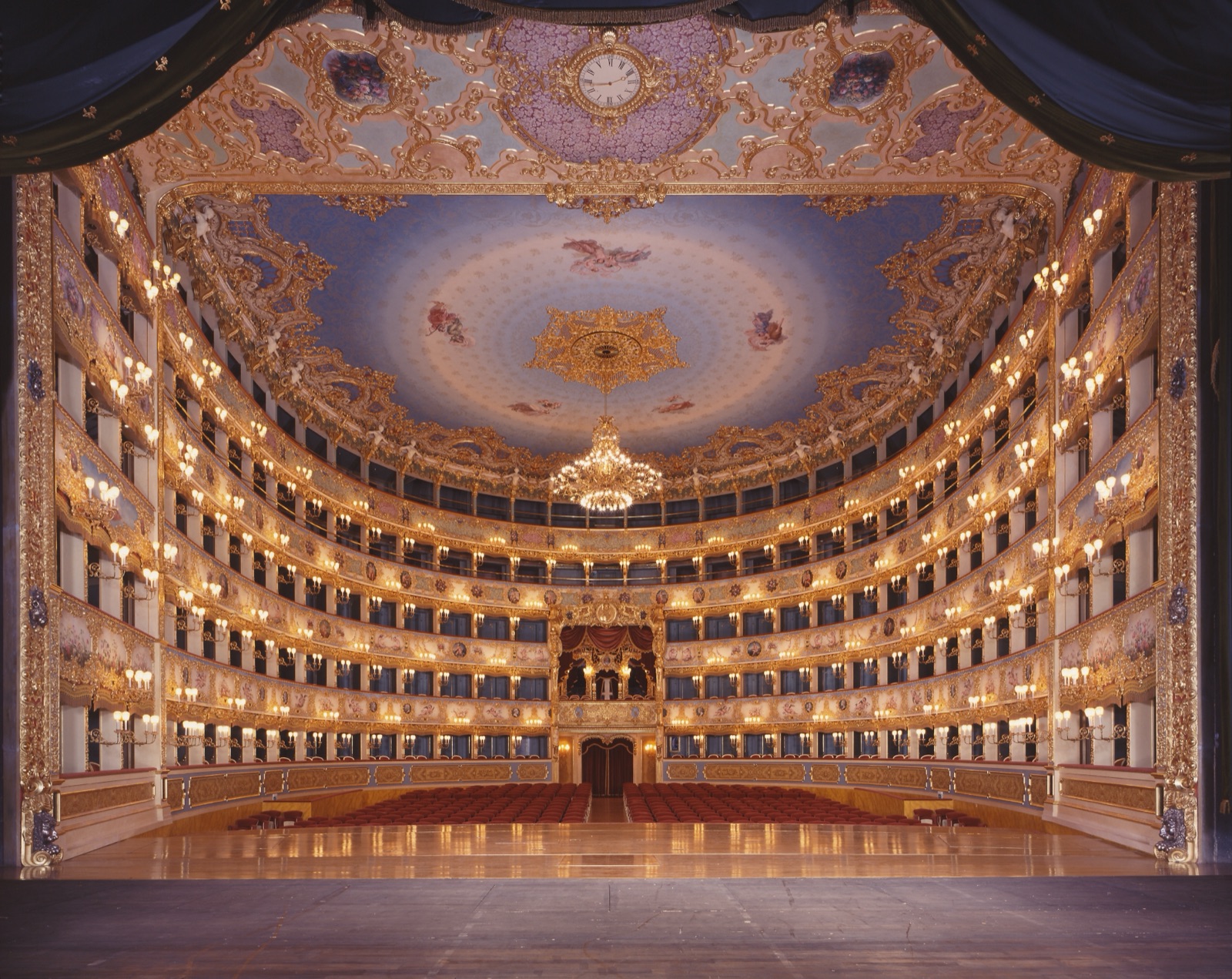
Teatro La Fenice, viewed from the stage — the angle Beatrice Venezi was scheduled to see for the first time on October 1, 2026. She would not get there. Photo by Pietro Tessarin, 2018, via Wikimedia Commons, CC BY-SA 4.0.
Investigation
Meloni's Conductor Accused La Fenice of Nepotism. La Fenice Fired Her.
Italy's government helped Beatrice Venezi become the first female music director of Teatro La Fenice. Then she gave an interview to an Argentine newspaper and accused the orchestra of inheriting jobs “from father to son.” Three days later she was fired — without ever conducting a single performance there. The full record of how she got the job, and how she lost it.
Cadenza Editorial·May 2026·Sources: Teatro La Fenice press releases, Italian Ministry of Culture, La Nación (Buenos Aires), L'Espresso, Il Fatto Quotidiano, Il Sole 24 Ore, ANSA, Il Mattino, Open, Il Gazzettino, Slippedisc, OperaWire, Opera Now, The Violin Channel, Euronews, Washington Post, Irish Times, Courthouse News, Pagella Politica, Wikipedia
Editor's note. This article relies on public reporting from Italian and international outlets, La Fenice statements where available, and contemporaneous coverage. Disputed claims are attributed to the source that made them. Where two named participants in the same event have given conflicting accounts on the public record, both accounts are reproduced.
The Same Evening
On the morning of September 22, 2025, La Fenice named its new music director.
By the same evening, the orchestra of La Fenice had published a public letter demanding the appointment be revoked.
Seven months later, the Foundation fired her. She had not, in that time, conducted a single performance there. She would not get the chance to.
Her name was Beatrice Venezi. She was thirty-six. She was the first woman ever named to lead the theatre in its 234-year history. She had publicly described herself as a personal friend of the Italian Prime Minister. Her four-year contract was set to begin on October 1, 2026, and run until March 31, 2030. None of that saved her.
The day she was fired — April 26, 2026 — the news was on the front page of every major Italian daily by morning. Reuters, AFP, the BBC, the Washington Post and the Irish Times all ran it. Italy's Minister of Culture Alessandro Giuli — who had publicly defended her appointment for seven months — issued a brief statement calling the dismissal an “autonomous and unappealable act of the Superintendent” that he “fully shared.” Three days later, on live radio with Fiorello, the same minister suggested Venezi should direct a different Italian theatre instead.
She was supposed to lead La Fenice for four years. She lasted seven months — without conducting a single note.
0
Performances conducted at La Fenice as music director
216
Days between her appointment and her dismissal
156
Days between dismissal and the start of her contract
This is not a podium feud. There was no rehearsal-room shouting match, no programming dispute, no artistic falling-out. Those happen after a music director starts the job. Venezi never started.
What follows is the seven-month record of how an Italian opera house came to appoint a conductor its musicians said, on day one, was unqualified to lead them; why it appointed her anyway; how she spent the months between her hiring and her firing; and what the whole episode reveals about how political power has been routed through Italian classical music since the Meloni government took office in October 2022.
The Press Conference
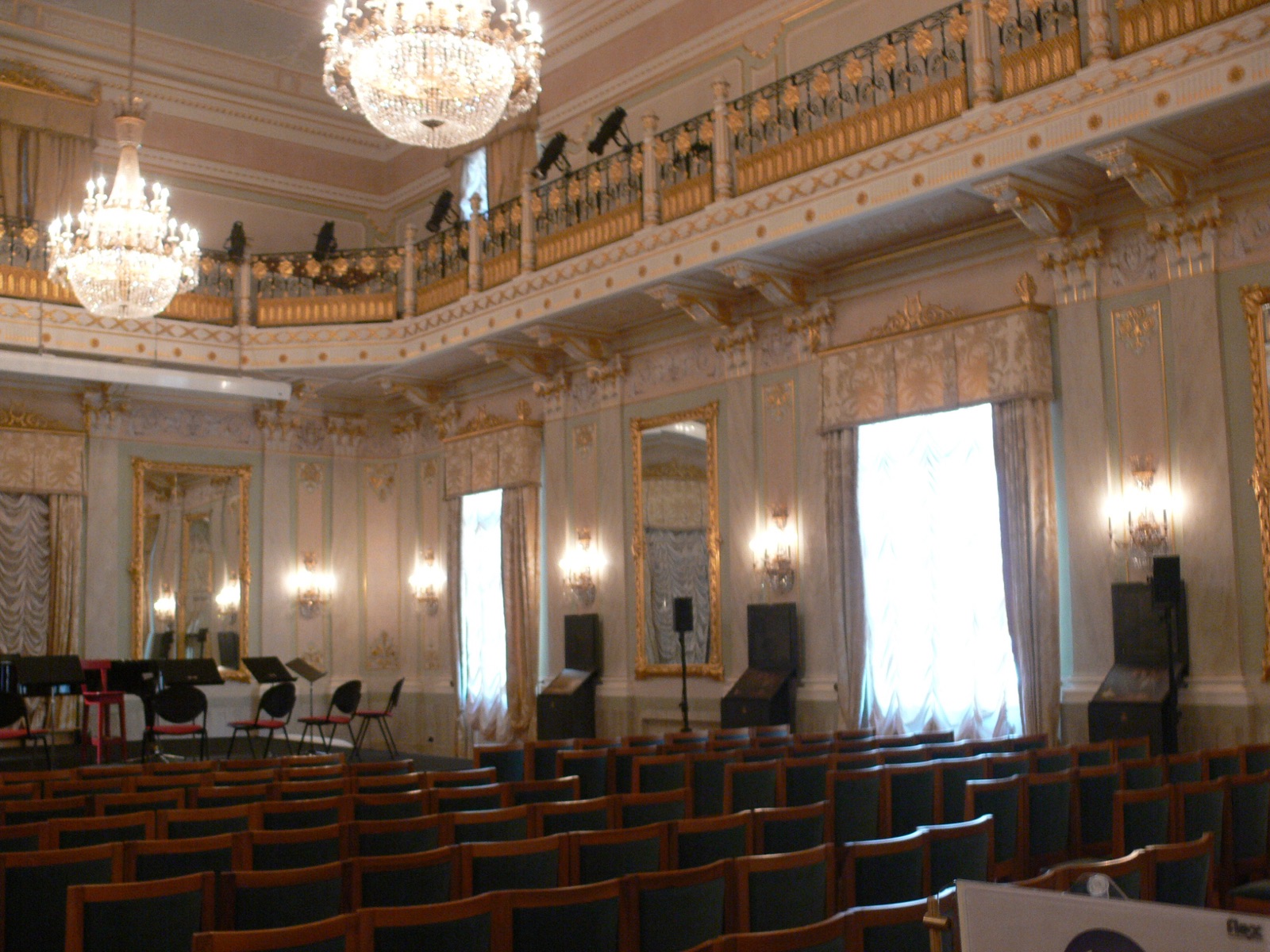
The Sale Apollinee — the gilded reception rooms one floor above the lobby of Teatro La Fenice, where the September 22, 2025 press conference naming Beatrice Venezi music director was held. Photo by Remi Mathis, 2012, via Wikimedia Commons, CC BY-SA 3.0.
The whole thing started on a Monday morning. September 22, 2025. The Fondazione Teatro La Fenice convened a press conference in the Sale Apollinee — the gilded reception rooms above the theatre's lobby — and named Beatrice Venezi music director of the theatre. She was the first woman ever appointed to the role in the institution's 234-year history.
The Foundation's release described the appointment as “unanimously approved by the Foundation's president, Mayor of Venice Luigi Brugnaro, and all members of the Board of Directors,” and as having “matured as a result of fruitful talks and the willingness shown by the Maestro.”
The Maestro's contract would begin on October 1, 2026, and run for four years. She would conduct an opening gala that month and at least one full opera production and one symphonic program per season, with additional galas and recordings. Her appointment had been negotiated, the Foundation said, with the new Superintendent Nicola Colabianchi — a 68-year-old composer and former superintendent of the Cagliari opera, himself appointed by Minister of Culture Alessandro Giuli only six months earlier, in March 2025.
The Fenice musicians learned of the appointment, in their own words, “exclusively through the press.”
We learned exclusively through the press of a decision in blatant contrast with previous public statements. The musicians of this Foundation were never consulted. Maestro Venezi has never conducted this orchestra. Her artistic and professional profile is not remotely comparable to those of the music directors who have preceded her in this role.
Within twelve hours of the press conference, the orchestra had signed a public letter addressed directly to Colabianchi calling for the appointment to be revoked. Within a week, the union representation (RSU) had voted to strike. Within a month, La Fenice would cancel the opening night of its 2025–26 season. Within seven months, the Foundation would tear up the contract entirely.
All of that begins on this date. To understand it, you need to know who was in the room on September 22, 2025 — and who was not.
Who Made This Happen
The Fondazione Teatro La Fenice is, on paper, a private-public foundation. Its highest authority is its Board of Directors, headed by the Mayor of Venice in his ex-officio role as Foundation president. The Superintendent — appointed by the Italian Minister of Culture from a board recommendation — runs the theatre day to day and serves concurrently as artistic director.
Five people made the September 22 appointment possible. Four of them gave it cover. One of them tore it down.
President of the Foundation
Luigi Brugnaro
Mayor of Venice since 2015, businessman, founder of the centre-right civic list “Coraggio Italia.” In his ex-officio role he chairs the Foundation Board. After her firing, Brugnaro told Il Mattino he had “welcomed her warmly” but conceded the contract “could not hold” and that Venezi had “responded over the line.” According to former Fenice superintendent Cristiano Chiarot, speaking publicly after the dismissal, it was Brugnaro who “admitted that she had been imposed on him, admitting to having had pressures from Rome.”
Superintendent & Artistic Director
Nicola Colabianchi
68 years old. Abruzzese composer, professor at the Accademia di Santa Cecilia in Rome. Appointed to La Fenice on March 9, 2025 by Minister Giuli on the unanimous recommendation of the Foundation board, after stints as superintendent of the Cagliari opera and artistic director of Rome Opera. Italian state broadcaster RAI News reported he was “appointed under political pressure given his well-known closeness to Meloni and Atreju” — the Fratelli d'Italia political festival. Colabianchi has denied this, saying: “No request — on the contrary, I anticipated Venezi's appointment to prevent there being interference.” In his telling, he hired her quickly so Rome would not have to ask. He signed her contract. Seven months later he tore it up.
Italian Minister of Culture (current)
Alessandro Giuli
Former editor of right-wing daily Libero, former president of the MAXXI museum in Rome. Appointed Minister of Culture on September 6, 2024, after the resignation of his predecessor Gennaro Sangiuliano. Inherited Venezi's ministerial advisory role. On April 26, 2026, Giuli publicly endorsed Colabianchi's decision to fire her, calling it an “autonomous and unappealable act of the Superintendent.” Three days later, on April 29, on Rai Radio 2's La Pennicanza in dialogue with Fiorello, Giuli said that if the Italian state could buy the Teatro Delle Vittorie in Rome and convert it into a symphonic theatre, “Beatrice Venezi will direct it.”
Italian Minister of Culture (predecessor)
Gennaro Sangiuliano
The minister who first hired Venezi. On November 17, 2022 — three weeks after the Meloni government took office — Sangiuliano signed the decree appointing Venezi as Music Advisor to the Ministry of Culture, where she remained until his resignation in September 2024. The role reportedly paid €30,000 a year, though those figures later became contested in a separate scandal that brought him down.
Prime Minister
Giorgia Meloni
By Venezi's own account in La Nación, the two have been personal friends since “before her political career.” In December 2021, when Meloni was still leader of the opposition, her party Fratelli d'Italia gave Venezi the Atreju21 award at its annual Roman political festival. After the appointment Venezi told the Argentine paper she admired Meloni as “an extremely competent and powerful woman” and that the support flowed “from woman to woman, from friend to friend.” Two days after Venezi's firing, Palazzo Chigi — Meloni's office — issued a statement saying the Prime Minister “does not interfere” in cultural appointments.
These are the public hands. There were others — the unnamed Roman pressures Brugnaro described, the cultural-policy advisors at the ministry, the Foundation board members who voted unanimously, the legal counsel who drafted a contract that, eight months later, would have to be torn up. But these five are on the record. Three of them are still in their jobs.
The CV
The single most concrete charge against Venezi's appointment was that she did not have the experience for the job. The Fenice musicians said this in their public letter on September 22. The unions said it in their strike call. Major international critics — including Norman Lebrecht of Slippedisc, who has been writing about classical music politics for forty years — said it in print.
The arithmetic is straightforward. La Fenice is one of Italy's eleven government-designated Fondazioni Lirico-Sinfoniche, the top tier of Italian opera houses. Per the Foundation's own published history, its principal music directors in recent decades have been Eliahu Inbal, Vjekoslav Šutej, Isaac Karabtchevsky, Marcello Viotti, Diego Matheuz, and Markus Stenz — the conductor Venezi was hired to replace. Among the principal guest conductors and frequent visitors have been Lorin Maazel, Seiji Ozawa, Riccardo Muti, Riccardo Chailly, Jeffrey Tate, Myung-Whun Chung, Christian Thielemann and Giuseppe Sinopoli — the tenured pipeline of major international podiums.
Venezi's biography is different.
The seat she was hired into
- Eliahu Inbal — conducted the Berlin Philharmonic, the Vienna Philharmonic, the Royal Concertgebouw, the New York Philharmonic and the NHK Symphony before La Fenice. Recorded complete cycles of Mahler and Beethoven. La Fenice principal music director in the 1990s.
- Marcello Viotti — Munich Radio Orchestra chief conductor, MDR Leipzig chief conductor, principal guest at the Vienna Volksoper. La Fenice music director from 2002 until his death in 2005.
- Isaac Karabtchevsky — São Paulo Symphony, Orchestre des Pays de la Loire, Bonn Beethovenhalle music directorships. La Fenice music director in the 2000s.
- Diego Matheuz — graduated from the Venezuelan El Sistema, mentored by Claudio Abbado, principal guest at the Bologna Comunale, conducting credits at La Scala, Vienna Symphony, Deutsche Oper Berlin, Tonhalle Zürich. La Fenice principal music director 2011–2014.
- Markus Stenz — Cologne Gürzenich-Orchester general music director (2003–2014), Hallé Orchestra principal guest conductor (2009–2014), Netherlands Radio Philharmonic chief conductor (since 2012). La Fenice outgoing music director, on the Wozzeck podium October 2025.
- Beatrice Venezi — Principal Guest Conductor of the Puccini Festival in Torre del Lago. Principal Conductor of the Nuova Orchestra Scarlatti Young (the youth wing). Music advisor to the Italian Ministry of Culture. The orchestra of La Fenice, in its September 22 letter, stated she had “never conducted an opera or a public symphonic concert at La Fenice.”
Some of the gap is generational; Venezi is thirty-six and her predecessors were not when they took the role. But the rest of it is on paper.
40
Opera performances claimed on Venezi's CV at the September 22 announcement
160
Concerts claimed on Venezi's CV at the September 22 announcement
100
Opera productions claimed on Teatro Colón program book, November 18, 2025
250
Concerts claimed on Teatro Colón program book, November 18, 2025
The math is impossible. Between September 22 and November 18 — fifty-seven days — Venezi's public CV grew by sixty operas and ninety concerts. To produce that volume of new work in fifty-seven days, she would have had to conduct, on average, more than one opera and nearly two concerts every single day. She did not. The growth was on the page, not the podium.
The discrepancy was first documented by Slippedisc in early November 2025, citing the printed Teatro Colón program book for the Buenos Aires La Traviata she guest-conducted that month. By the time of the firing, neither the Foundation nor Venezi's management had publicly addressed it.
In fifty-seven days, her public CV grew by sixty operas and ninety concerts. She had not conducted them.
The character of the engagements also matters. Venezi has held principal-conductor titles, but at smaller institutions: the Nuova Orchestra Scarlatti Young, the Milano Classica Orchestra, the Puccini Festival of Torre del Lago in a guest-conductor role. She has appeared as a guest conductor at major houses — including the Royal Opera of Versailles, the Sofia Philharmonic, and on tour — and has signed a major-label recording contract with Warner Classics, releasing her album My Journey: Puccini's Symphonic Works in 2019.
On her published curriculum, she has not held a music-director position at any of the eleven Italian Fondazioni Lirico-Sinfoniche or at an internationally tenured opera house before La Fenice. There is no public record of her leading a complete production at the Royal Opera House, La Scala, the Wiener Staatsoper, the Bayerische Staatsoper, the Metropolitan Opera, the Paris Opéra, the Mariinsky, the Concertgebouw, the Berlin Philharmonic, the Cleveland Orchestra, or the London Symphony Orchestra. The orchestra noted this in its September 22 letter, in plain language: “Her artistic and professional profile is not remotely comparable to those of the music directors who have preceded her in this role.”
She has trouble keeping the players together; she waves her arms in an unconvincing manner; the performances do not inspire my ears. Sending her to lead La Fenice is like sending out a schoolboy to captain Italy in the next World Cup.
In Buenos Aires, the Teatro Colón printed her in its November 2025 La Traviata program book initially as “principal guest conductor.” In the published edition that finally went into the audience's hands, the title had been quietly demoted to “guest conductor.” The premiere of the production was led by the seasoned Italian conductor Renato Palumbo, who had forty years of international experience. Venezi conducted reprise performances, after Palumbo had set the production.
The Argentine engagement, according to Slippedisc and corroborating Italian press reports, had been arranged through the Italian Embassy in Buenos Aires rather than via an artistic search by the Colón. Neither the Colón, the Embassy nor Venezi has, to date, publicly disputed that account.
Lucca, 1990
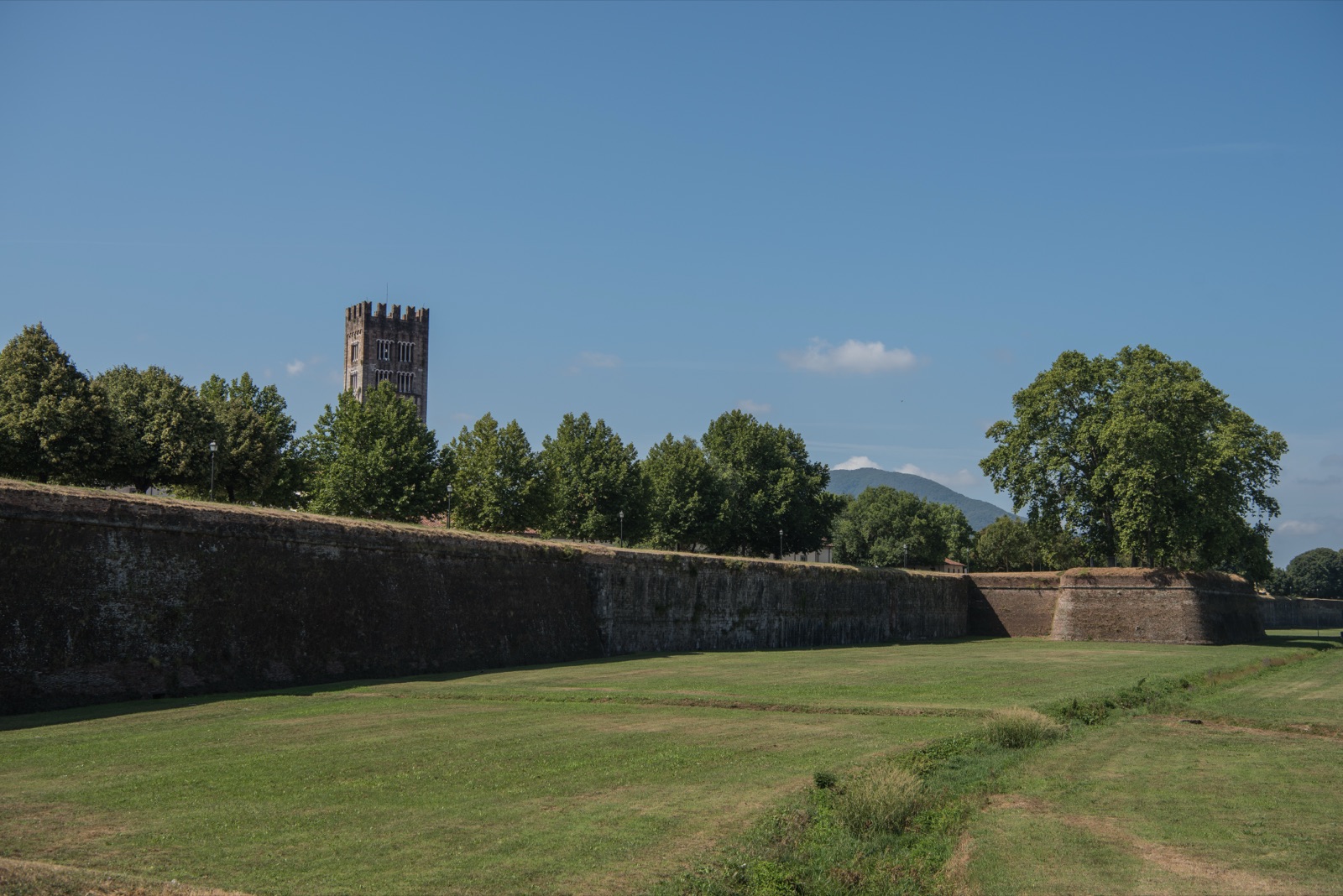
Beatrice Venezi was born on March 5, 1990 in Lucca. She grew up there. Her early career barely left it. She made her opera debut in 2016 at the Puccini Festival in Torre del Lago — a fifteen-minute drive from the Lucca city walls — conducting Busoni's Turandot. She returned to the festival in 2017 for the centenary of La Rondine, and was named Principal Guest Conductor. The Puccini Festival is one of the largest summer operatic events in Italy. It is not one of the eleven Fondazioni Lirico-Sinfoniche.
Her father, Gabriele Venezi, is a real estate businessman in Lucca and the editorial director of Lucca Times, a local paper. He is also — and this is the line that has followed his daughter across every major news story since 2022 — a former member of Forza Nuova, the far-right Italian political party founded by Roberto Fiore. According to coverage in Open, Il Mattino and Il Gazzettino in late September 2025, Gabriele Venezi ran as the Forza Nuova candidate for Mayor of Lucca in 2007 and held a national role within the party at that time.
The Renaissance walls of Lucca, where Venezi was born and grew up. Photo by Alex2015Genova via Wikimedia Commons, CC BY-SA 4.0.
In a long interview given to Il Gazzettino in late September 2025, after his daughter's appointment to La Fenice, Gabriele Venezi defended her publicly for the first time. He argued she was being attacked because the Italian cultural establishment was “defending its privileges,” and that he himself had “stopped doing politics” roughly fifteen years earlier — that is, around 2010 — “in order not to be an obstacle” to her career. The framing of the defence was striking. He did not deny his Forza Nuova past. He framed it as a sacrifice he had made for his daughter's sake.
Beatrice Venezi has not publicly disowned her father's political history. She has, in interviews, repeatedly said she will “always thank him” for the support he gave her career. She has also, equally repeatedly, said her own work has nothing to do with politics — that she is, as she put it to L'Unione Sarda in October 2025, “a self-made provincial girl, and the elite doesn't like that.”
The decisions she has made, year by year, are on the public record. Readers can draw their own conclusions about whether they describe a private artistic career or a public political one.
She studied piano. She won the Italian National Piano Competition “R. Zucchi” at the age of fifteen, in 2005. She graduated in piano from the Conservatory of Siena in 2010, then studied composition with the Lucchese composer Gaetano Giani Luporini before crossing over into orchestral conducting. She studied conducting in Florence with Piero Bellugi — the eccentric, internationally respected conductor who had been an assistant to Bruno Walter, Pierre Monteux and Sir Adrian Boult — and at the Accademia Chigiana in Siena with Gianluigi Gelmetti and the American conductor John Axelrod. Bellugi remained her primary teacher and mentor; he died in 2012, when she was twenty-two.
She graduated in orchestral conducting from the Giuseppe Verdi Conservatory of Milan in 2015, with full marks cum laude, under the conductor Vittorio Parisi. She was twenty-five.
Sanremo, 2021
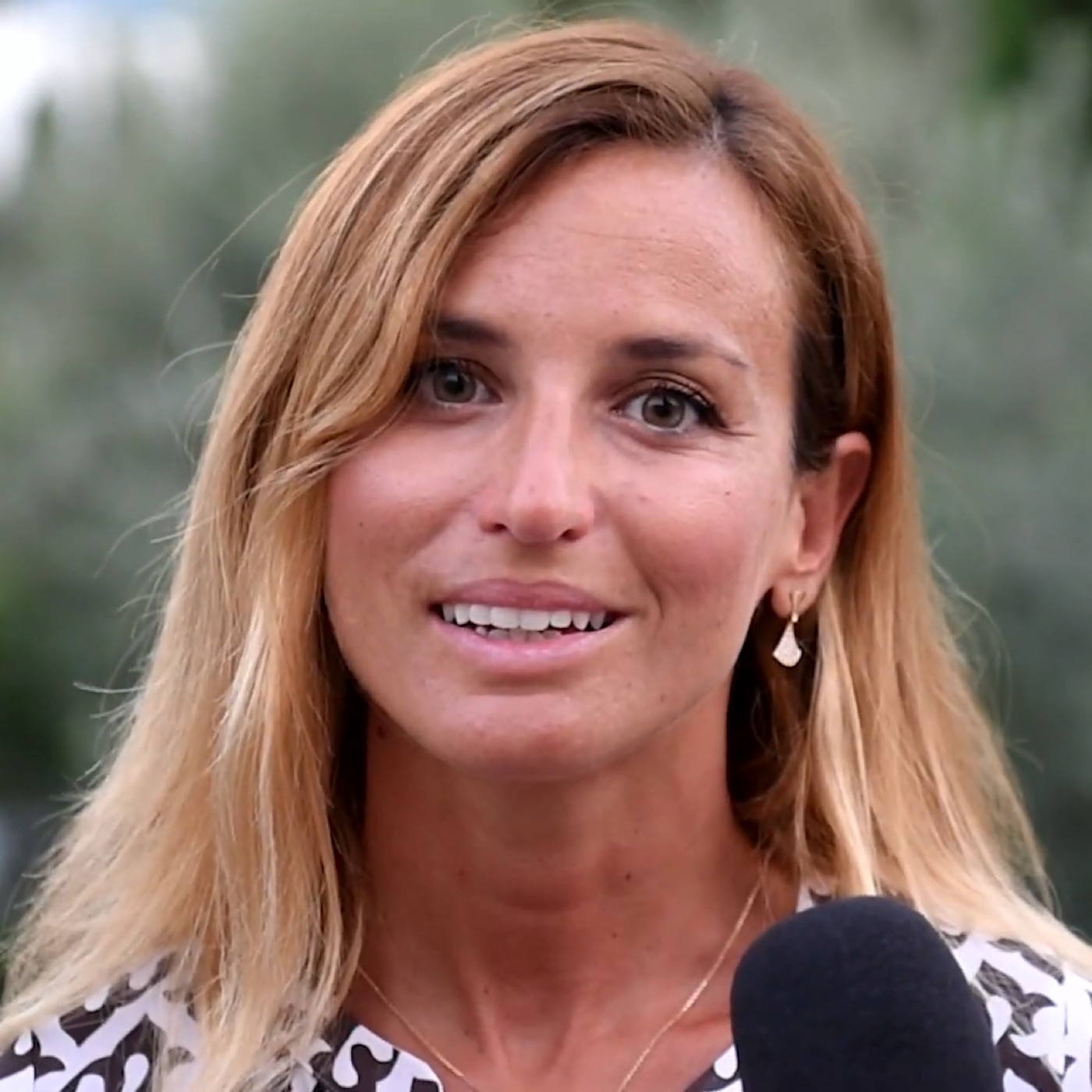
Beatrice Venezi gives an interview to the Consiglio Regionale Abruzzo — the regional assembly of Abruzzo, then governed by a centre-right coalition — in August 2023, ten months after her appointment as ministerial advisor. Photo by Consiglio Abruzzo via Wikimedia Commons, CC BY 3.0.
On the night of March 6, 2021 — the closing night of the seventy-first Italian Song Festival in Sanremo, broadcast live on RAI 1 to nearly twelve million viewers — Beatrice Venezi appeared as a co-host alongside Amadeus, and conducted a brief demonstration with a small orchestra on the Ariston theatre stage.
Then she did the thing that would define her public profile for the next five years. Amadeus, prompted, observed that she preferred to be addressed by the masculine form of her professional title — “direttore d'orchestra” rather than the feminine “direttrice.” Venezi confirmed it. She explained that the title denotes a role, and that she wanted that role recognized as having “the same validity, the same weight, the same pay and the same opportunity, whether it is a woman or a man.”
The reaction was immediate and predictable. Italian feminists and language activists protested that the masculine form was not gender-neutral but specifically masculine — that asking to be called direttore was not advocating equality but repudiating the feminine form of her own job. Several Italian newspapers ran think-pieces. Venezi defended her position in subsequent interviews, framing it as merit-over-language: she did not need a feminine title to prove she belonged.
The Sanremo moment was supposed to be a statement about merit. It became something else.
Nine months later, during Atreju 2021 — the annual political festival of Fratelli d'Italia, then still an opposition party, held in Rome at Piazza Risorgimento from December 6 to 12 — Beatrice Venezi was given the Atreju21 award.
The award was presented by Federico Mollicone, the Fratelli d'Italia member of parliament who is now chair of the Italian Chamber's Culture Commission. Giorgia Meloni, then leader of the opposition, was present. According to Atreju coverage in Secolo d'Italia — Fratelli d'Italia's own party newspaper — the award was given specifically to honor “the young orchestra director who, at Sanremo, had clarified she preferred to be called direttore,” framing her as a woman who believed equality was achieved through merit rather than “linguistic modifications.”
By Secolo d'Italia's own framing, the award was given for a public political stance Venezi had taken on national television. Venezi accepted it. Four years later, she would still describe herself in interviews as “not political,” a self-description readers can weigh against the documented record.
For her immense talent, for which she is recognized throughout the world as a symbol of the Italian artistic panorama.
The Ministry
The Meloni government took office on October 22, 2022. Twenty-six days later, Venezi had a job at the Ministry of Culture.
On November 17, 2022, Minister Gennaro Sangiuliano signed a ministerial decree naming her Music Advisor. The official communiqué from the ministry identified her role as supporting the Minister's direct collaboration offices, the General Secretariat, and the General Direction of Entertainment. She was thirty-two, part-time, with no tenured podium — and an advisor to the second-largest cultural ministry in Europe.
The same year, she was appointed artistic director of the Taormina Arte Foundation by Sicily's regional government, which by that point was led by a centre-right coalition that included Fratelli d'Italia. The two appointments came within months of each other. Both came from political authorities. Neither came from a theatre's artistic search committee.
The salary for her ministerial role was reportedly approximately €30,000 per year. The figure surfaced in 2024 when it became part of a different scandal entirely: the affair of Maria Rosaria Boccia, the entrepreneur who had been romantically and professionally linked to Sangiuliano and whose public revelations brought down his ministry that September.
In the course of that scandal, on La7 television in early September 2024, Boccia accused Venezi of a conflict of interest — alleging she received the €30,000 ministerial fee while simultaneously holding paid positions as an artistic director, taking paid private engagements, and accepting a fee for performing at the G7 Culture event in Naples. Boccia further claimed that the ministerial €30,000 figure “did not appear in the official records.”
Venezi denied the charge categorically, retained lawyers, and announced she was preparing to file criminal defamation proceedings against Boccia. Sangiuliano announced his own legal action against Boccia at roughly the same time. Sangiuliano resigned as Minister of Culture on September 6, 2024. Venezi's ministerial advisory role passed to his successor, Alessandro Giuli, who kept her on.
Nice, January 1, 2024
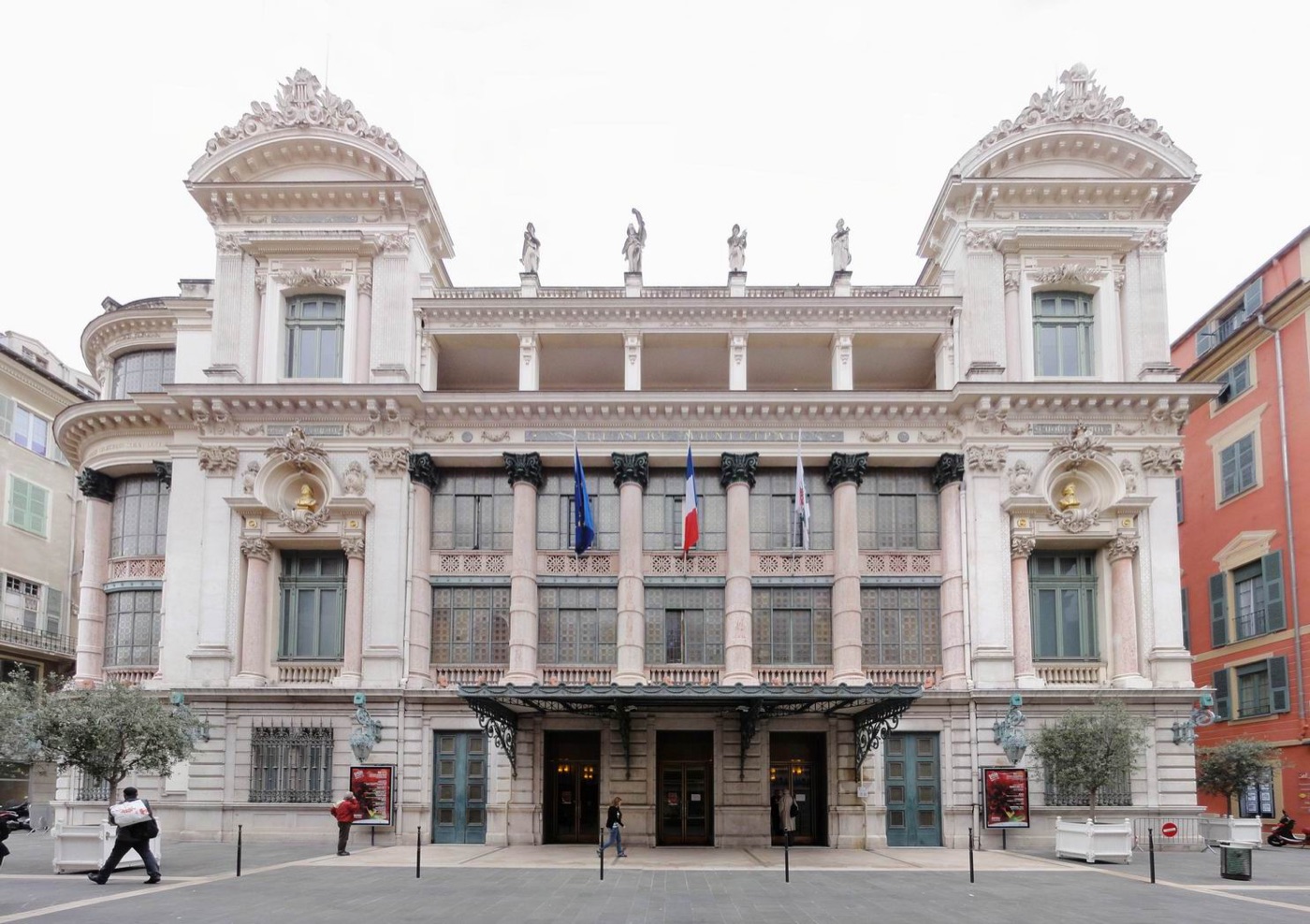
The Opéra de Nice. On January 1, 2024, four spectators in the upper gallery unfurled a banner reading “Non vogliamo i fascisti” during Venezi's New Year's concert. The protest was reported by Open, Il Fatto Quotidiano and others. Photo by Qjafcc via Wikimedia Commons, CC BY-SA 3.0.
The first time someone unfurled an antifascist banner at one of her concerts was January 1, 2024. The venue was the Opéra de Nice. Venezi was conducting the New Year's concert at the invitation of the centrist mayor, Christian Estrosi, who had also booked her to lead the Nice Philharmonic in Giselle from December 21 to 29, 2023.
In the days leading up to the New Year's concert, antifascist groups in Nice demonstrated outside the opera house, calling on the mayor and the theatre to cancel her appearance, citing her advisory role with the Italian government and her father's former Forza Nuova affiliation. Italian and French press reported the gathering at roughly fifty people. The municipality refused to cancel. The concert went ahead.
During the performance, four people in the upper gallery began chanting “Non vogliamo i fascisti!” — “We don't want fascists!” — and unfurled a banner with the same words. Some of the audience booed the protesters. Some applauded them. Venezi, on the podium, looked up at the gallery, registered what was happening, and then turned back to the orchestra and continued the concert.
The Nice protest was the first international demonstration against her on political grounds. It was reported widely in Italian and French media and made the international wire services. It was, in retrospect, also the dress rehearsal for what would happen twenty-one months later in Venice — except in Venice, the protest would come from the orchestra itself.
The Letter
The letter from the Orchestra of La Fenice was published on the afternoon of September 22, 2025, hours after the press conference, and addressed directly to Superintendent Nicola Colabianchi.
It was extraordinary in tone and detail. Italian symphony orchestras rarely write open letters; when they do, they usually limit themselves to general expressions of concern about their working conditions or artistic standards. The Fenice musicians did something different. They named the conductor. They specified what she had not done. They challenged the procedural legitimacy of the decision itself.
From the Orchestra of La Fenice, September 22, 2025
We learned exclusively through the press of a decision in blatant contrast with previous public statements. The musicians of this Foundation were never consulted. Maestro Venezi has never conducted this orchestra. Her artistic and professional profile is not remotely comparable to those of the music directors who have preceded her in this role.
We ask the Superintendent and the Foundation to revoke the appointment and to reopen the search through the procedures appropriate to the artistic standing of this institution.
Within days, the workers' representation (RSU) of the Foundation — which represents the orchestra, the chorus, the technical staff, and the administrative employees — voted to back the orchestra's position. The unions CGIL, UIL, FIALS, SLC and FISTel all signed on. A petition on Change.org demanding the revocation of the appointment opened, drawing thousands of signatures from Italian and international musicians. A letter from 140 La Fenice season-ticket holders followed, warning the Foundation that they would withdraw their subscriptions if the appointment stood.
By the end of September, the protest had spread. La Scala in Milan publicly expressed solidarity with the Fenice orchestra. Other Italian Fondazioni Lirico-Sinfoniche followed. On November 10, 2025, a procession of musicians, technicians, and administrative staff from theatres across Italy marched through Venice in support. Inside La Fenice, leaflets denouncing the appointment were thrown from the upper tiers during a separate symphonic concert.
Wozzeck
October 17, 2025. The Fenice was scheduled to open Alban Berg's Wozzeckthat evening — its outgoing music director Markus Stenz on the podium, closing the 2024–25 season.
At noon, the unions confirmed the strike would proceed. The orchestra walked out. The chorus walked out. The technical staff walked out. The performance was cancelled. The audience was turned away at the door of one of the most famous theatre lobbies in Europe, on the opening night of the closing opera of the season, three weeks after the incoming music director's name had been announced — a name none of them had been asked about.
Oct 17
Date of the cancelled Wozzeck premiere, 2025
6:30 pm
Curtain time the strike forced the theatre to abandon
2024-25
The closing season Stenz conducted, never finished publicly
Wozzeck was eventually performed, with cast and conductor unchanged, on substitute dates later in October. But it was not the only casualty. A closing symphonic concert of the same season was cancelled by a separate strike. Subscribers who had paid for full seasons were issued partial credits. The Foundation's communications increasingly took on a tone of damage control rather than artistic announcement.
In the months that followed, Venezi did appear at La Fenice — but not on its main podium. She conducted, by her own management's description, “a short promo event” tied to the Foundation's communications efforts around her appointment. The orchestra played. She did not lead a full production. She did not lead a subscription concert. She was, on the day she was fired, still scheduled to do both for the first time in October 2026.
Buenos Aires
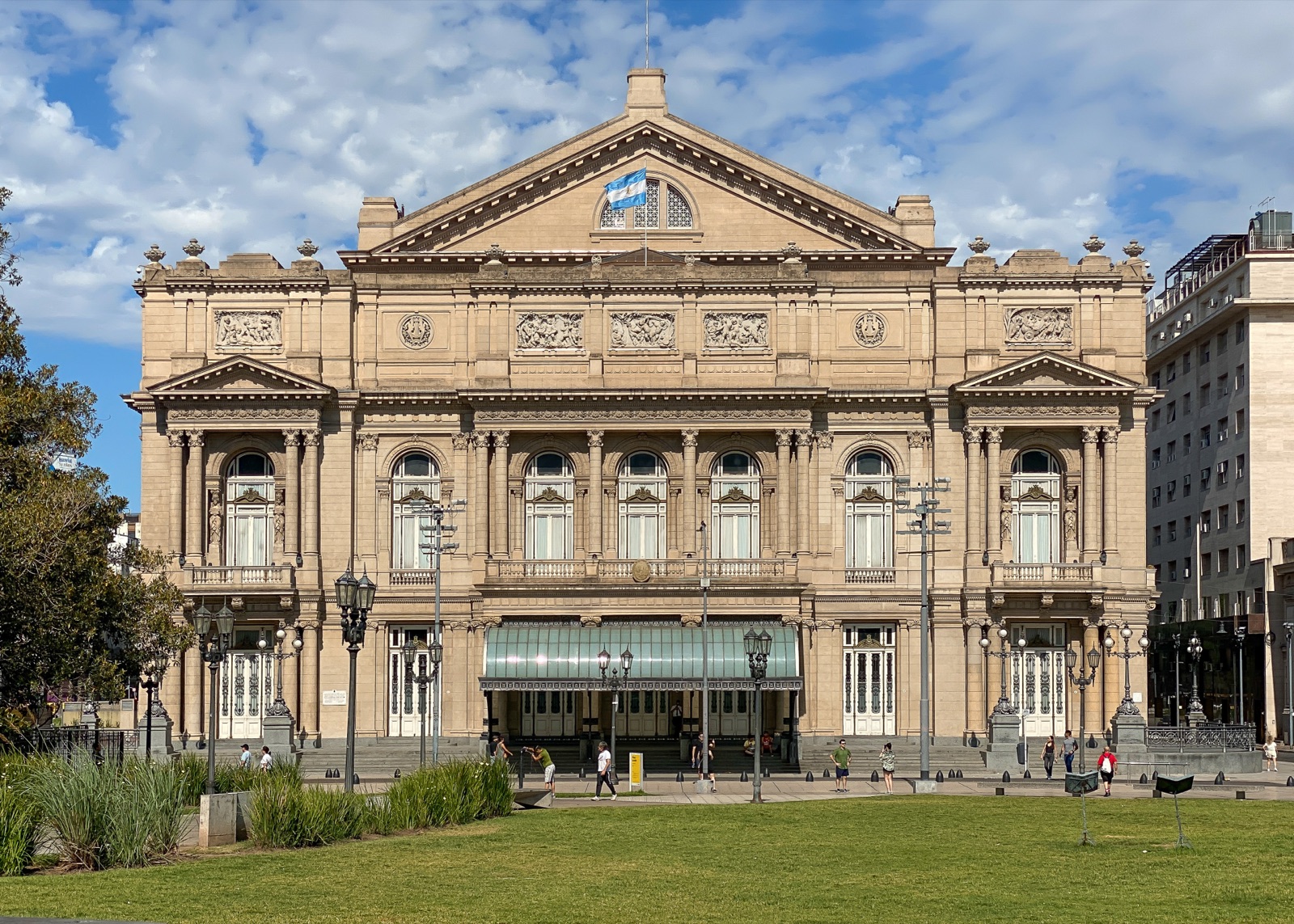
Teatro Colón, Buenos Aires. According to reporting in Slippedisc and Italian press, Venezi's November 2025 La Traviata reprises were arranged through the Italian Embassy in Argentina; Renato Palumbo conducted the premiere. Photo by EEJCC via Wikimedia Commons, released into the public domain (CC0).
In November 2025, while the orchestra she would supposedly lead was striking against her appointment, Venezi flew to Buenos Aires to guest-conduct Verdi's La Traviata at the Teatro Colón. The engagement had been brokered, according to reporting in Italian and Argentine media, through the Italian Embassy in Argentina — a point Venezi's critics flagged as further evidence that her bookings were flowing through diplomatic and political channels rather than artistic ones.
At the Colón, two telling details emerged. The first was that the printed program book initially listed her as “principal guest conductor.” In the version actually distributed to audiences, the title had been demoted to “guest conductor.” The second was that the production's premiere and subscription run was led by Renato Palumbo, an Italian conductor with forty years of international opera experience. Venezi conducted only the reprise performances, after the production had been set by Palumbo. In opera-house terms, this is the difference between leading a production and stepping in to caretake one.
It was also at the Colón, and in interviews tied to the Buenos Aires engagement, that the CV expansion documented earlier in this piece was published. Whether the inflation originated with her management, the theatre, or with Venezi herself remains an open question. None of the parties involved has publicly explained it.
The Interview
On April 23, 2026, instead of giving an interview to an Italian newspaper, Beatrice Venezi gave one to an Argentine one.
She had been the embattled music director-designate of La Fenice for seven months. She had not given a sustained interview to an Italian outlet since the fall. The Argentine daily La Nación ran the piece. In it, Venezi described the Italian classical music establishment as “stuck in the past,” afraid of “change” and “renewal.” She described herself as a self-made outsider — “I don't come from a family of musicians, and unlike others I've had no godfathers” — and contrasted herself with the Fenice orchestra in a single sentence that, within seventy-two hours, ended her contract.
I don't come from a family of musicians, and this is an orchestra where positions are practically passed down from father to son.
In the same interview she described her relationship with Giorgia Meloni — by then two years into her tenure as Italian Prime Minister — as one between “friends.” Asked about the Italian Premier's support, she said it had flowed “from woman to woman, from friend to friend,” and called Meloni “an extremely competent and powerful woman” whom she had known “before her political career.”
The phrase that ended her contract was the “father to son” one. Italian orchestras hire by national or international public competition, with auditions behind a screen — a process designed precisely to prevent the kind of inheritance Venezi had alleged. The RSU's response, posted within hours of the interview's circulation in Italian, was sharp.
The maestro's statements are false, serious, and offensive. Access to this orchestra occurs strictly through international public competitions, based on merit and professional rigour. We demand a public retraction.
The retraction did not come.
The Firing
On Saturday evening, April 26, 2026, the Fondazione Teatro La Fenice issued the statement that ended the appointment. It ran to fewer than two hundred words. It named no one but Venezi and Colabianchi.
Fondazione Teatro La Fenice, official statement, April 26, 2026
The Fondazione Teatro La Fenice, through its Superintendent Nicola Colabianchi, announces the cancellation of all upcoming projects with Maestro Beatrice Venezi.
The decision follows repeated and serious public statements by the Maestro that were offensive and harmful to the artistic and professional standing of the Foundation, its orchestra, and its institutional values.
Within minutes the statement was wired internationally. Within hours, Italian Minister of Culture Alessandro Giuli — Venezi's former boss at the ministry — issued a brief reply describing the dismissal as an “autonomous and unappealable act of the Superintendent,” one he “fully shared.” Three days later, on April 29, the same Giuli appeared on Rai Radio 2's La Pennicanza with Fiorello and said that, if the state could buy the Teatro Delle Vittorie in Rome and convert it into a symphonic theatre, “Beatrice Venezi will direct it.” The Italian government had endorsed firing her from one major theatre and, within the same week, suggested giving her another.
Two days later, Palazzo Chigi — the office of the Italian Prime Minister — released a short note saying the government “does not interfere with the choices” of the Fondazione. By this point, the unions had publicly welcomed the firing as “a necessary act of respect” for the orchestra.
April 26: Italy's Minister of Culture endorses firing Beatrice Venezi from La Fenice. April 28: Palazzo Chigi states that the Prime Minister “does not interfere” in cultural appointments. April 29: the same Minister of Culture, on live radio, says he wants Venezi to direct a different Italian theatre.
The Pivot
The pivot took three days.
On April 29, 2026, Beatrice Venezi gave an interview to the left-leaning Italian daily L'Unità. In it, she said she “should never have agreed to perform for Meloni at a Fratelli d'Italia event.” She said the Italian right had “made me into cannon fodder” — “carne da macello” in Italian, the phrase for an animal led to slaughter. She said she had been “used and left alone.”
The pivot was not subtle. For three and a half years, Venezi had been one of the most visible classical-music figures publicly aligned with the Italian centre-right: an award recipient at the Fratelli d'Italia festival, a ministerial advisor, a self-described friend of the Premier. According to Slippedisc and Italian press reporting, her Buenos Aires engagement was arranged through the Italian Embassy; her La Fenice appointment was, per former superintendent Cristiano Chiarot, signed under what Mayor Brugnaro described to him as “pressures from Rome” — a characterisation Superintendent Colabianchi has denied. Until April 2026, she had not, in any major interview, distanced herself from that alignment.
And then, in the week she lost her job, she did.
I shouldn't have played for Meloni at a Fratelli d'Italia conference. The right made me into cannon fodder. I was used and then left alone.
The reaction in the Italian right-wing press was swift and bitter. Outlets that had defended her for years — Il Giornale, Libero, Secolo d'Italia, La Verità — pivoted in turn, treating her statements as ingratitude. Outlets on the left — L'Espresso, Il Fatto Quotidiano, La Repubblica — treated them with the cold interest of prosecutors who had just been handed an unexpected witness.
Whether the pivot is sincere is not something this article can adjudicate. What the public record shows is that, for nearly four years, Venezi accepted awards, appointments and engagements arranged with the support of the Italian centre-right government and its political festival, and did not publicly distance herself from that alignment. Her own description of the relationship has, since April 26, 2026, changed.
What La Fenice Did, and Did Not, Do
La Fenice did one important thing. It tore up a contract that should not have been signed. The Foundation, faced with a music director-designate who had publicly accused its orchestra of nepotism in a foreign newspaper, refused to ride out the storm. It used the contractual exit it had — “serious and repeated public statements offensive and harmful to the institution” — and it walked.
That is not nothing. In Italian institutional culture, where political appointments tend to outlast their initial controversies and quietly normalize, it is something close to rare. The orchestra, the unions, and the season-ticket holders forced the issue from below. The Superintendent, having put his name on the original contract, took it off. He kept his job. The Mayor kept his. The Minister kept his. The Prime Minister kept hers.
But La Fenice did not do the harder thing, which is to ask publicly how an unanimous board vote — a vote that had been signed off by the Mayor of Venice and approved by the Italian government's Ministry of Culture — landed on a candidate the orchestra knew, instantly, was wrong for the job. The Foundation did not publish a report. It did not address the “pressures from Rome” that its own former superintendent Cristiano Chiarot has publicly described in Italian press. It did not reconcile, in public, Colabianchi's stated intent to act quickly in order to head off political interference with the fact that the appointment he made was the one critics described as politically driven.
That account is owed. It has not been given. Until it is, the Italian opera system will look to the next ambitious Roman politician exactly the same way it did before September 2025: as a place where, with sufficient leverage and sufficient embarrassment-tolerance, you can install your friends.
The Eight-Month Music Director
Beatrice Venezi is not the story. She is the most visible person in it. She accepted the appointments she was offered. She allowed CV figures to stand that Slippedisc documented as having grown by sixty operas and ninety concerts in fifty-seven days. She gave an interview to La Nación in which she accused her own orchestra of nepotism. She is, in the end, a thirty-six-year-old conductor who took the jobs she was given.
The story is the system that gave them.
Critics — including the Fenice unions, Slippedisc, L'Espresso and Pagella Politica — have described the period between October 2022 and April 2026 as a pattern: a young, ideologically aligned conductor with thin major-house experience given a ministerial advisory role; international engagements extended via diplomatic channels; and, eventually, the leadership of one of Italy's most prestigious opera houses. Whether the pattern was deliberate or cumulative is contested. The events themselves are on the record.
What is not contested is the response from below. The Italian opera orchestra — the specific, technical, pit-and-stage union of musicians and stagehands and chorus and lighting technicians who produce performances forty weeks a year for a paying public — wrote on day one that they did not consider Venezi qualified to lead them. They kept saying so for seven months. In the end, the Foundation acted in the same direction.
They knew Venezi had not led a major production. They knew the standard of her previous engagements. They knew what her predecessors had done, because they had played for them. They wrote it down on the day of the announcement, in plain language, and sent it to the Superintendent. He proceeded anyway. Seven months later he reversed himself, and not because he had changed his mind about the original decision. He reversed himself because the music director-designate had given an interview that made the original decision impossible to defend in public.
That is a victory for the Fenice musicians. It is also, separately, a verdict on the process that produced the appointment in the first place. The next time the Italian government tries this — and it will, because political appointments to publicly funded cultural institutions are one of the easiest forms of patronage available to any government — the orchestra will know what to do. They did it once already.
The first female music director of La Fenice never conducted La Fenice. She was hired in a press conference, resisted by the orchestra, defended by politics, and dismissed before a single downbeat.
In Italian, there is a phrase for a person whose job existed only on paper: nominato ma mai entrato in servizio. Appointed but never having entered service. That is what Beatrice Venezi was at Teatro La Fenice. She was named to one of the great podiums in Europe. She never reached it.
La Fenice will name another music director. The orchestra she would have led continues, this season, with guest conductors. The Foundation has begun a search.
Whoever it is, the orchestra will, this time, have been consulted before the press conference.
Timeline
March 5, 1990
Beatrice Venezi born in Lucca, Italy.
2007
Her father, Gabriele Venezi, runs for mayor of Lucca as the Forza Nuova candidate.
2010
Graduates in piano from the Conservatory of Siena.
2015
Graduates in orchestral conducting from the Giuseppe Verdi Conservatory in Milan, under Vittorio Parisi.
2016
Debut at the Puccini Festival in Torre del Lago conducting Busoni's Turandot.
March 6, 2021
Sanremo Festival co-hosting moment: tells Amadeus she prefers "direttore" to "direttrice".
December 11, 2021
Receives the Atreju21 award from Federico Mollicone at the Fratelli d'Italia political festival.
October 22, 2022
Meloni government takes office.
November 17, 2022
Sangiuliano signs the decree appointing Venezi as Music Advisor to the Italian Ministry of Culture.
January 1, 2024
Antifascist protest during her New Year's concert at the Opéra de Nice.
September 2024
Boccia accuses Venezi of conflict of interest on La7. Sangiuliano resigns. Giuli succeeds him and keeps Venezi on.
March 9, 2025
Nicola Colabianchi appointed Superintendent of La Fenice by Minister Giuli.
September 22, 2025
La Fenice announces Venezi as music director. Orchestra publishes open letter the same day demanding revocation.
October 17, 2025
Strike forces cancellation of the opening night of Wozzeck.
November 10, 2025
Cross-theatre solidarity procession through Venice. Leaflets thrown inside La Fenice.
November 18, 2025
Teatro Colón La Traviata. Initially listed as "principal guest conductor"; demoted to "guest conductor" in printed program. CV inflation documented.
April 23, 2026
La Nación interview: "an orchestra where positions are practically passed down from father to son."
April 26, 2026
La Fenice cancels all collaborations with Venezi. Giuli backs the dismissal as an "autonomous and unappealable act of the Superintendent."
April 28, 2026
Palazzo Chigi: Meloni "does not interfere" with cultural appointments.
April 29, 2026
On Rai Radio 2 La Pennicanza with Fiorello, Minister Giuli — three days after backing the firing — says Venezi should direct a future symphonic theatre at the Teatro Delle Vittorie in Rome. Hours later, Venezi tells L'Unità: "I was used and left alone. The right made me into cannon fodder."
October 1, 2026
Date her four-year contract was scheduled to begin. She would not have conducted that day.
A note on sources
This article was assembled from public-record sources only: official press releases from the Fondazione Teatro La Fenice and the Italian Ministry of Culture; Italian newspaper coverage in L'Espresso, Il Fatto Quotidiano, Il Sole 24 Ore, Il Mattino, Il Gazzettino, L'Unità, Open, Il Post, ANSA and Pagella Politica; international coverage in the Washington Post, the Irish Times, Euronews, Reuters, the BBC, AFP, Yahoo News and the Associated Press; classical-music trade press in Slippedisc, OperaWire, Opera Now, the Violin Channel, Bachtrack, Symphony, Moto Perpetuo, Finestre sull'Arte and Gramilano; and the published Wikipedia biography of Venezi. The April 23 La Nación interview was published in Spanish and translated quotations are taken from the multiple Italian and English secondary sources that reproduced them. The Atreju21 award details rely on Fratelli d'Italia's own party publication Secolo d'Italia.
No anonymous sources were used. Where quotations are given, they are attributed to a named individual in a published source. Where contradictory accounts exist — most notably between Mayor Brugnaro's reported admission of “pressures from Rome” and Superintendent Colabianchi's explicit denial of the same — both accounts are reproduced.
Comments
Sign in to join the discussion.