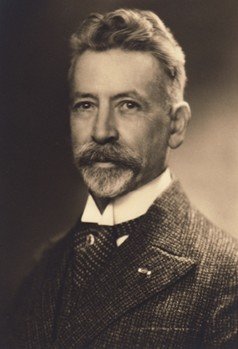
August De Boeck
1865–1937
Quick Facts
- Born
- 1865
- Died
- 1937
- Era
- Romantic
Tags
organistcomposermusicologistuniversity teachermusic educatormusician
Biography
WikipediaJulianus Marie August De Boeck (May 9, 1865 in Merchtem, Belgium – October 9, 1937 in Merchtem) was a Belgian composer, organist and music pedagogue. He was the son of organist and director Florentinus (Flor) De Boeck (1826-1892) Career
From 1880 he studied organ at the Royal Conservatory of Brussels under Alphonse Mailly, whose assistant he became until 1902.
In 1889 he met the young Paul Gilson who became a close friend and, despite being the same age, his teacher for orchestration. Gilson encouraged De Boeck's composition work.
He became an organist at various churches in Belgian villages (1892-1894 in Merchtem, 1894-1920 in Elsene). His academic career continued in 1907 as professor of harmony at the Royal Conservatory of Antwerp (1909–1920) and the Brussels Conservatory, and as director of the Conservatory of Mechelen (1921–1930). His students included Maria Scheepers. In 1930 August De Boeck retired to his birthplace, Merchtem.
As with Gilson, De Boeck's style was influenced by the Russian Five, and especially Nikolai Rimsky-Korsakov. Along with Gilson, he introduced impressionist composition in Belgium. He wrote about 400 compositions including vocal work, operas, religious pieces and instrumental compositions. Honours
1934 : Commander in the Order of Leopold.
Member of the Royal Academy of Science, Letters and Fine Arts of Belgium Works Orchestral works
1893 Rhapsodie Dahoméenne
1895 Symphony in G
1923 Fantasy on two Flemish folk tunes
1926 Fantasy for oboe and orchestra
1929 Concerto for violin and orchestra
1929 Concerto for Hans piano and orchestra (with Maria Scheepers)
1931 Nocturne
1932 Concerto for piano and orchestra
1936 Cantilène for cello and chamber orchestra
1937 In schuur
Cinderella, symphonic poem
Elegy for string orchestra
Gavotte for string orchestra Sacred works
Three Masses, for three voices and organ
17 Spiritual Songs
1898 Trois Pièces, for organ
1. Prélude
2. Andante
3.
Works & Events
No recorded events found.
Gallery(2)

Quick Facts
- Born
- 1865
- Died
- 1937
- Era
- Romantic
Tags
organistcomposermusicologistuniversity teachermusic educatormusician




Are you a musician? Join Cadenza for free