
For thirty years the most exacting performances on earth have been booked with the least exacting tools on earth. An email asking whether a soloist is free in March. A "let me check." A fee agreed on a phone call, a contract in a word processor, an invoice weeks later, a payment someone eventually remembers to chase.
Anyone who has watched a six-figure date quietly evaporate because the only record of the hold lived in one person's inbox knows exactly what this costs. It is not a small leak. It is the structural condition of an entire art form — a global economy of orchestras, halls, festivals, agencies and artists, coordinated almost entirely by memory.
That condition is ending, and it is ending inside a quiet, invitation-only platform called Kalinklo. It calls itself the private operating system for artist engagements — not a marketplace, not a directory, but the layer underneath the work that keeps everything else true. This is a piece of artist booking software, yes, but to call it that undersells the ambition: it is trying to be the thing the music business has somehow never had, a single record of how a booking actually happens, from the first held date to the final settled invoice.
We spent real time inside the product. Here is what we found, why it matters, and — because no honest assessment skips this — the one risk that could still sink it.
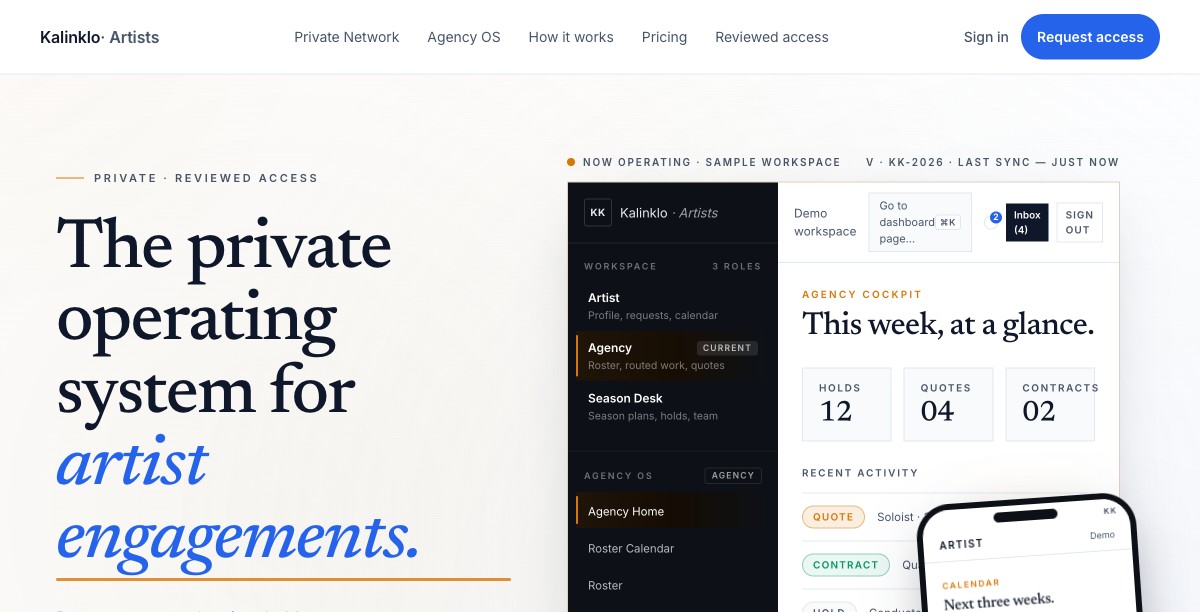 Kalinklo's agency cockpit: a week of holds, quotes and contracts at a glance — the view that today lives scattered across a dozen inboxes.
Every industry gets its operating system. Music's just arrived.
Look at what happened everywhere else. Sales got Salesforce. Payments got Stripe. Design got Figma. One by one, every serious field got an opinionated system that understood its real objects and refused to treat the work as generic — and the companies that built those systems stopped being vendors and became the system of record.
Premium live music never got one. And it is not as though no one tried. There is capable artist booking software out there: Prism.fm coordinates events across more than ten thousand venues; Gigwell gives agents and buyers a real cloud workflow; Overture runs bookings, contracts and calendars for some 350 agencies. These are good products. But they were built for the commercial-touring and venue world — around the gig — and almost none of them touch the thing that actually bleeds a classical agency: a 15-to-20-percent commission model the software itself does nothing to earn or reduce. They brought structure to the room next door. The concert world kept its spreadsheets.
Kalinklo's wager is that the most valuable, most relationship-bound corner of the business is the last one still missing its operating system, and that the window to build it is open right now. That is not a modest bet. It decides who runs the back office of an art form for a generation.
Watch one booking, in full
Abstraction convinces no one. So watch a single engagement move, exactly the way Kalinklo's own walkthrough lays it out — one illustrative Mahler booking, from availability to settlement, every state on one record. (The names are the platform's labelled sample data; the machinery underneath is real.)
It opens 104 days before the downbeat. An agency posts an artist's open window — November 11 to 14, held for symphonic two-night programmes, travel base Paris — with a fee bracket of €18–24k visible only to verified presenters. Not a public listing. A private availability, shown to vetted eyes.
Day 98. A concert hall sends not an email but a structured request: two nights, Mahler 5, opening with the Adagietto on the second night, a room near 2,000 seats, live-audio recording only, a fee proposal of €22,000 all-in — inside the posted bracket. The request carries an ID, because here a request is an object, not a paragraph.
Day 96. The agency drops a 14-day soft hold. The calendar locks, marked Priority 01, a timer ticking in plain view of both sides so nobody is ever left wondering whether the date is still alive.
Day 92. The quote: fee €22k, travel and per diem at agency standard, two rehearsals, an exclusivity radius of 120 km for 30 days. The agent edits one clause, approves, sends — and it ships as version 2, because the third revision must never silently bury the first.
Day 84. The contract. A draft is generated straight from the approved quote; the agency marks the exclusivity radius, the hall counters, the final version is signed on both sides — with the audit log already standing at 14 recorded events, each one time-stamped and attributable.
Day 60. From that signed contract, a deposit invoice: 30%, €6,600, balance scheduled for the day of performance. A human releases every transfer.
And seven days after the music stops, the line that holds the whole philosophy: the performance happens, and the ledger is sealed. Final balance paid, commission split routed, audit trail closed. State: Closed · €20,680 net · audit · sealed. The artist's next window is already open for planning.
One engagement, end to end, with nothing dropped between the calendar and the contract or between the contract and the cash — because none of it ever left the system.
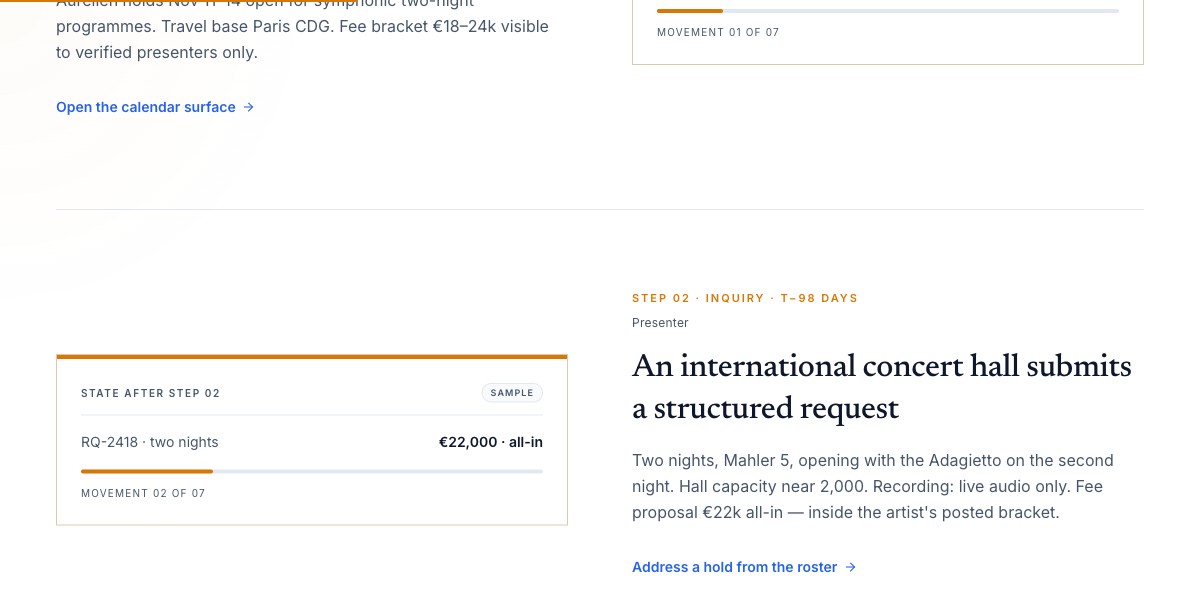 In the platform's sample engagement every state is an object, not a sentence — here the structured inquiry RQ-2418 (two nights, €22,000 all-in), its progress tracked beneath it.
What the room agrees, the ledger keeps.
That is not a slick demo. It is the thing every email-and-spreadsheet workflow has been failing to be for decades, finally shipped as one auditable record.
This is not a war with the agencies
Here is the question every agent asks in the first thirty seconds, and they are right to ask it: is this thing coming for me?
For twenty years, almost every technology that walked into music arrived as a threat to the humans in the middle. Streaming reset the labels. Marketplaces like GigSalad and The Bash turned booking into a search box and quietly cut the agent out of the transaction. So when a new platform shows up wearing the word "engagements," the reflex — it wants my clients — is not paranoia. It is memory.
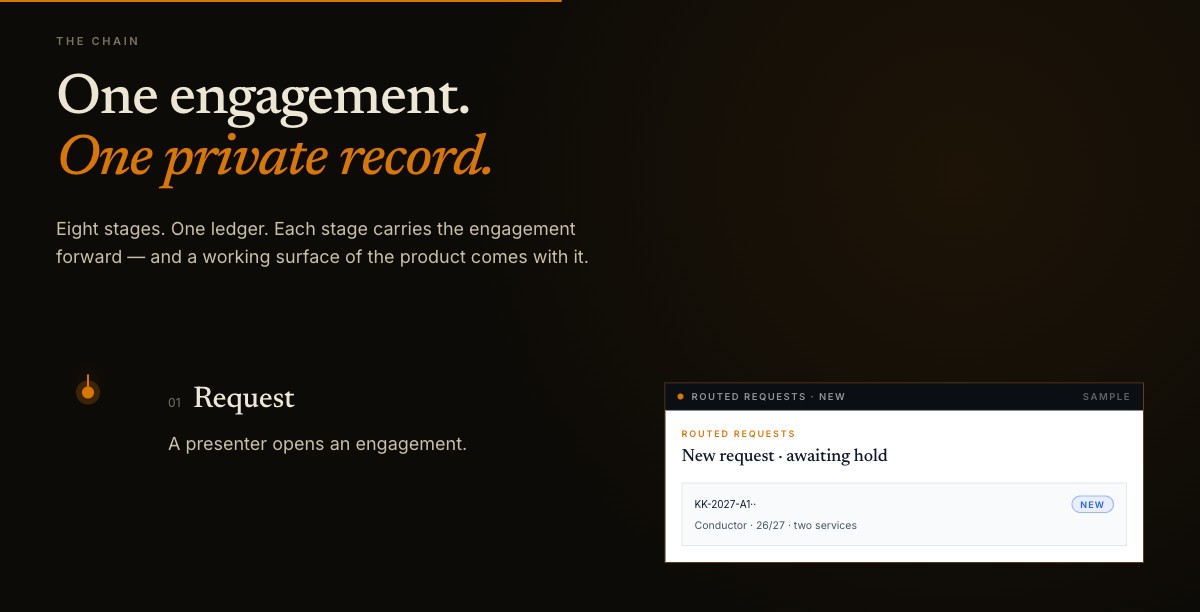 "One engagement. One private record." The chain Kalinklo automates is the overhead around representation — not the representation itself.
The answer is the single most important thing to understand about Kalinklo, and it is structural, not rhetorical: it operates at a different layer than the agency, and it has been built, deliberately, never to touch the layer the agency lives on.
What does a great classical agency actually sell? Not calendars. Not invoices. It sells judgment — which date, which orchestra, which conductor, which year. It sells taste, advocacy, the decade-long building of a career, and above all the relationships that took a lifetime to earn. None of that is software. None of it ever will be. It is the most human work in the business.
What Kalinklo sells is everything around that work — the hold that has to be tracked, the quote that has to be versioned, the contract that has to be signed, the invoice that has to be chased, the record that has to survive an audit. The overhead. The part that has nothing to do with taste and everything to do with not dropping a six-figure date because it lived in one person's inbox.
These do not compete. One runs on the other. Salesforce did not replace salespeople; it made the good ones unstoppable. Stripe did not replace businesses; it took the part of running one that nobody loves and made it vanish. A great recording console never wrote a symphony. The tool that wins a serious field is never the one that eats the craft — it is the one that clears the friction around the craft so the craft can scale.
And Kalinklo proves it with its design, not its slogans. It takes no fee on your bookings — it does not want a slice of the relationship business, only a flat fee for the machinery. It is white-label, so your clients see your name and your brand, never whose system runs underneath. It is private, not a marketplace — no public directory siphoning your demand to the highest bidder. You keep your clients. You keep your commission. You keep your name on the door.
So who is Kalinklo actually competing against? Not IMG Artists, not HarrisonParrott, not the boutique manager with eight artists and a brilliant ear. Its only real rival is the absence of a system — the spreadsheet, the inbox, the lost hold, the dispute nobody can settle because no one kept the record. The enemy is entropy. Against the agencies it is not a competitor at all; it is the thing that finally lets a great agent stop being a part-time administrator and represent more artists, more carefully, than the overhead ever allowed.
The design is the argument
Spend a minute inside and the second thing you notice — after the precision — is that it does not look like software.
It is built in the register of an archival publishing house: luminous off-white, serif display type set like the title page of a concert programme, a restrained blue-and-amber accent used like a signature, sections numbered like the movements of a work. The homepage tells you the truth about the job before it sells you anything — "Before the curtain rises, the work is scattered" — then shows the office "drawn in five surfaces": a six-week roster calendar, the one ledger, the season planner, "this work, at a glance," "one canonical record. Always."
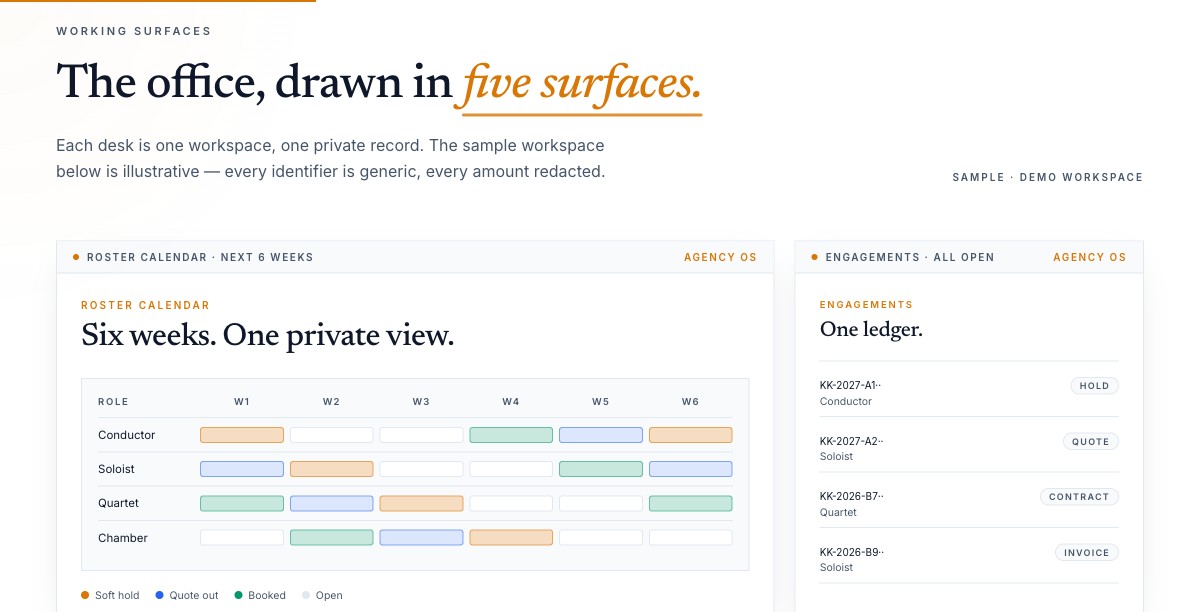 Two of the five surfaces: the six-week roster calendar — soft holds, quotes out, booked, open — beside the one ledger where every engagement lives.
That restraint is a thesis about trust. The serious-music world identifies a generic startup demo in about four seconds and rejects it on reflex. By dressing the most exacting software in the field in the visual language of the institutions it serves, Kalinklo signals it intends to last as long as they have. In a category where everyone else is shouting in gradients, the restraint is the flex.
The move that should end the argument: no fee on your bookings
Here is where Kalinklo becomes genuinely hard to compete with. Consider what every layer that has ever stood between an artist and a stage has taken:
| Who stands between artist and stage | What they take |
|---|---|
| Marketplaces | a skim on every booking they touch |
| Classical agencies | 15–20% of the fee |
| Kalinklo | a flat subscription — 0% of your bookings |
Across every agency tier and every season-planning tier, the pricing says the same thing in plain language: no platform fee on your engagements. The self-serve artist tiers say it too — no fee on your bookings. The platform that runs your entire booking operation does not take a percentage of your work. Your deals are yours, your relationships are yours, and if you are an agency your commission stays one hundred percent yours. You pay for the software the way you pay for electricity — a flat, predictable subscription — not a tax that grows with your success. (Kalinklo earns a commission only where you explicitly hire it to be your representative or to do the work for you; the software you bring your own deals to is clean.)
For an industry already paying 15–20 percent for representation, the argument is almost rude in its simplicity: the software was never the valuable part — your judgment and your relationships are, and those stay entirely with you. Replace your office overhead. Keep your business model. Keep your money. Any platform that asked agents to surrender a slice of every deal was always going to be routed around. Kalinklo asked for none of it — which is less generosity than strategy. It is how you win a relationship-driven industry: you make yourself impossible to resent.
The honest risk
No assessment worth reading pretends a new platform has no failure mode, and this one has a real one. A private, invitation-only network is only ever as valuable as the people already inside it. On day one, the inbound is thin. A roster tool with verified presenters but few of them is, for all its elegance, a more beautiful spreadsheet. This is the cold-start problem, and it is the thing that has killed better-funded platforms than this one.
Kalinklo's answer is the only honest one available: solve the supply and demand sides by hand, slowly, and reward the people who show up first. Access is reviewed one application at a time precisely so that the presenters inside are real and the artists are vetted — quality over a growth-chart vanity metric. The founding cohort exists to seed both sides of the ledger at once. It is a slower road than an open marketplace, and a riskier one. But it is the correct road for this market, because the entire value of the thing is that it is private and trusted — and you cannot buy trust with a sign-up button. The risk is real. The strategy answers it. Both of those statements are true, and any version of this story that left out the first one would not be worth your time.
Why this matters more than "nice software"
It would be easy to file all of this under convenience and move on. That would be a mistake, because the absence Kalinklo fixes is not a minor annoyance. It is a structural drag on an entire art form, and it has been quietly taxing the field for decades.
Start with the artist. A career in music is built one engagement at a time, and right now the record of those engagements — what was agreed, what was paid, what was promised — is scattered across other people's inboxes. A musician often cannot see their own history without asking the very people who hold it. A missed hold, a contract that never came back, an invoice that aged ninety days: each is a real cost, and each lands hardest on the person with the least leverage to absorb it.
Now the institution. Orchestras, halls and festivals increasingly answer to boards, to public funders, to procurement rules written for a world of auditable records. "The email said so" does not survive an audit. As more of the money in classical music arrives with governance attached, the ability to show — cleanly, with a timestamp — exactly how an engagement was agreed and settled stops being a convenience and becomes a requirement. A season planned on one private, auditable record is fast becoming the price of being trusted with public money.
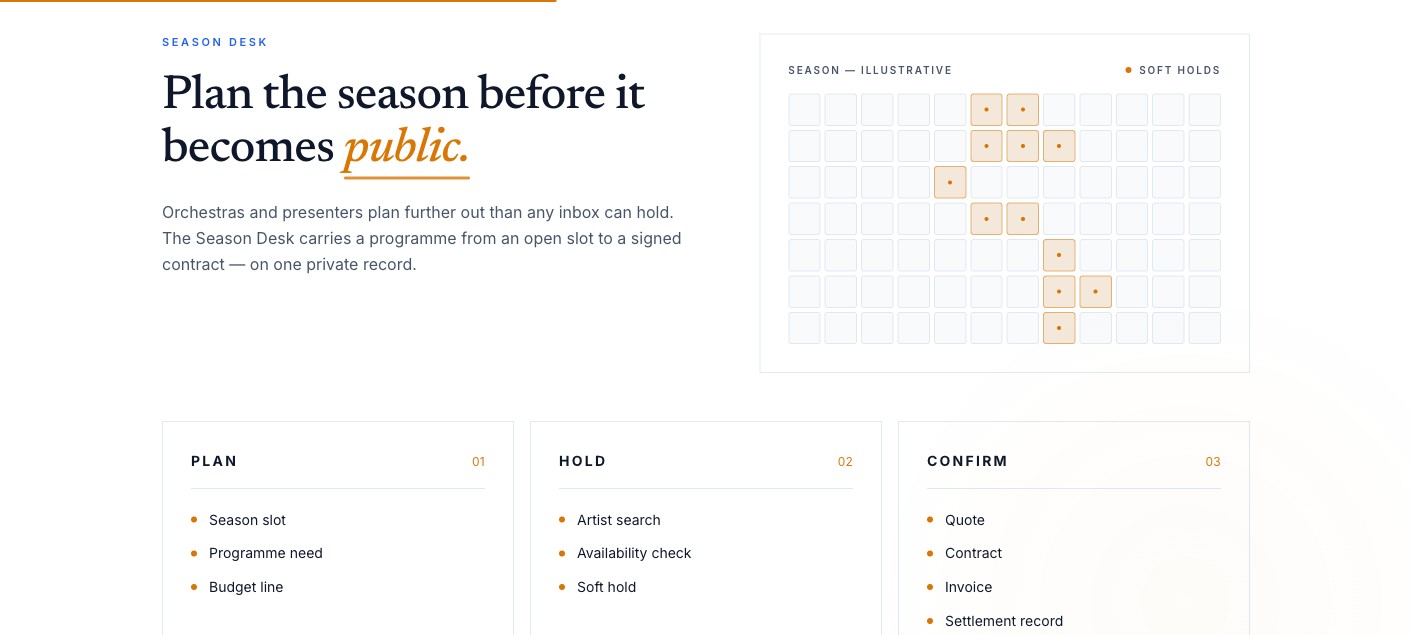 The Season Desk: orchestras and presenters plan further out than any inbox can hold — open slot to signed contract, on one auditable record.
Then the part nobody in the industry likes to say out loud: traditional representation is closed by design. The best agencies keep their rosters deliberately small — a dozen artists, sometimes sixteen — because attention does not scale, and a manager who signs a hundred names serves none of them well. That is not a flaw in the model; it is the model. But it has a brutal consequence: for every artist on a top roster there are hundreds of superb, working musicians who will never get on one — not for any lack of talent, but for lack of room. The entire apparatus of professional representation — the holds, the versioned contracts, the auditable record, the season-long planning — has lived behind a velvet rope that admits a few dozen people per agency and turns everyone else away at the door.
Kalinklo inverts that. You do not have to be one of the chosen sixteen: anyone can apply, and the same operating system the elite roster runs on is open to the self-managed soloist, the rising ensemble, and the boutique manager with a brilliant ear and no back office. The application is reviewed for quality, not capped at a roster size — a flat-fee system that hands a one-person practice the machinery a fifty-person agency used to need. That is the democratization that actually counts: not cheaper representation, but the infrastructure of representation — the part that used to require a seat on a sixteen-artist roster — finally available to everyone serious enough to ask. An art form does not widen when the talent improves. It widens when the tools that were a privilege of the few become available to the many. This is that, and it is overdue.
And underneath all of it is trust, the one currency classical music actually runs on. Reputations are decades in the making and a single botched booking in the breaking. A shared, sealed record — one both sides can see, neither side can quietly rewrite, and an auditor can verify — does not make the business less human. It makes it safer to be human in: fewer disputes, clearer terms, less of the friction that turns a good relationship sour over a misremembered fee.
Fields that build real infrastructure underneath their craft flourish; the ones that leave their coordination to memory and goodwill stay precarious. Classical music has been precarious about exactly this for a very long time. Giving it an operating system careful enough to keep the relationships human and the records exact is not a nicety. It is overdue — quietly one of the more important things anyone has tried to build for this business in a generation.
Why this is worth joining now
The best infrastructure plays in history rewarded whoever showed up early, and Kalinklo has built that logic into the door.
There is a founding cohort. A Verified Artist account is free — verified profile, media kit, calendar visibility, inbound from vetted presenters — and founding members are grandfathered, so the terms they enter on are the terms they keep. There is no credit card to apply. The only gate is the one that makes the whole thing worth being inside: access is reviewed by hand. Stack the facts and the case writes itself — the cost to get in is zero, the risk to apply is zero, the terms will never be better than they are in the founding window, and grandfathering only ever runs one direction.
And it is not a zero-sum invitation. The artist keeps every dollar booked; the agent keeps the client, the commission and the name on the door; the presenter gets records a board will accept. There is no seat at the table that is worse off inside this system than outside it — which is the signature of a real operating system: everyone gains by joining, and the whole thing strengthens as more of them do.
Built for five kinds of work — which means it is built to last
A toy serves one persona; an operating system serves the field. Kalinklo is "built for five kinds of work" — individual artists, its own managed artists, agencies, orchestras and presenters, and the institutions that need records a board and a public funder will accept.
The pricing ladder shows a company, not a feature. Agencies run on Agency OS — roster, requests, holds, quotes, contracts, invoices under one roof — from a solo manager at $499 a month to a full white-label portal from $7,500 a month with enterprise security and custom contracts. Presenters and orchestras run on Season Desk — multi-year, multi-venue planning from $12,000 a year to enterprise deployments beyond $48,000 a year — built around the way institutions actually buy: a whole season assembled and balanced over years, every line of it auditable. Artists who want it can step up to full managed representation, by invitation; organizations that want the work done for them can buy it as a service. The range is the tell. This is priced to run the back office of the entire premium music economy without ever taking a cut of the art itself.
The AI is real — and it is never allowed to act alone
Of course it has AI; the only question that matters in 2026 is whether the builders understood their domain well enough to leash it. Kalinklo did. The assistant summarizes a sprawling request thread, drafts a quote, catches the missing detail, surfaces the stuck deal and the hold about to expire. What it is structurally forbidden from doing is commit anything — every legal, financial or binding action passes a human approval gate, and every state change writes an exportable audit entry.
The machine prepares. The person decides. The ledger remembers.
This is exactly the architecture a relationship business should demand, and almost nobody ships it. The danger of AI in a world of contracts and fees is not that it is unhelpful; it is that it is confidently wrong in a way that costs a client. Kalinklo takes the leverage and refuses the liability.
The cost of waiting
Strip away the design, the demo, and the economics, and the argument underneath is plain: the most valuable corner of the music business has been running on the absence of a system, and the absence has finally found its replacement — one private, reviewed, auditable record that runs from an open date to a sealed settlement, with no fee on the work and founding access that is free, grandfathered, and requires no card.
So line up the real options, honestly. You can keep running on email and a spreadsheet — and keep paying the invisible tax of every dropped hold, every slow invoice, every dispute no record can settle. You can hand your relationships to a marketplace that will gladly sell them out from under you to the next bidder. Or you can run the same operation on a private, auditable system that takes nothing from your bookings, keeps your clients yours, and puts your name on the door. Stated plainly, it is not a close call. It is the difference between the way the work has always quietly leaked and the way it is about to be done everywhere — and the only question is whether you are early or late to it.
Industries do not get re-plumbed twice. The system of record that wins a field tends to win it for a generation, and the people who adopt it early stop competing on overhead and start competing on the only things that ever mattered — taste, judgment, and the relationships the platform was careful never to touch.
This is not a prediction. It is already running, it is private, and it is taking applications. You can see the whole thing — the office, the five surfaces, the sealed Mahler ledger — and apply, with no card and nothing to lose, at kalinklo.com.
Quick answers
What is Kalinklo?
Kalinklo is a private, invitation-only operating system for artist engagements — booking software that runs a classical-music engagement from open availability through hold, quote, contract, invoice and settlement as one auditable record, shared by the artist, the agency and the presenter.
Does Kalinklo take a commission on your bookings?
No. Across every Agency OS and Season Desk tier the platform charges no fee on your engagements — you pay a flat subscription and keep 100% of what you book. It earns a commission only where you explicitly hire it to represent you or to do the work for you, which is a separate, opt-in service.
How much does Kalinklo cost?
A Verified Artist account is free for the founding cohort and grandfathered. Agency OS runs from $499 a month for a solo manager to a $7,500-a-month white-label tier; Season Desk for presenters and orchestras runs from $12,000 to beyond $48,000 a year, depending on scale.
How do you get access to Kalinklo?
Access is by application and reviewed by hand — approval-gated, private by default, with no credit card required to apply at kalinklo.com.
Is Kalinklo a marketplace like GigSalad or The Bash?
No. It is a private workspace, not a public directory — there is no consumer-facing listing of artists to browse. It is closer to an operating system for agencies, artists and presenters than to a gig marketplace, and it is built for the premium, relationship-driven end of classical and live music.
Context on the artist-booking-software landscape: Prism.fm, Gigwell, Overture; on the 15–20% classical management commission and the major agencies (IMG Artists, HarrisonParrott, Askonas Holt, CAMI), see Sonicbids and Briffa Legal. Product copy, figures and workflow detail are drawn from kalinklo.com; its illustrative walkthrough uses labelled sample data. Photograph: the Great Hall of the Musikverein, Vienna (Wikimedia Commons).
Comments
Sign in to join the discussion.