
On February 21, 2026, at a CNN and Variety Town Hall alongside Matthew McConaughey, the thirty-year-old actor Timothée Chalamet said the thing the American opera industry has spent two decades refusing to say about itself.
His exact words: "I don't want to be working in ballet or opera, or things where it's like, 'Hey, keep this thing alive.' Even though it's like, no one cares about this anymore."
The Royal Ballet and Opera posted on Instagram within days: "Every night at the Royal Opera House, thousands of people gather for ballet and opera. For the music. For the storytelling. For the sheer magic of live performance." The English National Opera offered Chalamet free tickets. Seattle Opera offered fourteen percent off Carmen with the promo code TIMOTHEE. Mezzo-soprano Isabel Leonard called the comment a "cheap shot." Canadian soprano Deepa Johnny called it "disappointing." Irish singer Seán Tester called it "the kind of reductive take you hear when popularity is mistaken for cultural value." Weeks later, at the March 2026 Oscars, Conan O'Brien opened the broadcast by joking about "attacks from both the opera and ballet communities." In April, Charlize Theron called the remark "very reckless" in The New York Times.
Everybody responded. Nobody ran the numbers.
Running the numbers is what Cadenza does. So we ran them. And the honest answer is that Chalamet was half-right — in the most revealing way possible. The half he got right is the half the industry spent weeks refusing to admit. The half he got wrong is the half the industry can no longer see.
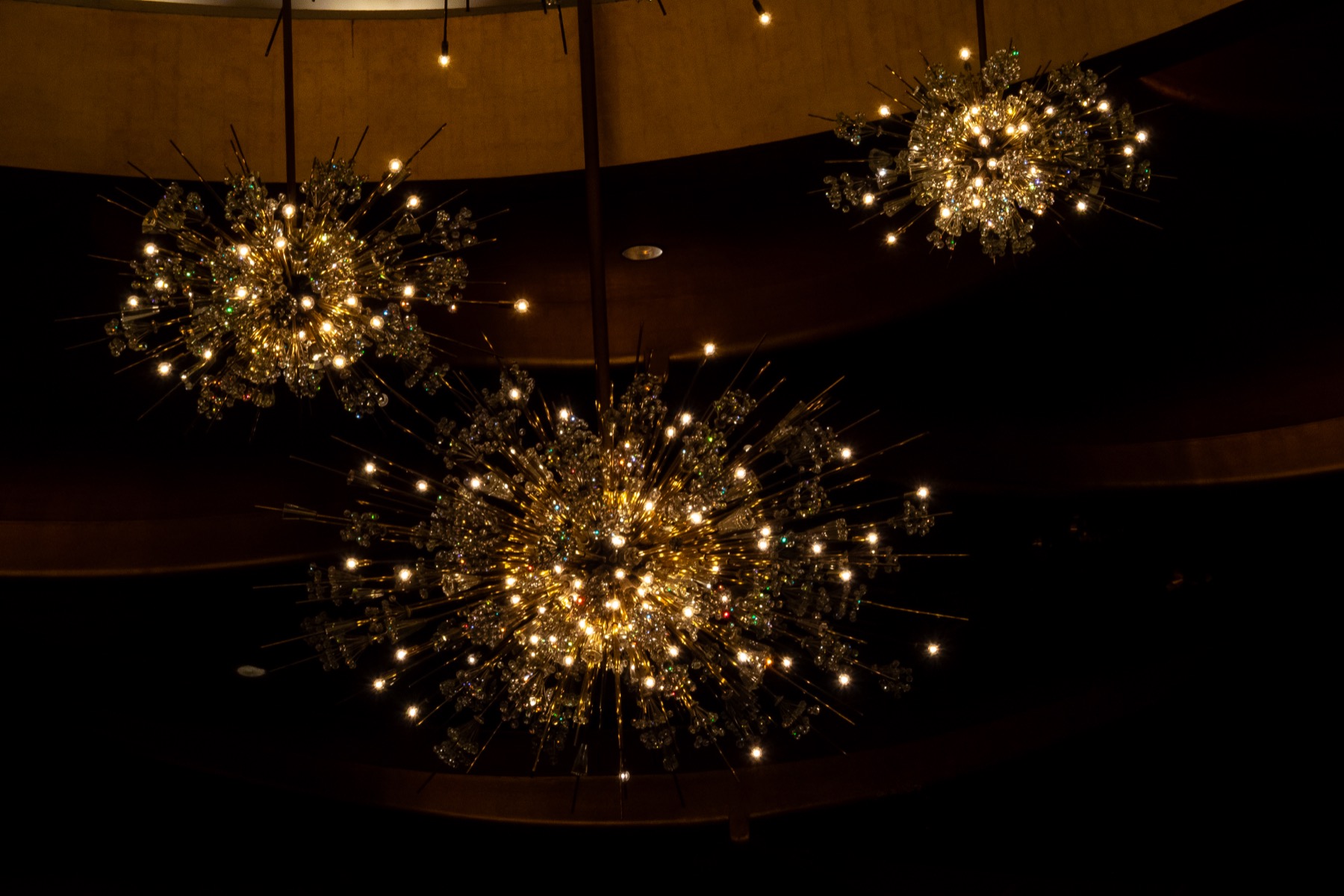
Inside the Metropolitan Opera House. The famous Lobmeyr crystal “Sputnik” chandeliers rise into the ceiling as the house lights dim — the ritual that opens every performance. 3,800 seats. Selling 72 percent. One-third of them empty every night. Photo: Julian Lupyan via Wikimedia Commons (CC0, public domain).
The Half He Got Right
Take Chalamet's sentence literally. Nobody cares. Test it against the industry's own IRS Form 990 filings, Moody's credit opinions, season-reporting box-office data, and subscription records. The answer is uncomfortable.
The Metropolitan Opera — America's largest performing-arts organization, the house Pavarotti built, the institution the rest of the world still treats as the flagship of American opera — is selling at 72 percent of capacity. One-third of the seats in the largest opera house in the Western hemisphere sit empty every night. Its HD Live cinema audience, once four hundred thousand viewers per broadcast, has halved. Its subscriber base has collapsed from 45 percent of ticket sales at the start of the Gelb era to 7 percent in 2024-25. Its subscribers average 70 years old; single-ticket buyers — 85 percent of the house — average 44. Its debt is rated Caa1 — seven notches below investment grade, deep junk — by Moody's Ratings. It has withdrawn 120 million dollars from its endowment in three years to cover operating deficits. It is considering the sale of the Chagall murals. It is considering the sale of the naming rights of the building itself. Its 2026-27 season has been cut to 17 productions, the smallest in at least 60 years (since the Met moved to Lincoln Center in 1966).
The San Francisco Symphony — one of the twelve-Grammy institutions, the orchestra Michael Tilson Thomas built — lost Esa-Pekka Salonen in March 2024 and has not replaced him. It has no music director. Its Davies Hall renovation has a $200 million funding gap. It has run deficits four consecutive fiscal years. Its board is still calling its strategic direction "visionary."
The English National Opera — the 90-year-old London institution — lost 100 percent of its Arts Council National Portfolio funding in November 2022 on a mandate that required it to relocate to Manchester. Its chorus and orchestra have been gutted. The institution that remains is at approximately 60 percent of its former size. It is a successor company with the same name.
The Boston Symphony Orchestra — the Nelsons-era Grammy-winning house — fired its conductor seven weeks ago and has not named a replacement. Its board has not explained the firing. Its senior musicians have publicly told the Boston Globe that the breakdown in trust is "in all likelihood irreparable."
The training pipeline — the thing that is supposed to produce the next generation of American opera singers and orchestral musicians — has an economics that can only be described as predatory. Juilliard charges $56,550 per year (tuition plus required fees) for a degree whose graduates earn a median first-year-after-graduation income of $14,067, per the U.S. Department of Education College Scorecard. The Department of Education's College Scorecard data is public record. Georgetown's Center on Education and the Workforce ranks seventy percent of fine-arts bachelor's programs at negative ROI. One hundred and seven classically-trained graduates compete for each salaried orchestral opening in America each year.
This is what Chalamet was describing. The sentence was careless. The observation was accurate.
The Metropolitan Opera has spent one hundred and twenty million dollars of its endowment in three years. The Boston Symphony has fired a Grammy-winning conductor. The English National Opera has been banished from London. The San Francisco Symphony has no music director. Seventy percent of music degrees lose money. In that context, the response from the institutions is not "he is wrong." The honest response is "he noticed."
The institutions did not give that response. They gave Instagram posts. Which is its own data point.
"No One Likes New Music" — and the Industry Can't Show You Anyone Who Does
The strongest version of Chalamet's claim is not the macro one — not "no one cares about opera." The strongest version is the specific claim the industry has been running from for twenty years: "no one likes new music."
That claim, too, is half-right. In its general form — nobody likes contemporary composition — it is false. Classical audiences love the contemporary works that have earned their way into the repertoire. Philip Glass's operas fill halls. John Adams's Nixon in China is in the canon. Britten's Peter Grimes is in the canon. Messiaen's Turangalîla-Symphonie, the work Andris Nelsons won a Grammy for recording with the Boston Symphony one week before his firing, is a living twentieth-century masterpiece. Audiences do not reject new music as a category.
They reject, specifically, the variety of new music American opera and symphony administrators have most aggressively programmed for the last two decades — work commissioned on identity-first criteria, marketed on the biographies of the composers as much as the music itself, and staged as institutional demonstrations of relevance.
The Metropolitan Opera's own box office is the ledger. Under Peter Gelb, the most ideologically-framed contemporary commissions and revivals of the last several seasons have delivered the following capacity, per Opera News and the Met's own season reporting:
- Grounded (Jeanine Tesori, 2024-25 new commission): 50 percent capacity. The worst-performing new production of the Met's season. Gelb publicly blamed critics for "having an agenda."
- El Niño (John Adams revival): 58 percent. The weakest of the Met's contemporary revivals.
- The Hours (Kevin Puts): 61 percent.
- Dead Man Walking (Jake Heggie): 62 percent.
- Fire Shut Up in My Bones (Terence Blanchard): 65 percent. A genuine artistic breakthrough — the Met's first opera by a Black composer — but 35 percent of the seats sat empty in revival.
- The First Emperor (Tan Dun, 2006): described by Anthony Tommasini in The New York Times as an "enormous disappointment." Never entered the repertoire.
- The Tempest (Thomas Adès, 2012): critically divided. Did not become a box-office draw.
The same seasons that the Met was selling its contemporary commissions at 50 to 65 percent of capacity, it was selling Puccini, Verdi, Mozart, and Strauss at or near 100 percent. The house was not rejecting new music. The house was rejecting this new music — the specific strain commissioned on political criteria, programmed on institutional-legitimacy criteria, and sold on the composer's identity rather than the work.
Chalamet was not in the rehearsal rooms when Grounded was cast. He did not read the Met's press release on the Terence Blanchard revival. He did not see the subscription cancellation letters that the Met will not publish. But the working musicians in the pit know. The donors know. The audience knows — and has been voting with its feet and its credit cards for two decades. When Chalamet said "no one cares," the 35 to 50 percent of the Met's empty seats on contemporary-commission nights said the same thing in chorus, only louder, and in numbers the Met's 990 will publish whether anyone wants to read them or not.
The industry's answer to "nobody likes new music" should have been: here are the commissioned works audiences have loved, here are their capacity numbers, here is the new music we built that entered the repertoire. The industry had its moment. The industry did not publish those numbers. The industry posted Instagram replies from performers the industry has not paid in a decade at a rate commensurate with the cost of the training they took on to get there.
The industry could not answer Chalamet because, on this specific claim, the Met's own attendance data is his strongest supporting evidence.
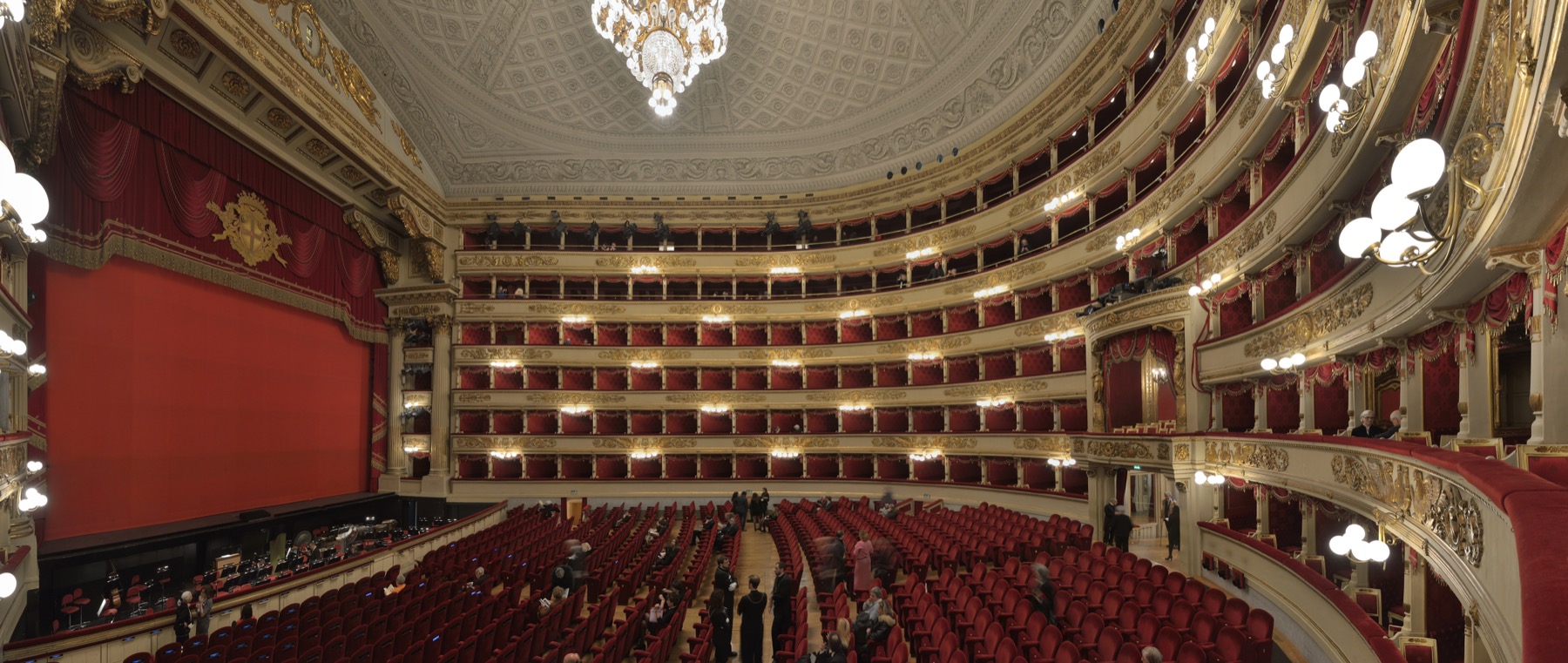
Teatro alla Scala, Milan. 2,030 seats, 175 boxes, gold leaf and red velvet since 1778. Sells out Verdi, Puccini, Mozart, and Wagner season after season. The counter-example to the American institutional model — an opera house run on the principle that great repertoire performed at the highest level will fill a room. It does. Photo: Wolfgang Moroder via Wikimedia Commons (CC BY-SA 3.0).
The Half He Got Wrong
Chalamet said "no one cares." Absolute. The data does not support the absolute form of the claim. The data supports a narrower and more interesting form: Americans paying $200 for tickets at Lincoln Center for programming commissioned under the current mandate care less than they used to care under the previous mandate.
That is a very different sentence. It has a location (America, specifically Lincoln Center and its peer institutions). It has a price point ($200). It has a programming specification (the current identity-first commissioning wave). And the comparison class is a prior period in which the same institutions, charging similar prices, were selling much more of the house.
Move any one of those variables and the picture changes.
The Paris Opéra Garnier runs at 85 percent capacity year after year. The Vienna State Opera regularly sells out. La Scala sells out. The Berlin Philharmonic has been sold out for a generation. Bayreuth has a waiting list measured in years. The Bavarian Radio Symphony fills the Munich Philharmonic hall. These are not dying institutions. They are the institutions American leadership classes use to signal their own cultural seriousness when they describe the declining state of the American houses. The distance between them and the Met is not the distance between opera and non-opera. It is the distance between two ways of running the same art form.
The training pipeline — the thing Chalamet's sentence implicitly dismisses as an investment in a dying skill — is booming globally. Two thirds of the students at the Hochschule für Musik Hanns Eisler in Berlin come from abroad. The Conservatoire de Paris, the Royal College of Music, the Vienna Universität für Musik, the Leipzig Hochschule, the Royal Academy of Music — all oversubscribed. Tuition in Germany is approximately €150 to €300 per year. France is under €500. The global demand for world-class classical training is so high that nation-states subsidize it almost entirely, and Americans who can afford the air ticket are increasingly going there instead of paying Juilliard's ~$226,000.
The streaming numbers contradict "no one cares" at an order of magnitude Chalamet apparently has not checked. Classical music generates billions of streams per year across Spotify, Apple Music, Deutsche Grammophon's Stage+, and YouTube. The Berlin Philharmonic's Digital Concert Hall has paying subscribers in the six figures. Daniel Barenboim's West-Eastern Divan Orchestra performances get millions of views.
The young-listener data specifically contradicts Chalamet's intuition. The Royal Philharmonic Orchestra's 2026 audience survey — which Cadenza has covered on this site — found interest in orchestral music among Gen Z and millennial listeners at a six-year high. The Classical Pulse 2026 study reports that the largest growing audience segment for classical music is listeners under 35, driven by streaming, film scores, and free events. The audience is not absent. The audience is younger, more diverse, and consuming the music in formats the institutions have been slow to inhabit. Luxembourg's Bach in the Subways festival filled 21 concert venues with 52 mini-concerts in a single day with free programming; the event was oversubscribed in every hall.
The art form is not dying. A specific delivery system for the art form is dying — an expensive, aging, administratively-captured American nonprofit model that has spent two decades commissioning work on non-musical criteria, charging $200 a seat for the privilege, and insisting to its own board that the audience's dwindling attendance is a communications problem rather than a product problem.
Chalamet's mistake was confusing the delivery system for the art. That is the mistake his defenders also made — confusing defense of the delivery system for defense of the art, when the two have come apart and the people who still love the art are increasingly visible in the gap between them.
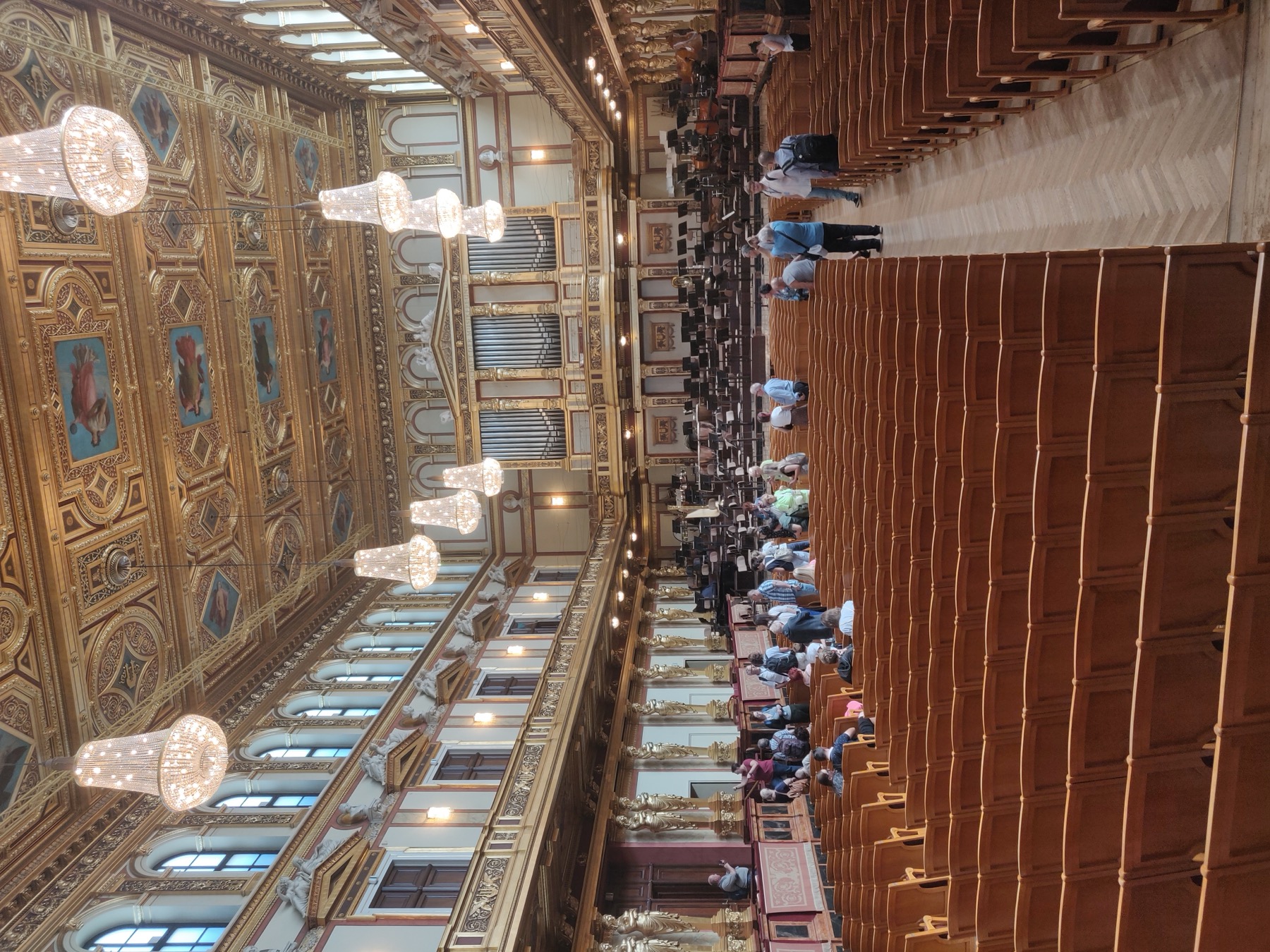
The Great Hall of the Musikverein, Vienna. 1,744 seats. The home of the Vienna Philharmonic. Host to the Vienna New Year’s Concert since 1941. Sells out on 300+ nights a year. This is what Chalamet was told does not exist. Photo: Michał Bulsa via Wikimedia Commons (CC BY-SA 4.0).
Who Actually Answered Him
The most interesting part of the Chalamet episode is the structure of who responded and who did not.
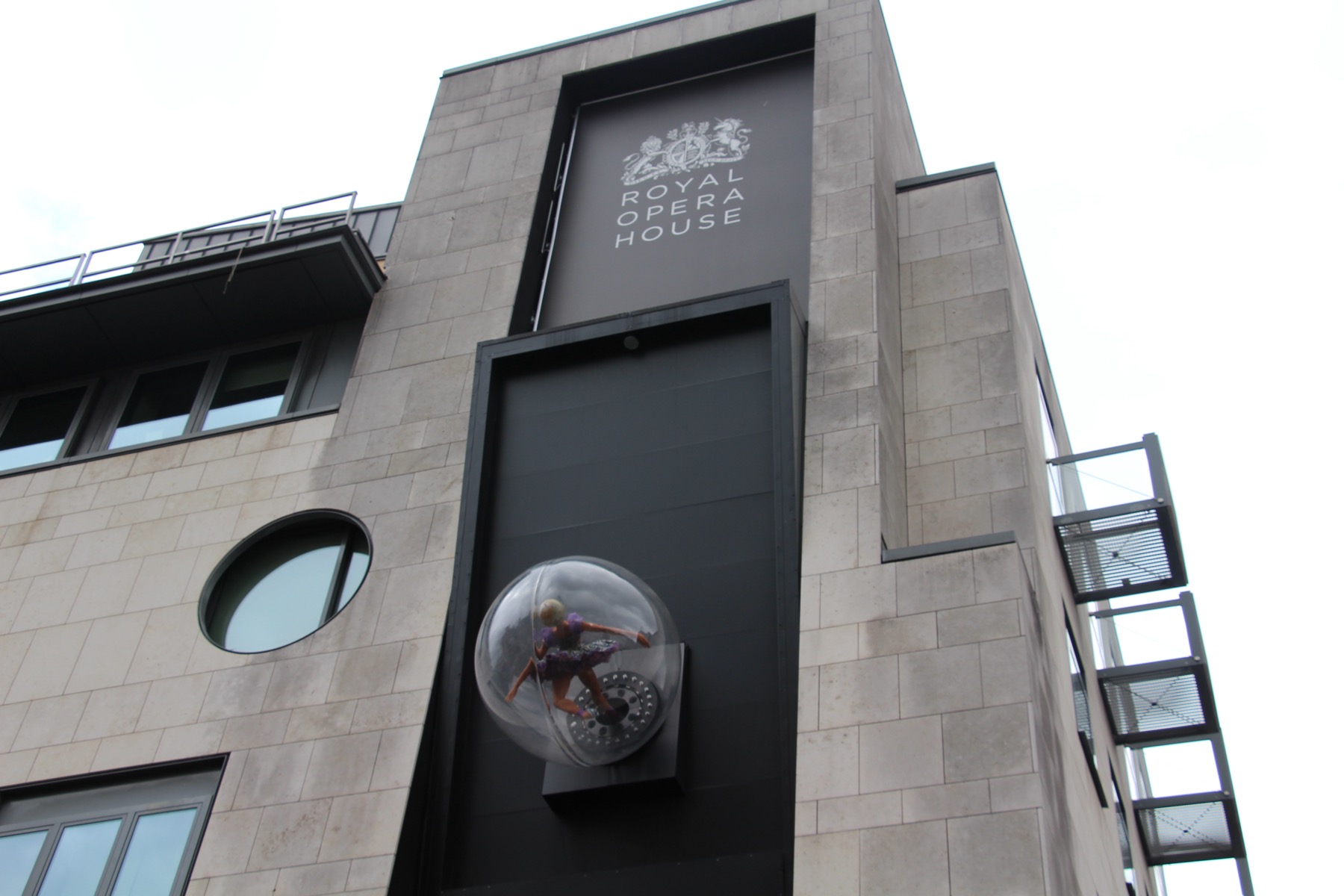
The Royal Opera House on Bow Street, Covent Garden. Its Instagram response to Chalamet: "Every night at the Royal Opera House, thousands of people gather for ballet and opera." A sentence the Metropolitan Opera cannot honestly type into a post, because the Metropolitan Opera's 3,800-seat house is selling 72 percent. Photo: Fred Romero via Wikimedia Commons (CC BY 2.0).
Who answered: working musicians. Isabel Leonard, one of the American singers still most-booked internationally. Deepa Johnny, a Canadian soprano with a rising career. Seán Tester, an Irish tenor. Anna Yliaho, a London-based dancer. Fernando Montaño, a Colombian dancer. The Royal Opera House's social-media team. The English National Opera's social-media team. Seattle Opera. These were the people inside the art making the case for the art — as a living thing, performed by living people, attended by living audiences, in real halls on real nights.
Who did not answer: the administrators. Peter Gelb did not answer Chalamet. The Metropolitan Opera's communications office did not answer Chalamet. The Boston Symphony Orchestra's board did not answer Chalamet. Chad Smith did not answer Chalamet. Barbara Hostetter did not answer Chalamet. Deborah Borda at the New York Philharmonic did not answer Chalamet. Matthew Spivey at the San Francisco Symphony did not answer Chalamet. Kim Noltemy at the Dallas Symphony did not answer Chalamet. The CEOs of the institutions whose box-office numbers Chalamet was describing chose, to a person, not to say anything at all.
This is what the industry will not admit about itself. The division that showed up in the Chalamet episode was not "opera versus its detractors." It was "the performers who still believe in the art, versus the administrators who are running the institutions that house it." The performers defended the art. The administrators let the performers speak on their behalf because the administrators could not, without lying, repeat the claims their own performers were making.
The Royal Opera House could truthfully say "thousands gather every night." The Met Opera could not say the same sentence — because the Met's gathering is thirty-five percent smaller than the building was designed to hold. The English National Opera could offer Chalamet free tickets — because the ENO, having already survived the worst political attack on a British opera house in living memory, now has less to lose than to gain by publicity. The Boston Symphony's board could not offer anything, because the Boston Symphony's board is in the middle of a public crisis it has declined to name, caused by a decision it has declined to explain, about a conductor it has declined to replace.
The difference between the institutions that answered Chalamet and the institutions that did not is the difference between institutions that still know what they are for and institutions that are running out of ways to say so.
Isabel Leonard defending opera to Timothée Chalamet on Instagram is, in this sense, the most accurate description of the state of American classical music that you can obtain in 2026. The working musician has to take the microphone because the institution that employs her cannot be trusted with it.
The Verdict
Timothée Chalamet was not entirely right. He was not entirely wrong. He said a thing in one sentence that the industry has refused to say in twenty annual reports. And the response from the industry — at the level of named institutions, named CEOs, and named boards — was not a data release. It was a wave of Instagram posts from artists who have, in most cases, been underpaid for the decade of their careers in which the administrators posting nothing were drawing million-dollar compensation packages to run the institutions into the trajectory Chalamet casually gestured at.
The performers are right that the art is alive. They are right that thousands gather every night at the Royal Opera House. They are right that Chalamet's sentence was dismissive, careless, and ungrateful to the art form whose film-scoring apparatus has contributed to his own career. They are right.
The performers are also, whether they meant to be or not, witnesses against the institutions that employ them. Because the institutions that could have answered Chalamet with data — with capacity numbers, with subscription growth, with endowment health, with commissioning success — chose silence. And the silence is the answer. The Metropolitan Opera said nothing because the Metropolitan Opera has nothing to say that does not make Chalamet's casual sentence look like the most accurate one-sentence summary of the Met's two-decade trajectory that has yet been published in a mainstream interview.
The New England Conservatory president did not rebut Chalamet. The Juilliard president did not rebut Chalamet. The Boston Symphony board did not rebut Chalamet. They could not. The data — the federal data, the agency data, the 990 data, the box-office data — is on his side for the version of opera and orchestral music these administrators have spent their careers building.
The irony is that the version of the art form Chalamet actually meant to defend his own field against — the precious, mandated, prop-it-up-because-we-should version — is precisely the version his opponents have built. The Met's 50-percent-capacity contemporary commissions. The BSO's ideological hiring. The ENO's forced relocation. The San Francisco Symphony's directorless drift. These are not the art. They are the institutional residue left behind when the art has been subordinated to the administrative priorities of the people running the buildings. Chalamet did not know he was critiquing his opponents. His opponents did not know they were agreeing with him when they declined to respond.
The performers, in the middle, know both. They know the art is alive. They know the institutions are sick. They posted the Instagram replies because the art is worth defending. They did not post them to defend the institutions. Read the Leonard statement again. Read the Tester statement again. Read the Royal Opera House's sentence: "Every night at the Royal Opera House, thousands gather." None of them said "the Metropolitan Opera's attendance is healthy." None of them said "the BSO board made the correct decision." None of them said "American institutional classical music is in good shape." They said the opposite — they said the art is in good shape, and they pointed at specific venues (the Royal Opera House, Seattle Opera, the ENO) rather than the ones Chalamet was implicitly describing.
Chalamet got the symptom right. The industry failed to diagnose. The performers offered the right defense of the art form. The administrators refused to defend the institutions. The Free Press published a former opera singer who agreed with Chalamet. The Conversation published an academic who agreed with Chalamet. Cadenza, having spent four months publishing the 990s, the Moody's downgrades, the College Scorecard data, and the firing of Andris Nelsons, can confirm the following:
Nobody cares about the American version of opera and symphonic music that Peter Gelb, the BSO board, the Arts Council England, and the San Francisco Symphony's board have spent the last fifteen years building. Not because the art is dead. Because the administrators have been killing it.
Chalamet said a sentence. The industry answered with Instagram posts. The box office answered with empty seats. The 990 answered with reserve draws. The Boston Globe answered with an ongoing investigation into why the most successful conductor in America was fired without explanation.
These are different answers. They do not disagree with each other. They are describing the same institution from different vantage points.
The art is not dying. The institutions are. Chalamet noticed. The people running the institutions did not answer him because they could not. The performers answered him because somebody had to defend the art, and the administrators were not going to do it.
That is what happened in the weeks after his Variety Town Hall. It is the most honest picture of American classical music anyone has drawn in public this year. And it was drawn, inadvertently, by a thirty-year-old actor who did not know he was holding the pen.
What Comes Next
The question now is whether the institutions will learn anything from this.
On current form, they will not. Peter Gelb will not cancel Grounded's second season. The BSO's board will not reverse the Nelsons firing. The ENO will not return to London. The San Francisco Symphony will not hire a music director on the old terms. The Juilliard board will not follow Curtis into tuition-free status. The ideological-commissioning wave will continue, because the board members who funded it cannot un-commit to it without confessing that the last decade of their institutional leadership was a mistake, and they will not confess. The institutions will go on selling at 50 to 65 percent. The administrators will continue to post press releases about "exciting new directions." The performers will continue to defend the art on Instagram. The audience will continue to vote with their seats — which is to say, by leaving them empty.
At some point — in the Met's case, probably within this decade — the reserve draws will run up against the endowment floor and the math will no longer close. At that point the question will stop being whether Chalamet was right, and start being which specific administrators' resignations are the first necessary step toward saving the art from the institutions that claimed to be keeping it alive.
Chalamet's sentence will age. His filmography is secure. Opera will outlast him. The question is whether the Metropolitan Opera and the Boston Symphony Orchestra, in anything resembling their current form, will outlast their own boards.
Timothée Chalamet said nobody cares. Tell the Royal Opera House. Tell Vienna. Tell Paris. Tell the Berlin Philharmonic. Tell the Bavarian Radio Symphony. Tell the students in Leipzig and at the Hanns Eisler. Tell the millions streaming Deutsche Grammophon. Tell the Gen Z listeners RPO's 2026 survey found at a six-year audience high. They care. They are not the problem.
The problem is the institutions that Chalamet was actually describing — the ones that said nothing for weeks. They cannot answer him. They will not answer him. They know what the numbers would say if they tried. So the silence continues. And the silence is the answer.
The Audience Is Here. The Jobs Are Here. Cadenza Is Where Both Meet.
Opera, orchestral, chamber, jazz, crossover. Auditions, competitions, festivals, fellowships, grants, teaching positions. Cadenza aggregates 1000+ classical opportunities worldwide — free for musicians. For the institutions Chalamet was actually describing: our Hiring OS puts your opening in front of the artists actually playing at the level you need.
Browse opportunities → · Hiring OS for institutions → · See plans
Get the next investigation in your inbox
We publish long-form investigations like this every few weeks. The Boston Globe, The New York Times, and Slippedisc have cited Cadenza's reporting. Get the next one first — no spam, unsubscribe anytime.
Sources: CNN & Variety Town Hall (February 21, 2026). Public Instagram posts by Royal Ballet and Opera, English National Opera, Seattle Opera, Isabel Leonard, Deepa Johnny, Seán Tester, Anna Yliaho, Fernando Montaño (April 16-18, 2026). Charlize Theron public comments (April 18, 2026). 98th Academy Awards (Conan O'Brien, March 2026). The Free Press, "I'm a Former Opera Singer. Timothée Chalamet Is Right." The Conversation, "The backlash ignores an awkward truth." Opera News season reporting 2024-26. Metropolitan Opera 990 filings (EIN 13-1624087). Moody's Ratings (March 18, 2026). Royal Philharmonic Orchestra 2026 audience survey. Hochschule für Musik Hanns Eisler published enrollment data. Georgetown Center on Education and the Workforce, "Ranking 4,600 Colleges by ROI" (2025). U.S. Department of Education College Scorecard. Cadenza prior coverage: bso-nelsons-investigation-why-fire-success-2026, bso-after-nelsons-the-playbook-of-collapse-2026, peter-gelb, metropolitan-opera-peter-gelb-factual-record-of-decline, music-degree-cost.
Comments
Sign in to join the discussion.