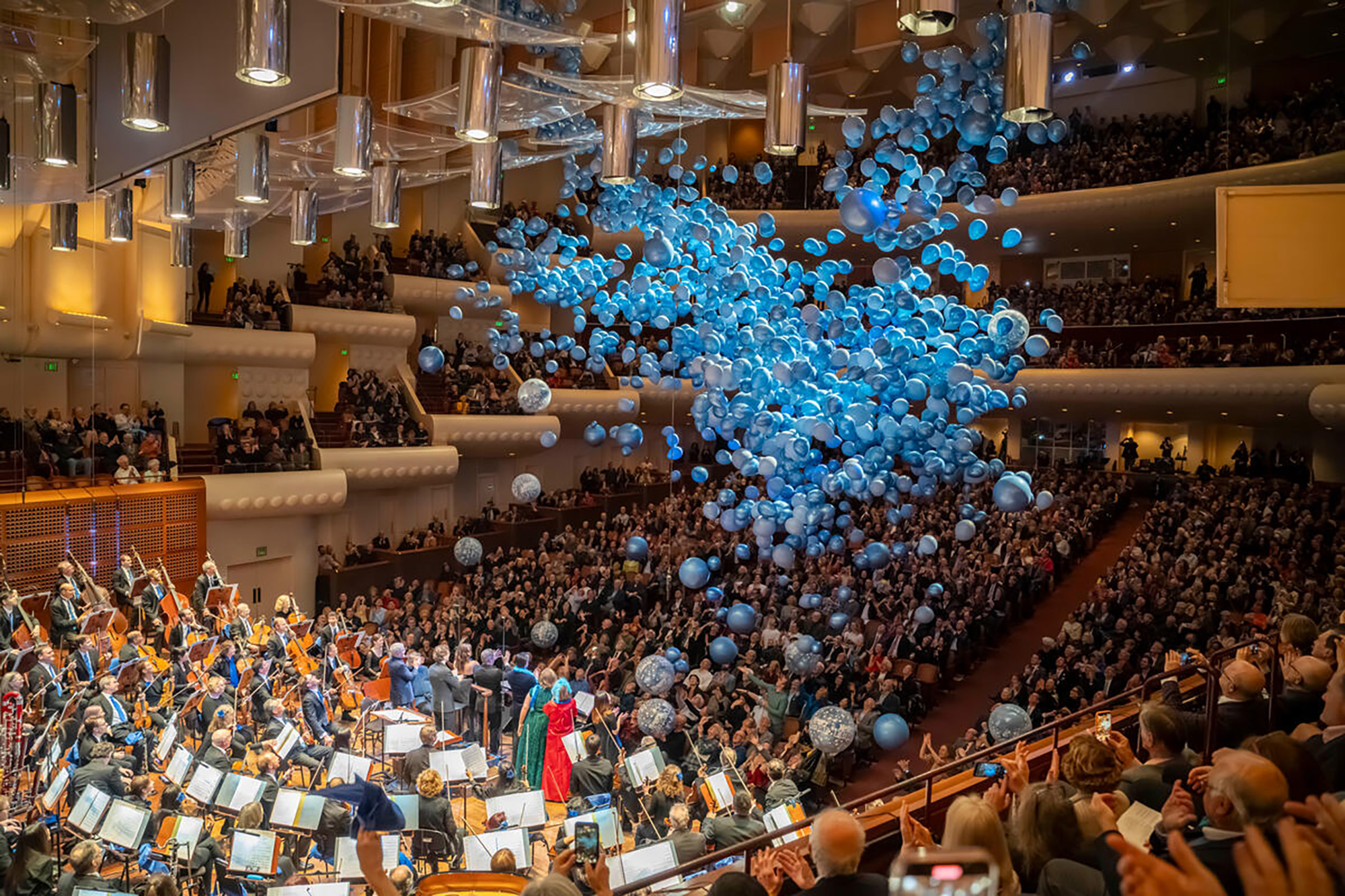
 Blue balloons fall over the stage at Davies Symphony Hall during his 80th birthday farewell concert — April 26, 2025. Photo: Stefan Cohen / San Francisco Symphony.
Michael Tilson Thomas died at home in San Francisco on Wednesday, April 22, 2026.
He was eighty-one. And two months before him, almost to the day, his husband of nearly fifty years had died in the same city. They were always going to leave together. Everyone who knew them knew that. They had been one person for a very long time.
If you are reading this and you loved classical music because of him — because of a Tchaikovsky symphony he walked you through on television one Sunday afternoon when you were fifteen, because of a Mahler cycle you listened to in college on headphones when nothing else in the world made sense, because of a Keeping Score episode that taught you how a harmony turned, because of a Copland Third that finally made a piece you thought you already knew mean something — stop for a second.
He loved you back. He really did.
He spent fifty-seven years on the podium, and almost every minute of it was devoted, in one way or another, to the idea that the audience and the orchestra and the composer were supposed to love each other. That the concert hall was a place where that love could happen, and then happen again the next night, and then — if the music director gave his whole life to it — happen for twenty-five years.
He was the music director who gave his whole life to it.
 Michael Tilson Thomas in 2008, during the filming of the Keeping Score television series. Photo: public domain via Wikimedia Commons.
A Los Angeles childhood, a Yiddish inheritance
Michael Tilson Thomas was born in Los Angeles on December 21, 1944, and his family tree is its own story.
His grandparents were Bessie and Boris Thomashefsky — pioneers of American Yiddish theatre, stars of the Lower East Side stage in the decades when entire immigrant neighborhoods crowded into the Grand Theatre to see them sing. They were, for a while, as famous inside American Yiddish culture as anyone has ever been. They were also deeply serious artists. They programmed Shakespeare in Yiddish. They built repertoire. They treated their audience as people worth doing great work for.
That inheritance mattered to him for his entire life. Very late in his career, he wrote a musical about his grandparents called The Thomashefskys, and he premiered it at Carnegie Hall with his husband Joshua at his side. It was not a vanity project. It was a direct line — from Bessie and Boris in 1905, to the American composers he would champion for half a century (Copland, Gershwin, Bernstein — also children of Eastern European Jewish immigrant families), to the young musicians he would still be coaching at New World in the year of his death. He saw himself as part of one long continuous chain of American musical inheritance, and he wanted us to see it that way too.
He grew up in a house where music and theatre were always on. He was a prodigy at the piano. By the time he was in his teens, he was playing premieres of Stravinsky works with the composer in the room. As a teenager he was already performing the music of John Cage. At eighteen he was studying with Ingolf Dahl at the University of Southern California. By his early twenties he was hanging around with Boulez, Stockhausen, and the avant-garde of the 1960s — not as a student, but as a young colleague. He absorbed all of it. He never dropped any of it.
He was one of the last American conductors who genuinely belonged to both halves of twentieth-century music: the European modernist intelligentsia and the American populist tradition. He was at ease in the European avant-garde and he was comfortable at the Hollywood Bowl. The two things were not contradictory to him. They never were.
Boston, 1969: the accident that launched everything
You cannot tell the Michael Tilson Thomas story without telling the Boston Symphony story, and you cannot tell the Boston Symphony story without October 22, 1969.
He was twenty-four years old. He had just been appointed an assistant conductor of the Boston Symphony Orchestra — one of the youngest the orchestra had named. He was weeks into the job. The music director was William Steinberg, the German-born conductor, a serious and commanding presence who was also, at that point, seventy years old and in declining health.
On the night of October 22, the BSO made its season's New York debut at Lincoln Center's Philharmonic Hall. During Brahms's Second Symphony in the first half, Steinberg fell ill. He was not well enough to continue.
The second half of the program was Robert Starer's Concerto for Violin, Cello and Orchestra — a contemporary American work — and Strauss's Till Eulenspiegel. No twenty-four-year-old assistant conductor had any business leading the Boston Symphony in its New York debut on thirty seconds' notice.
He walked out anyway. He conducted the second half. He got a standing ovation.
The next morning's New York Times made him famous overnight. Overnight, an American conductor nobody had heard of the day before was suddenly the most talked-about young maestro in the country. Within two years he was the Principal Guest Conductor of the Boston Symphony. Within three he was Music Director of the Buffalo Philharmonic. The career was launched.
It is important to understand what happened that night. He had stepped in because there was nobody else. But once he stepped in, he did not play defensively. He did not program something easy. He did not apologize for his age. He stood in front of the Boston Symphony at its New York debut and conducted as if the chance had always been his. Because in some real sense, it had.
That was already everything about him. The readiness. The seriousness. The refusal to condescend to the audience or to the music. The belief that new American work belonged on the same program as the canon. The willingness to be in front of the room when the room was not sure about him yet.
He did it that way every night for the next fifty-seven years.
The wandering years: Buffalo, Los Angeles, London
After Boston, he went everywhere.
The Buffalo Philharmonic, 1971 to 1979, where he built a relationship with a mid-sized American orchestra that became — almost accidentally — a model for how a young music director should approach a community. He programmed American music that nobody else would touch. He developed the orchestra's sound. He was twenty-six years old.
The New York Philharmonic Young People's Concerts, 1971 to 1977. He was Bernstein's chosen successor in the television role that had introduced an entire generation of American children to the symphony. He stood on the stage where Bernstein had stood, in a blue suit that was already becoming his trademark, and taught a new generation what a French horn sounded like, what a timpani roll could do, what a symphony actually was.
 Conducting the New York Philharmonic Young People's Concerts in 1977. He was thirty-two. Photo: public domain via Wikimedia Commons.
The Los Angeles Philharmonic, as Principal Guest Conductor from 1981 to 1985 — a homecoming to the city where he had grown up.
The London Symphony Orchestra, Principal Conductor from 1988 to 1995, then Principal Guest Conductor, and Conductor Laureate from 2016. He built one of the deepest relationships with a British orchestra that any American conductor has ever built. The LSO trusted him. He trusted them. He recorded some of the most important music of his career there — the Mahler, the Prokofiev, the Copland, the Bernstein.
And in 1987, in the middle of all of that, he and the philanthropist Ted Arison co-founded the New World Symphony in Miami Beach.
1995: San Francisco
When he arrived at the San Francisco Symphony in September 1995, he was fifty years old. He had already had several full careers. He could have retired to a life of guest conducting and recording and still been remembered as one of the significant American conductors of his generation.
He stayed for twenty-five years instead.
Nearly eighteen hundred performances with the orchestra across his half-century relationship with it. A recorded legacy of more than a hundred releases. Twelve Grammy Awards across his career. He never treated the podium as a runway to somewhere bigger. He believed — openly, in interviews, in rehearsal, in the way he waved the orchestra through the closing bars of every Mahler symphony he ever led — that what you gave an orchestra, and what an orchestra gave back, took decades.
Everything the San Francisco Symphony became, it became because he gave it his life.
Mahler played with an unusual depth, a patient seriousness most American orchestras did not attempt. Copland with a rhythmic joy European ensembles never quite found. Ives without apology. Berg and Bernstein on the same program, shrugged into each other like they had always belonged together.
He brought the orchestra to Europe again and again, and Europe — which had always been a little condescending about American ensembles — listened. The San Francisco Symphony under Michael Tilson Thomas became a fixture at the BBC Proms, at the Salzburg Festival, at the Barbican. The Europeans stopped being condescending. They started being admiring.
It takes an audience years to learn to trust a conductor like that. He gave them years. And they loved him for it.
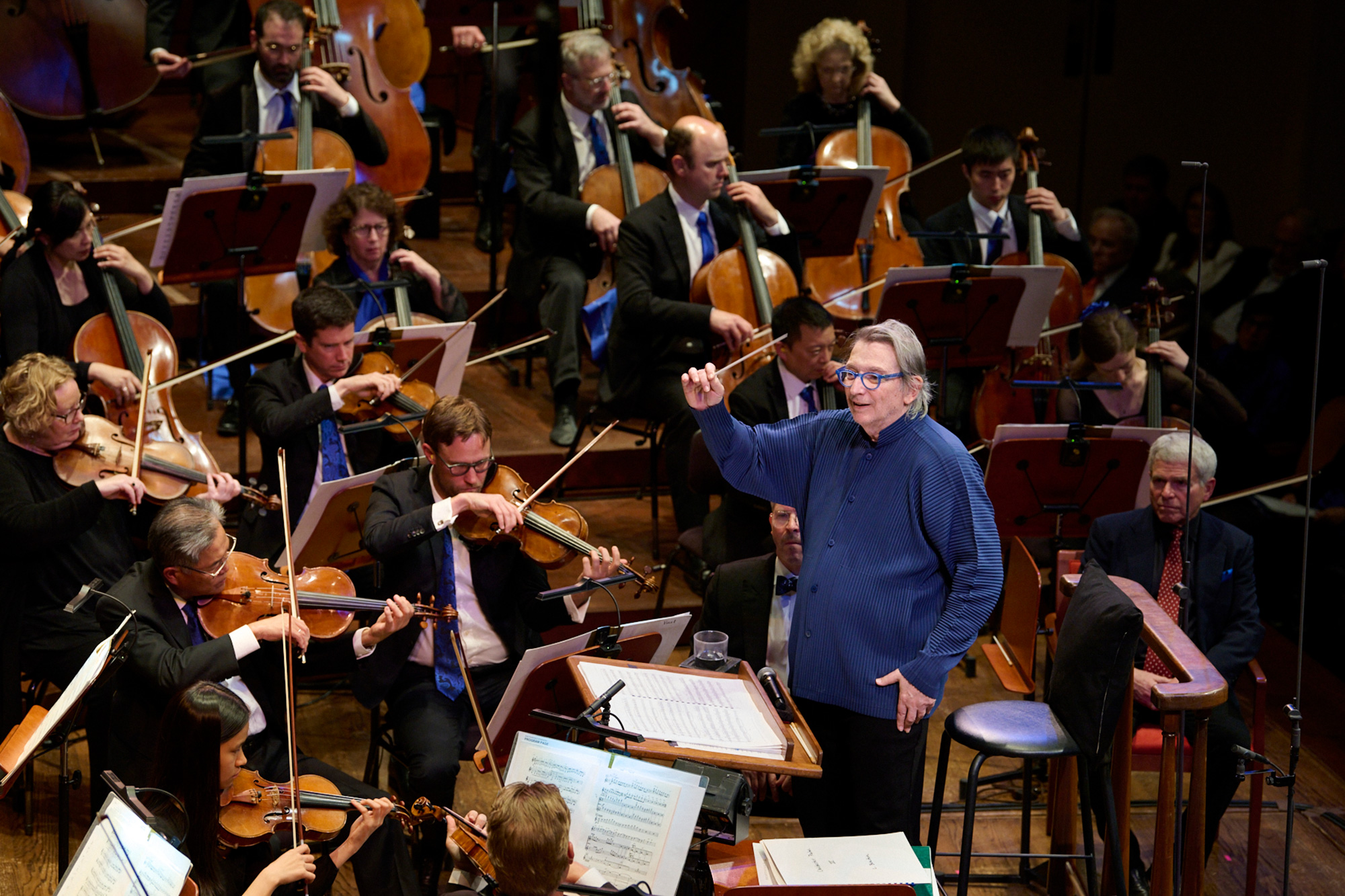 Conducting the San Francisco Symphony at Davies Symphony Hall — his final concert, April 26, 2025. Photo: Stefan Cohen / San Francisco Symphony.
The Mahler cycle
He recorded all nine Mahler symphonies with the San Francisco Symphony between 2001 and 2009, plus Das Lied von der Erde, plus the adagio of the unfinished Tenth, plus Mahler's songs.
The cycle won seven Grammy Awards. It is one of the significant recorded achievements of the American orchestra in the digital era. And it is a document of something more than virtuosity: it is a document of patience.
Listen to the San Francisco Symphony Mahler Third. The long, slow first movement — the one that Mahler said was about "summer marching in" — unfolds the way summer actually unfolds. Not dramatically. Not manipulatively. Just one small change at a time, until you look up and realize that an hour has passed and you are inside a different season. There is nothing in that recording that is rushed. There is nothing that is exaggerated. There is nothing that tries to prove anything to anyone.
That was his whole artistic temperament. He trusted the music. He trusted the musicians. He trusted the listener.
You could hear it in every bar he ever conducted.
The composer he protected: American music
He loved American music.
He loved it the way you love a brother who almost didn't make it, and who is still, even now, underappreciated.
Aaron Copland. Charles Ives. George Gershwin. Leonard Bernstein. John Adams. Samuel Barber. Lou Harrison. Henry Cowell. Steve Reich. Morton Feldman. Carlos Simon. Mason Bates. Jennifer Higdon. He played their music. He recorded their music. He commissioned new music from living American composers at San Francisco almost every season. He defended their music in interviews, on television, at donor lunches where he was being asked, politely, to program more Brahms.
He said no. He did not say it loudly. He said it patiently. He said it by simply putting the American work on the program anyway, and then playing it in a way that made the audience glad he had.
He recorded Ives's Holidays Symphony with the seriousness of a Brahms cycle, and you can hear, in every bar of it, that he believed Ives belonged there. He made Copland sound inevitable — the way a great actor makes a soliloquy sound inevitable, as if it could never have been any other line. He rescued Leonard Bernstein the composer from the shadow of Leonard Bernstein the celebrity, and made you understand that the Kaddish Symphony, The Age of Anxiety, the Serenade after Plato's Symposium, and the Chichester Psalms were not side projects. They were a life's work. He was right.
He was especially right about Bernstein, who had been his friend and mentor. He understood that Bernstein deserved to be remembered as a composer first, and he spent decades making sure that remembrance actually happened.
If you grew up hearing an American orchestra play an American composer and it sounded like the orchestra believed in it, you are somewhere in a chain of causation that leads back to him. He spent fifty years making sure the American composer was not a footnote.
Michael Tilson Thomas, composer
He was not only a conductor. He was a composer of real originality, and one of his private frustrations — which he rarely spoke about in public — was that his compositional work was overshadowed by his podium life.
He wrote Agnegram for his longtime patron Agnes Albert. He wrote the fantasy Urban Legend for contrabassoon and orchestra, a piece played more often than almost any contemporary contrabassoon work. He wrote From the Diary of Anne Frank, premiered in 1990, setting Anne Frank's words for narrator and orchestra. He wrote Poems of Emily Dickinson. He wrote Meditations on Rilke. He wrote The Thomashefskys, the Yiddish-theatre musical about his grandparents, which he premiered at Carnegie Hall.
He was a good composer. He would have been content, in another life, to be only a composer. He understood, better than most conductors, what it cost a composer to write. That understanding showed in every living composer he ever programmed.
He respected the act of writing music. He respected the people who did it. He treated premieres the way he treated Beethoven — with care, with curiosity, with an assumption that the new work might be as important as the old.
The New World Symphony
In 1987, in Miami Beach, he co-founded the New World Symphony.
That sentence does not carry enough weight on its own. Let us try again.
He looked at a generation of young American musicians who were graduating from Juilliard and Curtis and the Eastman School with nowhere to go between the conservatory and the high-stakes audition that would decide the rest of their career — and he built them a home.
A three-year fellowship. Intensive coaching. Real performance experience. An orchestra of their peers. Full professional concerts. Video masterclasses with the greatest soloists in the world, broadcast in both directions. Chamber music coaching. Career mentoring. Entrepreneurship training. Audition preparation with coaches who had actually sat on the other side of the screen. Health and body mechanics. Mental performance skills. Composition workshops. An education in what it means to be a working musician in the twenty-first century — not just a technically skilled one.
He designed it. He taught there. He coached young violinists through single phrases the way a chamber music teacher does — one measure at a time, refusing to move on until the student had heard it for themselves.
He did this as a full additional career, on top of San Francisco, on top of composing, on top of the television work, on top of being one of the most in-demand guest conductors in the world.
He did it because he understood, earlier than most people, that American orchestras were going to need this. That the model of going straight from conservatory to a major audition was broken. That the system needed an intermediate home. He didn't write a white paper about it. He built the home.
If you walk into Carnegie Hall tonight, or Davies tomorrow, or Symphony Hall in Boston, or Severance in Cleveland, or the Concertgebouw in Amsterdam — and an American orchestra plays at the highest level — you are almost certainly hearing musicians whose careers began, or were shaped, or were saved, at New World Symphony in Miami Beach.
He will never see most of what grew out of that building. He will not hear the premieres his former students will conduct in 2045. He will not see the recordings they will make. He will not read the reviews that will say, as reviews already say now, you can hear New World in their phrasing.
He knew he wouldn't. He built it anyway. That is what he was.
Keeping Score
In 2004, when most famous American conductors were learning to use Twitter and choosing not to, Michael Tilson Thomas made a television series called Keeping Score.
It was — it still is — the warmest piece of public music education in American history.
He would take a Tchaikovsky symphony and walk you through it slowly. He would explain what the composer was feeling. He would sit at the piano and play the themes. He would cue the orchestra and let you hear a passage twice, three times, until the harmony revealed itself. He would tell you, quietly and without performance, why the music mattered to him. He would say the hardest musicological things in the simplest possible sentences, without ever flattening them.
He did episodes on Beethoven's Eroica. On Stravinsky's Rite of Spring. On Shostakovich's Fifth. On Copland's Appalachian Spring. On Tchaikovsky's Fourth. On Berlioz's Symphonie fantastique. On Ives's Holidays Symphony. On Mahler's First.
Every episode ended with a full performance of the piece.
Every episode began with him quietly telling you why he wanted you inside it.
He never condescended. He never assumed you didn't already love it. He assumed you were smart, wanted to be smarter, and would be grateful for the help. Thousands of people — professional musicians, students, parents of children learning to play, retirees who had never bought a ticket to a classical concert in their lives — learned from those episodes how to listen.
He gave them the keys. They kept using them. They are still using them tonight.
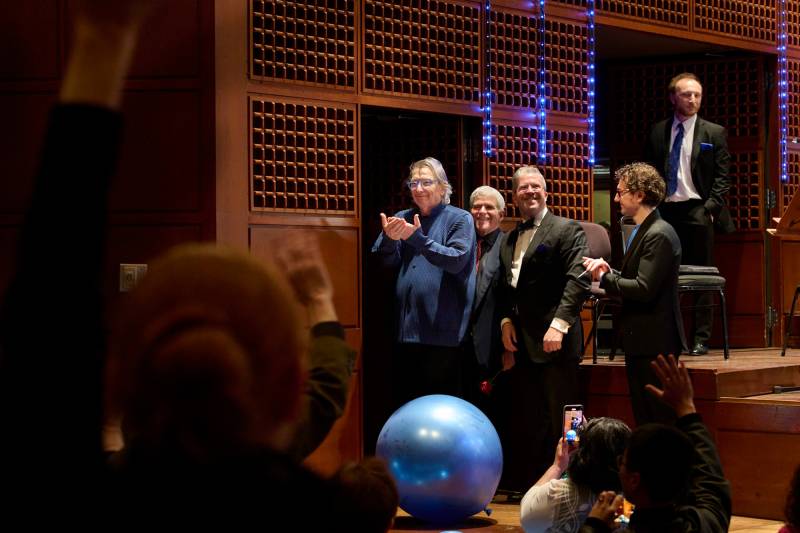 Michael Tilson Thomas and his husband Joshua Robison leaving the stage together after the farewell concert at Davies Symphony Hall, April 26, 2025. Joshua died ten months later. Photo: Stefan Cohen / San Francisco Symphony.
Joshua
His husband, Joshua Robison, was the love of his life.
They first met as children — Michael was twelve, Joshua was eleven. They became partners in 1976. They married in California in 2014. They were together for nearly fifty years.
Michael and Joshua were pioneers of a kind that the classical music world did not always acknowledge. At a time when very few American classical men were openly gay, they were publicly, unshowily, totally a couple. They were at openings together. They were at premieres together. They were at the Grammys together. When Michael was diagnosed in 2021, it was Joshua who walked him into surgery, Joshua who was there when he came out of it, Joshua who drove him to chemotherapy, Joshua who held his hand.
And when Joshua fell ill himself this past winter, Michael was the one holding his. They died at home in San Francisco, two months apart. Anyone who knew them understood that that was how it was always going to go. They had built one life, not two. Michael often said, in private, that Joshua was his editor — that he never showed a program to a board, gave an interview, or approved a recording mix without Joshua weighing in. Joshua was his taste, his patience, his steady.
They were, simply, in love for fifty years. They made it look easy. Nothing about it was easy — Michael spent his career traveling almost constantly, the public life was relentless, the demands were enormous. Joshua made all of it work. Michael never stopped being grateful, and he told anyone who would listen how grateful he was.
That, too, was a life's work. And it deserves to be honored here alongside the music, because for Michael, the music and the love were the same thing.
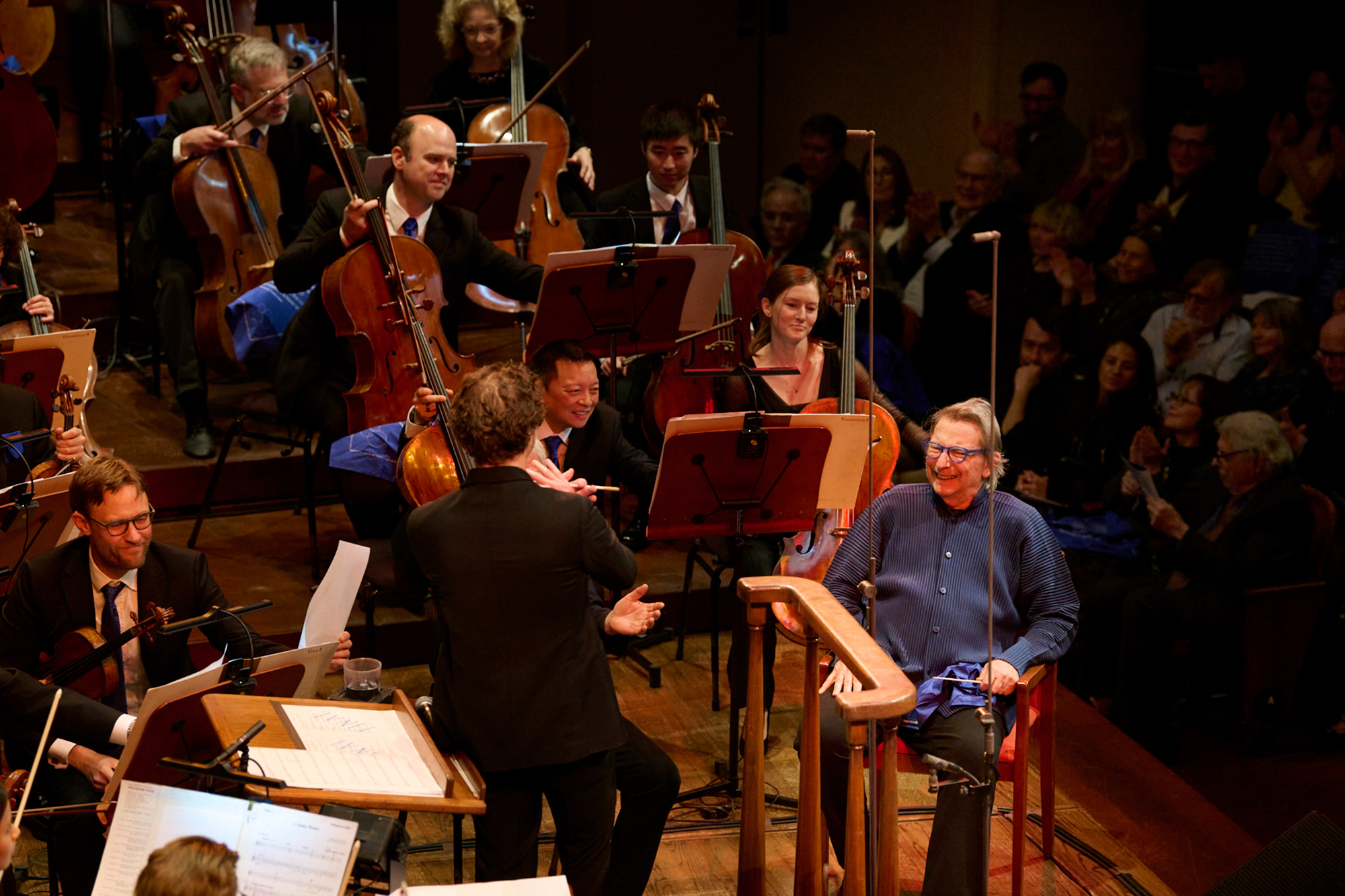 Seated center stage to receive the orchestra's tributes during the farewell concert. Davies Symphony Hall, April 26, 2025. Photo: Stefan Cohen / San Francisco Symphony.
The night the balloons fell
On April 26, 2025, Michael Tilson Thomas walked onto the stage at Davies Symphony Hall one last time.
He had announced only weeks earlier that the tumor had returned. He was frail. He was thinner than he had been a year before. Joshua — his husband, the man who had been at his side since 1976, the man who had always been the person he looked for in the wings — helped him to the podium.
The program was Respighi's Roman Festivals. It is an unforgiving piece of music for a conductor in full health. He led it anyway. Slowly. Carefully. With the same phrasing, the same patience, the same refusal to rush, that had defined his twenty-five years at Davies.
The San Francisco Symphony played for him the way musicians play for a teacher they know they will never see again. Every entrance was offered to him. Every climax was shaped the way he had shaped it in rehearsal, as if they were holding it up for his approval even now. Toward the end of the piece, in the long build of the Befana finale, you can hear the orchestra almost leaning toward him — playing into him, giving him the music back.
Frederica von Stade sang tribute. Jessica Vosk sang tribute. He sat in a chair at the front of the stage, hand at his heart, nodding, mouthing the words he had heard a thousand times.
At the end, the audience stood. They stood and they stood and they did not stop.
And then, from the ceiling of Davies Hall, thousands of blue balloons began to fall. Blue, because blue had been his color for fifty years — the blue suits, the blue scarves, the blue of a thousand curtain calls. They drifted down slowly, covered the stage, covered the floor, covered the seats, covered him.
He looked up. He smiled. He reached for Joshua's hand.
There are certain moments in American concert life that do not happen often and cannot be manufactured. That was one of them.
Everyone in the hall knew what they were watching. He knew too.
He let himself be loved. For once in his life, for an entire evening, he did not deflect. He did not joke. He did not change the subject to Copland or to his latest composition. He sat in the middle of a thousand blue balloons and he held his husband's hand and he let himself be loved.
Ten months later, in February 2026, Joshua died in his sleep.
Two months after that, on Wednesday, April 22, Michael died too.
What he gave us
He leaves behind an enormous library of recordings — Mahler, Copland, Bernstein, Ives, Prokofiev, Stravinsky, Gershwin, Bartók, Berg, Britten, Debussy, Sibelius, Tchaikovsky, Reich, Adams, Bates, and his own compositions — any one of which would be a significant career on its own.
He leaves behind the graduates of the New World Symphony, now scattered across every major orchestra in the world, carrying his phrasing, his patience, his insistence on beauty, into the rest of the twenty-first century. They are in the concertmaster chair of more than one American major. They are on the podium of more than one professional orchestra. They are teaching at Juilliard, at Curtis, at the Royal Academy. A few are in the strings section of the Berlin Philharmonic. They are in the orchestras on every HBO and Netflix and Apple TV score. They are everywhere.
He leaves behind the San Francisco Symphony, still — six years after his official retirement — playing with his sound. That sound does not go away quickly when a music director leaves. It is in the bowings, in the rehearsal habits, in the institutional memory of roughly a hundred full-time professional musicians who spent a quarter of their adult lives making music with him every week. They will carry it for decades.
He leaves behind Keeping Score, a body of public music education work that will teach listeners born in 2040 how to hear a Tchaikovsky symphony as if the composer himself were explaining it to them.
He leaves behind The Thomashefskys, his grandparents' musical, a link backward through his own family to American immigrant music.
He leaves behind his own compositions, which we will continue to play, because they deserve to be played.
He leaves behind a way of being on a podium — generous, curious, patient, wide open, unafraid, loving — that is the standard by which every conductor who comes after him will be measured, whether they know it or not.
And he leaves behind a blue balloon.
Thank you, Michael.
For Ives. For Copland. For Mahler. For Gershwin. For Leonard. For John. For Carlos. For Ruth and Lou and Henry. For every young musician you coached quietly and patiently through a phrase until they heard it for themselves. For Keeping Score. For the New World Symphony. For the Thomashefskys. For twenty-five years at Davies. For the Mahler cycle. For the American orchestra as it exists, at its best, at this moment in 2026 — which is the best it has ever been, in no small part because of you.
For the balloons.
For Joshua.
For all of it.
Go well.
— The Cadenza Team cadenza.work April 23, 2026
Comments
Sign in to join the discussion.