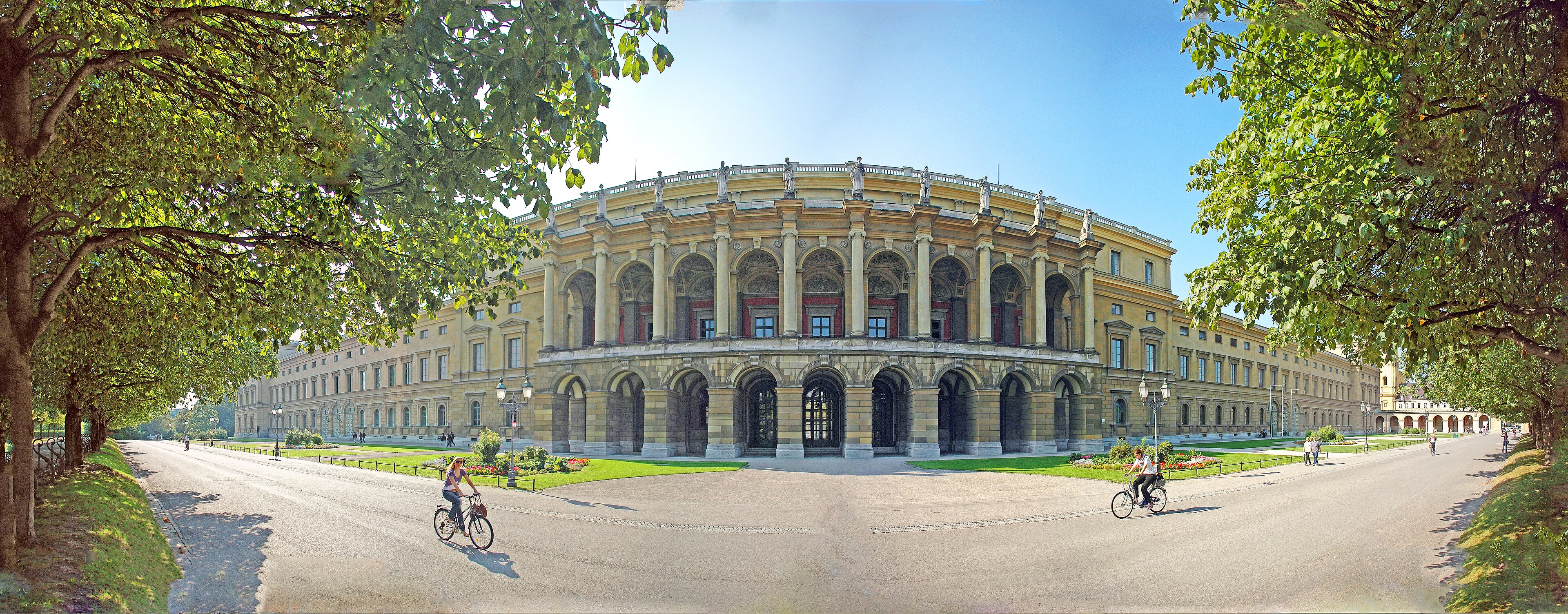
The bassoon final of the 75th ARD International Music Competition began at four o'clock on Friday afternoon in the Herkulessaal of the Munich Residenz, with the Symphonieorchester des Bayerischen Rundfunks under Bar Avni. By the time this was written the competition had posted the result, and a search for it in English turned up nothing beyond the competition's own pages.
Enrico Bassi takes the first prize and €15,000. Jappe Dendievel takes the second prize, €10,000, and the audience prize. Laure Thomas takes the third, €5,000.
Two days earlier, on 9 September and in the same hall, the organ prizes went to William Fielding of Blackburn, first; Alexis Grizard, second and the audience prize; and Julian Emanuel Becker, third.
Those six are the main prizes. Three more names belong in the same paragraph: musicians who never reached a final and still went home with a prize, and it is the one that asks the most of a player.
The two lists
The ARD publishes each category in German and in English. For organ and bassoon the two do not agree, and the disagreement is not a translation nicety.
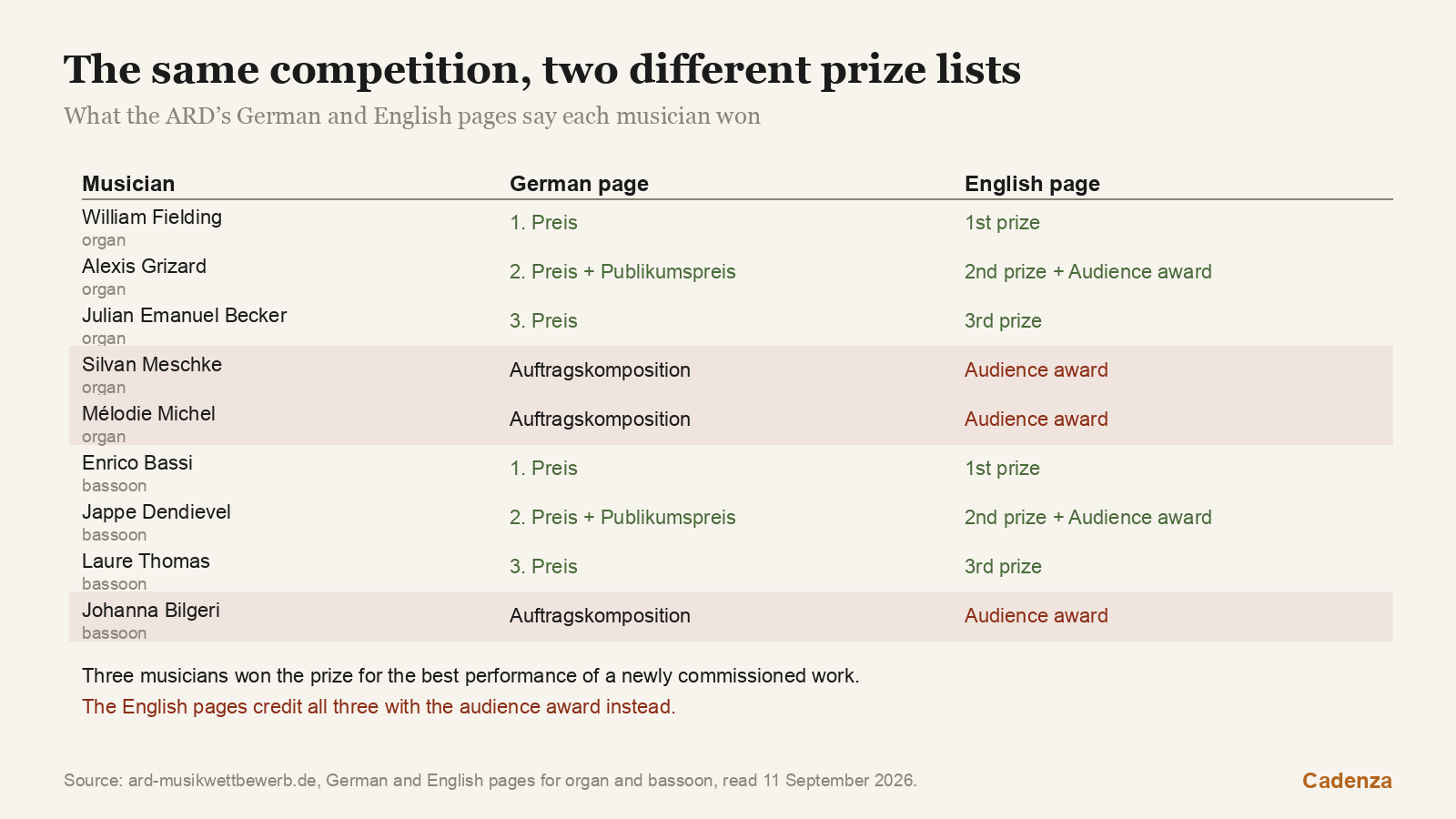
On the German organ page, Silvan Meschke and Mélodie Michel are each marked "2026: Auftragskomposition". On the English organ page, both are marked "2026: Audience award". On the German bassoon page, Johanna Bilgeri is marked "2026: Auftragskomposition". On the English bassoon page she is marked "2026: Audience award".
Auftragskomposition means commissioned composition. The prize is for the best performance of the new work written for the competition. It is a different prize from the audience prize, funded separately and decided a different way.
The error is not confined to the category listings. Each competitor has an individual profile page, which is the page a concert promoter or a conservatory looks at, and the English version of Bilgeri's page and of Meschke's page both carry "2026: Audience award" as well.
Everything else on those pages translates correctly. Semifinale becomes "Semifinals". 2. Runde becomes "2nd round" for all eleven bassoonists who got that far. Publikumspreis becomes "Audience award", correctly, for Grizard and for Dendievel. Only Auftragskomposition comes out wrong, and it comes out wrong the same way all three times it appears. That looks less like a mistake about these three musicians than one bad entry in a translation table, with the consequence that two different German terms now land on the same English words.
Why this is checkable rather than arguable
The competition's invitation brochure for 2026 sets out what it funds, and it removes any ambiguity about how many audience prizes exist.
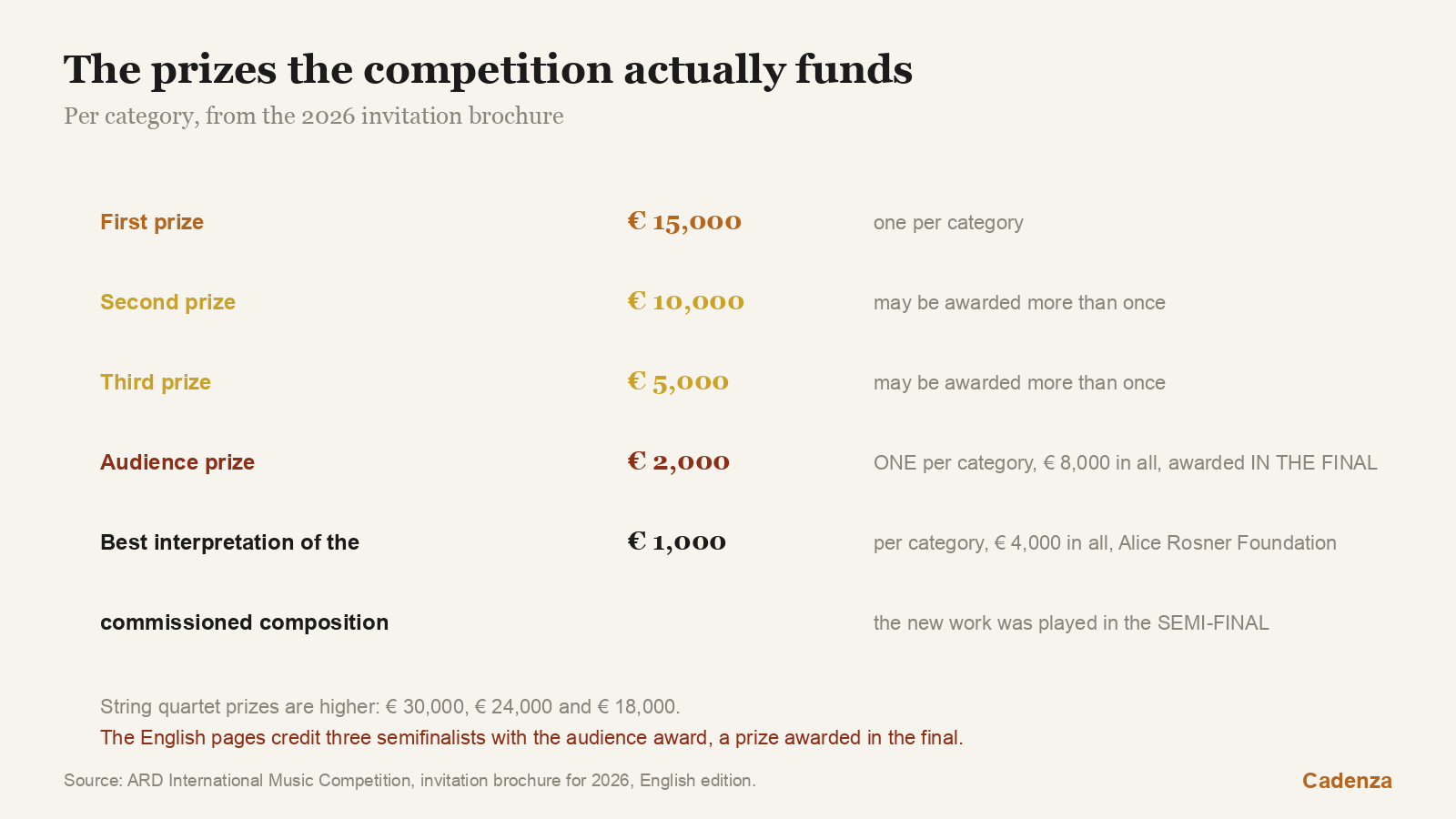
Audience prizes total €8,000 across the competition, and the brochure lists them one by one: "Bassoon in the amount of € 2.000", "Organ in the amount of € 2.000", "Percussion in the amount of € 2.000", "String Quartet in the amount of € 2.000". One each. Separately, "Special Prizes totaling € 4.000 for the best interpretation of the commissioned compositions, made possible by the Alice Rosner Foundation" are awarded at €1,000 in each of the four categories. That is a different prize, from a different donor, decided a different way.
Four categories at €2,000 is exactly the €8,000 the brochure says the audience prizes come to, so there is no room in that pot for a second audience award anywhere. On the English pages there are five: three in organ and two in bassoon, in a competition funded for four across all four categories.
One sentence in the brochure settles it without any arithmetic at all. The audience prizes, it says, "will be awarded in the final round as follows". Meschke and Michel did not reach the organ final. Bilgeri did not reach the bassoon final. Their own English cards say so: Meschke's and Michel's each read "2026: Semifinals" directly above "2026: Audience award". The page contradicts itself on its face, crediting semifinalists with a prize the competition awards in the final.
There is a second reason the labels cannot both be right. The ARD's Jury Guidelines for 2026 separate the two kinds of award: "The awarding of the official prizes is decided by the jury only", while "The jury shall have an advisory capacity in the awarding of special prizes." An audience prize is decided by an audience. A prize for the best account of a commissioned work is decided by listening to a particular piece. They are different prizes, decided by different people.
What the three actually did
This is the part the mislabelling erases.
The organ category's commissioned work was Enjott Schneider's Das Glasperlenspiel for organ solo. The bassoon category's was Nina Šenk's Settling for bassoon. The ARD's own pages mark both UA, Uraufführung, a world premiere, and place both in the semi-final round. That is the detail that makes sense of everything else: the new piece was played in the semi-final, so a semifinalist could win the prize for playing it well, which is exactly what these three did. The audience prize belongs to the final, which is why it cannot be theirs.
In organ the prize went to two players rather than one, so Meschke and Michel share a pot the brochure sets at €1,000 for that category. All three left Munich with a prize the competition created specifically to reward the hardest thing it asks of anyone: take a new score, learn it fast, and make it convincing in front of a jury. On the English pages that achievement has been replaced with a popularity vote they did not win, in a category where the popularity vote went to somebody else.
The English pages need a proofreader
The prize labels are the consequential error. They are not the only one.
William Fielding's biography on the English site is printed in German, at length, and it is worth reading: a chorister at Blackburn Cathedral, three years at St Mary's Music School in Edinburgh, two years of organ and piano at the Royal College of Music with David Graham and Kathron Sturrock, organ scholar of the Chapel Royal at Hampton Court Palace, then a move to Toulouse in 2020 to study with Michel Bouvard and Yoann Tardivel, a recording of Duruflé's Requiem with the Maîtrise de Toulouse, the Prix François Vidal for his graduation concert in 2022, and since then the organ class of the Conservatoire National Supérieur in Paris under Olivier Latry and Thomas Ospital. He was organist in residence at the Sapporo Concert Hall Kitara in Japan in 2023-24, played Suntory Hall and the Osaka Symphony Hall, released a first solo disc in July 2024, and is assistant organist at the Basilica of Saint-Sernin in Toulouse.
Two of Fielding's earlier prizes are named on that page. One of them, the Grand Prix d'Orgue Jean-Louis Florentz, appears as "Jean-Lois Florentz". Elsewhere the English calendar advertises three "PRICE WINNERS' CONCERT" events on 16, 17 and 18 September, lists a "PERSCUSSION SEMIFINALS", and bills a bassoon "Flahmob" for 12 September. None of those is going to cost anybody a booking, and together they suggest the prize labels are a proofreading failure rather than anything worse. The prize labels are still the ones that could cost somebody a booking.
The statistics nobody opened
While the category pages were open, Cadenza read the competition's own Statistik 2026, a document Cadenza has not seen quoted anywhere.
Four hundred and ninety-two musicians applied, from 42 countries and four continents: 269 from Europe, 191 from Asia, 29 from the Americas and three from Australia. Foreign applicants were 89.7 percent of the field. After a preselection, 184 musicians from 32 countries were invited to Munich.
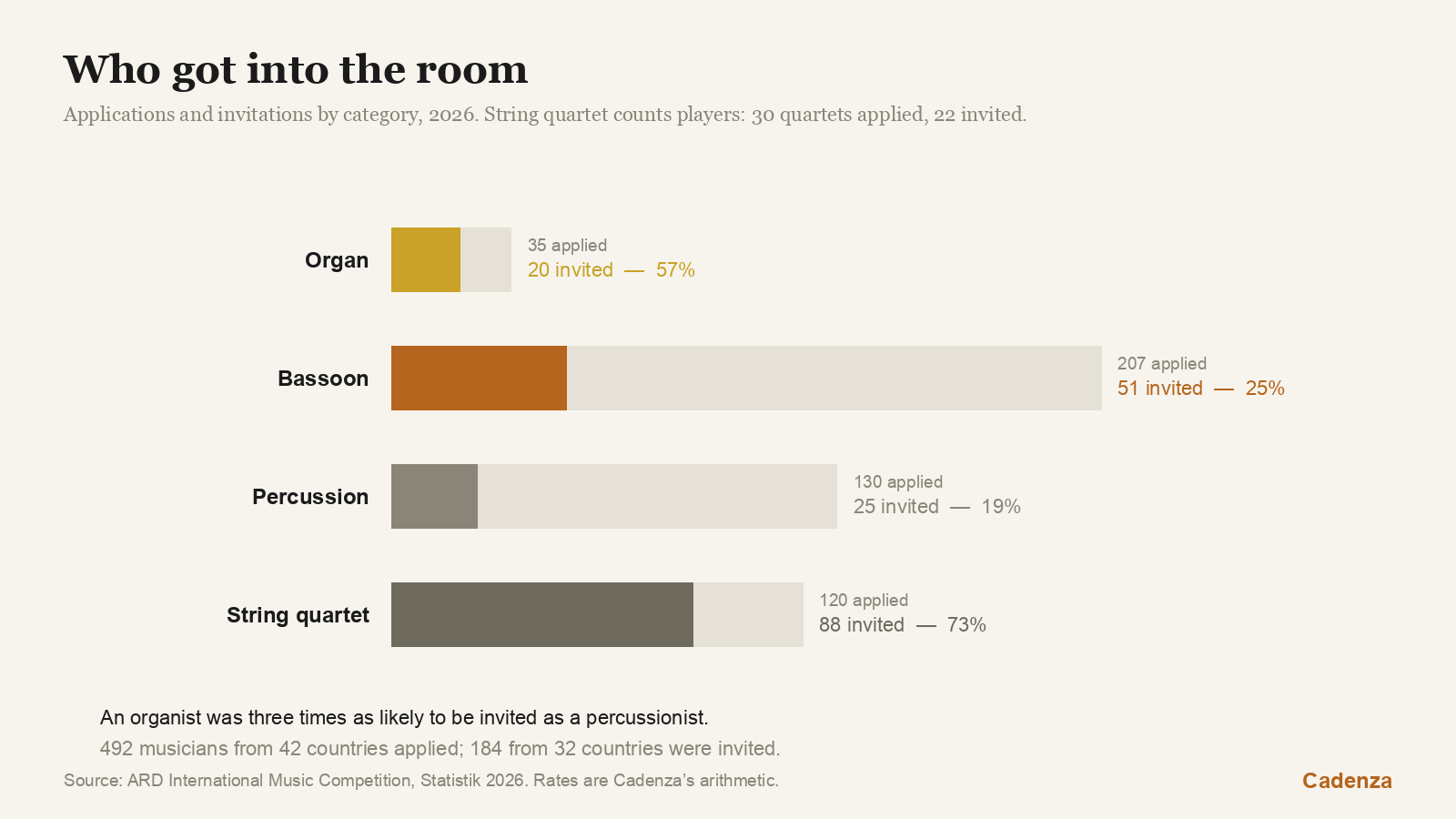
Split it by instrument and the odds are wildly uneven. Organ drew 35 applications and invited 20, an admission rate of 57 percent. Bassoon drew 207 and invited 51, or 25 percent. Percussion drew 130 and invited 25, or 19 percent. So an organist was three times as likely to be invited to Munich as a percussionist.
That is not an argument about quality. It is an argument about supply, and it is the sort of number a student weighing up a second study instrument deserves to see.
One row in that document does not reconcile, and it is worth spelling out because the competition can fix it in a minute. The statistics give percussion 130 applications, then break the field down by gender as 17 women and 88 men, which comes to 105. Bassoon, organ and string quartet all add up exactly, and every admissions figure in the document adds up exactly.
The shortfall is not random. The document also states its own totals of 177 women and 315 men, and those are short by 12 and 13 against the sum of its own rows. Twelve and thirteen are precisely the numbers of women and men admitted in percussion. Add each back and the percussion row becomes 29 women and 101 men, at which point all four of the document's stated totals reconcile to the digit: 29 plus 101 is the stated 130, the women's column reaches the stated 177, the men's the stated 315, and the pair the stated 492. No other pair of values does that.
So the likeliest reading is that the two percussion cells hold applications minus admissions rather than applications. That is an inference from arithmetic, not something the ARD has confirmed, and it is why Cadenza is not publishing a gender admission rate for percussion.
What the guidelines now say about first prizes
One more line in the Jury Guidelines is worth noting. It reads: "A first prize shall be awarded. First prizes may only be awarded once for each category. Second and third prizes may, with the approval of the competition administration, be awarded several times per category."
Both categories decided so far have awarded a first prize. Two remain: the string quartet final on 12 September and percussion on 13 September, the latter again with the Bavarian Radio Symphony Orchestra under Bar Avni, and with a commissioned work by Bryce Dessner.
If you go. Three prize-winners' concerts follow the finals. The first is on 16 September and features prize winners across the categories. The second, on 17 September, is with the Munich Chamber Orchestra. The third, on 18 September, is with the Bavarian Radio Symphony Orchestra under Dennis Russell Davies in the Herkulessaal. Tickets for the 2026 competition went on sale through BRticket on 4 August.
For the record
Cadenza has written to nobody and telephoned nobody about the prize labels. This piece rests on the competition's own published pages and documents, read in both languages on 11 September 2026, with one exception worth naming: the organ final's own listing has already rolled off the site now that it is past, so the date and hall for that final come from the competition's calendar as it stood earlier in the week rather than from a page that can be opened today. If the English pages are corrected after publication, that will be a good outcome and this article will say so.
Three names to have right, in the meantime. Silvan Meschke and Mélodie Michel won the organ prize for the best performance of the world premiere of Enjott Schneider's Das Glasperlenspiel. Johanna Bilgeri won the bassoon prize for the best performance of the world premiere of Nina Šenk's Settling. None of the three won an audience award.
Every one of these nine names began as a line on an application form. The ARD's 2026 call closed last winter, and 492 musicians answered it. Cadenza carries the competitions with open deadlines, free to musicians, on its competitions board, and current orchestral vacancies on its jobs board.
The question the competition will be asked next is a simple one. The prize-winners' concerts begin on 16 September, and the three names in question go in front of an international audience that week. Will the English pages say what the German ones say by then?
Sources: the ARD International Music Competition's own pages, read in both languages on 11 September 2026: bassoon, English and Fagott, German; organ, English and Orgel, German; the individual profile pages for Enrico Bassi, Johanna Bilgeri, William Fielding and Silvan Meschke; the invitation brochure for 2026; the Jury Guidelines 2026; and Statistik 2026.
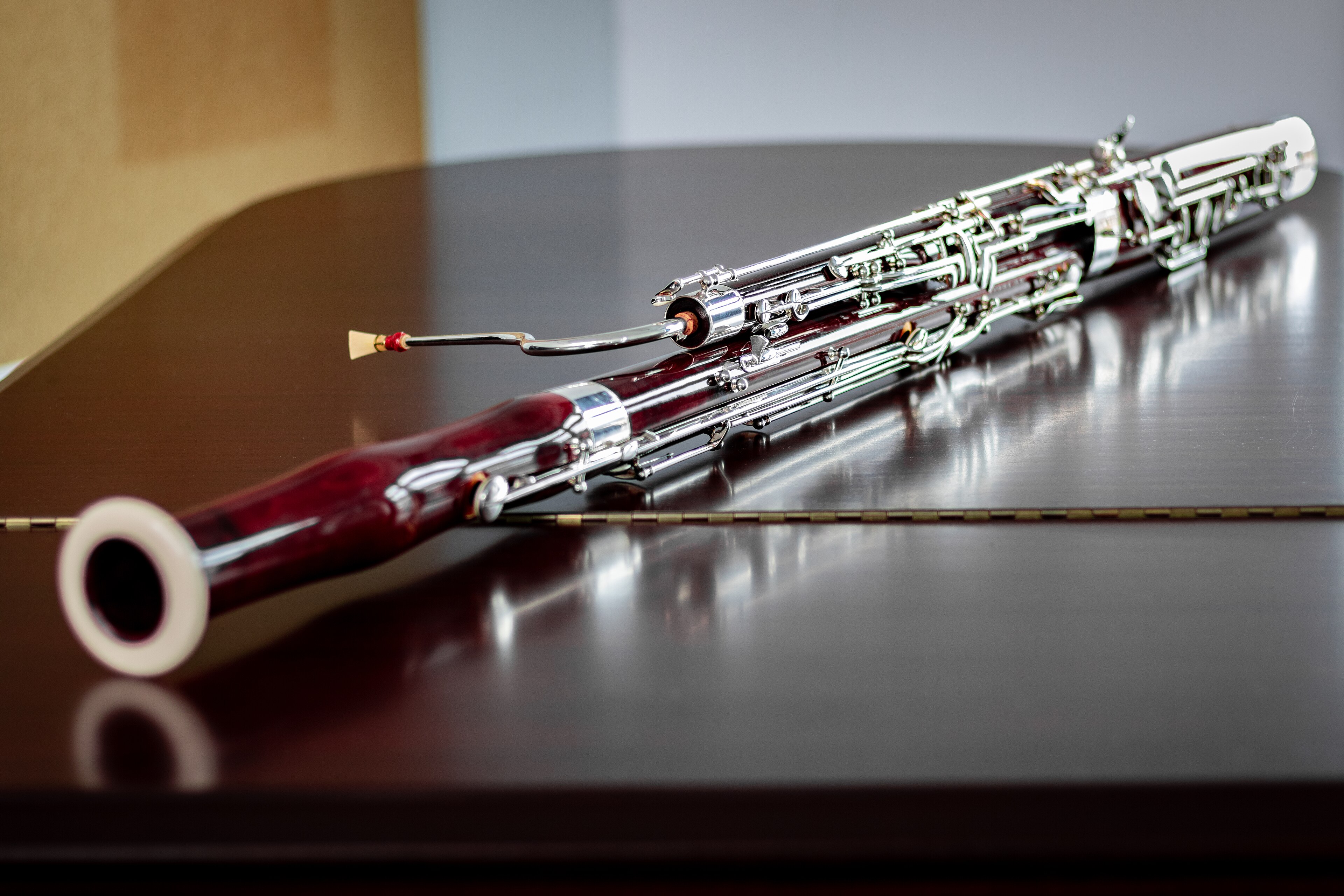
Cover photograph: the Herkulessaal of the Munich Residenz, 2009. Guido Radig, CC BY 4.0, via Wikimedia Commons. In-body photograph: a bassoon. mark.drummer, CC BY 2.0, via Wikimedia Commons. Charts by Cadenza from the competition's own published documents.
Cover photograph: The Herkulessaal of the Munich Residenz, where the ARD International Music Competition held its bassoon final on 11 September 2026, photographed in 2009. Guido Radig, CC BY 4.0, via Wikimedia Commons.
Comments
Sign in to join the discussion.