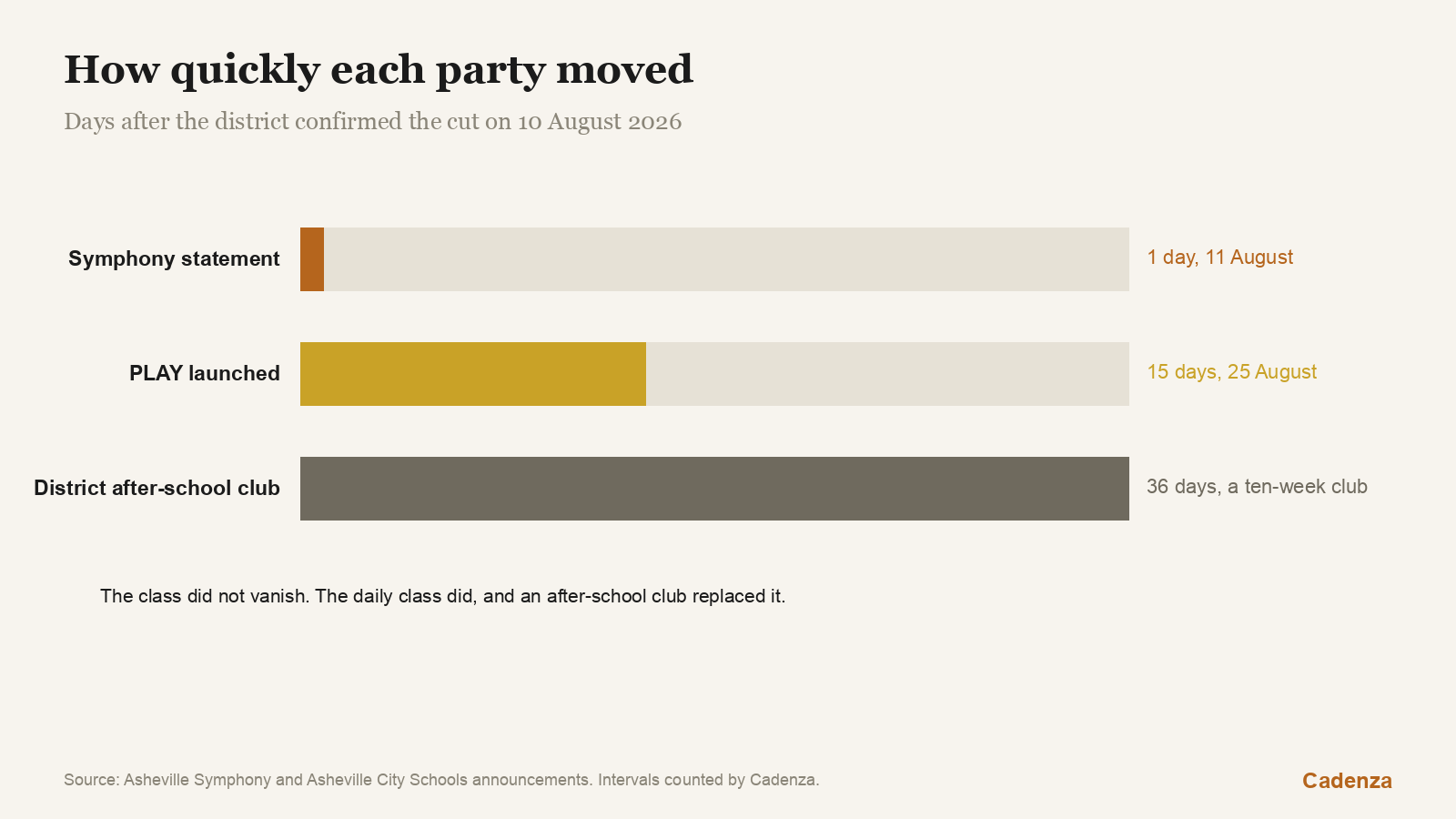
On 10 August, Asheville City Schools confirmed that Asheville Middle School would have no orchestra class in 2026-27. On 11 August, the Asheville Symphony issued a public statement. On 25 August, fifteen days after the confirmation, it launched a programme called PLAY, Private Lesson Assistance for Youth, that pays up to 75 per cent of the cost of weekly private lessons for string students at the middle school and the high school.
That is a fast institutional response, and it is the story. It is not, as some accounts have it, a response within days. The statement took one day. The programme took fifteen. The district's own after-school replacement took thirty-six.
Tyson Hamrick, the symphony's Director of Education and Youth Orchestra, has described learning the cuts were coming through more than one channel. The district's own record shows the superintendent had contacted him by 3 August, and a parent's Facebook post on 6 August was the first public airing, three days before any news report.
The number everyone has used is not the district's number
Every account of this story says 58 students were enrolled in the middle school orchestra. Cadenza could not find that figure in any district document.
What Asheville City Schools wrote in its own board budget memo of 3 August is 39: fourteen sixth-graders, thirteen seventh-graders and twelve eighth-graders. The 58 appears only in press coverage. Cadenza is not able to explain the gap between the two figures and is not going to guess at one, but the district's own table is the document, and it says 39.
That matters because the whole case for the cut is an enrolment case. Kimberly Dechant, the district's chief of staff, said it could not justify the course at that enrolment given the size of the district. Hamrick attributes the elimination to funding rather than enrolment. The two are closer than they look, and the reason is a formula.
Why the formula lands on strings and not on band
North Carolina provides no state allotment for music teachers in grades six to twelve. Asheville City Schools pays for them out of local money, and it allots them on a ratio: one music teacher for every 150 students enrolled in a music programme. Principals, not the district, then decide how an allotted position is actually spent, which is how a single daily class becomes the unit that gets cut.
Run the two middle school music programmes through that ratio and the outcome is arithmetic rather than preference.
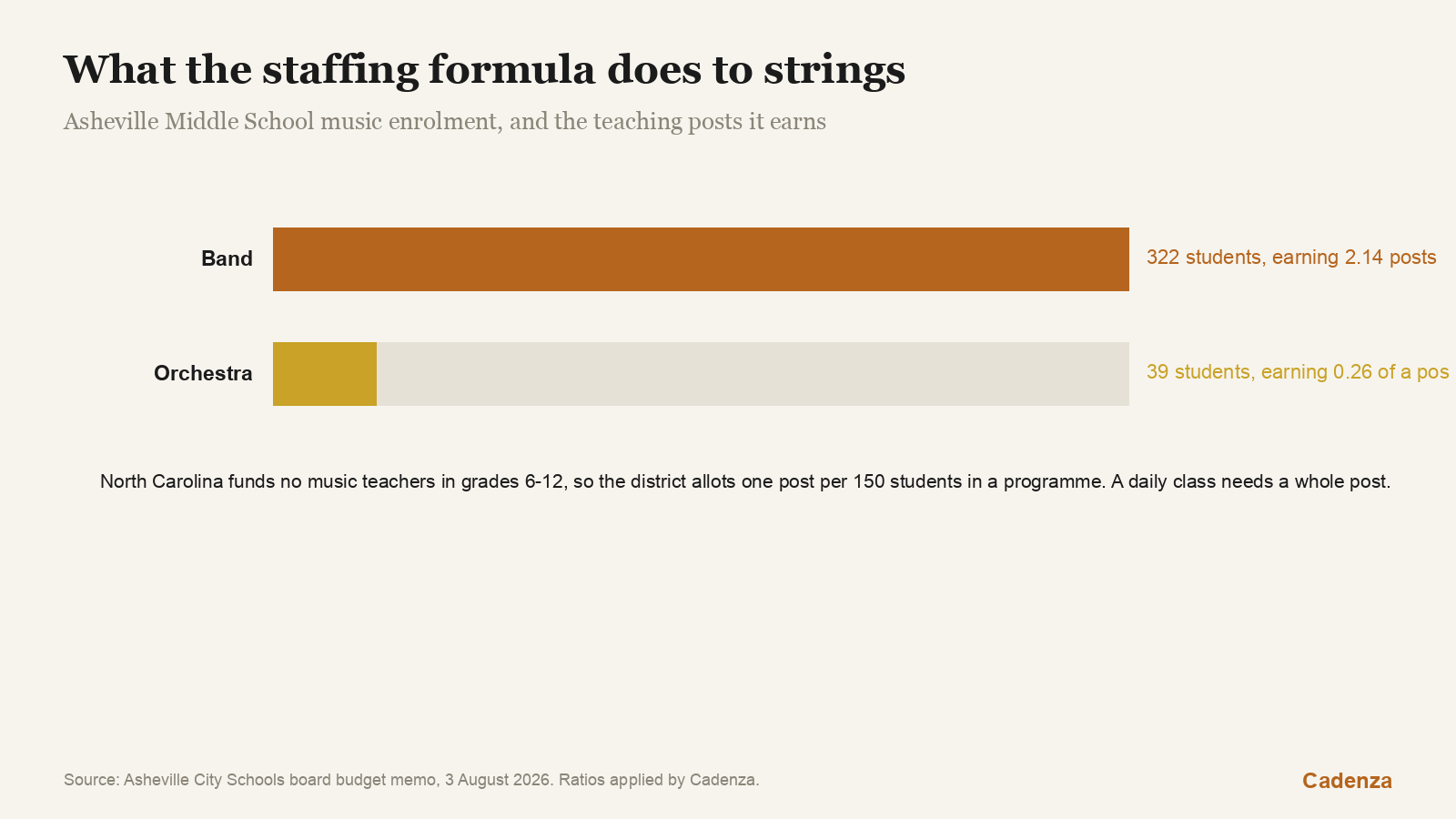
Asheville Middle School band enrols 322 students, which earns 2.14 full-time equivalent posts. Orchestra enrols 39, which earns 0.26. Band is the only music programme at the school that earns its own staffing outright. Orchestra earns roughly a quarter of the teacher a daily class requires.
This is the structural point, and it is now evidenced rather than asserted. Band survives district cuts more reliably than strings not because anyone prefers wind instruments but because a headcount-based staffing formula rewards the programme that recruits in hundreds. The district said as much: band serves significantly more students, and it continues at both schools. It is specifically strings that lost a daily class, because winds and brass sit inside the band programme.
Two further things in the memo are worth recording. The two schools were carrying seven music teachers against an earned allotment of 6.15 posts, an overage of 0.85. Eliminating one full post to close a 0.85 gap over-corrects it, and leaves the two schools 0.15 of a post below the allotment their own formula earns them. And the high school music table does not pass its own ratio check, because the fourteen rising orchestra students appear twice, overstating that allotment by 0.08 of a post.
The orchestra teacher had been given a reduced course load and a year to recruit, and had added fourteen rising sixth-graders. The decision to cut stood after the school board deadlocked three to three on a motion to keep the programme for another year.
One correction to the record while we are here. The class did not vanish entirely. It became a ten-week after-school club, so a programme exists at the school. What ended was the daily class.
What PLAY actually pays
PLAY is benchmarked to a real price. The Academy for the Arts publishes a rate of 55 dollars for a 45-minute lesson, and the symphony's subsidy is calculated against it. Assistance is paid directly to the instructor rather than reimbursed to the family.
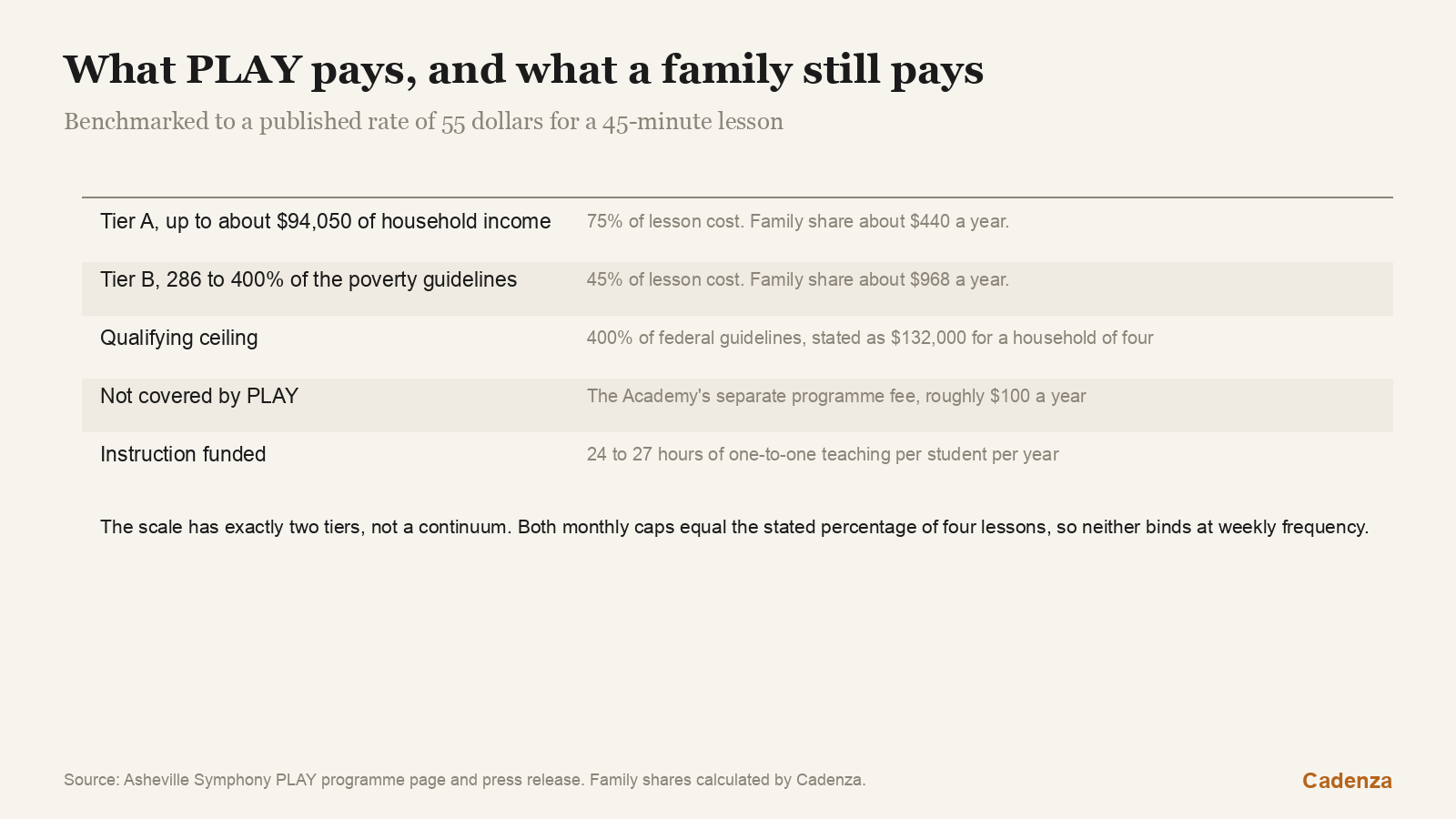
The scale is not a continuum, which is worth saying because it is often described as one. There are exactly two tiers. Tier A covers 75 per cent and reaches households up to about 94,050 dollars. Tier B covers 45 per cent for households between 286 and 400 per cent of the federal poverty guidelines.
The qualifying ceiling is 400 per cent of those guidelines, which the symphony states as 132,000 dollars for a family of four, with extenuating circumstances considered above it. Cadenza checked that against the primary federal table. The 2026 Department of Health and Human Services guideline for a household of four in the contiguous states is 33,000 dollars, and 400 per cent of that is exactly 132,000. Hamrick has said the threshold was set high deliberately, so that almost any applicant qualifies.
Both monthly caps work out to exactly the stated percentage of four lessons at 55 dollars, so neither cap bites at weekly frequency. They only begin to bind for a student taking more than four lessons a month.
What the subsidy does not cover is worth knowing before applying. The Academy charges a separate per-semester programme fee, roughly 100 dollars a year, and PLAY covers lesson cost only. On top of that a Tier A family still pays about 440 dollars a year and a Tier B family about 968.
The size of the substitution
Set the programme against the thing it replaces and the numbers are closer than expected.
There are about 53 string students across the two schools, the 39 at the middle school plus the fourteen at the high school. If every one of them took Tier A support at weekly frequency, the annual cost would fall somewhere between 69,960 and 78,705 dollars. That is the same order of magnitude as the single teacher's salary the district was weighing against a small headcount.
The range exists because the symphony's own materials are inconsistent about the term. A stated eight-month term and a September-to-May span of nine months differ by 165 dollars per student at Tier A, and the published wording supports both readings.
In instruction time, PLAY funds between 24 and 27 hours of one-to-one teaching per student per year. A daily class is more contact time than that. One-to-one teaching is more concentrated. The symphony has been careful about the comparison itself, framing PLAY explicitly as a bridge and not as a substitute for a daily in-school class, and it also expanded its youth orchestra scholarships to cover up to 90 per cent of tuition. That expansion sits under a general scholarship heading rather than being restricted to the students who lost the class.
A year ago it was a line in a budget memo
Everything above began as a staffing table in a document published on 3 August, three days before a parent noticed and seven before the district confirmed anything. Budget memos are where music programmes are decided, and they are public.
Cadenza carries youth schemes, competitions and orchestral vacancies, free to musicians, on its competitions board and its jobs board.
If you are a family in Asheville. PLAY serves string students at Asheville Middle School and Asheville High School whether or not they play in the youth orchestra. The ceiling is 400 per cent of the federal poverty guidelines, stated as 132,000 dollars for a household of four, and the symphony says it will consider circumstances above that. Budget for the Academy's separate programme fee and for the family share, because the subsidy covers lesson cost only.
The question the district will be asked next is about its own formula rather than this year's decision. It cut a full teaching post to close an overage of 0.85, which leaves both schools below the allotment the formula earns them, and its high school table counts fourteen students twice. Will Asheville City Schools publish a corrected music staffing table before it sets next year's budget?
Sources: Asheville City Schools' board budget memo of 3 August 2026 and its music staffing tables; the Asheville Symphony's own PLAY programme page and its press release of 25 August 2026; the symphony's staff page for Tyson Hamrick's title; the Academy for the Arts' own published pricing for the 55 dollar lesson rate, which Cadenza's researcher confirmed independently of the symphony's materials; the 2026 Department of Health and Human Services federal poverty guidelines for the 132,000 dollar threshold check; and reporting by WHQR, WFAE, Blue Ridge Public Radio and Mountain Xpress. The staffing arithmetic, the cost of full take-up, the instruction-hour comparison and the poverty-guideline check are Cadenza's calculations from those documents.
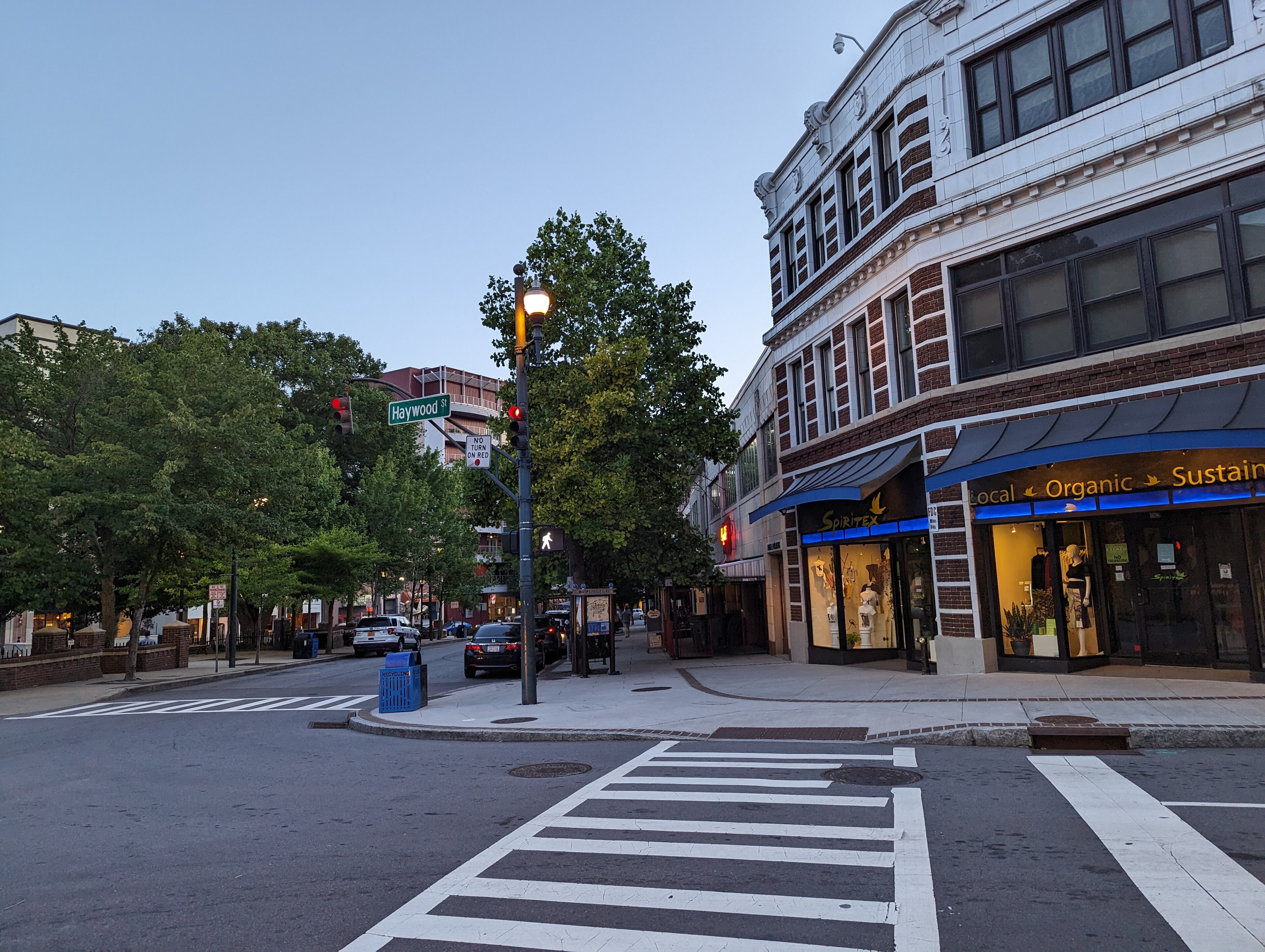
Cover photograph: downtown Asheville, North Carolina, June 2023. Jeremy Thompson, CC BY 2.0, via Wikimedia Commons. Charts by Cadenza.
Cover photograph: Downtown Asheville, North Carolina, photographed in June 2023. Jeremy Thompson, CC BY 2.0, via Wikimedia Commons.
Comments
Sign in to join the discussion.