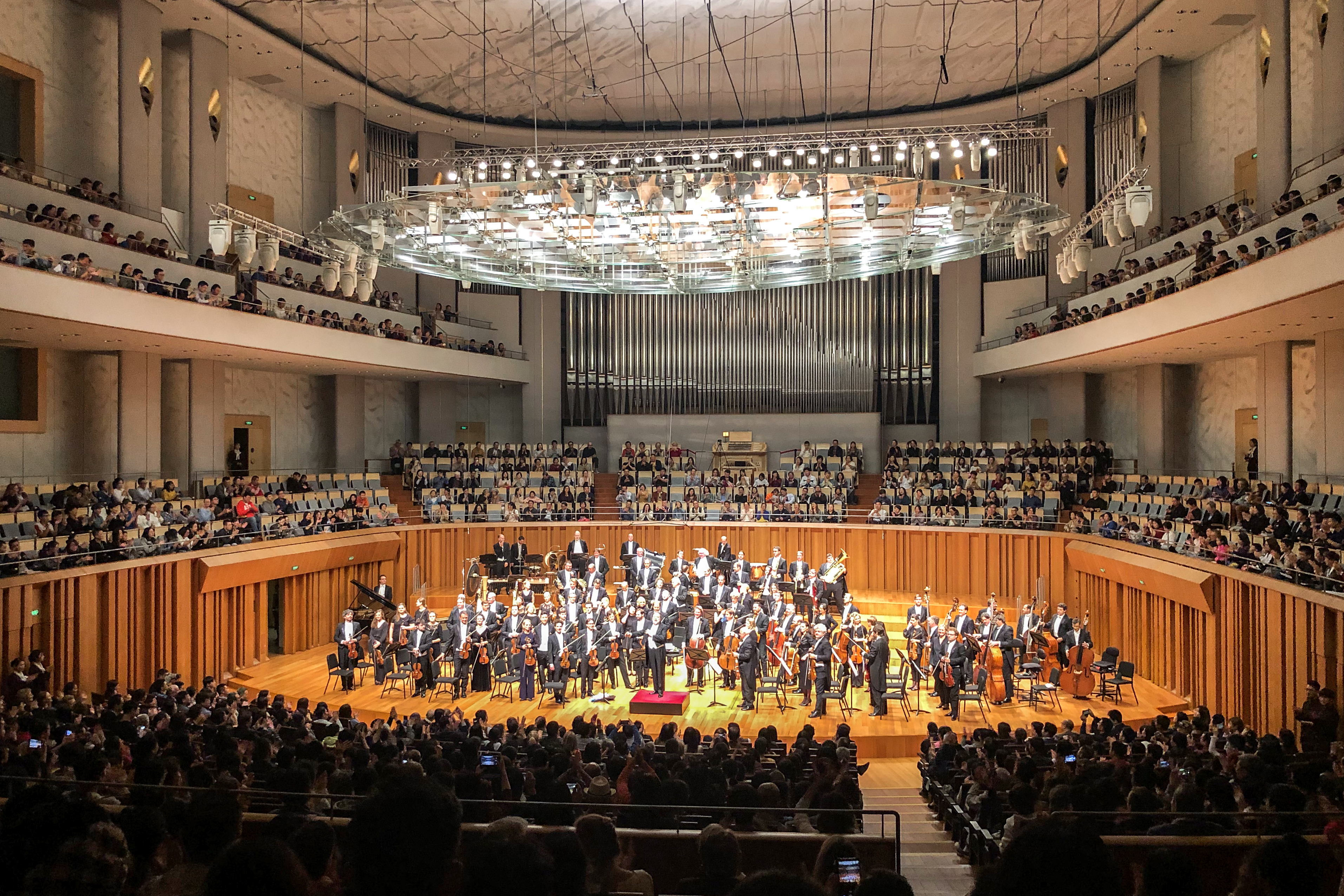
On 7 October, Charles Dutoit turns 90. On 9 October he walks onto the stage of the National Centre for the Performing Arts in Beijing to open the 29th Beijing International Music Festival, with Elisabeth Leonskaja, who is 80, as his soloist. One hundred and seventy years between the podium and the piano.
They play Mozart's Piano Concerto No. 22 in E flat and Respighi's Roman Trilogy. It is worth saying that this is not an all-Mozart opening, as some accounts have had it: the festival's own Chinese announcement bills the Respighi alongside the concerto, and the complete trilogy is a substantial second half.
The festival runs from 9 to 20 October, twelve days, themed 京华·协奏, which the festival renders in English as Beijing Cappella. It is built around the 270th anniversary of Mozart's birth, under the banner Mozart for Everyone, and it was founded in 1998 by Long Yu, which makes this the 29th consecutive edition.
Five concertos, one evening, and the timings to prove it
The single most demanding thing on the programme belongs to Ning Feng, who will play and direct the complete set of Mozart violin concertos in one evening with the Kammerakademie Potsdam.
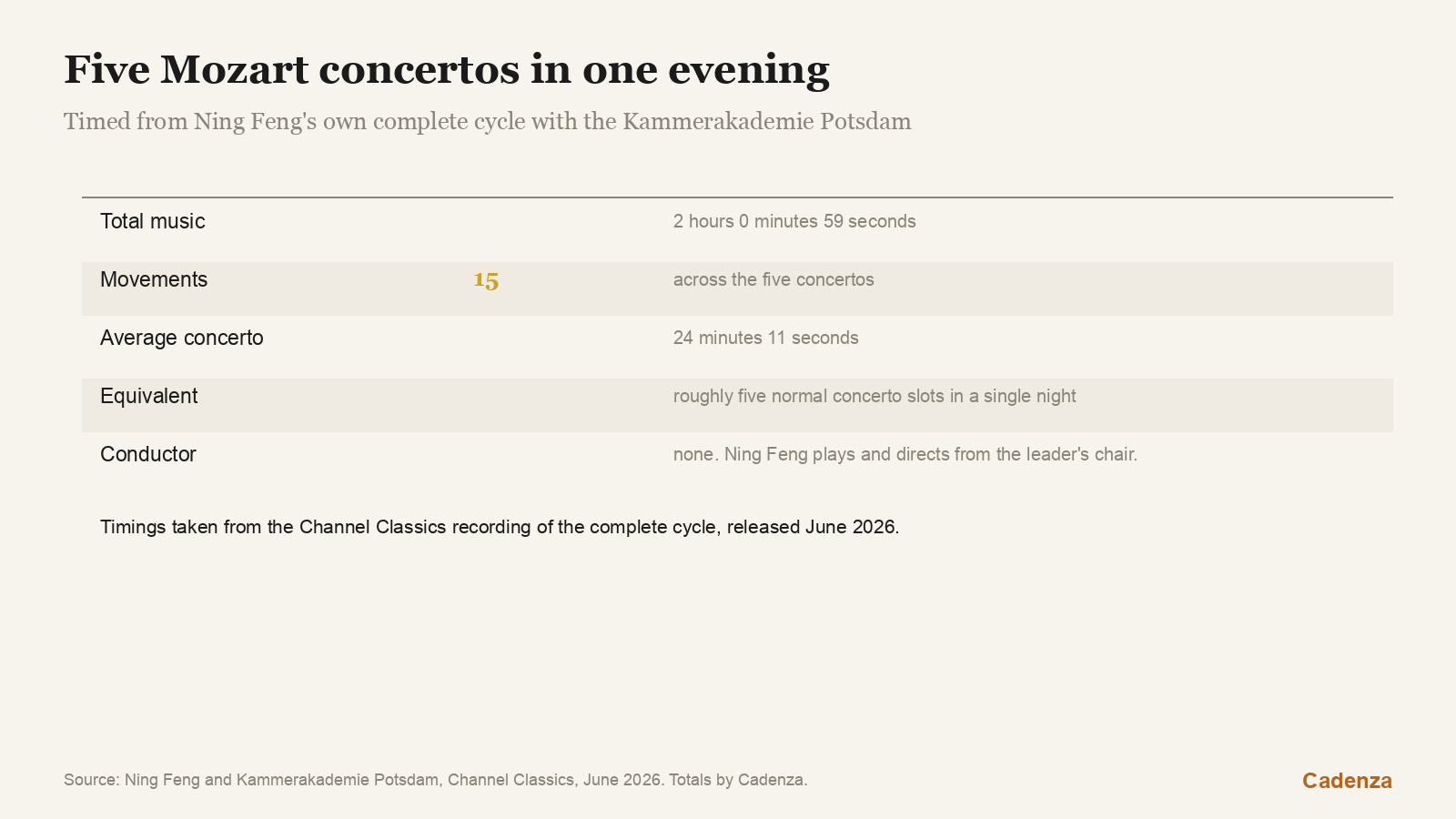
That is an unusual claim to be able to check, and in this case it can be, because Ning Feng and the Kammerakademie recorded the complete cycle for Channel Classics and released it in June 2026. Cadenza added up their own timings.
Two hours and fifty-nine seconds of music. Fifteen movements. An average concerto of 24 minutes 11 seconds. For a player, that is roughly five normal concerto slots in a single night, played from the leader's chair rather than in front of a conductor, which removes the one person whose job is to hold it together when the soloist is also directing.
Nothing else in the festival asks as much of one musician. It is also a neat piece of festival programming, because the five concertos were written by a composer in his late teens and early twenties, and hearing them consecutively is the clearest way to watch Mozart learn to write for the violin. A festival built on the 270th anniversary of his birth could hardly find a better single evening, and the anniversary arithmetic is exact: Mozart was born in 1756.
The access programme is bigger than the ticketed one
This is the finding Cadenza did not expect, and it took counting rather than reading.
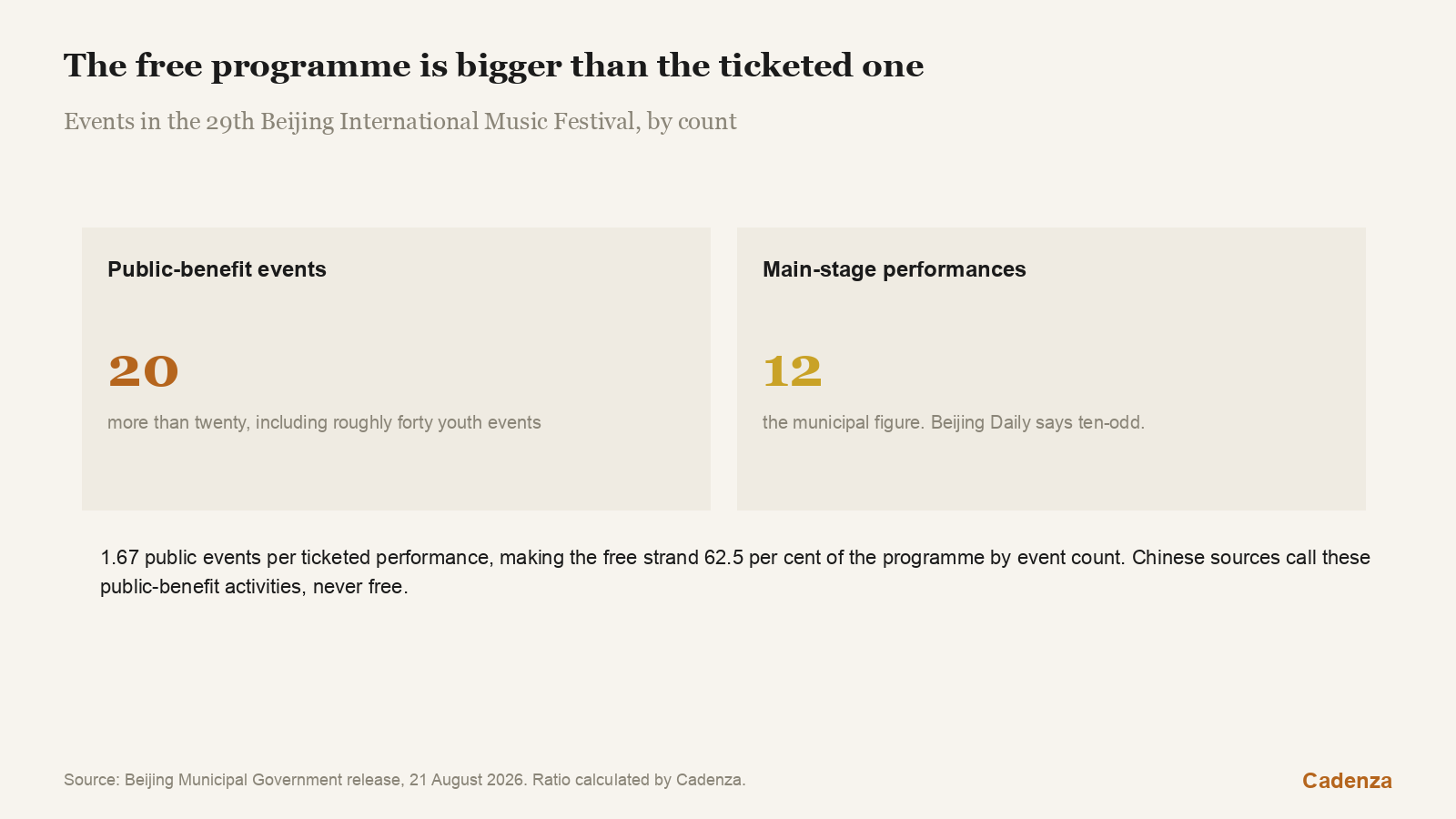
The festival lists more than twenty public-benefit events against twelve main-stage performances. That is 1.67 public events for every ticketed one, and it makes the free strand 62.5 per cent of the programme by event count.
What those events actually are is itemised: open rehearsals for the opera, parent-and-child backstage days, opera introductions, an online Mozart quiz and roughly forty youth events. There are pop-ups and themed markets in Chaoyang Park, at Taikoo Li Sanlitun and at The Box, plus an event billed as the London Philharmonic in Beijing. The festival has also put in place a unified aggregated ticketing platform with Maoyan, and student discount tickets.
Two corrections to how this has been described elsewhere. The pop-ups are in parks and retail districts, not on the street. And no Chinese source uses the word free. The term used throughout is 公益活动, public-benefit activities, which is a broader and more accurate description of a category that includes rehearsals and talks as well as performances.
One widely repeated detail Cadenza cannot stand up: lunchtime concerts in office towers. That appears only in the English press release of 8 September and in no Chinese source, including the official municipal one. It may happen. It is not documented, so it is not in this article as a fact.
The residency, and a Magic Flute that has been round the world
The London Philharmonic Orchestra is orchestra-in-residence across four performances, and the four reconcile cleanly: two nights of The Magic Flute plus two concert programmes under its principal conductor Edward Gardner, one of them on 12 October with the baritone Liao Changyong.
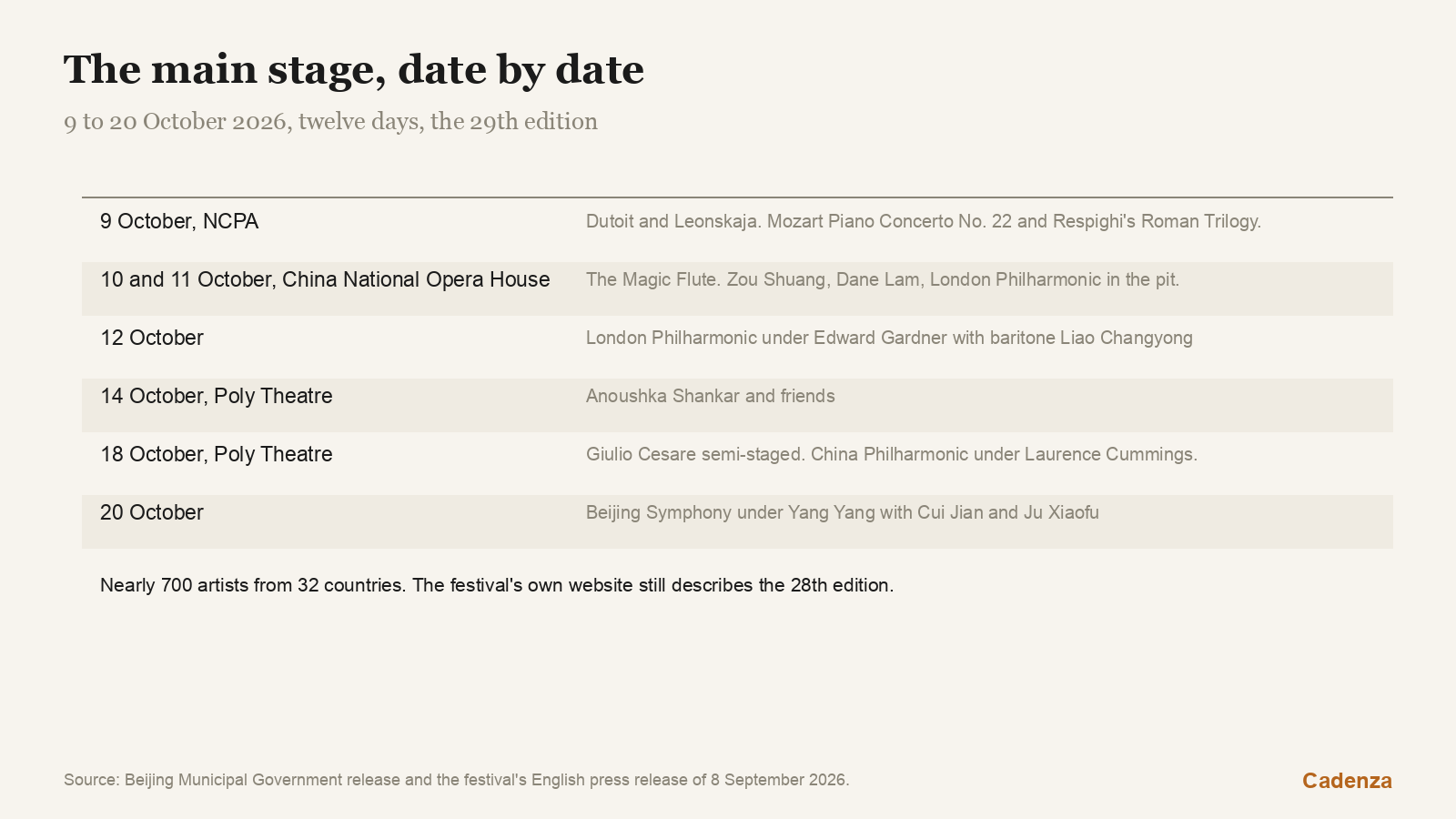
The Magic Flute plays on 10 and 11 October at the China National Opera House, directed by Zou Shuang and conducted by Dane Lam, with the London Philharmonic in the pit. It is co-produced by four named institutions.
It is not a new production, and that is the more interesting fact. Zou Shuang's staging opened at Opera Hong Kong from 15 to 18 May 2025 and then ran in Adelaide for State Opera South Australia from 28 August to 6 September 2025, which the company confirms on its own production page. Beijing is the third city on a route that has crossed two hemispheres, and a co-production that actually travels is rarer than one that is announced.
Handel's Giulio Cesare is semi-staged at the Poly Theatre on 18 October, with the China Philharmonic Orchestra under Laurence Cummings, produced by the KT Wong Foundation, renewing a partnership that followed their Handel Semele. The cast includes Aryeh Nussbaum Cohen and Nardus Williams. It is one performance, not a run, and Cadenza has not repeated the claim that it is a Chinese premiere, which it could not verify.
Anoushka Shankar plays the Poly Theatre on 14 October with friends. Closing night, 20 October, pairs the Beijing Symphony Orchestra under Yang Yang with the rock musician Cui Jian and the pianist Ju Xiaofu, under the heading classical rock.
The numbers that are published, and the two that do not close
The official Beijing municipal release gives four scale figures: 32 countries, nearly 700 artists, nine orchestras and twelve performances, plus more than twenty public events.
Two of those need care. Only seven orchestras are ever named across every available source, so the figure of nine is published but not verifiable from the roster. And Beijing Daily's own report of the same press conference says 十余场, ten-odd performances, rather than twelve. Cadenza is quoting the municipal figures and flagging both gaps rather than reconciling them silently.
The festival orchestra itself is assembled from the elite orchestras of the China Musicians Association's Symphony Orchestra Alliance, which the English release calls the League of China Orchestras. That body exists, and Long Yu chairs it as well as chairing the festival's artistic committee. A national pooling mechanism for players is a structural fact about how large Chinese festivals are staffed, and it is not mentioned in any English-language coverage.
Where the announcement actually happened
Cadenza set out to write that the scale figures existed only in Chinese. They did not, and the record is worth correcting because it runs the other way.
The programme was made public at a press conference in Beijing on 20 August, and the official municipal release carried all four scale figures in English on 21 August. The festival's own English press release is datelined 8 September, nineteen days later. So the English-language information was available from the Chinese government's own portal weeks before the festival's own English announcement.
The gap that does exist is elsewhere. The festival's own website, at bmf.org.cn and its English mirror, carries nothing at all about the 29th edition. The newest item on it concerns the 28th, last year's.
A year ago it was a listing
Every player in that pooled festival orchestra reached it through an audition in a member ensemble, and the roughly forty youth events are where the next intake starts. The Kammerakademie Potsdam's cycle with Ning Feng began as a recording project before it became a single evening.
Cadenza carries orchestral vacancies and competitions with open deadlines, free to musicians, on its jobs board and its competitions board.
If you go. Opening night is 9 October at the National Centre for the Performing Arts. The Magic Flute is on 10 and 11 October at the China National Opera House, Anoushka Shankar on 14 October and Giulio Cesare on 18 October at the Poly Theatre, and the festival closes on 20 October. Tickets run through the festival's new aggregated platform with Maoyan, and student discounts exist. The public-benefit events, which outnumber the ticketed ones, are the cheapest way in.
The question the festival will be asked next is the least glamorous one available. It is about to host nearly 700 musicians from 32 countries, and its own website still describes last year's edition. When will bmf.org.cn carry the 29th festival?
Sources: the Beijing Municipal Government portal's release of 21 August 2026, which is the strongest primary source and carries all four scale figures; China News Service and Beijing Daily's reports of the 20 August press conference; the festival's own English press release of 8 September 2026; OperaWire and Classical Music Daily; State Opera South Australia's own production page for the Adelaide run of the Zou Shuang Magic Flute; and Ning Feng and the Kammerakademie Potsdam's complete Mozart violin concerto cycle for Channel Classics, released June 2026, from which the timings are taken. Cadenza verified that bmf.org.cn and bmf.org.cn/en carry nothing on the 29th edition. The timings, the free-to-ticketed ratio and the age arithmetic are Cadenza's own.
Cover photograph: the concert hall of the National Centre for the Performing Arts, Beijing, 2019. N509FZ, CC BY-SA 4.0, via Wikimedia Commons. Charts by Cadenza.
Cover photograph: The concert hall of the National Centre for the Performing Arts in Beijing, where the 29th Beijing International Music Festival opens on 9 October 2026, photographed in 2019. N509FZ, CC BY-SA 4.0, via Wikimedia Commons.
Comments
Sign in to join the discussion.