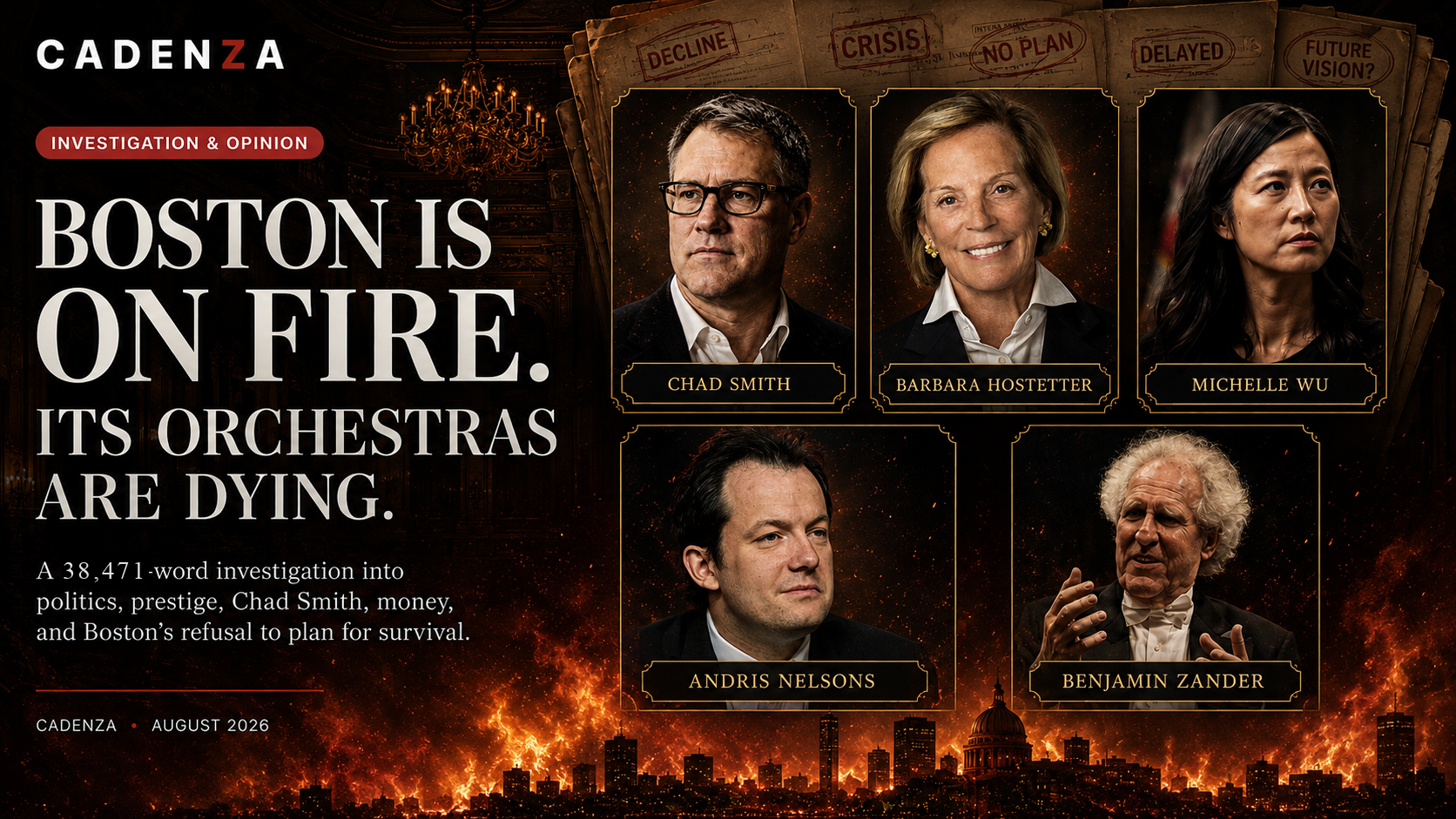
Editorial standard
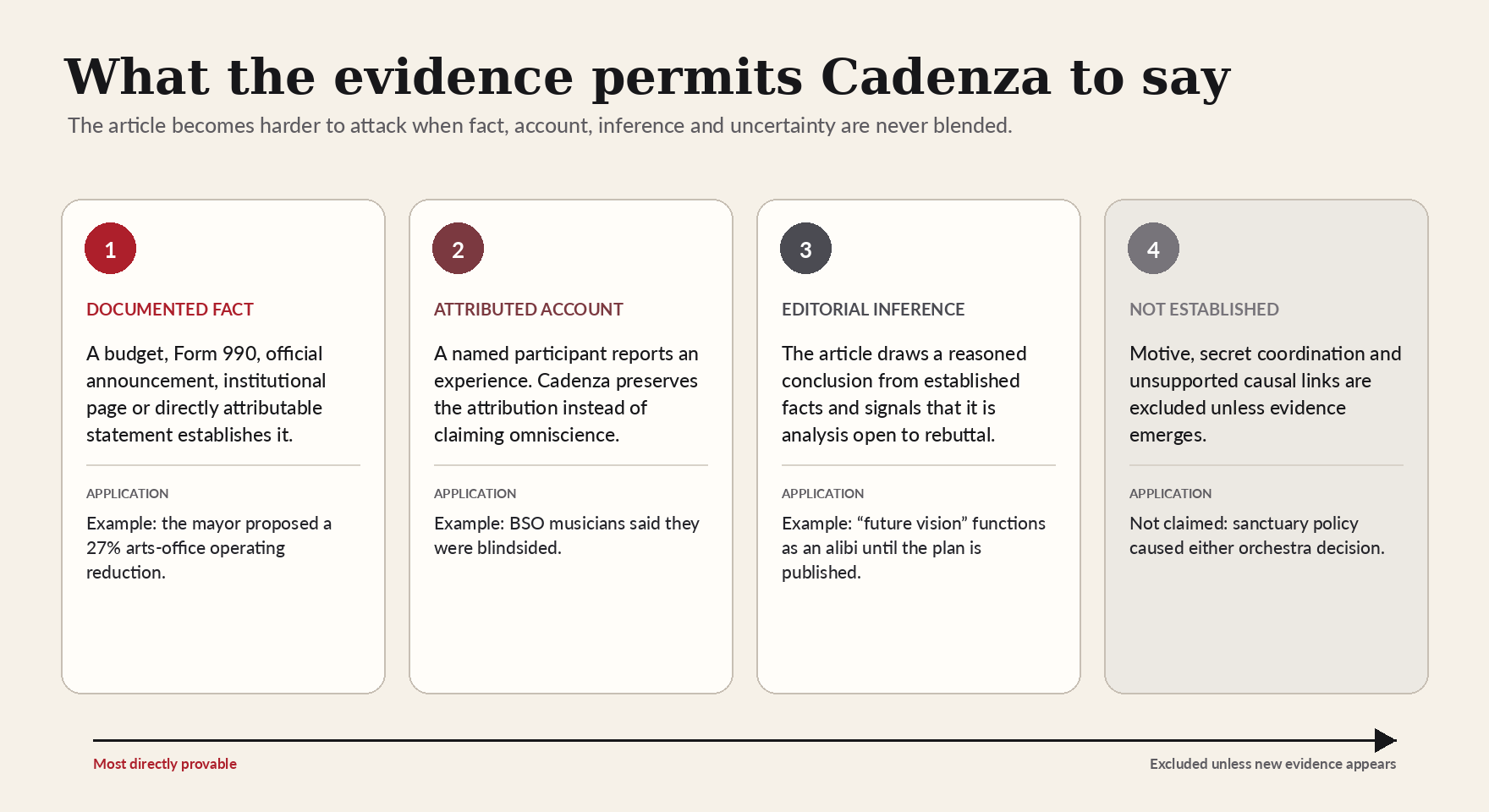
This is a reported opinion investigation about municipal priorities, nonprofit governance, artistic authority and institutional survival. It does not allege criminal conduct. It does not claim that Boston’s sanctuary policies caused an orchestra to close, that money for immigrants was transferred to orchestras, that diversity initiatives caused the Boston Symphony Orchestra to end Andris Nelsons’s tenure, or that every arts organization must continue forever. The public record does not establish those claims.
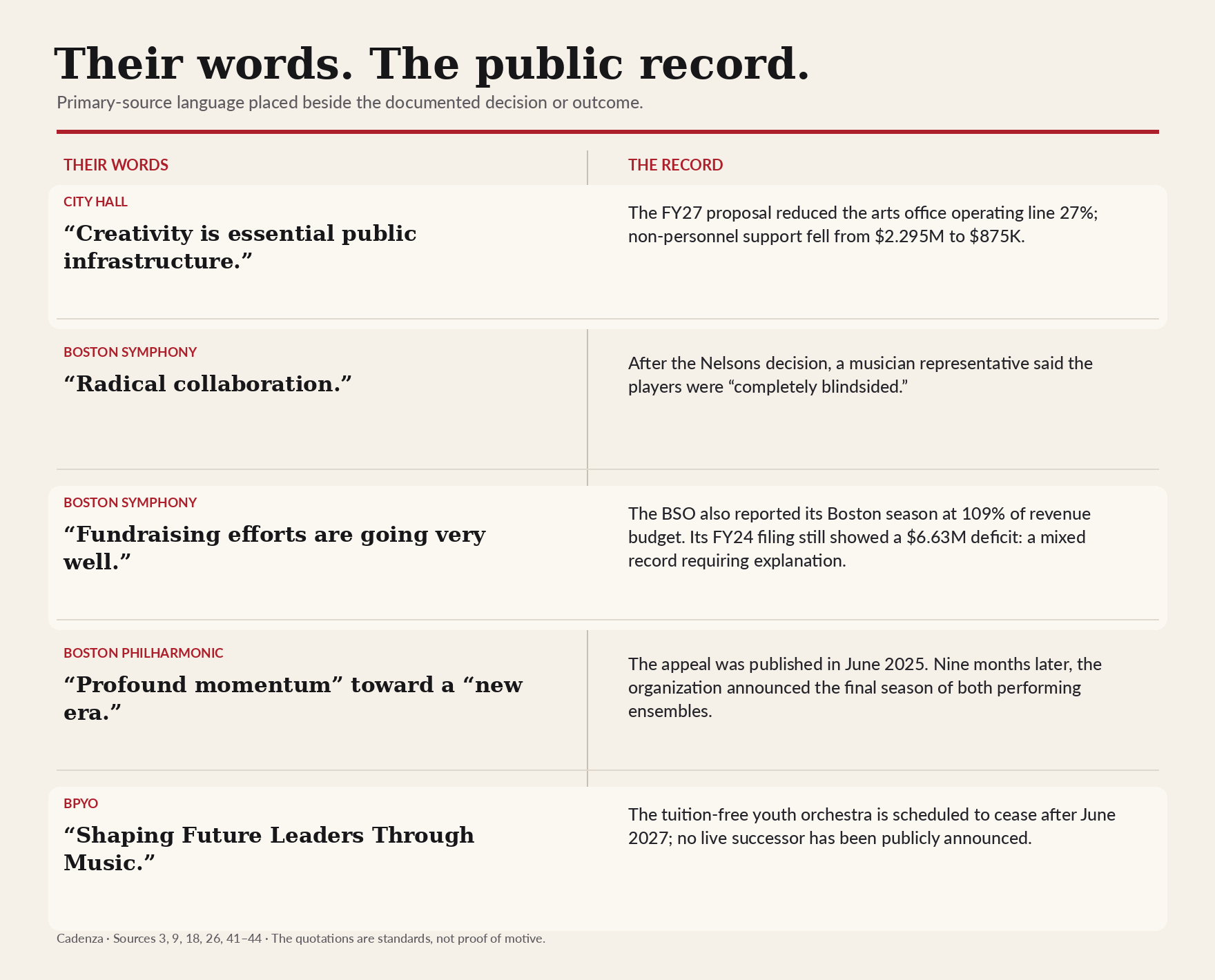
The article applies a narrower test: when leaders publicly invoke belonging, collaboration, sustainability, possibility and the future, do their budgets, governance processes and succession decisions give those words practical meaning? Short quotations are used not as proof of motive but as standards the institutions chose for themselves. The record is then placed beside those standards.
The political critique is values without stewardship: moral and symbolic language becoming a substitute for competence, continuity, power-sharing, audience trust and succession. The culture-war term woke appears only where that argument is directly examined. It is not a shortcut around evidence.
The headline’s fire is an editorial metaphor, not a literal allegation. The BSO is not described as insolvent or scheduled to close. It is described as an institution in a documented governance and trust crisis. The BPO and BPYO are scheduled to cease performing after 2026–27. “Its orchestras are dying” refers to those closures and to the contraction of Boston’s live orchestral capacity, not to a claim that every Boston orchestra is ending.
Boston’s institutions wrote their own indictment
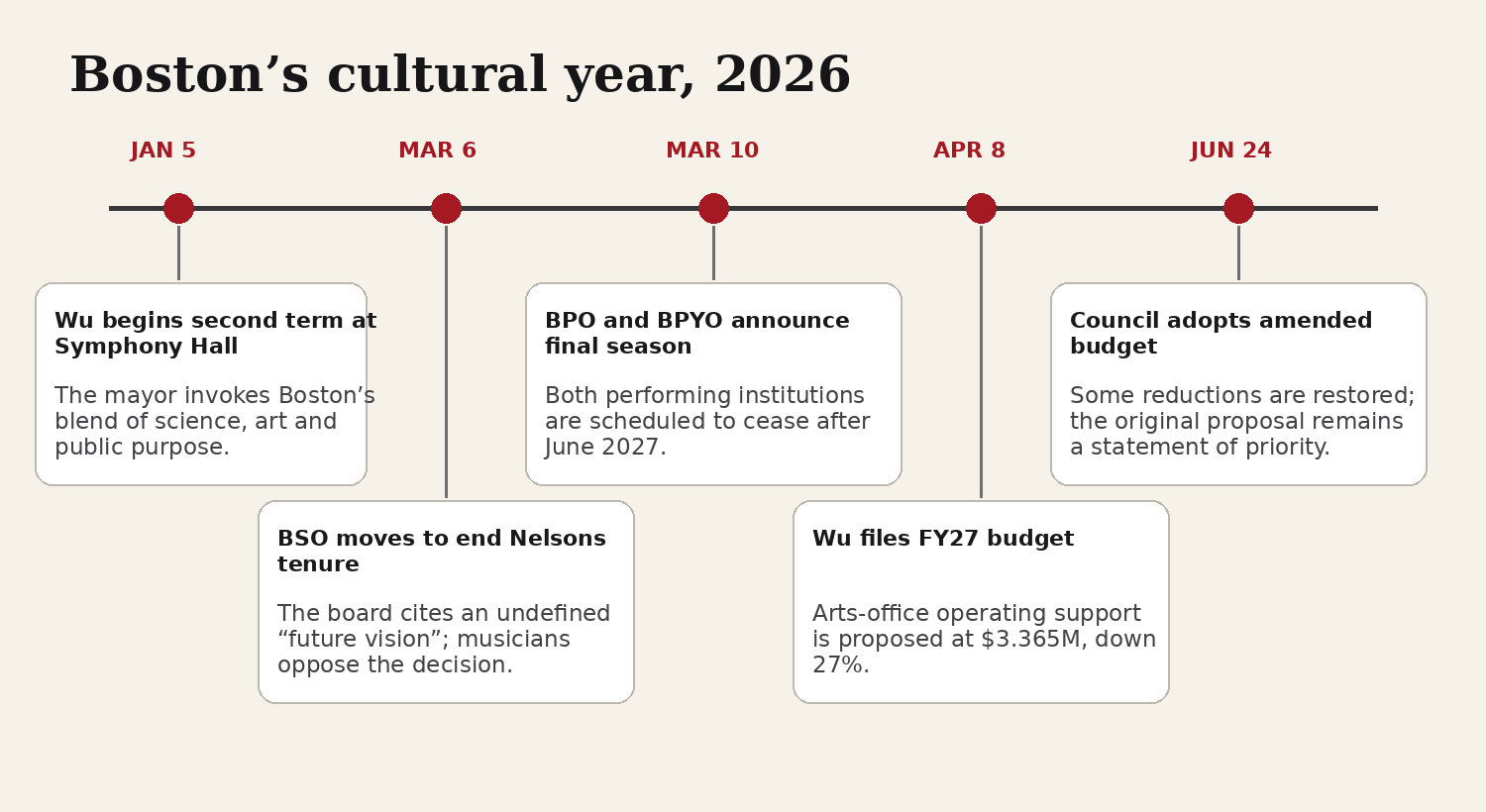
Boston began 2026 in Symphony Hall.
The City described inauguration week as a program intended to spark “belonging and civic pride.” On January 5, Michelle Wu stood beneath Symphony Hall’s gilded ceiling to begin her second term as mayor. The setting was not neutral. The hall supplied history, grandeur and civic legitimacy to an administration presenting Boston as a place where institutions make belonging real. 401
Then the language met the record.
On March 6, the Boston Symphony Orchestra announced that Andris Nelsons would leave after the 2026–27 season because the parties were not aligned on “future vision.” Nelsons said the decision was neither expected nor wanted and that he understood it was not based on his artistic standards, performances or achievements. The musicians later said they were completely blindsided. 1118
Four days later, the Boston Philharmonic announced a “Final celebratory season.” After the spring of 2027, both the adult orchestra and the tuition-free Boston Philharmonic Youth Orchestra would cease performing. The live ensembles would give way to the Zander Center, an institution organized around Benjamin Zander’s educational and digital legacy. 212227
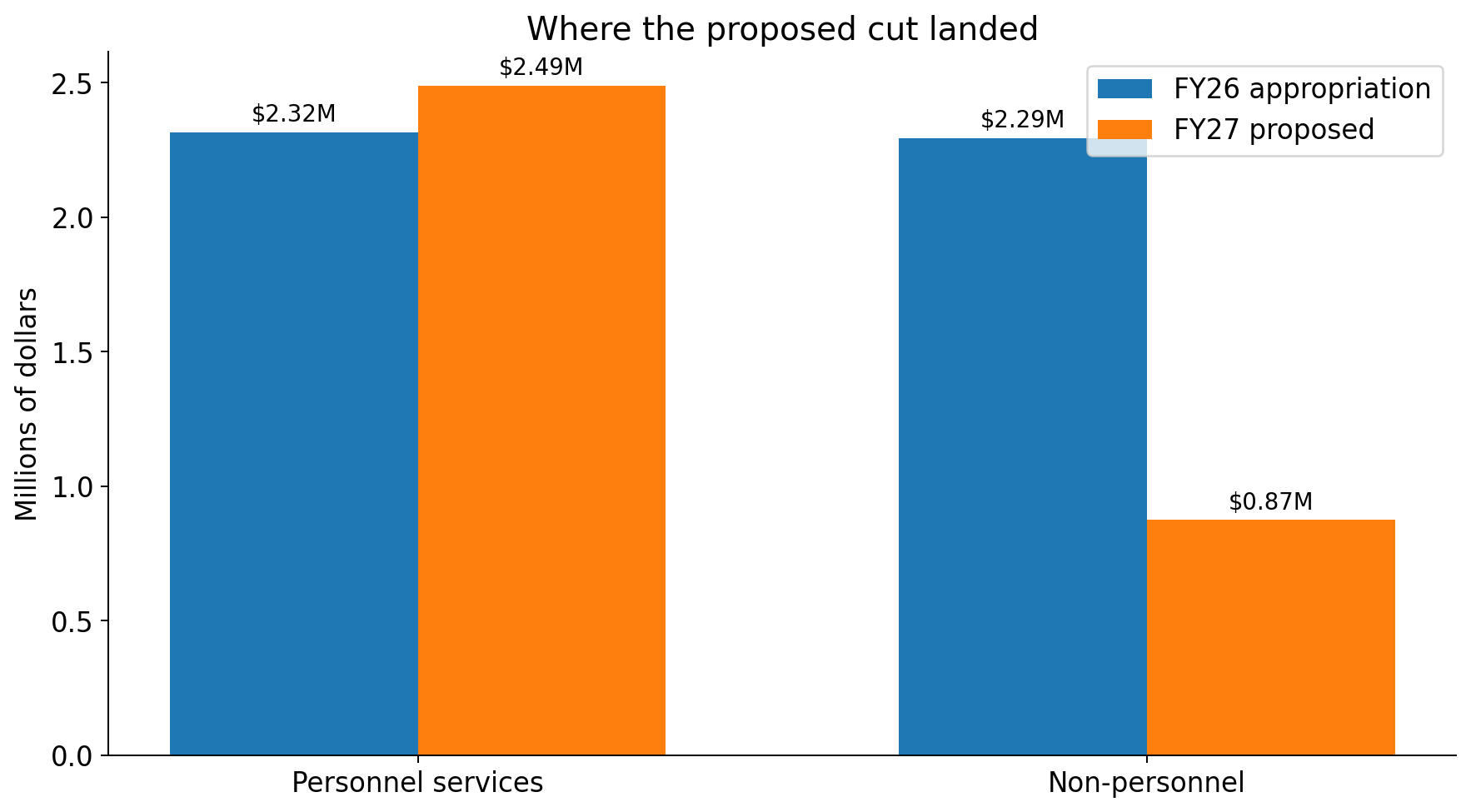
On April 8, Wu filed a $4.9 billion operating plan that proposed reducing the Mayor’s Office of Arts and Culture from $4,611,840 to $3,365,057: a cut of $1,246,783, or 27 percent. Personnel spending was proposed to rise, while non-personnel spending fell from roughly $2.295 million to about $875,000. Contracted services fell from just over $2.01 million to $691,000. The City Council later restored part of the reduction, and the final enacted budget should not be confused with the mayor’s initial submission. The proposal remains a primary record of executive priority. 346
In May, City Hall published another sentence: “Creativity is essential public infrastructure.” 9
These are Boston’s own words.
This investigation does not need to invent a secret meeting connecting City Hall, the BSO and the BPO. No evidence shows that Wu ordered Nelsons’s departure, that the BSO caused the Philharmonic to close, or that sanctuary policy extracted money from the arts budget. The institutions are legally separate, their finances differ and their decisions arose through different governing bodies.
The indictment is convergence.
The fire in the headline is the spread of institutional failure across connected systems: a major orchestra at war with its own musicians, two performing ensembles moving toward extinction, a city arts office initially offered up for a disproportionate cut, and a donor-and-governance class responding with strategy language faster than with public accountability. It is metaphor, but it is not empty metaphor. The heat comes from documented decisions.
Boston’s political and cultural establishment speaks with unusual confidence about belonging, collaboration, sustainability, transformation, possibility and the future. Its own public record shows an arts office offered up for a disproportionate cut, musicians excluded from a decision they considered fundamental, an acclaimed conductor removed for a vision never publicly defined, and a youth orchestra extinguished after its parent organization spent years teaching leadership and asking donors to invest in orchestral music’s future.
The method of this article is therefore simple: put the promise beside the decision. Let the institutions set the standard. Let their budgets, filings, announcements and mission language answer them.
“Belonging and civic pride.” 40
The record: Symphony Hall served as the stage for the mayor’s inauguration. Three months later, the administration proposed cutting the operating budget of the office charged with sustaining Boston’s cultural sector by 27 percent. 3
The question: Was culture a governing priority—or civic scenery?
“Creativity is essential public infrastructure.” 9
The record: The proposed budget increased arts-office personnel spending while reducing non-personnel capacity by roughly $1.42 million and contracted services by roughly $1.32 million. 3
The question: What kind of infrastructure is protected in language and reduced in the ledger?
“Radical collaboration.” 42
The record: The BSO publicly said collaboration was a strategic emphasis. After the Nelsons decision, musician Todd Seeber said the players were “completely blindsided.” 18
The question: Collaboration with whom, at what stage, and with what power?
“Fundraising efforts are going very well.” 42
The record: The same official update cited a $15 million maintenance grant; another reported the Boston Symphony season at 109 percent of revenue budget. The audited operating deficit remained serious. The public record is mixed, not simple. 4217
The question: Where is the document reconciling momentum, assets, deficits and the decision to rupture artistic leadership?
“Our greatest impact lies ahead.” 41
The record: The BSO later ended the rolling relationship it had announced in 2024, while Nelsons said artistic standards and achievements were not the reason. 1136
The question: What measurable future required this decision, and why has the institution not published it?
“Profound momentum” toward a “new era of arts and culture.” 43
The record: That language appeared in June 2025. In March 2026, the organization announced that both performing ensembles would end after one final season. 22
The question: What changed in nine months, and when did the board know it?
“Shaping Future Leaders Through Music.” 44
The record: The youth orchestra teaches leadership, but no live successor institution was identified in the public materials reviewed for students who would have auditioned after 2027. 2522
The question: Did the definition of leadership include building something capable of outliving its founder?
An “investment in the future of orchestral music.” 43
The record: The current cohort receives a final tour. On the public record reviewed, there is no next BPYO cohort after the final season unless a successor intervenes. 25
The question: Whose future was the investment designed to preserve?
“Make Boston a municipal arts leader.” 49
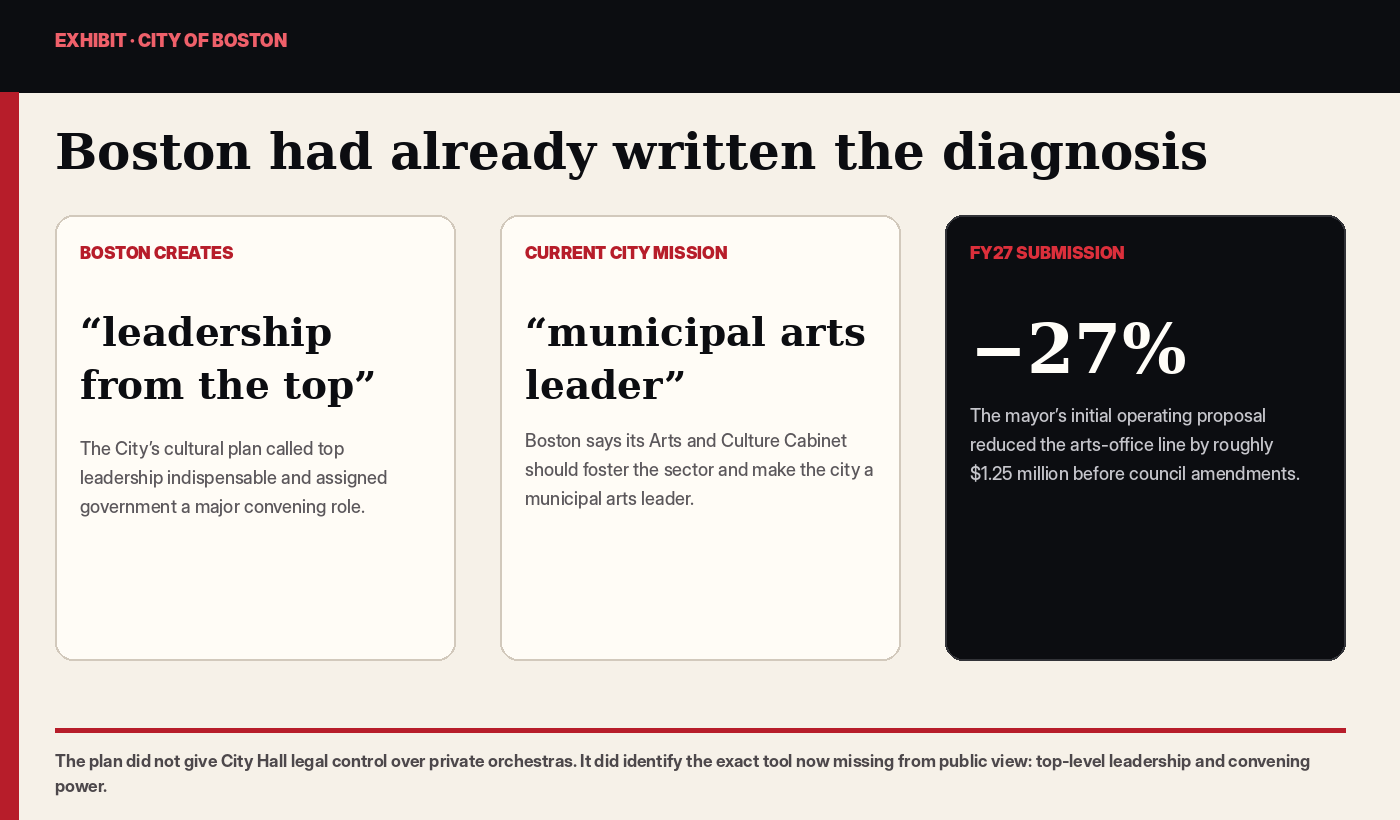
The record: The mayor’s initial FY27 submission proposed a 27 percent reduction in the arts office’s operating line before council amendments changed the outcome. 350
The question: What is the measurable continuity policy behind the claim of leadership?
“Leadership from the top” would be “indispensable.” 48
The record: Boston’s own cultural plan assigned government a major convening role. Cadenza found no announced citywide continuity process responding to the BPO and BPYO closures in the public materials reviewed through August 11. 48
The question: If convening power is the tool, why has it not been visibly used?
“Deep confidence in his artistic leadership.” 45
The record: In January 2024, the BSO extended Nelsons on an evergreen agreement “into the foreseeable future.” About twenty-five months later, it cited an undefined lack of alignment on future vision. 4511
The question: What changed, on what date, against which written criteria?
“Empower creative artists to do their very best work.” 46
The record: Chad Smith made that promise when appointed CEO and specifically anticipated partnership with Nelsons and the players. Musicians later said they were blindsided by the decision ending Nelsons’s tenure. 4618
The question: Did empowerment include information, influence or consent at the decisive moment?
“Nurture emerging musicians.” 47
The record: An April 2026 fundraiser continued to describe that mission while the final season and institutional conversion were already the public future. The current cohort benefits; the next cohort has no announced live home. 4753
The question: What exactly did contributions support: final-season delivery, wind-down, the Zander Center or live continuity?
The BPO is “Ben’s musical playground.” 52
The record: The founder-centered digital institution survives while both live ensembles are scheduled to end. The phrase is the Center’s, not Cadenza’s. 5227
The question: Was the institution designed to outlive the founder—or to preserve the founder after the institution?
“Audition for … FINAL SEASON!” 53
The record: The audition system is still capable of finding and assembling a new cohort. It is being used once more, with no announced successor process for the cohort that would follow. 53
The question: Why is a renewable educational system being treated as biologically inseparable from one conductor?
His BSO profile calls the indefinite Nelsons extension a major first-year investment in the orchestra’s artistic future. 54
The record: The same chief executive later defended the decision to end that future while the public rationale remained “future vision.” 5560
The question: What documented change converted Smith’s signature investment into a result he later defended as necessary?
Thirty-two voting trustees present in person or remotely reportedly voted unanimously. 58
The record: Musicians said they were not consulted before the decision. The later successor-search structure reserved five of eleven committee seats for players. 1856
The question: Why was player expertise essential after the rupture but not before it?
“Business as usual will no longer suffice.” 56
The record: The donor memo finally supplied detail about attendance, endowment restrictions, facilities and programming—but also blamed internal personnel and community members for fundraising damage after leadership’s own decision. 5657
The question: Was the memo a strategic plan, a fundraising appeal, a defense brief—or all three?
Hostetter said her decisions were approached with “humility” and appreciation for the people who make the BSO. 58
The record: She chaired the board, helped select Smith, presided over the unanimous vote and continued to support him while musicians described profound exclusion and distrust. 4658
The question: What does humility require after the people on stage say the process denied their expertise and voice?
The quotations do not independently prove hypocrisy, bad faith or motive. They do something more disciplined: they establish standards voluntarily adopted by the institutions. The rest of the article tests performance against those standards.
Everyone in Boston has an explanation. City Hall says orchestras are private nonprofits. Boards say markets changed. Executives cite declining attendance. Donors cannot underwrite every deficit. Conservatories educate musicians rather than operate civic institutions. A founder-led ensemble may be artistically inseparable from its founder. Each defense contains some truth.
At the end of all those truths, musicians lose continuity, young players lose an orchestra and the public receives language instead of an accountable transfer plan.
That is the case against cultural Boston.
What this investigation finds
The public record supports ten central findings.
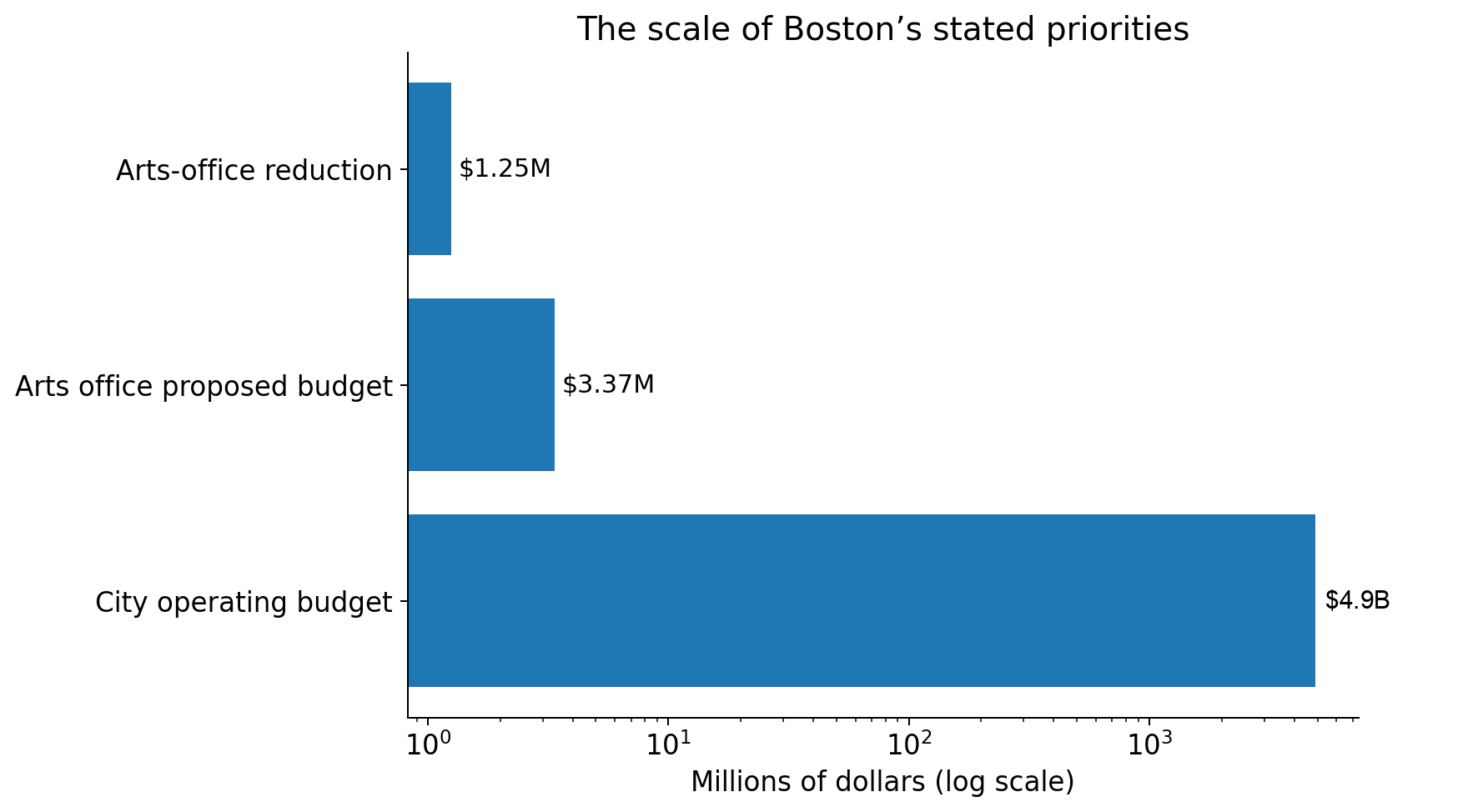
First: the municipal arts budget was microscopic before the proposed cut. Wu’s $3.365 million proposal represented about 0.069 percent of a $4.9 billion operating plan. The proposed $1.247 million reduction represented roughly 0.025 percent of the city budget. This does not prove every grant was effective. It does establish that Boston’s structural fiscal problem was not created by the arts office. 34
Second: the proposed reduction concentrated pain in outward-facing capacity. Personnel services rose from about $2.317 million to $2.490 million while non-personnel spending fell from about $2.295 million to $875,000. Contracted services fell from a little over $2.01 million to $691,000. An office can retain its chief, titles and mission while losing much of what reaches artists and organizations. Bureaucracy survives; reach contracts. 3
Third: the City Council’s repair matters but does not erase the proposal. The final budget process restored part of the reduction, and the article states that clearly. The mayor’s April submission remains evidence of what the executive branch initially placed below other claims when balancing the plan. A proposed budget is not destiny. It is still a priority document. 6
Fourth: immigration policy did not cause the orchestral crisis. Wu’s proposal also reduced the Office for Immigrant Advancement, defeating the crude claim that arts money was simply handed to sanctuary programs. The valid comparison is institutional urgency. On immigration, City Hall issued orders, coordinated agencies, litigated and communicated nationally. No comparable municipal convening or rescue process appeared when the BPO and BPYO announced closure. 578
Fifth: the BSO’s own communications make its explanation problem worse. Before the rupture, the BSO described fundraising positively, cited a $15 million maintenance grant, reported its Boston Symphony season above revenue budget, emphasized cross-institutional collaboration, and forecast greater future impact. None of those statements eliminates long-term financial risk. Together, they require management to reconcile the optimistic public record with a later claim that a dramatic artistic break served the institution’s future. 4142
Sixth: the Nelsons decision remains publicly underexplained. The board placed Nelsons on an evergreen arrangement in 2024 and decided in 2026 that the relationship should end. The stated rationale is not a published strategy, financial model, artistic criterion or governance finding. Nelsons’s statement that the decision was not based on artistic standards makes the absence of a specific rationale more consequential. 1136
Seventh: the musicians did not experience the process as meaningful collaboration. Their support for Nelsons does not grant them an automatic veto. It does establish a legitimacy problem. When an institution advertises collaboration but its core artists report being blindsided by its most consequential artistic decision, the burden shifts to the board to explain what consultation actually occurred and what power it carried. 1842
Eighth: the BSO has both a serious operating problem and extraordinary capacity. Its fiscal-year 2024 filing showed about $117.1 million in revenue, $123.7 million in expenses and $618.4 million in net assets. Net assets are not the same thing as unrestricted operating cash, and the summary filing does not establish what could be spent immediately. The numbers nonetheless distinguish the BSO from an organization with no meaningful capacity or options. A two-word rationale is too small an explanation for an institution of this scale. 17
Ninth: the Boston Philharmonic’s ending was planned, not shown by the latest public filing to be an immediate insolvency event. Its fiscal-year 2025 filing showed approximately $3.48 million in revenue, $3.27 million in expenses and a positive result of roughly $214,000, following losses in the two prior years. Contributions supplied more than 86 percent of revenue, revealing real founder-and-donor vulnerability. The record supports fragility. It does not, by itself, establish that eliminating both ensembles was the only available path. 26
Tenth: the BPYO is a separable public-interest asset even if the adult orchestra is not. The adult BPO may be unusually bound to Zander’s interpretive identity. The youth orchestra exists to renew itself. It is tuition-free, serves musicians aged roughly twelve to twenty-one, teaches leadership and has built systems for auditions, rehearsals, tours and donor support. Those functions could in principle be transferred, renamed, merged or independently governed. The public materials reviewed do not document a competitive transfer or rescue process. 232544
The broad conclusion is not that Boston hates art. The evidence shows something more plausible and more damaging: responsibility is fragmented until preventable losses can be described as nobody’s decision.
City Hall lacks direct control. Boards possess legal control but diffuse moral ownership. Executives can cite trustees. Trustees can cite markets. Donors can cite sustainability. Founders can cite artistic identity. Universities can cite mission limits. By the time each actor has explained what it cannot do, the institution is gone.
That is not a conspiracy.
It is a system designed to produce endings without authors.
The primary-source docket
The strongest accusations in this article do not begin with Cadenza’s adjectives. They begin with documents Boston’s institutions wrote for donors, residents, volunteers, musicians and families.
City Hall used the hall as proof of belonging
Document: the City’s official inauguration program.
What it established: Symphony Hall was not merely rented space. The administration deliberately placed a message of civic belonging inside one of Boston’s most powerful cultural symbols. 40
What it tests: whether the city treats culture as governing infrastructure after the ceremony ends.
The arts office’s mission met its own ledger
Document: the mayor’s FY27 Arts & Culture budget.
What it established: the proposed operating line fell by $1,246,783; non-personnel support fell by $1,419,974; contracted services fell by $1,320,120. 3
What it tests: the practical meaning of calling creativity public infrastructure.
The BSO reported both momentum and risk
Documents: its annual report, volunteer committee updates and Form 990.
What they established: the BSO reported strong Boston-season revenue against budget, positive fundraising indicators and a major maintenance grant while its tax filing recorded a significant annual deficit. 174142
What it tests: whether management can reconcile the mixed record with an undefined artistic rupture.
Collaboration was a published standard
Document: the BSO’s own volunteer-facing strategic update.
What it established: collaboration and constituency inclusion were presented as institutional priorities before musicians said they were blindsided by the Nelsons decision. 1842
What it tests: whether stakeholders possessed influence or only visibility.
The Philharmonic asked donors to fund a future
Document: a June 2025 appeal signed by the BPO’s chairman and president.
What it established: supporters were told the ensembles were flourishing, the organization was growing and donations would sustain future access and orchestral music. 43
What it tests: when closure entered formal planning and what donors were told at the time.
The youth orchestra’s purpose was renewal
Documents: the BPYO audition FAQ and sponsorship materials.
What they established: a tuition-free program with auditions, rehearsals, concerts, tours and explicit leadership training for musicians aged roughly twelve to twenty-one. 2544
What it tests: why a renewable educational mission must end with the retirement of one conductor.
The BSO promised a foreseeable future
Document: the BSO’s January 25, 2024 contract-extension release.
What it established: an evergreen agreement, the CEO’s stated deep confidence in Nelsons’s artistic leadership and an expectation that he would keep the institution healthy and vibrant for years. 45
What it tests: the chronology, criteria and consultation behind the reversal approximately twenty-five months later.
The CEO appointment promised artistic empowerment
Document: the BSO’s May 2023 announcement appointing Chad Smith.
What it established: Smith described partnership with artistic directors as a chance to empower artists and specifically anticipated building with Nelsons and the players. 46
What it tests: whether artists were empowered at the moment that mattered most.
Boston had already named the necessary civic tool
Document: the City’s Boston Creates cultural plan.
What it established: top-level leadership could be indispensable; City government possessed legal authority and convening power; Boston’s cultural sector suffered from fragmentation and limited municipal support. 48
What it tests: whether the City used its own diagnosis when live institutions faced discontinuity.
The City still claims municipal arts leadership
Document: the City’s current government mission page.
What it established: the Arts and Culture Cabinet exists to foster the cultural community, promote participation and make Boston a municipal arts leader. 49
What it tests: the difference between operating a cabinet and leading an ecosystem through crisis.
The Philharmonic kept asking patrons to nurture musicians
Document: the April 11, 2026 forty-seventh-season fundraiser page.
What it established: a $500 event, a special announcement from Zander and a statement that participation supported artistic excellence, emerging musicians and transformative experiences. 47
What it tests: the intended use, restrictions and disclosure attached to late-stage fundraising.
The successor institution describes the orchestra personally
Document: the Benjamin Zander Center’s public website.
What it established: the BPO is presented as Zander’s musical playground, while the BPYO is presented as evidence of what young people can accomplish. 52
What it tests: whether preservation of a personal teaching legacy displaced preservation of a renewable live mission.
The audition page records the final cutoff
Document: the BPYO’s 2026–27 audition page.
What it established: a functioning audition process explicitly recruiting for the final season. 53
What it tests: whether the system could be transferred before the next cohort disappears.
Smith’s official biography makes the reversal personal
Document: the BSO’s current Chad Smith profile.
What it established: the institution itself presents the indefinite Nelsons extension as a major first-year investment by Smith in the artistic future. 54
What it tests: whether Smith can identify the evidence and chronology that caused him to defend the opposite outcome.
The board’s private memo finally described the plan
Document: the April 21 “State of the Boston Symphony Orchestra” memo, as reported in detail by the Boston Globe.
What it established: leadership’s attendance, endowment, facilities, fundraising and programming case; the desired profile of the next music director; and its accusation that internal critics were damaging fundraising. 56
What it tests: why this detail was sent to advisers after the rupture rather than used to create consent before it.
The vote was unanimous; the institution was not
Record: Boston Magazine’s reconstruction of the board vote and notification process.
What it established: thirty-two voting trustees reportedly voted unanimously; the Players Committee was called in urgently and the announcement followed almost immediately. 58
What it tests: whether unanimity inside the boardroom reflected analysis—or insulation from the institution outside it.
Public defense replaced public explanation
Records: Smith’s March, June and July interviews.
What they established: he defended the deliberateness and necessity of the decision, emphasized broader and more inclusive service, and described the BSO as requiring a turnaround. 555860
What it tests: whether a diagnosis of institutional pressure proves that removing Nelsons was the best or only remedy.
The docket does not establish bad faith. Public optimism can coexist with private danger; strategic planning can change; a board may learn facts not previously known. But the documents create questions that cannot be answered by replacing one slogan with another.
The BSO must reconcile its collaboration language with the players’ account of exclusion. The BPO must reconcile a donor appeal about growth and future access with a closure plan announced months later. City Hall must reconcile the language of infrastructure with the proposed contraction of outward-facing arts capacity.
Their own work does not decide the verdict. It determines the burden of explanation.
The argument we are making—and the one we are not
The central argument is precise:
Boston’s political and cultural leaders have allowed values-language to outrun stewardship. Their own public materials celebrate belonging, collaboration, sustainability, possibility and the future; their documented decisions weaken the institutions through which those values must endure.
That is an editorial judgment built on separately stated facts. It is not a claim that every leader acted from the same motive.
How claims are classified
The article makes five distinctions that cannot be blurred without weakening it.
Priority is not causation. Wu’s forceful defense of sanctuary policy is relevant as evidence that her administration knows how to mobilize around a perceived civic threat. It is not evidence that immigration policy caused the BPO to close or the BSO to remove Nelsons.
A proposal is not an enacted result. The 27 percent reduction appeared in the mayor’s April budget submission. The council later changed the outcome. Both facts belong in the story. The proposal reveals executive preference; the amendments reveal legislative resistance.
Assets are not unrestricted cash. The BSO’s net assets do not make annual deficits imaginary. They establish capacity, not infinite liquidity. The article therefore asks for a quantified plan rather than declaring that wealth makes management easy.
Public praise is not proof of private health. A line saying fundraising is going well does not rule out structural danger. It does prevent leaders from presenting the past as uniformly catastrophic without reconciling their own optimistic reports.
A founder’s artistic centrality is not the same as a youth program’s legal inseparability. Zander may be impossible to replace artistically. The BPYO’s mission, systems and future students can still be offered for transfer.
This article does not argue against immigrants, contemporary composers, fellowships, free family access or attempts to broaden audiences. Those programs can be valuable. Nelsons himself publicly supported the BSO Resident Fellowship for early-career musicians from historically underrepresented backgrounds. 20
The criticism begins when an institution cites access while the pathway contracts; collaboration while participants lack power; sustainability while live capacity disappears; transformation while no successor receives the work; or infrastructure while operating reach is cut.
The article also leaves room to be disproved.
A published BPO succession file showing that qualified successor conductors, merger partners and funders were seriously pursued and failed would weaken the charge of founder-centered neglect.
A BSO strategic plan connecting the Nelsons decision to clear artistic, financial and audience milestones—and documenting meaningful musician participation—would weaken the charge of opacity.
Evidence that Wu convened a serious, time-bound cultural-continuity process after the closures would weaken the charge of civic passivity.
That is what makes the argument testable rather than merely partisan.
Part I — Culture as civic scenery
The inauguration inside the monument
A political inauguration is theater. The building, music, sequence of speakers and visual symbols tell the public what the administration wants to be understood before policy details begin.
Wu’s second inauguration at Symphony Hall was therefore a revealing civic production. The hall embodied inherited excellence, acoustic precision, continuity and Boston’s claim to seriousness. It placed the mayor inside an institution built through the long accumulation of money, labor, taste, discipline and public trust. The event allowed contemporary politics to wrap itself in cultural permanence. 12
Wu praised the BSO and its participation in Boston Family Days. She spoke about a city where people belong and where public institutions open doors. The argument was attractive. Culture should not function as a private club for people who already know its rituals. A child should be able to enter Symphony Hall without parents who subscribe, donate or understand the difference between a concerto and a symphony. No serious cultural conservative should oppose the creation of future audiences.
But access has two dimensions. The first is whether a person can enter. The second is whether there will still be something to enter.
The progressive cultural imagination has become far more fluent in the first than the second. It measures tickets distributed, demographic reach, partnerships formed and barriers removed. Those measures can be valuable. They can also become a substitute for the harder indicators: earned revenue, repeat attendance, artistic loyalty, donor renewal, labor trust, leadership succession and the survival of ensembles through changes in personalities.
Boston Family Days can introduce a family to the BSO. It cannot decide who leads the BSO, repair a ruptured relationship between management and musicians, or replace the Boston Philharmonic Youth Orchestra after it closes. Free access is an invitation to a system whose institutional foundations must be secured elsewhere.
There was a second irony in the venue. Symphony Hall was not merely the backdrop to Wu’s inauguration; it was already at the center of unresolved questions about Boston’s cultural future. The BSO had enjoyed major artistic success under Nelsons, including Grammy recognition and international visibility. It also faced attendance pressure, deficits and questions about local connection. Those realities required honest governance. Instead, the public would soon receive an unexplained rupture.
The mayor did not control that decision. Yet the sequencing was almost allegorical: Boston’s political establishment celebrated itself inside the monument, then the monument’s governing establishment destabilized its artistic leadership.
The phrase “culture as scenery” describes this habit. Leaders love culture when it furnishes a room, legitimizes a speech, beautifies a redevelopment, generates tourist photographs or proves that a city is sophisticated. They become less enthusiastic when culture demands recurring operating money, difficult governance, confrontation with donors, deference to artistic expertise or the admission that a strategic experiment has failed.
Buildings are especially useful because buildings cannot object. Symphony Hall can be praised, photographed and protected as a landmark. Musicians can ask questions. Conductors can dispute a board. Youth orchestras require annual fundraising, transportation, coaching, insurance and administrative attention. Living culture is inconvenient. Heritage is compliant.
That distinction will recur throughout this investigation. Boston is not literally abandoning every cultural building. It is in danger of preserving the containers while allowing the living relationships inside them to weaken.
The city’s political class can point to the hall. The BSO board can point to the endowment. The BPO can point to the Zander archive. Donors can point to named spaces and programs. Everyone can produce an artifact proving commitment.
The question is whether the orchestra plays next year, whether the musicians trust their leaders, whether a successor has been prepared and whether a child entering through a free-access program encounters a growing institution or a managed decline.
A culture is not a room.
It is a chain of obligations across time.
A government fluent in values
Michelle Wu did not invent progressive Boston. She is its clearest contemporary expression.
Her political appeal combines municipal competence—housing, transit, schools, climate adaptation and neighborhood services—with a moral argument about belonging and protection. City communications repeatedly describe Boston as a home for everyone. Inauguration week was designed around community voice, inclusion and civic pride. This is not incidental language; it is part of the administration’s theory of legitimacy. 407
The sanctuary-city conflict made that theory visible in action. In February 2026, Wu issued an executive order responding to federal immigration enforcement. The order restricted use of city property for specified civil enforcement activity, directed documentation of alleged misconduct and instructed the city’s legal apparatus to challenge actions the administration considered unlawful. When the federal government sued, Boston defended its position and a judge later dismissed the challenge for lack of standing. 78
Whatever one thinks of the policy, the administrative lesson is clear: when the mayor believes a defining civic value is threatened, City Hall knows how to act as though the threat matters. It can issue orders, assemble lawyers, coordinate departments, publish guidance, join coalitions and sustain national confrontation.
The orchestral crisis produced no comparable display.
A mayor cannot and should not command a private orchestra to retain a conductor. Nor can an executive order force a donor to finance a successor. Government nevertheless has tools beyond coercion: convening, mediation, matching funds, public visibility, university coordination, research, access to space, emergency grants and the ability to make preventable cultural loss politically costly.
Where was the emergency meeting after the BPO and BPYO announced that both ensembles would close?
Where was the citywide succession initiative for a tuition-free youth orchestra?
Where was the coalition of conservatories, universities, foundations, alumni, donors and youth-music organizations?
Where was the public demand that the BSO reconcile its own language of collaboration with musicians’ description of being blindsided?
Absence of those actions does not prove hostility toward music. It establishes a hierarchy of urgency.
Some issues arrive with national networks, legal categories, practiced slogans and obvious reputational rewards. Cultural continuity is harder. It requires leaders to defend institutions that may appear elite, audiences that may be older, traditions that resist easy metrics and operating costs that cannot be solved through symbolism.
That difficulty is exactly why leadership exists.
The sanctuary comparison concerns mobilization, not a shared bank account. Wu’s initial budget also proposed a significant reduction for the Office for Immigrant Advancement, which defeats the lazy story that she simply moved money from music to immigrants. 5
It also reveals a broader problem. Progressive identity did not automatically protect even offices associated with the administration’s stated values when funding tightened. Language can remain expansive while delivery contracts.
A politics of care should be judged by whether cared-for systems function. A politics of inclusion should be judged by who holds power. A politics of sustainability should be judged by what survives transition. A politics that calls creativity infrastructure should be judged by durable investment.
Boston’s public record does not yet pass those tests.

The critique: values without stewardship
The relevant institutional pattern can be described without a culture-war slogan.
It has six features.
Moral overstatement. Ordinary choices are presented as tests of decency rather than tradeoffs among competing goods. A programming framework becomes proof of belonging. A grant demonstrates whose stories count. Once a policy is moralized, dissent can be treated as hostility toward the constituency invoked by the policy rather than a disagreement over design.
Symbolic substitution. Leaders create statements, committees, trainings, celebrations, branded access programs and strategic vocabulary that communicate virtue but do not repair the institution’s core weakness. The activities may be worthwhile. Substitution occurs when they stand in for succession, audience rebuilding, financial discipline, artistic strategy or power-sharing.
Selective accountability. Ideological or reputational errors receive immediate attention; long managerial failures are normalized as complexity. A disputed phrase can trigger a review. Forty-eight years without a durable succession structure can become a moving final season.
Stakeholder theater. Institutions invoke community and collaboration while decisive power remains concentrated in a small board or executive group. Participants are invited to speak, appear and be surveyed but not to control criteria, information or votes.
Euphemistic decline. Closures become transitions. Cuts become focus. A firing becomes a vague vision dispute. The disappearance of live capacity becomes a legacy center. The words may be technically defensible while protecting leaders from the moral weight of the result.
Temporal extraction. Present leaders borrow prestige from institutions built by earlier generations while leaving fewer opportunities to later ones. A mayor uses Symphony Hall as civic scenery. A founder preserves his archive while the next cohort loses the orchestra. A board spends artistic trust accumulated over years without publishing what it buys in return.
Critics often call this pattern woke. The term is imprecise and can attract people eager to blame immigrants, minority musicians or contemporary composers for decisions they did not make. The article therefore does not depend on the word.
The more exact accusation is values without stewardship.
An orchestra can diversify repertoire and balance its books.
A city can protect immigrants and protect cultural infrastructure.
A board can expand access and share artistic power.
A founder can preserve a legacy and transfer a live mission.
The problem is not too much justice. It is using the vocabulary of justice as evidence that the institution is being competently governed.
There is a conservative version of the same vice. It substitutes patriotism, heritage, donor prestige and nostalgia for adaptation, fair treatment and succession. A board may invoke tradition while underpaying artists. A founder may praise excellence while building no successor. The labels differ; the evasion is the same.
Boston’s leaders have invited moral judgment by making moral language central to their public case. That invitation operates in both directions.
If inclusion is the standard, explain why musicians lacked meaningful power.
If sustainability is the standard, explain the extinction of two ensembles.
If leadership is the standard, publish the succession work.
If infrastructure is the standard, defend the budget.
The city cannot request applause for its values and immunity for its results.
Boston had already written the diagnosis
Boston did not enter 2026 without a theory of cultural stewardship. The City had already written one.
The Boston Creates cultural plan—developed under an earlier mayoral administration and therefore not a personal pledge by Michelle Wu—identified precisely the structural weakness now exposed. It said some cultural tasks would require leadership from the top. It assigned City government a major role because of its legal authority and convening power. It described Boston as a city with limited foundation, corporate and municipal support for the arts relative to peers and warned about fragmentation across the cultural sector. 48
That older document matters because municipal government is not supposed to lose institutional memory every time the office changes hands. A city plan is useful only if later administrations either implement it, replace it with a better plan or explain why its diagnosis no longer applies.
The diagnosis still appears in Boston’s current public identity. The City says the Arts and Culture Cabinet should foster the cultural community, promote participation and “make Boston a municipal arts leader.” 49
The FY27 budget release used another revealing hierarchy. It said the proposal protected core city services and invested in Boston’s future. Wu said City government is where Boston finds a way to do what matters most. The same release acknowledged that tighter conditions would significantly reduce or remove discretionary grants after years of expanded cultural programming. 51
That is a legitimate fiscal argument. Health insurance, schools, public safety, snow removal, debt and contractual obligations are not invented pressures. The adopted FY27 budget confirms a citywide environment of targeted reductions, with department appropriations falling after adjustment for extraordinary health-care growth. 50
But the language creates a classification question City Hall has not answered.
Is cultural continuity a core service, a future investment or a discretionary amenity?
Boston’s public statements place it in all three categories when symbolism or aspiration is useful. Its initial budget treatment placed much of the outward-facing capacity in the discretionary category when money tightened.
The city cannot be blamed for every private nonprofit’s governance. It can be judged on whether it used the instrument its own plan called indispensable: top-level convening.
Cadenza’s review through August 11 found no announced municipal process with a timetable, named participants and defined outcomes to examine whether the BPYO could be transferred, whether the BPO’s live assets could be preserved, or how the city should respond to the BSO’s destabilizing leadership transition. That is a date-bounded public-record finding, not a claim that no private call, meeting or inquiry occurred. City Hall has been asked to provide any contrary record.
The distinction is important. A mayoral photograph with an orchestra is not leadership. A grant program is not by itself ecosystem planning. A statement that creativity is infrastructure is not a continuity mechanism.
Leadership would mean knowing which institutions are at risk before the public farewell. It would mean convening parties who cannot convene themselves, attaching deadlines to rescue discussions, identifying legal and financial barriers, and stating openly when no viable rescue exists.
Boston had already described that work.
What is missing is evidence that Boston did it.
Part II — The budget records the priority
The arithmetic rhetoric cannot erase
Budget documents are among the least poetic objects government produces. That is their virtue.
Speeches arrange values in the order that flatters a leader. Budgets arrange obligations in the order that money permits. They do not reveal every motive, and they can be altered by legislatures, outside revenue and events. But they show what an administration was prepared to fund when forced to convert language into numbers.
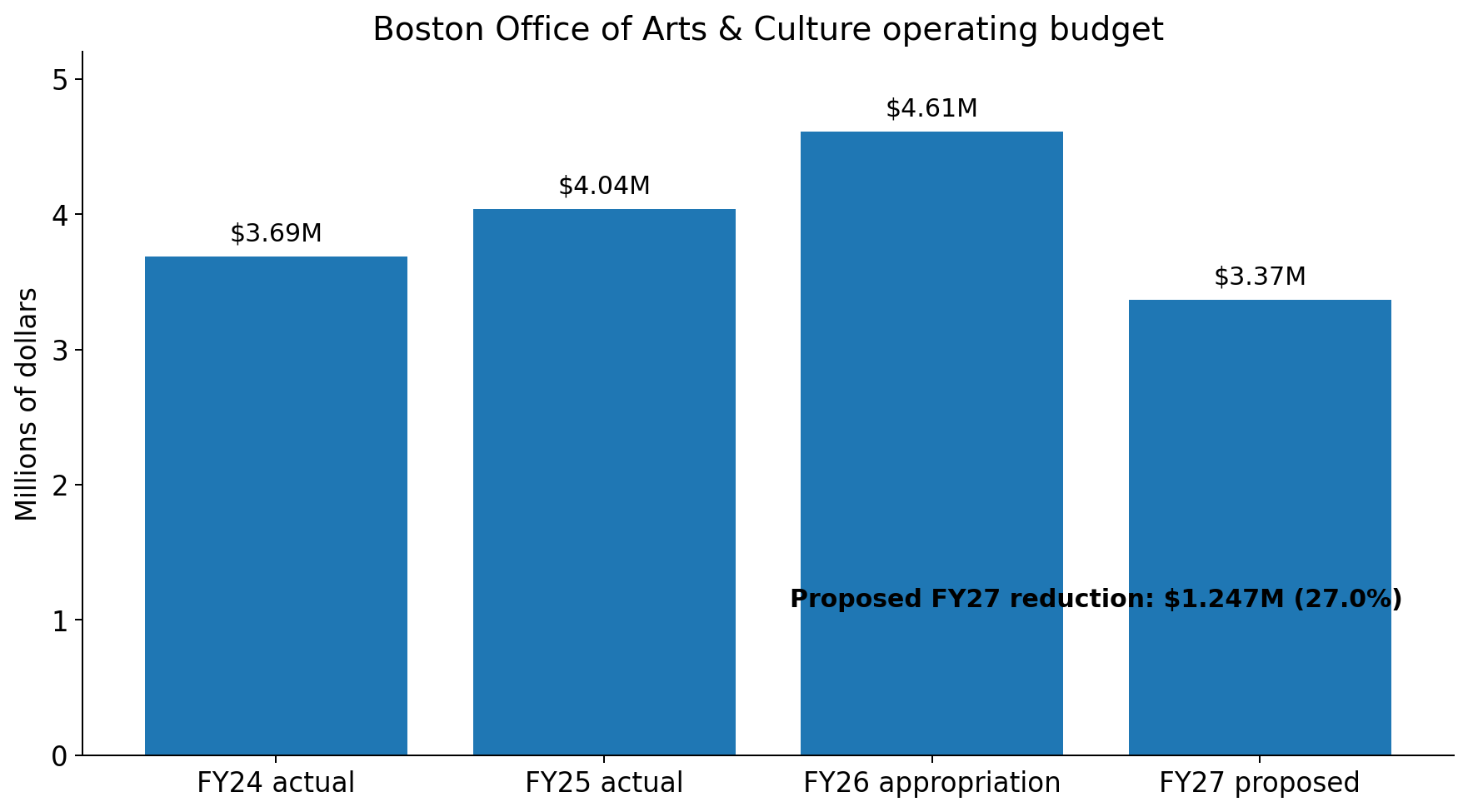
Wu’s fiscal-year 2027 proposal placed the Mayor’s Office of Arts and Culture at $3,365,057 in operating support. The prior year’s appropriation was $4,611,840. The proposed decline was $1,246,783, or 27 percent. The city’s full operating budget was approximately $4.9 billion. 34
The proportions are almost absurd.
The proposed arts office represented about seven-hundredths of one percent of the city budget. The reduction represented roughly two-and-a-half hundredths of one percent. Boston could eliminate the entire proposed arts office and still have more than 99.93 percent of its operating budget remaining. No serious analyst can argue that this office created Boston’s overall fiscal challenge.
That does not automatically make every arts dollar sacred. A small program can be wasteful. A grant can lack measurable impact. A department can duplicate another agency’s work. Governments should assess results, not protect every line because its name sounds virtuous.
But scale changes the burden of proof.
When an administration proposes a 27 percent reduction to a function that already consumes less than one-tenth of one percent of spending, the question is not simply whether the city needs savings. It is why such a small target was asked to absorb such a large proportional hit. The answer offered publicly was that Boston faced a difficult fiscal environment, including a deficit associated with snow removal and rising public-safety and health costs. That explains pressure. It does not explain selection. 5
Cuts are political partly because they are distributive and partly because they are rhetorical. A government protects what it believes would be costly to injure. Large constituencies can threaten officeholders. Legally mandated services cannot easily be touched. Union contracts, debt service and public safety obligations constrain choices. Small cultural organizations have less leverage. They may protest, write letters and testify, but they rarely close streets, determine bond ratings or decide elections.
Arts funding therefore becomes a tempting source of symbolic savings. The dollar amount is too small to repair the city’s structural problem, but the administration can show that every department is sharing pain. The pain, however, is not shared equally. A 27 percent reduction can be existential to a grant program while disappearing as a rounding error in the general budget.
That is austerity as performance.
City Hall demonstrates discipline by cutting a function whose weakness makes the cut politically manageable. The budget may look tougher. The fiscal structure barely changes. The cost appears later in lost projects, canceled performances, fewer commissions, reduced neighborhood programming and exhausted organizations forced to replace public support with private fundraising.
Those secondary costs are rarely booked against the department that caused them. They disperse across the city. A musician leaves. A small presenter closes. A rehearsal is canceled. A youth program charges more. An independent artist takes unrelated work. A neighborhood loses an event. Each outcome looks private. Together they are public policy.
The city’s own document makes another distinction impossible to ignore: the cut was not evenly distributed inside the arts office.
The office survives; its reach contracts
The FY2027 arts document divides spending into personnel and non-personnel services.
Personnel services were proposed to rise from $2,316,892 to $2,490,083, an increase of approximately $173,000. Non-personnel spending fell from $2,294,948 to $874,974, a reduction of about $1.42 million. Contracted services fell from $2,011,120 to $691,000. External funds also declined, from roughly $4.836 million to $3.696 million. 3
The political meaning is not that staff should have been fired instead. Cultural workers in government perform necessary labor, and retaining expertise can be rational. The meaning is that an office can remain institutionally visible while losing much of its outward capacity.
The mayor can still have an arts office.
The website can still exist.
A chief can still be appointed.
Press releases can still describe creativity as infrastructure.
What contracts is the money available to make that language tangible outside City Hall.
This is a common pattern in bureaucratic decline. The shell remains because eliminating a department creates bad optics. The connective tissue—grants, contracts, partnerships, commissioned work and flexible program support—is reduced because it is easier to classify as discretionary. Eventually the office spends more of its energy administering scarcity and explaining its importance.
GBH reported that the proposal threatened the elimination of community grants, a smaller staff footprint and a pause in the city’s Artists in Residence program. Arts advocates reacted not because they believed Boston could fund every request, but because the size of the reduction contradicted the administration’s own language about the creative economy. 5
The city had reason to understand the stakes. Boston’s cultural sector is not a decorative appendage to an otherwise productive economy. It supports employment, tourism, education, hospitality, neighborhood identity and the city’s appeal to students and skilled workers. Even the administration’s own arts leadership has described creativity as essential public infrastructure. 9
“Infrastructure” is an important word. Roads are not expected to justify themselves solely through ticket revenue. Parks are not dismissed as elitist because some neighborhoods use them more than others. Libraries are not told that books must balance their own accounts. Public safety is not funded only when it produces a profitable event.
Calling culture infrastructure implies that its benefits exceed the direct transaction between a performer and a ticket buyer. It implies that continuity matters, that capacity cannot be rebuilt instantly after collapse and that public investment can preserve goods that markets alone undersupply.
If the administration genuinely believes that, then the budget proposal was incoherent.
If it does not believe it, then the language was branding.
There is no third option in which culture is essential infrastructure on Monday and a convenient 27 percent cut on Wednesday without explanation.
The city council’s repair does not erase the proposal
The final budget process matters because a fair article must distinguish an opening proposal from enacted law.
Boston’s City Council amended the mayor’s plan. The council’s changes totaled about $11.8 million in a $4.9 billion budget—approximately two-tenths of one percent. Wu accepted nearly all of the changes, rejecting about $1.4 million. Reporting on the final plan indicated that some of the proposed reductions were restored. 6
This complicates the story in two useful ways.
First, institutions can respond to pressure. Arts advocates, councilors and residents did not merely complain; they altered the outcome. That is democratic government functioning as designed. A publication that ignored the restoration would be writing propaganda rather than analysis.
Second, the council’s intervention confirms that the original proposal was contestable. The cuts were not imposed by an external receiver, bond covenant or court order. They were choices inside a political process. Other elected officials could choose differently.
Wu’s acceptance of most amendments deserves credit. It also does not convert her initial filing into someone else’s idea.
Executive budgets reveal priority because they are the administration’s first comprehensive statement of what should be funded. Negotiation changes that statement, but it does not erase it. A mayor cannot claim the prestige of proposing a new initiative and disown the meaning of proposing a cut.
The distinction is especially important because defenders often use final amendments to neutralize all criticism: nothing to see, the money was restored, the process worked. That response mistakes the article’s argument.
The argument is not merely that a particular grant line ended at a particular number. It is that the mayor’s administration, during a year of visible cultural destabilization, initially regarded a 27 percent arts-office reduction as an acceptable component of fiscal adjustment.
That judgment belongs in the public record.
A city’s cultural policy cannot depend on a yearly rescue operation by advocates and councilors. Organizations need predictable support to plan seasons, hire people, contract artists and build partnerships. Volatility itself creates costs. A threatened grant may cause an institution to delay commitments, reduce ambition or spend scarce staff time on emergency lobbying. Even when money is restored, uncertainty has already entered the system.
The best response from Wu would not be indignation at the criticism. It would be a durable funding rule: establish a minimum recurring level for municipal arts support, index it sensibly, publish clear performance measures and stop treating cultural capacity as an expendable adjustment account.
The city’s budget is large enough to make that commitment without pretending it solves every problem in Boston.
What the budget does not prove
The ugliest version of the culture-war argument would say this: Michelle Wu spent Boston’s money on illegal immigrants, cut the arts, and therefore caused orchestras to collapse.
That sentence is politically satisfying to some readers and unsupported by the record.
The municipal arts proposal did not fund the BSO’s operating budget. The BSO and BPO are private nonprofit organizations with their own boards, revenue, donors and financial structures. The BPO announced a planned transition tied to Zander’s retirement and legacy. The BSO’s Nelsons decision emerged from its board and management. City grants may affect the ecosystem around them, but the $1.247 million proposed reduction cannot honestly be described as the direct cause of either institutional event.
Nor does the budget show a simple transfer from arts to immigration. GBH’s analysis noted that the same proposal reduced the Office for Immigrant Advancement by about 43 percent and cut other offices associated with equity and inclusion. 5
Those facts should be stated prominently, not buried as a technical caveat.
Why, then, discuss sanctuary politics at all?
Because governance is more than ledger transfer. It is the allocation of attention, authority, risk and public voice.
Wu has demonstrated that she understands how to elevate an issue into a defining civic conflict. On immigration enforcement, she used executive power, legal strategy and political communication. The administration framed the matter in constitutional and moral terms, coordinated agencies and made clear that Boston would not treat the issue as routine. 78
Cultural collapse need not produce the same legal tools, but it should produce comparable seriousness. The mayor could have convened the institutions. She could have asked the city’s philanthropic leaders to fund a BPYO transition. She could have publicly urged the BSO board to explain its governance. She could have created a cultural-continuity working group with a six-month deadline. She could have used the symbolic power of the same office that occupied Symphony Hall in January.
The comparison therefore concerns salience.
Some threats are immediately recognized as threats to Boston’s identity. Others are privatized as the unfortunate business of nonprofit boards.
The city insists that it is a sanctuary because the treatment of vulnerable residents implicates its values. That is a legitimate argument. The city should also recognize that cultural institutions create a sanctuary of another kind: places where memory, discipline, beauty, aspiration and collective attention are protected from the short horizon of markets and politics.
No, an orchestra is not a human being, and the moral claims are not identical. But a city that presents itself as a defender of community should understand that communities are partly made from institutions that outlive individual careers.
The immigration comparison becomes dishonest only when it is used to blame immigrants. It becomes useful when it exposes selective intensity among leaders.
The people least responsible for Boston’s orchestral failures are the immigrants whom both sides of the culture war invoke. Progressives use them to demonstrate virtue. Reactionaries use them to explain unrelated decline. In both cases, actual decision-makers disappear.
This investigation puts them back in view:
Michelle Wu filed the budget.
The BSO board decided to end Nelsons’s tenure.
Chad Smith leads the BSO’s administration.
Barbara Hostetter chairs its board.
Benjamin Zander and the BPO board designed the transition that ends two performing ensembles.
Donors determine what they will fund.
Conservatories determine what responsibilities they will accept.
Those are the people and institutions with agency. Criticism should rise toward power, not fall onto residents who had no vote in a boardroom.
The best case for Michelle Wu
A strong prosecution states the defense.
Wu can argue that Boston’s cultural policy is broader than one budget line and that her administration has expanded access in meaningful ways. Boston Family Days provides Boston public-school students, Boston Pre-K participants and their families free admission to participating institutions on designated Sundays. The program includes prominent museums and cultural organizations and extends through 2026. Its funders include private philanthropists, among them Barbara and Amos Hostetter. 10
The administration can also point to earlier growth in arts-office activity, the appointment of arts leadership, neighborhood programming and efforts to connect residents with institutions many had regarded as inaccessible. Wu’s defenders can say that federal pandemic support expired, citywide expenses rose and the mayor was forced to submit a constrained plan affecting many offices, not merely culture. 59
They can add that the BSO is not a municipal agency. With more than $600 million in net assets, it would be strange to demand that City Hall rescue it while Boston confronts housing pressure, school needs, public health, transportation and poverty. The BPO likewise made its own succession decision. Government should not become the permanent underwriter of every organization whose founder retires.
All of that is reasonable.
It is also insufficient.
Family Days is an access program, not a continuity policy. It helps people use institutions; it does not secure the institutions’ governance. It may even increase the contradiction. Boston is inviting families into a cultural system whose leaders are removing a successful conductor, ending a youth orchestra and shrinking public support.
Private wealth at the BSO does not absolve City Hall of convening responsibility. A mayor need not write the orchestra a blank check to insist that an institution central to Boston’s identity explain a destabilizing decision. Public officials routinely use moral suasion with universities, hospitals, developers and employers they do not legally control.
The existence of larger social needs does not justify every small cut. Because the arts office is so tiny relative to the overall budget, preserving it would not require choosing music over housing or immigrants over violins. That binary is itself a political construction. A $4.9 billion city can protect a $4.6 million office and still address urgent human needs.
Most importantly, the defense does not answer the question of leadership.
A mayor is not merely a bookkeeper. She is a convener of civic power. Boston’s wealth is fragmented across private institutions, foundations, universities and individuals. No single orchestra can command that network. City Hall can.
Wu’s administration likes the language of public infrastructure. Infrastructure policy requires coordination across owners, users, funders and time. A bridge may be state-owned, federally funded and privately engineered; the city still cares whether it collapses. Cultural infrastructure likewise crosses legal boundaries.
The mayor did not create Boston’s orchestral crisis. She has not responded at the level the crisis deserves.
That is the charge.
Infrastructure in language, discretion in the ledger
In May 2026, Wu’s administration announced Joseph Henry as Boston’s chief of arts and culture. The official release described creativity as “essential public infrastructure.” 9
The phrase was almost perfect.
It recognized that culture is not a luxury added after a city has solved everything else. Cities never solve everything else. Housing, schools, health, safety and inequality remain unfinished in every generation. If culture must wait until no urgent social problem exists, it will wait forever.
Culture is infrastructure because it makes repeated collective life possible. It forms places where strangers share attention. It connects institutions to neighborhoods and generations to memory. It trains discipline that cannot be automated. It gives children an identity beyond consumption and adults a language for experiences politics cannot contain. It attracts visitors, workers, students and investment, but its value is not exhausted by economic impact.
Infrastructure also has a temporal property: it must be maintained before failure is visible.
A bridge can look stable while corrosion advances. An orchestra can continue presenting polished concerts while subscriptions erode, governance trust collapses and no successor is prepared. By the time the public sees closure, the decisive neglect may be years old.
This is where Boston’s public language becomes indicting. Once leaders call creativity infrastructure, they accept the duty to monitor continuity, not merely celebrate events. They must ask which institutions are systemically important, where succession is weak, what youth pathways are at risk, how audience data is changing, which venues are unaffordable and what modest intervention can prevent irreversible loss.
Boston appears to lack a public map of its cultural dependencies.
The BPO and BPYO announced extinction as though they were isolated brands. But the youth orchestra connected families, teachers, schools, conservatories, touring partners and future professional musicians. Its disappearance affects a network. The BSO’s leadership conflict affects freelancers, donors, students, critics, audiences and Boston’s global reputation. Municipal grants affect small organizations that feed the same ecosystem.
An infrastructure mindset would examine those connections before failure.
A campaign-décor mindset arrives for the photograph.
Wu’s inauguration at Symphony Hall was not wrong. It became meaningful in retrospect because the administration borrowed the symbolism of continuity without accepting visible responsibility for continuity. The hall was useful as a stage. The crisis inside Boston’s musical life was treated as someone else’s portfolio.
The strongest response from City Hall would be to prove this interpretation wrong through action. Convene the institutions. Publish a cultural-continuity report. Establish a rescue mechanism for youth ensembles. Secure recurring grant support. Ask hard questions of boards. Use municipal visibility to attract matching philanthropy. Set deadlines.
Until that happens, “essential public infrastructure” is a phrase Boston has not funded with the seriousness it implies.
Part III — The Boston Symphony case file: vision, power and a broken chain of trust
A decision with a slogan where the reason should be
The Boston Symphony Orchestra did not dismiss an obscure employee in a routine reorganization. It decided that one of the most internationally visible conductors of his generation would not continue as music director after the 2026–27 season.
Andris Nelsons had led the BSO since 2014. The relationship produced major recordings, international touring, critical attention and Grammy Awards. In 2024 the orchestra announced a rolling contract intended to continue unless either side chose to end it. Less than two years later, the board chose an exit. The BSO’s own 2026–27 season materials still present Nelsons as music director through that final cycle. 11121336
The official explanation was a lack of alignment over “future vision.”
Those two words have performed extraordinary labor.
They imply strategic depth without disclosing strategy. They suggest irreconcilable difference without identifying the difference. They sound forward-looking, which allows anyone asking for evidence to be portrayed as attached to the past. Most usefully, they distribute responsibility. A board did not force out a conductor; two visions ceased to align.
Nelsons’s public statement deprived the phrase of its comforting ambiguity. He said the decision was not what he wanted and that he understood it was not based on his artistic standards, performances or achievements. If that account is accurate, the board deliberately ended a successful artistic relationship for reasons it has not presented in a form the public can evaluate. 11
Perhaps the board has a compelling case. Nelsons may have resisted a programming direction, residency expectation, fundraising role, governance arrangement, media strategy or organizational change that trustees consider indispensable. There may be confidential negotiations that cannot be disclosed in full. Conductors of major international careers can be absent, difficult to schedule or insufficiently embedded in local civic life. The Guardian’s analysis of the split noted criticism concerning Nelsons’s Boston presence and the changing expectations placed on American music directors. 19
Those possibilities are not evidence. They are possibilities.
The board asks the public to accept its judgment precisely where the evidence ends.
That request would be easier to grant if the decision had emerged from a transparent process with visible musician participation, clear strategic objectives and a record of management credibility. Instead, musicians publicly said they were shocked and rallied in support of Nelsons. Cadenza’s earlier reporting documented the gap between the institution’s language of collaboration and the experience of those on stage. 182829
Boards have legal authority for a reason. An orchestra cannot be governed by plebiscite after every rehearsal. Musicians may value artistic relationships that executives believe are financially or institutionally inadequate. A music director’s popularity with players is relevant but not dispositive.
Yet authority is not self-justifying. The greater the decision, the greater the explanatory burden.
The BSO is not owned in the ordinary sense by the current trustees. They are temporary custodians of an institution built by predecessors, musicians, donors and audiences over nearly a century and a half. Their legal power exceeds their moral ownership. When they alter artistic leadership, they owe the institution’s constituencies more than a slogan.
The stated rationale should therefore be unpacked into questions capable of answer:
What artistic outcomes did the board seek that Nelsons would not support?
What audience outcomes did it seek?
What measurable residency or community obligations were disputed?
What financial assumptions informed the decision?
What alternatives were offered?
What formal role did musicians have before the decision became irreversible?
What risk assessment compared retaining Nelsons with entering a multi-year search?
What is the timetable for choosing a successor?
What authority will musicians possess in that process?
If the board cannot answer those questions because of confidentiality, it should explain the limits narrowly rather than use confidentiality as a blanket over policy. If it can answer and chooses not to, the opacity is deliberate.
The public should not confuse prestige with accountability. The BSO’s scale, history and endowment make scrutiny more necessary, not less. Large institutions can survive bad explanations longer than small ones because their brands absorb damage. That resilience allows governance habits to persist until trust has already eroded.
The Nelsons decision is therefore not only about a conductor. It is a test of whether a nonprofit board believes artistic legitimacy flows downward from authority or upward from the musicians and public whose trust it holds.
So far, the board’s answer appears to be: trust us because we are the board.

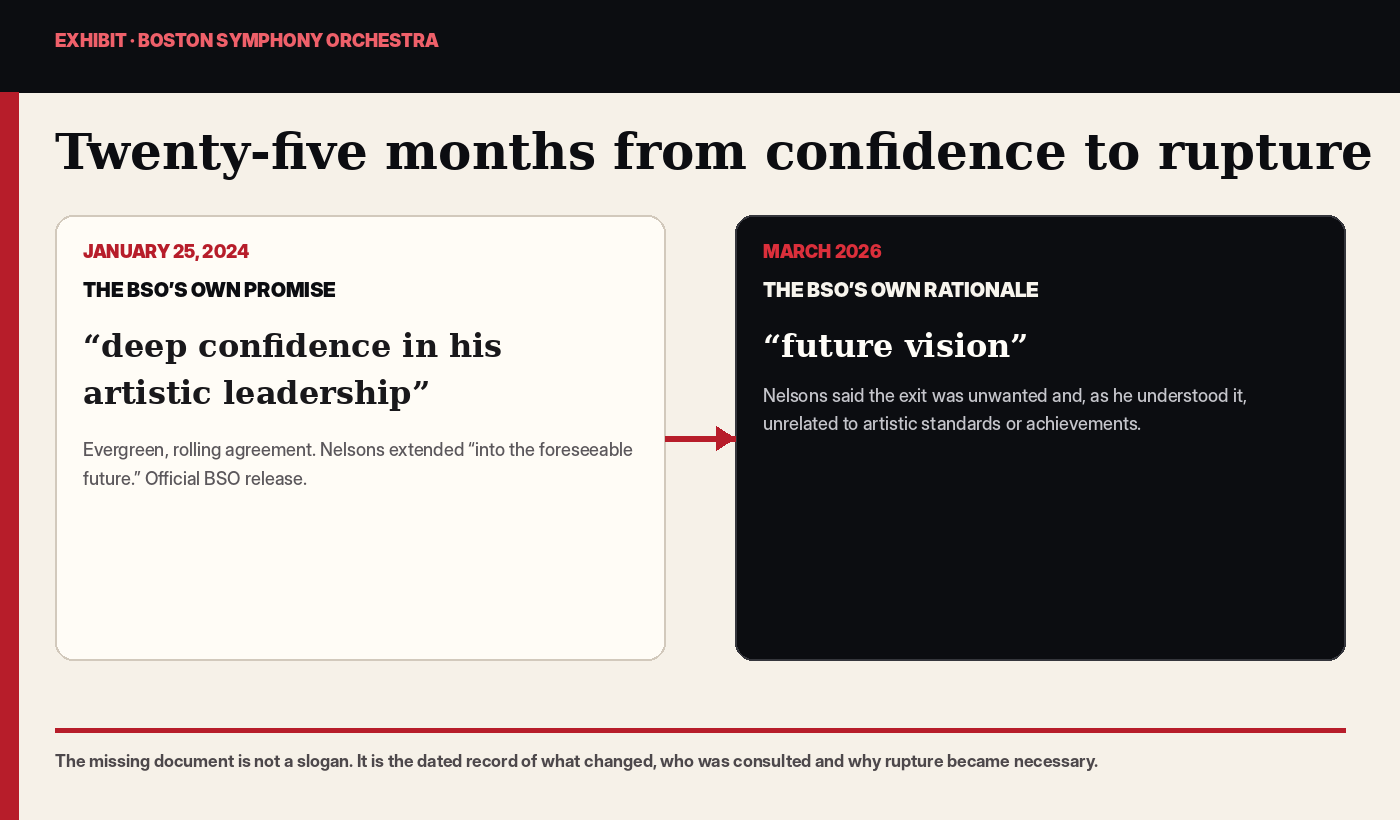
Twenty-five months from “foreseeable future” to “future vision”
The most damaging document in the BSO story was written by the BSO.
On January 25, 2024, the orchestra announced that Nelsons would move to an evergreen, rolling contract. Chad Smith said the arrangement extended Nelsons into the foreseeable future and expressed the institution’s deep confidence in his artistic leadership. He said Nelsons would help keep the BSO healthy and vibrant for years to come. 45
This was not a generic anniversary tribute buried in a gala program. It was the official explanation for a new contractual structure. The institution was telling musicians, audiences, donors, presenters and the international field that continuity under Nelsons was not merely tolerable; it was a strategic vote of confidence.
The language also belonged to Smith personally. When the BSO appointed him chief executive in May 2023, he described artistic partnership as an opportunity to empower creative artists to do their best work. He specifically looked forward to partnering with Nelsons, the players, staff and trustees to build on the institution’s legacy. The appointment release charged him with sustaining orchestral excellence, expanding audiences and deepening civic engagement. 46
Approximately twenty-five months after the evergreen announcement, the institution said the relationship would end because of future vision.
The contrast does not prove dishonesty.
An evergreen agreement is not a lifetime appointment. A board is allowed to change its judgment. A new financial forecast can expose risk. Negotiations can fail. A conductor can resist expectations he once accepted. An executive can learn that a partnership is not producing the audience, residency, fundraising or institutional outcomes he believed possible.
But a reversal this sharp creates a documentary burden.
If the 2024 confidence was genuine, what changed?
On what date did it change?
Which written objective was missed?
Was the problem artistic planning, Boston residency, touring, fundraising, donor relations, education, authority, personality, cost or some combination?
Were the new expectations conveyed to Nelsons in writing?
Was he given time and a defined process to meet them?
Did the musicians receive any structured opportunity to evaluate the costs and benefits before the decision became irreversible?
What did the board believe an evergreen contract meant when it approved one?
The point is not semantic entrapment. “Foreseeable future” is not a legal guarantee that no future board may reconsider. It is a public assertion of institutional judgment. When the judgment changes, an accountable organization explains the changed facts and criteria rather than behaving as though the earlier assertion never existed.
The BSO has so far offered the final label without the intermediate record.
There is no published chronology showing the movement from confidence to rupture. No public scorecard identifies the future the institution sought, Nelsons’s response, the alternatives considered or the role of musicians. No disclosed document explains why the risks of a major search became preferable to the relationship the BSO had just described as healthy for years to come.
The institution may possess such a file. If it does, redaction is available. Confidential compensation, health and private personnel material can be withheld while the board releases dates, categories, criteria, governance steps and non-confidential conclusions.
The burden is especially high because the BSO wrote both sides of the contradiction.
It chose the phrase deep confidence.
It chose foreseeable future.
It chose future vision.
It now has to publish the bridge between them.
The board vote: 32–0, and the artists learned afterward
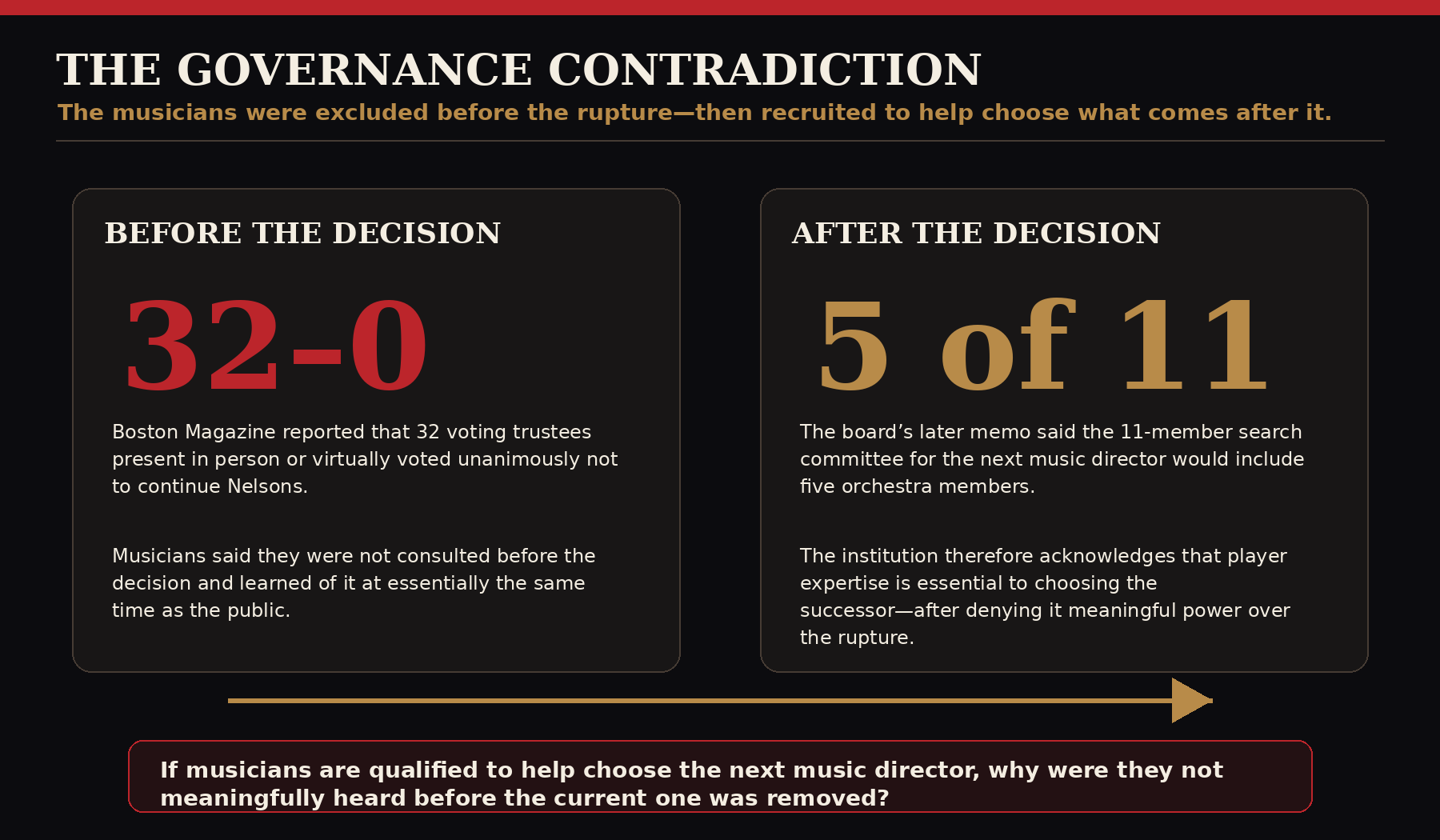
The phrase “the board decided” can conceal as much as it reveals. Boston Magazine’s July reconstruction supplied a number: thirty-two voting trustees were present in person or virtually for the decisive meeting, and the vote was unanimous. The magazine reported that Smith waited outside the room, learned the result, and traveled to London to meet Nelsons’s representatives in an effort to negotiate an amicable separation. Nelsons’s representatives and Smith later disputed aspects of what was offered. 58
The number matters because unanimity is often presented as proof of institutional confidence. It can also be evidence of a board culture in which dissent did not survive the room.
Cadenza cannot determine from the public record which interpretation is correct. Meeting minutes, board materials, individual questions and any recorded abstentions are not public. The article should not pretend to know the contents of a confidential deliberation.
What the record does show is a profound asymmetry.
Thirty-two trustees reportedly possessed enough information and authority to end the relationship.
The musicians who would live with the artistic consequences said they were not meaningfully consulted before the decision. Members of the Players Committee were called urgently to a meeting, informed by Smith in the presence of lawyers, and then had almost no time to digest the news before the broader announcement circulated. 1858
The board’s later memo said the eleven-member search committee for the next music director would include five orchestra members. 56
That is the governance contradiction in a single comparison.
The institution concedes that musician judgment is indispensable when selecting the next artistic leader. It did not grant comparable power before removing the present one.
A board may respond that selection and non-renewal are legally different actions. Of course they are. That legal distinction does not answer the moral and practical question. If player knowledge is valuable enough to occupy almost half the successor-search committee, why was it insufficient to be heard before a decision that made a successor necessary?
The BSO cannot solve that contradiction by saying trustees had fiduciary responsibility. Fiduciary responsibility is a duty to exercise judgment, not a license to exclude expertise. A hospital board does not become medically competent because it possesses legal authority. An orchestra board does not become artistically omniscient because its vote is binding.
The reported unanimity should therefore increase scrutiny, not end it.
What alternatives were presented?
Did anyone request delay?
Did any trustee ask for a formal musician assessment?
Was management performance evaluated alongside Nelsons’s performance?
Did trustees receive independent advice, or principally the strategic analysis prepared through the executive structure they were being asked to endorse?
Did the board examine the cost of donor revolt, musician distrust, crisis communications and international reputational damage?
Did it receive a written transition-risk analysis?
A unanimous vote can be courageous. It can also be the sound a closed system makes when everyone in the room receives the same framing.
The BSO should publish enough of the decision record to show which it was.
Chad Smith’s own words make the case harder, not easier
Cadenza does not need anonymous speculation to establish the central case against Chad Smith. His own institution has already assembled the exhibit.
The BSO’s official profile describes his first year as a period of major investment in the artistic future. The profile identifies the indefinite extension of Nelsons’s contract as one of those investments. 54
The 2023 appointment announcement had already framed Smith as a leader of future vision. Hostetter praised that vision. Smith described artistic partnership as a way to empower creative artists and specifically anticipated building with Nelsons, the musicians, staff and trustees. 46
In the 2026 BSO–NEC alliance announcement, Smith called himself “a steward of the Boston Symphony’s legacy.” That word matters because stewardship is the standard his own institution chose, not one imposed by Cadenza. 62
In January 2024, Smith publicly expressed deep confidence in Nelsons and expected him to help keep the BSO healthy and vibrant for years. 45
By March 2026, Smith was the executive face of a decision ending that future.
In his first extensive interview after the announcement, he said the board had made a deliberate decision and that attention had to turn to the future. He acknowledged work was required to rebuild trust, while also saying the rollout occurred through a considered process. The musicians, after meeting him and trustees, said they received no reassurance that a path to rebuilding trust existed. 55
In June, Smith publicly framed the decision around a need for the orchestra to serve Boston more expansively and inclusively. He cited declines across the institution and the need to think differently about programming, voices and audiences while retaining the classical canon. 60
In July reporting, he described the BSO as needing a turnaround and said the institution had to pivot. He presented the choice in existential terms: fix the problems or fail. 5859
There is a coherent diagnosis inside those statements.
Audiences have declined over decades.
Subscriptions have weakened.
Facilities require substantial investment.
The institution needs broader civic relevance.
A great orchestra cannot assume prestige will reproduce itself forever.
Cadenza does not dispute those premises.
The missing step is causation and remedy.
How does ending Nelsons’s music directorship solve deferred maintenance?
How does it repair marketing weakness?
How does it restore subscriptions?
How does it create a marquee education program?
How does it produce the hundreds of millions in philanthropy the board says may be required?
How does it improve the management culture described by current and former employees?
How does it rebuild musician trust after the people on stage say the process denied their role?
A diagnosis of institutional pressure is not proof that one particular intervention is sound. A doctor who correctly identifies fever has not thereby justified amputation.
Smith’s defense repeatedly moves from broad problems to a specific conclusion without publishing the bridge between them. The BSO has declining attendance; therefore the artistic partnership must end. Boston must be served more broadly; therefore Nelsons cannot remain. The institution needs change; therefore resistance to management’s plan is resistance to survival.
Each conclusion may be true. None follows automatically.
The public needs the missing document: the analysis showing why retaining Nelsons under revised obligations, adjusted residency, changed programming, stronger community requirements or a time-bound improvement plan was less viable than forced transition.
Without that analysis, “turnaround” becomes a magic word. It transforms every objection into evidence that change is necessary and every consequence into proof that the old culture is resisting.
Smith is plainly intelligent. He has experience at one of the world’s most innovative orchestras. He can articulate a sophisticated theory of audience expansion. That makes the failure of explanation less excusable, not more.
The executive with the clearest vocabulary bears the greatest responsibility for the fog.
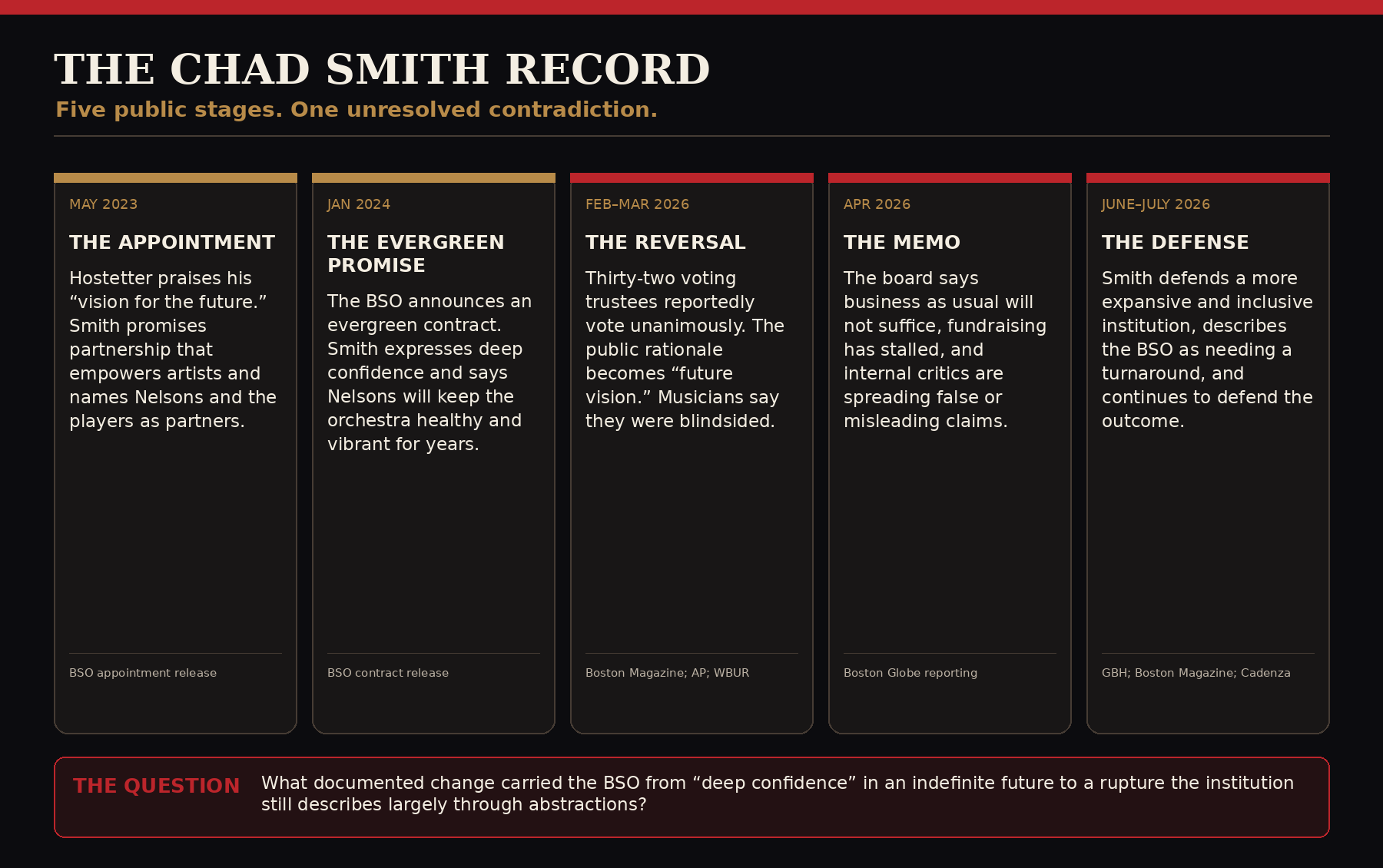
The apology that preserves every consequence
Cadenza’s earlier reporting synthesized Smith’s June interviews with national and Berkshire outlets. In those interviews, he accepted that the decision’s rollout had been poor while continuing to defend the substance. He reportedly described the outcome as “sound,” said reinstatement was “off the table,” and framed the larger conflict as an “epic battle” over what an orchestra should become. 37
These phrases are short, but they reveal the structure of the response.
The method can be regretted.
The result cannot be reconsidered.
The executive will not resign.
The critics become participants in a battle over the future.
That is not accountability in the ordinary sense. It is an apology designed to absorb anger without changing power, policy or personnel.
An institution can reasonably decide that reversal would create new harm. Reinstatement may be contractually difficult. Resignation is not automatically the right remedy for every failed rollout. The article should not pretend consequences are simple.
But accountability requires at least one of four things:
A decision changes.
A leader changes.
A process changes in a binding way.
Or the institution publishes enough evidence to demonstrate that the disputed outcome was necessary despite the damage.
The BSO has not yet completed any of those tasks at a level commensurate with the crisis.
It has promised player involvement in a future search. That is useful, but it does not repair exclusion from the decision that triggered the search.
It has described programming ideas. That is useful, but it does not prove Nelsons could not execute or support them.
It has acknowledged trust damage. That is necessary, but acknowledgment without transfer of power leaves the structure intact.
It has defended the decision. Defense is not accountability.
Smith’s position amounts to this: the envelope was mishandled, the letter was correct, and the recipient must live with it.
That is why the controversy persists. People are not confused about whether leadership regrets the manner. They understand that leadership regrets the reaction while remaining committed to every action that produced it.
The memo is where “future vision” finally became legible
For seven weeks, the BSO’s public rationale was almost content-free. Then the board wrote a detailed memo to its nonvoting advisers.
The Boston Globe reported that the April 21 document, titled “State of the Boston Symphony Orchestra,” described a long decline in classical attendance and subscriptions, frequent operating deficits, heavy use of endowment support, a largely restricted endowment, major deferred maintenance and the need for potentially hundreds of millions in new philanthropy. It said business as usual would no longer suffice. 56
The memo also described the desired next music director.
The person would need extraordinary musicianship and rapport with players, but also make the BSO the principal focus of his or her artistic life and work collaboratively with key constituencies. The document promised continued emphasis on the Western classical canon while expanding thematic, humanities and affinity programming. 56
This was the first time the board’s “future vision” became concrete enough to test.
It was not a secret plan to abolish Beethoven.
It was a plan combining canonical focus, broader programming, stronger local commitment, education, facilities investment and massive fundraising.
Some critics should acknowledge that. The memo complicates the easiest culture-war caricature. The BSO’s leadership was not publicly proposing to replace the orchestra with pop entertainment. It was attempting to build a broader institutional model around the core orchestra.
But the memo also creates new problems.
If the desired music-director profile required the BSO to be the principal artistic focus, was Nelsons formally told that his Leipzig role and international schedule had become disqualifying?
When?
Was he offered a revised calendar or residency structure?
Was the board’s concern his physical presence, his programming, his fundraising, his relationship with Smith, or all of them?
If the Western canon remained central, why did later public defense lean so heavily on diverse voices and expansive service as though Nelsons stood against those aims?
Nelsons had already conducted new work, premieres and programs that the BSO could cite as evidence of its own breadth. The board’s case cannot merely assert a future direction already visible in the orchestra’s recent past. It must show the collaboration required to sustain and deepen it had failed.
The memo’s most damaging element was not its financial analysis. It was its treatment of dissent.
According to the Globe, it accused certain BSO personnel and community members of spreading false or misleading claims and severely setting back fundraising. An earlier staff version, sent and then rescinded, linked current critics to people who had opposed the previous chief executive. 56
That move turns governance criticism into pathology.
Leadership makes a controversial decision.
Musicians and patrons object. By August, the independent Stand With Andris campaign publicly claimed more than 4,000 signatures and months of unanswered requests for explanation; those figures are the campaign’s own date-bounded account, not an audit by Cadenza. 61
Donors hesitate because the institution appears divided.
Leadership then cites the hesitation as damage caused by the critics.
The institution becomes both arsonist and fire investigator.
That metaphor is editorial. The documented sequence is not.
A board may believe rumors were false. It should identify the false claims and correct them with evidence. What it should not do is collapse principled disagreement, labor anger, patron concern, media reporting and malicious misinformation into one category called resistance to change.
The memo is valuable because it finally gives the public something to evaluate. It is alarming because the document frames the institution’s own people as obstacles at the precise moment leadership needs their consent.
Fundraising stalled after leadership created the rupture
The board’s financial concern deserves serious treatment. Major arts institutions cannot survive on applause. If seven- and eight-figure gifts are delayed, the threat is real.
The Globe later reported that substantial prospective gifts had been put on hold, although none of the prospective donors had definitively walked away. BSO leadership said fundraising remained on track while acknowledging pauses around strategic planning because the plan had been publicly discredited or distanced by parts of the institution. 57
That wording is revealing.
Donor hesitation was not an asteroid. It followed a board decision and a communications process that leadership controlled.
The board cannot count donor backlash as an external force while excluding the decision that generated it from the causal chain.
Perhaps musicians and patrons amplified the damage. Public campaigns are designed to exert pressure. Some claims in any emotionally charged dispute may be exaggerated. A board has the right to defend itself.
But the BSO’s response should begin with ownership:
We made the decision.
We chose the timing.
We chose the explanation.
We chose the consultation structure.
We created the conditions in which donors had to ask whether the institution was unified.
Only after stating that can leadership fairly assess the responsibility of critics.
The board’s current narrative risks becoming self-sealing. If fundraising improves, the strategy was right. If fundraising worsens, internal opponents sabotaged it. Under that logic, no outcome can falsify leadership’s judgment.
A bulletproof strategic plan must include falsifiable milestones.
What level of subscription recovery is expected?
What donor commitments must close, and by when?
What expense reductions are planned?
What audience experiments will be judged successful?
What is the cost of the transition itself?
What portion of the capital campaign depends on repairing trust with the musicians?
At what point would the board acknowledge that the Nelsons decision impaired rather than improved institutional sustainability?
Without those thresholds, “turnaround” is not a plan. It is an indefinite exemption from accountability.
The turnaround CEO and the human cost of change
Smith has described himself as a change agent, and the BSO board appears to agree. Boston Magazine reported that he said he had moved out or replaced roughly half the leadership team and had introduced stronger metrics and accountability. He characterized the BSO he inherited as requiring a turnaround. 58
Change in senior management can be necessary. Long-lived cultural institutions accumulate silos, habits, protected relationships and outdated systems. A chief executive hired to modernize cannot be expected to preserve every position and practice.
The question is not whether Smith changed personnel.
It is how he exercised power while doing so.
Public reporting has attributed complaints to current and former employees who described an abrasive or intimidating management style, including allegations that colleagues were belittled or berated. Cadenza’s prior profile collected those accounts and kept them attributed; Boston reporting later repeated specific complaints. Smith has defended his actions as part of difficult leadership change. Hostetter has continued to support him. 385859
These allegations do not establish that every complaint is true. Departing executives can be resentful. Institutional change creates winners and losers. Anonymous or pseudonymous accounts require caution.
But the pattern cannot be dismissed simply because change is difficult.
A CEO who says people resist accountability must also accept accountability for the culture through which he imposes it.
A leader cannot define every departure as proof that reform was necessary.
A board cannot define every complaint as fear of metrics.
A strategy that requires replacing half the leadership team, rupturing the relationship with the music director, alienating the musicians, putting gifts on hold and hiring crisis communications may still be correct.
The burden of proof is now enormous.
Smith’s strongest defense is that the old model was already failing and incrementalism would have produced slower decline. That may be true. But transformation is not measured by the number of people removed. It is measured by the capacity built, trust earned and results delivered.
The BSO should publish a change ledger:
Which leadership functions were reorganized?
Which measurable weaknesses were corrected?
Which roles were eliminated and why?
What savings or revenue gains followed?
What employee-engagement measures exist?
What independent process is available for complaints about senior leadership?
How is the board distinguishing resistance to accountability from evidence that the method of change is itself damaging the institution?
The phrase “I was hired to make change” is an explanation of mandate.
It is not an evaluation of performance.
Artistic success does not settle everything—but it settles something
A common defense of the BSO board begins with a truism: awards do not guarantee institutional health.
Correct.
An orchestra can win Grammys while subscriptions decline. A conductor can produce admired recordings and still fail at fundraising, civic presence, planning or internal relationships. Artistic excellence does not exempt a leader from the full demands of the role.
But artistic success is not irrelevant merely because it is incomplete.
Under Nelsons, the BSO achieved sustained international recognition. The orchestra and conductor won multiple Grammy Awards, and their recording work became a defining part of the institution’s contemporary identity. In 2026 Nelsons received major European recognition, while the BSO’s work continued to be honored. 141530
These achievements matter for three reasons.
First, the core product of an orchestra is music. A board may manage assets and strategy, but the institution exists because musicians play. When artistic results are strong, leaders seeking change must show why non-artistic deficiencies outweigh the disruption of ending that relationship.
Second, success creates audience expectations. Listeners invest not only in individual concerts but in a developing artistic partnership: cycles, repertoire relationships, sound, touring identity and long-form recording projects. A board that interrupts the partnership does not merely alter a personnel chart. It breaks a narrative audiences have been asked to follow.
Third, artistic success affects recruitment and reputation. Musicians choose auditions, guest artists accept invitations and donors attach themselves to institutions partly because of artistic leadership. A vague strategic promise may not replace a known conductor’s international network.
The board may have judged that the benefits had plateaued or that the costs of the relationship were too high. That is a legitimate category of decision. It is not legitimate to demand that the public infer the case from silence.
The phrase “not about artistic standards” is especially consequential. If Nelsons’s understanding is wrong, the BSO should correct it. If it is right, then the board has acknowledged—through silence if not directly—that it was willing to sacrifice a successful artistic partnership for another objective.
Name the objective.
An institution that spends years telling audiences to listen carefully should not ask them to stop listening when management speaks.
There is also a broader ideological context. Contemporary arts administration often treats artistic excellence as one value among many, sometimes with suspicion because “excellence” can be associated with exclusion, inherited standards or elite authority. The corrective was necessary where the term concealed closed networks and unequal opportunity. But an orchestra that becomes embarrassed to place artistic excellence at the center of its hierarchy has lost the reason it exists.
This does not mean excellence is neutral or self-defining. Repertoire, training and criticism evolve. It means that the highest purpose of a symphony orchestra is to create extraordinary musical experiences. Access, education, fairness and civic engagement deepen that purpose. They do not replace it.
The BSO’s public messaging about its future should therefore begin with music. What sound does the institution seek? What repertoire relationship? What conducting philosophy? What artistic risks? What role for the orchestra’s own musicians? What does the next music director need to accomplish that Nelsons could not or would not?
Instead, the public received a phrase equally at home in a corporate restructuring, university presidency search or technology consultancy.
Future vision.
The language is not accidentally generic. Generic language frees management from artistic specificity.
It also creates an ideological opening. A “future vision” can encompass audience diversification, digital expansion, civic engagement, climate goals, new-music commitments, labor changes and brand positioning. Each may be defensible. The problem arises when the collection becomes too diffuse to evaluate and the institution’s musical center disappears.
The public should resist the implication that asking about artistic standards is reactionary. It is not nostalgia to insist that an orchestra’s governing case be musical as well as managerial.
Nelsons’s awards do not prove the board had no reason to act.
They prove the board’s reason had better be substantial.
“Radical collaboration” meets the musicians
The BSO’s musicians are employees. They are also the institution’s artistic substance.
That dual status creates a governance problem shared by orchestras everywhere. Legally, boards oversee management and management bargains with labor. Artistically, the orchestra’s identity resides in a body of players whose collective knowledge cannot be reproduced by a trustee, executive or consultant.
A credible system has to honor both realities.
Before the Nelsons rupture, the BSO’s own volunteer-facing update described Chad Smith as bringing increased focus to “radical collaboration.” The same page said the institution had held conversations intended to ensure constituencies felt welcomed and valued. 42
Those words are not incidental marketing. They are a governance promise.
After the board announced that Nelsons would leave, bassist and players-committee chair Todd Seeber told WBUR that the musicians were completely blindsided and could not understand the decision. Musicians rallied publicly, wrote to the board and questioned whether management was trying to seize artistic direction. 18
The two records must be read together.
“Radical collaboration” does not require unanimous consent. It does require more than presenting a settled outcome to the people whose work gives the institution its identity.
The musicians’ support for Nelsons does not prove the board’s decision was substantively wrong. Artists can underestimate financial risk, resist necessary change or prefer a relationship that no longer fits broader strategy. Boards sometimes must make choices employees oppose.
But an organization that claims collaboration has an additional burden: it must show the architecture of participation.
Who represented the musicians before the board decided?
What information did those representatives receive?
Were they asked to evaluate options or merely consulted about concerns?
Could their objections alter criteria, timing or outcome?
Did they know that non-renewal was under active consideration?
If confidentiality limited participation, what fiduciary mechanism was offered to include elected musician representatives safely?
The public record does not answer those questions.
Stakeholder theater follows a familiar sequence. Leadership announces listening. Participants attend surveys or meetings. Decisive authority remains concentrated. After the decision, the existence of consultation is cited as proof that the process was inclusive. Dissent is then interpreted as resistance to change.
Cadenza cannot know every internal conversation that occurred. The article therefore does not state that no musician was ever consulted. It states the provable point: the musicians’ public account of the process was surprise, opposition and distrust. 18
Confidentiality is not a complete defense. Institutions routinely create committees whose members accept confidentiality obligations, share redacted findings, distinguish consent from consultation and publish process rules without disclosing sensitive personnel information.
The alternative is paternalism: management decides what artists need and later explains the future to them.
That model is especially difficult to defend in an institution that devotes public language to voice. Cultural organizations have learned to ask whose voice is absent from programming, panels and public narrative. They should ask whose voice is absent from power.
A season can include underrepresented composers while musicians lack authority over artistic succession.
A brochure can feature diverse players while a board remains structurally insulated.
A strategic plan can promise belonging while the people who belong most deeply to the orchestra experience exclusion.
The answer is not musician rule. Players have factions, interests and blind spots. Trustees carry legal duties. Management operates a complex enterprise. The answer is shared governance designed honestly.
At minimum, elected BSO musicians should hold meaningful participation in the music-director search, receive the strategic criteria, evaluate candidates at each stage and obtain a published explanation of how their assessments affect the result. “Meaningful” cannot mean trustees listen and ignore without account.
The next music director will enter an institution where the previous one was removed over an undisclosed vision conflict and the players publicly challenged the process. A famous appointment may fill the hall for an announcement. It will not repair the constitution.
Trust is not restored by selecting a name.
It is restored by changing how power works.
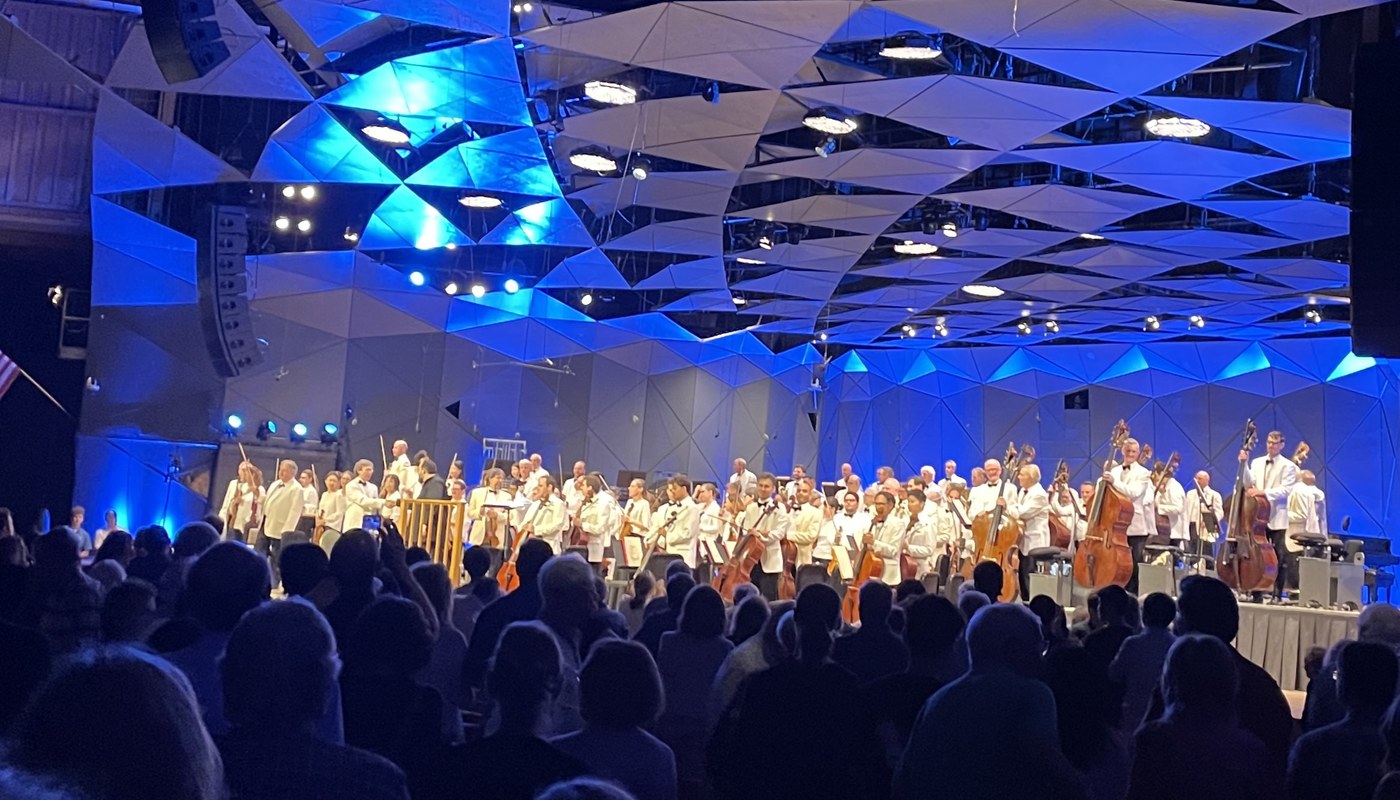
The BSO’s finances: crisis, capacity and the institution’s own mixed record
The Boston Symphony Orchestra faces genuine financial pressure.
Its federal filing for the fiscal year ending August 2024 reported approximately $117.1 million in revenue and $123.7 million in expenses, a deficit of roughly $6.6 million. The preceding year showed a larger gap: about $93.2 million in revenue against $110.6 million in expenses, a deficit of approximately $17.4 million. 17
Those numbers are serious. Repeated operating deficits can consume flexible reserves, weaken confidence and force structural change. An endowment is not a checking account; assets may be restricted by donor intent, board designation or prudent-spending policy. Buildings and collections can enlarge a balance sheet without producing operating cash.
The same filing reported approximately $618.4 million in net assets at the end of fiscal 2024, up from about $587.1 million in the prior year. Total assets were roughly $680.3 million and liabilities about $61.9 million. 17
The accurate conclusion is double.
The BSO has a material operating problem.
The BSO also has extraordinary institutional capacity.
The institution’s own contemporaneous communications make the record more complicated still.
An August 2024 volunteer committee update said overall fiscal-year revenue was expected to surpass budget. It reported Fall Pops at 198 percent of revenue budget, Holiday Pops at 108 percent, the BSO season at 109 percent and Spring Pops at 95 percent; Tanglewood was the weak segment at 84.8 percent, attributed in part to weather and lower popular-artist sales. The same page said the development team was near its fiscal-year target. A later update described fundraising positively and cited a $15 million grant for deferred maintenance. 42
These internal-facing figures are not audited financial statements and should not be treated as substitutes for Form 990 results. They measure performance against budget, not necessarily against the full cost of operations. A revenue line can beat a conservative target while the organization still loses money overall.
That caveat does not make the communications irrelevant.
They show that the BSO’s own public record contains both momentum and danger. Any later narrative of existential necessity must reconcile both.
What deteriorated after those reports?
Which assumptions proved wrong?
How much of the deficit was structural rather than planned investment?
What part of the problem was attributable to attendance, buildings, compensation, fundraising, programming, touring, management structure or Tanglewood?
How does ending the Nelsons relationship improve each line?
Was the decision attached to a quantified turnaround plan?
What revenue growth or cost reduction is expected from the successor strategy?
Will the next music director spend more time in Boston, program differently, fundraise more, cost less or accept a different division of artistic authority?
If the decision was primarily artistic, what was the artistic deficiency?
If it was primarily financial, why has the institution not published the financial bridge?
The board may possess compelling answers. The public has received no document adequate to the scale of the act.
Management narratives often emphasize deficits; critics emphasize endowment. Both can mislead. A wealthy institution can be structurally unsustainable if recurring operations outrun dependable revenue. A wealthy institution also possesses bridge funding, campaign capacity, pricing options, asset strategy, donor networks and time that smaller organizations lack.
Those options include temporary endowment draws within policy, a special transition campaign, management restructuring, targeted expense reductions, touring changes, donor challenges, digital products, pricing reform and a transparent multiyear audience plan. None is painless. Their existence is why the board must show its work.
The public filing also raises a question of proportionate accountability. Musicians, conductors and programs are visible costs. Administrative strategy is harder to isolate. When classical attendance declines over two decades, the period spans multiple executives, marketing systems, pricing choices, artistic regimes and external shocks. Concentrating the remedy on the podium is attractive because the podium contains one person.
A conductor can be replaced in a headline.
A failed business model cannot.
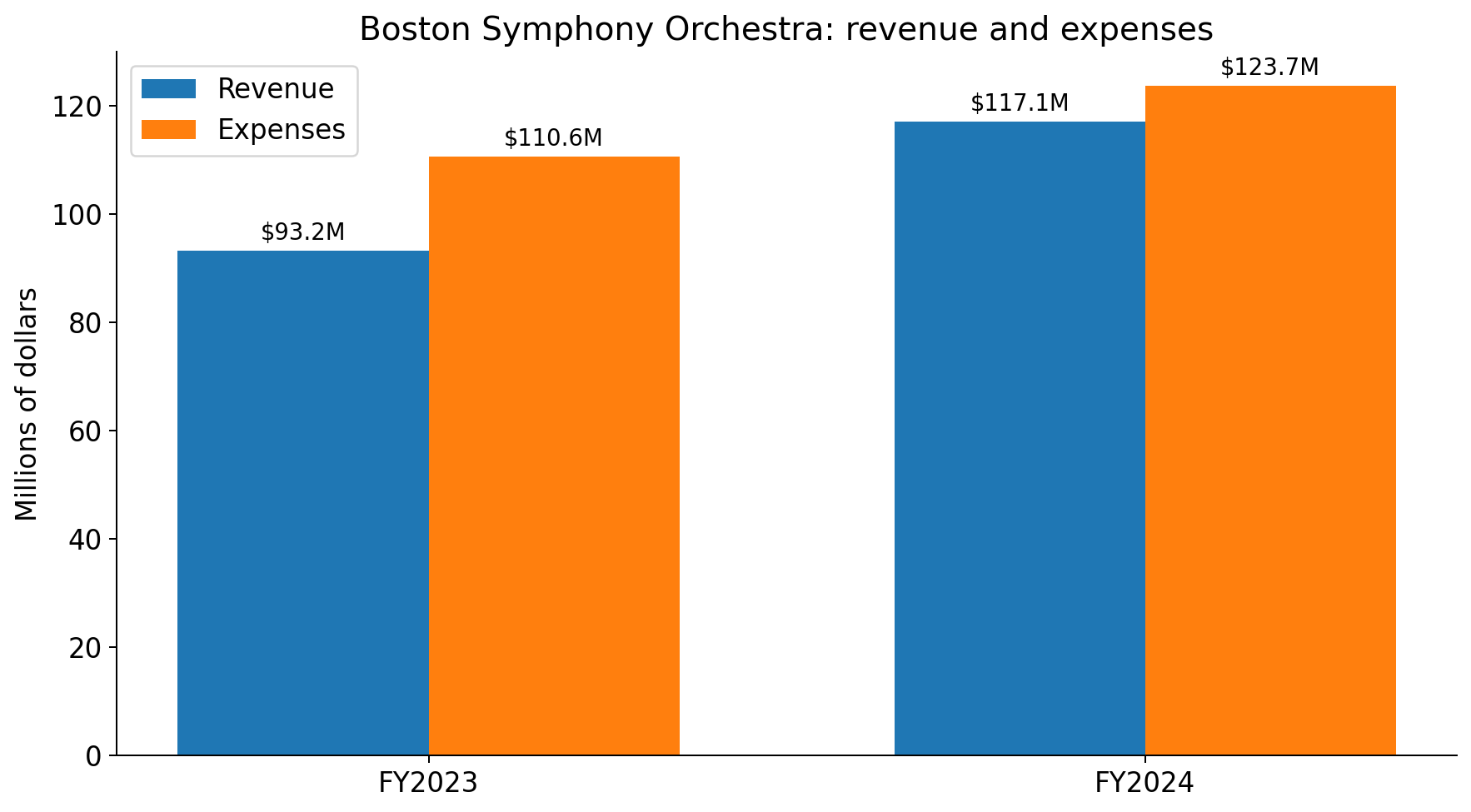
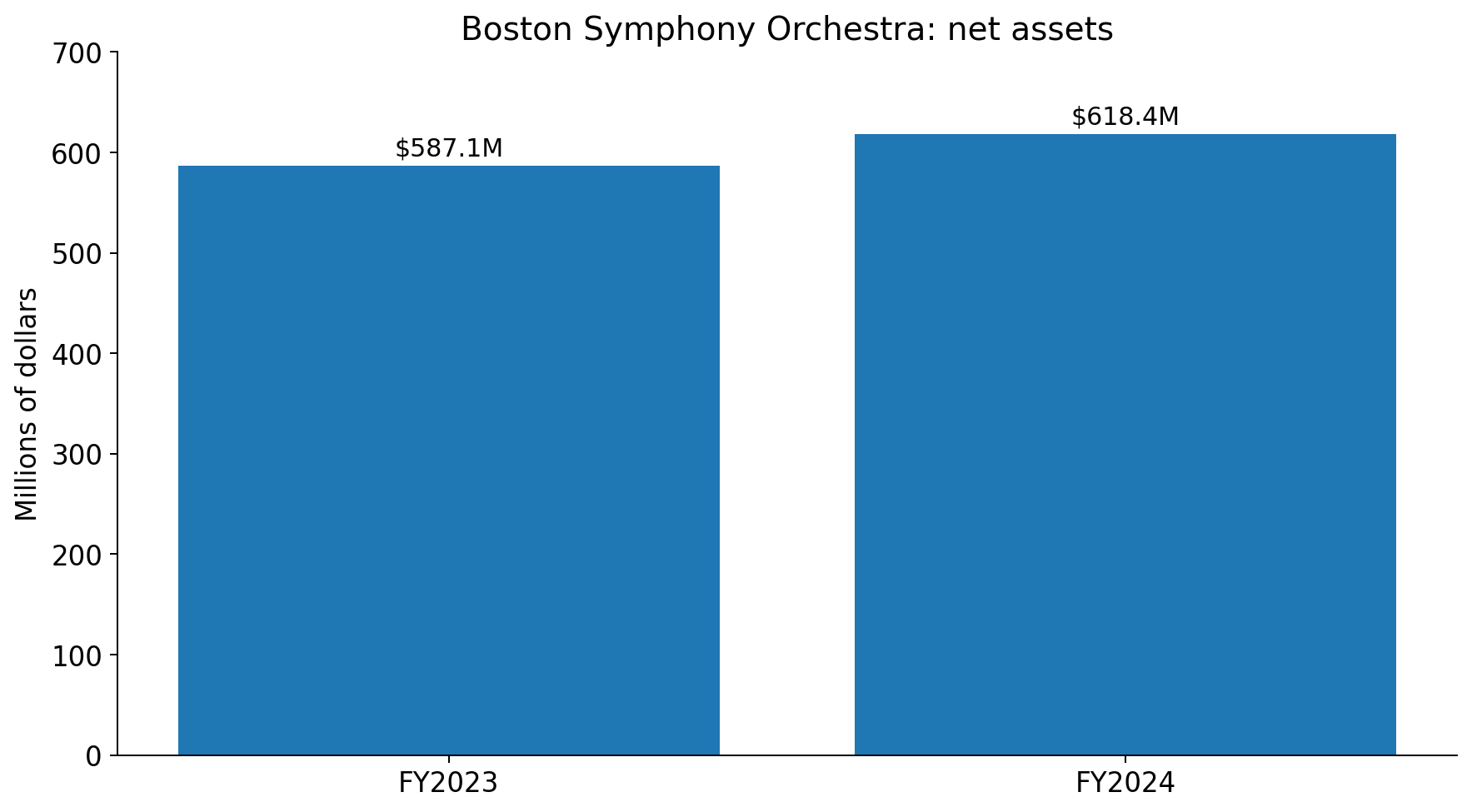
This combination—deficits, assets, prestige, strong segments and long-term audience pressure—requires unusually sophisticated governance. It requires leaders who can distinguish temporary disruption from structural change and communicate honestly enough to retain artistic trust.
The Nelsons decision may be part of such a strategy.
The strategy has not been shown.
Until it is, the board’s explanation remains authority without public accounting.
The real audience crisis
Boston’s classical-music audience problem is not invented.
Reporting in 2026 described significant attendance pressure across the city’s classical institutions, with organizations experimenting with pricing, formats and programming. BSO leadership has cited a long-term decline in classical attendance. 34
The causes are structural and interconnected.
Subscription behavior has weakened across many performing-arts sectors. Younger audiences are less likely to commit months in advance to fixed packages. Remote work and changed commuting patterns affect downtown habits. Streaming and infinite digital entertainment compete for attention. Housing costs push artists and potential audiences away from the urban core. Childcare, transportation and restaurant costs make a concert night expensive before a ticket is purchased. The pandemic accelerated behavioral change and broke routines that institutions assumed would return automatically.
Classical organizations also contributed to their own difficulty. Pricing has often been opaque. Concert etiquette can feel socially coded. Marketing language may be reverential rather than inviting. Programs sometimes lack a clear reason for a casual listener to choose this night over any other. Institutions have relied on donor subsidy while treating audience development as a campaign rather than a permanent discipline.
The crisis is real enough that ideological critique alone cannot solve it.
Removing every diversity statement would not restore subscriptions.
Ending sanctuary policy would not sell the balcony.
Retaining Nelsons would not by itself reverse two decades of behavioral change.
Keeping the BPO open under a successor would still require money and an audience.
The ideological critique becomes unserious when it treats politics as a magical explanation for all decline. Culture has changed. Economics has changed. Institutions must adapt.
The relevant question is how they adapt.
Adaptation can mean better pricing, more flexible subscriptions, neighborhood performances, stronger digital discovery, family access, shorter formats, deeper education, musician-led programming, contemporary repertoire and new partnerships. It can also mean protecting the distinctive experience that makes live orchestral music worth leaving home for: concentration, scale, acoustic force, interpretive depth and the encounter with a disciplined collective.
What adaptation cannot mean is the elimination of artistic identity in pursuit of generic relevance.
An orchestra that responds to declining attendance by becoming less recognizably an orchestra competes on the terms of media forms that will always be cheaper, faster and more convenient. Its advantage is not that it can imitate a social platform. Its advantage is that a hundred musicians can create an unrepeatable event in a room.
The BSO’s next strategy must therefore answer two audiences at once.
It must give existing listeners reasons to remain loyal after a destabilizing leadership decision.
It must give new listeners reasons to return after the free ticket, special event or first encounter.
That work requires trust between artists and management. Musicians need to believe experiments serve the art rather than merely the brand. Audiences need to believe programs arise from conviction rather than demographic targeting. Donors need evidence that innovation is disciplined, not desperate.
A board that cannot explain why it ended a successful music directorship begins this challenge with a deficit more dangerous than the one on its tax return: a deficit of credibility.
The countercase against Nelsons
Fairness requires more than admitting that an opposing argument exists. It requires presenting the strongest version.
The case against continuing Nelsons might run as follows.
The BSO needs a music director who is intensely present in Boston, deeply connected to civic institutions, available for fundraising, visible to younger audiences and willing to shape a broad institutional strategy beyond conducting. Nelsons’s international commitments and European base may have limited that role. His artistic achievements, while substantial, may not have translated into sufficient local audience growth or organizational transformation. A rolling contract should not become permanent entitlement. The board, possessing confidential information and fiduciary responsibility, may have concluded that another decade would delay necessary change.
This is not a ridiculous argument.
American music directors have historically been expected to function as civic leaders, fundraisers, recruiters and public faces. A conductor who excels on the podium but appears intermittently may not meet the institution’s evolving needs. The board may also believe that the post-pandemic environment demands a different combination of skills.
There are three problems.
First, much of this case is inference because the BSO has not made it clearly.
Second, the board renewed the relationship on a rolling basis in 2024. If local presence and institutional role were already inadequate, what changed in less than two years? If the shortcomings became apparent later, what benchmarks had been established? What remedial conversations occurred?
Third, a new music director is not guaranteed to solve the problem. The international pool of conductors with elite artistic credibility, local availability, fundraising appetite, audience charisma, institutional diplomacy and willingness to accept the BSO’s governance environment is not infinite. A search can consume years. Interim uncertainty may deepen audience and donor weakness.
A responsible board might still take that risk. It should show that it has measured it.
The countercase also fails when it becomes a retroactive character indictment. Nelsons was good enough to lead recordings, tours and seasons for more than a decade. If his role design was inadequate, management and trustees share responsibility for designing and renewing it. Institutions often treat a departing leader’s limitations as though they appeared independently of the people who supervised the relationship.
The board cannot rewrite twelve years as someone else’s mistake.
The correct conclusion is not that Nelsons must remain forever. It is that the BSO’s public case for ending his tenure is radically below the standard appropriate to the decision.
What accountability for Chad Smith would actually require
Cadenza has previously called for Chad Smith to leave. That remains an editorial judgment, not a factual claim that resignation is legally required. The basis is institutional accountability: he is the chief executive of record during a governance rupture, a collapse of musician trust, donor hesitation and a public explanation that arrived in fragments over months. 283738
A fair article should state the alternative.
Smith could remain and still meet an accountability standard if the institution completed a verifiable reset.
Publish the strategic plan in enough detail to test it.
Publish the chronology from the 2024 evergreen announcement to the 2026 vote.
Disclose the formal consultation process and explain why musicians had no binding role before the decision.
Commission an independent review of management culture and the decision process, with findings reported publicly.
Establish musician participation in governance that cannot be withdrawn after the crisis passes.
Publish annual targets for classical attendance, subscriptions, contributed revenue, unrestricted reserves, facilities fundraising, education reach and employee retention.
State what result would count as failure of the strategy.
Leadership is not accountability-proof because it speaks the language of urgency. The more existential the diagnosis—turnaround or failure, epic battle, business as usual no longer sufficient—the more specific the scoreboard must become.
If Smith will not provide that record, then the board is not asking Boston to trust a strategy.
It is asking Boston to trust Chad Smith.
The institution’s own recent history shows why that is not enough.
Barbara Hostetter: the chair, the donor and the board’s moral ownership
Barbara W. Hostetter is not a ceremonial figure in this story.
The BSO identifies her as chair of the Board of Trustees. She served on the search committee that selected Smith and publicly praised his vision for the future. The BSO’s donor records list Barbara and Amos Hostetter among its great benefactors in the ten-million-dollar-and-above tier. 164146
Those facts do not prove self-dealing, improper motive or legal conflict. Major donors often become trustees because they have demonstrated commitment and capacity. Hostetter’s philanthropy has supported cultural access and civic work across Boston.
The facts do establish concentrated influence.
She helped choose the executive.
She chairs the body that voted unanimously.
Her household is among the institution’s largest donor families.
She signed or authorized the board’s public and donor-facing defense.
She has continued to support Smith while the institution’s musicians contest his leadership.
That concentration means the board chair’s explanatory burden is greater than a generic trustee’s.
Boston Magazine reported that after meeting distressed musicians, Hostetter emphasized that the decision had been made and that the institution had to move forward. The same reporting later carried a statement in which she invoked excellence, relevance, inclusivity, humility and appreciation for the people who make the BSO. 58
Those are admirable standards.
They also cross-examine the process.
Humility would require acknowledging that legal authority did not equal artistic understanding.
Appreciation would require more than hearing musicians after the decisive vote.
Inclusivity would require shared power, not only expanded programming.
Excellence would require protecting the conditions under which musicians believe they can produce it.
Moving forward is a management preference. It is not a substitute for accounting backward.
The board memo compounds the problem. It described critics as spreading misleading claims and impeding fundraising. Hostetter’s role as chair makes that posture hers to explain, even if she did not draft every sentence. 5657
Which claims were false?
Who verified that?
Why were they not corrected point by point?
Why did an earlier staff communication link current dissent to opposition against the previous CEO?
What independent mechanism examined whether the critics were identifying real dysfunction rather than resisting necessary change?
A board chair cannot use the collective noun “trustees” to absorb responsibility. Thirty-two people may have voted, but someone set the agenda, determined the information flow, shaped the decision process and owned communication.
That is the chair’s job.
Cadenza’s call for Hostetter to step aside rests on a governance principle: when a board’s most consequential decision produces profound distrust and its defense treats internal critics as impediments, the chair must either demonstrate a credible process or accept leadership consequences.
Her philanthropy deserves acknowledgment.
It does not purchase exemption from the standard she asks other institutions to meet.
The BSO’s annual report says the board provides steady direction and expansive foresight. The Nelsons crisis is the test of that sentence. 41
Steady direction is not unanimity.
Expansive foresight is not a plan circulated after the damage.
The board’s moral ownership will not end when Nelsons leaves. It will be measured by the institution that remains: its musician trust, audience loyalty, donor confidence, artistic standards, labor relations and willingness to explain itself.
If those measures worsen, Hostetter cannot say the board merely made a difficult decision in good faith.
Good faith is the beginning of governance, not the result.
Part IV — Benjamin Zander and the institution built around him
The achievement before the indictment
Benjamin Zander’s accomplishment should not be minimized in order to criticize its ending.
He founded the Boston Philharmonic Orchestra in 1978 and built it into an institution with a distinct identity: ambitious repertoire, intense interpretive conviction, educational explanation and a direct relationship between conductor and audience. He became an internationally known speaker on leadership and possibility. His pre-concert talks and interpretation classes brought listeners inside the work rather than treating knowledge as a private credential. 23
In 2012, he founded the Boston Philharmonic Youth Orchestra. The BPYO offered tuition-free participation, tackled major symphonic repertoire and toured internationally. It asked young musicians to behave not as students approximating professional work but as serious artists responsible to one another. 2425
These achievements matter. The BPO was never simply a small imitation of the BSO. Its scale, employment model and institutional history were different. It depended heavily on contributed revenue and on the force of a founder’s personality. That dependence produced artistic energy as well as vulnerability.
Zander’s admirers are right to resist a cheap story in which one of Boston’s most influential musicians is reduced to ego. Founders often create what committees cannot. They persuade people to give money before an institution has proof. They establish a style, recruit loyal collaborators, absorb risk and make a public believe that an improbable project is necessary. Without personality-centered leadership, the BPO and BPYO might never have existed.
The relevant question is not whether Zander should have been less important.
It is whether the organization should have remained permanently inseparable from his importance.
Founders hold a double obligation. The first is creation. The second is conversion: turning personal authority into institutional capacity that others can inherit. Creation makes a project possible. Conversion makes it an institution.
Some founders never complete the second task. The organization’s donors are their donors. Its public voice is their voice. Staff members learn to interpret their preferences. Boards are selected partly for loyalty. Success reinforces the structure because everyone concludes that the founder’s centrality is the source of achievement. Succession planning is postponed until it feels like betrayal.
Then biology imposes a deadline.
Zander is entitled to retire. At 87, no reasonable critic can demand that he continue a conducting schedule indefinitely. The moral issue is not age. It is what forty-eight years of leadership were used to prepare.
The BPO’s answer, on the current public record, is a final season followed by cessation of performances and the creation of the Zander Center. The center is intended to preserve digital media, educational holdings and the founder’s work. 2227
The archive survives.
The orchestras do not.
That asymmetry transforms an honorable retirement into a governance question.

Their phrase: “Final celebratory season”
The Boston Philharmonic’s official announcement presents 2026–27 as its final celebratory season. The BPO is scheduled to conclude its Boston performances with Mahler’s Ninth Symphony; the BPYO’s final Boston concert is built around Mahler’s Second. 21
The repertoire gives the ending ceremonial force. It also risks converting a governance decision into metaphysics.
Mahler makes mortality feel inevitable. A final chord can persuade an audience that disappearance belongs to the natural order.
Organizations do not die in the way people do.
They dissolve, transfer, merge, rename, shrink, suspend, recapitalize or close because governing bodies choose among options. A corporation, donor network, music library, audition process and rehearsal system do not acquire an eighty-eighth birthday because the founder does.
Calling the season celebratory is understandable as tribute. It becomes evasive if celebration displaces scrutiny.
The organization’s own language creates the scrutiny. The documents preceding the farewell make the ending more difficult to sentimentalize.
The fundraising record before the farewell
On June 6, 2025, the Boston Philharmonic published a donor appeal around the BPYO’s Mexico tour. The appeal said the ensembles’ energy, stage chemistry and audience response demonstrated profound momentum carrying the organization into a new era. It described every contribution as an investment in the future of orchestral music and said support would allow the organization to continue to grow. 43
Nine months later, the organization announced that both live ensembles would end.
The sequence does not prove that anyone lied.
Public optimism can coexist with serious private risk. A board can believe in June that a successor, donor or restructuring path will succeed and conclude by March that it will not. A fundraising appeal can accurately support a tour and current students even when long-term continuity is uncertain. The words “future of orchestral music” do not legally promise that the same corporation will perform forever.
But the public record moves the burden of explanation.
The organization says years of discussion and strategic planning preceded the transition. If that is true, closure risk existed during at least some portion of the period in which donors were being told about momentum, growth and the future. 27
The missing facts are chronological:
When did the board first place closure on an agenda?
When did it first receive a financial or succession analysis recommending closure?
When did it conclude that the BPYO could not continue independently?
Which donors received notice before the public announcement?
What did solicitation materials say about the possible destination of unrestricted and restricted gifts?
Which gifts were legally committed to tours, live ensembles, educational access or future cohorts?
What communications were sent after the decision to explain the new purpose of giving?
The April 11, 2026 fundraiser adds a second layer. The page advertised a $500 post-concert event, a special announcement from Zander and the proposition that participation directly supported the mission to present music at the highest level, nurture emerging musicians and create transformative experiences. 47
By then, the closure announcement was public. That timing makes the page different from the June appeal: donors could know they were supporting a final season. It does not eliminate the need for precision. A contribution could support current concerts, the last BPYO cohort, wind-down costs, the Zander Center, restricted activity or some combination. Each use can be legitimate. They are not interchangeable.
The article therefore does not accuse the BPO of deceiving donors or misusing gifts. It asks the organization to publish the solicitation timeline, restricted-fund schedule, board decision date and treatment of gifts made before and after closure became the preferred outcome.
The successor institution’s own language sharpens the governance concern. The Benjamin Zander Center describes the BPO as “Ben’s musical playground for over four decades” and the BPYO as the place to be inspired by what young people can accomplish. 52
The phrase musical playground may be affectionate rather than legal. It nevertheless reveals how personally the orchestra is framed inside the institution designed to preserve it digitally. Cadenza did not impose the possessive. The Center did.
Meanwhile, the BPYO’s audition page invites young musicians to apply for the final season. The machinery still works: excerpts, applications, video submissions, staff contact and selection. The page documents not an organization incapable of renewing a cohort, but an organization choosing to renew it one last time. 53
That difference is the heart of the succession case.
The adult orchestra may be artistically inseparable from Zander in the board’s judgment. The youth orchestra’s declared purpose is to form people who come after him. If the audition, rehearsal, coaching, touring and fundraising systems can function for 2026–27, the board must show why they cannot be transferred for 2027–28.
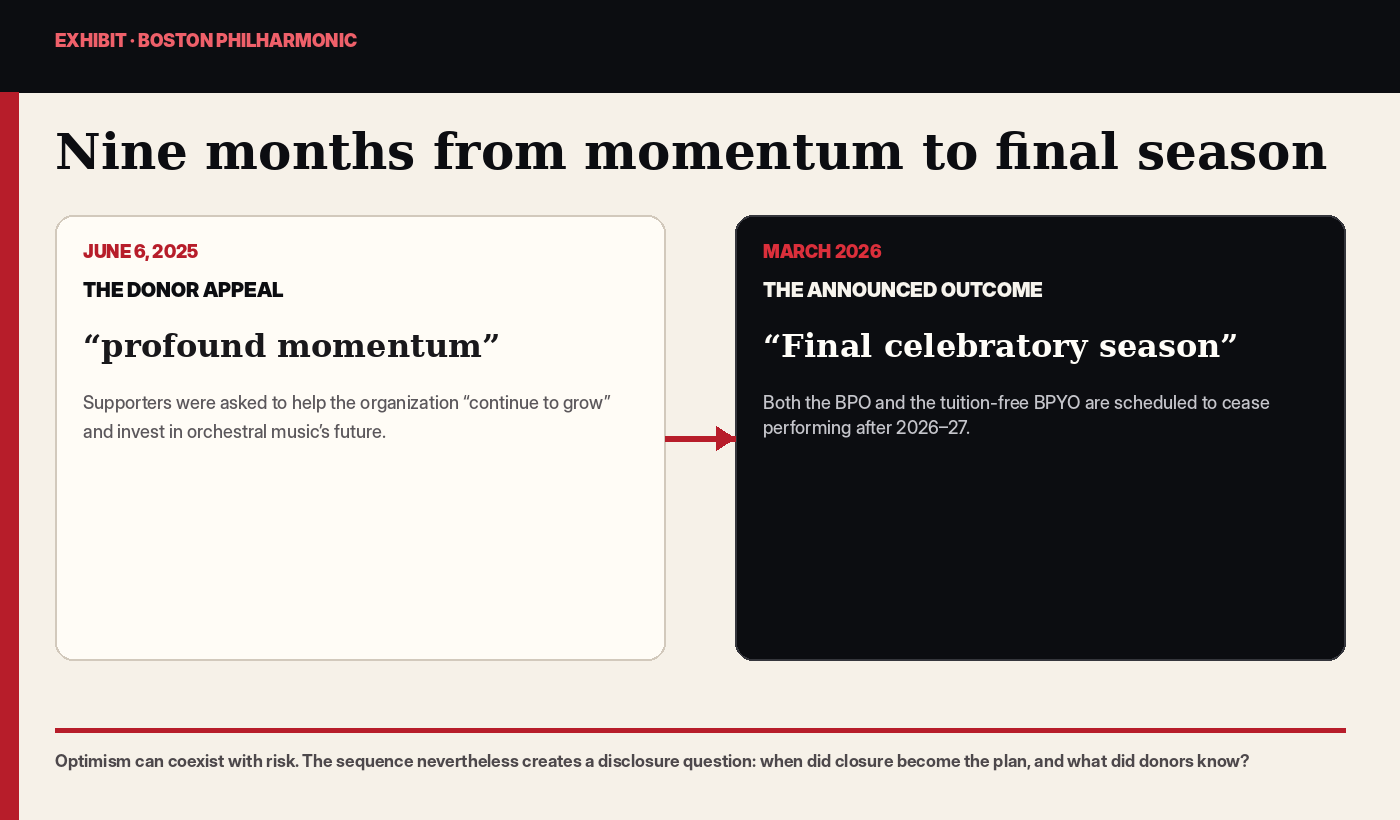
The Zander Center may preserve valuable interpretation classes, lectures, recordings and educational media. Digital access can reach more people than a single orchestra. None of that makes a center equivalent to an ensemble.
An archive stores the record of collective action.
An orchestra creates collective action.
Live ensembles generate opportunities media cannot: a first professional call, a first principal chair, a confrontation with a difficult score, the discipline of a section, the experience of adjusting in real time and the transmission of craft between generations in a room.
When an organization presents preservation of media as succession to performance, it changes the object being preserved. It keeps content and relinquishes capacity.
That may ultimately be the only feasible outcome. If so, years of planning should have produced a file of alternatives.
Was an international successor search conducted?
Were candidates approached?
Was an interim co-conductor considered?
Could the adult orchestra have become musician-led for a transition?
Were merger talks held with a conservatory, university or presenter?
Could the BPYO have been separated into its own nonprofit?
Were major donors asked to endow five years of overlap?
Were the performing assets offered for transfer?
What minimum annual funding would have preserved the youth orchestra?
Without those answers, “final celebratory season” performs the same function as “future vision”: it gives deliberation a polished name while withholding the deliberation.
Forty-eight years is enough time to plan
Succession is difficult in founder-led organizations. That truth cannot become an excuse proportional to the time available.
The BPO existed for nearly half a century before announcing its final season. Zander was not a young founder surprised by sudden retirement. His age was public, and the centrality of his role was obvious. Every strategic plan for the last decade should have treated succession as an immediate operational risk.
A basic nonprofit risk register would identify founder dependence through several indicators:
Contributed revenue tied to one person’s relationships.
Artistic identity tied to one person’s interpretive authority.
Audience loyalty tied to one public personality.
Board culture shaped by one founder.
Educational products branded around one teacher.
No visible successor with comparable legitimacy.
Each indicator appears relevant to the BPO.
The purpose of naming the risk is not to insult the founder. It is to preserve the founder’s work. Responsible boards intervene while the founder remains active enough to introduce successors, transfer donor trust and endorse institutional independence.
The hardest step is psychological. A succession plan requires everyone to imagine the institution without the person who made it meaningful. Founders may fear dilution. Boards may fear conflict. Donors may prefer the certainty of the known leader. Staff may avoid a subject that threatens their positions. Admirers may interpret planning as disloyalty.
Delay feels respectful.
Until delay becomes destruction.
The BPO’s closure announcement indicates that leadership and the board spent years discussing and planning the transition. 2227
That statement makes the outcome more troubling. If there had been no planning, the failure would be negligence. If there were years of planning and the chosen result was to end both performing organizations while establishing a founder-centered legacy institution, then closure appears not to have been the unavoidable collapse of an unprepared organization. It appears to have been a preferred model of succession.
Cadenza cannot know the private constraints. A successor may have been judged artistically inadequate. Donors may have refused to continue. Contracts and staffing may have made an interim model impossible. The board may have concluded that an institution so deeply identified with Zander would become a diminished imitation under anyone else.
Those are serious considerations.
They also reveal the original structural problem: the organization was allowed to become so identified with one individual that continuation itself could be framed as inauthentic.
An institution is not a signature interpretation that must die with its creator. Orchestras have changed music directors throughout history. Some transitions fail. Others create new eras. A successor should not reproduce Zander. The point of succession is difference within continuity.
The BPO could have honored its founder by allowing another artist to argue with the legacy, extend it, change it and keep musicians working.
Instead, the legacy is protected from reinterpretation by ending the live institution.
That is the safest possible treatment of a founder’s image and the most dangerous possible treatment of a founder’s organization.
The youth orchestra is the hardest count in the indictment
The BPO and BPYO should not be treated as the same loss.
The adult orchestra was founded around a particular artistic relationship among Benjamin Zander, musicians and audience. One can argue that its identity is unusually inseparable from him.
The youth orchestra exists for young people.
Renewal is built into its design. Participants age out; a new cohort arrives. That makes its extinction with Zander much harder to defend than the ending of the adult ensemble.
The BPYO’s own materials call its mission “Shaping Future Leaders Through Music.” They describe approximately 120 musicians aged twelve to twenty-one, selected through audition, participating tuition-free so that financial circumstances do not determine access. Its FAQ says Zander gives weekly leadership assignments and leads discussions about contribution, musical purpose and the mission of an orchestra. 4425
Those words establish an unusually direct standard.
Leadership is not only inspiration while the leader is present.
Leadership is preparation for the moment the leader is absent.
The BPYO’s 2025 appeal framed each contribution as support for orchestral music’s future. The organization said donor support enabled it to give more students access, reach global audiences and continue growing as a cornerstone of Boston’s culture. 43
The current plan gives the final cohort a final European tour. It gives the next cohort no institution.
This is not merely a rhetorical inconsistency. It is a distributional choice across time.
Current students receive the accumulated donor network, reputation, systems and founder attention. Future students—some of them now children who have not yet chosen an instrument—receive none of it unless another organization reconstructs the capacity from scratch.
Tuition-free matters. Serious music training already requires private lessons, instruments, transportation, recordings, summer programs and family time. The BPYO did not erase inequality, but it removed one major institutional price barrier. Its disappearance narrows an advanced pathway in a city that publicly celebrates access.
An access program is not successful because one cohort enters.
It is successful because the door remains for the next cohort.
The youth orchestra is also a separable asset. Its name, alumni network, audition process, rehearsal systems, tour knowledge, music library, teaching relationships, donor contacts and public reputation have value independent of the adult BPO series. Even if Zander’s professional ensemble could not continue, the BPYO could have been offered to a new governing body.
Boston contains plausible partners: conservatories, universities, youth-music organizations, foundations and presenters. Transfer would be difficult. It might require a new name, smaller first season, different conductor, shared administration or reduced touring. It would involve negotiations over intellectual property, insurance, staff and restricted gifts.
Complexity is not impossibility.
The public announcement does not describe an open request for proposals, merger process or rescue campaign. It moves from final season to legacy center.
The children do not turn 88 because Benjamin Zander does.
That sentence is severe because the result is severe.
A final tour may be transformative for students already inside. It does nothing for the thirteen-year-old who would have auditioned the following season.
The test of educational leadership is not whether the final students receive a beautiful farewell.
It is whether there is a first rehearsal for the next students.
The BPO’s finances do not establish immediate insolvency
The Boston Philharmonic’s public tax data provide context that the farewell narrative alone does not.
For fiscal year 2025, the organization reported approximately $3.48 million in revenue and $3.27 million in expenses, producing positive net income of about $214,000. It ended the year with roughly $1.01 million in net assets. Contributions accounted for approximately $3.01 million, or 86.5 percent of total revenue. 26
The prior years were weaker. Fiscal 2024 showed revenue of about $3.36 million against expenses of roughly $3.90 million, a deficit near $540,000. Fiscal 2023 showed revenue around $4.02 million and expenses around $4.20 million, a deficit of approximately $176,000. 26
These figures support several conclusions.
The BPO is small compared with the BSO.
It is heavily donor-dependent.
It experienced meaningful deficits.
Its net-asset cushion is limited.
It nevertheless did not enter fiscal 2025 as a balance-sheet ruin. The most recent year in the dataset was positive.
A one-year surplus does not guarantee sustainable operations. Contributions can be volatile. A final-season campaign or unusual gift can distort a year. Touring and youth programming are costly. Founder-linked donations may disappear on retirement. The tax return cannot reveal every restriction or future commitment.
But the numbers undercut any simple claim that the orchestra had no option because it was already financially dead.
The stronger financial story is concentration risk. More than four-fifths of revenue came from contributions. If donors gave to Zander rather than to an independent mission, succession could cause revenue to collapse. That is precisely why fundraising transfer should have been a central board responsibility years earlier.
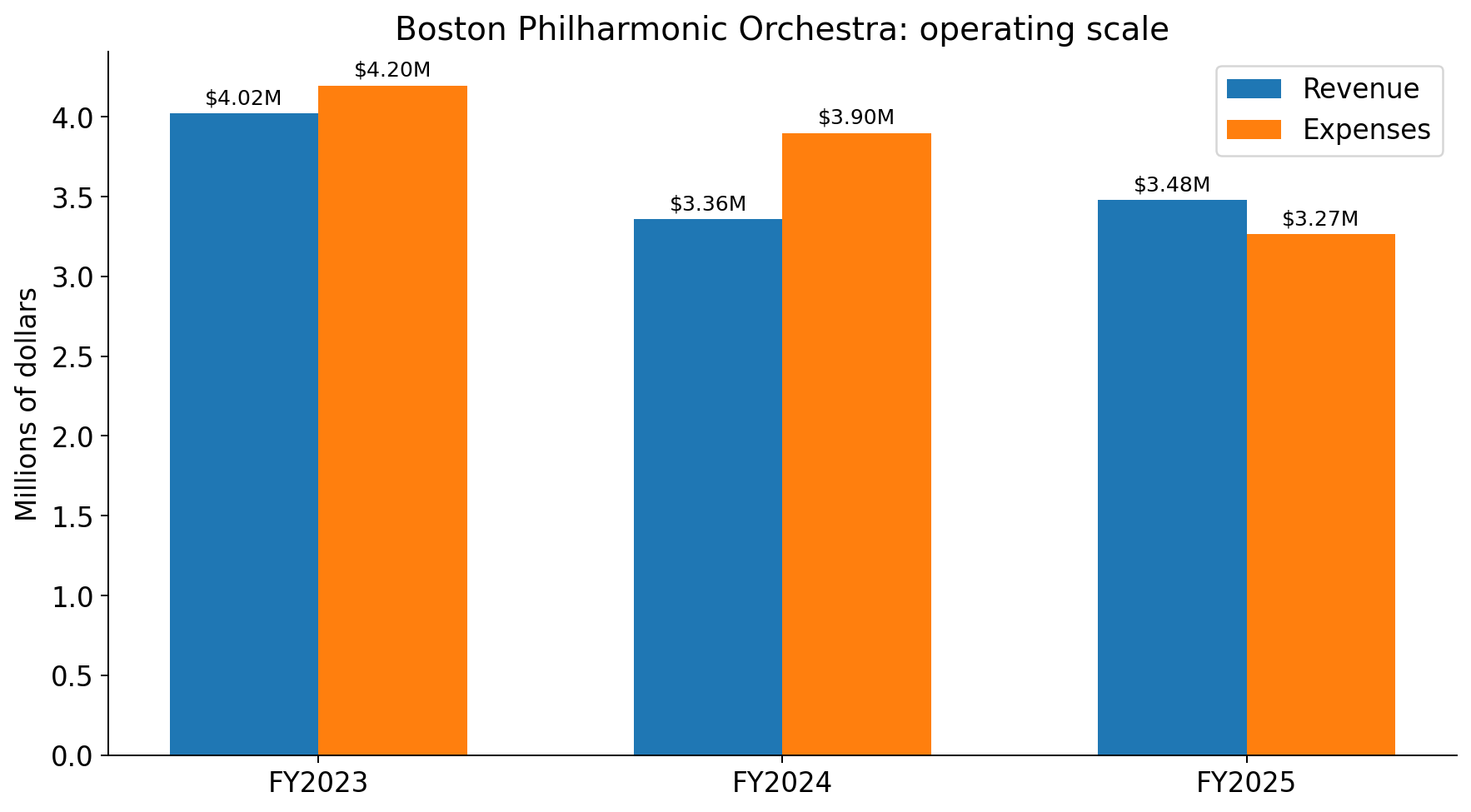
The public deserves a transition budget.
What would it cost to operate only the BPYO?
What portion of current contributions is expected to continue after Zander?
What unrestricted reserves are available?
What assets will transfer to the Zander Center?
Will funds donated to support live performance be used for digital legacy work, and under what restrictions?
Were donors given the option to redirect gifts toward a successor youth organization?
What salaries or contracts end with the ensembles?
What liabilities remain?
These are not hostile questions. They are the ordinary questions of charitable stewardship.
The organization’s tax filing listed no salary compensation for Zander in the reported line, aside from a small amount in other compensation. That fact complicates the image of a founder extracting personal financial benefit. 26
The criticism is not that Zander got rich from closing an orchestra.
It is that the organizational structure appears to preserve his named educational legacy more effectively than the live institutions built around it.
That is a question of power and priority, not personal enrichment.
The Zander Center: preservation or canonization?
Legacy institutions can perform important public work. Archives disappear when no one digitizes them. Interpretation classes, lectures, annotated scores and recordings can teach future musicians. A well-designed Zander Center could become a serious educational resource.
The danger is canonization.
When an organization transitions from a living ensemble to a center dedicated to its founder, the founder moves from participant in an evolving institution to the fixed subject of the institution. Disagreement becomes curation. Successors become interpreters of the founder rather than leaders with independent authority.
That structure protects reputation. It can also freeze artistic life.
Zander’s teaching has emphasized possibility: the transformation that occurs when people encounter a score, a leader or one another differently. A performing institution embodies possibility because the outcome is not secured. A new conductor might challenge his tempos. Musicians might develop a different sound. Audiences might resist and then respond. The legacy would remain alive because it could be changed.
An archive offers certainty. The recorded class will always end the same way.
This is the paradox of memorial culture. In trying to preserve a person’s influence, institutions may remove the conditions that made influence possible.
The BPO existed because musicians gathered to make decisions under pressure. The BPYO existed because young people risked failure in public. The Zander Center may preserve the explanation of those acts. It cannot reproduce their institutional consequence unless it also creates live opportunities.
The center could answer this critique by becoming more than an archive. It could operate fellowships, sponsor a successor youth ensemble, fund guest-conductor residencies, preserve music libraries for public use, support orchestral training and distribute grants to organizations continuing the educational mission.
No public announcement identified in the sources reviewed establishes that scale of live continuation.
Until it does, the transition looks less like the preservation of possibility than the preservation of Benjamin Zander.
That conclusion is painful because the man’s work deserves preservation. It is also why the standard should be high. The greater the legacy, the greater the obligation not to reduce it to a museum of itself.
The strongest defense of Zander and the board
The defense begins with artistic truth: some institutions really are inseparable from their founders.
The BPO’s audience may attend specifically for Zander’s interpretations and talks. Its donors may support his work rather than a generic orchestra. Its musicians may have other primary employment and gather for this particular relationship. A successor could inherit the name but not the purpose. Continuation might become institutional ventriloquism—someone else conducting inside Zander’s brand.
The board may also have explored alternatives privately and concluded that none was financially responsible. A public successor search could humiliate candidates or damage final fundraising. A merger partner might demand control inconsistent with donor restrictions. The BPYO’s international touring and tuition-free model may require a fundraising level unavailable without Zander. Closing with dignity can be better than spending reserves on a diminished afterlife.
There is wisdom in knowing when an institution’s form has completed its work. Not every nonprofit must become immortal. The cultural sector contains too many organizations preserved through inertia because boards fear admitting that a mission can be fulfilled elsewhere.
This defense deserves respect.
It still requires evidence.
If the BPO is uniquely personal, the board should explain why it incorporated and raised charitable money as an institution rather than a finite artistic project. If donors understood that performances would end with Zander, that expectation should be documented. If alternatives were examined, publish the categories and reasons for rejection without violating confidential negotiations.
The defense is weakest regarding the BPYO. Youth education is not inherently tied to one conductor. A successor would necessarily change the program, but change is the normal condition of education. The students are already different every year.
The board may answer that the BPYO’s distinct philosophy is Zander’s philosophy. Fine. Transfer the operational assets under a new name. Allow another institution to create something different from the infrastructure taxpayers, donors, families and musicians helped build.
No one has a moral right to perpetual use of the BPO name.
The public has a legitimate interest in whether the capacity is discarded.
The leadership question Zander must answer
Zander has spent decades speaking to executives and organizations about leadership. His public message emphasizes possibility, engagement and the ability to awaken potential in others. That history makes the succession question unavoidable.
Leadership is not merely the ability to produce excellence while present.
It is the ability to create conditions in which excellence can continue without you.
A conductor controls time. He decides when an ensemble begins, how tension accumulates and where a phrase releases. Institutional leadership demands a longer sense of time. The final cadence is not retirement; it is succession.
What did Zander do to identify and empower conductors capable of carrying parts of the mission?
What authority did he transfer while he still possessed it?
What donor relationships became institutional rather than personal?
What governance reforms allowed the board to imagine a future without his approval?
What parts of the BPYO could continue under different artistic principles?
If those efforts failed, what did he learn?
The public does not need a confession. It needs an honest account.
Zander can say that the work was intentionally finite. He can say the institution’s true legacy is its alumni and recordings. He can say a successor orchestra would be false. He can say the funding was unavailable. Each answer can be evaluated.
Silence leaves the harsher interpretation intact: after forty-eight years, the institution was allowed to remain a biography with a payroll.
The line is cruel only if the responsibility is small.
The responsibility is enormous.
Part V — The ecosystem everyone assumes someone else will save
Boston does not lack money
The phrase “there is no money” is rarely true in a wealthy city. The accurate phrase is “the people who control money have chosen other uses for it.”
Boston and its metropolitan region contain extraordinary concentrations of private wealth, university endowments, hospital systems, foundations, technology capital, finance and real estate. The BSO itself holds hundreds of millions in net assets. The BPO raised more than $3 million in contributions in its most recent reported year. Symphony Hall attracts politicians because it symbolizes a city that believes itself culturally important. 1726
The problem is not absence. It is fragmentation and preference.
Cultural philanthropy often rewards capital projects, named spaces, access initiatives, special productions and founder legacies. Those gifts create visible objects and discrete stories. Unrestricted operations are harder to sell. Succession planning is harder still. A donor can see the room bearing a family name. It is less satisfying to finance a deputy artistic director who may someday replace a beloved founder.
Yet organizations usually fail in the unglamorous spaces between gifts.
They fail because the annual operating model depends on extraordinary fundraising every year.
They fail because no one funds the transition period when two leaders overlap.
They fail because databases, development staff and audience research are treated as overhead.
They fail because donors underwrite innovation but not maintenance.
They fail because a board prefers a final gala to five uncertain seasons under a successor.
Boston’s donor class cannot claim helplessness while retaining the power to determine which forms of culture receive continuity.
The BPO’s tax data show how concentrated that power is. With more than 86 percent of fiscal-year 2025 revenue coming from contributions, donors were not peripheral supporters. They were the business model. 26
If the organization could not continue without Zander, one explanation is that donor loyalty was not transferred from the person to the mission. That transfer is a governance task, but it is also a donor choice. Philanthropists who say they care about youth, education and access should be asked whether their support ends when the charismatic founder leaves.
The BSO offers a different problem. Its scale and assets can make donors assume that the institution will survive regardless of governance quality. Survival, however, is not the only standard. A wealthy orchestra can become artistically timid, administratively bloated, mistrusted by musicians and disconnected from audiences while remaining solvent enough to avoid collapse. Donors who continue writing checks without demanding transparency subsidize the insulation.
Philanthropy should therefore adopt a continuity test.
Before funding a major cultural institution, ask:
Does the board have a current succession plan for artistic and executive leadership?
Are musicians or artists represented in governance?
What percentage of revenue is unrestricted and recurring?
How are audience retention and first-time return measured?
What happens if the founder or principal donor leaves tomorrow?
Does the organization publish enough financial and strategic information for outsiders to understand risk?
Are grants expanding a durable system or adding a temporary program to a weakening core?
These questions are not anti-philanthropic. They protect gifts from being converted into memorials for organizations that leaders failed to maintain.
Boston Family Days illustrates both the promise and limitation of philanthropy. Private funding helps families enter major cultural institutions. That is valuable. But the presence of Barbara and Amos Hostetter among the funders also demonstrates how the same small network can influence public access, institutional governance and elite cultural policy. 1016
Concentration is not corruption. It is risk.
A city whose cultural future depends on the preferences of a limited donor class requires stronger public convening and transparency. Otherwise, strategic decisions occur inside overlapping social networks where generosity can discourage scrutiny.
Gratitude is not governance.
The conservatories train musicians for an ecosystem they do not govern
Boston’s musical prestige depends heavily on education. The region’s conservatories, universities and pre-college programs attract students from around the world. They produce performers, teachers, composers, administrators and audiences. Their brochures treat Boston itself as part of the educational offer: students will live among major orchestras, halls, ensembles and artistic networks.
That offer creates responsibility.
A conservatory cannot guarantee employment. It cannot rescue every ensemble. Its primary legal obligations are to its own institution and students. But when the surrounding ecosystem contracts, schools cannot behave as neutral suppliers of more musicians.
The BPYO’s closure should have triggered immediate interest from every major music school in the region. A tuition-free youth orchestra is not redundant simply because conservatories operate ensembles. It serves students before or outside full-time collegiate enrollment and creates a bridge into advanced training. Its touring, alumni and audition infrastructure could complement existing programs.
A transfer would present obstacles. Universities move slowly. Labor rules, facilities, insurance, child protection, fundraising and branding require negotiation. A school might not want to inherit deficits or a founder-centered culture. It might prefer to develop its own program.
Those are reasons to design a process, not reasons to accept extinction without one.
Boston’s music schools should publicly answer whether they were approached about the BPYO and, if so, what conditions prevented continuation. If they were not approached, the BPO board should explain why. If no single school can absorb the ensemble, a consortium could share rehearsal space, administration and teaching resources.
The conservatories also have a role in the BSO governance debate. They train students to understand artistic standards, orchestral culture and professional ethics. Their faculty often perform inside the same ecosystem. Yet higher education tends to avoid confronting powerful cultural employers. Relationships, donor overlap and career dependence encourage silence.
That silence teaches a lesson too.
Students learn that institutions speak publicly about equity and courage while privately treating governance conflict as dangerous. They learn to write statements about social values but not to question the board that controls their possible employer. They learn that artistic labor is celebrated rhetorically and excluded structurally.
A healthier educational culture would treat nonprofit governance as part of professional training. Musicians should understand tax filings, contracts, board duties, endowments, donor restrictions, succession and audience economics. Otherwise, they enter careers in which administrative decisions determine their lives while they are told that finance is someone else’s expertise.
That separation benefits management.
The artist who understands only the score can be excluded from the budget conversation. The administrator who understands only the budget can redefine the artistic mission without challenge.
Boston’s institutions should train leaders fluent in both.
The audience is not a demographic problem to be solved
Arts organizations often speak about “the audience” as though it were a failing external constituency.
The audience is aging.
The audience is not diverse enough.
The audience will not subscribe.
The audience wants shorter concerts.
The audience needs digital content.
Some of these observations are supported by data. The tone, however, often treats people as a market segment that has disappointed management rather than as partners whose trust must be earned.
Audiences do not owe institutions attendance because the institutions are historic. They do not owe loyalty to a board whose decisions they cannot understand. They do not owe enthusiasm for programming designed by committee. They are not morally deficient because they compare ticket prices with other uses of time and money.
At the same time, critics should not romanticize audience preference as infallible. Institutions have a duty to challenge listeners, present unfamiliar work and resist becoming jukeboxes for the most marketable canon. Artistic leadership sometimes requires asking an audience to follow before it understands the destination.
The relationship depends on trust.
A listener accepts unfamiliar music because the institution has built credibility. A subscriber tolerates uneven nights because the season forms a larger argument. A donor funds risk because artists appear to be taking meaningful rather than fashionable risks. A family returns after a free event because the experience felt genuine, not because a marketing funnel captured an email address.
Boston’s current governance failures damage that trust.
The BSO tells audiences that a celebrated conductor must leave but not why. The BPO tells them that the orchestra and youth ensemble will end as part of a positive transition. City Hall tells them culture is infrastructure while proposing a severe cut to the office responsible for supporting it.
Each institution asks the audience to accept words contradicted by observable reality.
Then leaders wonder why people disengage.
The audience-development crisis will not be solved solely by cheaper tickets. Price matters, especially for families and younger adults, but trust determines whether a discounted visitor becomes a returning listener.
Nor will it be solved solely by representation. A program that reflects more communities can create entry points and correct historical exclusion. It cannot compensate for weak artistic conviction or confusing institutional identity.
The most effective audience strategy is an orchestra that knows why it exists, communicates that purpose clearly and invites people into excellence without treating knowledge as a prerequisite.
Zander understood part of this. His talks attempted to give listeners tools without condescension. The tragedy is that the institution built around that relationship did not produce a visible successor who could create a different but equally serious invitation.
The BSO’s opportunity is larger. Its musicians are among the most powerful audience-development assets Boston possesses. Give them public voice. Let sections curate programs. Build recurring neighborhood residencies around individual players. Explain decisions honestly. Make the institution feel inhabited by artists rather than administered around them.
A city does not rebuild an audience by deciding what demographic categories ought to care.
It rebuilds an audience by giving actual people something worth caring about and a reason to believe their care is respected.
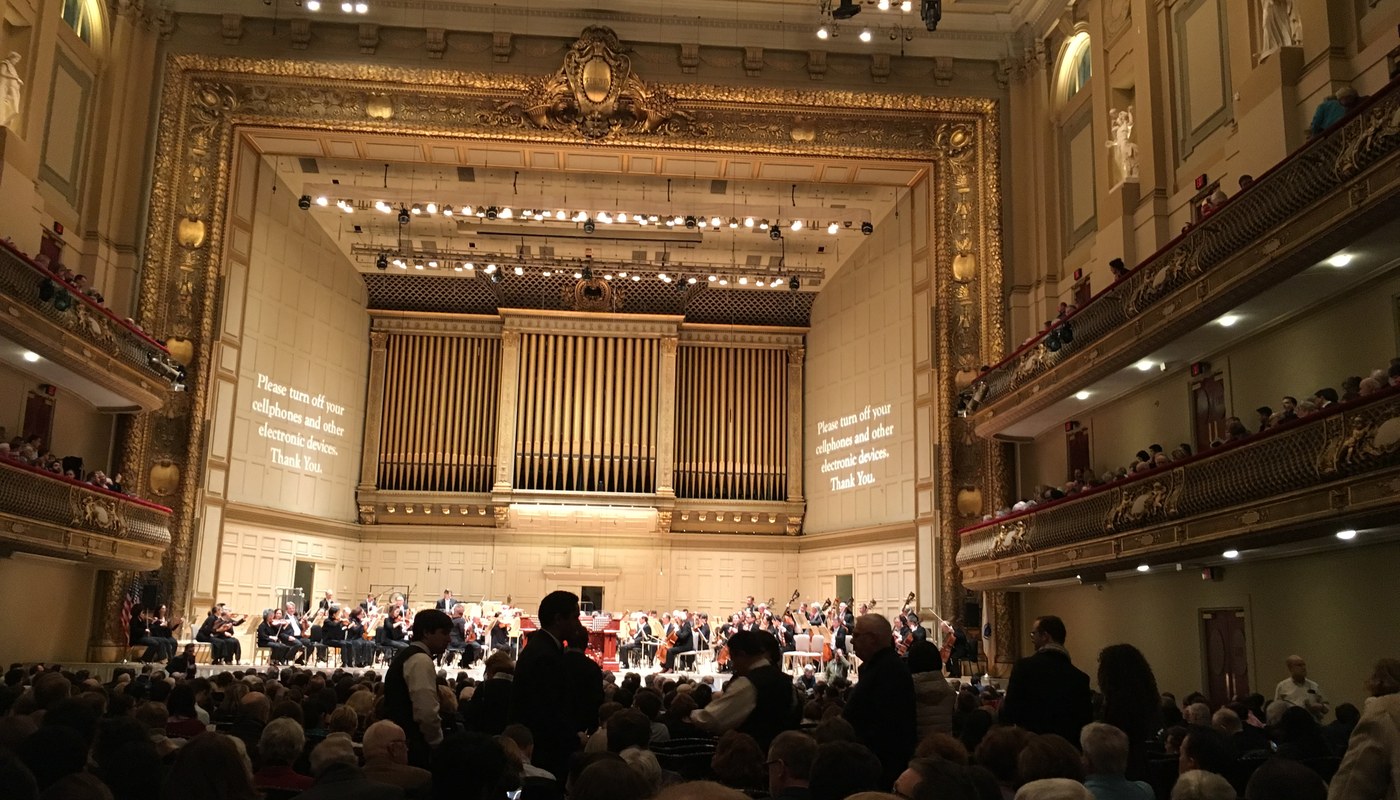
Housing, cost and the invisible cultural exodus
Boston’s arts crisis cannot be separated from the cost of living.
Musicians often assemble careers from multiple employers: orchestra services, teaching, church work, recording, touring, chamber music and private lessons. Their income may be respectable in aggregate and precarious in timing. Housing costs turn schedule gaps, illness and canceled work into immediate risk.
When artists move farther from the city, the ecosystem pays hidden costs. Commutes become longer. Last-minute substitutions are harder. Rehearsal attendance requires more time. Informal collaboration declines. Teaching becomes geographically fragmented. Young musicians decide that the prestige of Boston does not justify the expense.
Audiences face similar pressure. A concert ticket is only one component of the night. Transportation, parking, food, childcare and time create an all-in price. Institutions can discount seats and still lose the household decision.
City Hall has broader responsibility here than it does over a private orchestra’s music director. Housing, transit, zoning, late-night transportation and public space all shape cultural participation. Wu’s focus on housing and municipal services therefore belongs in the best case for her administration. Cultural policy cannot be reduced to arts grants.
But that broader view should increase coordination. If affordability is driving artists and audiences away, the city needs a cultural-labor strategy connected to housing and transit policy.
Possible tools include artist-preference units in selected developments, rehearsal-space requirements in cultural districts, property-tax incentives for affordable studios, late-night transit coordination after performances, shared municipal rehearsal facilities and grants tied to fair pay.
None will save an organization that refuses succession. They address the environment in which succession must operate.
Culture-war criticism sometimes treats every urban problem as the result of ideological excess. Boston’s housing crisis has deeper causes: constrained supply, regional fragmentation, land costs, permitting, demand from high-income sectors, university expansion and national economic forces. It would be foolish to claim that a diversity statement raised rent.
The ideological failure lies elsewhere. Progressive cities often describe artists as essential to vibrant, inclusive neighborhoods while presiding over economic conditions that displace them. Murals and cultural districts then become aesthetic evidence of community after the people who created the culture can no longer afford to remain.
The same pattern appears inside institutions. Musicians are celebrated as the heart of the orchestra while strategic power and financial security remain elsewhere.
Symbolic centrality, material precarity.
That may be the most concise description of contemporary cultural labor.
Federal retrenchment is real—and local passivity is still a choice
Boston’s cultural institutions operate inside a national funding crisis. Federal arts support has faced political attack and retrenchment. New England organizations reported substantial lost funding and employment effects in 2026. Cadenza has examined the wider pattern of American orchestral contraction separately. 3239
This context matters because local leaders can reasonably say they are absorbing shocks beyond their control. Federal grants often leverage private gifts, support experimental work and reach smaller organizations without large development departments. Their removal forces cities, states and donors to decide whether to replace them.
It also creates a danger of convenient blame.
When every problem is attributed to Washington, local governance escapes review. The BSO’s decision regarding Nelsons was not dictated by a federal grant. The BPO’s succession model was not written by Congress. Boston’s initial arts-office reduction was filed by City Hall.
External pressure reveals priorities; it does not erase agency.
A city that expects less federal support should strengthen local coordination. It should identify which cultural capacities would be difficult or impossible to rebuild after loss. It should distinguish between temporary program cancellation and irreversible institutional extinction. It should create matching funds that encourage private donors to replace lost public support.
Massachusetts has state cultural infrastructure and grant mechanisms that can be part of such a response. 33 The challenge is fragmentation: city, state, foundations, universities and private institutions each possess pieces of the solution while no one accepts responsibility for the whole.
This is why the mayor’s convening role matters. Wu cannot print federal money. She can bring the actors into one room and require a continuity plan.
The absence of such a plan is not fiscal destiny.
It is political choice.
Media euphemism and the performance of neutrality
Cultural journalism often struggles to cover institutions that supply access, advertising, sources and prestige. The result is a language of managed decline.
A conductor is “moving on.”
An orchestra “concludes a chapter.”
A youth ensemble “celebrates its legacy.”
A board “embraces a new vision.”
A budget “reflects difficult choices.”
Each phrase can be factually defensible and morally evasive.
Neutrality should not mean adopting the institution’s nouns.
When an orchestra ceases performing permanently, it closes.
When a board decides not to continue a conductor who wants to remain, it removes him from the future of the institution.
When a mayor proposes 27 percent less money, she proposes a cut.
When a youth orchestra has no next season, young musicians lose an institution.
Plain language is not activism. It is a prerequisite for analysis.
Cadenza’s own previous coverage of Boston has not always met that standard. Our farewell article about Zander emphasized beauty, mortality and Mahler. It captured the artistic emotion of the final season but did not interrogate succession hard enough. 31
This article corrects that imbalance.
Correction is not a sign that earlier work was worthless. Journalism should become sharper as evidence and implications accumulate. A publication that never revises its framing is protecting its pride rather than pursuing truth.
Media also tend to personalize artistic conflict while depersonalizing administrative power. The conductor’s temperament, schedule and repertoire are examined. Trustees appear as “the board,” an abstract collective. Executives speak through institutional statements. Donors remain unnamed unless they fund something celebrated.
This structure distorts accountability. A board is composed of people. A strategic decision has authors. A transition has beneficiaries and costs.
Naming leaders is not harassment. It is how nonprofit governance becomes visible.
The same standard should apply to Cadenza. This article uses forceful language and makes editorial demands. Readers should be able to inspect its sources, distinguish fact from inference and submit corrections. The right-of-reply questions are published in full precisely because aggressive opinion without procedural fairness becomes propaganda.
The goal is not to sound neutral.
It is to be fair enough that the argument remains standing after the institutions answer.
The ideological economy of cultural administration
Why do organizations become so skilled at progressive language while remaining weak at continuity?
Part of the answer is labor-market incentive.
Arts administrators advance through institutions that increasingly evaluate candidates on their ability to speak about inclusion, partnerships, audience development, community engagement and organizational change. Those skills matter. They are also portable. An executive can move from one institution to another with a vocabulary of transformation even when results at the previous institution remain uncertain.
Succession work is less portable. It requires deep local relationships, patience and willingness to create power for someone else. Audience rebuilding may take a decade. Labor trust is difficult to quantify. Protecting institutional memory rarely produces a conference keynote.
Boards face similar incentives. Trustees want to be associated with modern, admired institutions. Supporting access initiatives and new strategic language demonstrates relevance. Challenging a founder about succession can damage friendships. Questioning an executive’s theory can make a trustee seem resistant to change. Insisting on artistic criteria may be portrayed as nostalgia.
The ideological economy rewards visible alignment and hides invisible maintenance.
Consultants reinforce the pattern. Strategic plans often contain language broad enough to satisfy multiple constituencies: innovation, belonging, sustainability, excellence, collaboration. Because the goals are abstract, failure can be explained by incomplete implementation rather than a mistaken theory.
Artists experience the consequences concretely. Their work is canceled, their conductor removed, their ensemble closed or their grant lost.
This does not mean every administrator is cynical. Many are overworked people trying to keep difficult institutions alive. The problem is systemic: the available language makes it easier to demonstrate virtue than to admit tradeoffs.
A city that wants cultural continuity must change the incentives.
Fund organizations that publish succession plans.
Require artist representation in governance.
Measure repeat attendance, not only first-time access.
Reward unrestricted reserves and realistic operating budgets.
Ask executives to state what they will stop doing, not only what they will launch.
Require boards to publish postmortems when major initiatives fail.
Make maintenance prestigious.
Until then, Boston will continue producing leaders fluent in the future who leave less behind.
The distributed-responsibility machine
Cultural decline becomes politically stable when responsibility is divided among enough actors.
The city says it does not control private nonprofits.
The state says local institutions should lead.
The board says management developed the plan.
Management says the board holds authority.
Donors say they respond to institutional proposals.
Institutions say donors will not fund operations.
Conservatories say they educate rather than employ.
Audiences say programming no longer speaks to them.
Artists say they lack power.
Critics say markets have changed.
Every statement contains some truth. Together they create a machine in which no actor possesses enough responsibility to be blamed and every actor possesses enough excuse to remain passive.
The machine is especially effective in Boston because the city’s institutions are prestigious. Prestige reassures people that someone competent must be in charge. The BSO has trustees. The BPO has a board. City Hall has an arts office. Universities have presidents. Foundations have program officers. Surely the system will respond.
Then the announcement arrives: final season.
The proper response is to reconstruct responsibility around the specific power each actor holds.
City Hall can convene, fund and signal urgency.
The BSO board can explain decisions, reform governance and include musicians.
The BPO and Zander can publish alternatives and offer youth assets for transfer.
Donors can fund succession and operations.
Conservatories can receive educational infrastructure.
Audiences and media can demand answers and reward artistic seriousness.
No actor can solve the entire problem. Each can stop pretending to be powerless.
Part VI — The values–stewardship contradiction
Inclusion without power
The arts sector speaks constantly about inclusion. The word can mean access, representative hiring, disability accommodation, affordability, diverse repertoire, welcoming language or protection from discrimination.
Those goods are real. They are not identical.
Boston’s cultural crisis exposes a missing category: inclusion in power.
Musicians may be included on stage and excluded from strategy.
Families may be included in free-admission programs and excluded from any assurance that the producing institution remains stable.
Young players may be included in a tuition-free orchestra and excluded from the succession decisions that eliminate it.
Residents may be included in civic celebration and excluded from understanding how charitable assets and public priorities are governed.
Presence is not authority.
An orchestra could improve demographic representation and remain autocratic. A city could distribute thousands of free tickets while reducing the capacity that creates programs. A board could publish an excellent equity statement and surprise the artists with a decision defining their future.
The next stage of inclusion must be constitutional rather than cosmetic.
Who votes?
Who sees information?
Who sets criteria?
Who can delay a decision?
Whose objection requires a written answer?
Who owns the consequence?
For the BSO, inclusion means formal musician power in artistic succession.
For the BPYO, it means treating students, families, alumni and teachers as constituencies in a transferable mission rather than beneficiaries of a founder’s discretion.
For City Hall, it means involving cultural workers in budget design before reductions appear.
For donors, it means financing structures that survive individual preference.
Without power, inclusion is an invitation issued by people who can revoke the room.
Collaboration without shared authority
The BSO’s phrase “radical collaboration” is useful because it is so ambitious. Radical collaboration would not merely increase the number of conversations. It would alter where authority sits.
A musician committee with access to strategic criteria is structural.
A listening session is procedural.
A trustee obligation to answer the players’ written assessment is structural.
A survey is procedural.
An elected artist vote in the search is structural.
A photograph of musicians at a planning event is symbolic.
The same test applies to the city. A cultural-continuity summit with money, deadlines and assigned owners would be structural. A celebration of creativity without a rescue mechanism is symbolic.
And it applies to Zander. Transferring the BPYO to an independent board would be structural. Preserving videos about leadership while ending the ensemble is memorial.
This is why language matters. It allows the public to see whether leaders are using words literally.
Sustainability without survival
“Sustainability” can refer to climate, finance, workload, touring, buildings or long-term planning. Its breadth makes the term safe.
It should be tested literally.
Does the capacity continue?
The BSO may be financially unsustainable at its current operating pattern. Intervention is necessary. A sustainable strategy must protect artistic trust as well as reduce deficits. A poorly explained conductor rupture can create transition costs, donor uncertainty and internal damage.
The BPO may have judged that its contribution-heavy model could not survive Zander. A sustainable transition should then have begun years earlier through diversified revenue, shared authority and overlap. Ending the activity makes the line sustainable by deleting the line.
City Hall may have faced legitimate fiscal pressure. Cutting a tiny arts office can make a budget table balance without making Boston’s cultural ecosystem more durable.
This is accounting sustainability: the problem disappears because the program or institution does.
Real sustainability preserves capacity through change. It accepts that transition may temporarily require inefficiency. A successor may need to work beside a founder. An audience strategy may lose money before habit forms. A municipal grant may prevent a larger future rescue.
Culture accumulates slowly. Ensembles develop sound over years. Donor trust and audience behavior repeat across generations. Once dispersed, those systems cannot be recreated by reversing a line item.
The contradiction is not ideological in the abstract. It is empirical: institutions use the word sustainability while choosing outcomes that terminate the thing supposedly being sustained.
Transformation without succession
“Transformation” flatters every participant. It implies courage, modernity and motion. No executive wants to promise maintenance, even when maintenance is the heroic need.
The BSO’s stated plan implies transformation after Nelsons.
The BPO describes transition into the Zander Center.
City Hall frames contraction as a narrower operating plan.
Transformation is not automatically improvement. A fire transforms a building.
The moral content depends on what is carried forward, who consents and who pays.
In Boston, musicians pay through uncertainty. Young players pay through lost opportunity. Audiences pay through broken continuity. Leaders retain the privilege of naming the change.
Succession is more demanding because it requires a receiver. Someone must take authority. Assets must transfer. Knowledge must be taught. Donors must be introduced. Failure can be located.
Transformation can end in an abstract destination.
Succession ends with another person responsible.
The BSO announced the ending of one artistic era without publishing a search constitution capable of restoring trust. The BPO announced a legacy institution rather than a performing successor. City Hall announced infrastructure language without a continuity program.
A future without succession is not a future.
It is a press release after an ending.
Possibility without relinquishment
Benjamin Zander’s public work is organized around possibility: the capacity to reframe limits, awaken contribution and lead people toward outcomes they did not imagine.
That philosophy makes the succession failure more—not less—important.
The final possibility is relinquishment.
Can the founder allow the mission to continue under a person who interprets differently?
Can donors be introduced to a successor rather than a memorial?
Can the youth orchestra change its name, reduce its touring, share administration or adopt a new conductor in order to remain alive?
Can the Zander Center support an institution Zander does not control?
If every possibility ends at preservation of the founder’s own corpus, possibility has become branding.
The strongest proof of a teacher’s impact is not that students remember him.
It is that they inherit authority.
The institution reaches the future—or the values are ornamental
Cultural organizations publish values: excellence, access, equity, innovation, collaboration, education and sustainability.
Existence is not always a sufficient value. Harmful institutions may deserve closure. Resources can be transferred into better forms.
But when the mission remains valuable, continuity is the condition that makes every other value possible.
An orchestra that closes cannot diversify next season.
A youth ensemble that disappears cannot recruit the next cohort.
An arts office stripped of outward capacity cannot distribute access effectively.
A board that loses artist trust cannot collaborate through a statement.
The first test of every decision should be:
Does this increase the probability that the mission will serve people ten years from now?
If not, what superior institution receives the assets, knowledge and constituency?
If neither answer exists, the values are ornamental.
Boston’s establishment is confident that it holds the right values. Its record does not yet show how those values reach the next generation.
Part VII — The case against this article
Maybe ideology is not the decisive variable
The most immediate objection is terminological.
Some critics will call the pattern examined here woke. Others will call it managerialism, nonprofit progressivism, elite institutional culture or ordinary incompetence wrapped in fashionable language. The first term is imprecise and heavily weaponized. It can signal that a conclusion preceded the reporting, attract readers eager to blame immigrants or minority musicians for decisions they did not make, and flatten municipal policy, nonprofit governance, philanthropy and artistic leadership into one culture-war grievance.
That objection has force. It is why the title names a crisis of stewardship rather than announcing an ideological verdict.
The term still belongs inside the analysis because the failure is not merely technical. Boston’s leaders and institutions publicly seek authority through the language of belonging, equity, collaboration, sustainability, transformation and public values. The question is whether that moral language sometimes protects decision-makers from ordinary tests of competence, continuity and power-sharing.
Readers should therefore remove the label and retest every claim. The budget figures remain. The Nelsons explanation remains underdeveloped. The musicians’ opposition remains. The BPO and BPYO are still scheduled to close. The succession questions remain unanswered. If the case survives without the culture-war word, it is evidence rather than branding.
The article also rejects the lazy causal story. Immigration policy did not remove Nelsons. Diversity initiatives did not close the BPYO. No progressive program is alleged to have produced each loss. The criticism is narrower: values-language becomes dangerous when institutions treat it as evidence of stewardship rather than a promise that stewardship must fulfill.
Maybe the mayor has almost nothing to do with this
A second objection concerns jurisdiction.
Michelle Wu does not appoint the BSO board. She does not employ Nelsons. She does not control the BPO’s charitable corporation. She cannot order donors to support a successor. The mayor’s direct operating budget for arts is tiny precisely because Boston’s major institutions are not municipal agencies.
Holding her responsible for private decisions risks converting the mayor into a symbolic villain merely because she is the most visible progressive in the city.
This objection also has force.
The article does not argue that Wu bears equal responsibility for every event. The BSO board owns the Nelsons decision. Zander and the BPO board own their transition. Donors own their funding choices. The mayor’s responsibility is civic coordination and municipal priority.
A city is more than the assets legally titled to City Hall. Mayors regularly convene private hospitals, universities, developers, employers, sports organizations and nonprofit leaders when their actions affect public life. They use public attention, permitting, partnerships, grants and moral suasion without asserting direct control.
Wu’s inauguration at Symphony Hall demonstrated that the relationship between City Hall and the BSO is civic, not merely private. The institution is part of the city’s symbolic capital. The mayor can borrow that capital; she can also spend political capital to protect the ecosystem around it. 1
The criticism should remain proportionate. Wu is not “the woman who killed Boston’s orchestras.” She is the mayor who has not treated their destabilization as a citywide continuity crisis and who filed a severe arts-office reduction in the same year.
That is enough for accountability without fantasy.
Maybe the arts cut was simply responsible budgeting
Boston faced real fiscal constraints. Snow removal, public safety, health costs and uncertainty in external funding cannot be wished away. Department leaders often submit requests larger than available revenue. A mayor must protect core services and balance the budget. 5
The arts office’s prior growth may have depended partly on temporary federal support. Returning toward an earlier baseline can look like a cut while reflecting the expiration of extraordinary funds. Personnel retention can preserve institutional capacity even when grant programs pause. The council process restored some reductions, demonstrating that the system adjusted.
The responsible-budget defense is strongest when it asks what critics would cut instead. Every advocate believes a favored program is tiny and valuable. Add enough “tiny” programs and the total becomes large. Public officials cannot treat all cultural spending as exempt.
The answer should not be that art has mystical priority over health or schools.
It should be that the administration has not shown that reducing a minuscule arts office by 27 percent was an efficient response to a $4.9 billion budget problem. A serious defense would publish program-level evaluations, identify low-impact spending, explain why the selected cuts caused less harm than alternatives and establish a timeline for restoration.
Absent that analysis, the proposal reads as proportional severity applied to a politically weak function.
The final amendments mitigate the outcome. They do not answer the original rationale.
Maybe the BSO board knows facts the public cannot know
Confidentiality is not always a pretext.
Employment relationships involve private communications, health, negotiations, compensation, scheduling and interpersonal conflict. A board may possess information that would be unfair or unlawful to disclose. Nelsons may have rejected conditions the orchestra regards as essential. Public explanation can damage future cooperation during the remaining season.
The board’s critics should therefore avoid claiming that no reason exists merely because no reason has been published.
The correct claim is narrower: no reason sufficient for public evaluation has been published.
Boards can communicate without revealing protected details. They can define strategic criteria, explain governance process, publish musician participation, identify financial objectives and distinguish artistic from non-artistic concerns. They can state what changed between the 2024 rolling agreement and the 2026 decision.
Confidentiality governs personal particulars. It does not erase institutional policy.
If the board cannot describe the policy without exposing private details, the policy may not be as developed as its public shorthand suggests.
Maybe Nelsons was the wrong leader for the next era
Artistic achievement can coexist with institutional mismatch. The BSO may need a music director who spends more time in Boston, conducts more weeks, engages aggressively in fundraising, communicates directly with local audiences and participates deeply in strategic planning. Nelsons’s European commitments may make that model impossible.
The board may also believe that a new conductor can attract different audiences, renew repertoire and reset internal expectations. Waiting until a relationship visibly deteriorates could be worse than acting while performances remain strong.
This is the strongest substantive defense of the decision.
It remains speculative because the BSO has not adopted it publicly in sufficient detail. It also transfers a large risk to the musicians and audience. A new era is not available on demand. Searches take time. Candidate availability, chemistry and bargaining power constrain choice. The next music director may be less artistically compelling, no more present and equally expensive.
The board’s duty was not to preserve Nelsons forever. It was to prove that the probable benefit of change justified the probable cost. The public record does not yet show that proof.
Maybe the BPO should be allowed to end with dignity
Not every organization needs succession. Some artistic projects are intentionally finite. The BPO may have been, in essence, Zander’s interpretive instrument. Continuing the name under a different conductor might mislead audiences and donors. A final season can honor the work rather than forcing a diminished version to struggle.
The nonprofit sector also suffers from institutional accumulation. Organizations compete for limited money, staff and audience long after their original purpose has weakened. Closure can free resources for newer forms.
This argument is persuasive regarding the BPO if the board can show that continuation would lack artistic and financial integrity.
It is less persuasive regarding the BPYO. Education is inherently transferable. Even if Zander’s specific institution ends, operational assets and donor relationships can seed another program. The public need not demand immortality of the brand. It can demand non-destruction of useful capacity.
Dignity should not mean opacity. A dignified ending includes an account of why transfer failed, how restricted funds will be used and what opportunities exist for students who would have entered next.
Maybe the Zander Center is a larger form of legacy
Digital educational content can reach millions, while an orchestra reaches hundreds or thousands at a time. The Zander Center may preserve and distribute decades of teaching in a way that produces more global impact than continued local concerts. It may sponsor live activities not fully described in the initial announcement.
That possibility should be welcomed.
The center can rebut this article by publishing a program that materially sustains live music: scholarships, conductor development, ensemble grants, an independent successor to the BPYO, residencies and open access to educational assets.
The criticism is based on the announced structure, not hostility to digital education. If the center becomes a funder of live continuity rather than a repository of personal legacy, the judgment should change.
Cadenza should say so publicly if it does.
Maybe progressive cultural policy is helping more than this article admits
Access programs, diverse repertoire, fellowships and community partnerships may be building audiences that traditional institutions failed to reach. Their effect can take years to appear. Measuring only subscriptions or immediate revenue may undervalue social benefit. A family day can change a child’s life even if the family does not become a subscriber next season.
This is true.
The article does not call for ending those programs. It argues that they must be integrated with continuity. The proper metric is not old audience versus new audience. It is whether the institution can retain existing trust, create new trust and remain financially and artistically capable of serving both.
Progressive policy becomes the problem only when leaders treat its presence as an answer to unrelated governance failures or use criticism as evidence of hostility toward inclusion.
A fellowship can be good.
A board process can be bad.
Both statements can be true at the same time.
Maybe the market, not ideology, is decisive
The broadest objection is that orchestral decline reflects economics and behavior, not ideology. Attendance has weakened across regions with different politics. Costs have risen. Donor generations are changing. Music education has contracted. Digital entertainment offers vast choice. Boston’s events may be local expressions of a national model under pressure.
This is also true.
Ideology does not create every structural problem. It shapes how institutions understand, communicate and respond to those problems.
A market crisis requires adaptation. An ideological institution may prefer symbolic initiatives that satisfy peer expectations while postponing hard restructuring. It may classify audience skepticism as resistance rather than information. It may communicate closure through moralized language that protects leadership. It may exclude artists from power while displaying them as stakeholders.
The market explains pressure.
Governance explains the response.
This article is about the response.
Part VIII — A rescue plan for classical Boston
First principle: preserve capacity before brands
The goal should not be to freeze every current organization in its exact form. Some brands may need to merge, rename or end. The priority is preserving useful capacity: musicians, youth pathways, libraries, donor relationships, rehearsal systems, venues, audience data, teaching networks and artistic knowledge.
This distinction can break the false choice between permanent subsidy and total extinction.
The BPO name may end while its youth-orchestra capacity continues under another institution.
The BSO may change music directors while reforming governance so artistic trust survives.
The arts office may redesign grants while preserving recurring support and external reach.
A continuity policy begins by inventorying what will be lost if no action occurs.
Action 1: Wu should convene a Boston Cultural Continuity Summit
The mayor should call a closed working summit followed by a public report. Participants should include the BSO, BPO, BPYO representatives, Boston Youth Symphony Orchestras, New England Conservatory, Berklee, Boston University, Harvard, major foundations, cultural unions, musician representatives, youth-program families and state cultural officials.
The summit should not be another values forum. It should have a ninety-day mandate and specific outputs:
A map of institutions at risk within five years.
A succession-status survey for major cultural nonprofits.
A plan for preserving BPYO assets or creating a successor program.
A fund for urgent cultural continuity.
A rehearsal-space and housing assessment.
A governance standard tied to municipal grants.
An audience-data cooperative shared across institutions.
A public schedule for implementation.
The city does not need to control the institutions to organize the information and pressure required for action.
Action 2: establish a Boston Cultural Continuity Fund
The fund should combine city money, state participation and private matching support. Its purpose should be narrow: prevent irreversible loss during leadership transitions, mergers, venue crises or sudden funding shocks.
It should not become a permanent bailout for organizations unwilling to change. Grants should require:
A credible operating plan.
Transparent financials.
Artist or worker representation in governance.
A succession plan.
Measurable audience strategy.
Protection of charitable assets.
A transfer plan if the organization cannot continue.
The city’s contribution could begin modestly relative to the full budget and be leveraged through philanthropy. The point is not to replace private support but to coordinate it around continuity rather than prestige.
Action 3: restore and stabilize municipal arts support
Boston should establish a recurring minimum for the arts office at least equivalent to the FY2026 nominal appropriation, adjusted through a transparent formula. Temporary federal funds should be identified separately so their expiration does not produce misleading cliffs.
The office should publish program-level outcomes while protecting experimental work from simplistic commercial metrics. Measures can include participants, repeat engagement, artist pay, neighborhood distribution, leveraged private support, youth pathways and organizational survival.
The council should not have to rescue the office from an executive cut every year.
Action 4: the BSO should publish the plan behind its stated rationale
The board should release a document that answers, in institutional rather than personal terms:
Why continuation with Nelsons was judged incompatible with the BSO’s strategy.
What changed after the 2024 rolling agreement.
What artistic, financial, civic and residency criteria define the next music director.
How musicians participated in the decision and how they will participate in the search.
What transition costs are expected.
What three-year audience and financial outcomes will define success.
What governance reforms will prevent another trust rupture.
A redacted public version can protect confidential information. The current phrase is not enough.
Action 5: create binding musician participation in the BSO search
The BSO should establish an elected musician committee with defined powers.
At minimum, musicians should approve the artistic shortlist, conduct formal evaluations after candidate weeks, receive access to relevant strategic criteria and hold seats on the final recommendation committee. The board can retain fiduciary authority while committing publicly that it will not appoint a candidate rejected by a substantial supermajority of the orchestra.
This is not management surrender. It recognizes that the people who make the sound possess expertise unavailable to trustees.
Action 6: commission an independent BSO governance review
The review should examine the Nelsons process, board composition, management-board relations, musician voice, strategic-planning transparency, executive performance measures and conflict-of-interest policies.
Its findings should be published, with narrow redactions where legally necessary.
Cadenza’s editorial position is that Chad Smith and Barbara Hostetter should leave their leadership roles because the present crisis occurred under their authority and has not been adequately explained. An independent review could confirm, complicate or rebut that judgment. The institution should prefer evidence to loyalty.
Action 7: offer the BPYO for transfer before closure
The BPO board should issue a public request for expressions of interest from nonprofits, conservatories, universities and consortiums willing to continue a successor youth orchestra.
The offer should identify transferable assets:
Music library and equipment.
Audition systems and student records, subject to privacy law.
Alumni and teaching networks.
Donor contacts where consent permits.
Touring knowledge and partnerships.
Brand or naming rights, if appropriate.
Restricted and unrestricted funds available for mission continuity.
Staff expertise.
A successor need not retain the BPYO name or replicate Zander’s model. It should preserve tuition-free or need-blind access as far as possible.
If no viable proposal emerges, the board will possess public evidence that alternatives were tested. At present, it does not.
Action 8: publish the BPO succession file
The board should release a narrative report describing the options considered over the years it says were devoted to transition planning. It need not identify confidential candidates. It should state whether the organization explored:
A named successor.
An artistic-director model.
A rotating-conductor model.
Musician leadership.
Merger.
University affiliation.
Separate survival of the BPYO.
A five-year donor bridge.
Transfer of assets.
Reduced-season continuation.
The report should explain why each failed or was rejected.
The purpose is not to humiliate the board. It is to give other founder-led cultural organizations a case study before they repeat the same outcome.
Action 9: require succession plans for major grants
City and state funders should require organizations above a sensible size to maintain current succession plans for founders, artistic directors and chief executives. The plans should not dictate names years in advance. They should identify interim authority, donor-transfer strategy, communications, board responsibility and asset disposition.
Funders already require audits, budgets and nondiscrimination policies. Founder risk is equally material.
Action 10: fund overlap
Successful succession is expensive because the outgoing and incoming leaders may need to work together. Donors dislike paying two people for one apparent role. That overlap is often the most valuable period in the entire institutional lifecycle.
Boston foundations should create dedicated succession grants covering deputy leadership, documentation, donor introductions, staff retention and interim artistic work.
The grant should reward founders who transfer power before crisis, not memorialize them after closure.
Action 11: build an audience cooperative
Boston’s orchestras and presenters should share anonymized audience data through a neutral cooperative. Institutions need to understand cross-attendance, first-time return, price sensitivity, geographic reach and barriers without each building expensive isolated systems.
Shared data can identify whether the city has lost people from classical music entirely or merely shifted them among organizations and formats.
The cooperative should protect privacy and prohibit anti-competitive coordination on prices. Its purpose is research and audience development.
Action 12: put musicians in public
The BSO and other institutions should make musicians visible as thinkers, programmers and civic participants—not merely portraits in a roster.
Players can host neighborhood series, explain repertoire, curate digital pathways, mentor students and speak honestly about orchestral life. This is not extra unpaid emotional labor. Institutions should compensate it.
Zander’s success in speaking directly to audiences demonstrated demand for interpretation. That capacity should be distributed among many artists so it does not disappear with one personality.
Action 13: protect rehearsal space
Boston should map rehearsal and small-performance spaces at risk from redevelopment or rent increases. Zoning, tax incentives and municipal property can preserve affordable rooms.
An orchestra’s public concert is the visible tip of a vast rehearsal economy. When rooms disappear, small ensembles and early-career musicians vanish first.
Cultural infrastructure begins before the stage.
Action 14: stop using access as the only success story
Free admission should continue. Institutions should add measures of return and depth.
Did the family attend again?
Did a child join a school ensemble?
Did the program create a relationship with a musician or teacher?
Did a first-time attendee become a low-cost subscriber?
Did the institution change anything after listening to participants?
Access without continuation can become a photograph of inclusion rather than a pathway.
Action 15: make executives publish stop-doing lists
Every strategic plan adds priorities. Few remove them. Organizations accumulate initiatives until staff, money and attention are spread too thin.
The BSO, arts office and major cultural nonprofits should publish what they will stop doing in order to fund core work. This forces leaders to reveal hierarchy rather than hide behind universal aspiration.
A real strategy sacrifices something by name.
Action 16: build a public cultural-risk dashboard
City Hall should publish an annual dashboard with voluntary and grant-linked data:
Operating margin.
Months of unrestricted cash.
Leadership tenure and succession status.
Audience trend.
Artist pay.
Venue risk.
Concentration of contributed revenue.
Youth-program capacity.
The dashboard should not shame small organizations for poverty or reduce art to a score. Its purpose is early warning. Institutions can provide explanatory notes and protect sensitive information through ranges.
Boston knows how to monitor infrastructure. It should monitor cultural infrastructure before closure announcements.
Who pays for the rescue?
The plan requires money, but less than the cost of rebuilding after collapse.
City funding can supply coordination and a modest base.
State cultural funds can support regional infrastructure.
Foundations can match continuity grants.
Universities can contribute space, administration and teaching.
Major donors can underwrite succession.
Institutions can redirect a portion of project-specific fundraising toward operating reserves.
Audiences can support transparent campaigns tied to measurable plans.
The BSO can use its scale and fundraising capacity to lead rather than consume the entire conversation.
The answer is not one heroic check. It is an agreement that continuity itself deserves funding.
What success would look like by 2028
The BPYO or a credible successor rehearses under independent governance.
The BSO selects its next music director through a process musicians recognize as legitimate.
The board publishes a strategic framework and financial milestones.
Boston’s arts office has stable recurring support.
A cultural-continuity fund has prevented at least one avoidable closure or forced an orderly transfer.
Major institutions maintain succession plans.
Audience data show not only first-time access but repeat engagement.
Rehearsal-space loss is measured and addressed.
The Zander Center supports live educational activity as well as archives.
City Hall reports publicly on the ecosystem it once used mainly as ceremony.
None of these outcomes requires Boston to abandon progressive values.
They require Boston to make those values operational.
Part IX — The accountability ledger
Michelle Wu: responsibility without direct control
The mayor’s share of responsibility is political rather than corporate.
She did not sign Nelsons’s employment agreement. She did not write the BPO bylaws. She did file the FY2027 budget, choose Symphony Hall for her inauguration and present culture as part of Boston’s public identity. She possesses the visibility and convening authority no orchestra executive can match.
Her accountability therefore has four parts.
The first is the proposed cut. The document belongs to her administration. Its later amendment does not change authorship.
The second is the mismatch between language and priority. Calling creativity essential infrastructure creates an expectation of continuity planning.
The third is inaction at the ecosystem level. No public emergency process comparable to the scale of the disruptions was identified in the sources reviewed through August 11, 2026.
The fourth is opportunity. Wu can still change the story. A mayor who convenes a serious rescue process, stabilizes arts support and helps preserve youth-orchestra capacity would demonstrate that progressive governance can perform stewardship rather than merely describe values.
Her critics should judge the result, not demand ideological surrender. Boston need not repeal the Trust Act to save culture. It needs to apply to culture the same conviction that it applies when defending a core civic identity.
The Boston City Council: the rescue should become policy
The council’s amendments show that legislative pressure mattered. Councilors who restored funding deserve credit for preventing the mayor’s opening proposal from becoming the untouched final result. 6
Their responsibility does not end with annual restoration.
A council that repeatedly patches executive cuts without creating stable policy leaves the arts sector in permanent uncertainty. It should hold hearings on cultural continuity, request detailed program evaluations and establish a recurring baseline for the arts office.
Councilors should also ask whether city grants can require governance standards. Public money need not control artistic choices, but it can demand succession planning, financial transparency and worker voice.
The council’s greatest risk is symbolic opposition: denounce the cut, restore part of it, take credit and move on. The orchestral crisis is larger than one line item.
Legislative oversight should follow the institutions into the next budget year.
Chad Smith: the executive owns implementation
Smith’s responsibility is operational.
A board can approve a strategic direction; the chief executive must convert it into a functioning institution. He must manage the relationship among musicians, artistic leadership, donors, staff, audiences and trustees.
The Nelsons crisis indicates failure in at least one of those relationships. Even if the decision was correct, the rollout produced musician opposition, public confusion and reputational damage. A sophisticated strategy should have anticipated those consequences and prepared a transparent explanation.
Executives sometimes argue that they implement board decisions. That is incomplete. A chief executive advises the board, shapes information, recommends options and controls much of the communication. If Smith opposed the decision, his position is relevant. If he supported it, he must own the rationale.
Cadenza’s editorial call for his resignation is based on the absence of a credible public bridge from rupture to improvement. A leader cannot ask an institution to absorb dramatic change on the promise that the plan exists somewhere out of view.
Smith can rebut the call by publishing the plan, restoring musician trust and producing measurable results. Until then, accountability should not be deferred to a successor or a future season.
Barbara Hostetter: the chair owns the board
The board chair’s responsibility is constitutional.
She shapes agendas, committee leadership, executive oversight, trustee culture and the process through which major decisions become institutional acts. Whatever the role of individual trustees, the chair cannot be separated from the board’s most consequential choice.
Hostetter’s philanthropy and support for public access are evidence of commitment, not immunity. 1016
The chair should publish a governance account of the Nelsons decision and authorize an independent review. She should disclose the composition of the search structure, the role of musicians and the standards by which the board will evaluate management during the transition.
Cadenza’s call for her to step aside is severe. It reflects the principle that leadership positions carry consequence when trust collapses. If every chair remains after every opaque rupture, board accountability is ceremonial.
The BSO trustees: collective nouns do not vote
“The board” is a useful abstraction and a dangerous hiding place.
Trustees are individuals who receive materials, ask questions and vote or consent. They possess different expertise and degrees of influence. Some may have opposed the decision. The public should not assume unanimity without evidence.
The BSO should disclose whether the Nelsons decision required a vote, how many trustees participated and whether dissent was recorded, to the extent bylaws and privacy permit. This is not a demand for personal correspondence. It is a demand to understand how authority was exercised.
Trustees should also ask whether their composition matches the institution’s needs. Wealth and fundraising networks matter, but a board governing an orchestra requires artistic, labor, audience, digital, education and nonprofit-turnaround expertise. Diversity should include forms of knowledge, not only identity and status.
Every trustee should be prepared to answer one question privately and publicly: what evidence convinced you that ending Nelsons’s tenure would make the BSO stronger?
A trustee unable to answer should not have approved the decision.
Benjamin Zander: the founder owns the succession culture
Zander’s responsibility is not for aging. It is for the culture built around his centrality.
A founder cannot single-handedly control donors, boards and future leaders, but he can normalize succession, empower deputies, share public authority and insist that the mission outlive him. His voice almost certainly carried unusual weight in any transition discussion.
The central question is whether he used that weight to maximize continuity of the institutions or preservation of the founder’s defined legacy.
The Zander Center points toward the latter on the current record. That may be an incomplete picture. The center may develop live programs. The board may have exhausted transfer options. Zander should explain.
His greatest possible final act would not be the last Mahler concert. It would be the transfer of youth-orchestra capacity to a successor he does not control.
That would turn leadership teaching into institutional proof.
The BPO board: years of planning create years of responsibility
The board’s announcement invokes a long planning period. That claim eliminates the defense of surprise.
Boards exist partly to protect missions from founder dependence. They must ask questions founders understandably resist. They hold charitable assets for public purposes beyond personal loyalty.
The BPO board should therefore publish its succession file and open a transfer process for the BPYO. It should identify which assets move to the Zander Center and which could support live continuation.
If donor restrictions prevent transfer, disclose the categories. If no successor could raise enough money, publish the estimated gap. If candidates were considered, describe the process without naming people who require confidentiality.
The board does not owe the public every private conversation.
It owes enough information to show that closure was the least harmful option rather than the most convenient way to preserve a founder-centered identity.
Donors: intention is not impact
A donor can have generous intentions and still reinforce fragility.
Restricted gifts may create programs that institutions cannot sustain. Named initiatives may divert staff from core operations. Loyalty to a founder may prevent authority from transferring. Refusal to fund overhead may hollow out administration. Demand for visible innovation may punish maintenance.
Boston’s donors should examine the incentives attached to their gifts.
Did funding make the organization more independent or more dependent?
Did it create recurring capacity or a temporary obligation?
Did it strengthen artist power or board prestige?
Did it support the successor or only the celebrated incumbent?
The most valuable gift in a succession crisis may be anonymous, unrestricted and structurally boring.
That is precisely why it is rare.
Conservatories and universities: prestige creates ecosystem duty
Boston’s educational institutions benefit from the city’s cultural brand. They recruit students into a promise of proximity to world-class music. Their alumni and faculty populate local ensembles. Their donors overlap with arts institutions.
They should not be treated as emergency wallets, but they should be present in continuity planning.
A university that cannot absorb the BPYO may be able to provide rehearsal space, administration, legal assistance, faculty coaching or a fiscal sponsor. Several institutions together could do what one cannot.
Silence is also a choice. Prestige without ecosystem duty becomes extraction: schools draw students and tuition from Boston’s musical reputation while accepting no responsibility when the surrounding pathways disappear.
The musicians: voice requires organization
Musicians are the least powerful group in many strategic decisions and the most essential to the art. That imbalance will not correct itself through appeals to respect.
Players need formal mechanisms: elected committees, governance seats, access to financial education, coordinated public communication and alliances across institutions. Labor representation protects employment terms; artistic governance requires additional structures.
Musicians must also accept responsibility for audience relationships. It is not enough to demand authority internally while leaving public communication entirely to marketing departments. Artist voice should reach neighborhoods, schools, donors and media.
The BSO musicians’ public support for Nelsons demonstrated collective agency. 18 The next step is constitutional reform, not only protest.
Critics and publications: aggression requires procedure
Cadenza is part of the accountability ledger.
A forceful headline will attract attention and hostility. The publication must earn its argument through sourcing, corrections and response opportunities.
That means avoiding unsupported motive claims, distinguishing tax data from audited current financials, updating figures when new filings appear and publishing institutional responses in full enough context to be fair.
It also means admitting where the thesis may be wrong. This article includes the countercase not as decoration but as a set of conditions that could change the judgment.
If the BPO demonstrates a serious failed transfer process, the succession indictment should narrow.
If the Zander Center funds live continuation, the archive critique should change.
If the BSO publishes a compelling strategic case and reforms musician governance, calls for resignation should be reconsidered.
If Wu convenes and funds a continuity response, the charge of passivity should be updated.
Opinion should have consequences for the writer too.
Part X — The questions Boston’s institutions should answer
How to respond
These questions are published here in full and remain open. Cadenza will publish any response it receives, either in full or accurately summarised and attributed, and will correct this article where a factual correction is supported by documentation. Responses may be sent to news@cadenza.work.
Questions for Mayor Michelle Wu and the City of Boston
What actions has the mayor taken, or does she intend to take, in response to the announced end of the Boston Philharmonic Orchestra and Boston Philharmonic Youth Orchestra after the 2026–27 season?
Has the administration contacted Benjamin Zander, the BPO board, BPYO families or potential successor institutions regarding preservation or transfer of the youth orchestra?
Will the mayor convene a citywide cultural-continuity summit involving orchestras, conservatories, universities, foundations, musician representatives and state officials?
Why did the FY2027 executive budget propose reducing the Mayor’s Office of Arts and Culture operating budget from $4,611,840 to $3,365,057?
Which specific programs, grants or contracted services would have been reduced or eliminated under the original proposal, and what program-level evaluation supported those choices?
Does the administration accept the characterization of creativity as essential public infrastructure? If so, what continuity planning does that designation require?
What was the final enacted FY2027 operating amount for the arts office after council amendments, and which threatened programs were restored?
Does the city maintain a list of cultural institutions at risk of closure, leadership failure or venue loss? If not, will it create one?
What authority does the mayor believe City Hall should exercise—through convening, grants, public advocacy or partnership—when major private cultural institutions face destabilizing transitions?
The mayor used Symphony Hall for her second inauguration and praised Boston Family Days. How does the administration respond to the criticism that it uses major cultural institutions symbolically without matching that symbolism with continuity policy?
Boston’s cultural plan said leadership from the top could be indispensable and assigned City government a major convening role. Which portions of that plan remain active policy, and what documented continuity action followed the March 2026 announcements?
The City says it seeks to make Boston a municipal arts leader. What measurable outcomes, deadlines and accountable officials define that claim for 2026–28?
Documents requested: final enacted arts-office line-item tables; the decision memorandum supporting the original non-personnel and contracted-services reductions; program-level restoration schedule; all non-exempt communications concerning the BPO/BPYO closure or possible transfer; any cultural-risk register, continuity plan or convening record.
Questions for the Boston Symphony Orchestra
Please provide the board packet, agenda, attendance record and nonprivileged minutes for the meeting at which the reported 32–0 vote occurred, together with any written risk analysis comparing continuation of Nelsons with transition. 58
Please explain the exact status of the 2024 evergreen agreement and identify the contractual action taken in 2026: non-renewal, notice of termination, failure to extend, or another mechanism. 4554
Please identify each factual claim in the April adviser memo that leadership believes critics stated falsely or misleadingly, and provide the evidence supporting the correction. 56
Please explain why the successor-search committee includes five musicians while musicians had no reported meaningful role before the decision creating the vacancy. 5658
Please provide the targets by which the board will judge Chad Smith’s turnaround strategy in 2027, 2028 and 2029, including attendance, subscriptions, unrestricted reserves, contributed revenue, facilities fundraising, employee retention and musician trust.
What specific strategic issues constituted the lack of alignment over “future vision” between the BSO and Andris Nelsons?
Which elements can be disclosed without violating employment confidentiality?
Did the board’s decision concern residency, conducting weeks, fundraising, programming, financial strategy, governance, community engagement or another category? Please identify all applicable categories.
What changed between the 2024 announcement of a rolling contract and the 2026 decision to end Nelsons’s music directorship?
Did the board take a formal vote? If so, how many trustees participated, and was the decision unanimous?
What formal role did BSO musicians have before the decision became final?
How does the BSO respond to musicians who said they were blindsided and opposed the decision?
What binding role will musicians have in the search for the next music director?
Will the BSO publish the artistic, civic, residency, financial and fundraising criteria for the next music director?
What transition costs does the institution expect between Nelsons’s departure and the appointment of a permanent successor?
What measurable attendance, earned-revenue and fundraising outcomes form the board’s plan?
Will the board commission an independent governance review of the Nelsons process and publish the findings?
How does the board assess the performance of chief executive Chad Smith in connection with the decision, communication and resulting musician opposition?
How does the board assess chair Barbara Hostetter’s responsibility for the process?
Does the BSO dispute any financial figures in this article derived from its federal filings? If so, please provide the appropriate audited or current figures and explain relevant restrictions.
Does the BSO believe its public emphasis on collaboration and inclusion is consistent with the musicians’ experience of the Nelsons decision?
Cadenza has called for Smith and Hostetter to leave their roles. What is the institution’s response?
Please provide the board and committee materials supporting the January 2024 evergreen agreement, including the criteria behind the stated deep confidence in Nelsons’s leadership.
On what date did the board’s assessment materially change, which criteria changed, and what written notice or performance expectations were given to Nelsons?
How does Chad Smith reconcile his 2023 promise to empower creative artists and partner with Nelsons and the players with the musicians’ account of being blindsided?
Documents requested: the January 2024 evergreen-contract approval materials; dated strategic-plan versions; relevant redacted board and committee minutes; Nelsons evaluation criteria and notices; musician-consultation chronology; search-governance charter; current audience plan; liquidity and restriction schedule.
Questions for Andris Nelsons or his representatives
What specific strategic issues did the BSO identify as irreconcilable?
Were changes proposed regarding residency, conducting weeks, programming, fundraising, institutional strategy or authority?
What efforts were made to resolve the differences before the board’s decision?
Does Nelsons believe the relationship could still have continued under revised terms?
How does he respond to criticism that his presence in Boston was insufficient for the evolving expectations of an American music director?
What role, if any, does he intend to play in supporting musicians and audiences during the final season?
Questions for Benjamin Zander, the Boston Philharmonic and its board
What does the organization mean when it says leadership and the board spent years discussing and strategically planning the transition?
Was a formal search conducted for a successor music director or artistic leader? If not, why not?
Were any conductors approached about succeeding Zander?
Did the organization examine a rotating-conductor, musician-led, merger, university-affiliation, reduced-season or co-leadership model?
Which institutions, if any, were approached about receiving the BPO or BPYO?
Why must the BPYO cease operating when Zander retires?
Was the BPYO offered for transfer as a distinct program? If not, will the board do so before the final season ends?
What is the estimated annual cost of continuing the BPYO independently?
What proportion of current donor support does the board believe is tied specifically to Zander?
Were donors asked to finance a five-year transition under new artistic leadership?
What assets, restricted funds, music libraries, donor relationships, records and intellectual property will transfer to the Zander Center?
Will any charitable assets historically used for live performance remain available to a successor ensemble?
What live-performance, scholarship, ensemble or fellowship activity will the Zander Center operate or fund?
Does the organization dispute the federal-filing figures used in this article? If so, please provide updated financial information.
How does Zander answer the criticism that an institution built over forty-eight years should have been capable of surviving his retirement?
How does the board answer the criticism that preserving a founder-named center while ending both performing ensembles prioritizes memorialization over succession?
Will the organization publish a succession report describing the alternatives considered and reasons for rejection?
On what date did closure first appear in formal board or committee materials, and had that occurred when the June 6, 2025 appeal described profound momentum, continued growth and donations as investment in the future?
Please identify the intended use of proceeds from the April 11, 2026 fundraiser and distinguish support for the final season, current BPYO students, wind-down, restricted activity and the Zander Center.
Will the board publish communications to donors explaining how gifts made before and after the closure decision would be treated?
Why does the Benjamin Zander Center publicly describe the BPO as Zander’s musical playground, and how does the board respond to the concern that this framing confirms founder-centered governance?
What minimum budget, assets and legal permissions would be required to operate the BPYO independently in 2027–28, and will the board publish that number before the final season begins?
Documents requested: dated succession chronology; board resolutions and alternatives matrix; search, merger and transfer outreach; June 2025–present donor communications; restricted-fund schedule; April 2026 fundraiser accounting; Zander Center governing documents; BPYO asset inventory; minimum independent-continuation budget.
Questions for Boston’s major conservatories and universities
Were you approached about receiving, partnering with or supporting the BPYO after Zander’s retirement?
Would your institution consider providing rehearsal space, administration, faculty support, a fiscal sponsorship or joint governance for a successor tuition-free youth orchestra?
What responsibility do Boston’s music schools believe they hold for preserving the regional performance and training ecosystem from which they benefit?
Do you teach nonprofit governance, financial literacy and succession planning as part of professional musician training?
Would you participate in a city-convened cultural-continuity summit?
Questions for major Boston cultural funders
Do your grant programs fund leadership overlap, succession planning and unrestricted operations?
Would you support a transfer or successor to the BPYO?
Do you require major grantees to maintain current succession plans?
How do you evaluate whether project-specific grants strengthen or weaken long-term institutional capacity?
Would you match city funding for a Boston Cultural Continuity Fund?
Part XI — The verdict
Boston has a vocabulary for everything except responsibility
Boston is not culturally empty. Its musicians still perform at an extraordinary level. Its halls carry history. Its schools attract talent. Its donors possess resources. Its audiences still demonstrate curiosity and loyalty. This is not a city without culture.
It is a city allowing responsibility for culture to dissolve.
City Hall can articulate belonging while treating arts capacity as a discretionary margin.
The BSO can articulate collaboration while its musicians describe surprise and exclusion.
The BPO can articulate possibility while announcing no live possibility beyond its founder.
Donors can articulate access while succession remains unfunded.
Conservatories can articulate professional formation while declining responsibility for the ecosystem into which graduates enter.
Media can articulate nuance while translating closure into transition.
Each contradiction can be defended alone. Together they form a governing culture.
The charge is not that everyone secretly intended decline. The charge is that public language has become detached from literal outcomes, and that detachment protects the people with power.
The essential questions are answerable.
Did the mayor propose the 27 percent arts-office reduction? Yes. 3
Did the council later change the result? Yes. 6
Did the City call creativity essential infrastructure? Yes. 9
Did the BSO publish the plan that justified ending the Nelsons relationship? Not in the sources reviewed for this edition.
Did the BSO’s own communications describe strong fundraising, above-budget Boston Symphony revenue and an ambitious collaboration agenda? Yes. 42
Did musicians say they were blindsided? Yes. 18
Did the BPO publicly portray the organization as carrying strong momentum into a promising next chapter in June 2025? Yes. 43
Did it announce the end of both ensembles in March 2026? Yes. 22
Did the BPYO teach leadership and ask donors to support orchestral music’s future? Yes. 2543
Has the organization publicly documented an open transfer process for the youth orchestra? Not in the sources reviewed for this edition.
Those propositions do not require a slogan. They require answers.
The city that mobilizes—and the culture it leaves private
Boston’s response to federal immigration policy proves that City Hall can mobilize when it understands an issue as a defining civic threat. It can coordinate law, departments, communications and political alliances. 78
That capacity is not objectionable. It is evidence.
The orchestra crisis was treated differently: as a collection of private nonprofit decisions outside municipal control.
Legally, that distinction is real.
Civically, it is insufficient.
A city is more than the services government directly operates. It is a network of institutions whose loss changes what residents inherit. Mayors routinely convene private employers, hospitals, universities, developers, sports organizations and philanthropies when a public interest is at stake. Cultural continuity deserves the same instrument.
An orchestra is a form of sanctuary in a different and subordinate sense. It protects sustained attention from distraction, difficult work from immediate market logic and intergenerational craft from disappearance. A youth orchestra protects the proposition that disciplined collective effort can alter a young person’s future.
Those institutions are not more important than human safety. They are part of what makes a safe city worth inhabiting.
The comparison is not an attack on immigrants. It is a question for the mayor:
Why does one category of belonging activate the machinery of government while another is left to private boards until closure becomes a press release?
The final responsibility of Benjamin Zander
Zander still has time to change the hardest part of this story.
He can use the final season not only to commemorate but to transfer. He can ask donors to capitalize an independent youth institution. He can release operational assets, endorse a successor who is not his replica and make the Zander Center a grant-maker for live ensembles rather than solely a repository.
His own philosophy raises the standard. The BPYO asks young musicians how they will contribute to society and change the musical landscape. The founder should answer the same question about institutional succession. 25
The greatest final demonstration of possibility would be an institution continuing in a form he does not control.
Retirement at 87 is dignity.
Allowing an orchestra’s capacity to disappear without a documented transfer effort is a policy outcome, even when no government formally orders it.
The two should not be confused.
The final responsibility of the BSO board
The board can still publish the strategy, define the search constitution, empower musicians and establish measurable milestones.
It can explain how a rolling contract announced in 2024 became a non-renewal in 2026.
It can reconcile the institution’s optimistic communications with its later necessity argument.
It can disclose the categories of disagreement without revealing protected personnel material.
It can commission an independent governance review.
Or it can wait for the cycle to pass, announce a famous successor and assume prestige will restore trust.
That approach may work cosmetically. Symphony Hall will fill for an announcement. Donors will attend. A portrait will change. The governance culture will remain.
The next strategic rationale will be equally unavailable to the people required to live inside it.
The final responsibility of Michelle Wu
Wu can decide that Boston’s cultural crisis deserves municipal leadership without claiming control over private boards.
She can convene, stabilize funding, create a matching continuity fund and make the preservation or transfer of the BPYO a public goal.
None of that requires abandoning progressive politics. It requires applying their language literally.
If creativity is infrastructure, govern it as infrastructure.
If belonging matters, include artists in power.
If sustainability matters, prevent avoidable loss of capacity.
If youth opportunity matters, do not allow a tuition-free orchestra to disappear without a documented rescue process.
If Boston can confront Washington over its values, it can confront a boardroom over its stewardship.
A funeral with better vocabulary
Boston has learned to describe inclusion while excluding musicians from power.
It has learned to describe sustainability while live capacity disappears.
It has learned to describe access while the pathway behind the open door closes.
It has learned to describe transformation while avoiding succession.
It has learned to describe culture as infrastructure while budgeting its reach as discretion.
It has learned that every institution should reflect the politics of the present.
It has forgotten that somebody must carry the institution into the future.
This crisis cannot be reduced to one budget, one conductor or one aging founder. The pattern is larger because the responsibility is distributed.
Boston does not lack money.
It does not lack musicians.
It does not lack universities, foundations, halls, audiences, history or intelligence.
It lacks a governing culture in which preservation and transfer of living institutions are treated as first-order duties.
Keep the sanctuary policy if voters support it.
Keep the fellowships.
Keep Family Days.
Keep commissioning new music.
Keep opening doors.
But keep the orchestra too—or show, in public, who receives its mission when it ends.
Values that cannot survive the institutions through which they become real are not a legacy.
They are a funeral with better vocabulary.

Methodology, standards and corrections
Reporting method
This edition treats prior Cadenza essays as a reporting archive and an editorial record, not as self-validating authority. Claims first assembled in Cadenza’s BSO coverage were checked against official BSO materials, IRS-derived filings, City records and named reporting wherever those underlying sources were available. Cadenza’s own earlier conclusions are identified as prior editorial judgments. 2829373863
This article was constructed from City of Boston budget documents and releases; public statements from the BSO, BPO and BPYO; federal Form 990 data; the BSO’s official annual-report archive; official leadership and program pages; contemporaneous reporting; and Cadenza’s earlier Boston investigations. 35
Financial figures drawn from Form 990 filings are historical and may not reflect current internal forecasts, restrictions, subsequent gifts or audited fiscal-year 2026 performance. They are used to describe scale and trend, not to claim access to confidential cash positions.
Calculations comparing budget lines were performed from the published dollar figures. Percentages are rounded. The proposed arts-office budget of $3,365,057 divided by a $4.9 billion city budget is approximately 0.069 percent. The proposed reduction of $1,246,783 is approximately 27.0 percent of the FY2026 appropriation.
The article distinguishes Wu’s April executive proposal from the final council-amended budget. It does not state an exact final arts-office amount because the cited final-budget reporting establishes restoration of some reductions without, in the sources reviewed for this edition, providing a single verified final line corresponding exactly to the original cabinet table.
Opinion standard
Statements such as “a biography with a payroll,” “the vision explanation is an alibi,” and calls for leadership resignations are editorial judgments. They are based on the documented pattern but are not presented as neutral facts.
The article does not allege unlawful conduct, financial self-dealing or discriminatory intent by any named person. It does not infer motive where the public record establishes only outcome.
Corrections policy
Cadenza should publish corrections promptly and append material updates to the article. A correction should state what was wrong, provide the accurate information and identify the date of change. Clarifications should not be used to conceal substantive errors.
Documents supporting a correction request should be reviewed against primary records. Opinion should be revised when new facts materially alter the inference.
Image credits
Lead hero: Cadenza editorial illustration featuring Chad Smith, Barbara W. Hostetter, Michelle Wu, Andris Nelsons and Benjamin Zander. It is an illustrative composite, not a photograph of a real scene. The fire is metaphorical. Likenesses were developed from supplied and publicly available reference material.
Additional images: Michelle Wu photograph by Capt. Kevin M. Lindow/U.S. Army (public domain); Andris Nelsons by Alexander Böhm (CC BY-SA 4.0); Benjamin Zander by Вени Марковски (CC BY 3.0); Boston Symphony at Tanglewood by Yinglong999 (CC BY-SA 4.0); Symphony Hall audience by Arnold Reinhold (CC BY 3.0). Charts, documentary exhibits and diagrams by Cadenza from cited public data and reporting.
Appendix A — The evidence ledger
January: culture as civic authority
The year’s opening image matters because it establishes the standard Boston set for itself.
Wu’s inauguration did not occur in a generic convention center. It took place in Symphony Hall, a building whose authority comes from continuity. The official city account linked the ceremony to Boston Family Days and to an idea of the city in which public institutions open themselves to residents. 12
The evidence does not show hypocrisy merely because later problems emerged. Politicians cannot predict every board decision. The relevance is that City Hall recognized the BSO as civic infrastructure when the institution conferred prestige on the administration.
That relationship cannot be declared private only when accountability becomes inconvenient.
March 6: the BSO chooses rupture
The Associated Press reported that the BSO and Nelsons would end their music-director relationship after the 2026–27 season and that the board cited a difference over its future direction. Nelsons’s statement described the decision as neither expected nor wanted and said he understood it was not based on artistic standards, performances or achievements. 11
The language establishes several facts and leaves several questions.
The board, not Nelsons, initiated the ending.
The public rationale was strategic rather than explicitly artistic.
Nelsons disputed the desirability of the result.
The article does not establish the private source of the disagreement.
That boundary matters. Cadenza can condemn opacity. It cannot invent the confidential issue.
March 10: two performing institutions announce an ending
The BPO’s official season materials and contemporaneous reporting establish that both the adult orchestra and BPYO are expected to cease operations after the 2026–27 cycle, with a Zander Center succeeding the performing organizations in some form. 212227
The word “closure” is accurate because regular performance by the two named ensembles ends. The word does not imply bankruptcy.
The public record also supports describing the transition as planned. The organization referenced years of discussion. That claim increases the importance of understanding which alternatives were considered.
April 8: the mayor files the budget
The city’s arts-cabinet document supplies the relevant numbers directly. It shows the FY2026 appropriation, FY2027 proposed amount, personnel and non-personnel components, contracted services, external funds and capital spending. 3
The calculation is simple:
$4,611,840 minus $3,365,057 equals $1,246,783.
$1,246,783 divided by $4,611,840 equals approximately 27.03 percent.
The calculation does not depend on an advocate’s characterization.
The citywide $4.9 billion operating figure appears in Boston’s budget materials. 4
The article’s description of the arts office as tiny relative to the whole is therefore mathematical, not rhetorical.
May: the administration calls creativity infrastructure
The appointment announcement for the new arts chief used the language of essential public infrastructure. 9
That phrase is not quoted to mock the official. It provides the administration’s own standard. Infrastructure requires maintenance, risk assessment and continuity. The article’s argument is that Boston has not yet demonstrated those practices at ecosystem scale.
June: the legislative process changes the outcome
WBUR’s final-budget reporting establishes that the council amended the budget and that Wu accepted most changes. 6
This fact limits the claim Cadenza can make. The article may accurately say Wu proposed the cut and that the council restored some reductions. It should not state that every original reduction became final.
The distinction is preserved throughout.
The BSO financial record
ProPublica’s Nonprofit Explorer reproduces data from federal filings. For the fiscal year ending August 2024, the BSO reported roughly $117.1 million in revenue, $123.7 million in expenses and $618.4 million in net assets. 17
Those figures are historical. They do not reveal the current unrestricted cash balance, board-designated reserves or exact restrictions on endowment funds. The article therefore rejects two simplistic interpretations:
The BSO is not broke in the ordinary sense.
The BSO is not free to spend every asset without consequence.
The financially responsible demand is transparency about how the Nelsons decision relates to the operating plan.
The BPO financial record
The latest available filing in the cited dataset shows positive net income in fiscal 2025 after losses in the two preceding years, with contributions forming the overwhelming majority of revenue. 26
The record supports the description “vulnerable, not yet dead.” It does not prove the organization could continue unchanged. Future donor loss after Zander’s retirement could be severe.
That possibility is exactly why donor-transfer planning is relevant.
What evidence would change the article
Several forms of new evidence could materially alter the conclusions.
A documented BPO process showing that qualified successor institutions were approached, substantial bridge funding was sought, the BPYO was offered for transfer and every viable path failed would weaken the accusation of avoidable succession failure.
A Zander Center plan committing significant recurring funds to live youth-orchestra activity would weaken the archive-versus-orchestra critique.
A BSO strategic document identifying clear deficiencies, showing meaningful musician involvement and quantifying the benefits and risks of ending Nelsons’s tenure would strengthen the board’s case.
Evidence that Nelsons rejected reasonable local-presence or institutional obligations after repeated attempts at resolution could materially shift the judgment.
A city-led continuity initiative with stable arts funding would change the assessment of Wu’s response.
A publication should not fear evidence that complicates its headline. It should publish it.
Appendix B — What happens if Boston does nothing
The BSO enters a prestige transition
Without governance reform, the BSO will likely conduct a search centered on prestige. Famous candidates will appear. Guest weeks will be scrutinized. Donors and critics will debate chemistry. The final appointment may generate excitement.
The underlying problem will remain if musicians lack real power and the strategic rationale remains hidden.
A prestigious successor can temporarily restore attention while deepening institutional dependence on a single personality. If attendance does not recover, management may conclude that the new conductor failed to execute the plan. Another cycle of blame begins.
The danger is not immediate collapse. It is the normalization of opaque governance inside a wealthy institution capable of surviving its own mistakes.
The BPO becomes a memory brand
The final concerts will likely be emotionally powerful. Alumni will return. Press coverage will celebrate Zander. Recordings and talks will circulate. The Zander Center will gather the archive.
Without a live successor, the BPO will gradually become a memory brand. Its name will refer backward. The institution’s public energy will center on preservation of what happened rather than creation of what happens next.
This is not worthless. Memory matters.
It is less than the continuation Boston had time to attempt.
The BPYO gap is absorbed invisibly
Some BPYO students will find other programs. Boston contains strong youth-music opportunities. Families with resources will adapt. Talented players will continue.
That apparent absorption can hide the loss.
The student who cannot afford an alternative may simply disappear from advanced orchestral training. The teacher who relied on the BPYO as a goal will adjust expectations. The young musician who needed Zander’s specific scale and touring model will receive something different or nothing.
No single statistic will show the missing person.
That is how opportunity gaps become invisible: the institution closes, and the people who would have entered never appear in the dataset.
City Hall learns that cultural cuts are survivable
When an arts-office reduction produces protest but no lasting political cost, future administrations learn that culture remains an easy adjustment. Councilors may restore money when attention is high. In a quieter year, the cut may stand.
Organizations respond by lowering expectations, seeking more restricted private gifts and becoming more dependent on the same donor class whose preferences shape the ecosystem.
The language of public infrastructure remains. The public share contracts.
Donors finance the finality they could have prevented
Farewell seasons attract money because they are emotionally clear. A donor knows what the gift supports: one last tour, one final Mahler, a preserved archive.
Succession is messier. The next conductor may disappoint. The new institution may change. The first seasons may be uneven.
If donors prefer the beauty of endings to the uncertainty of continuation, philanthropy becomes an aesthetic of finality.
Boston will receive excellent funerals.
It will lose ordinary Tuesdays of rehearsal, administration and gradual renewal.
Conservatories continue producing graduates
Schools will enroll new classes. Students will arrive with ambition. Faculty will teach auditions, excerpts and artistry. The educational machine can continue even as local employment and ensemble pathways contract.
This separation creates pressure to sell a global rather than local future: students are trained in Boston for careers somewhere else, if careers materialize at all.
An educational capital that does not maintain its own ecosystem becomes an exporter of aspiration and importer of tuition.
The culture war consumes the evidence
Progressives may dismiss the article as a disguised culture-war attack. Conservatives may circulate its sharpest lines while ignoring the sections rejecting immigrant blame and defending inclusion programs. The debate may produce partisan satisfaction without institutional action.
That would be the final failure.
The purpose of provocation is to force responsibility, not to create another identity signal.
Readers should ask what each institution does after publication. The only useful measure is whether a plan changes.
Appendix C — A definition of cultural stewardship
Stewardship is not preservation of everything old.
It is the disciplined transfer of valuable capacity through time.
It has six elements.
Clarity: the institution knows its core mission and can distinguish it from programs accumulated for fashion, funding or prestige.
Continuity: leadership transitions are planned before crisis, with authority, knowledge and donor relationships deliberately transferred.
Reciprocity: artists, audiences, workers, donors and communities are treated as participants with obligations and power, not merely stakeholders in a presentation.
Solvency: annual operations are connected to dependable revenue, realistic costs and reserves adequate for disruption.
Adaptation: the institution changes methods without discarding the purpose that makes it distinctive.
Accountability: leaders explain consequential decisions, accept consequences and revise when evidence disproves their theory.
By this definition, Boston’s institutions are not failing uniformly.
The BSO retains immense artistic and financial capacity but is failing clarity and accountability.
The BPO achieved extraordinary mission over decades but is failing continuity.
City Hall has programs supporting reciprocity and access but is failing fiscal continuity and ecosystem coordination.
Donors provide solvency in moments but often fail to fund transfer.
Conservatories provide adaptation in training but insufficient ecosystem responsibility.
The point of the framework is not to condemn permanently. It is to identify the missing obligation.
A culture survives when every institution asks not only, “What do we value?” but also, “What are we doing now so someone else can practice that value after we leave?”
Boston has answered the first question repeatedly.
This year has exposed its failure to answer the second.
Appendix D — Why an orchestra is not just another nonprofit
An orchestra occupies an unusual place between company, school, ritual and public memory.
It is a company because it hires workers, negotiates contracts, raises revenue, owns assets and answers to a board.
It is a school because knowledge moves continuously through sections, auditions, coaching, guest artists and young musicians watching older ones work.
It is a ritual because the concert depends on repeated conventions: people gather at a time, the lights change, the room becomes quiet and attention is sustained without the interruptions that govern most modern life.
It is public memory because repertoire allows the present to encounter decisions made by people who cannot return to explain themselves. A score survives only through institutions capable of teaching its language and assembling the forces it requires.
These qualities make orchestras expensive and resistant to ordinary productivity gains. A Mahler symphony does not require fewer musicians because software improves. Rehearsal cannot be infinitely compressed without changing the result. The physical experience is difficult to scale: one orchestra can reach more people through a broadcast, but the broadcast is not the same product as being present in the hall.
Economists have long recognized this general pressure in live performance. Costs rise with the wider economy even when the labor required for the work cannot shrink in equivalent proportion. Ticket revenue alone therefore struggles to sustain institutions committed to large forces, accessible prices, education and ambitious repertoire.
This does not absolve management. It makes competent management more important.
An orchestra must assemble a mixed economy of tickets, subscriptions, donations, endowment support, touring, recordings, rentals, education, sponsorship and public investment. Each stream has a constituency and a risk. A decline in one can be hidden by another for years. Prestige can attract donations even while audience habit weakens. Endowment growth can mask operating deficits. Sold-out special events can coexist with a shrinking subscription base.
Boards require unusual humility because much of the institution’s value is not created by the people holding formal power. Trustees may be accomplished financiers, lawyers, executives or philanthropists. They cannot individually produce the object they govern. Their authority depends on stewardship of expertise held by musicians.
This is why the Nelsons decision carries weight beyond an ordinary leadership change. The music director mediates between board strategy and artistic reality. Removing that person without the confidence of the players destabilizes the central relationship through which the nonprofit becomes an orchestra.
Founder-led ensembles create another variation. Zander’s personality did not merely market the BPO; it shaped the interpretive work. That artistic centrality can make succession difficult in a way unlike replacing a corporate chief executive. But difficulty does not eliminate responsibility. It requires earlier, more imaginative planning.
The youth orchestra complicates the analogy further. Its purpose is not only the concert. It is the production of future capacity. When the BPYO closes, Boston does not simply lose a season of events. It loses a mechanism through which young musicians become capable of sustaining the larger ecosystem.
That is why cultural continuity should be treated as infrastructure policy rather than charity sentiment. The relevant asset is not merely a legal entity. It is a web of skills and relationships that becomes more valuable through use and can disappear through disuse.
A city can create a new nonprofit quickly. It cannot instantly create an orchestra whose players know one another, whose donors trust the mission, whose audience has formed a habit and whose students understand the path.
Closure is therefore asymmetric. Ending can occur in one board meeting. Rebuilding can take a generation.
That asymmetry should govern every decision in this article. It does not mean nothing may close. It means leaders must prove that the capacity is obsolete, transferable or genuinely impossible to sustain before they destroy it.
The BSO has not publicly demonstrated that its artistic relationship with Nelsons was incompatible with a viable future.
The BPO has not publicly demonstrated, in the sources reviewed, that its performance capacity and youth mission could not be transferred.
City Hall has not publicly shown that a 27 percent reduction to a microscopic arts office was the least harmful fiscal choice.
The evidence gap is where accountability belongs.
Appendix E — Continuity is not a culture-war position
Some readers will interpret defense of an old orchestra as cultural conservatism. In the literal sense, preservation conserves. That does not make the program right-wing.
Continuity can be radically inclusive.
A stable institution can expand access over decades. A youth orchestra that survives can recruit students previously excluded. A secure ensemble can commission unfamiliar work without risking its identity on each project. Musicians with governing power can challenge both artistic stagnation and administrative fashion.
Precarious institutions are often less progressive in practice. When money is uncertain, leaders rely more heavily on wealthy donors. When jobs are scarce, musicians tolerate poor conditions. When programs exist only through short grants, staff cycle and communities are asked to trust new initiatives repeatedly. When succession is absent, authority stays concentrated around founders.
Durability distributes power across time.
It allows people not yet present to inherit an opportunity.
That is the moral case for saving or transferring the BPYO. The relevant constituency includes young musicians who have not auditioned yet. They cannot attend the board meeting. Continuity represents them.
It is also the case for transparent BSO governance. Future musicians and audiences will live with the board’s choice. A process confined to present trustees narrows a public trust to current title-holders.
Progressive politics at its best understands structural power, interdependence and obligations to future generations. Applied honestly, those ideas support succession, artist authority, operating stability and public investment.
Conservative thought at its best understands inheritance, institution, restraint and duties to what was received. Applied honestly, those ideas also support succession, artist authority, operating stability and public investment.
Both traditions fail when they become branding.
The progressive failure is to discuss structural barriers while neglecting the institution’s structure.
The conservative failure is to praise tradition while refusing the adaptation required to transmit it.
A serious left should be angry when workers lose voice, public goods become dependent on private wealth, educational access contracts and executive authority escapes accountability.
A serious right should be capable of more than mocking unfamiliar composers or shouting a culture-war label at every access program. Tradition cannot be preserved without money, adaptation, governance and willingness to transfer authority beyond a beloved founder.
The coalition required to preserve Boston’s musical life need not agree about national politics. It needs agreement on a civic principle:
Institutions carrying irreplaceable artistic and educational capacity should not disappear through opacity, vanity, fragmentation or preventable neglect without a documented effort to transfer what can be saved.
That principle can unite people who disagree about sanctuary policy, repertoire, taxation and government.
Culture-war division protects the incumbents. Progressives can dismiss critics as reactionary. Conservatives can blame immigrants. Boards escape examination. Donors remain celebrated. No one has to complete the transfer.
Continuity breaks the arrangement by asking every participant a practical question:
What are you willing to fund, disclose, share, transfer, reform or relinquish so the mission reaches people who are not yet in the room?
That question is not left or right.
It is stewardship.
Comments
Sign in to join the discussion.