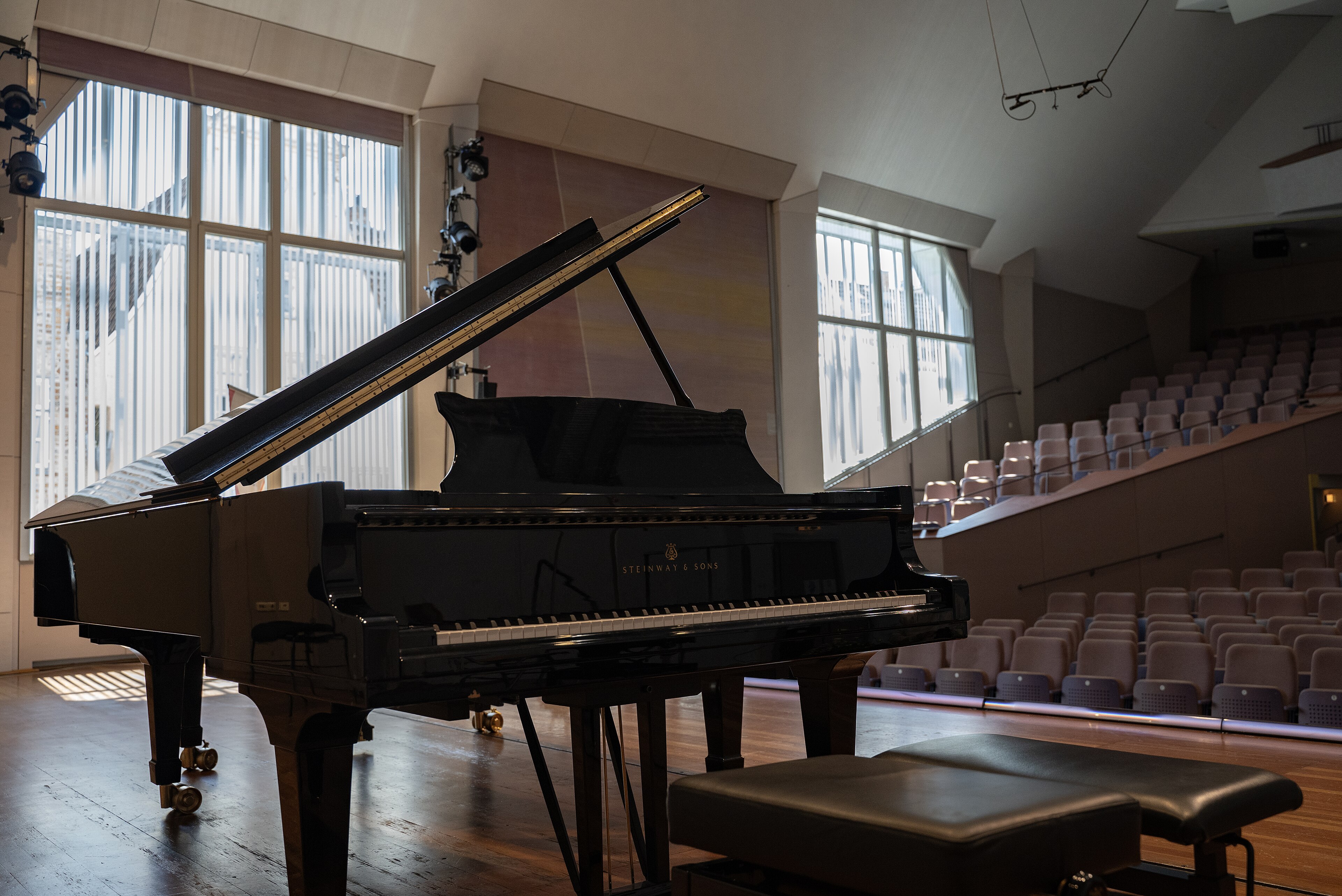
Over three days in February, in a building in Lübeck, forty-nine young string players auditioned for the use of an instrument they could never afford to buy. Thirty-four of them got one.
That is the 33rd competition of the Deutscher Musikinstrumentenfonds, the German Musical Instrument Fund, run by the Deutsche Stiftung Musikleben. It ran from 20 to 22 February 2026 at the Musikhochschule Lübeck, the second time the competition has been held at that venue, and the official award list is dated 9 March.
Almost nothing about it has appeared in English. The list itself is a remarkable document, because it names every recipient with their birth year and their city, next to the instrument they will be playing.
What was handed out
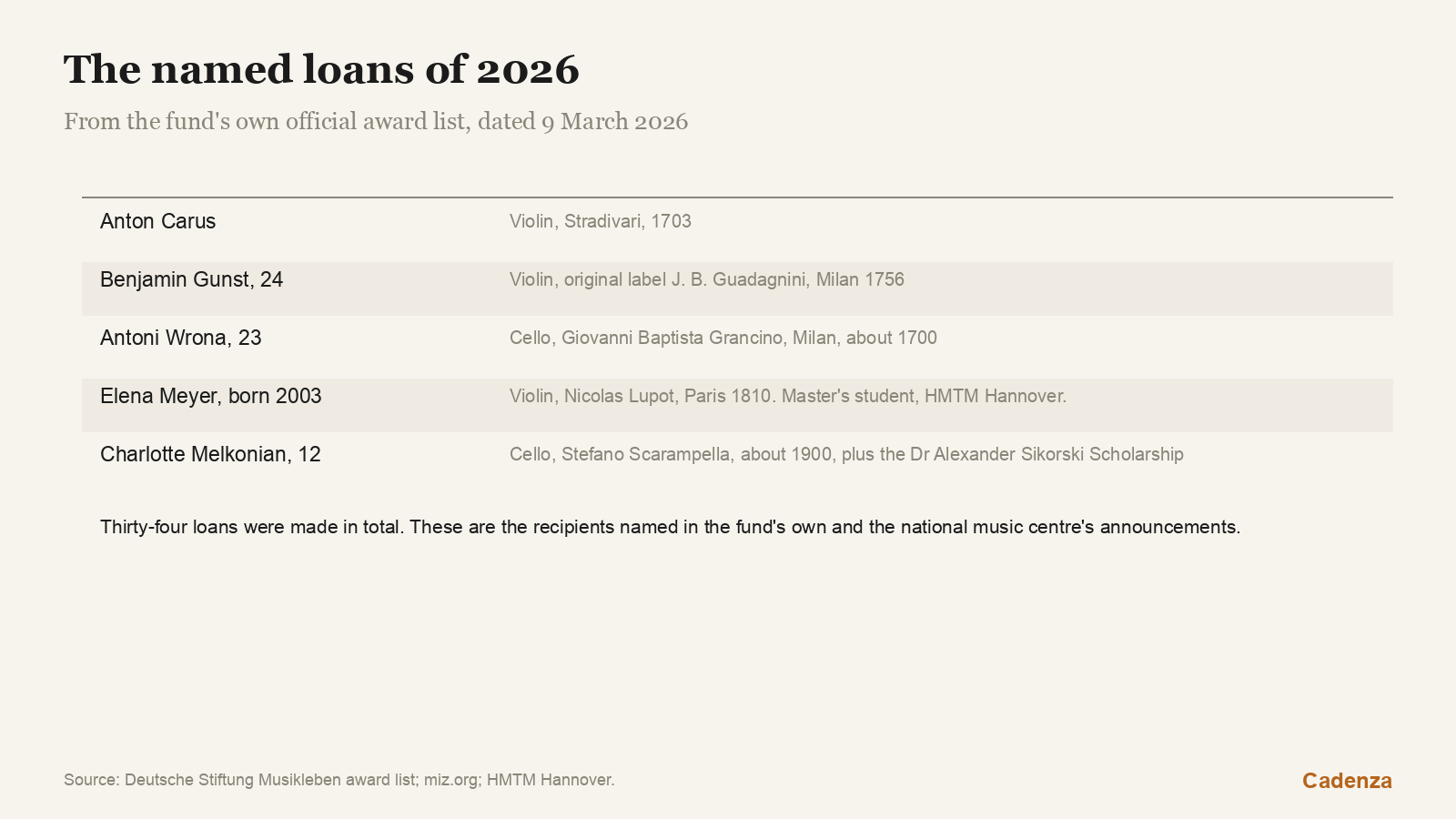
Anton Carus received a Stradivari violin of 1703. Benjamin Günst, who is 24, received a violin carrying the original label of J. B. Guadagnini, Milan 1756. Antoni Wrona, 23, received a cello by Giovanni Baptista Grancino, Milan, from around 1700. Elena Meyer, born in 2003 and a master's student at the Hochschule für Musik, Theater und Medien Hannover in the class of Professor Krzysztof Węgrzyn, received a violin by Nicolas Lupot, Paris 1810.
And a cello by Stefano Scarampella, made around 1900, went to Charlotte Melkonian, who is twelve.
The jury chair, Professor Krzysztof Węgrzyn, said the youngest participant was twelve years old and really impressed them. Melkonian also received the Dr Alexander Sikorski Scholarship, which the fund awards to a particularly gifted cellist. Cadenza is naming the award because it is a published result and the jury praised it publicly, and is leaving the rest of a twelve-year-old's life alone.
The ratios nobody prints
Put each instrument's age next to its new player's and the numbers are absurd in the best way.
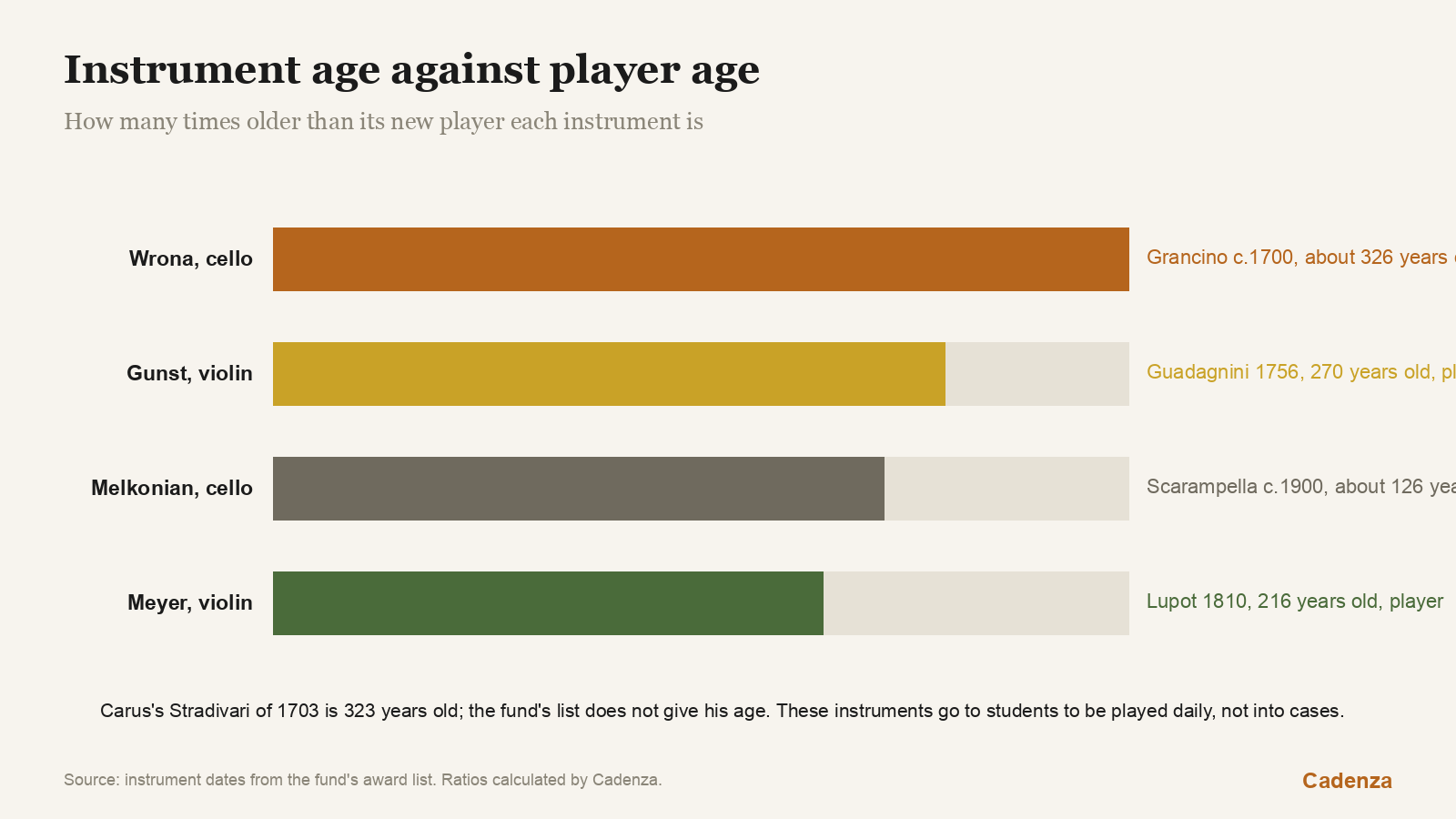
Wrona's Grancino cello is about 326 years old, which is roughly fourteen times his own age. Günst's Guadagnini is 270, about eleven times his. Meyer's Lupot is 216, about nine times theirs. Melkonian's Scarampella is about 126 years old, which is more than ten times hers. Carus's Stradivari is 323.
These are not museum pieces going into cases. They are going to students, to be played every day for one or two years, and then re-auditioned for.
The odds, and why they are unlike a competition
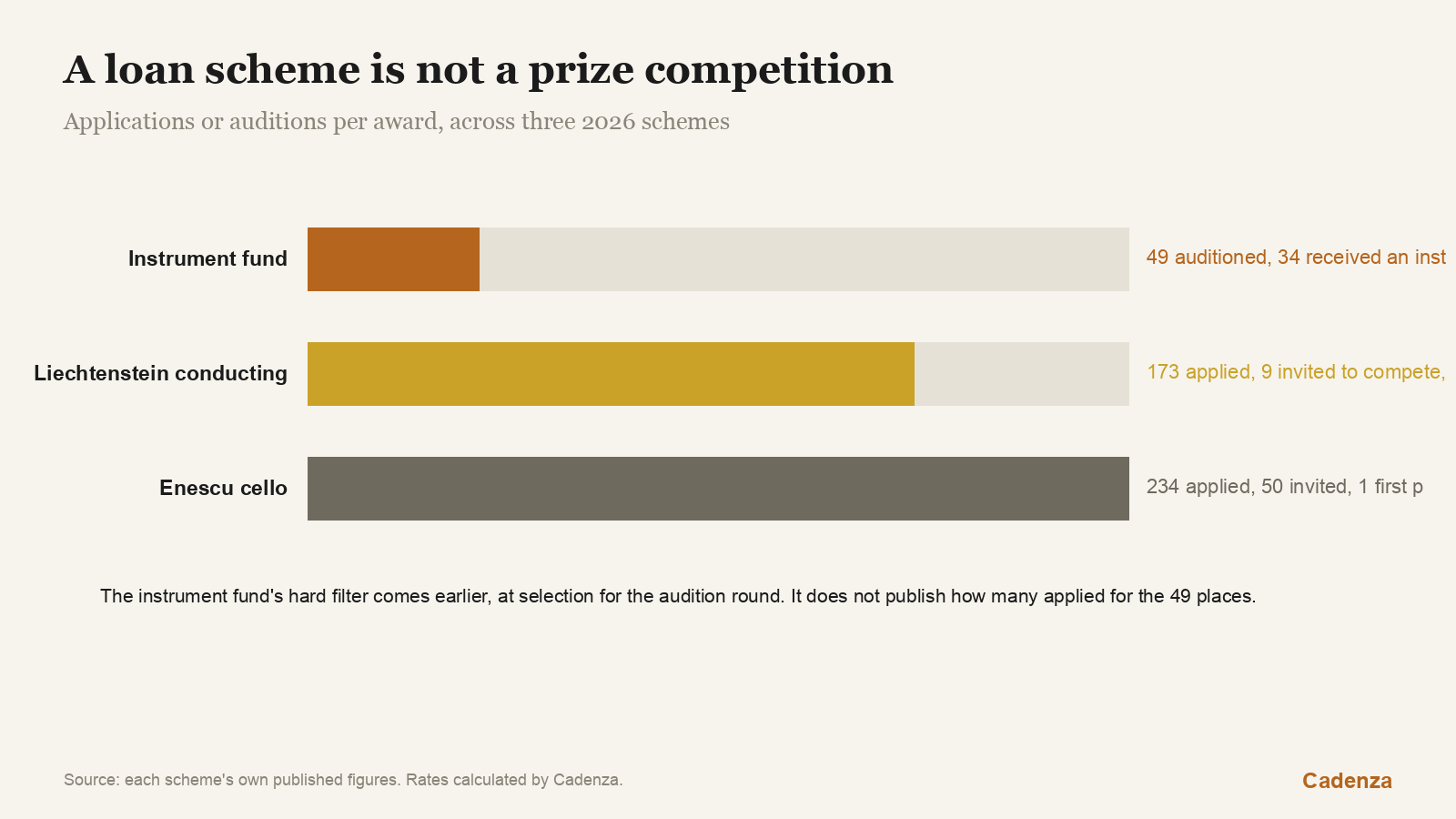
Forty-nine players auditioned and thirty-four received a loan. That is a success rate of 69.4 per cent, and ten further players had existing loans extended.
Compare that with the competitions Cadenza has covered this week. The Enescu cello section drew 234 applications for one first prize. The inaugural conducting competition in Liechtenstein drew 173 applications and invited nine people to compete. Against those, a scheme where roughly seven of every ten auditioners walk away with a three-hundred-year-old instrument looks like a different kind of institution altogether, and it is.
The narrowing happens earlier here. The hard filter is getting into the audition round at all, and the fund does not publish how many applied for those forty-nine places. That is the one number missing from an otherwise unusually transparent process, and it is the number a hopeful applicant would most want.
How the scheme actually works
The rules are worth knowing precisely, because they are specific and they are generous.
The maximum age for an entrant is 28. Loans run for one to two years and are renewable by re-audition up to the age of 30. So the scheme is not a prize that is won once. It is a rolling tenancy that a player has to keep earning, which means the same instrument can pass between several players across a decade.
The fund's own pages describe a collection of more than 280 instruments, built up since its founding in 1993, with the first competition following. Thirty-four loans against a collection of that size means roughly twelve per cent of the whole holding changes hands every year. Trade coverage has given the collection as around 250, so Cadenza is quoting the fund's own higher figure and noting the discrepancy rather than splitting the difference.
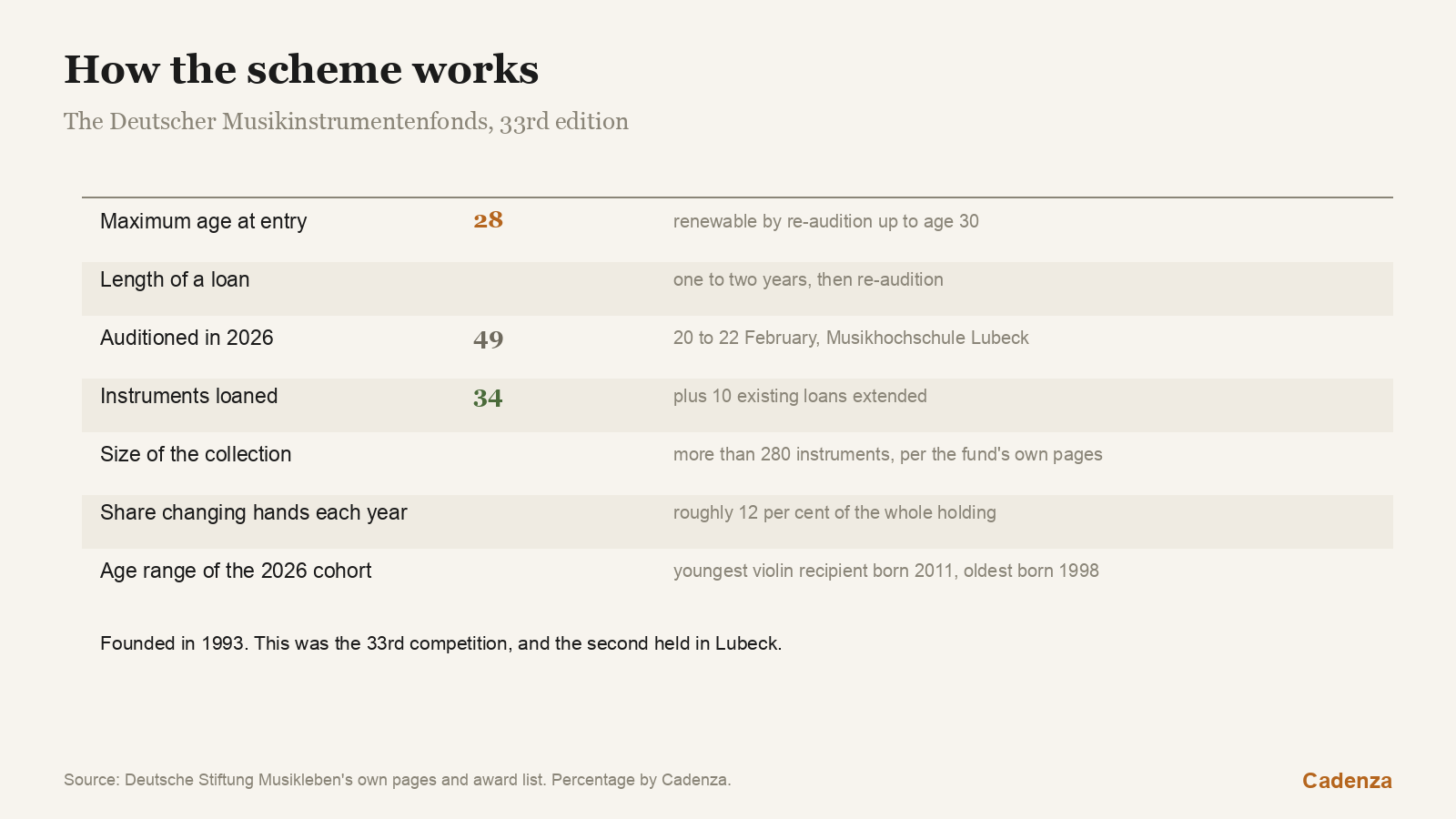
The 2026 cohort spans the full range the rules permit. The youngest violin recipient on the official list was born in 2011 and comes from Berlin. The oldest was born in 1998, which is the entry ceiling exactly.
The churn, which is the part to understand
Alongside the thirty-four new loans, ten players had existing loans extended. Put those together and forty-four instruments were committed in a single weekend: thirty-four moving to new hands, ten staying put.
That is the mechanism that makes a collection of this size work. Because loans run one to two years and stop at thirty, the fund never has to buy an instrument for a career. It buys one for a collection, and the collection serves player after player. An instrument acquired in the 1990s may already have been through half a dozen students, each of whom had to re-audition to keep it.
For the player, the consequence is that the instrument is never quite theirs, and the date it goes back is known from the start. For the fund, the consequence is leverage: the same money serves perhaps ten times as many musicians as an outright gift would.
It is also why the venue matters more than it looks. The competition has now been held twice at the Musikhochschule Lübeck, and Lübeck is where the Possehl Foundation is based, whose chairman, Professor Wolfgang Sandberger, was among those the fund quoted on this year's results. A weekend of auditions needs a building with enough rooms, enough instruments in one place at one time, and a jury willing to sit through forty-nine players. That is a substantial logistical undertaking for what is presented, modestly, as a competition.
Why a loan scheme matters more than a cash prize
For a young string player, the instrument is the career-limiting expense, and it is an order of magnitude larger than the prize money available to fix it. A first prize of €15,000 at a major competition, which is what the Enescu and the ARD both pay, does not buy a professional-level modern violin, let alone an old Italian one.
A loan sidesteps the problem entirely. It does not make the player an owner, and it comes with the insecurity of a fixed term and a re-audition. But it means the sound a student is developing is the sound they will be judged on, rather than a compromise they will spend a decade trying to trade up from.
That is why this competition deserves the same attention as the prize competitions, and gets almost none. A first prize makes a headline in the trade press within a day. Thirty-four instrument loans, which will shape how thirty-four players sound for the next two years, made none at all in English.
A year ago it was an application
Every one of these thirty-four loans began with an application to a fund with published rules, an age ceiling of 28, and a renewal route to 30. The next round will be the 34th.
Cadenza carries competitions, schemes and instrument funds with open deadlines, free to musicians, on its competitions board, and current orchestral vacancies on its jobs board.
If you are applying. The ceiling is 28 at entry and 30 for renewals, and the loan runs one to two years, so plan for a re-audition rather than a permanent acquisition. Read the fund's own results list rather than the trade write-ups: it gives every recipient's birth year and city, which tells you exactly what level of player is winning what level of instrument. Note also that the competition has now been held twice in Lübeck rather than its previous home.
The question the fund will be asked next is the friendliest one in this article. It publishes more than almost any comparable scheme: every name, every birth year, every instrument and maker. Will it also publish how many people applied for the forty-nine audition places, so that the next cohort knows the real odds?
Sources: the Deutsche Stiftung Musikleben's own official award list for the 33rd Deutscher Musikinstrumentenfonds competition, dated 9 March 2026, which names every recipient with birth year, city and instrument; the fund's own competition pages for the dates, the Lübeck venue, the age limits and the size of the collection; the Hochschule für Musik, Theater und Medien Hannover press release of 19 March 2026 for Elena Meyer's instrument, course and teacher; miz.org, the German Music Information Centre, which names Günst, Wrona, Melkonian and Carus with their instruments; and The Violin Channel for the jury chair's quotation and the audition and loan counts. The success rate, the instrument-to-player age ratios, the collection-rotation percentage and the comparisons with other competitions are Cadenza's arithmetic.
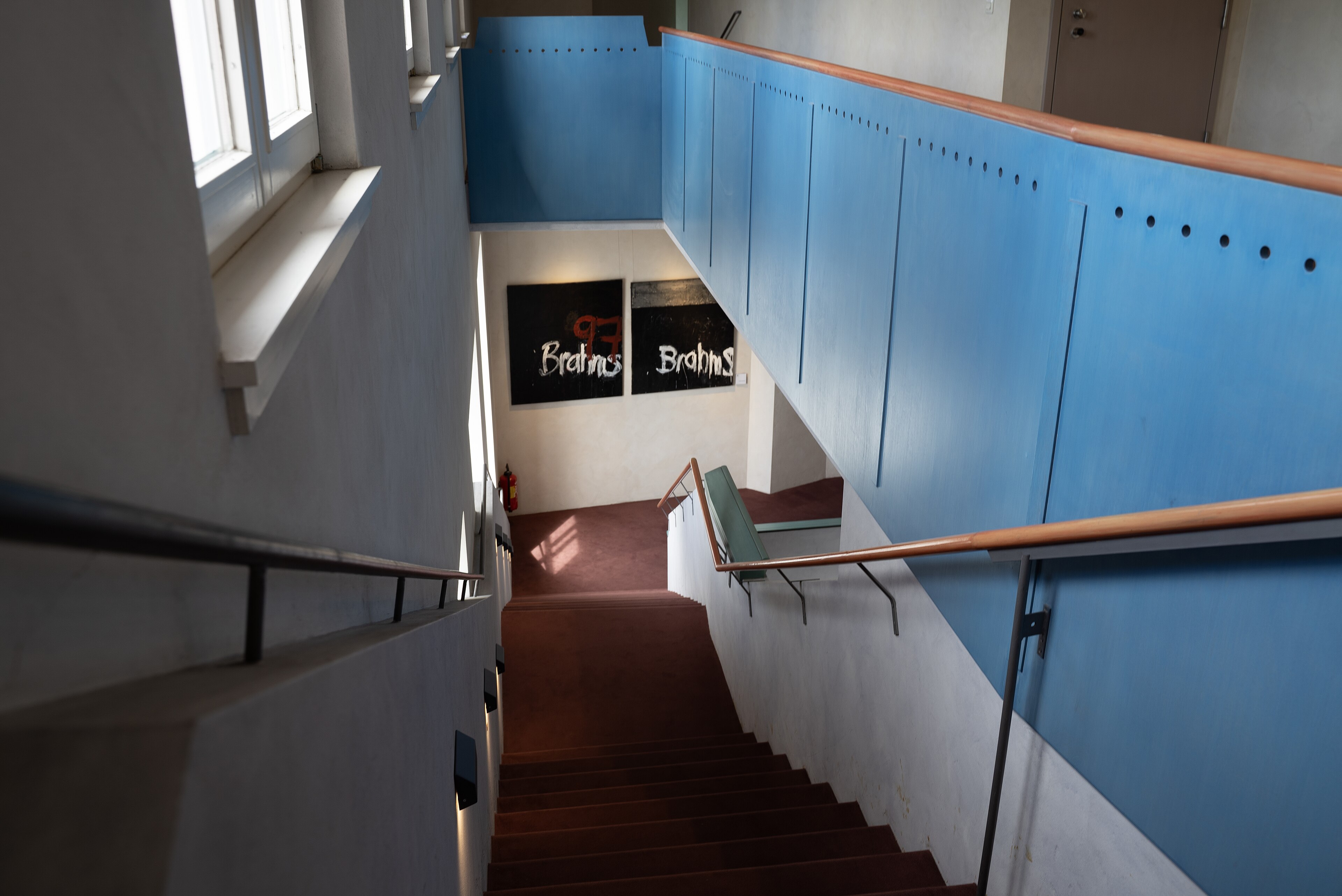
Photographs: the Musikhochschule Lübeck, during a national youth music competition in the same building, and its staircase. Both CVComposer, CC BY-SA 4.0, via Wikimedia Commons. Charts by Cadenza.
Cover photograph: The Musikhochschule Lübeck, where the 33rd Deutscher Musikinstrumentenfonds competition was held in February 2026, photographed during a national youth competition in the same building. CVComposer, CC BY-SA 4.0, via Wikimedia Commons.
Comments
Sign in to join the discussion.