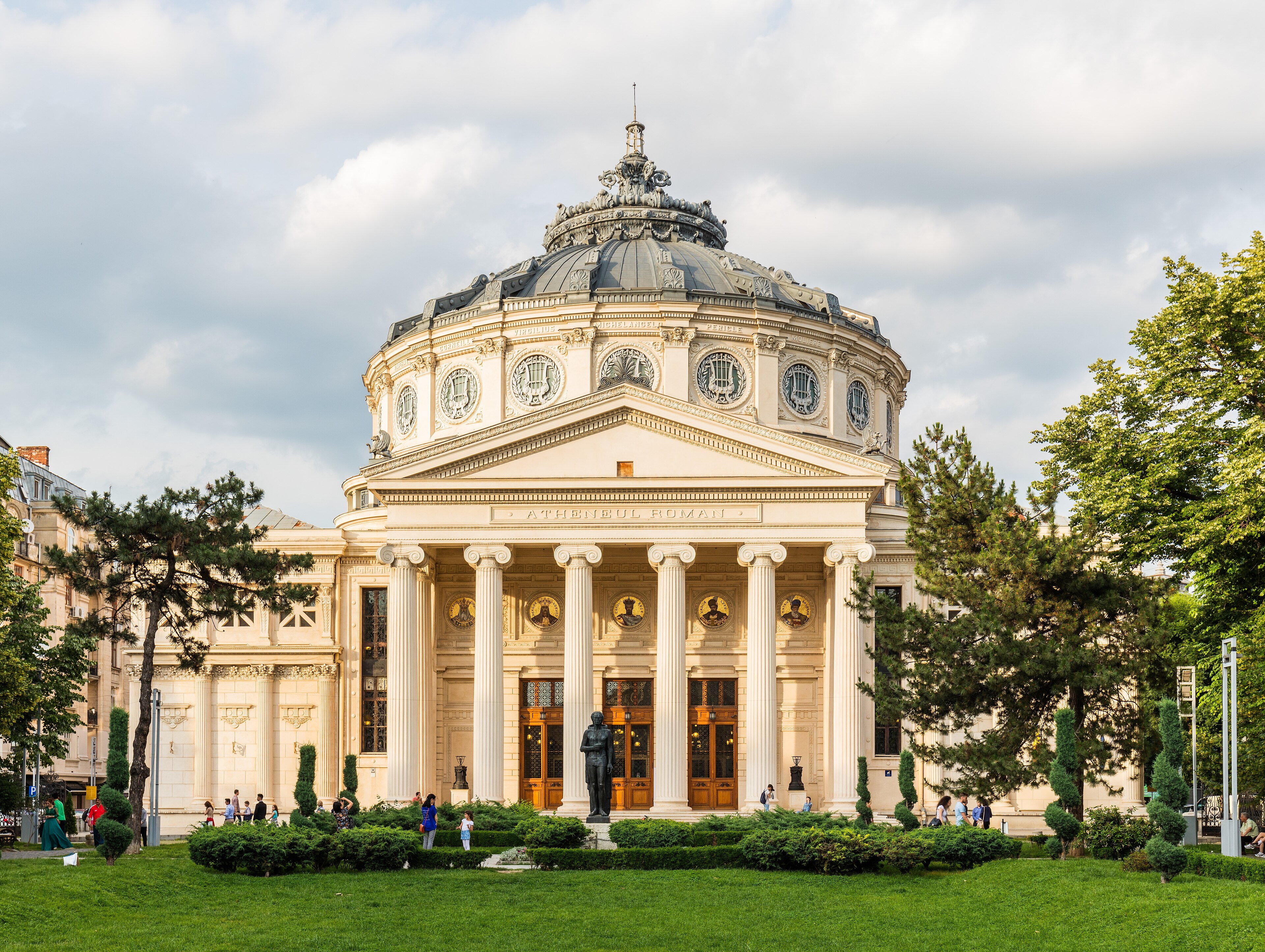
Samuel Niederhauser has a job. He is principal cellist of the Luzerner Sinfonieorchester, a salaried section leader in a Swiss orchestra, and on Monday 7 September he walked into the Romanian Athenaeum in Bucharest, played Shostakovich's First Cello Concerto with the National Radio Orchestra under Case Scaglione, and won the cello section of the George Enescu International Competition.
He is 28, born on 2 February 1998. The five other cellists who reached the semi-final were 14, 17, 19 and 21, plus a conservatory postgraduate. He was exactly twice the age of the youngest of them.
That is the part of this story worth putting first, because most competition reporting is about people who do not yet have orchestral jobs. Niederhauser took first prize of €15,000, a further €2,000 for the best account of the imposed work, Malika Kishino's Waves of Gravel, and the €1,000 audience prize. Eighteen thousand euros, and a concert at the Teatro Fraschini in Pavia on 14 February 2027.
The runner-up is the other headline
Joshua Kovac is 19, born on 14 June 2007, and Czech-American. He took second prize, €10,000, and the €3,000 Serafim Antropov-Manu Prize for Enescu's C major cello sonata, the work the composer catalogued as his second. Thirteen thousand euros.
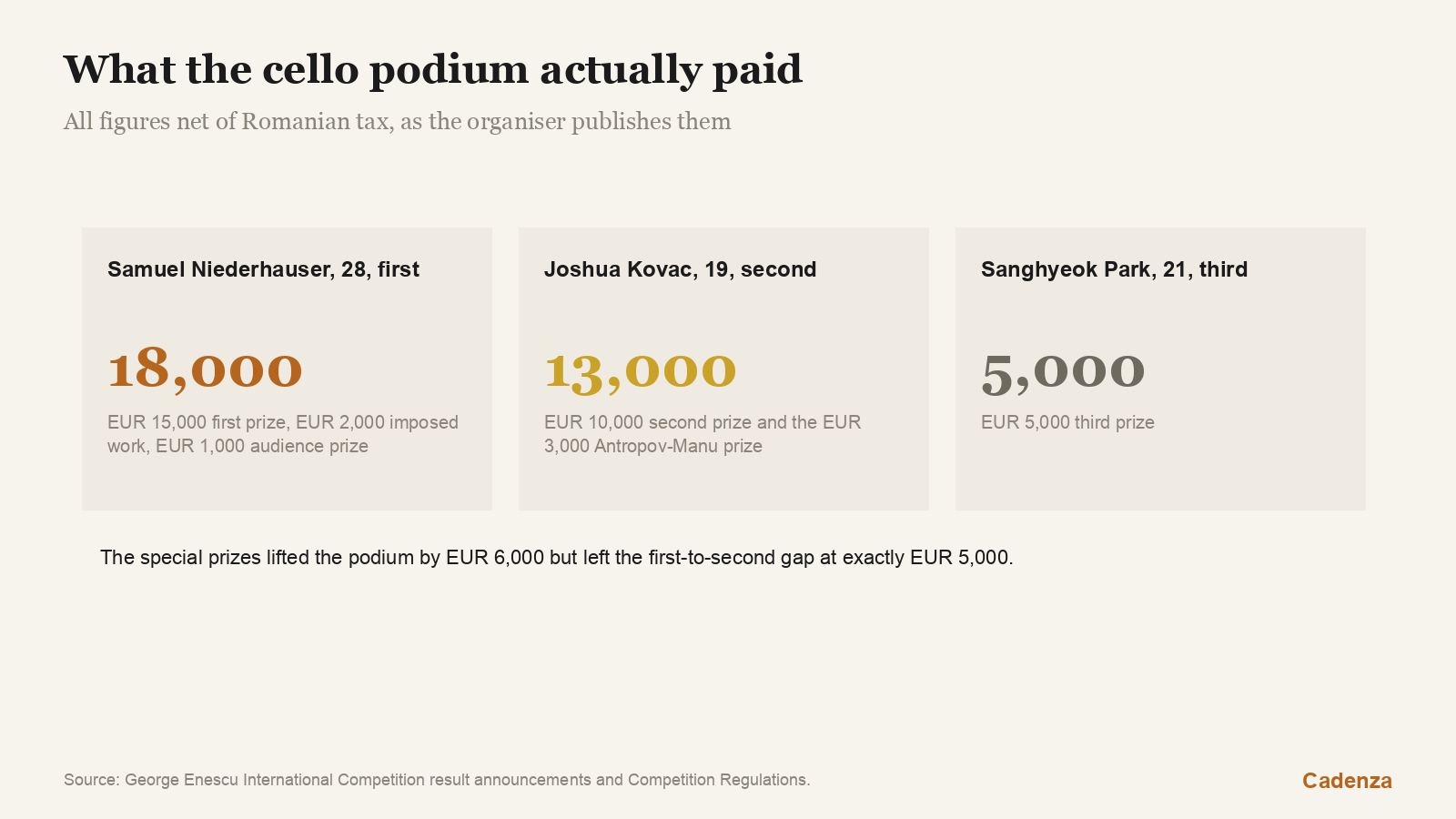
Set €13,000 against the bare first prize of €15,000 and Kovac finished within €2,000 of winning, taking 86.67 per cent of what first place alone pays. Against what Niederhauser actually banked, he took 72.22 per cent. He also took 2.6 times what third prize paid.
Sanghyeok Park, 21, from South Korea, born on 10 November 2004, took third prize and €5,000.
One frame to avoid, because it is tempting and wrong. The special prizes did not shuffle the podium. The gap between first and second is €5,000 before the specials and €5,000 after, because the winner and the runner-up each collected €3,000 in extras. What the specials did was lift the whole podium by €6,000, a 20 per cent uplift on the ranking prizes, and hand a 19-year-old a sum that reads like a first prize.
Two details of timing are worth stating because they are easy to get wrong. Neither special prize was won at the final. The Kishino imposed work was a Round Two requirement, played on 2 and 3 September, and the Enescu sonata opened the semi-final on 5 September. The prizes announced on 7 September were earned across the whole week.
All of these figures are net. The organiser, ARTEXIM, withholds Romanian tax before paying, and quotes its prizes accordingly. One prize in the cello section is published gross instead: the €1,500 Playing for Tomorrow award from BRD, which went to Seojin Jung of South Korea, who is 14 and was one of the six semi-finalists.
The funnel nobody prints
The competition announced a record in July: 819 applications from 55 countries, a rise of nearly 23 per cent, which implies a previous edition of about 666. Of those 819, some 756 were applications to the four competition sections and 63 were for the masterclasses. Of the 756, 645 were instrumental and 111 were for composition.
The cello section drew 234 of them.
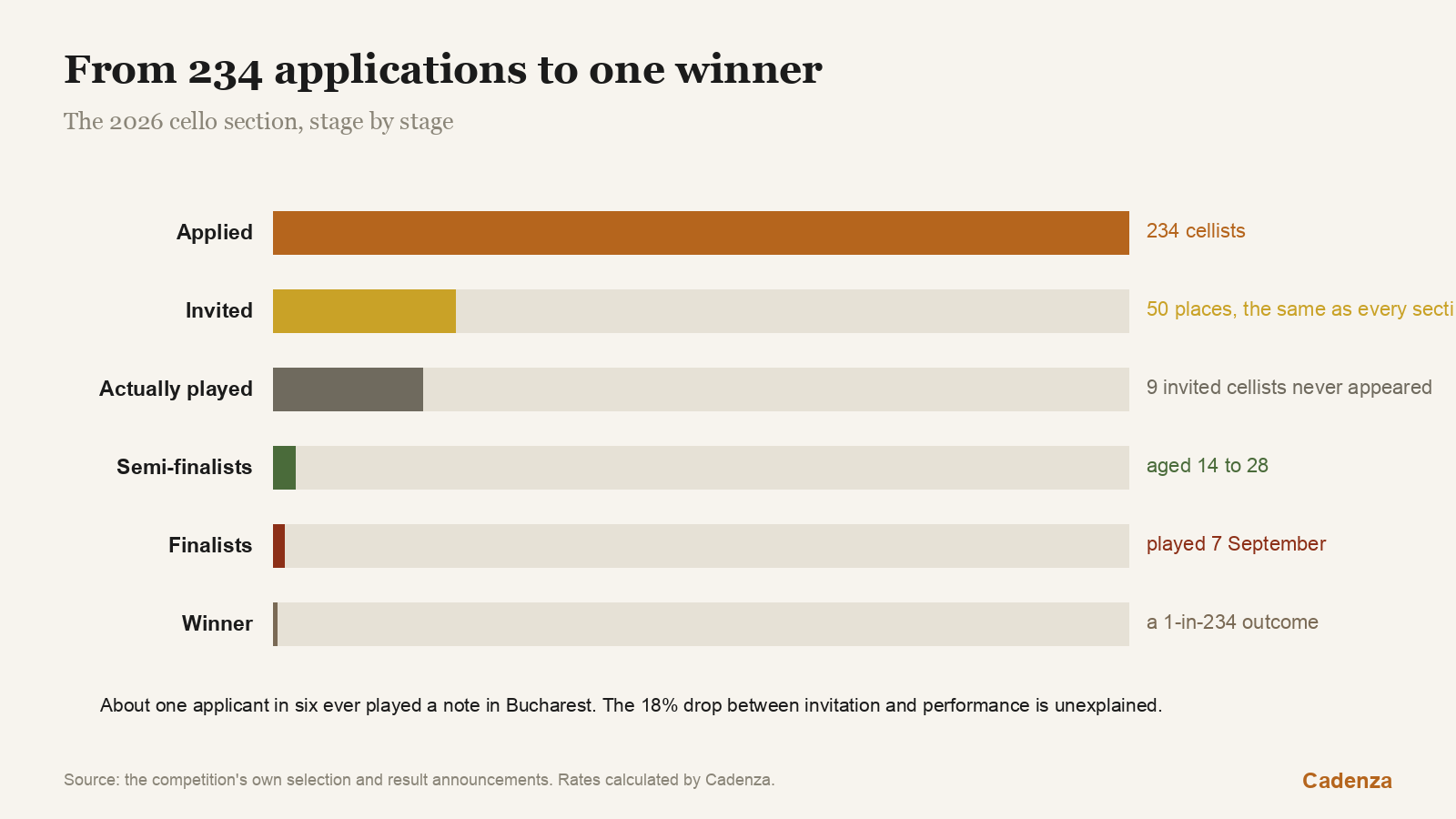
Fifty cellists were invited to Bucharest, the same allocation every instrumental section received. Forty-one actually played. Nine invited cellists never appeared, an 18 per cent attrition rate between invitation and performance that the coverage has not mentioned and that the organiser does not explain.
So winning the cello section was a one-in-234 outcome, and only about one applicant in six ever got to play a note in Bucharest. For a player weighing up whether to enter, those are the two numbers that matter, and neither appears in any announcement.
The commitment those forty-one players made is also worth spelling out, because it is longer than a competition week sounds. Round One ran from 29 to 31 August. Round Two followed on 2 and 3 September, the semi-final on 5 September and the final on 7 September. A cellist who went the distance was in Bucharest for at least ten days, and one who was eliminated in Round One had travelled there for a single appearance. The competition has been running on some version of that pattern since it was first organised in 1958.
What the pool is, and who fills it
The brief Cadenza started from said the total prize value was above €150,000. No organiser source states any total, so we added up every cash prize published across the four section registration pages and the 34-page Competition Regulations, then regrouped the same figures a second way as a check. Both methods give the same answer.
The whole competition paid out €139,500.
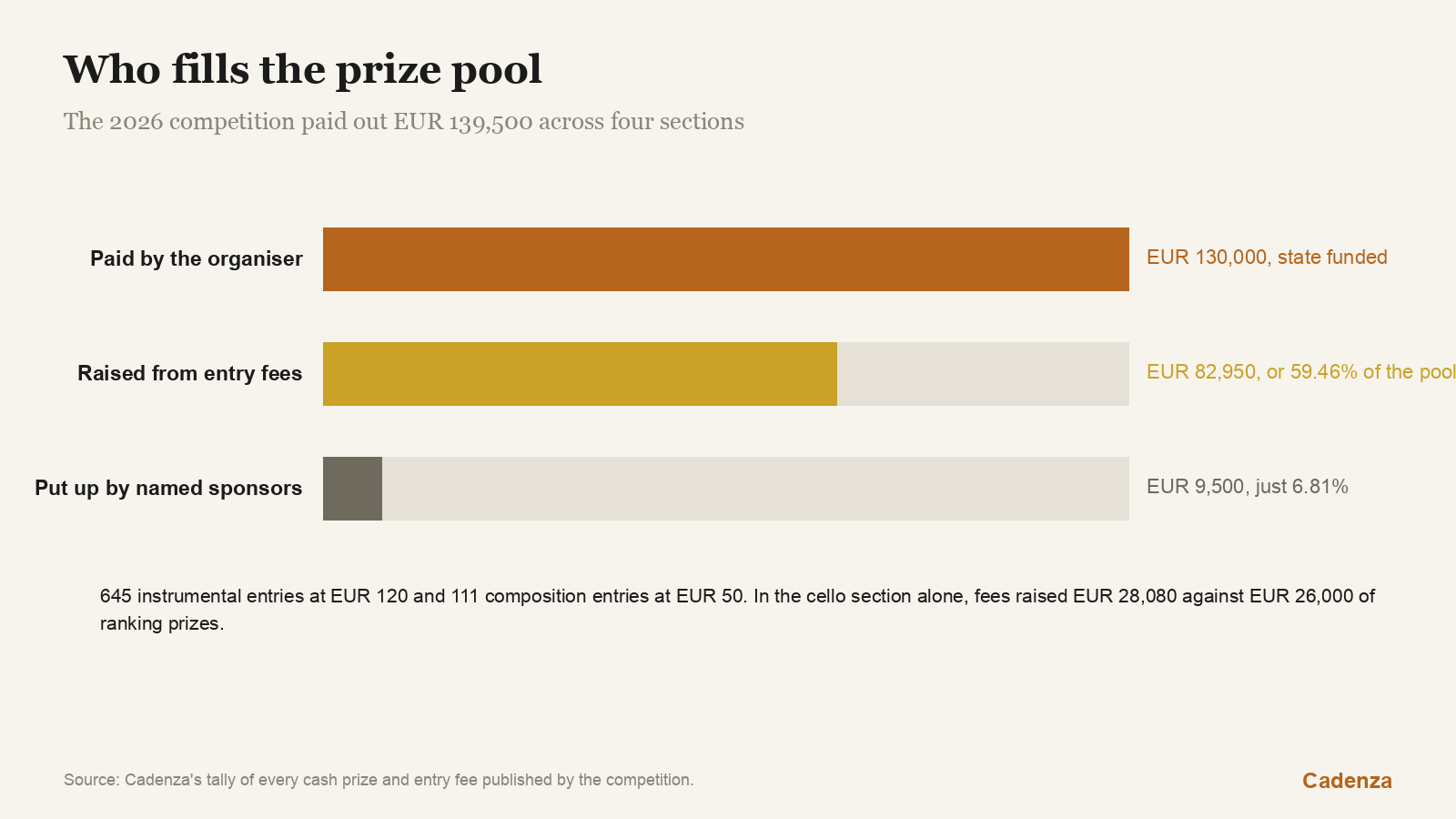
Named sponsors account for €9,500 of that, which is 6.81 per cent. The remaining €130,000 comes from the state-funded organiser. Every ranking prize in every section is the same: €15,000, €10,000 and €5,000 net. The composition section drew 111 entries and paid €22,000 across three prizes.
Then there are the entry fees. Instrumental entry cost €120 per section and composition €50 per entry. Six hundred and forty-five instrumental applications at €120 is €77,400. One hundred and eleven composition entries at €50 is €5,550. Applicants paid €82,950 to enter.
That is 59.46 per cent of the entire €139,500 the competition paid out. In the cello section alone, 234 applications at €120 raised €28,080, which is more than the €26,000 of ranking prizes the section awarded.
This is not an accusation. Competitions cost money to run, juries and halls and orchestras are not free, and the Enescu pays more than most. It is simply the arithmetic of who capitalises a prize fund, and it says that the people competing for the money are supplying most of it.
Seen from the winner's side the return is spectacular. Niederhauser turned a €120 entry fee into €18,000, exactly 150 times his outlay. Kovac's return was 108 times, Park's nearly 42 times. Seen from the side of the 193 cellists who applied and never played in Bucharest, the fee bought an application.
The round that had not happened before
The 2026 semi-final did something the competition had never done before. The semi-finalists led the orchestra themselves, soloist and leader at once, with no conductor on the podium. The organiser called it a first in the competition's history, which is the right way to put it. The competition began in 1958, so this was a first in sixty-eight years of editions, not the revival of something older.
The guest concertmaster for the conductor-less cello semi-final was Bogdan Zvorișteanu. It is worth noting that the organiser's own advance release, published on 17 August, had named a different player for that chair, Adrian Iliescu, so the line-up changed between announcement and performance.
The jury numbered nine, a president and eight members, and all nine judged only the semi-final and the final. Arto Noras presided over the cello panel.
Two cellos, 158 years apart
Both men at the top of the podium play borrowed instruments, and the competition documents them, which is rarer than it should be.
Niederhauser plays a Carlo Giuseppe Testore of 1690, on loan. It is 336 years old and predates the competition's own founding by 268 years. Kovac plays a Jean-Baptiste Vuillaume of 1848, on private loan, which is 178 years old. A century and a half separates the two instruments that came first and second.
A year ago it was an entry form
Every name here began as an application with a €120 fee attached, submitted months before anyone played. The cello section's 234 applicants read the same regulations PDF that sets out the rounds, the imposed work and the net prizes, and the next edition's will too.
Cadenza carries the competitions with open deadlines, free to musicians, on its competitions board, and current orchestral vacancies on its jobs board.
If you are entering. Read the Competition Regulations rather than the news pages. They are the document that tells you the prizes are net of Romanian tax, that the imposed work is judged in Round Two rather than the final, and that fifty players per section are invited. Budget for the €120 and for getting to Bucharest, because the invitation does not come with a fee waiver.
The question the competition will be asked next is about that 59 per cent. Entry fees now supply most of the money the Enescu pays out, and nine invited cellists this year decided not to come. Will the organiser publish what a place in Bucharest actually costs a player to take up?
Sources: the George Enescu International Competition's own pages, read on 11 and 12 September 2026: the cello result, the finalists announcement, the record-applications release, the play and conduct announcement, the selection announcement, the cello section registration page, the composition section page and the Competition Regulations PDF. Niederhauser's post is confirmed on the Luzerner Sinfonieorchester's own page. Also consulted: The Strad. The prize-pool total, the entry-fee arithmetic, the attrition rate and the returns on a €120 fee are Cadenza's calculations from those documents.
Cover photograph: the Romanian Athenaeum, Bucharest, 2016. Diego Delso, CC BY-SA 4.0, via Wikimedia Commons. Charts by Cadenza.
Cover photograph: The Romanian Athenaeum in Bucharest, where the cello final of the George Enescu International Competition was played on 7 September 2026, photographed in 2016. Diego Delso, CC BY-SA 4.0, via Wikimedia Commons.
Comments
Sign in to join the discussion.