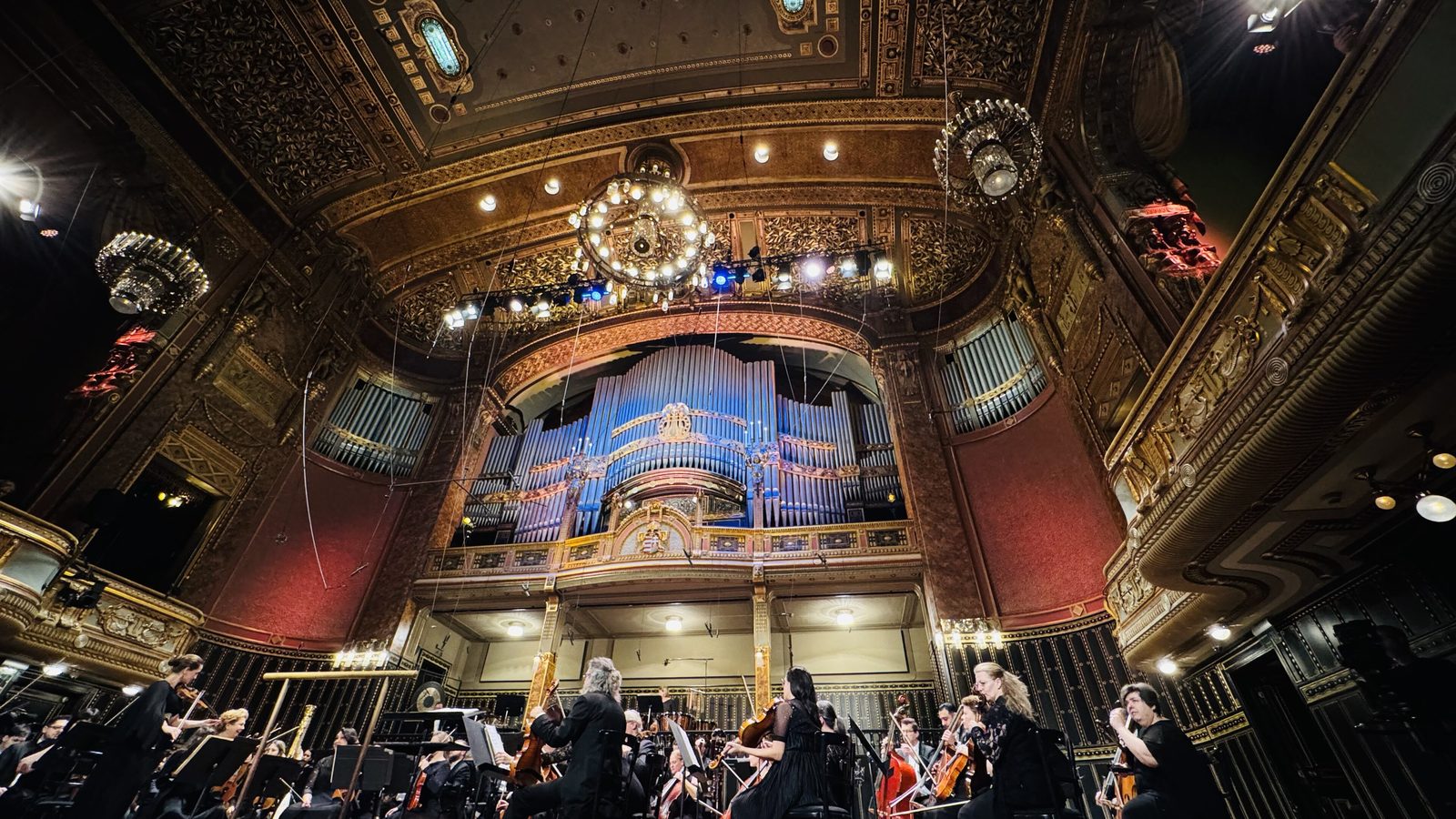
On the evening of Saturday 5 September 2026, in the Grand Hall of the Liszt Academy in Budapest, twelve singers stood in front of an orchestra for the final of the 7th Éva Marton International Singing Competition. When the jury came back, one of them had taken the first prize of €30,000, the €5,000 special prize for the best performance of a Liszt song, and the audience award. On Sunday the twelve finalists sang again at a gala in the Hungarian State Opera, and the prizes were presented.
The singer was Valentina Pravdina, a soprano from Russia, aged 30 according to Slipped Disc. The competition's own account is compact: first prize, Liszt prize, audience prize, all to one name. Slipped Disc reported the result the next morning. Here is what she won, what she beat, and why a Budapest prize is a different thing from a Brussels one.
The field
The competition, organised by the Liszt Academy and named for the Hungarian dramatic soprano who chairs its jury, has been held in the early September of even-numbered years since 2014. The 2026 edition, by the organisers' figures:
| Stage | Date | Singers |
|---|---|---|
| Preliminaries, live | 31 August to 2 September | 80 |
| Semi-final | 3 September | 26 |
| Final, with orchestra | 5 September, Liszt Academy Grand Hall | 12 |
| Gala and prizes | 6 September, Hungarian State Opera | 12 |
Eighty singers in the live preliminaries to twelve in the final is a ratio of about seven to one. What distinguishes the Marton from the smaller voice competitions is the last two rows: a full orchestral final in the Liszt Academy's Grand Hall, and a gala on the stage of a national opera house the following night. A young singer who reaches the final has sung with an orchestra in the Grand Hall and on the Andrássy út stage inside twenty-four hours, in front of anyone in Central European casting who cared to come.
The prize
Pravdina's cash total is €35,000: the €30,000 first prize plus the €5,000 Liszt song prize. No cash value is listed for the audience award, which is, in a voice competition, arguably the most telling of the three, because it is the one prize decided by the people who buy tickets.
The competition's announced prize fund is €70,000, with a €20,000 second prize, a €10,000 third and a €10,000 Éva Marton special prize alongside the first, so the winner took half of it. For comparison with another of the year's big prizes for a young musician, the Queen Elisabeth Competition's cello first prize in May was €25,000 plus a four-year loan of the 1710 "Casals" Goffriller; the Marton's first prize is larger in cash and comes without an instrument, which is the nature of the voice.
What the Budapest prize is really made of is the room. An orchestral final in the Liszt Academy and a gala on the Hungarian State Opera's stage are programmed as a showcase, and they are attended as one. A singer who wins in Budapest has been heard, in one weekend, in the two rooms where Hungarian casting is done. Singers enter for that as much as for the cheque.
Who she is
Pravdina is a soprano, 30, and Russian, and the Slipped Disc report added, alongside the result, that she has little prospect of Western engagements until the war in Ukraine is over. Cadenza records Norman Lebrecht's observation without extending it: a competition jury judged the singing, and the singing won three prizes in two nights. What her calendar looks like in 2027 will be the measure of whether the room heard her the same way.
The Liszt song prize is worth a sentence of its own. The Marton requires every singer to bring a Liszt song to the preliminaries, alongside two arias, and the prize for the best performance is the competition's way of tying itself to the building it is held in. Pravdina won it. A soprano who can carry a Liszt song in the composer's own academy has done something specific.
Elsewhere in September: a baritone in Siena
Another voice prize of the week went the opposite way in age and career. On 5 September OperaWire reported that the French baritone Ludovic Tézier will receive the 2026 Premio Bastianini, presented by the Associazione Internazionale Culturale Musicale "Ettore Bastianini" in the singer's native Siena, in its fifth edition since 2017. The ceremony is on 26 September in the Ettore Bastianini foyer of the Teatro dei Rinnovati.
The award citation, as quoted by OperaWire, credited Tézier with the "legato," the "burnished timbre, poise, and expressive elegance" that connect him to Bastianini's art. Previous recipients include Simone Piazzola, Nicola Alaimo, Luca Salsi, Amartuvshin Enkhbat and, in memoriam, Dmitri Hvorostovsky. Enkhbat, it happens, opens the San Francisco Opera's season on 12 September as Simon Boccanegra, if the company's orchestra, which has threatened an opening-night strike, plays.
A prize at the start of a career and a prize at the height of one, in the same week, tell the same story from both ends: the profession still has a way of saying, in public and with a jury's signature, that a voice is the real thing.
What a voice competition is for
Instrumental competitions tend to produce soloists; voice competitions produce casts. That is why the Marton's structure, an orchestral final and an opera-house gala rather than a recital, matters more than its cheque. The twelve finalists in Budapest were auditioning for houses as much as for a jury, and the eleven who did not win the first prize were heard by the same people.
Cadenza lists open competitions, with deadlines, fees, age limits and prize funds from the official notices, on its competitions board. Two voice competitions to watch this autumn: the Mirjam Helin International Singing Competition, whose 2027 edition moves to Turku, with applications open from 2 to 30 November 2026 for singers born in 1995 or later, and the Opera Crown competition in Tbilisi, which has just announced its fifth edition for 8 to 13 November. The Marton is held in even-numbered years, so the next edition is due in 2028.
For the singers who reached Budapest's final and did not win, the useful fact is the one the prize list leaves out: they sang with an orchestra in the Grand Hall on Saturday and on the Hungarian State Opera's stage on Sunday, and the people who matter were in the seats both nights.
Sources: Éva Marton International Singing Competition, 2026 results and schedule; Slipped Disc, 6 September 2026; OperaWire, 5 September 2026, Premio Bastianini; Mirjam Helin International Singing Competition; OperaWire, Opera Crown fifth edition.
Cover photograph: The Liszt Academy of Music, Budapest, whose Grand Hall hosted the orchestral final. Evgenia Jarabik, CC BY-SA 4.0, via Wikimedia Commons.
Comments
Sign in to join the discussion.