On 26 September the Teatro del Maggio Musicale Fiorentino gives Mahler's Second Symphony in the Sala Zubin Mehta, the auditorium named after its honorary director for life. Zubin Mehta will be in the audience. He was to have conducted.
Mehta, who turned 90 on 29 April, has withdrawn. The theatre announced it on 8 September. Thomas Guggeis conducts instead, and he was already in the building, rehearsing Berg's Wozzeck for performances the following week.
The theatre's statement is brief and generous: "Teatro del Maggio and Maestro Mehta thank Maestro Guggeis, who is currently engaged in rehearsals for the opera Wozzeck, for accepting to conduct the concert and ensuring its regular performance."
That is the news. The reason to write it up is what happened the last time Zubin Mehta cancelled on Thomas Guggeis's watch, because it is the reason anybody outside Germany knows Guggeis's name.
Berlin, 2018
On 3 January 2018 the Staatsoper Unter den Linden announced that Mehta needed shoulder surgery and would cancel his engagements to the end of March. Its own press release says so plainly: Mehta had to undergo a shoulder operation and cancel his commitments through to the end of March 2018, and this affected the musical direction of the new production of Richard Strauss's Salome, whose premiere was set for 4 March.
Christoph von Dohnányi took the production over. Thomas Guggeis, then 24 and Daniel Barenboim's assistant at the house, was assigned a single performance, the last night of the run on 17 March.
Then Dohnányi withdrew too. The house's second press release, dated 2 March, records that he had asked to be released from conducting Salome, citing artistic differences with the director Hans Neuenfels, and that Guggeis had already conducted the dress rehearsal.
So the 24-year-old assistant, down for one night at the end of a run, inherited the entire production including its premiere. The critic Yehya Alazem, writing in klassik-begeistert about that first night, recorded the sequence and then the result: under Guggeis the Staatskapelle Berlin produced detailed, well-flowing playing that sounded wonderful in its balance between symphonic and chamber-musical feeling.
One correction to the version of this story that circulates. It is often told as Guggeis taking over hours before the premiere. He did not. Dohnányi stepped away shortly before the dress rehearsal on 1 March, Guggeis conducted that rehearsal, and the house announced the change on 2 March, two days before the premiere. The drama belongs to the Generalprobe, not the first night, and the distinction matters because the real version is impressive enough without improvement.
The arithmetic
From that premiere to this Florence concert:
| Guggeis conducts the Salome premiere, Berlin | 4 March 2018 |
| Guggeis conducts Mahler 2 in Mehta's place, Florence | 26 September 2026 |
| Elapsed | 3,128 days, about 8 years and 7 months |
And the symmetry that nobody has set down. The 2018 chain began with a Mehta withdrawal. Count from the day the Staatsoper announced Mehta's shoulder surgery, 3 January 2018, to the Florence concert, and it is 3,188 days.
A cancellation by Zubin Mehta started Thomas Guggeis's career. Eight and a half years later, another one hands him a Mahler Second in a hall named after the man.
Where Guggeis is now
He is no longer a house assistant. Since the 2023-24 season Guggeis has been General Music Director of Oper Frankfurt and artistic director of the Frankfurter Museumskonzerte, on an initial five-year contract. He also holds the title of Staatskapellmeister at the Staatsoper Unter den Linden, the house where the Salome happened.
He was born in 1993 in Dachau, in Bavaria. His exact birth date is not publicly documented, so his age today can only be given as 32 or 33, and this piece is not going to round it to whichever sounds better.
The hall with his name on it
The Sala Zubin Mehta seats somewhere between 1,100 and 1,200 and was inaugurated in Mehta's honour on 21 December 2021, with the President of the Italian Republic, Sergio Mattarella, present. Mehta is the Maggio's honorary director for life.
So the 26 September concert is an unusual piece of theatre in itself: a conductor sitting in the audience of a room named after him, with his wife Nancy beside him, while somebody else conducts the Resurrection Symphony from the podium he would have stood on.
The soloists are the soprano Nikoletta Hertsak and the mezzo-soprano Natalie Lewis.
Mahler's Second is also, of all the pieces that could have been on that stand, among the least forgiving to hand over at short notice. It runs about eighty minutes, needs a chorus and two vocal soloists as well as a large orchestra, and its finale depends on an offstage band whose timing cannot be fixed by watching the beat. A conductor taking it on three weeks out is not covering a routine programme.
What the 2018 premiere was actually like
It is worth being precise about what Guggeis walked into, because "he stepped in and it went well" flattens the thing.
Neuenfels's staging divided the house and was booed. The reviews separate the production from the pit, and it is the pit that made Guggeis's name. Alazem's account credits him with building the drama, and with drawing playing from the Staatskapelle Berlin that balanced symphonic weight against chamber-music transparency.
A 24-year-old had two days' notice of the premiere, one dress rehearsal already behind him, a divisive production around him and an audience prepared to boo it. What the reviews record is that the orchestra sounded good.
Where to hear him in Florence
The Mahler concert on 26 September had sold out before Mehta withdrew, so it is not something a reader can act on. The rest of Guggeis's Florence fortnight is.
He conducts Berg's Wozzeck at the same theatre in Deborah Warner's production from the Royal Opera House, Covent Garden. The premiere is on Sunday 27 September at 17:00, with repeats on Wednesday 30 September at 20:00 and Saturday 3 October at 15:30, in the Sala Grande. Tickets run from €15 to €130 through the theatre's own box office.
The performance on 30 September is broadcast live on Rai Radio 3, which costs nothing and can be heard anywhere.
This is not the first cancellation of the year
Reporting a ninety-year-old conductor's withdrawals requires some care, and Cadenza is going to report only what institutions have themselves announced and nothing about anyone's health beyond that.
On 5 November 2025 the Bavarian State Opera announced that Mehta was withdrawing from Die Fledermaus performances between 31 December and 10 January, for personal reasons, and that Nicholas Carter would replace him. In May 2026 it was reported that he had withdrawn from a June Turandot in Munich, conducting a lightened programme at a gala on 30 May instead. The Florence withdrawal was announced on 8 September.
Beyond those announcements there is nothing on the record, and nothing else belongs in print.
The job that made it possible
Guggeis was not a guest in Berlin in 2018. He was staff.
He had been Daniel Barenboim's assistant at the Staatsoper since the 2016-17 season, which is why he was already on the Salome schedule for its final night, and why he knew the score well enough to take a dress rehearsal at no notice and a premiere three days later.
That is what an assistant conductor is for, and it is the least glamorous line on any opera house's payroll. It is also the line that saved two productions in a row in Berlin in 2018 and a sold-out Mahler Second in Florence this month.
A year ago it was a season brochure
The Florence concert was in the Maggio's published season and its tickets had been sold out for some time before the change of conductor was announced, which is why this piece cannot offer it as something to go to.
Cadenza carries auditions, vacancies and schemes with open deadlines, free to musicians, on its jobs board and competitions board.
If you want to hear Guggeis in Florence. The Wozzeck dates are above, and the 30 September performance is on Rai Radio 3 for nothing.
The question is for the profession rather than for either conductor. Guggeis got his career because a house had an assistant ready who already knew the score, and used him. How many houses still keep somebody on the staff who could take a premiere at two days' notice, and how many have quietly stopped?
Sources: the Staatsoper Unter den Linden's own press releases, the first announcing Mehta's withdrawal from Salome after shoulder surgery and Dohnányi's taking over and the second, dated 2 March 2018, announcing that Guggeis would take over from Dohnányi and recording that he had already conducted the dress rehearsal; Yehya Alazem's review of the premiere in klassik-begeistert, which is free to read and was read in full; Oper Frankfurt's own page for Guggeis's current post; and the Teatro del Maggio Musicale Fiorentino's statement on the Florence change of conductor, as carried by The Violin Channel. The intervals of 3,128 and 3,188 days are Cadenza's arithmetic from those dated announcements.
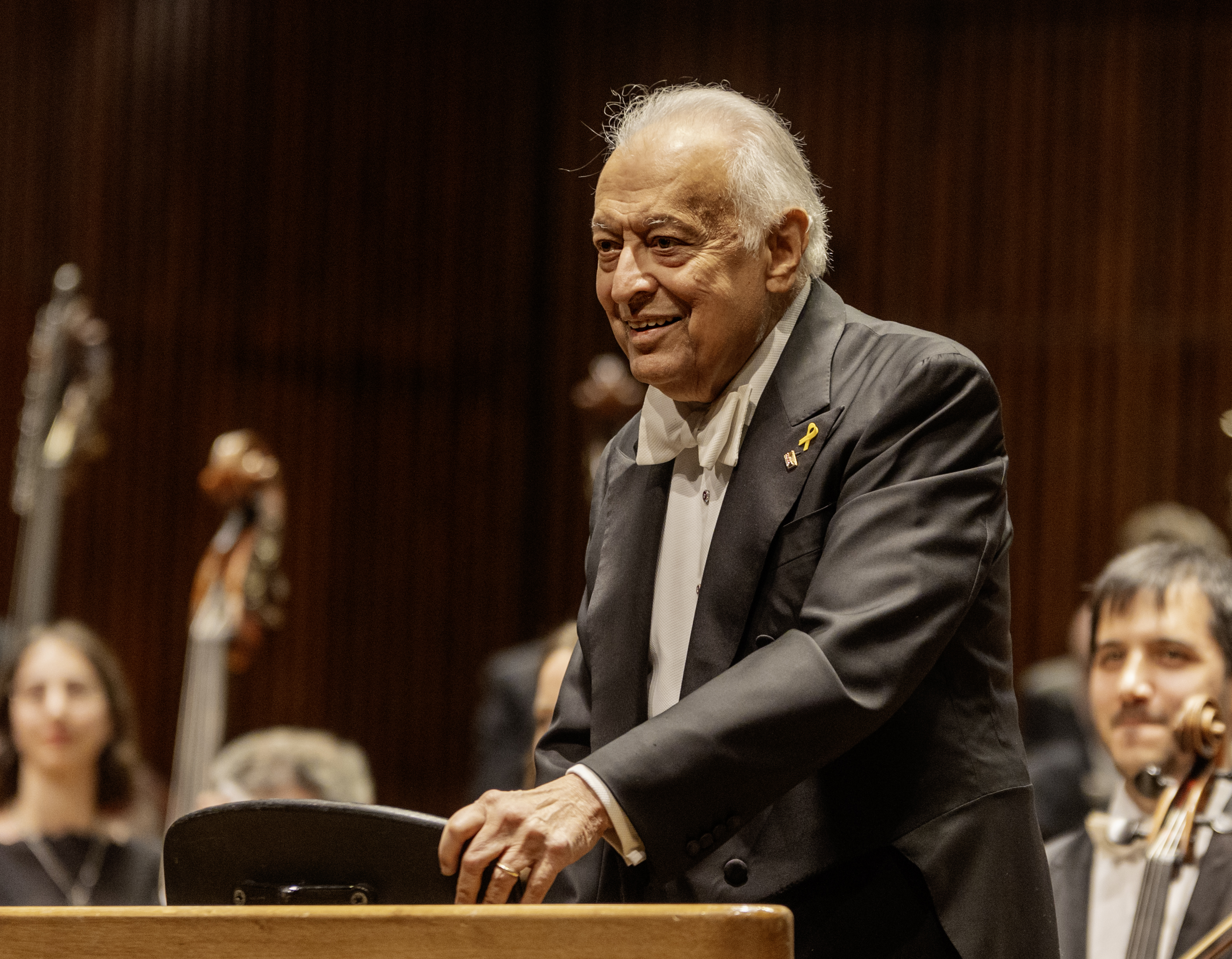
Cover photograph: Zubin Mehta, 2024, CC BY-SA 4.0, via Wikimedia Commons. No freely licensed photograph of Thomas Guggeis exists on Wikimedia Commons.
Cover photograph: Zubin Mehta at the podium in 2024. CC BY-SA 4.0, via Wikimedia Commons.
Comments
Sign in to join the discussion.