THE MOST DAMNING OBJECTS IN THE REPORT ARE RECOMMENDATION LETTERS#
The most damaging evidence in Interlochen Center for the Arts' new historical-abuse report is not an anonymous social-media accusation, a rumor passed among alumni or a conclusion imposed by an outside critic.
It is the institution's own surviving paper trail.
In one case, Interlochen's personnel file reflected that administrators held a series of meetings with an arts faculty member about conduct of a sexual nature toward someone. Within days of the third meeting, one administrator wrote that employee a recommendation. Interlochen placed him on leave. About a month later, another administrator wrote a second recommendation. The employee was then released from his contract at his request. The report identifies him only as Respondent 14. (Sanghavi report, pp. 28-30.)
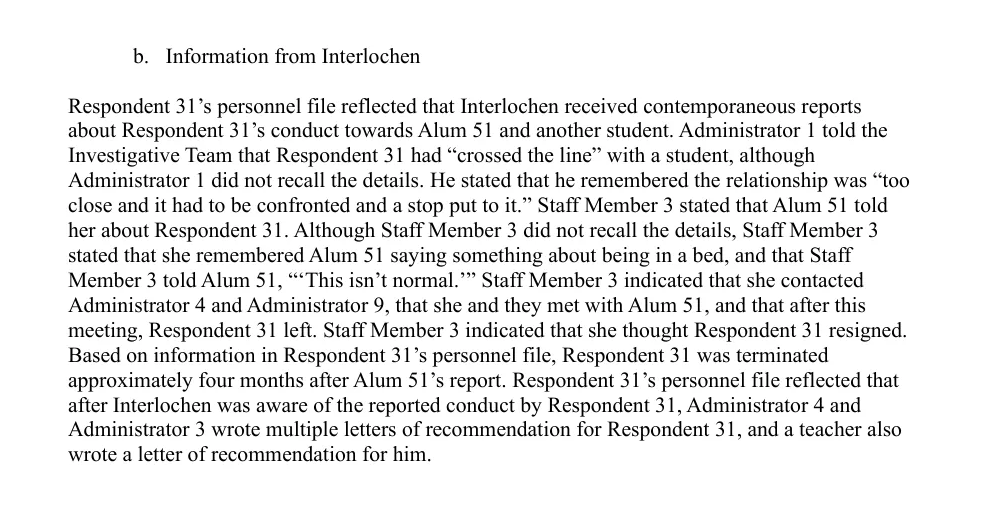
In another case, Interlochen received contemporaneous reports concerning an arts faculty member's conduct toward a student and another young person. The institution terminated him approximately four months after one report. Yet the personnel file reflected that, after Interlochen knew of the reported conduct, two administrators and a teacher wrote multiple letters of recommendation for him. The report identifies him as Respondent 31. (Sanghavi report, pp. 48-50.)
These letters matter because recommendation letters are not ceremonial objects in classical music and elite arts education. They move careers. They carry institutional credibility from one school, studio, ensemble or youth program to another. When an institution recommends an adult after receiving a sexual-misconduct report, it does not merely close a personnel matter. It may export risk while concealing the information that would allow the next institution to evaluate that risk.
The report does not publish the letters. It does not name their recipients. It does not say where the employees went next, what the writers disclosed, whether the recommendations contained warnings, or whether any later employer was told about the allegations.
That silence is not a small archival gap. It is one of the central unresolved facts in the entire investigation.
The recommendation letters are not the only institutional records that demand scrutiny.
A supervisor recommended that Respondent 46 not be rehired after counselors were made uncomfortable by the way he showed affection to campers. An administrator attributed the concern to conflict between the employee and supervisor and hired him anyway. Years later, personnel records documented concerns involving individual students in his room and car, a temporarily withheld contract that was restored, a resignation, and a later report from another student and parent that led Interlochen to contact child-protection authorities and work with a detective. (Sanghavi report, pp. 71-73.)
Respondent 41's file reflected three contemporaneous reports in the 1990s involving sexual comments or conduct students and others perceived as advances. The report says no disciplinary action was taken beyond documenting the concerns. He later resigned for reasons an administrator said were unrelated to those issues. (Sanghavi report, pp. 62-63.)
Respondent 42's personnel file said he was leaving for personal reasons and contained no indication that Interlochen knew of sexual misconduct. Former administrators, however, recalled a report involving a student on his boat, a meeting in which he was told he was finished at Interlochen, and his termination. (Sanghavi report, pp. 63-66.)
Alumni accounts describe an even harsher side of the institutional response. One former student said an administrator called him a sexual slur, blamed him after he reported an alleged assault by a faculty leader and told him to leave quietly or the school would tell his parents. Another said that after an adult employee was fired for having sex with her, three male administrators questioned her about her menstrual cycle and placed her on probation. These are reported accounts, not adjudicated findings. The investigators did not determine whether every incident occurred exactly as described. They belong in the record because the institution commissioned a process that chose to publish them. (Sanghavi report, pp. 30 and 37-39.)
Interlochen's report is full of allegations against individuals. The institutional shame lies in the moments when the school reportedly or demonstrably had information and the adult's career still received protection, ambiguity, delay or assistance while the student carried exposure, discipline, fear or silence.
That is the story the numbers alone cannot tell.
THE DOCUMENTED SHAME LEDGER#
These entries are not all the same category of evidence. Some come from personnel files, some from administrator interviews and some from alumni reports. Each is labeled so that institutional records are not confused with unadjudicated allegations.
| Record | What the investigation documents |
|---|---|
| Recommendations after notice - Respondent 14 | Personnel records reflected meetings about conduct of a sexual nature, followed by recommendation letters from two administrators before the employee's contract ended. |
| Recommendations after notice - Respondent 31 | Personnel records reflected multiple recommendation letters from two administrators and a teacher after Interlochen received contemporaneous reports. |
| A no-rehire warning overridden - Respondent 46 | A Camp supervisor recommended against rehiring; an administrator hired the employee anyway. Later records documented additional concerns and a later external report. |
| Three reports, no discipline beyond documentation - Respondent 41 | The employee's file reflected three contemporaneous reports of nonphysical sexual conduct or perceived advances. The report says no disciplinary action followed beyond recording them. |
| A departure described as personal - Respondent 42 | The personnel file recorded a personal-reasons departure and no notice of sexual misconduct; administrators recalled a sexual report and termination. |
| Adult fired, student says she was punished - Respondent 15 | An alum reported that the adult was fired while she was interrogated by administrators and placed on probation. The respondent could not be identified from the information she chose to provide. |
| Reporter says he was blamed and removed - Respondent 20 | An alum reported that after disclosing alleged assault, an administrator insulted him, blamed him and arranged his departure. No surviving personnel file was available. |
This ledger does not establish that Interlochen knew about every allegation in the report. Many alumni explicitly said they never told an adult at the time. Many personnel files contained no evidence of contemporaneous notice. Some employees were removed quickly, and in later cases Interlochen contacted law enforcement or child-protection authorities.
The ledger establishes something narrower and more serious: the report contains multiple cases in which institutional notice, warning signs or direct reports existed, and the response described in records or testimony was incomplete, delayed, punitive toward a student, badly documented, quietly resolved or accompanied by professional assistance to the accused adult.
AT A GLANCE#
| The investigation | What the report says |
|---|---|
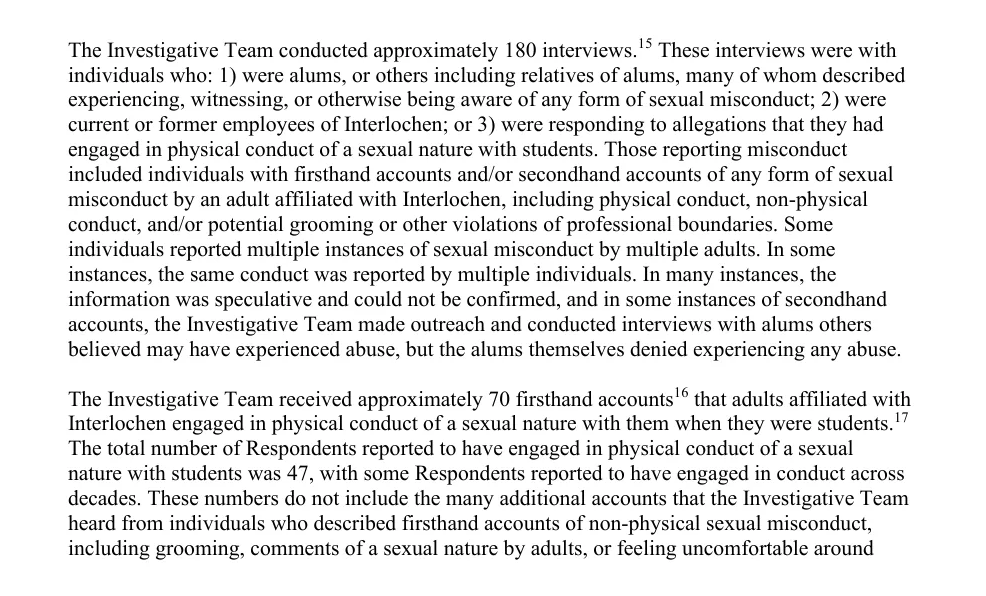
| Interviews conducted | Approximately 180 |
| Unique people interviewed | Approximately 150 |
| Firsthand reports of physical conduct of a sexual nature | Approximately 70 |
| Adults implicated in those reports | 47 |
| Historical span | 1950s through the 2010s |
| Current Interlochen employees among the accused | None, according to Interlochen |
How the report’s approximately 70 firsthand reports break down#
7 direct reports involving Respondent 1
61 firsthand reports involving Respondents 2 through 46
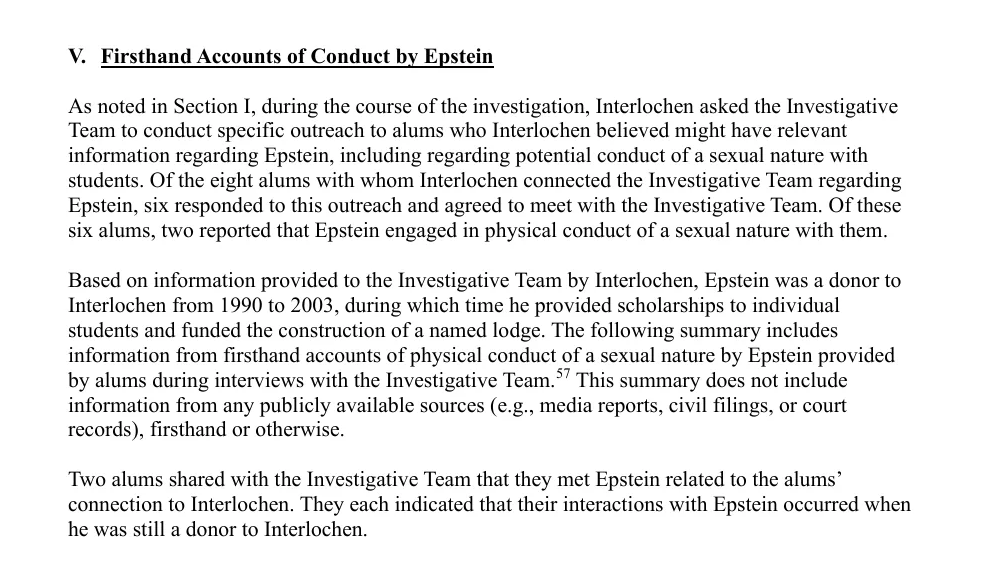
2 firsthand reports involving Jeffrey Epstein
= approximately 70
The report cautions that these are counts of reports, not judicial findings, and that counting historical accounts across decades is necessarily approximate. Some alumni reported conduct involving more than one adult. The approximately 70 figure also does not include the wider body of reported grooming, sexual comments and nonphysical boundary violations documented separately.
A SEVEN-DECADE RECORD - AND THE TWO-YEAR INVESTIGATION THAT FINALLY PUT IT IN PUBLIC#
| Date or period | What the record says |
|---|---|
| 1928 | Interlochen began as a summer music camp in northern Michigan. |
| 1950s | The earliest conduct described in the investigation dates to this decade. |
| 1962 | Interlochen Arts Academy opened as a boarding high school. |
| 1960s-2010s | The report's firsthand accounts span these decades, with most reported incidents occurring before 2000. |
| 1990-2003 | Jeffrey Epstein was an Interlochen donor, supporting tuition and helping fund a lodge that bore his name. |
| 2005 | Interlochen reported Thomas Clower's conduct to law enforcement, terminated him and later confirmed his conviction for attempted fourth-degree criminal sexual conduct. |
| 2009 | Interlochen says the former Epstein lodge was renamed Green Lake Lodge after his first conviction became known to the institution. |
| April 2024 | An alum contacted Interlochen about the longtime faculty member who became the initial subject of the investigation. |
| September 2024 | Interlochen and its board engaged Sanghavi Law Office to conduct the external investigation. |
| June 2025 | The scope expanded to any adult affiliated with the Academy in any decade; Camp accounts and targeted Epstein outreach were later included. |
| June 2026 | Green Lake Lodge was demolished after local law enforcement was offered the opportunity to photograph it for possible evidentiary use. |
| July 27, 2026 | Sanghavi Law Office dated and released the 97-page investigation report. |
The chronology prevents two distortions.
First, the allegations cannot be compressed into one historical moment. The report describes conduct over seven decades, with institutional practices, leaders and social norms changing across that span.
Second, the investigation itself did not begin after Jeffrey Epstein became a useful headline. It began with an alum's report about a longtime faculty member, then expanded as additional accounts surfaced. Epstein became one part of a much broader institutional record.
WHAT THIS REPORT IS — AND WHAT IT IS NOT#
The force of this story depends on precision.
Sanghavi Law Office did not make findings that every reported incident occurred exactly as described. The investigators state explicitly that they chronicled historical accounts but did not adjudicate them. They also did not make formal findings about whether Interlochen’s responses were sufficient, timely or appropriate. This was an institution-commissioned external investigation, not a criminal trial. (Sanghavi report, pp. 3–4.)
That limitation must appear in every responsible account of the report.
It should not be used to make the report disappear.
The investigators interviewed alumni, relatives, current and former employees and some accused individuals. They reviewed available personnel and student files, institutional correspondence and other records. They sought responses from adults accused in firsthand reports. Four of the respondents discussed in the main section concerning other adults participated in interviews. More than one-third of the 47 accused adults were deceased by the time of the investigation. Others declined, did not respond, could not be located or could not be identified from the information available. (Sanghavi report, pp. 7–10.)
The investigators also faced serious archival limits. Interlochen’s current record-retention policy calls for personnel files to be kept for seven years. Some older files had been purged before this investigation began; others no longer existed or were unavailable. Donors, trustees, substitute teachers and visiting artists often had no personnel files because they were not employees. Some alumni did not know an adult’s full name or chose not to disclose it. The report does not claim that records were destroyed to obstruct this inquiry, but the result is the same for historical accountability: in many cases, the institutional paper trail is thin or gone. (Sanghavi report, pp. 9–11.)
Only 10 current or former employees were interviewed specifically about institutional response. None had served as an Interlochen administrator in the 1960s or 1970s. No person interviewed had worked at Interlochen in any capacity during the 1960s, and only one had worked there for a single semester in the 1970s, without being an administrator. That means the earliest decades — where some of the most serious patterns are described — are reconstructed primarily through alumni accounts and surviving records rather than testimony from the leaders who were responsible at the time. (Sanghavi report, p. 9.)
The investigation is also not necessarily finished. The report says additional outreach and interviews remained, that more alumni may come forward after publication and that the investigative team could prepare a supplemental report. Interlochen says Elizabeth Sanghavi will continue receiving information through October 2026. (Sanghavi report, pp. 6–7; Interlochen community letter.)
The published document is therefore not a census of every harmful incident that occurred at Interlochen. It is a record of what investigators were able to gather under the limits of time, memory, participation, privacy and surviving documentation.
That is why the approximately 70 reports should be understood as a documented minimum, not a scientifically complete measurement of the institution’s history.
FACT BOX: ESTABLISHED, REPORTED AND UNRESOLVED#
| Category | What can be stated |
|---|---|
| Established by the investigation process | Approximately 180 interviews; approximately 150 unique participants; approximately 70 firsthand physical-conduct reports; 47 accused adults; decades of available record review. |
| Reported by alumni or others | The individual accounts of grooming, touching, assault, coercion, institutional notice, retaliation and lifelong harm. Investigators did not adjudicate every account as fact. |
| Documented in institutional files | In several cases, records show contemporaneous reports, warnings, meetings, departures, terminations, referrals to authorities or recommendation letters written after concerns were known. |
| Admitted by respondents | At least two respondents acknowledged conduct crossing sexual or professional boundaries, although their descriptions did not always match alumni accounts. |
| Criminally established | Thomas Clower, identified in the report as Respondent 43, pleaded guilty to attempted fourth-degree criminal sexual conduct after conduct reported in 2005. Jeffrey Epstein and Ghislaine Maxwell’s criminal histories are independently established, though the Interlochen report evaluates specific alumni accounts rather than retrying their broader crimes. |
| Still unresolved | The identities of most respondents remain private; law enforcement must decide whether any viable prosecution or other action remains; additional alumni may still come forward. |
This distinction does not weaken the article. It makes the indictment more exact.
The defensible claim is not that Interlochen knew everything or covered up every allegation. Many alumni told investigators they never disclosed what happened, and many files contained no evidence of contemporaneous notice.
The defensible claim is that the report documents repeated opportunities for abuse, repeated failures of oversight and several specific cases in which adults at Interlochen allegedly or demonstrably received warning signs, reports or direct disclosures — yet the institutional response was delayed, punitive toward students, poorly documented, quietly resolved or accompanied by assistance that could help an accused adult move elsewhere.
That is enough to demand shame.
THE NUMBER THAT ENDS THE “ONE BAD ACTOR” EXCUSE#
One predator can exploit a blind spot.
Forty-seven accused adults across seven decades reveal something larger.
The report’s 47 adults were not concentrated in a single studio, decade or job category. They included people whose authority came from teaching, housing, administration, trusteeship, philanthropy and simple physical access to campus. Some allegations concern relatively brief boundary violations. Others describe grooming, repeated sexual contact, coercion, assault or relationships extending beyond a student’s time at the school.
The severity differs. The recurring structure does not.
VISUAL: FIRSTHAND REPORTS INVOLVING RESPONDENTS 2–46, GROUPED BY THE DECADE IN WHICH THE ALLEGED CONDUCT FIRST BEGAN#
The report groups a respondent under the first decade in which alleged conduct began, even when additional reports extend into later decades. Respondent 1 and Epstein are treated in separate sections.
Counts are grouped by the decade in which reported conduct first began. Respondent 1 and Epstein are treated separately in the report.
The 1970s and 1980s dominate the numerical record, but the timeline does not stop there. The report includes three firsthand reports grouped under conduct beginning in the 2000s and one grouped under the 2010s, in addition to other allegations involving adults whose reported conduct crossed decades. (Sanghavi report, pp. 16, 20, 37, 53, 66 and 71.)
Interlochen’s defense cannot reasonably be that standards were different in every relevant era.
Social expectations, laws and institutional policies did change. But alumni in the report describe saying no, moving away, screaming, reporting concerns, seeking medical attention, telling parents, asking for different teachers and warning adults. Some accused adults allegedly acknowledged that their conduct could cost them their jobs or lead to arrest. Administrators sometimes investigated and terminated people. Those facts show that the impropriety was not invisible even at the time.
There is no historical era in which rape, forced sexual contact, intoxication used to gain access, or an adult’s exploitation of a child’s dependency becomes an acceptable teaching method.
The report itself recognizes that an adult–student “relationship” is not made appropriate because a teenager once perceived it as consensual. The power difference is built into the educational relationship. (Sanghavi report, p. 4.)
THE ANATOMY OF ACCESS#
The report identifies six recurring conditions: limited communication with families, vulnerability associated with age and isolation, adult–student power imbalances, extensive adult access to students, gaps in oversight and barriers to reporting. (Sanghavi report, pp. 81–89.)
Those categories are clinical. The stories underneath them are not.
1. PRAISE BECAME A DOOR#
Many accounts begin with recognition.
An adult noticed a young artist, praised the student’s talent, offered extra coaching, gave special opportunities, arranged a scholarship, invited the student to perform, promised connections or made the student feel chosen.
That attention carried unusual force in an arts school. A teenager was not merely being complimented. The praise came from someone who might determine whether the student received a part, stayed in a studio, kept funding, entered a conservatory or gained access to a professional network.
The report describes alumni who believed an adult’s attention proved that they were gifted, mature or special. Several later understood that attention as grooming. One alum said an adult made students feel like “one of the chosen ones.” Another described a promise of future success through professional contacts. The report also notes that scholarships could deepen dependency when the person offering or facilitating financial support later pursued the recipient. (Sanghavi report, pp. 82–83.)
This is one of the central dangers of elite training: artistic validation is not merely emotional. It is currency.
2. PRIVATE INSTRUCTION NORMALIZED PRIVATE ACCESS#
One-to-one teaching is fundamental to music education. So is physical demonstration. Breathing, posture, embouchure, hand position, muscular tension and movement may require a teacher to observe or occasionally touch a student.
The report shows how that legitimate pedagogical context could blur the line between instruction and intrusion. Alumni described touching that began as apparently normal teaching and then moved elsewhere. Some said they could not immediately tell whether contact was technical, affectionate, sexual or a test of how much they would tolerate.
Historically, some practice rooms and studios had no windows, or their windows were covered. Hours of private contact with prestigious teachers could occur without another adult seeing what happened. The report quotes an alum who observed that touch is part of refining a performing artist’s instrument, making arts students particularly vulnerable when boundaries are unclear. (Sanghavi report, pp. 83–84.)
3. THE SIGN-OUT SYSTEM SOMETIMES FUNCTIONED AS PERMISSION, NOT PROTECTION#
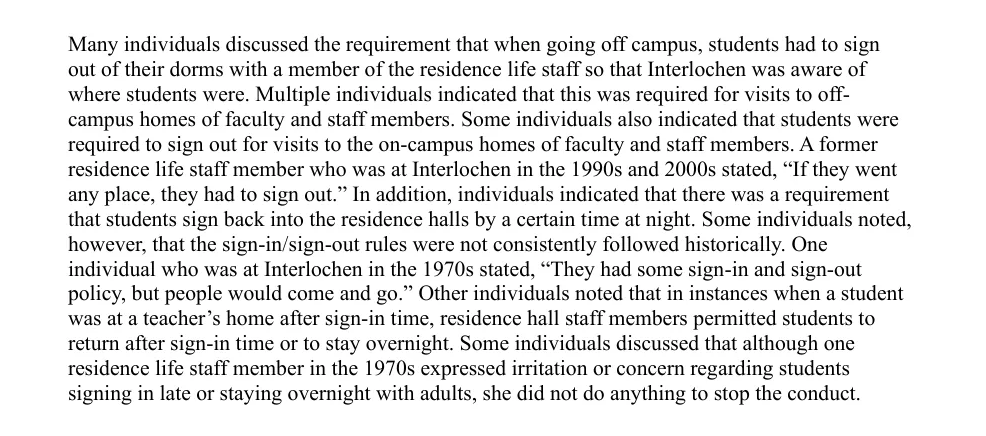
Students were often required to sign out before leaving campus or visiting an adult’s home. On paper, that system allowed residence staff to know where children were.
The report describes something more troubling in practice.
Alumni said teachers and staff signed students out for dinners, drives, weekends, travel and overnight stays. Some residence employees reportedly knew students were returning late or remaining overnight at faculty homes. At least one alum recalled a staff member offering a warning but not stopping the arrangement. Others described sign-in and sign-out rules as inconsistently followed. (Sanghavi report, pp. 85–86.)
A control that records a child’s location but does not challenge why the child is alone overnight with an adult can become an institutional receipt for danger.
4. HOMES, CARS, CABINS, WOODS AND HOTELS REMOVED WITNESSES#
Again and again, the reported setting changes from school to somewhere private.
Faculty homes appear throughout the report. So do cars, cabins, campgrounds, wooded areas, boats and hotel rooms. Adults allegedly offered dinner, transportation, a bath, a massage, a trip, an overnight stay, a place to rest or a private conversation. What looked like mentorship or hospitality created isolation.
The sponsor-group system was intended to give boarding students a family-like connection. Alumni described group dinners, baking, movies and gatherings in faculty homes as positive parts of the Interlochen experience. But the report also says some sponsors used the system to develop one-on-one access to students in private homes. (Sanghavi report, pp. 84–85.)
The lesson is not that every meal or mentorship was predatory. It is that a child-protection system cannot depend on guessing which admired adult deserves an exception.
5. RESIDENCE-LIFE STAFF COULD BECOME FRIENDS INSTEAD OF GUARDIANS#
Residence employees lived close to students and controlled daily freedoms. Some alumni remembered staff members who maintained clear boundaries. Others described young residential employees behaving more like peers, confidants or friends.
That closeness could be comforting to children living away from home. It could also create access to bedrooms, private rooms, alcohol and emotionally intimate conversations. Several respondents in the report held residence-life roles. Some alumni described being invited into staff rooms to watch television, drink, receive back rubs or talk privately. (Sanghavi report, pp. 84 and 71–73.)
The institution’s current residence-life policy now stresses a two-students-to-one-adult or two-adults-to-one-student structure and tells staff to act as mentors rather than friends. The existence of that rule today is an acknowledgment of the danger in the historical boundary collapse. (Sanghavi report, p. 90.)
6. DONORS AND TRUSTEES HAD STATUS WITHOUT ORDINARY EMPLOYEE CONTROLS#
The report describes a historically open campus where donors and trustees could attend rehearsals, walk through student areas, sponsor young people, invite students away and cultivate relationships without being integrated into the same supervision structure as employees.
One alum said donors were given virtually free rein. Another criticized the institution for giving children’s information to donors. The report describes a trustee who allegedly selected students, financed travel to his out-of-state home and caused at least one student to miss stretches of school. (Sanghavi report, pp. 85–86.)
Jeffrey Epstein fits directly into this category.
He was not faculty. He did not need a studio assignment. Wealth created another route.
THE SHAME IS NOT ONLY WHAT ADULTS ALLEGEDLY DID. IT IS WHAT THE INSTITUTION DID AFTER IT KNEW.#
Many allegations in the report were never disclosed at the time. That distinction matters. An institution cannot respond to information it never receives.
But the report also contains cases in which alumni say they reported, adults observed warning signs, personnel files recorded concerns or administrators met with accused employees.
Those cases are where institutional accountability becomes unavoidable.
CASE FILE: RESPONDENT 14 — REPORTS, LEAVE, AND RECOMMENDATION LETTERS#
An alum said an arts faculty member kissed and touched her during lessons in the 1970s. She eventually confronted him and asked whether he could promise not to do the same thing to another student. According to her account, he said he could not make that promise.
She then reported him to Academy leadership. She said an investigation followed, other people came forward, the teacher stopped appearing in class and she was told he would be asked to resign. She also said she was told he would be allowed to resign so the matter would not appear on his record.
The surviving personnel file adds the most damaging institutional detail. It reflected multiple meetings with the respondent concerning sexual conduct toward someone. Within days of a third meeting, an administrator wrote him a recommendation letter. After Interlochen placed him on leave, another administrator wrote a second recommendation. He was later released from his contract at his request. (Sanghavi report, pp. 28–30.)
The report does not determine what those administrators believed or why they wrote the letters.
The letters exist.
A recommendation written after concerns of sexual conduct is not a neutral administrative act. It can transfer risk from one institution to another while preserving the recommender’s quiet. It helps an adult retain professional mobility after a child has taken the risk of reporting.
CASE FILE: RESPONDENT 31 — FOUR MONTHS TO TERMINATION, RECOMMENDATIONS AFTER NOTICE#
Two alumni reported sexual conduct by an arts faculty member in the 1980s, and the personnel file contained a report involving a third student.
One alum said she reported the conduct to a staff member and then met with senior administrators. She remembered feeling blamed and said no one apologized. A staff member recalled telling the student the situation was not normal and escalating it to administrators.
The personnel file showed that Interlochen received contemporaneous reports. It also showed that the respondent was terminated approximately four months after one report — and that, after Interlochen knew of the reported conduct, two administrators and a teacher wrote multiple letters of recommendation for him. (Sanghavi report, pp. 48–50.)
This is not an allegation reconstructed solely from memory. The recommendation letters were in the file.
Interlochen should have to explain, publicly and specifically, why adults believed a recommendation was appropriate after reports involving students. The 2026 report records the fact but does not identify the administrators, quote the letters, state where they were sent or trace whether the respondent obtained later access to children.
That is an unfinished accountability question, not a historical curiosity.
CASE FILE: RESPONDENT 20 — A STUDENT SAYS HE REPORTED ASSAULT AND WAS CALLED THE PROBLEM#
An alum described grooming by an arts faculty member and division director in the 1980s, followed by repeated sexual conduct and an alleged assault during travel that caused him to seek medical attention.
He said he reported the respondent to an administrator after the adult would not leave him alone. According to the alum, the administrator called him a “slut,” said he had caused the situation and told him to leave quietly or the school would tell his parents. He said an administrator drove him to the airport and that his parents were told he was gay. He believed the resulting rumors presented him, rather than the adult, as the problem. Another alum provided corroborative information concerning parts of his account. (Sanghavi report, pp. 37–39.)
Interlochen told investigators it no longer possessed the respondent’s personnel file, and the employees interviewed for the investigation did not report knowledge of sexual conduct involving that respondent.
The investigators did not adjudicate the alum’s account.
But if it occurred as described, the institutional response was not merely inadequate. It weaponized a child’s sexuality, fear of family disclosure and dependence on the school to remove the student while leaving the adult’s professional status comparatively protected.
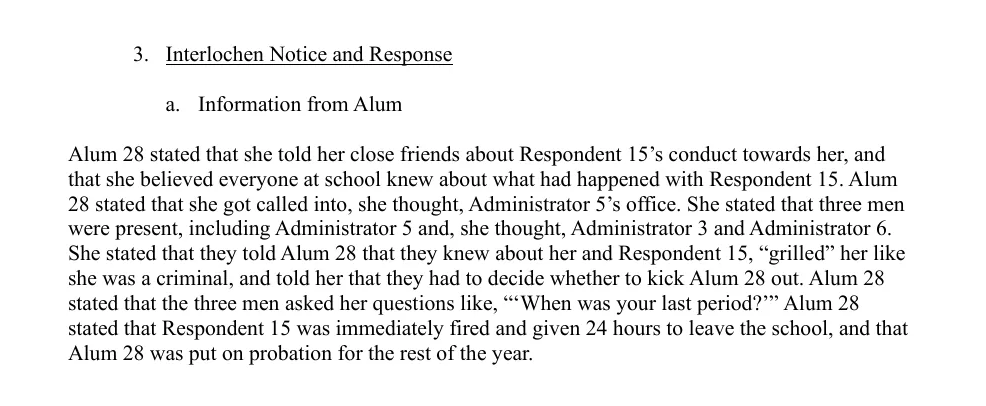
CASE FILE: RESPONDENT 15 — THE ADULT WAS FIRED; THE STUDENT SAYS SHE WAS PUT ON PROBATION#
An alum reported that a staff member invited her to his campus residence after a performance and had sex with her after she went numb.
She said the school summoned her before three male administrators, questioned her in a manner she experienced as criminalizing and asked about her menstrual cycle. According to her account, the staff member was fired and given 24 hours to leave — while she was placed on probation for the remainder of the year. (Sanghavi report, p. 30.)
The respondent could not be identified from the information the alum chose to provide, so Interlochen could not produce records about him.
The alleged response reveals a historical logic that appears elsewhere in the report: discipline could fall on the child because the child had broken a rule, been in the wrong place, consumed alcohol, stayed out late or participated in conduct initiated by an adult.
A system that treats student rule-breaking and adult sexual exploitation as comparable misconduct teaches children that disclosure may worsen their position.
CASE FILE: RESPONDENT 32 — WARNINGS ACROSS DECADES, AN ADMISSION, AND A LATE RESIGNATION#
Two alumni described sexual conduct by an academic teacher, one in the 1980s and another in the 1990s. The respondent agreed to an interview.
He denied intercourse with students but acknowledged sexual touching involving one student and “probably” another. He described one relationship as beginning in a father-daughter mode and then changing into other roles. He ended the interview after discussing that relationship. (Sanghavi report, pp. 50–51.)
The personnel file showed that Interlochen received a contemporaneous report in the 1980s. An administrator spoke separately with the student and teacher, who both denied the conduct at the time. The school received another contemporaneous report in the 1990s, after which an administrator warned the teacher that further unprofessional touching would result in termination. A former student wrote again in the 2000s describing sexual conduct from the 1980s; approximately six weeks later, the respondent resigned. (Sanghavi report, p. 52.)
This is not a story of an institution with no information. It is a story of information arriving in stages across decades, with the adult remaining in the institution through warnings and denials until a much later disclosure produced an exit.
CASE FILE: RESPONDENT 46 — A REHIRE WARNING OVERRIDDEN#
The report’s 2010s section concerns a residence-life employee. One alum described becoming intoxicated while drinking alone with the respondent and alleged sexual touching while he was barely conscious. A second student later reported a sexual relationship with the same adult, according to the personnel file.
The file showed an earlier warning: before the first alum entered the Academy, a Camp supervisor had recorded concern that the respondent showed affection to campers in a way that made counselors uncomfortable and recommended that he not be rehired. An administrator hired him anyway, attributing the concern to a difficult relationship with the supervisor. (Sanghavi report, pp. 71–72.)
Later, administrators questioned the respondent about possible inappropriate or physical conduct and initially withheld a future contract. Additional concerns were raised about him taking individual students off campus and having students alone in his room. The contract hold was then lifted, and he continued in residence life for the next academic year before submitting a resignation. After another student and parent reported conduct, Interlochen notified child protective services, worked with a detective, barred him from campus and warned him to stop contacting students. (Sanghavi report, pp. 72–73.)
The early recommendation not to rehire was not proof of sexual misconduct. It was a safeguarding warning.
The decision to override it is exactly the kind of discretionary exception that child-protection systems are designed to prevent.
CASE FILE: RESPONDENT 41 — THREE REPORTS DOCUMENTED, NO DISCIPLINE BEYOND RECORDING THEM#
A respondent who held residence-life and later arts roles was the subject of one alum’s account of physical boundary violations. His personnel file also reflected three contemporaneous reports in the 1990s involving nonphysical sexual conduct or perceived advances toward students.
According to the report, no disciplinary action beyond documenting the concerns was taken. The respondent, through counsel, denied improper conduct. An administrator said he later left because he was ready to move on, not because Interlochen asked him to resign. (Sanghavi report, pp. 62–63.)
Three documented reports should not become three isolated pieces of paper.
A safeguarding institution must aggregate patterns.
CASE FILE: RESPONDENT 42 — THE PERSONNEL FILE SAID “PERSONAL REASONS”; ADMINISTRATORS REMEMBERED A SEXUAL REPORT#
Four alumni described conduct involving an arts faculty member, including three reports of physical sexual conduct in the 2000s. One alum said a guidance counselor learned of an incident and brought him to administrators; he said the respondent vanished from campus that day.
Former administrators told investigators they remembered a report involving a student, a boat and sexual conduct, and that the respondent was terminated or told he was finished at Interlochen.
The personnel file, however, contained an undated letter in which the respondent announced he was leaving for personal reasons. The file did not include information showing that Interlochen had notice of sexual conduct with a student. (Sanghavi report, pp. 63–66.)
The report does not explain why institutional memory and the surviving personnel record diverge.
That divergence matters. When a file describes “personal reasons” while administrators remember a sexual-conduct report, future employers and investigators may see a clean departure where the institution itself understood something far more serious.
THE COUNTEREXAMPLES: INTERLOCHEN SOMETIMES ACTED QUICKLY#
The report also documents instances of faster action.
In the 1990s, two students reported conduct by Respondent 34. The personnel file reflected that Interlochen terminated him approximately three days after one report and notified child protective services about both students. (Sanghavi report, pp. 54–55.)
In 2005, after allegations involving Respondent 43, Interlochen met with students, contacted child-protection authorities, reviewed electronic communications, cooperated with law enforcement and terminated the teacher. He was arrested and later pleaded guilty to attempted fourth-degree criminal sexual conduct. Interlochen identifies him publicly as Thomas Clower. (Sanghavi report, pp. 66–68; Interlochen community letter.)
These examples are important for two reasons.
First, they prevent a dishonest claim that every response was identical or that Interlochen never protected a student.
Second, they make the failures in other cases harder to excuse. The institution was capable of treating a report as urgent, removing an adult, contacting external authorities and preserving a record. When it instead allowed quiet departures, wrote recommendations, lifted contract holds or focused discipline on students, those were choices — not inevitable products of ignorance.
THREE NAMED RESPONDENTS WERE STILL ATTACHED TO FOUR OFFICIAL FUNDS IN INTERLOCHEN'S FY2025 GIVING REPORT#
The investigation names only four numbered respondents publicly, plus Jeffrey Epstein. Three of those numbered respondents also appeared in Interlochen's own FY2025 Annual Report of Gifts through scholarships or program endowments bearing their names.
The official report, covering June 1, 2024 through May 31, 2025, listed the following four recognitions. S3
- Byron Hanson Guest Teaching Endowment
- Ann and Byron Hanson Endowed Camp Scholarship
- Jack (John R.) and Mary Lou Hood Endowed Academy Scholarship
- Charles K. McWhorter Memorial Scholarship
The report contains no allegation against Ann Hanson or Mary Lou Hood. Their names are included here only because the official funds are jointly named.
The timing requires precision. The FY2025 giving report preceded publication of the July 2026 investigation. Its presence does not prove that Interlochen continued honoring the three men after making the report public. It does show that while the historical investigation was underway, the institution's official philanthropic record continued to present their names as part of the machinery that supports teaching and student access.
The July 2026 community letter says Interlochen is reviewing naming recognitions connected to people whose conduct does not reflect the institution's values. It does not announce which recognitions have already been removed, what will happen to the underlying assets, whether the funds will be renamed, or whether scholarship recipients and donors will be told why a name changed.
THE NAMING RECORD#
| Publicly identified person | The investigation's public description | FY2025 fund or endowment carrying the name |
|---|---|---|
| Byron Hanson, Respondent 1 | Seven independent direct reports involving conduct in the 1960s and 1970s, including five reports concerning students and two concerning conduct after graduation; multiple corroborating accounts. | Byron Hanson Guest Teaching Endowment; Ann and Byron Hanson Endowed Camp Scholarship |
| John "Jack" Hood, Respondent 8 | Four independent direct reports of conduct involving students in the 1970s. | Jack (John R.) and Mary Lou Hood Endowed Academy Scholarship |
| Charlie McWhorter, Respondent 19 | Two independent direct reports involving students, with additional corroborating information. | Charles K. McWhorter Memorial Scholarship |
Naming is not bookkeeping. In a school, it is institutional speech.
A scholarship tells a student whose memory deserves to finance possibility. An endowment tells teachers and donors which legacy the institution intends to preserve. When an abuse investigation changes what is publicly known about the names attached to those funds, a quiet database edit would not by itself explain the institutional history that made the change necessary.
The report's promised naming review is therefore not peripheral. It is a test of whether Interlochen treats recognition as an accountability record or merely as a branding problem.
THE FIVE PUBLIC NAMES - AND THE 42 THE PUBLIC STILL DOES NOT KNOW#
The report generally assigns numbers to accused adults in order to protect alumni privacy and avoid interfering with potential law-enforcement work. Interlochen says it provided the names of all accused individuals to the Grand Traverse County Prosecuting Attorney’s Office and the Grand Traverse County Sheriff’s Office.
Five adults in the physical-conduct sections are publicly named.
Three were deceased and, according to Interlochen, were identified because investigators received multiple independent firsthand accounts describing repeated or pervasive conduct. A fourth had already been convicted. Jeffrey Epstein is discussed by name because his identity and criminal history were already matters of extensive public record. (Interlochen community letter, July 2026.)
BYRON HANSON — RESPONDENT 1#
Byron Hanson worked at Interlochen from 1960 to 2015 as a faculty member and administrator. He was the initial subject of the investigation.
Interlochen’s summary says investigators received seven independent direct reports of sexual misconduct involving Hanson in the 1960s and 1970s, with multiple corroborating accounts. The detailed report describes five alumni who said conduct began while they were students and two who described conduct after graduation. Several student accounts involved private time in his home, drives, dinners, alcohol, touching or sexual activity. (Interlochen community letter; Sanghavi report, pp. 12–15.)
The institutional-notice section is revealing even where it is inconclusive. Some alumni said they did not report. Others believed residence staff must have known they were spending nights at Hanson’s house because those staff controlled sign-outs and evening returns. One alum recalled receiving a warning from a residence employee. Another said staff objected to the idea of students staying overnight but did not believe they had authority to stop it. (Sanghavi report, p. 14.)
Interlochen no longer had Hanson’s personnel file. The investigation began after an alum contacted the school in April 2024, after which the president and board initiated the external review. (Sanghavi report, p. 15.)
Hanson’s five-decade institutional tenure makes the absence of a surviving personnel file especially consequential. The public record now contains multiple direct reports, but little institutional documentation capable of showing what supervisors observed, discussed or ignored during the years he held authority.
JOHN “JACK” HOOD — RESPONDENT 8#
John “Jack” Hood worked as a teacher and administrator from 1963 to 1979 and later returned in seasonal roles through 2004. Investigators received four independent direct reports involving conduct in the 1970s. (Interlochen community letter.)
The accounts describe repeated invitations to private settings: a basement, walks in the dark, camping, a backyard, an office with a locked door and an offer to use a bathtub at his home. Some alumni said they resisted or left. Some said residence staff expressed irritation or concern about late returns. The personnel file did not show contemporaneous notice, though one alum wrote to an administrator decades after Hood’s departure. (Sanghavi report, pp. 21–23.)
Again, the report does not establish that administrators knew the full nature of what alumni now describe. It does show how ordinary institutional privileges — taking students walking, camping, home or into private offices — created opportunities that no child-safety system should leave to personal judgment.
CHARLIE McWHORTER — RESPONDENT 19#
Charlie McWhorter served as an Interlochen trustee from 1970 to 1999. Investigators received two independent direct reports and multiple corroborating accounts. (Interlochen community letter.)
One alum said McWhorter paid for him to travel during school breaks and summers, stay at McWhorter’s out-of-state home and share a bed, where repeated sexual conduct allegedly occurred. Another described overnight stays and sexual touching. A former board member said that in the 2000s he saw McWhorter leave an on-campus hotel room with a person he assumed was a student because the person wore the student day uniform, and that he told another board member. (Sanghavi report, pp. 36–37.)
The file provided by Interlochen did not show notice of sexual conduct involving students.
McWhorter’s case matters because it destroys the comforting idea that risk was limited to faculty studios. A trustee could possess money, prestige, access and institutional legitimacy without being subject to the same daily supervision as an employee. The report’s broader donor-access section describes students being selected, sponsored, flown away and introduced to adult networks under the banner of opportunity. (Sanghavi report, pp. 85–86.)
THOMAS CLOWER — RESPONDENT 43#
Thomas Clower was an arts faculty member from 2003 to 2005. Unlike the other named numbered respondents, his case includes a criminal conviction.
The report says a student and another witness described conduct at Clower’s home. Interlochen’s records showed that the institution reported the matter to child-protection authorities, electronic communications reflected grooming, law enforcement became involved, Clower was arrested and Interlochen terminated him. He later pleaded guilty to attempted fourth-degree criminal sexual conduct. (Sanghavi report, pp. 66–68.)
Interlochen points to this case as evidence of a response that included reporting and removal.
It is also evidence that the school’s systems could work when information was centralized, documented and escalated externally.
JEFFREY EPSTEIN — DONOR, ALUMNUS AND A SYMBOL OF THE LARGER FAILURE#
Epstein attended Interlochen Arts Camp in 1967 and later donated more than $400,000 between 1990 and 2003, including money for a lodge that bore his name. He visited campus, sometimes with Ghislaine Maxwell, and used philanthropy to support scholarships and institutional projects. Public reporting before the Sanghavi report documented allegations from women who said they first encountered Epstein through Interlochen. Interlochen demolished the former Epstein lodge in June 2026 after giving local law enforcement an opportunity to document it. S1S4S5
The external report adds two firsthand alumni accounts.
One alum said she met Epstein and Maxwell at Interlochen, where they offered to pay tuition. She said Epstein engaged in physical conduct on campus and later during visits to New York while she was still an Interlochen student. She also said financial support for later education was withdrawn after she did not engage in requested conduct.
A second alum said she may first have met Epstein and Maxwell during a New York visit while she was a student and later visited Epstein after graduation. She described being taken to a room with a massage table and being asked to participate in conduct she found troubling. Two people provided corroborative information concerning aspects of her account. (Sanghavi report, pp. 73–74.)
The second alum’s mother told investigators that she called Interlochen soon after learning what had happened. According to the mother, she told the person answering the main number that Epstein was preying on students and was connected to the school as a benefactor. She said she was told Interlochen knew of no problem, that Epstein was not a teacher and that the incident had not happened on campus. She said no one followed up. (Sanghavi report, p. 74.)
Interlochen provided no records showing notice of Epstein misconduct, and interviewed employees did not report contemporaneous knowledge. The report therefore presents a painful contradiction rather than a resolved finding:
The institution had no record. A mother says she made the call.
That distinction is the entire problem with relying on institutional files as proof that an institution received no warning. A call that was minimized, misrouted, never memorialized or never escalated can vanish from the archive while remaining unforgettable to the person who made it.
The report says another alum remembered two adults warning him about Epstein. One could be identified only by position and the other was deceased. It also says many alumni viewed Epstein and Maxwell’s broad campus access as evidence of a larger structural issue: adults who were not employees could obtain access to students in an open environment. (Sanghavi report, pp. 73–74.)
Interlochen renamed the lodge in 2009 after Epstein’s first conviction and conducted internal reviews that it said found no evidence in its records of crimes at the school. The building was later demolished. S1S4S5
Removing the name was appropriate.
Removing the building may have been appropriate.
Neither action answers how a donor obtained access to young artists, how scholarship relationships were supervised, what information moved between fundraising and student-safety offices, why a mother’s reported warning left no trace, or whether donor prestige caused adults to interpret obvious risk as generosity.
The most important sentence in the Epstein section is not his name.
It is the report’s description of adults who were not employees having access to children.
That is how the famous scandal connects to the other 46 respondents.
“WHY DIDN’T THEY REPORT?” THE REPORT ANSWERS THAT QUESTION REPEATEDLY#
The reflexive question in abuse cases is often why a child did not tell someone.
The Interlochen report documents a more useful question: what did the institution teach students would happen if they did?
THEY FEARED LOSING THE ADULT THEY DEPENDED ON#
Some adults were beloved, prestigious and professionally powerful. Alumni described large “fan clubs” around certain teachers. A student who reported could believe they were destroying the community’s hero, ending classmates’ training or becoming known as the reason a respected adult disappeared.
The report says some adults explicitly warned students that disclosure could cost the adult a job or lead to arrest. That warning could make the child feel responsible for protecting the adult. (Sanghavi report, p. 87.)
THEY FEARED LOSING THEIR OWN PLACE#
Students described fear of expulsion, scholarship loss, damaged recommendations and punishment for alcohol, smoking, curfew or being in a prohibited location.
One alum described a pervasive atmosphere in which speaking against faculty could threaten scholarship support and college recommendations. Others believed that admitting they had drunk alcohol with a teacher would lead the school to discipline them. The report notes that Interlochen’s reputation for expelling students over rule violations may have reinforced that fear. (Sanghavi report, pp. 87–88.)
When the adult controls opportunity and the institution controls belonging, silence can look less like passivity than survival.
SOME COULD NOT SAFELY GO HOME#
Interlochen was a refuge for many students.
Alumni described escaping abusive homes, hostile schools, isolation or communities where their identity was unsafe. Some said Interlochen saved their lives. For those students, reporting could mean removal from the place where they finally belonged and return to a home that felt more dangerous. (Sanghavi report, p. 88.)
This is the cruelty of exploiting a sanctuary: the child may feel there is nowhere else to go.
THEY HAD LIMITED CONTACT WITH FAMILY#
Before mobile phones, students might rely on shared hall phones, limited mail and scheduled contact. The campus was geographically isolated. Alumni said that distance deprived them of ordinary family conversations in which a troubling interaction might have surfaced. (Sanghavi report, pp. 81–82.)
Boarding schools do not merely educate children. They temporarily replace the family’s daily protective presence. That creates a higher duty, not a lower one.
SOME SAID THEIR REPORTS WERE MINIMIZED, IGNORED OR TURNED AGAINST THEM#
The report contains accounts of students approaching adults and receiving little help, being disbelieved, feeling blamed or watching nothing happen. One alum described trying three adults and concluding, “Three strikes, you’re out.” Another said the response to her report was at least as traumatic as the conduct itself. (Sanghavi report, pp. 25 and 80.)
A reporting system is not defined by the number of channels printed in a handbook. It is defined by what happens to the first frightened child who uses one.
THE DAMAGE DID NOT END WHEN THE STUDENT LEFT CAMPUS#
Interlochen’s report devotes an entire section to impact, and that section should not be treated as an emotional appendix.
The consequences are part of the institutional cost.
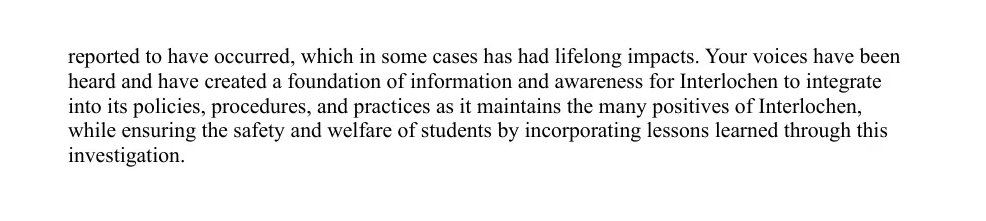
Alumni described damage to their connection with Interlochen, academic work, artistic careers, mental health and personal relationships. Some still loved the school and credited it with transforming or saving their lives. That complexity does not reduce the harm. It makes the betrayal sharper: the same institution could be both sanctuary and source of trauma. (Sanghavi report, pp. 77–79.)
Some alumni stopped returning to reunions. Some withdrew financial support. Some said they could no longer separate beautiful memories from the knowledge of what happened to them or their friends.
Some changed majors, abandoned artistic disciplines or selected only teachers of a particular gender. Some decided not to pursue performance careers. One described giving up music as a career; another said abuse crushed the dream that had brought him to the school. Alumni described wondering whether praise reflected talent or sexual interest and whether opportunities were earned or exchanged through favoritism. (Sanghavi report, pp. 79–80.)
The report records anxiety, depression, post-traumatic stress, eating disorders, insomnia, nightmares, substance misuse, damaged self-esteem and difficulty trusting judgment. Some alumni blamed themselves for years. Some struggled with intimacy or interpreted kindness as danger. (Sanghavi report, pp. 79–81.)
This is why a recommendation letter written for an accused adult cannot be dismissed as old paperwork.
A career may have continued on one side of the letter.
A career may have ended on the other.
PULL QUOTE#
The institution retained its prestige. Some students lost their relationship with music.
Interlochen’s 2026 letter apologizes for lifelong effects on identity, trust, relationships and careers. That acknowledgment is necessary. It also creates an obligation to think beyond present-day policy compliance.
A school cannot repair career loss with a new handbook.
INTERLOCHEN IS NOT ALONE. THAT IS NOT A DEFENSE.#
The recurring conditions in the Interlochen report are not unique to northern Michigan.
They are recognizable across elite music education: one-to-one tuition, physical contact, intense competition, boarding, revered teachers, international students far from home, scholarship dependency, professional gatekeeping and a closed career world in which a single teacher can influence a student’s future.
Britain's Independent Inquiry into Child Sexual Abuse examined the four specialist music schools participating in England's Music and Dance Scheme - Chetham's School of Music, the Yehudi Menuhin School, the Purcell School and Wells Cathedral School - and stated that allegations of sexual abuse by teachers or other adults had arisen at all four. The inquiry identified music-specific risks that closely resemble the conditions described at Interlochen: a high proportion of one-to-one tuition, physical contact used in instruction, famous freelance teachers who may have little training in teaching children, boarding students far from home and young musicians who revere the person controlling their artistic progress. S6
The resemblance to Interlochen is not rhetorical. It is structural.
CHETHAM’S SCHOOL OF MUSIC#
The British inquiry documented abuse and institutional failures at Chetham’s spanning decades. In a police investigation launched after former students came forward, 47 alleged perpetrators were reported, 35 associated with Chetham’s. The inquiry described cases in which powerful teachers exploited private lessons, homes and boarding-school dependency. It found that a former director of music’s departure was publicly described as retirement for ill health after he acknowledged a relationship crossing professional boundaries, and that relevant authorities were not notified. S6
The inquiry concluded that school leaders sometimes placed reputation before pupil welfare. It also recorded the devastating death of survivor Frances Andrade after she gave evidence at the trial of former director of music Michael Brewer, who was convicted of abusing her when she was a student. S6
The comparison does not mean every allegation at Interlochen is equivalent to every Chetham’s case. The investigations used different methods and legal systems.
It means the industry has already been warned, in official language, about the same combination of private tuition, reverence, boarding and gatekeeping now visible in the Interlochen record.
THE CURTIS INSTITUTE OF MUSIC#
In 2020, a law-firm review accepted by Curtis’s board found violinist Lara St. John’s account of abuse by her former teacher credible and received information concerning alleged misconduct or abuse from more than two dozen additional former students and others across decades. Reporting on the review described a power structure in which a primary teacher could determine whether a student remained enrolled, creating a chilling effect on complaints. S7
Curtis now says it created a trauma fund, independent hotlines, stronger policies, a Title IX role and an annual public outcomes report summarizing misconduct reports and institutional responses. S7
The significance is not that one institution has solved abuse.
It is that another elite conservatory’s investigation identified the same central danger: a student’s teacher can hold artistic authority, emotional authority and practical control over the student’s future at the same time.
THE ROYAL CONSERVATORY OF MUSIC#
In May 2026, the Royal Conservatory of Music in Toronto announced that it would launch an independent external investigation after survivors publicly described alleged sexual abuse dating to the 1970s and 1980s. The institution said it had completed an internal review and was examining additional historical records, including material connected to the period when the University of Toronto owned and operated it. S8
That investigation is still developing, and no equivalence should be assumed.
Its existence nevertheless shows that the classical-music world’s historical reckoning is not over.
WHAT THE OTHER INSTITUTIONS ESTABLISH - AND WHAT THEY DO NOT#
| Institution or inquiry | Publicly established record | Why it is relevant to Interlochen | Limit of the comparison |
|---|---|---|---|
| IICSA specialist-music-school inquiry | Allegations existed at all four specialist music schools studied; the inquiry identified one-to-one teaching, physical contact, prestige and boarding as heightened risks. | It independently identifies the same structural conditions described by Interlochen alumni. | It concerns different schools, legal systems, leaders and incidents. |
| Chetham's School of Music | The inquiry documented convictions, allegations involving multiple adults and serious institutional-response failures. | It shows how celebrated music teachers and closed professional networks can obstruct reporting and accountability. | Chetham's history is not proof of any individual allegation at Interlochen. |
| Curtis Institute of Music | Curtis accepted a 2020 review that described a credible rape-and-abuse account and roughly two dozen additional misconduct accounts; it acknowledged failures and published reforms. | The report described students fearing the major teacher who could determine whether they remained enrolled - a direct parallel to career control in elite training. | Curtis is a conservatory, not a residential secondary school or summer camp. |
| Royal Conservatory of Music | In May 2026 the RCM announced an independent investigation after public survivor accounts. | It shows that historical-abuse accountability is still unfolding across music education. | That investigation was ongoing at publication; no final findings should be presumed. |
VISUAL: THE RECURRING RISK ARCHITECTURE#
A pattern across institutions is not an excuse for Interlochen.
It is evidence that leaders in elite music education had reason to understand the risk long before 2026.
The industry’s mythology has too often confused artistic greatness with moral authority. It has treated harshness as rigor, access as mentorship, emotional dependency as devotion and boundary violations as eccentricity. The report shows the cost of that confusion when the student is a child.
No teacher’s ear, résumé, awards, donor network or artistic reputation entitles that adult to private possession of a student.
WHAT INTERLOCHEN SAYS HAS CHANGED#
Interlochen’s present-day policies are materially different from the environment described by alumni.
According to the report, current rules prohibit sexual contact and relationships extending beyond a professional level. Employees are directed to limit touch to areas such as a student’s hand, shoulder and upper back; touching normally covered by a bathing suit is prohibited, as are back rubs between employees and students. Staff are told not to be alone with students in sealed or obscured rooms. Residence-life employees follow a two-to-one structure and are instructed to act as mentors rather than friends. (Sanghavi report, pp. 89–90.)
Faculty may not host an individual Academy student at home, though groups may be invited under rules. Off-campus trips require parental permission and minimum chaperone ratios. Camp faculty may not take students off campus or host them in staff housing. Donor meetings with students are supposed to occur publicly or virtually under adult supervision, and student thank-you letters are reviewed. (Sanghavi report, pp. 90–91.)
Students have several reporting routes, including any employee, an online form with an anonymous option, a safety email address, Michigan’s OK2Say program, campus safety, health services and emergency services. Interlochen says an internal response team coordinates immediate safety, support and investigation, and an accused employee can be removed from student contact. All employees are treated as mandated reporters. (Sanghavi report, pp. 91–92.)
The institution says employees, volunteers and trustees undergo background checks; staff receive annual training; students receive orientation on boundaries and reporting; campus safety operates around the clock with more than 20 full- and part-time officers; more than 200 cameras monitor public and exterior areas; visitors register and wear identification; and students can access mental-health support at all hours. (Sanghavi report, pp. 92–95.)
Interlochen’s letter also announces a series of responses to the historical investigation:
- Names of accused individuals were given to the county prosecutor and sheriff.
- An independently administered counseling fund will help pay for future therapeutic care for affected people.
- Facilitated alumni dialogue and support sessions are planned.
- Reporting and information systems will be centralized and expanded.
- Additional staff education is planned.
- Naming recognitions associated with misconduct will be reviewed.
- An arts installation will be commissioned to honor survivors.
(Interlochen community letter, July 2026.)
These are meaningful actions.
They are not absolution.
Policies describe what an institution intends to do. History records what people actually did when prestige, convenience, loyalty and fear competed with those intentions.
The report itself makes that point: written safeguards reduce risk only when adults comply and the institution enforces them. (Sanghavi report, p. 89.)
VISUAL: THEN AND NOW#
| Historical conditions described by alumni | Current safeguards described by Interlochen |
|---|---|
| Students alone in faculty homes | Faculty prohibited from hosting one Academy student alone |
| Inconsistent sign-out enforcement | Parental permission and structured travel rules |
| Residence staff acting like friends | Two-to-one structure and mentor-not-friend guidance |
| Unsupervised donor access | Supervised, public donor interactions |
| Covered or windowless private spaces | Restrictions on sealed or obscured rooms |
| Unclear reporting routes | Multiple direct and anonymous reporting channels |
| Concerns kept within departments | Centralized institutional response team |
| Weak or incomplete historical records | Central reporting and incident tracking commitments |
The right standard is not whether Interlochen has more rules than it had in 1975.
The right standard is whether a child today can say no to a famous teacher, report a donor, challenge a department head or disclose a concern without believing that artistic opportunity will disappear.
That cannot be proven by policy text alone.
WHAT THE REPORT AND RESPONSE STILL DO NOT ANSWER#
Interlochen deserves credit for commissioning and publishing a report that is deeply damaging to its own history.
It does not deserve to treat publication as the end of accountability.
As of July 29, 2026, the report and accompanying letter leave major questions unresolved.
1. WHO WROTE THE RECOMMENDATIONS, WHAT DID THEY SAY, AND WHERE DID THE ACCUSED ADULTS GO?#
The report documents recommendation letters written after administrators knew of reports involving Respondents 14 and 31. It does not name the authors publicly, reproduce the letters, identify recipients or trace subsequent employment involving children.
That information matters because safeguarding does not end at the campus gate. A quiet departure accompanied by institutional endorsement can export danger.
2. WHICH LEADERS RECEIVED REPORTS, AND WHAT ACCOUNTABILITY APPLIES TO THEM?#
Administrators are generally numbered. That protects privacy and law-enforcement interests, but it also obscures institutional responsibility.
The public knows the names of several accused adults. It does not know the full identity and later careers of leaders who allegedly blamed students, dismissed concerns, wrote recommendations, lifted holds or allowed departures to be described in sanitized terms.
The report does not make formal findings about the adequacy of those responses. That methodological choice leaves the institution with an obligation to conduct the governance analysis the investigators did not.
3. WHY DID SOME PERSONNEL FILES FAIL TO REFLECT WHAT ADMINISTRATORS REMEMBERED?#
The Respondent 42 file described departure for personal reasons while former administrators remembered a sexual report and termination. Other long-serving respondents had no surviving personnel files.
Interlochen should explain historical record practices, departure coding, reference policies and whether any known allegations were omitted from files deliberately, negligently or as a result of ordinary retention practices. The current report does not answer that.
4. IS THERAPY FUNDING THE FULL REDRESS MODEL?#
Interlochen has announced a counseling fund. That is valuable.
The response does not announce a broader independent compensation or restorative-justice program for people who describe lost education, lost careers, decades of therapy, damaged relationships or institutional retaliation. It does not state the fund’s size, duration, eligibility standards or whether survivors will govern it.
The report records alumni asking for financial support, a survivor group, accountability and transparent ownership of institutional harm. (Sanghavi report, pp. 95–97.)
5. WILL THERE BE AN INDEPENDENT MONITOR OR PUBLIC PROGRESS REPORT?#
Interlochen describes current safeguards and future initiatives. The letter does not announce an independent monitor, a survivor-led oversight body or a recurring public report showing how many safety complaints are received and how they are resolved.
Curtis, after its own review, committed to an annual outcomes report. Interlochen’s response as published does not make an equivalent commitment. S7
6. WILL THE INVESTIGATION PUBLISH A SUPPLEMENT?#
The report says follow-up work remains and that more alumni may come forward. Interlochen says the investigator will receive information through October 2026.
The public should know whether supplemental findings will be published automatically, under what standard and on what timeline.
7. WHAT WILL LAW ENFORCEMENT DO?#
Interlochen says it gave every accused person’s name to local authorities. Many accused adults are deceased, many allegations are decades old and legal limitation periods or evidentiary barriers may prevent charges.
No one should confuse the absence of prosecution with proof that nothing happened. Nor should the report be treated as a substitute for criminal process where a viable case exists.
As of publication, the report says authorities will determine whether prosecution or other action is possible. It does not announce charging decisions.
8. HOW WILL INTERLOCHEN TEST CULTURE, NOT JUST COMPLIANCE?#
The institution lists extensive modern safeguards. Alumni asked for examination of present culture, including whether star students and celebrated adults still receive exceptional treatment.
A school can have cameras, forms and annual training while students remain afraid to challenge the person who controls their future.
The decisive measure is whether power has changed.
THE INSTITUTION CANNOT HIDE INSIDE THE WORD “HISTORICAL”#
Interlochen repeatedly emphasizes that most allegations predate 2000 and that the institution today is different.
That is relevant. It is not exculpatory.
A current institution inherits more than land, endowment, buildings, archives, alumni prestige and donor relationships. It inherits obligations created by the way those assets were built and protected.
The school cannot claim continuity when celebrating nearly a century of artistic achievement and discontinuity when confronting the people harmed along the way.
It cannot say “our tradition” when discussing excellence and “another era” when discussing accountability.
The report contains people who say Interlochen saved their lives. It contains people who say it damaged them for life. Both truths belong to the institution.
A credible reckoning does not require the present administration to confess personal responsibility for decisions made before its members arrived. It requires the institution to accept institutional responsibility without shrinking the story into a collection of deceased bad actors.
The report’s own evidence resists that shrinking.
There were approximately 70 firsthand reports.
There were 47 accused adults.
There were teachers, residence employees, administrators, trustees, donors and outsiders.
There were private studios, homes, cars, cabins, boats, woods and hotels.
There were students who did not tell.
There were students who tried.
There were adults who acted.
There were adults who allegedly blamed.
There were recommendation letters.
There were quiet departures.
There were records that did not contain what people remembered.
There were careers that continued.
There were artistic lives that did not.
That is not one scandal.
It is an institutional history.
THE SHAME BELONGS WHERE THE POWER WAS#
Elite arts institutions teach young people that courage is necessary for great work.
The alumni who participated in this investigation demonstrated that courage after the institution had already received the benefit of their talent, tuition, labor, performances, loyalty and silence.
Interlochen’s publication of the report is important. But the institution should not be congratulated as though transparency were a gift it bestowed on survivors.
The truth entered the record because alumni carried it there.
The moral test begins after publication.
It begins with whether Interlochen names institutional failures as directly as it names current safeguards. It begins with whether recommendation letters are fully explained, whether leaders’ decisions are examined, whether survivors shape redress, whether supplemental findings are guaranteed public release and whether present-day students can challenge power without risking their future.
It begins with the classical-music world abandoning the idea that genius deserves exceptions.
No scholarship buys access to a child.
No recommendation owns a student’s silence.
No donor’s money places that person beyond supervision.
No teacher’s reputation outweighs a report.
No institution’s beauty cancels what happened inside it.
Interlochen wanted to make the invisible visible.
Now it has.
The institution must live with what can no longer be unseen.
SUPPORT AND REPORTING INFORMATION#
Interlochen says Elizabeth Sanghavi will receive additional reports through October 2026 at elizabeth@sanghavilawoffice.com or 617-505-3010. After that period, reports may be sent to investigation@interlochen.org.
The institution’s independently administered counseling-support resource can be reached through Michael Riley at interlochen@mhradvising.org or 469-552-5022, according to the community letter accompanying the report.
Anyone facing immediate danger should contact local emergency services. Reporting to Interlochen or its investigator does not replace the option of contacting law enforcement, child-protection authorities, legal counsel or an independent survivor-support organization.
SOURCE NOTES#
Source 1 - Primary document. Sanghavi Law Office, LLC, Investigation Report: External Investigation of Historical Abuse - Interlochen Center for the Arts, dated July 27, 2026, together with Interlochen's accompanying community letter. This is the principal source for allegations, methodology, institutional records, current-policy descriptions and reported impacts. The original document supplied for this investigation is linked in the publication package.
Source 2 - Interlochen investigation page. Interlochen Center for the Arts, External Investigation Into Historical Abuse.
Source 3 - Interlochen FY2025 Annual Report of Gifts. Interlochen's annual reports index and FY2025 report pages listing the Byron Hanson Guest Teaching Endowment, Ann and Byron Hanson and Jack Hood scholarships and Charles K. McWhorter Memorial Scholarship.
Source 4 - Epstein reporting. Associated Press, Interlochen Center for the Arts says it will tear down lodge formerly named for Jeffrey Epstein, May 27, 2026.
Source 5 - Interlochen Public Radio. Interlochen to tear down Green Lake Lodge, once named for Jeffrey Epstein, May 26, 2026. IPR discloses that it is employed by an Interlochen subsidiary and says its newsroom operates with editorial independence.
Source 6 - Independent Inquiry into Child Sexual Abuse. The 2022 Residential Schools Investigation Report, especially Music schools and Additional risks in specialist music schools.
Source 7 - Curtis Institute of Music. Curtis's 2020 investigative report and board statement and its current safety and reform summary.
Source 8 - Royal Conservatory of Music. The RCM Initiates Independent Third-Party Investigation after Allegations of Historical Sexual Abuse, May 1, 2026.
EDITOR’S METHODOLOGY NOTE#
Cadenza has not attempted to identify anonymous alumni, respondents or administrators. Except where a criminal conviction or a respondent’s admission is stated, descriptions of individual conduct remain allegations or reports documented by the external investigators. The article distinguishes the investigators’ record from judicial findings and includes Interlochen’s current safeguards and institutional response. Analysis concerning patterns, institutional choices and unresolved accountability questions is based on the report’s documented accounts and records.
Comments
Sign in to join the discussion.