In February 1686, a woman in her mid-sixties who had run an Ursuline convent in Novara since before most of her singers were born sent a book of fourteen motets to the printers Fratelli Camagni in Milan. She dedicated it to Leopold I, Holy Roman Emperor. The dedication is dated Novara, 22 February 1686. The book is her twelfth published opus, Motetti a voce sola.
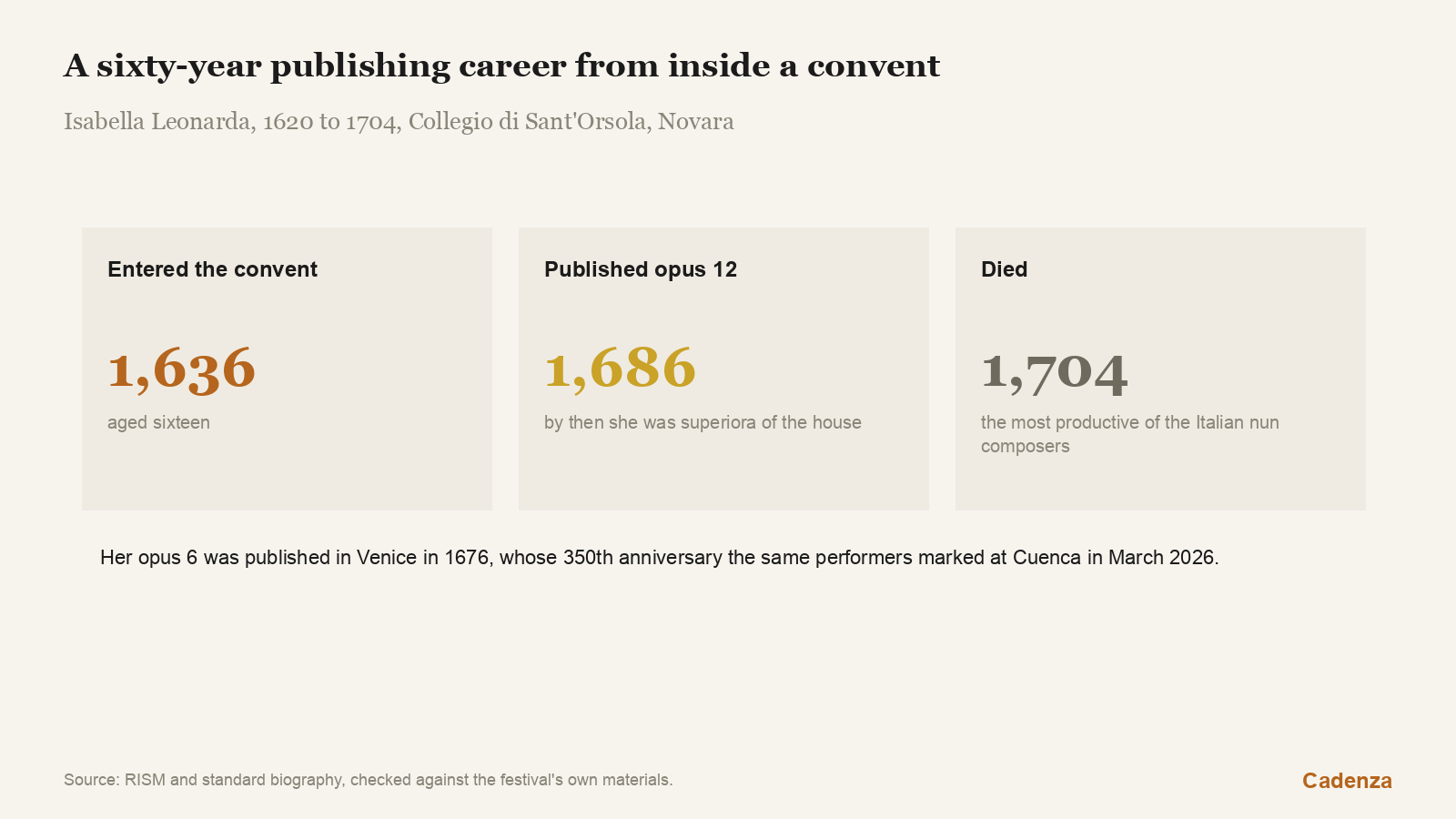
Isabella Leonarda had entered the Collegio di Sant'Orsola in 1636, aged sixteen. By 1686 she was its superiora. She published across roughly sixty years and was the most productive of the Italian nun composers, and she died in 1704.
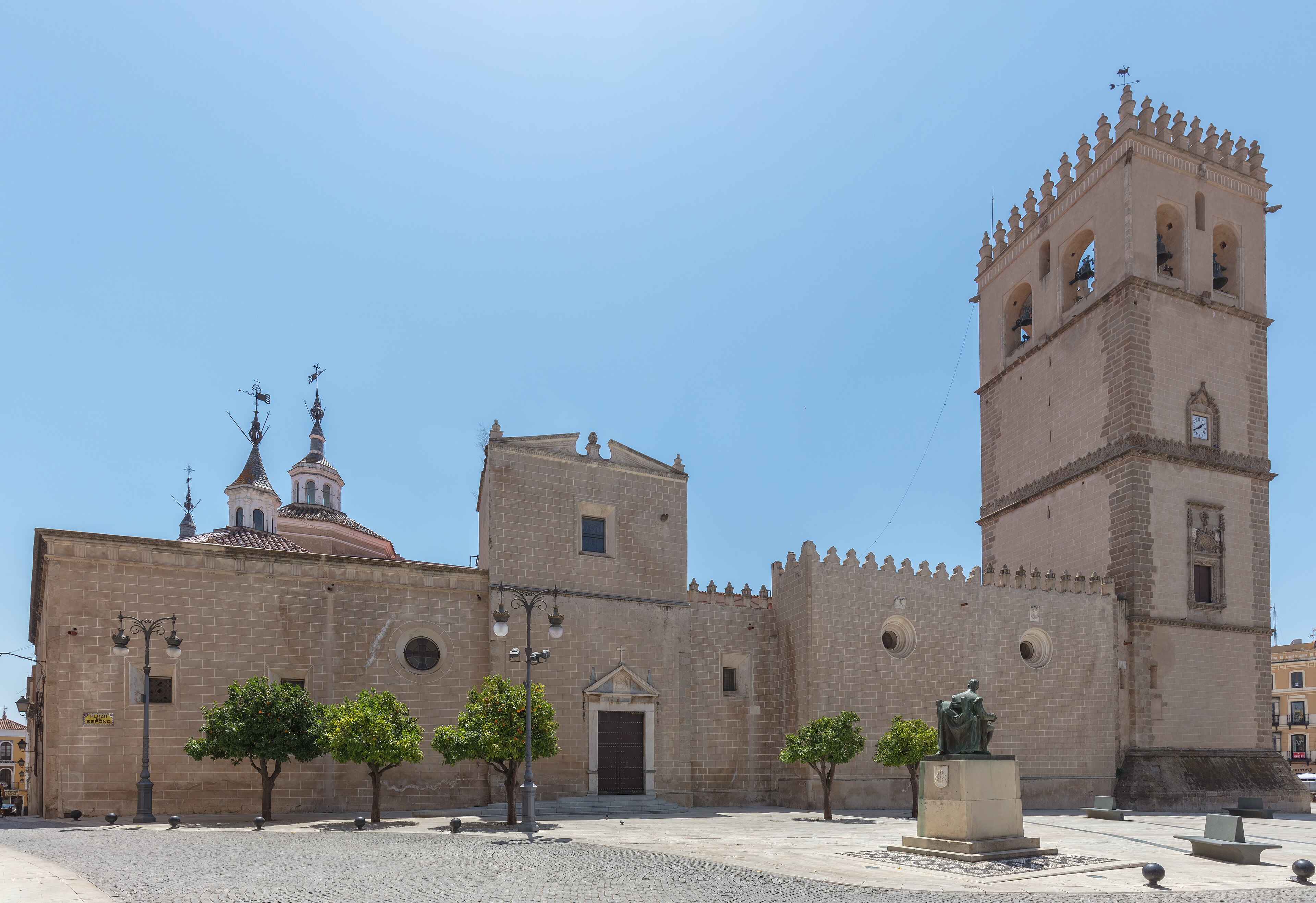
On Sunday 13 September at six in the evening, in the Cathedral of St John the Baptist in Badajoz, two of those fourteen motets will be sung. The soprano is Elisabeth Hetherington, who is Canadian and based in the Netherlands. The players are Pérgamo Ensemble, which at Badajoz is a duo: Guillermo Turina on cello and Eva del Campo on harpsichord and organ. The programme is called Filia Musicae, and it also carries music by Lucrezia Orsina Vizzana, Chiara Margarita Cozzolani and Rosa Giacinta Badalla.
The festival says the Motet op. 12 no. 4 is being performed for the first time in modern times. That claim is worth handling carefully, and Cadenza went looking for the book.
It is a printed book, and it was never lost
The story has circulated as a manuscript recovered from a Vienna archive. It is not a manuscript. It is a printed edition, catalogued in RISM, the international census of musical sources, under the number 990032063, with the series reference A/I I 99. The title page runs Motetti a voce sola … Opera duodecima … consagrata alla Sagra Cesarea Maestà … Imperatore Leopoldo Primo. Fourteen motets, printed in Milan.
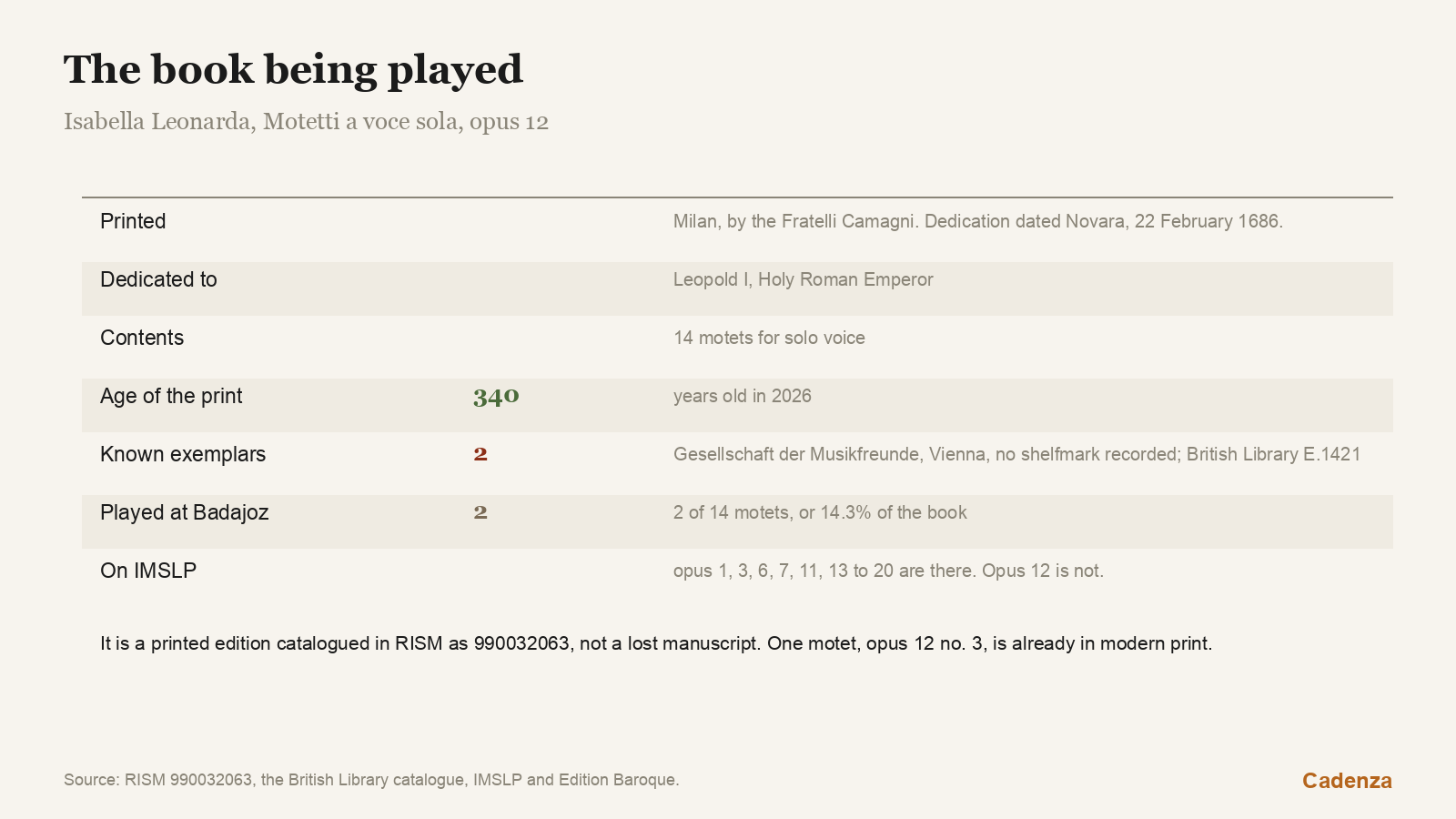
Two exemplars are recorded. One is in the archive of the Gesellschaft der Musikfreunde in Vienna, and RISM records its shelfmark as no indication given. The other is in the British Library, where it does have one: E.1421. So the copy with a citable shelfmark is in London, not Vienna, which is the reverse of how the story has been framed.
Op. 12 has been in that census for decades. What is true, and genuinely interesting, is that it is the least circulated of Leonarda's printed collections. IMSLP carries her opus 1, 3, 6, 7, 11, 13, 14, 15, 16, 17, 18, 19 and 20. It does not carry opus 12. A performer looking for this music has had to go to one of two libraries, which is a different and more ordinary kind of obscurity than a lost manuscript, and it is the kind that actually keeps repertoire off concert platforms.
One motet from the book is already in modern print. O pupuline belle, op. 12 no. 3, appears in Edition Baroque's collection Per il santissimo natale for soprano and basso continuo, which the publisher's own page confirms contains three Christmas motets.
On the premiere claim
The claim has a single origin. The festival's own release makes it, and the Diputación de Badajoz, the festival's public funder, repeats it. Cadenza found no independent corroboration, and a first-performance-in-modern-times claim is close to unprovable in principle, since it requires knowing that nobody has sung a piece in three centuries.
There is also a prior concert to weigh. On 30 March 2026, the same Hetherington and Pérgamo pairing gave a Leonarda programme called Leonarda in pace at the 63rd Semana de Música Religiosa de Cuenca. That was 167 days before Badajoz, five and a half months earlier, and it was pegged to the 350th anniversary of the Venice publication of Leonarda's op. 6 in 1676, which is exactly right.
So the fair description is this. A soprano and a Spanish early-music group are working through Leonarda's output across a series of concerts, the Badajoz date is the second of them this year, and the specific motet the festival names may well be new to the modern stage. Cadenza attributes that to the festival rather than asserting it, and notes that the performers themselves have described the opus as one they believed lost or at least not yet accessed, which is a careful formulation.
What is not in doubt is the proportion. Badajoz performs two of the book's fourteen motets, which is 14.3 per cent of it. This recovery is arriving two pieces at a time, not as a collection, and at that rate the book has years left in it.
The Badajoz line-up is also smaller than the Cuenca one. Cuenca used two violins; Badajoz is soprano, cello and keyboard. For anyone programming this music, that is useful: it can be done with three people.
The rest of the festival is the same idea, twice over
This edition is built around repertoire recovery, music by cloistered nuns in Baroque Italy, and recovered Ibero-American repertoire. Sixteen days, five programmes, six concerts, organised by the Sociedad Filarmónica de Badajoz. Those two numbers reconcile exactly, because one programme is given twice.
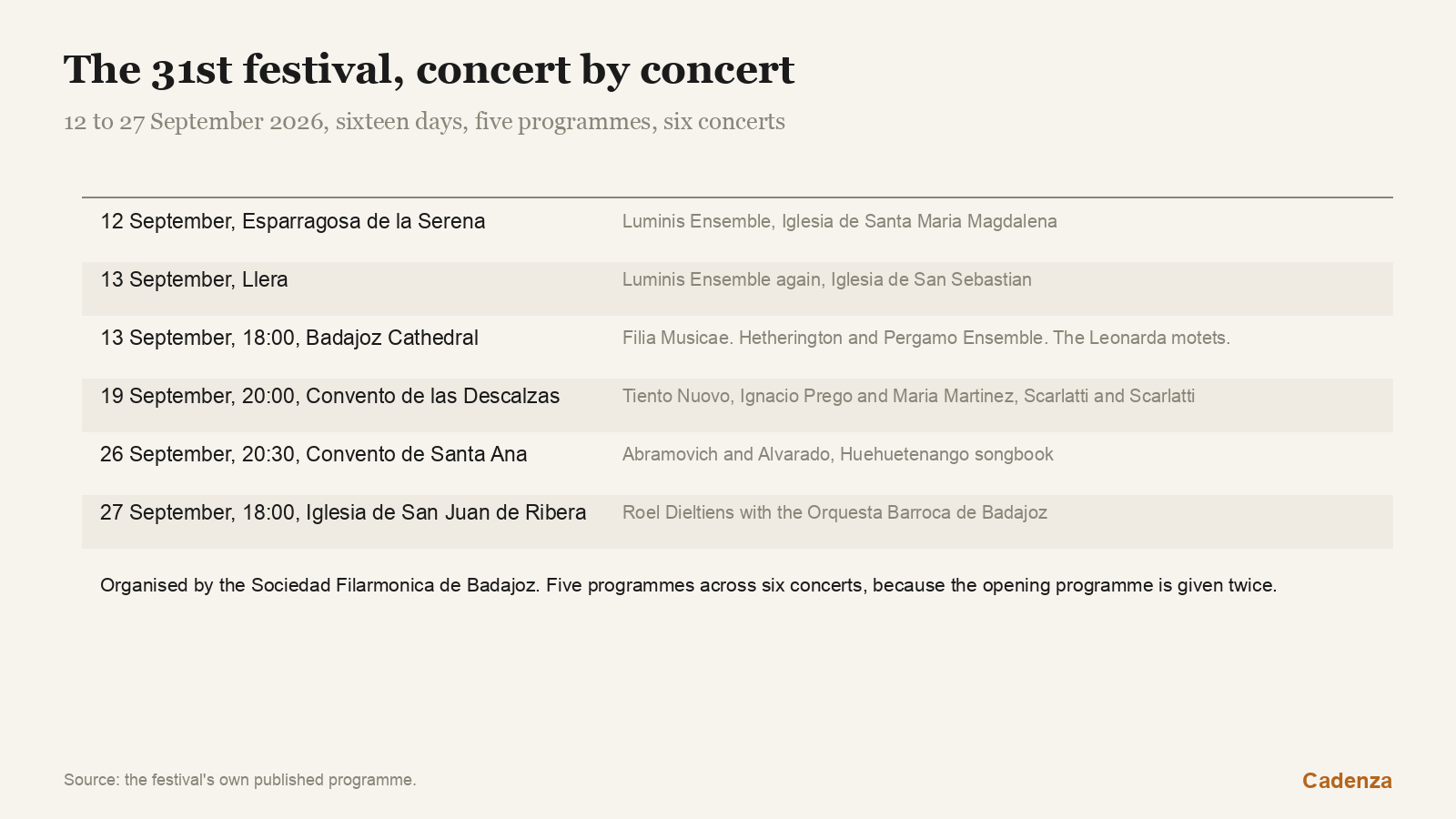
Luminis Ensemble opens on 12 September in the Iglesia de Santa María Magdalena at Esparragosa de la Serena and repeats the programme on 13 September in the Iglesia de San Sebastián at Llera. Tiento Nuovo, with the harpsichordist Ignacio Prego and the cellist María Martínez, play Scarlatti and Scarlatti on 19 September at eight in the evening in the Convento de las Descalzas. Ariel Abramovich and Jonatan Alvarado give Huehuetenango: músicas de un cancionero interrumpido on 26 September at half past eight in the Convento de Santa Ana. The Belgian cellist Roel Dieltiens, founder of Ensemble Explorations and Professor of Cello in Zurich, closes the festival on 27 September at six, as both soloist and conductor of the Orquesta Barroca de Badajoz.
The Huehuetenango programme deserves its own note, because the source is as remarkable as the Leonarda. The material is held at Indiana University's Lilly Library and comes from Santa Eulalia, San Juan Ixcoy and neighbouring Guatemalan highland towns. The holding library describes thirteen bound volumes and two fragments, dating from about 1570 to 1635. Press accounts have given this as fifteen volumes, which is a miscount: it is fifteen items, thirteen of them volumes.
The two strands have something in common that the programme note does not point out. Both sets of music survive a long way from where they were made and a long way from where they will now sound. Leonarda's book left Novara for a Milanese press and ended up in Vienna and London. The Guatemalan songbook left the highlands for a library in Indiana. A festival in Extremadura is the place where both come back into sound this month, and neither journey was planned by anybody.
One small puzzle Cadenza could not settle. A thirty-first edition implies a first edition in 1995, and the festival's own stated founding year is one year off that. Either the first cycle ran in 1996 or a year was skipped somewhere.
A year ago it was a listing
Every concert above is a date on a small society's calendar in a provincial Spanish city, funded by a provincial government, and it is producing work that larger institutions are not. The Leonarda motets exist on a stage this month because two performers went to a library.
Cadenza carries competitions and orchestral vacancies, free to musicians, on its competitions board and its jobs board.
If you go. Filia Musicae is on 13 September at 18:00 in Badajoz Cathedral. The festival runs to 27 September across the cathedral, the Convento de las Descalzas, the Convento de Santa Ana, the Iglesia de San Juan de Ribera and two village churches in Esparragosa de la Serena and Llera. If you cannot get to Extremadura, the British Library copy of op. 12 has a shelfmark, E.1421, and twelve of its fourteen motets are still waiting.
The question the festival will be asked next is the one its own claim invites. It has named a specific motet as a first performance in modern times, and it is the only source for that. Will it publish which copy of op. 12 the edition was made from, and who made it?
Sources: the Festival de Música Sacra y Antigua de Badajoz's own programme and releases, and the Diputación de Badajoz, read on 11 and 12 September 2026; RISM for the printed source, its title page, its Milan imprint, its dedication date and its two recorded exemplars, including the British Library shelfmark E.1421; Edition Baroque's own page for Per il santissimo natale; the 63rd Semana de Música Religiosa de Cuenca's own programme for the 30 March 2026 Leonarda concert; Pérgamo Ensemble's own agenda for the Badajoz line-up; the performers' own biographies for Hetherington's and Dieltiens' nationalities and posts; Indiana University's Lilly Library finding aid for the Guatemalan Huehuetenango material; IMSLP's Leonarda category for the absence of op. 12; and Scherzo. The proportions, intervals and anniversary checks are Cadenza's arithmetic.
Cover photograph: the Cathedral of St John the Baptist, Badajoz, 2020. Diego Delso, CC BY-SA 4.0, via Wikimedia Commons. Charts by Cadenza.
Cover photograph: The Cathedral of St John the Baptist in Badajoz, where Pérgamo Ensemble and Elisabeth Hetherington give Filia Musicae on 13 September 2026, photographed in 2020. Diego Delso, CC BY-SA 4.0, via Wikimedia Commons.
Comments
Sign in to join the discussion.