In the 2026-27 season Jonathan Tetelman sings Werther in a new production at the Bayerische Staatsoper. In the same season he makes his role debut as Samson in Samson et Dalila at the Staatsoper Unter den Linden, and his role debut as Radamès in a new Aida at Houston Grand Opera.
Put those three next to each other and you have the most interesting question in his career. Werther is one of the lightest leading roles in the French repertory, a lyric part that lives on line and restraint. Samson and Radamès are two of the heaviest roles written for a tenor, parts that need to carry over a large orchestra and a chorus for an entire evening.
Very few tenors are offered all three in one twelve-month period. Fewer still accept.
What the season actually contains
Alongside the two role debuts and the Munich Werther, Tetelman returns to the Bayerische Staatsoper for Rigoletto and to the Wiener Staatsoper as Cavaradossi in Tosca. There is a gala La Bohème in Bonn, concerts with the Berliner Philharmoniker under Kirill Petrenko, recitals across Europe and galas in Germany, Austria and Monaco.
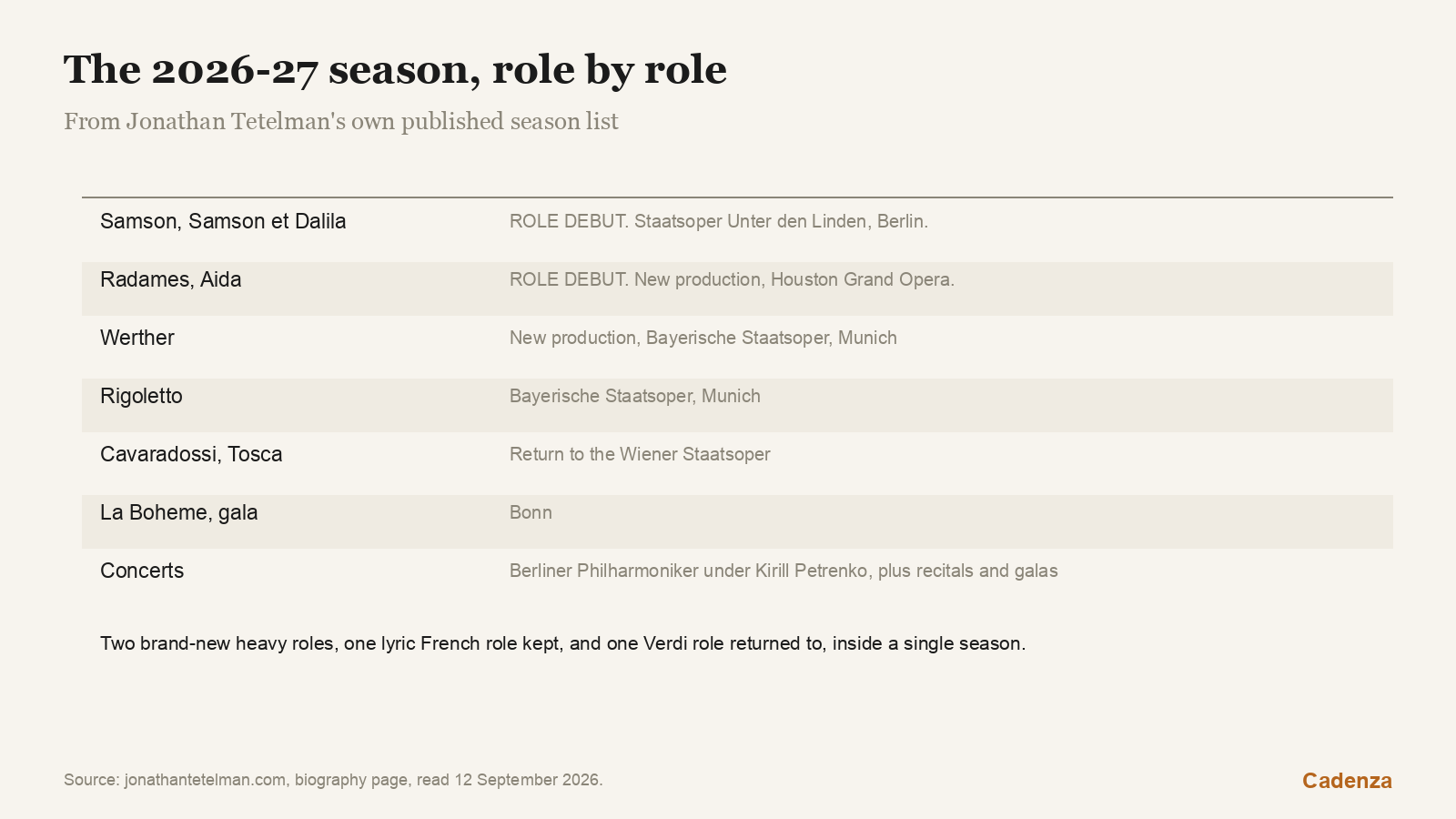
That is a season with two brand-new heavy roles in it, one repertory spinto role he has sung many times, one lyric French role, and one Verdi role he is returning to. It is not a specialist's season. It is a season that tests a range.
The weight ladder, and where he has just stepped
Opera casting has a rough working vocal taxonomy, and it is useful here because it is the language the profession itself uses. Lyric tenor roles sit at one end, spinto in the middle, and the dramatic roles at the far end.
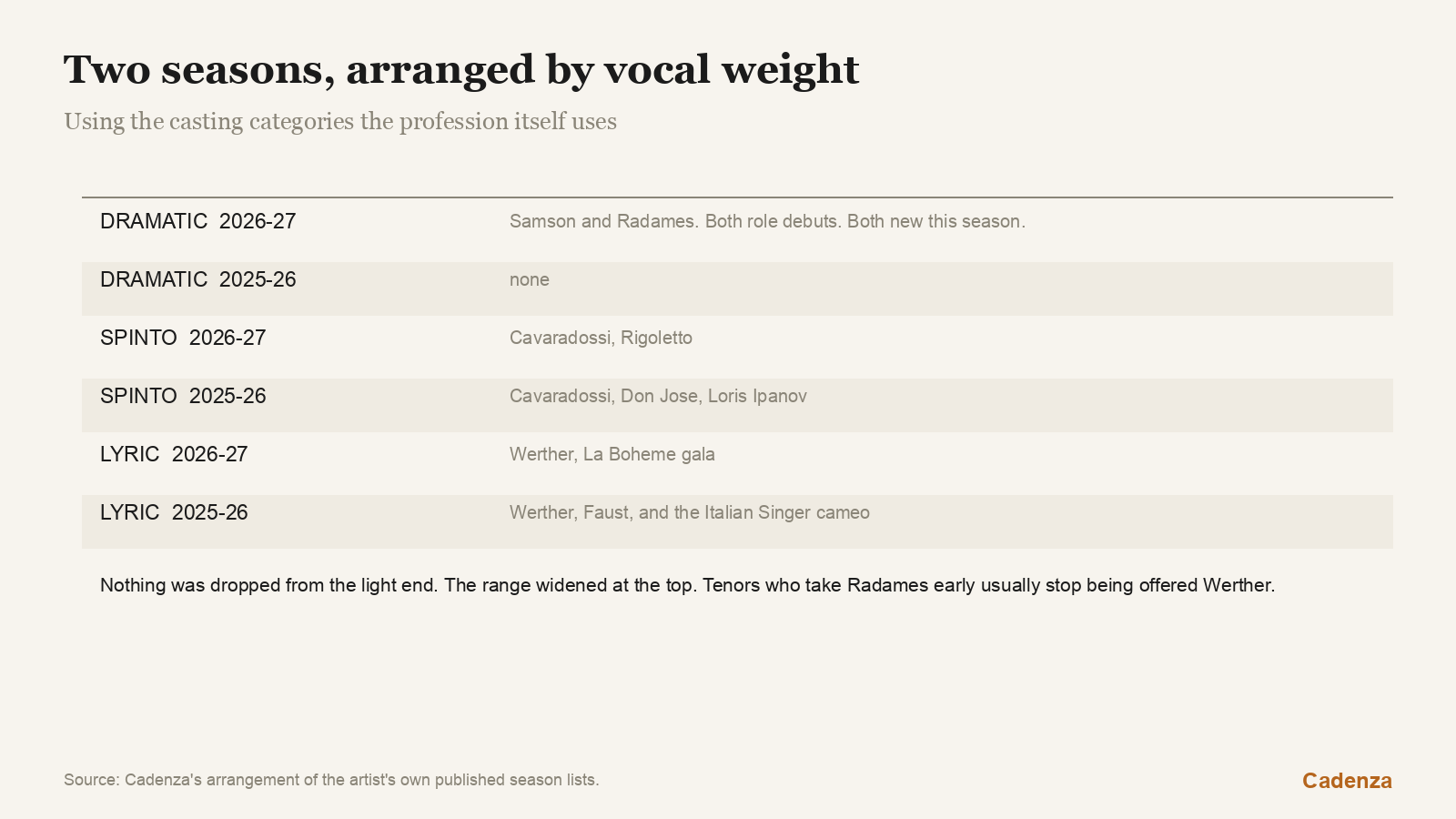
Set his 2025-26 season against his 2026-27 one and the shape of the move is clear.
Last season he sang Cavaradossi in Vienna, Loris Ipanov in Fedora at the Deutsche Oper Berlin, the title role in Faust in Munich, and made his house debut at Opernhaus Zürich in the title role of Werther. He returned to the Salzburg Festival as Don José in a new Carmen under Teodor Currentzis, sang a Puccini celebration Tosca in Rome broadcast live on RAI, and made his debut as the Italian Singer in Der Rosenkavalier at the Festspielhaus Baden-Baden. He also made his Carnegie Hall debut, alongside the guitarist Bernie Williams.
That is a season whose centre of gravity is lyric-to-spinto. Faust and Werther are lyric. Don José and Cavaradossi are spinto. The Italian Singer is a cameo of five minutes.
This season adds two roles at the heavy end while keeping Werther. Nothing has been dropped. The range has simply widened at the top.
What those two roles actually ask for
It is worth being concrete about why Samson and Radamès sit where they do, because vocal weight gets used as a vague compliment when it describes something quite specific.
Radamès opens with Celeste Aida almost immediately after the curtain, which asks a tenor to be fully warm within minutes, and the role then has to carry the triumphal scene over a full chorus and stage band before returning to sing quietly in a sealed tomb at the end of the evening. It is a stamina role with a soft ending, which is the hardest combination to cast.
Samson carries an oratorio's worth of declamation across three acts and ends by pulling down a temple, and the part sits low for long stretches before demanding weight at the top. Werther, by contrast, is a role that can be damaged by too much voice. Its best moments are quiet, and a tenor who has spent a season pushing over an Aida chorus has to find his way back to them.
The people he has worked with are a reasonable proxy for how seriously the profession takes him. His own biography lists Plácido Domingo, Elīna Garanča, Jonas Kaufmann, Asmik Grigorian, Andris Nelsons, Teodor Currentzis and Kirill Petrenko among his collaborators.
Why this is the question rather than the answer
Tenors who take on Radamès and Samson early usually stop being offered Werther. The heavier roles thicken a voice over time, and the lyric French parts are the first thing to go. That is the conventional trajectory and it is why the combination in this particular season is worth writing down rather than just admiring.
Keeping Werther in the same year as Samson is a statement that he intends to hold both ends. Whether that is possible over a decade is a genuinely open question, and nobody, including him, can answer it yet. What can be said is that three major houses have independently decided he can do it now: Berlin for Samson, Houston for Radamès, Munich for Werther.
Cadenza is not going to predict how his voice develops. Anyone who tells you they can is guessing. The useful thing a reader can take from this is the map, and the map says he is at the widest point of his repertoire so far.
The speed of it
The other number in this story is time.
Tetelman signed an exclusive agreement with Deutsche Grammophon in October 2021. His debut album for the label, Arias, was released in August 2022, recorded with the Orquesta Filarmónica de Gran Canaria under its chief conductor Karel Mark Chichon. It won him the OPUS KLASSIK Young Artist of the Year award in 2023.
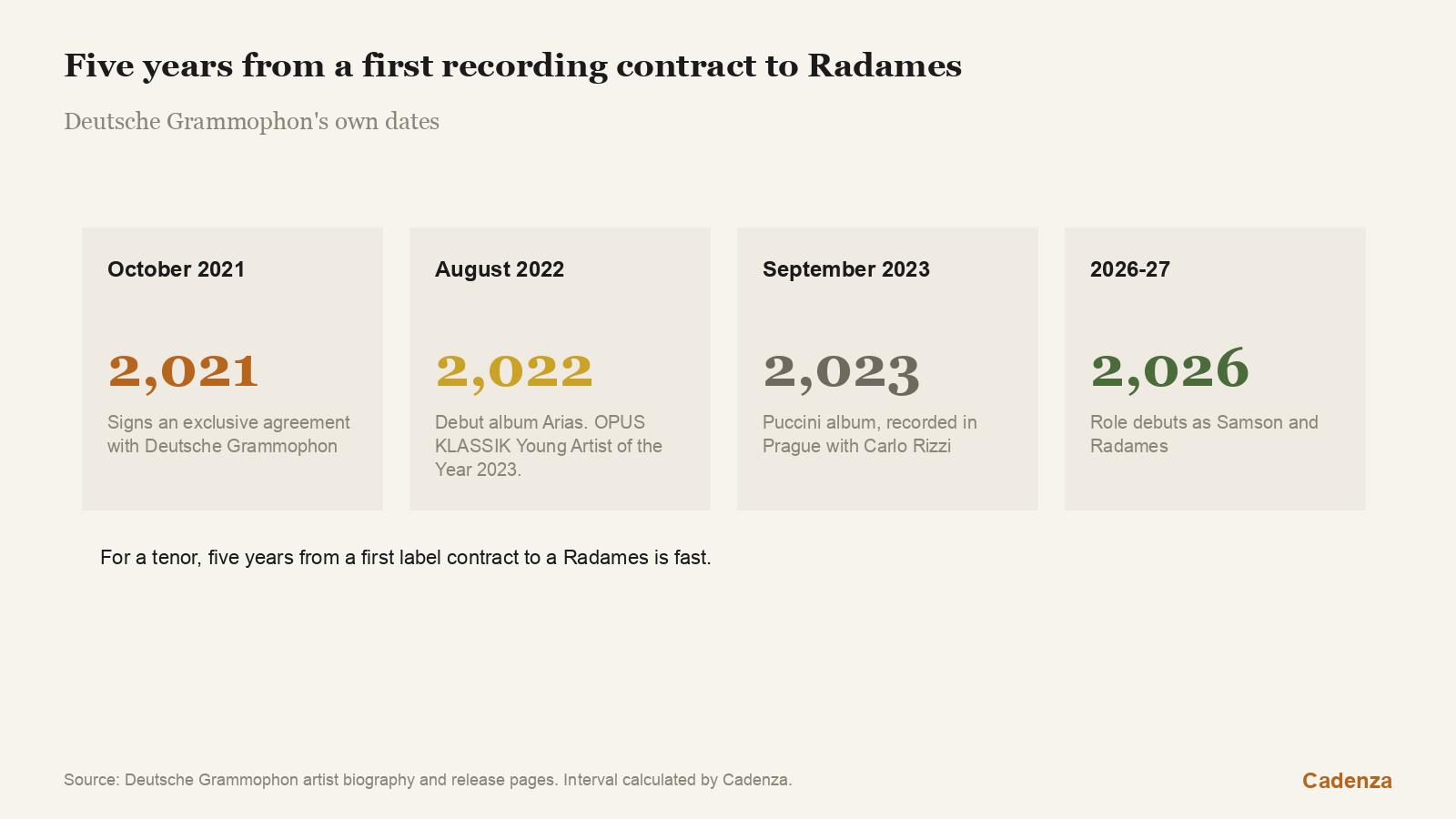
His second album, a Puccini tribute, followed in September 2023, recorded in Prague with the PKF Prague Philharmonia under Carlo Rizzi, with guest appearances by the soprano Vida Miknevičiūtė and Federica Lombardi. It drew a Voice and Ensemble Award in 2024, with the awarding magazine calling him the young Puccini tenor of our day. He then recorded Cavaradossi in Tosca alongside Eleonora Buratto and Ludovic Tézier with the Accademia Nazionale di Santa Cecilia under Daniel Harding.
From signing a first recording contract to a role debut as Radamès is five years.
For a singer, that is fast. For a reader deciding whether to buy a ticket, the relevant part is that the houses booking him are the ones with the most to lose from a miscast tenor.
Where he sings, which is the other measure
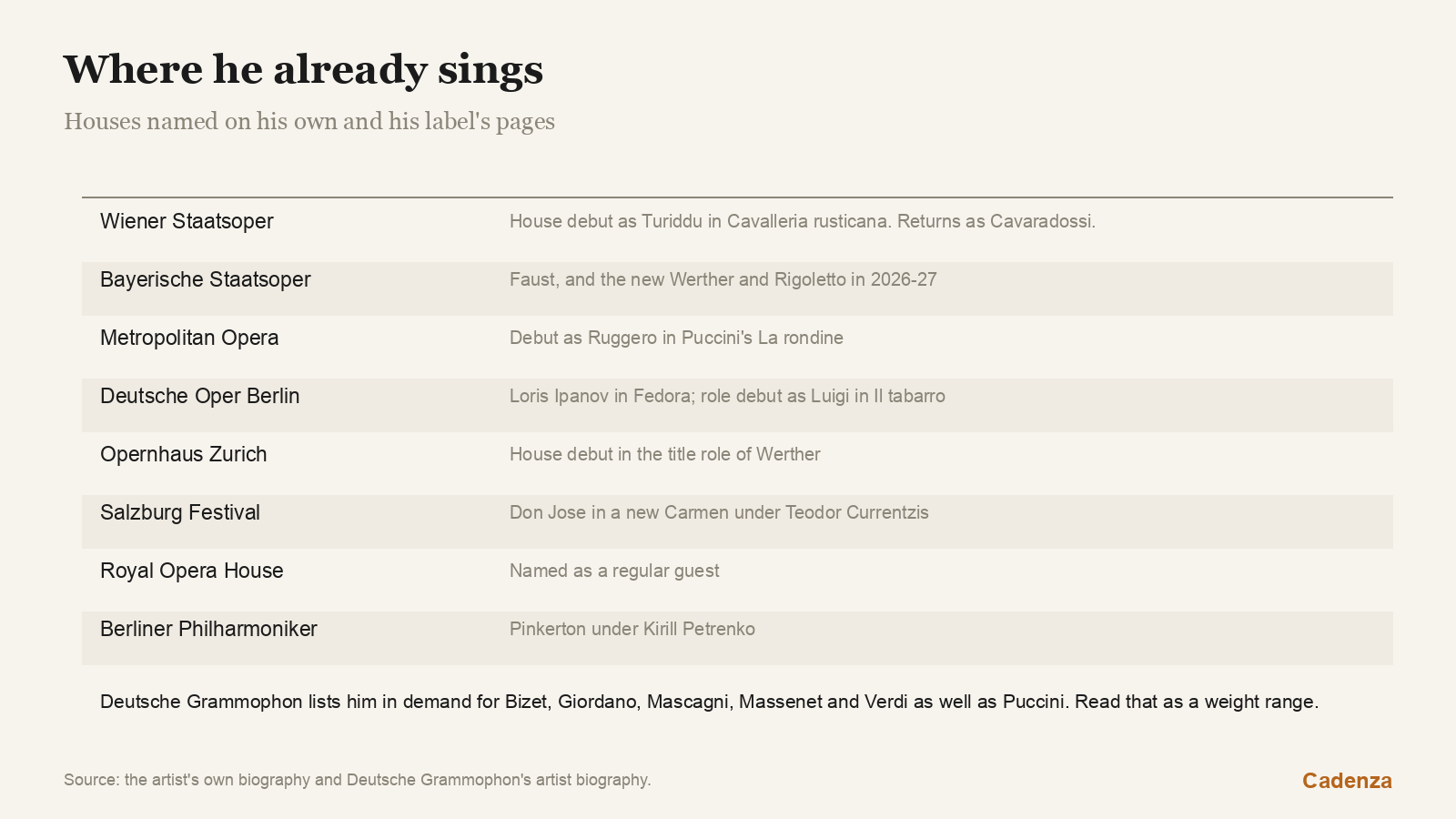
He is a regular guest at the Wiener Staatsoper, the Bayerische Staatsoper, Opernhaus Zürich, the Royal Opera House, the Metropolitan Opera, the Deutsche Oper Berlin and the Salzburg Festival. His Met debut was as Ruggero in Puccini's La rondine, and his Vienna house debut was as Turiddu in Cavalleria rusticana. He has taken role debuts as Luigi in Il tabarro at the Deutsche Oper Berlin and sung Pinkerton with the Berliner Philharmoniker under Kirill Petrenko.
Deutsche Grammophon describes him as in demand for leading roles by Bizet, Giordano, Mascagni, Massenet and Verdi as well as Puccini. That list is worth reading as a weight range rather than a compliment: Massenet at one end, Giordano and Verdi at the other.
Born in Chile and raised in the United States, he also programmes Latin American and Neapolitan repertoire alongside the opera, and says he believes great singing should be both artistically uncompromising and universally accessible.
A year ago it was a listing
Every one of those house debuts began as a contract negotiated a season or two ahead, and the young-artist route into houses like these runs through studio programmes and auditions that publish their intakes.
Cadenza carries opera and orchestral vacancies, free to musicians, on its jobs board, and competitions with open deadlines on its competitions board.
If you go. The Samson role debut is at the Staatsoper Unter den Linden and the Radamès is in a new production at Houston Grand Opera. The new Werther and the Rigoletto are at the Bayerische Staatsoper, and the Tosca is at the Wiener Staatsoper. If you want to hear the two ends of this season in one trip, Munich is the place: the Werther and the Rigoletto are in the same house.
The question the profession will ask next is not whether he can sing Samson. Three houses have already answered that. It is whether a tenor can hold Werther and Radamès in the same throat for a decade, and the first real evidence arrives when the Munich Werther opens after the Berlin Samson.
Sources: Jonathan Tetelman's own biography page, which carries the 2026-27 and 2025-26 season lists quoted here, and Deutsche Grammophon's artist biography for the October 2021 exclusive agreement, the recordings, the awards and the house and role debuts. Album details from Deutsche Grammophon's own release pages for Arias and its Tosca. The vocal-weight arrangement is Cadenza's, using standard casting categories, and the five-year interval is our arithmetic. Cadenza has not attempted to predict how any singer's voice will develop.
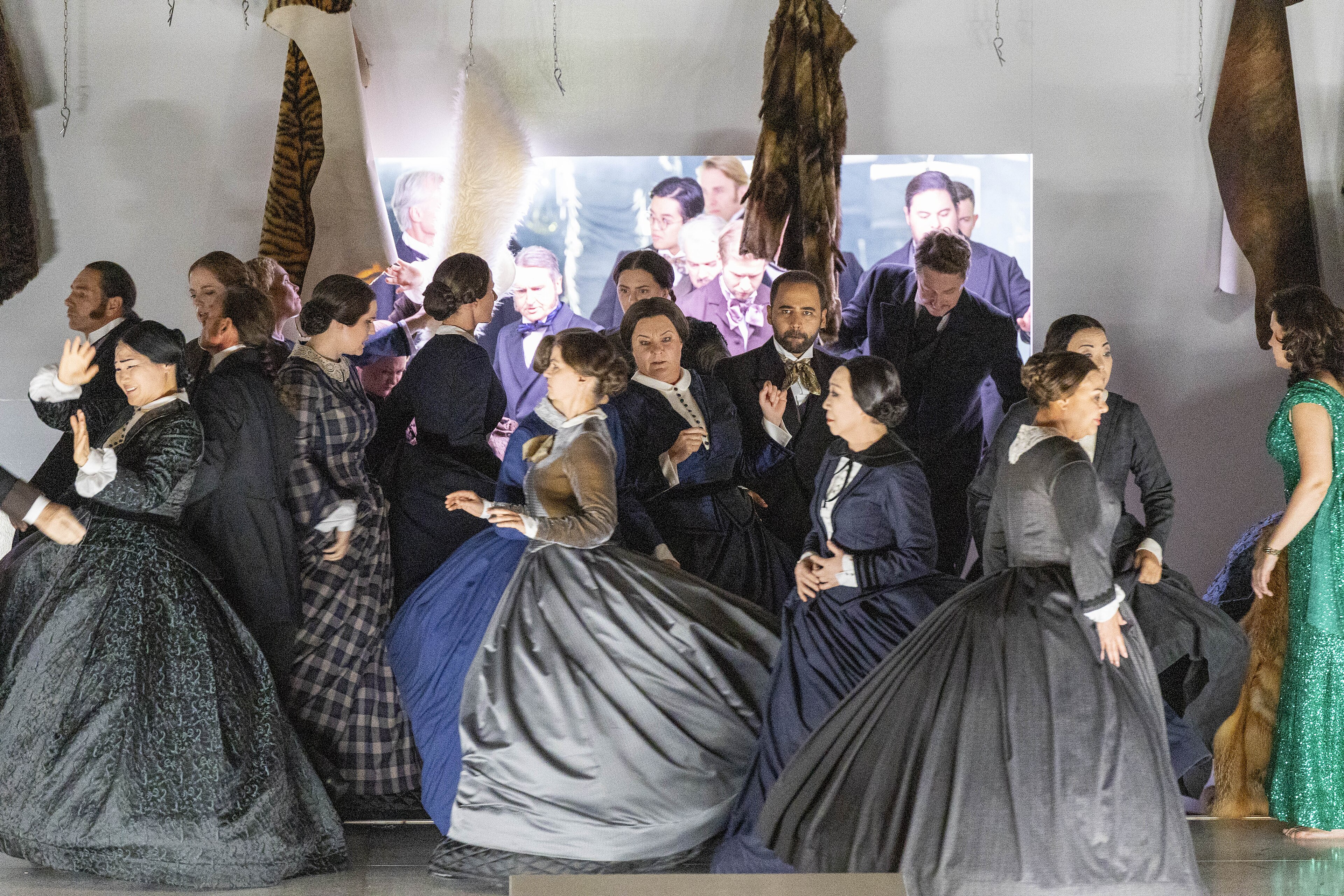
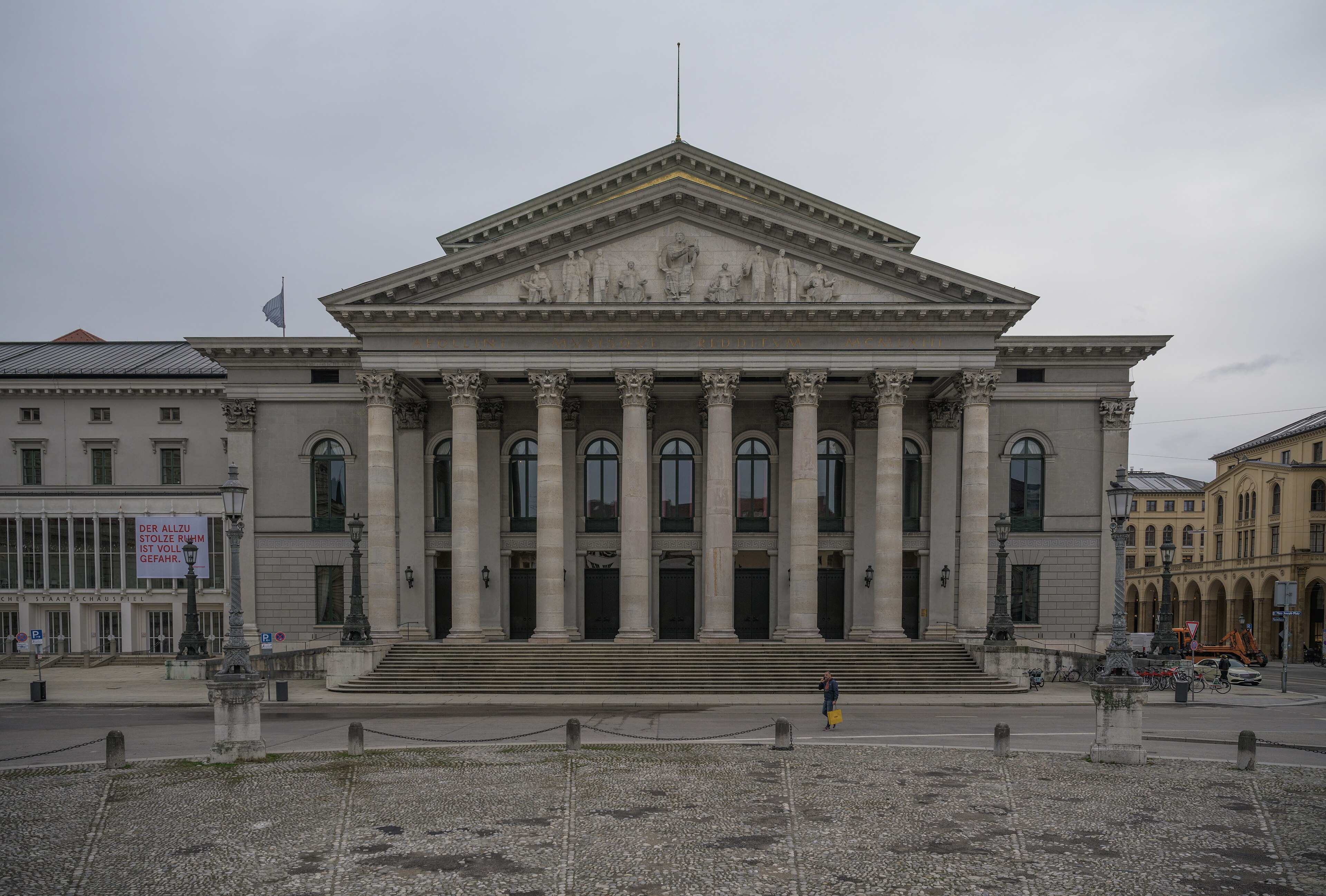
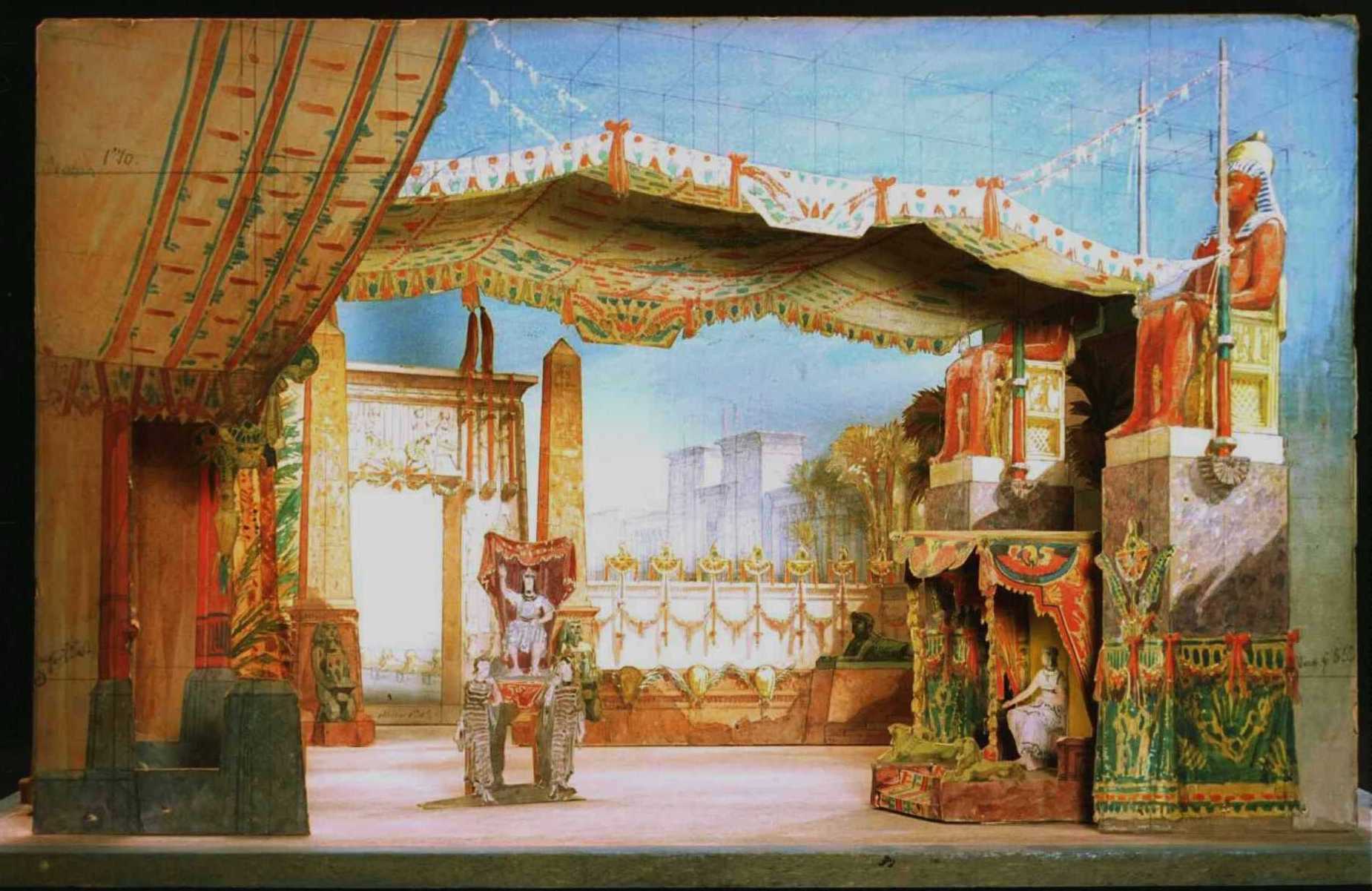
Cover photograph: the Staatsoper Unter den Linden, Berlin, November 2025. Photogoddle, CC0, via Wikimedia Commons. In-body photographs: an Aida production at the Staatsoper Unter den Linden, 2023, Dr. Frank Gaeth, CC BY-SA 4.0; the Nationaltheater München, Wilfredor, CC0; and a stage design for Aida by Francesc Soler i Rovirosa, 1876, public domain. All via Wikimedia Commons. Charts by Cadenza.
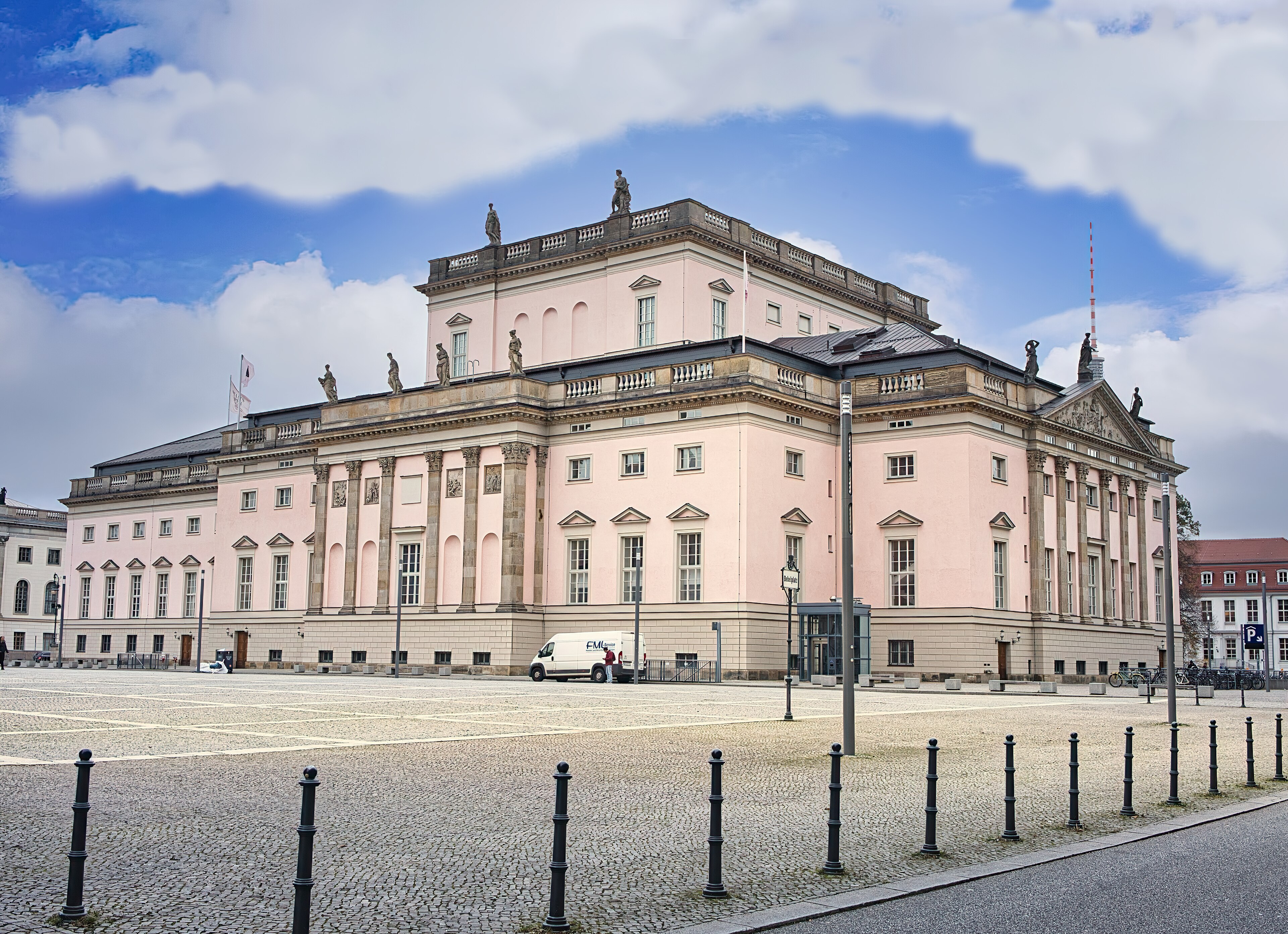
Cover photograph: The Staatsoper Unter den Linden in Berlin, where Jonathan Tetelman makes his role debut as Samson in 2026-27, photographed in November 2025. Photogoddle, CC0, via Wikimedia Commons.
Comments
Sign in to join the discussion.