On 8 June 2026 the Louisville Orchestra announced the results of a season that most American orchestras would describe as a fantasy. Nineteen performances sold out. Single-ticket revenue for the Classics series was the highest of Music Director Teddy Abrams' tenure. More than 75,000 people heard the orchestra live, nearly 50,000 of them at paid concerts and 13,000 more at free ones. The budget balanced, with revenue exceeding expenses. And the Commonwealth of Kentucky, which most states would consider an unlikely patron of a symphony orchestra, voted another $3.2 million to keep the orchestra touring free of charge to towns like Frenchburg and Cadiz, places of a few hundred or a few thousand people, through 2028.
None of this happened by accident, and none of it happened in a large city. Louisville proper has about 640,000 residents, roughly 790,000 with the consolidated county. The orchestra plays a hall it shares with touring Broadway. What it has instead of scale is a decade-old decision to treat the entire state as its audience, and a set of programmes that put the orchestra in schools, libraries, parks and county seats more often than it sits in its own hall.
This is how it was done, from the orchestra's own figures.
The season, by the numbers
The orchestra's end-of-season announcement, reported by Spectrum News on 9 June, set out the 2025–26 record:
| Measure | 2025–26 |
|---|---|
| Sold-out performances | 19 |
| People reached, all programmes | 75,000+ |
| Paid attendance | Nearly 50,000 |
| Free concerts and community programmes | 13,000+ |
| Classics series single-ticket revenue | Highest of the Abrams era |
| Fiscal result | Balanced; revenue exceeded expenses |
Board Chair Jordan Harris: "The Louisville Orchestra is stronger today than at any point in recent memory." Abrams: "Kentuckians are showing up in record numbers because they want to be a part of the Louisville Orchestra family." Interim CEO Nathaniel Koch called it "a remarkable year."
"Kentuckians are showing up in record numbers because they want to be a part of the Louisville Orchestra family." — Teddy Abrams, Music Director
Those are the sentences every orchestra's press office wants to write. What distinguishes Louisville is that the numbers underneath them are not concentrated in the hall.
The classroom first
The orchestra's education reach in 2025–26, from the same release:
- MakingMUSIC served nearly 8,000 students from 43 Jefferson County Public Schools.
- Classroom visits reached 133 classrooms and a further 3,570 students.
- Friday Field Trips brought more than 10,000 students from 65 middle and high schools into the hall.
- Once Upon an Orchestra gave 18 performances in public libraries.
Add those up and the orchestra put itself in front of roughly 22,000 school-age Kentuckians in one season, before counting the families who came to the free concerts. For an orchestra with nearly 50,000 paid attendances a year, that is not an outreach line item. It is the audience pipeline, built a classroom at a time.
There is a pattern here that the numbers make visible. Nineteen sold-out performances did not come from a marketing campaign aimed at the people who already buy tickets. They came from a decade of putting the orchestra in front of people who had never bought one, and then giving those people a reason to come downtown: a Yuja Wang, a Morgan Freeman, an Itzhak Perlman playing with the orchestra for the first time in nearly two decades. The season's headliners were the payoff, not the strategy.
The tour that a legislature pays for
The In Harmony Tour is the part of the Louisville model that few, if any, American orchestras run at the same scale. In 2025–26 it delivered 46 free community events across Kentucky, thirteen of them full-orchestra performances, to 14,000 people, according to the orchestra's report. Concerts went to towns that have never had a professional orchestra and, in most cases, never expected one.
In April 2026 the Kentucky General Assembly approved $3.2 million to continue the tour through 2028, taking total legislative support for the programme to $11.8 million (Louisville Orchestra, 15 April 2026). In July the orchestra announced six new Kentucky stops: free performances in Elizabethtown, Frenchburg and Bardstown on 17, 18 and 19 September under Gabriel Lefkowitz, and in Cadiz, Greenville and Henderson on 11, 12 and 13 February 2027 under Abrams.
Consider what that funding represents. A state legislature that is not, in the national imagination, a natural home for symphonic subsidy has now voted three times to send its orchestra to the counties: $4.3 million in March 2022 to start the tour, $4.3 million in 2024 to continue it, and $3.2 million this April to carry it to 2028. The first vote was a bet on a pilot. The second and third were made after legislators had watched the orchestra play their own county seats, and heard about it from constituents. A pilot that gets renewed twice, by a legislature, is a programme that delivered.
Free at the front door
The orchestra opens its 2026–27 season on 12 September not in its hall but at the Iroquois Amphitheater, free, with the Pedrito Martinez Group and conductor Ahmed Alom in a programme of Afro-Cuban music for its Music Without Borders series (announced 28 July). Its Play America concert for Independence Day was free. Its ROARchestra evening at the Louisville Zoo was a yacht-rock programme. Its Creators Corps, the composer-residency programme that embeds composers in the city for a season, marked five years in August.
A reader who thinks of orchestras as institutions of the concert hall might see a list like that as dilution. The season's balance sheet says otherwise. An orchestra that plays the zoo, the park, the library and the county seat is an orchestra whose name is known to people who would never have looked it up, and the nineteen sold-out nights were bought by exactly those people. The free concerts are the marketing budget, spent on music instead of advertising.
Five years of composers in residence
The programme that best explains why Louisville's audiences feel ownership of the orchestra is the one that produces the least ticket revenue. The Creators Corps, announced in March 2022 with its first residencies that September, places composers in the city for a season at a time, as salaried staff with housing and a studio: they live in Louisville, write for the orchestra and its community programmes, and show up at the same schools and libraries the orchestra does. In August 2026 the orchestra marked the programme's fifth year under the banner "5 years Strong: Where Community Belongs," and profiled the 2026–27 cohort, Susanna Hancock and Seare Ahmad Farhat, named the previous December, on its news page.
The point of the Corps is not that Louisville audiences have developed a taste for premieres, though the 2026–27 season's stated focus on world premieres and new commissions suggests they have. It is that a composer who has spent a year in the city's classrooms is a composer whose premiere the city turns out for. The orchestra has, in effect, built a pipeline for new music the same way it built a pipeline for new audiences: by putting the people who make it where the people who hear it already are.
What another orchestra could copy
Three practices in the Louisville record travel, and none of them requires a state legislature to start.
Count reach, not just attendance, and publish both. Louisville reports 75,000 people reached and 50,000 paid attendances in the same sentence. Most orchestras report only the second number, because the first is harder to sell to a board. But the first is where the second comes from, and an orchestra that measures it will fund it.
Put the free concert at the front of the season, not the end. The Iroquois Amphitheater opener on 12 September is the first thing Louisville does each autumn. A free concert in September is an invitation to the season; a free concert in June is a thank-you for a season already over. The order changes who comes.
Ask the state for a pilot, then let the counties argue for the renewal. Kentucky's first $4.3 million bought a tour that did not yet exist. Every dollar since was voted by legislators whose constituents had already attended. Any orchestra with a bus and a willingness to play a high-school gymnasium can make the second and third votes easy, and those votes are what took the total to $11.8 million.
Leadership for the next chapter
The season closed with two governance changes that suggest the board intends to keep going rather than consolidate. On 15 June, Harris was appointed to the board of the League of American Orchestras, which puts Louisville's approach in front of the rest of the field. On 15 July the orchestra named Jude Vaclavik as chief executive, ending the interim period under Koch, in what the orchestra described as a partnership with Abrams.
Abrams has been music director since 2014. Twelve seasons is long by contemporary standards, and it is the span over which the Louisville model was built. The continuity matters: In Harmony, MakingMUSIC and the Creators Corps are all programmes that pay off years after they start, and a music director who leaves after five would never have seen the return.
What comes next
The 2026–27 subscription season opens on 16 October with Verdi's Requiem. Leslie Odom Jr., Ledisi and Michael Feinstein are on the schedule; a Salome with Kentucky Opera is planned; the orchestra says the artistic focus is world premieres and new commissions. The In Harmony Tour continues into 2028 on state funding already voted.
The honest caveat is that a record season sets a hard comparison for the next one, and that orchestras which rely on marquee names for their sold-out nights must keep finding them. Louisville's answer, on the evidence of this season, is that the marquee names are the visible tenth of the work. The other nine-tenths happened in 43 schools, 18 libraries, 46 community events and a state capitol.
If you go
- 12 September, Iroquois Amphitheater, Louisville. Season opener, free: the Pedrito Martinez Group with conductor Ahmed Alom, Music Without Borders.
- 17, 18 and 19 September, Elizabethtown, Frenchburg and Bardstown. In Harmony Tour, free; registration required.
- 16 October, Louisville. Subscription season opens with Verdi's Requiem.
- 11, 12 and 13 February 2027, Cadiz, Greenville and Henderson. In Harmony Tour, free.
Dates and programmes as announced by the orchestra; check louisvilleorchestra.org before travelling.
Why it matters beyond Kentucky
Cadenza reports on orchestras in trouble because, for much of this year, that has been most of the news. Louisville is the counter-example worth studying, and its lesson is uncomfortable for institutions that would rather fix their finances in the hall: the orchestra grew by leaving it.
Every orchestra on Cadenza's organisations index has a version of the same choice. The ones hiring this season are, more often than not, the ones whose audiences are growing. You can see which are which by browsing the current auditions and jobs, free.
Sources: Spectrum News, 9 June 2026; Louisville Orchestra news releases, April–August 2026: season results (8 June), In Harmony Tour funding (15 April) and expansion (22 July), CEO appointment (15 July), free season opener (28 July), Creators Corps anniversary (9 August).
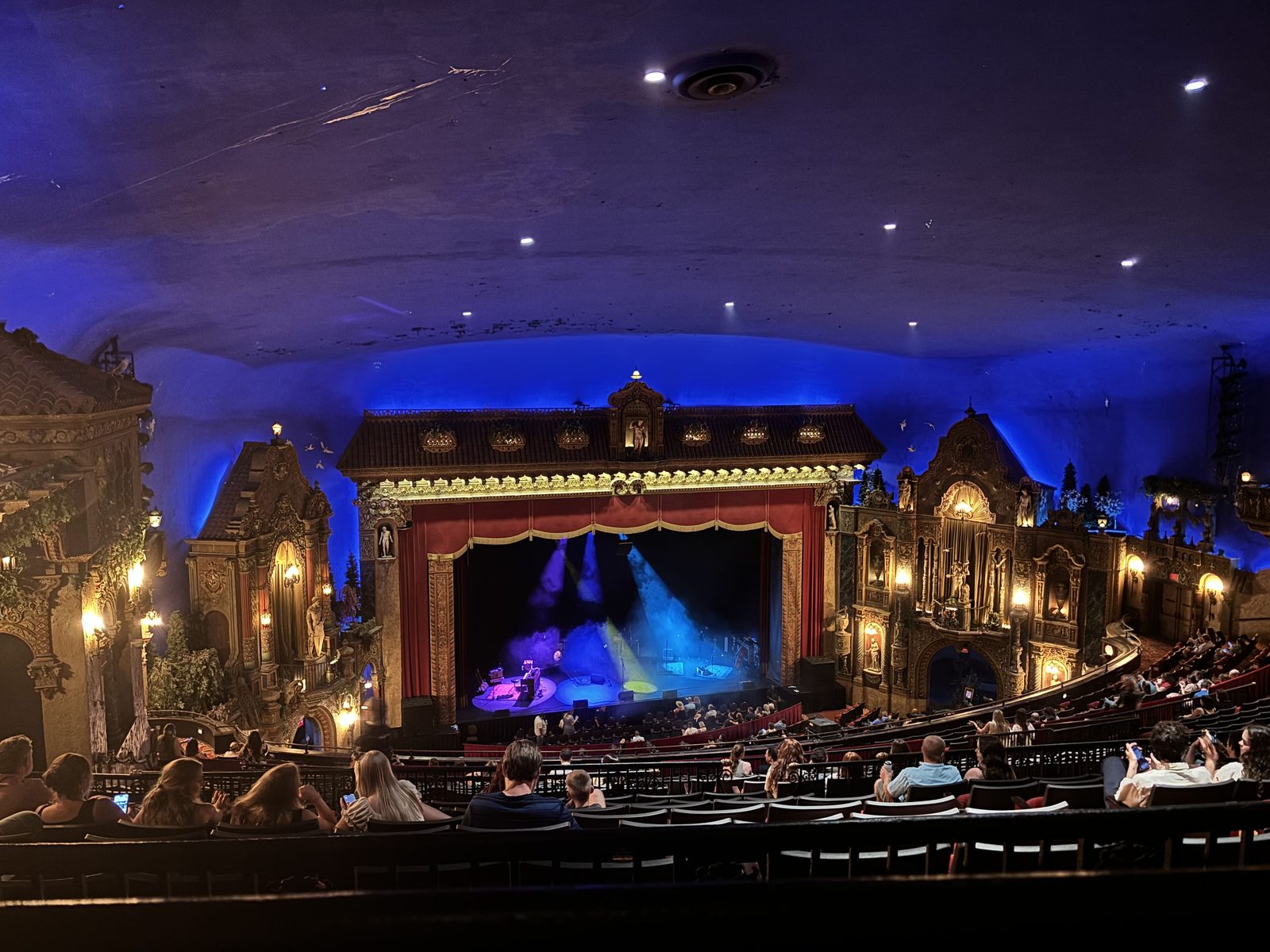
Cover photograph: The Louisville Palace, downtown Louisville. The orchestra's own home is Whitney Hall at the Kentucky Center, a few blocks away. PCN02WPS, CC BY-SA 4.0, via Wikimedia Commons.
Comments
Sign in to join the discussion.