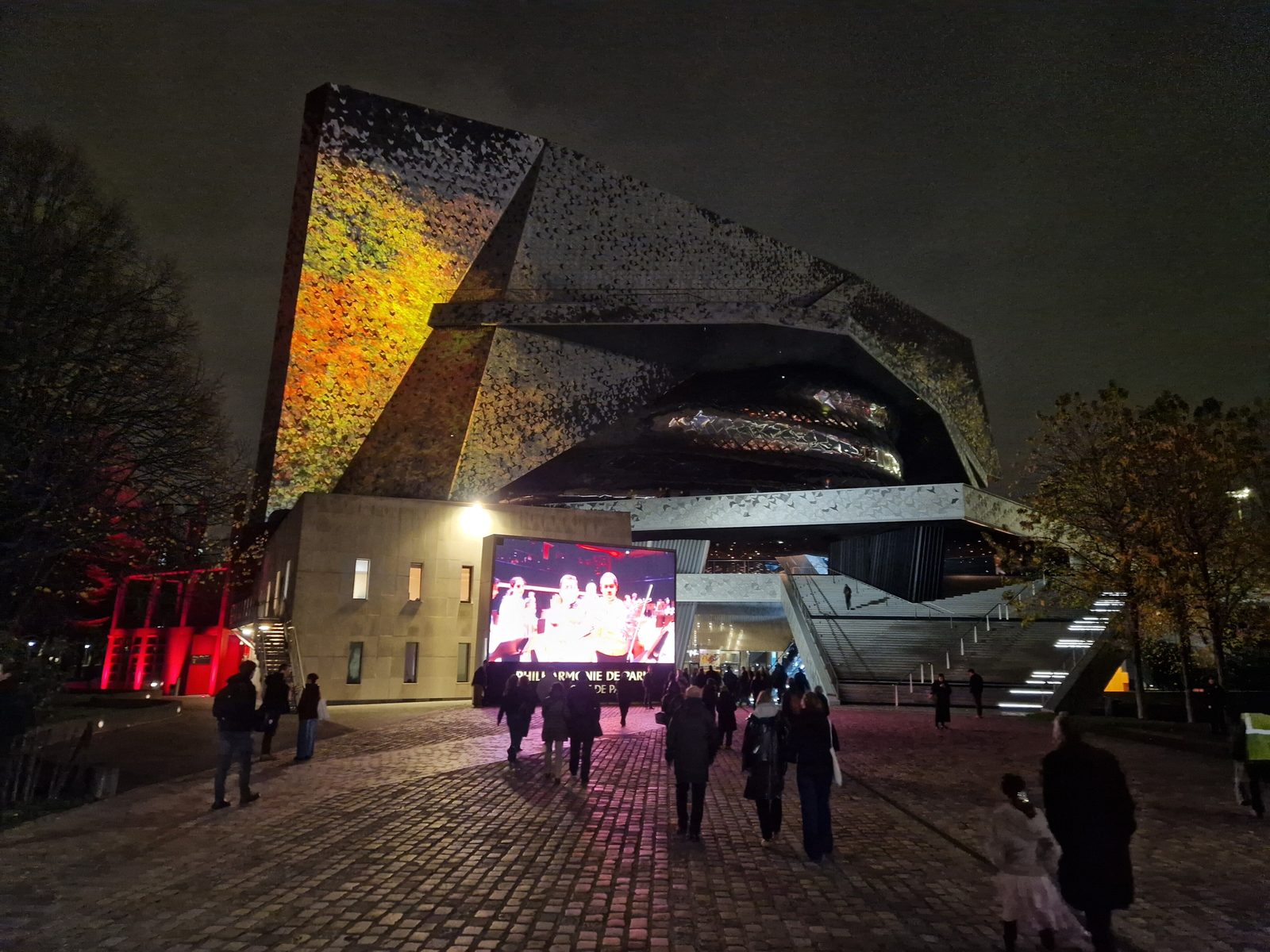
For ten days each September the Philharmonie de Paris takes the seats out of the front of its Grande salle Pierre Boulez and sells the floor. The second edition of Les Prem's, the hall's Proms-inspired festival, runs from 1 to 10 September 2026 with 700 standing places in front of the stage at €15, and the orchestras on that stage were the Met Orchestra under Yannick Nézet-Séguin, the Royal Concertgebouw Orchestra under Santtu-Matias Rouvali and the Orchestre de Paris under Klaus Mäkelä. The first edition, in September 2025, sold 14,000 tickets across five concerts, according to the Philharmonie's director general Olivier Mantei as reported by Slipped Disc, and about half the audience was under 28.
Mantei also says the model pays for itself: lower the price, raise the number in the room, come out level. None of the reports we read checks that against the hall's own capacity figures, so we did.
The document
The figures below are the institution's, or its director's as quoted.
| Figure | 2025, first edition | 2026, second edition | Source |
|---|---|---|---|
| Dates | 2 to 11 September 2025 | 1 to 10 September 2026 | Philharmonie |
| Orchestras | Gewandhausorchester Leipzig (Nelsons), Berliner Philharmoniker (Petrenko), La Scala orchestra and chorus (Chailly), Orchestre de Paris (Mäkelä) | Met Orchestra (Nézet-Séguin, 2 concerts), Royal Concertgebouw Orchestra (Rouvali), Orchestre de Paris (Mäkelä, 2 concerts) | Philharmonie |
| Standing places per concert | "plusieurs centaines" (Philharmonie); 700 (Classicagenda, Ôlyrix) | 700 | Forum Opéra, Classica, Le Temps |
| Standing price | €15 | €15 | Classicagenda, Forum Opéra |
| Other prices offered | €12, €15, €25; €11 under-28 rate (the hall's standard youth price, per Le Bonbon) | not published | Le Bonbon |
| Tickets sold | 14,000 across five concerts | pending | Slipped Disc |
| Share of audience under 28 | about half | pending | Slipped Disc |
| Capacity change | "quelque trois cent cinquante places" added | not stated | Classica |
| Hall capacity, symphonic layout | 2,400 | 2,400 | Philharmonie |
Two flags. The Philharmonie's own 2025 announcement said only "plusieurs centaines de places debout au parterre"; the 700 figure comes from the press, and for 2026 Forum Opéra, Classica and Le Temps all give it. And Slipped Disc's English summary describes "standing-room concerts for those under 28 for €15", whereas none of the French reports we read attaches an age condition, and the Philharmonie's own pages (announcements, concert pages, réductions, FAQ, terms of sale) do not mention the standing tickets at all; its ticketing site would not render for us. What Mantei actually claims is that half the people who bought them were under 28, which is a different and more interesting statement.
What was said
The Philharmonie announced the line-up on 17 June 2026: after "les Allemands" and "les Italiens" of the first year, this edition would turn to "les Américains du MET Orchestra" and "les Néerlandais du Concertgebouw", with Mäkelä opening "sa dernière saison auprès de l'orchestre" with Mahler's Third. Forum Opéra's Christine Ducq set out the mechanism on 26 August: "L'originalité de son dispositif est de proposer 700 places supplémentaires debout devant la scène de la Grande Salle Pierre Boulez à 15 euros."
On 1 September, the day the Met Orchestra opened, Classica's Philippe Venturini reprinted a statement Mantei had made after the first edition ("constatait l'an dernier Olivier Mantei"): "On a battu des records de fréquentation puisque l'on a augmenté la jauge de quelque trois cent cinquante places, sans entamer la recette." In English: we broke attendance records because we increased capacity by some three hundred and fifty places, without eating into revenue. Classica's piece continues with a second quotation: "Cela démontre clairement que la démocratisation de la musique passe par la qualité de l'outil." Democratising music, that is, depends on the quality of the tool, meaning the hall. Venturini's own gloss: "Le prix d'une place de cinéma pour approcher à quelques mètres l'Orchestre du Metropolitan Opera de New York."
On 4 September Jean-Jacques Roth in Le Temps, in a piece whose standfirst ends "Succès monstre", wrote: "Les sièges du parterre ont été retirés pour accueillir jusqu'à 700 personnes pour des places à 15 euros." He also noted the scale gap with London: the Proms offer "près de 90 concerts avec, pour chacun, 1000 places debout à 8 livres", whereas the Paris "mini-festival ne concentre que cinq concerts".
The same day Slipped Disc carried Mantei's remarks in English, translated from a French source it does not name. "The Proms were already rethinking listening conditions and ticket prices to make classical music more popular," Mantei said. "The idea is to ask ourselves: how do we break down barriers and make ourselves accessible without compromising on the quality of the music?" On the experience of standing at the lip of the stage, the audience "has the privilege of standing so close to the artists: it creates an intense moment." And on money: "We lower the prices, but we increase the number of people in the hall; so, naturally, we break even."
One eyewitness count from the first edition: reviewing La Scala's concert on 7 September 2025 for Ôlyrix, José Pons described roughly 700 people standing on the floor in front of the seated balconies, many of them young, some of them accompanied children.
The second half is ours
Start with the standing section. Seven hundred places at €15 is €10,500 a night, and €52,500 over the five concerts of an edition.
Now put that beside Mantei's other number. If 700 standing places produced a net gain of "quelque trois cent cinquante places", then roughly 350 parterre seats came out to make room for them, and Classicagenda described the 2025 arrangement as removing the costly front rows. For the swap to leave revenue untouched, as Mantei says it did, the €10,500 a night from the floor has to match what those seats used to bring in. Divide €10,500 by 350 and the implied average yield of a removed seat is €30. That, on these figures, is the whole trick in one line: two people at €15 stand where one person sat at €30, and the hall gains 350 bodies, most of them young, at the front. The Philharmonie has not published the prices of the seats it removed, so €30 is our inference from its director's two figures, not a number the hall has stated.
The attendance claim is consistent with the room, within rounding. Fourteen thousand tickets over five concerts is 2,800 a night. The Philharmonie's venue page gives the Grande salle 2,400 places in symphonic configuration; add Mantei's "quelque" 350 and the enlarged house holds about 2,750. Mantei's round number is about 2 per cent above that, which is what a full house plus rounded figures looks like.
The under-28 claim is where the festival looks most consequential. Half of 14,000 is about 7,000 under-28 tickets in five nights. The Philharmonie's 2025 attendance release, covered by franceinfo on 27 January 2026, gave 520,718 people at public concerts, a 92.7 per cent fill rate, and 53,953 under-28s, or 10 per cent of concert attendance. The two counts may not be built the same way: if the annual figure counts youth-rate tickets, a €15 standing ticket is not one. But taken at face value, five Prem's evenings would have drawn a number of under-28s equal to about 13 per cent of the entire year's under-28 concert audience. That, on its director's account, is why the Philharmonie is doing this again.
Now the comparison across cities. The BBC's 2025 season figures, as reported by Music Week on 17 September 2025: 86 concerts, 72 at the Royal Albert Hall; "almost 300,000 people attended"; "nearly 71,000 Promming tickets were sold" at £8; 41 sold-out concerts, average evening attendance above 90 per cent, 20 per cent of audiences under 30 and 40 per cent under 40. The Proms kept £8 for 2026, a season of 86 concerts from 17 July to 12 September, with, by the Proms' long-standing practice, around a thousand standing places per concert.
| City and scheme | Standing or youth price | Places | Age condition | Season scale |
|---|---|---|---|---|
| Paris, Les Prem's | €15 standing | 700 per concert | none stated | 5 concerts, 3,500 standing tickets |
| London, BBC Proms | £8 standing | around 1,000 per concert | none | 72 Albert Hall concerts; nearly 71,000 Promming tickets in 2025 |
| London, Wigmore Hall | £5 seated, selected concerts; free tickets for ages 8 to 24 from September 2026 | 25,000 £5 tickets a season at launch in 2018 | under 35 | 54 scheme concerts listed |
| Hamburg, Elbphilharmonie U30 | €12 REDticket from two weeks out; 50 per cent off single tickets | not published | under 30 | numerous concerts |
| Vienna, Konzerthaus youth membership | €20 a ticket, best available; €20 returns 30 minutes before | not published | under 30, €25 a season | nearly all cycles |
| Paris, Philharmonie's own youth rate | €11 single, €9 by subscription of three or more | quota per concert | under 28 | whole season |
Three things fall out of the table. The Paris standing ticket is the dearest standing ticket in the set, above the Proms' £8 on any recent exchange rate, above Hamburg's €12 and Wigmore's £5, below only Vienna's €20 youth seat, and dearer than the Philharmonie's own under-28 seat at €11, which the hall's FAQ says corresponds to a specific location in the room. On these figures Les Prem's is not a youth discount; it is a standard-price product at the level of a cinema ticket, placed in the best position in the house, and the young audience came anyway. The lesson for any hall thinking of copying it is not "make it cheap for the young" but "make the best place in the room the cheap one".
The second is scale. Nearly 71,000 Promming tickets over 72 Albert Hall concerts is about 986 a night, close to the thousand on offer; at £8 the Proms' standing floor is worth roughly £568,000 a season. Paris sells 3,500 standing tickets a year. Le Temps is right that this is a mini-festival, and it does not need to be more than that to move the hall's youth numbers.
The third is demography. London reports 20 per cent of its audience under 30 across a season built on £8 standing. Paris claims half its Prem's audience under 28 across five nights at a higher price, with programmes (the Salome finale, Mahler's Third, Prokofiev's Fifth) that are not obviously chosen as bait.
The overlap looks planned. The Met Orchestra made its BBC Proms debut on 26 August 2026 with Strauss and Elza van den Heever in the Salome finale, and on 27 August with Saariaho's Lumière et pesanteur, Mahler's Rückert-Lieder and Fourth Symphony with Joyce DiDonato, as Bachtrack's reviews record. Five days after the Mahler Prom the orchestra opened Les Prem's with the same Strauss programme, and gave the same Saariaho and Mahler on 2 September. The two festivals Mantei says are built on the same idea shared their headline orchestra, and its programmes, within a week.
If you go
The Met Orchestra (1 and 2 September) and the Concertgebouw (3 September) have played. Two concerts remain, both marked "Complet" on the Philharmonie's page:
- Wednesday 9 September 2026, 20h00, Grande salle Pierre Boulez: Orchestre de Paris, Klaus Mäkelä, Mahler Symphony No. 3, with Wiebke Lehmkuhl, mezzo-soprano, and the Orchestre de Paris women's, youth and children's choirs. About 1 hour 39 minutes. Sold out.
- Thursday 10 September 2026, 20h00, same programme. Sold out.
The Philharmonie's official resale platform, the Bourse aux billets, allows resale at no more than face value with a €1 fee to the buyer; youth-rate tickets cannot be resold there. Standing places for the festival were €15. Outside the festival the under-28 single ticket is €11, or €9 on a subscription of three or more concerts, with last-minute tickets from €11 to €30 thirty minutes before performances for under-28s, over-65s, jobseekers and benefit recipients.
What happens next
Mantei has made two numerical claims in public: 14,000 tickets, half under 28, and a 350-place capacity gain that left revenue intact. The first is consistent with the hall's published capacity; the second cannot be tested, because the hall has not published the prices of the seats it removed. A second edition with sold-out Mahler nights and the Met Orchestra fresh from London suggests the first was not a novelty effect. The Philharmonie's whole concert year runs at 10 per cent under-28; Les Prem's, on its director's account, runs at 50. So the question the hall will be asked next is not whether the September floor works, but why the seats go back in on 11 September: if the best place in the room at €15 fills with under-28s for ten days, what stops the Philharmonie from leaving them out for a week every month?
Sources: Philharmonie de Paris, Prem's 2026 announcement, 17 June 2026; Philharmonie de Paris, Met Orchestra (1), 1 Sept 2026; Philharmonie de Paris, Met Orchestra (2), 2 Sept 2026; Philharmonie de Paris, Royal Concertgebouw Orchestra, 3 Sept 2026; Philharmonie de Paris, Orchestre de Paris / Mäkelä, 9 and 10 Sept 2026; Philharmonie de Paris, Les Prem's 2025 announcement, 23 June 2025; Philharmonie de Paris, all our venues; Philharmonie de Paris, réductions et abonnements; Philharmonie de Paris, FAQ; Forum Opéra, 26 Aug 2026; Classica, 1 Sept 2026; Le Temps, 4 Sept 2026; Slipped Disc, 4 Sept 2026; Classicagenda, 12 Sept 2025; Le Bonbon, 5 Sept 2025; Ôlyrix, 8 Sept 2025; franceinfo, 27 Jan 2026; Music Week, 17 Sept 2025; The Classical Source, BBC Proms 2025; BBC Music Magazine, Proms 2026 listings; Wikipedia, BBC Proms; Bachtrack, Met Orchestra Prom, 26 Aug 2026; Bachtrack, Met Orchestra Prom, 27 Aug 2026; Wigmore Hall, Under 35s; Wigmore Hall, discounts and concessions; The Strad, 30 Oct 2018; Elbphilharmonie U30; Wiener Konzerthaus, youth membership; Wikimedia Commons, File:Philharmonie de Paris at night.jpg
Cover photograph: The Philharmonie de Paris at night, December 2025. Gerda Arendt, CC0 1.0, via Wikimedia Commons.
Comments
Sign in to join the discussion.