
In the last two weeks of the summer, three prizes were awarded to young string players that, between them, describe how the profession now pays for the start of a career. None was a competition in the Brussels sense; two were foundation awards, one was a competition for players aged thirteen to eighteen. Together they are worth about €90,000 in cash. The cash is the least of it.
A Vienna string quartet founded in 2022 received €60,000 and five of the best chamber stages in German-speaking Europe. A sixteen-year-old from Tianjin won $20,000 and a two-year loan of a fine violin. And Anne-Sophie Mutter's foundation gave the Aida Stucki Prize for the first time, by the foundation's own published list, since 2013, at a Lucerne concert that carried two world premieres.
The Motus Quartet and the Ponto Prize
The Jürgen Ponto Foundation's Music Prize for 2026 went to the Motus Quartet of Vienna, reported by The Violin Channel and Slipped Disc in the last week of August. The prize is €60,000, and it is given to quartets with a record in international competition.
The quartet was founded in 2022: the violinists Tim de Vries and Karla Križ, the violist Erin Pitts and the cellist Domonkos Hartmann. Their mentors, as listed in the announcement, are Eckart Runge, Oliver Wille, Hatto Beyerle and Valentin Erben, which is to say the founding cellist of the Artemis Quartet, the violinist of the Kuss Quartet, and two founding members of the Alban Berg Quartet. They have also worked closely with György Kurtág, whose quartet writing is a rite of passage for ensembles that intend to be taken seriously.
Here is what the prize consists of beyond the cheque: engagements at the Beethovenfest Bonn, the Schleswig-Holstein Music Festival, the FaustForum in Staufen, the Wiener Konzerthaus and the Tonhalle Zürich. For a quartet founded in 2022, that is a season's worth of the appearances that a management company would otherwise spend two years trying to secure. The money pays for the year; the stages pay for the decade.
The foundation itself has a history worth knowing. It was established in 1977 by his widow, Ignes Ponto, and Dresdner Bank in memory of the bank's chairman Jürgen Ponto, who was murdered that year by the Red Army Faction. For almost fifty years it has used a banker's name to fund young chamber musicians, which is one of the stranger and better legacies of the German 1970s.
Mingzhe Ye and the Cooper
The Cooper International Competition at Oberlin alternates between piano and violin and is open to players aged thirteen to eighteen. Its 2026 violin edition, announced by Oberlin on 11 August, drew seventeen violinists from seven countries and was decided in a concerto final with the ProMusica Chamber Orchestra under David Danzmayr.
The results:
| Place | Violinist | Age | From | Final concerto |
|---|---|---|---|---|
| First | Mingzhe Ye | 16 | Tianjin, China | Tchaikovsky |
| Second | Elizabeth Poppy Song | 16 | Haworth, New Jersey | Prokofiev No. 2 |
| Third | Minji Choi | 16 | Irvine, California | Tchaikovsky |
| Fourth | Emrik Revermann | Toronto | ||
| Fifth, tied | Jiye Kang and Hyunsuk Ryu | Jeju and Seoul |
The jury was chaired by Sibbi Bernhardsson, with Jinjoo Cho, Scott Mello, Ami Oike and Qian Zhou. Bernhardsson's verdict on the week: "It was inspiring to listen to these wonderful young musicians perform over the last few days... the future of classical music is great."
Ye's prize is the model of how a competition for teenagers should be built. The cash is $20,000. Around it: a two-year loan of a rare violin from Jonathan Solars Fine Violins, a guest-artist appearance with the ProMusica Chamber Orchestra in the 2027–28 or 2028–29 season, a $500 Arkady Fomin award from the North Shore Chamber Music Festival, and a private lesson with Vadim Gluzman. Read that as a sixteen-year-old's next two years: an instrument they could not otherwise afford, a concerto date with a professional orchestra, and an hour with one of the great violinists of the generation above. The $20,000 buys the plane tickets.
Moncado and the Stucki
The Aida Stucki Prize is given by the Anne-Sophie Mutter Foundation in memory of the Swiss violinist and pedagogue who taught Mutter, and it is awarded rarely. The 2026 prize, reported by The Violin Channel on 6 September, is the first since Daniel Müller-Schott's in 2013, by the foundation's published list of recipients. It went to Elias David Moncado, a German-Spanish-Malaysian violinist and scholarship holder of both the Mutter and Gautier Capuçon foundations, with €10,000.
Moncado's record before the prize is the reason for it: the youngest winner of the Grand Prix at the Karol Lipiński Competition in 2019, and winner of the Valsesia Musica and Vladimir Spivakov competitions in 2021. He plays the 1724 "Ludwig, ex-Szigeti" Stradivarius, on indefinite loan from L-Bank Baden-Württemberg since 2025.
What makes the Stucki different from the other two prizes is where it was handed over. The prize was presented on 3 September at the Lukaskirche during the Lucerne Festival, at a debut concert for the foundation's scholars that included two Mutter Foundation commissions marking her fiftieth anniversary with the festival: Texu Kim's Jeogori for solo violin, premiered by Ye-Eun Choi, and Yie-Eun Chun's Kinderszenen for string quartet, in which Moncado played alongside David Tobin, Hwayoon Lee and Lionel Martin. A prize handed over mid-concert, between premieres, says the recipient is expected to make music, not collect it.
What the three have in common
Set the three side by side:
| Prize | Cash | What came with it |
|---|---|---|
| Jürgen Ponto Music Prize, Motus Quartet | €60,000 | Beethovenfest Bonn, Schleswig-Holstein, FaustForum, Wiener Konzerthaus, Tonhalle Zürich |
| Cooper International Competition, Mingzhe Ye | $20,000 | Two-year violin loan; ProMusica concerto date; lesson with Vadim Gluzman |
| Aida Stucki Prize, Elias David Moncado | €10,000 | A Lucerne Festival debut concert with two world premieres; the Mutter Foundation's name |
In every case the thing that will still matter in five years is in the right-hand column. A quartet's career is made on stages; a teenager's is made on an instrument and a concerto; a soloist's is made on repertoire and a patron. The cheques are real and welcome, and they are the part of each prize that is spent by spring.
That is the quiet shift in how the profession funds its young. Twenty years ago a prize was money and a line in a biography. Now the serious ones are built as a package of the things money buys badly: dates, instruments, teachers, new work. The foundations have worked out that they are not rewarding a performance. They are underwriting a decade.
For anyone entering
Every prize in this piece began as a listing with a deadline. The Cooper's next violin edition is two years away; the Ponto is by nomination; the Stucki is at the foundation's discretion. But the competitions and awards currently open, with their age limits, fees and what the prize actually consists of, are on Cadenza's competitions board, 73 of them as of this week, each carrying the official notice. Read the right-hand column before the left one.
Sources: The Violin Channel, Jürgen Ponto Foundation 2026 prize; Slipped Disc, 27 August 2026; Oberlin College and Conservatory, 11 August 2026; The Strad, 12 August 2026; The Violin Channel, 6 September 2026, Aida Stucki Prize; The Violin Channel, Moncado and the ex-Szigeti Stradivarius.
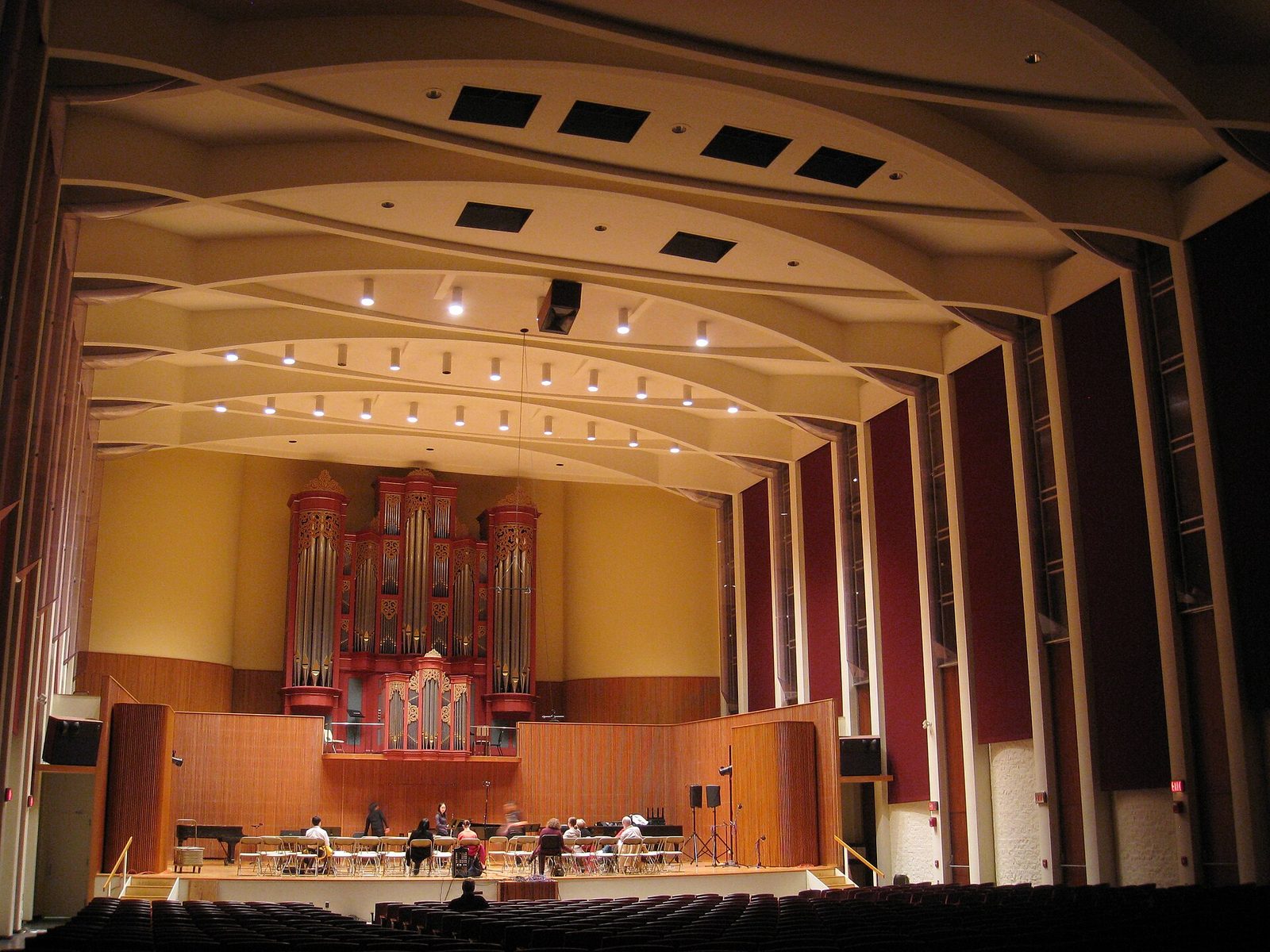
Cover photograph: The Großer Saal of the Wiener Konzerthaus, one of the stages that comes with the Motus Quartet's prize. Dozor, CC BY-SA 4.0, via Wikimedia Commons.
Comments
Sign in to join the discussion.