On Thursday 10 September the Royal Philharmonic Orchestra published its annual tracking research. Two thousand UK adults, nationally representative, and 89 per cent of them said they were interested in attending a classical or orchestral concert. In 2018 the figure was 79 per cent. Among under-25s it has gone from 78 per cent to 92.
The orchestra's own page calls this a six-year peak. It is the highest reading the orchestra has ever published, and by the orchestra's own labelling convention it is an eight-year high.
That is not a quibble. It is the difference between a good headline and the right one, and the RPO has given the good one away.
How the convention works, and why eight is the answer
The full published series has seven readings. There is no 2019 figure and no 2020 figure.
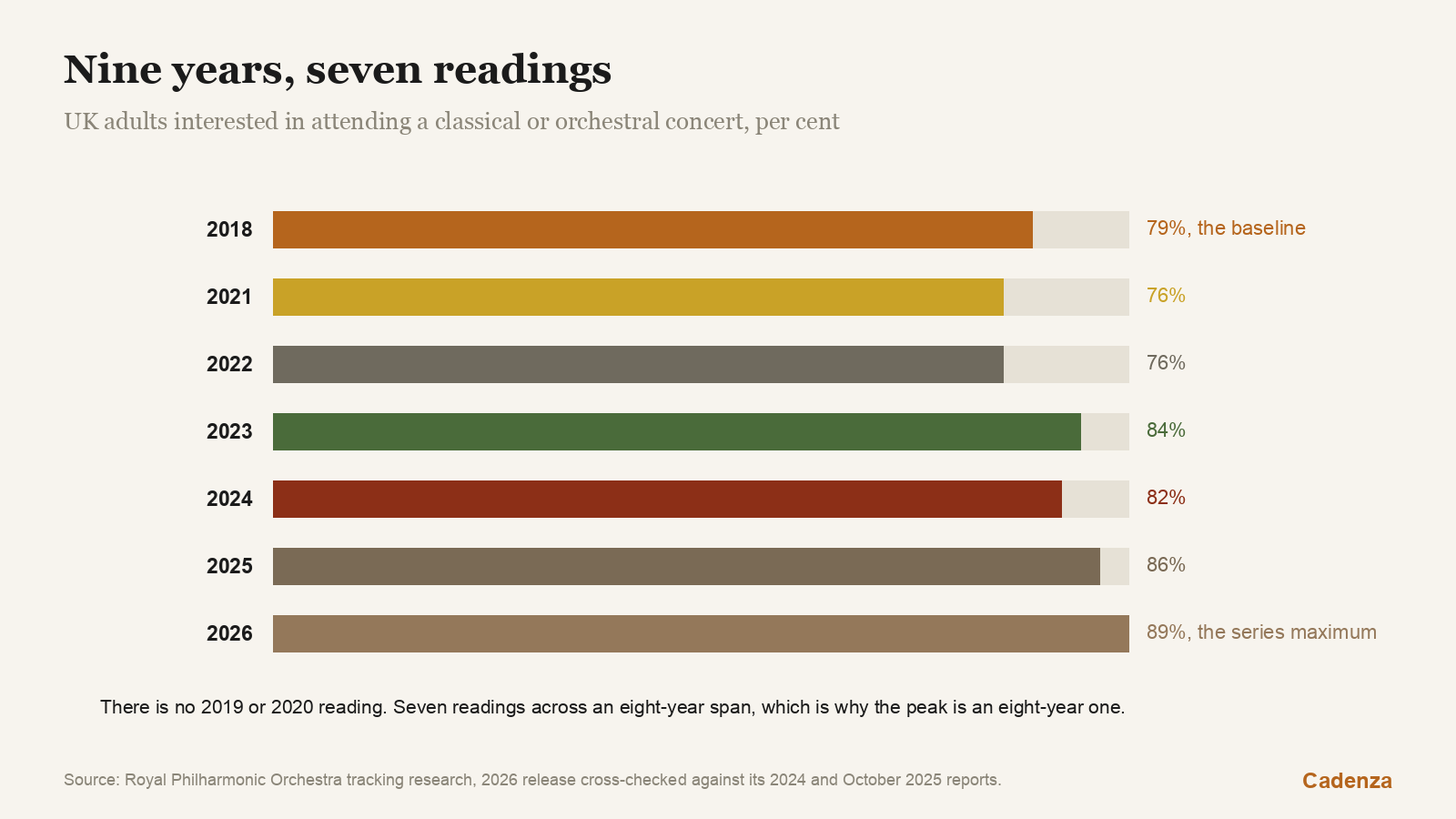
Seventy-nine per cent in 2018. Seventy-six in 2021 and again in 2022. Eighty-four in 2023, 82 in 2024, 86 in 2025 and 89 in 2026. The table is internally consistent, and Cadenza cross-checked the 2018, 2022, 2023 and 2025 readings against two earlier RPO reports, which carry the same numbers.
Those earlier reports also establish how the orchestra names its own results. It labels a peak by the span of calendar years the series covers, not by the count of readings in it, and it has done so twice. Apply that convention to 2018 through 2026 and the span is eight years. The orchestra's live page says six.
Two syndications of the identical press release carry the phrase eight-year peak in the same sentence where the RPO's own site says six-year peak, which is how Cadenza noticed. The press release appears to have gone out one way and the website another.
While we are in the small print, the release also says traditional classical repertoire has held its appeal for seven consecutive years. On its own table it cannot have. Seven readings are spread across nine calendar years, and two of those years have no reading at all.
Is the rise real?
Worth asking, because a three-point move on a sample of 2,000 is not automatically a finding.
At that sample size the 95 per cent confidence interval is about plus or minus two points, so the critical difference between two readings is roughly 2.05 points. The move from 86 per cent in 2025 to 89 in 2026 is 3.0 points, which clears the bar, though not by much. The comparison with 2024 is a seven-point move against a critical value of 2.17, and the comparison with the 2018 baseline is ten points. Those are solid.
Ten points on a base of 79 is a relative increase of 12.7 per cent in eight years. That is the number to keep.
One caution the orchestra could remove easily. The under-25 movement from 78 to 92 per cent is the most quoted figure in the release, and the RPO does not publish the base size for that subgroup anywhere. A fourteen-point move in a youth subsample could be robust or it could be noise, and nobody outside the orchestra can tell.
What the 89 per cent actually measures
One distinction governs how this number should be used, and the release is honest about it while most retellings are not. The question asks whether someone is interested in attending a classical or orchestral concert. It does not ask whether they attended one.
Stated interest and ticket sales are different quantities, and the gap between them is the whole of an orchestra's marketing problem. Eighty-nine per cent of UK adults expressing interest is compatible with almost any attendance figure at all, because interest costs nothing to declare. What the series is good for is direction rather than level: the same question, asked the same way, to the same size of sample, repeatedly. On that basis the direction is unambiguous and has been upward since 2022.
The orchestra describes its research programme as being in its ninth year as of June 2026, which is consistent with a 2018 start and with the two missing pandemic years. Nine years of asking is a real asset, and it is rarer in this sector than it should be. Very few British orchestras publish any audience time series at all, which is part of why the RPO's numbers get quoted so widely and why the labelling matters.
The crossover runs one way
The release's most interesting material is about taste overlap, and it does not say what it is being read as saying.
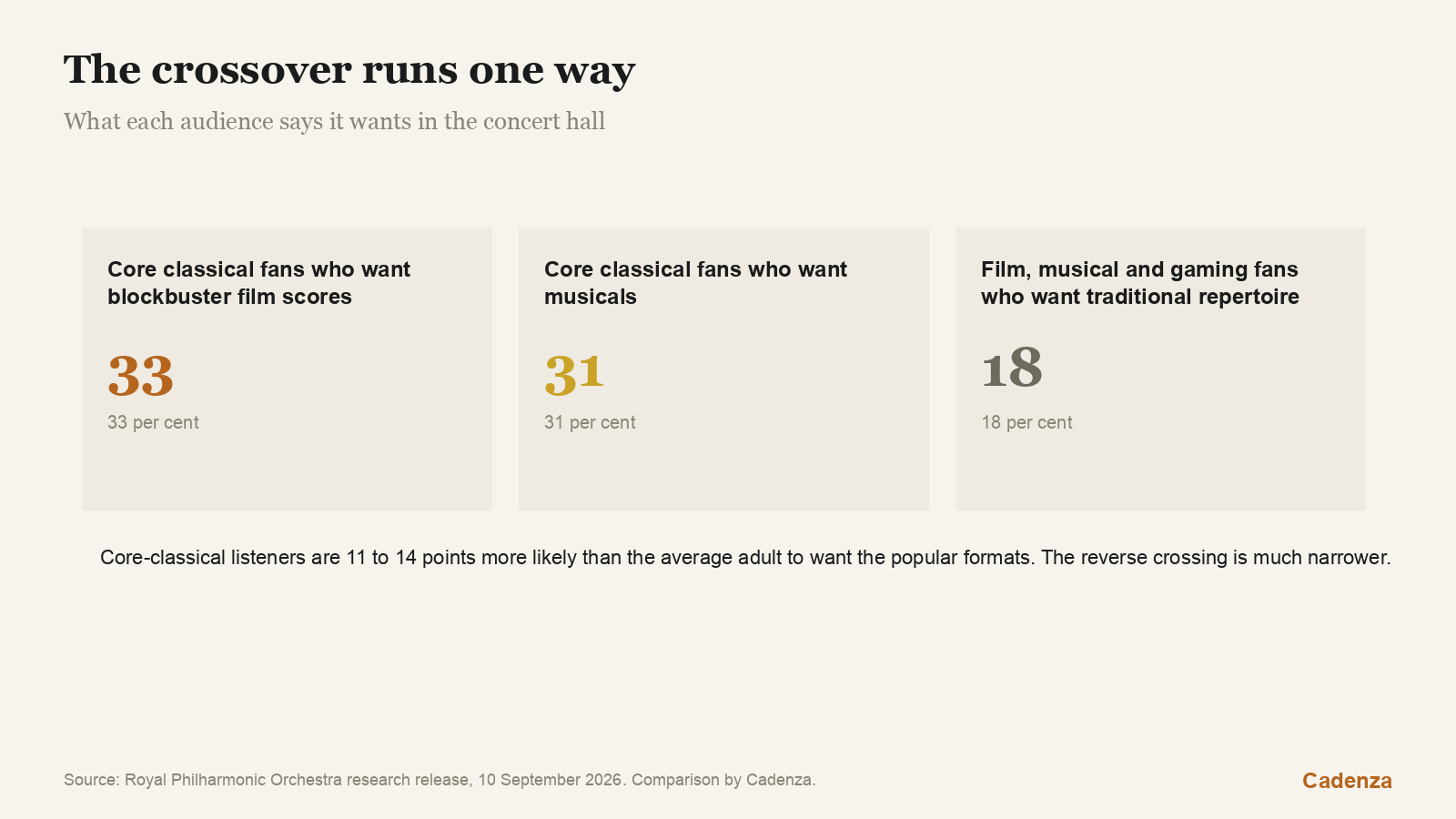
Among people who describe themselves as core classical fans, 33 per cent want blockbuster film scores in the concert hall and 31 per cent want musicals. Among people who come to orchestral music through film, musical theatre and gaming, 18 per cent want traditional repertoire in the hall.
So the traffic is asymmetric. Core-classical listeners are between eleven and fourteen points more likely than the average adult to want the popular formats. The reverse crossing is much narrower. An orchestra that programmes a film night is, on this evidence, selling primarily to people who already buy classical tickets, and only secondarily recruiting from the film audience into the subscription series.
Cadenza started this piece expecting to write that these figures rebut the claim that film nights cannibalise the core season. They do not. What they show is something more useful to a programmer: the film night is a service to the existing audience as much as a recruitment device, and the recruitment effect is real but small.
There is a second reason to handle the format figures carefully. The release puts blockbuster film soundtracks at 29 per cent, film screenings with live orchestra at 25 and musicals at 28, each described as a two-year rise. The orchestra's own release of October 2025 put blockbuster film soundtracks at 35 per cent. Every one of the three popular-format figures is five to nine points lower in the 2026 release than in the 2025 one. Cadenza cannot reconcile the two sets, so this article treats the format numbers as a snapshot and not as a trend, and the direction of travel in that part of the data should not be quoted until the orchestra explains the gap.
The headline interest series, by contrast, reconciles cleanly across three separate RPO publications. That part is sound.
The season this lands in
The research arrived alongside the orchestra's 80th anniversary. The RPO gave its first concert in 1946, in Croydon, so 2026 is its eightieth year, and the arithmetic is exact.
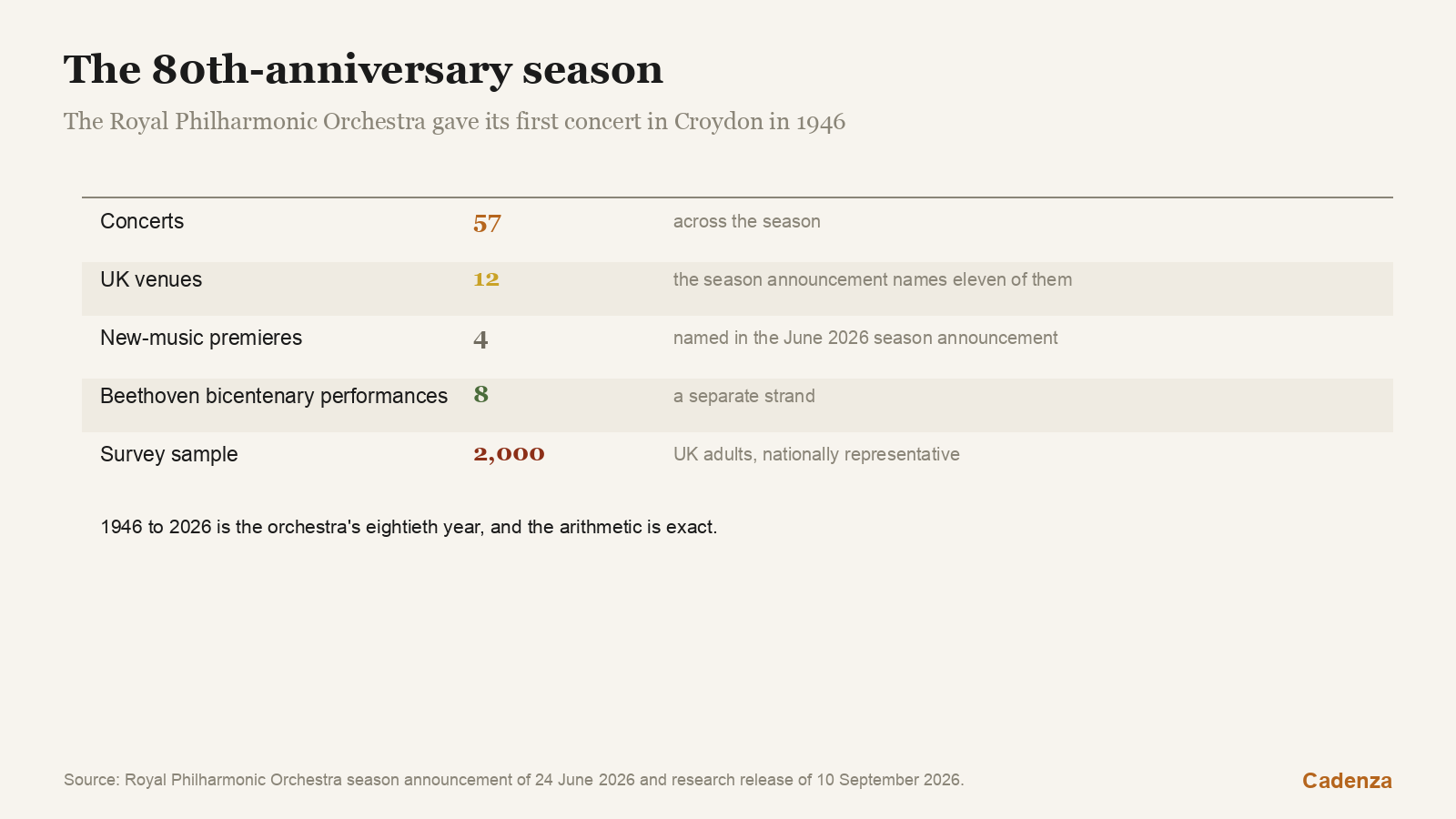
Fifty-seven concerts, twelve UK venues, four new-music premieres and eight performances in a Beethoven bicentenary strand. The concert, venue and premiere figures are independently confirmed by the orchestra's fuller season announcement of 24 June, which names the four premieres.
One small gap. That announcement names eleven venues, not twelve. Cadenza could not identify the twelfth from any published source.
Vasily Petrenko, the orchestra's Music Director, and Sarah Bardwell, its Managing Director, are both quoted in the release.
A year ago it was a listing
An orchestra with 89 per cent of the country saying it is interested still has to fill halls on particular nights, and the route in for a player is the same as ever: an audition notice, a trial, a fixed list. The research is a reason to look.
Cadenza carries current orchestral vacancies, free to musicians, on its jobs board, and competitions with open deadlines on its competitions board.
If you are quoting this research. Use the interest series, which reconciles across three RPO publications, and say that it measures stated interest rather than attendance. The two are not the same thing and the release does not claim they are. Do not quote the popular-format figures as a trend until the conflict with the October 2025 release is resolved, and do not quote the under-25 movement as precise without a base size.
The question the orchestra will be asked next is a simple one it can answer in a day. Its own website calls 89 per cent a six-year peak while the press release syndicated to the trade calls it an eight-year peak. Which number does the RPO stand behind, and will it publish the two missing years and the under-25 base size alongside it?
Sources: the Royal Philharmonic Orchestra's own press index and its research release of 10 September 2026, together with its earlier research reports of 2024 and October 2025, which supply the 2018, 2022, 2023 and 2025 readings and establish the orchestra's own labelling convention; and the orchestra's fuller season announcement of 24 June 2026 for the 57 concerts, the venues and the four premieres. Also consulted: ArtsProfessional and NE Connected, the two syndications that carry the eight-year wording. The significance testing, the relative-increase calculation, the crossover comparison and the labelling-convention check are Cadenza's own work on the orchestra's published figures.
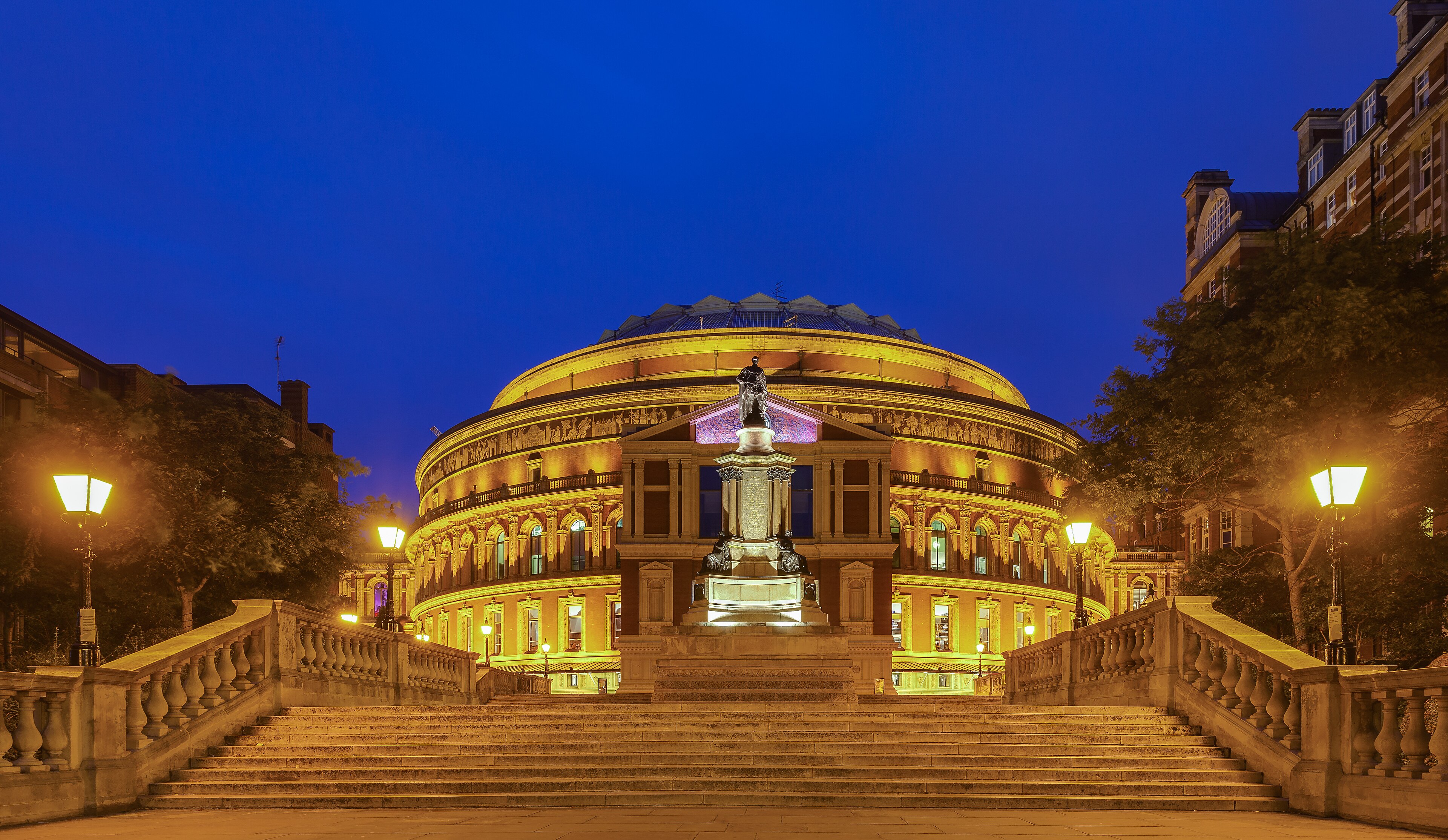
Cover photograph: the Royal Albert Hall, London, 2014. Diego Delso, CC BY-SA 4.0, via Wikimedia Commons. Charts by Cadenza.
Cover photograph: The Royal Albert Hall, one of the venues in the Royal Philharmonic Orchestra's 80th-anniversary season, photographed in 2014. Diego Delso, CC BY-SA 4.0, via Wikimedia Commons.
Comments
Sign in to join the discussion.