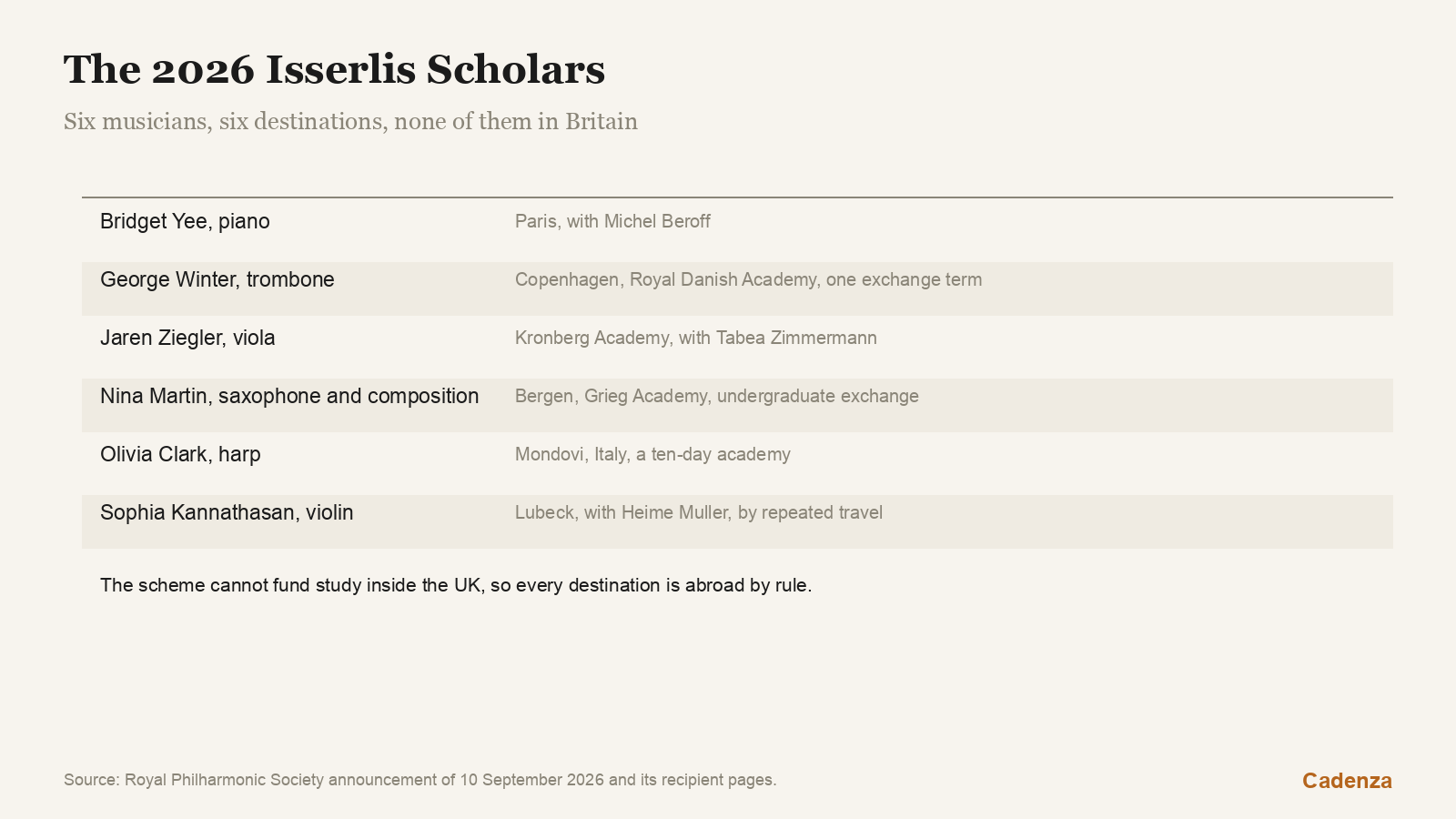
On 10 September the Royal Philharmonic Society published a list of six names. Bridget Yee will study piano with Michel Beroff in Paris. George Winter takes his trombone to the Royal Danish Academy in Copenhagen. Jaren Ziegler continues viola at the Kronberg Academy. Nina Martin goes to the Grieg Academy in Bergen for saxophone and composition. Olivia Clark, who is seventeen and from Reading, has a place at the HarpMasters Academy in Mondovì. Sophia Kannathasan will work on the violin with Heime Müller in Lübeck.
The total is £22,500, and the money comes from a bequest made to the society by Cecilia Helen Northcote. At her wish the scholarship carries the name of Julius Isserlis, whom the society describes as an inspirational Russian pianist, composer and teacher. It was first awarded in 1980.
The society tells this story with a particular anecdote. Its own announcement notes that the scholarship helped Sir Stephen Hough when he was just nineteen, enabling him to study at the Juilliard School, and that it helped Imogen Whitehead, now Principal Trumpet of Britten Sinfonia. The Hough award is dated 1980 on the society's own list of recipients, the scholarship's first year.
Cadenza went through that list and counted every award the society has made in the four rounds from 2023 to 2026. Twenty-four awards. The United States has taken one of them.
Where the money actually sends people
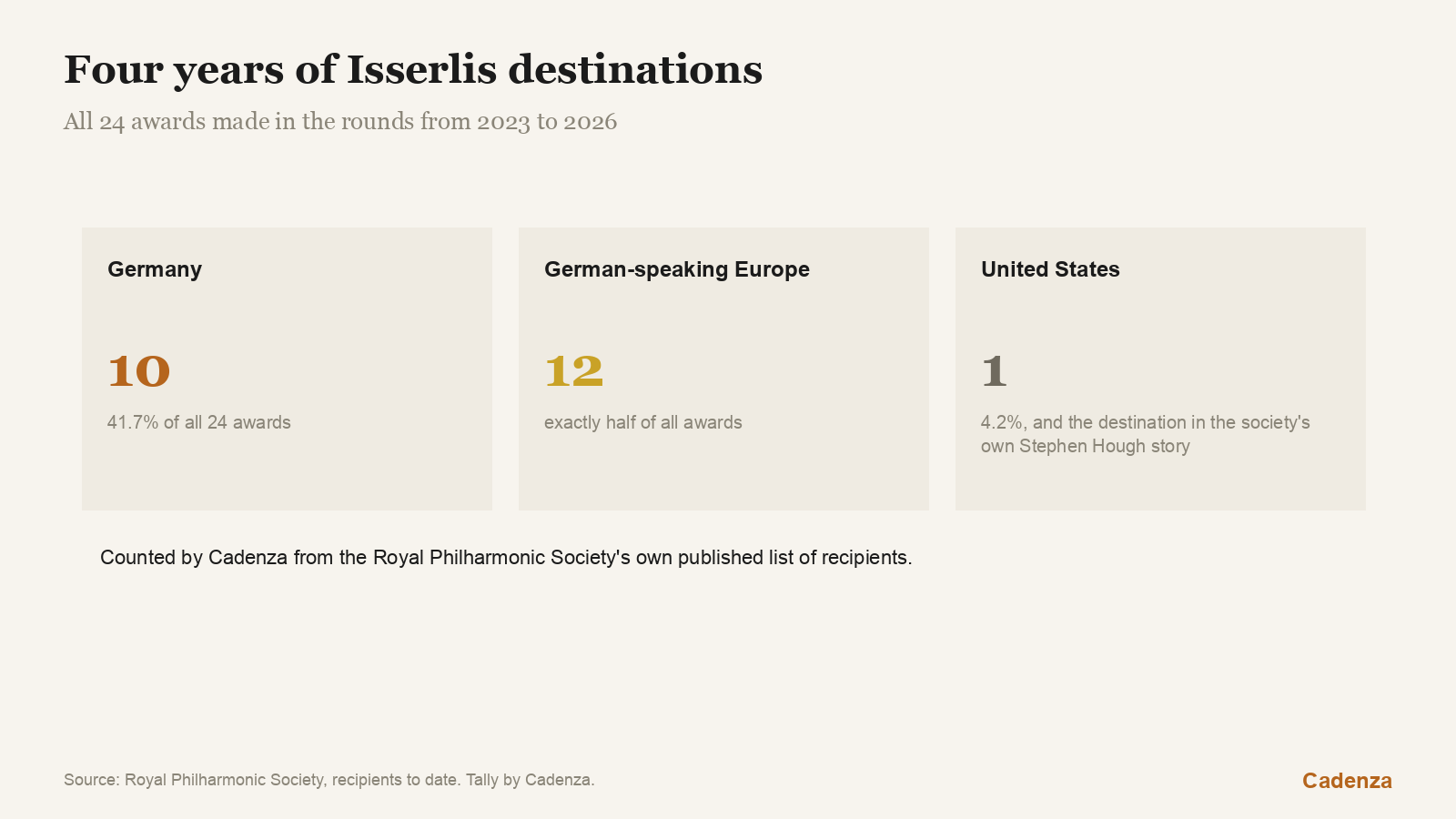
Germany alone accounts for ten of the twenty-four awards, which is 41.7 per cent. Widen it to German-speaking Europe and the figure is twelve of twenty-four, exactly half. The single American award across four years is 4.2 per cent of the total, and it is the destination in the society's own showpiece story about Hough.
This is not a complaint about the society, which funds what applicants ask for. It is a description of where British-resident musicians in their late teens and twenties now believe the best finishing school is, because the applications are theirs and the destinations follow the teachers. The names in the 2026 list make the point better than the percentages. Ziegler is at Kronberg with Tabea Zimmermann. Kannathasan is going to Müller in Lübeck. Yee has been working with Beroff since 2025.
One structural fact should be stated before anyone reads a trend into the geography. The scheme cannot fund study inside the United Kingdom at all. The society's own application guidelines say plainly that it is unable to accept applications to fund study within the UK. So the fact that all six 2026 destinations are abroad is a rule, not a finding. What the rule does not determine is which abroad, and that is where the German-speaking half comes from.
The six, and what they are actually doing
Three of the six are not relocating, which is worth saying because a scholarship list can read as though everyone is emigrating.
Winter's Copenhagen place is a single exchange term from the Royal College of Music, and he has said he will return to the RCM in January. Martin's Bergen term is an exchange in the final year of her undergraduate degree at the Royal Welsh College of Music and Drama. Kannathasan, who has just finished a master's at the Guildhall School, said she is excited to travel regularly to Lübeck, rather than move there. Clark's Italian course is ten days.
That mix matters for any reader thinking of applying. This is not only a scheme for people ready to leave the country for years. It funds a term, a course of lessons reached by repeated travel, and a ten-day summer academy, alongside longer study.
Two of the six arrive with a significant credential already. Ziegler won the strings final of BBC Young Musician in 2022 at sixteen, the first violist to do so, and the society describes him as currently the only British student at the Kronberg Academy. Clark is Principal Harpist of the National Youth Orchestra of Great Britain for 2026.
It is also worth being accurate about who is eligible, because the scheme is often described as being for British musicians and it is not. The guidelines open it to applicants of any nationality between the ages of fifteen and twenty-five who are permanently resident in the UK and hold the right to work in the UK. Both conditions apply, not just residence. The society itself introduces Bridget Yee as a Malaysian pianist. The test is where you live and work, not what passport you hold.
The arithmetic the announcement does not carry
The society does not publish a per-recipient breakdown, so the only per-head figure available is an average, and it should be read as one rather than as anybody's award. Twenty-two thousand five hundred pounds across six recipients is £3,750 each.
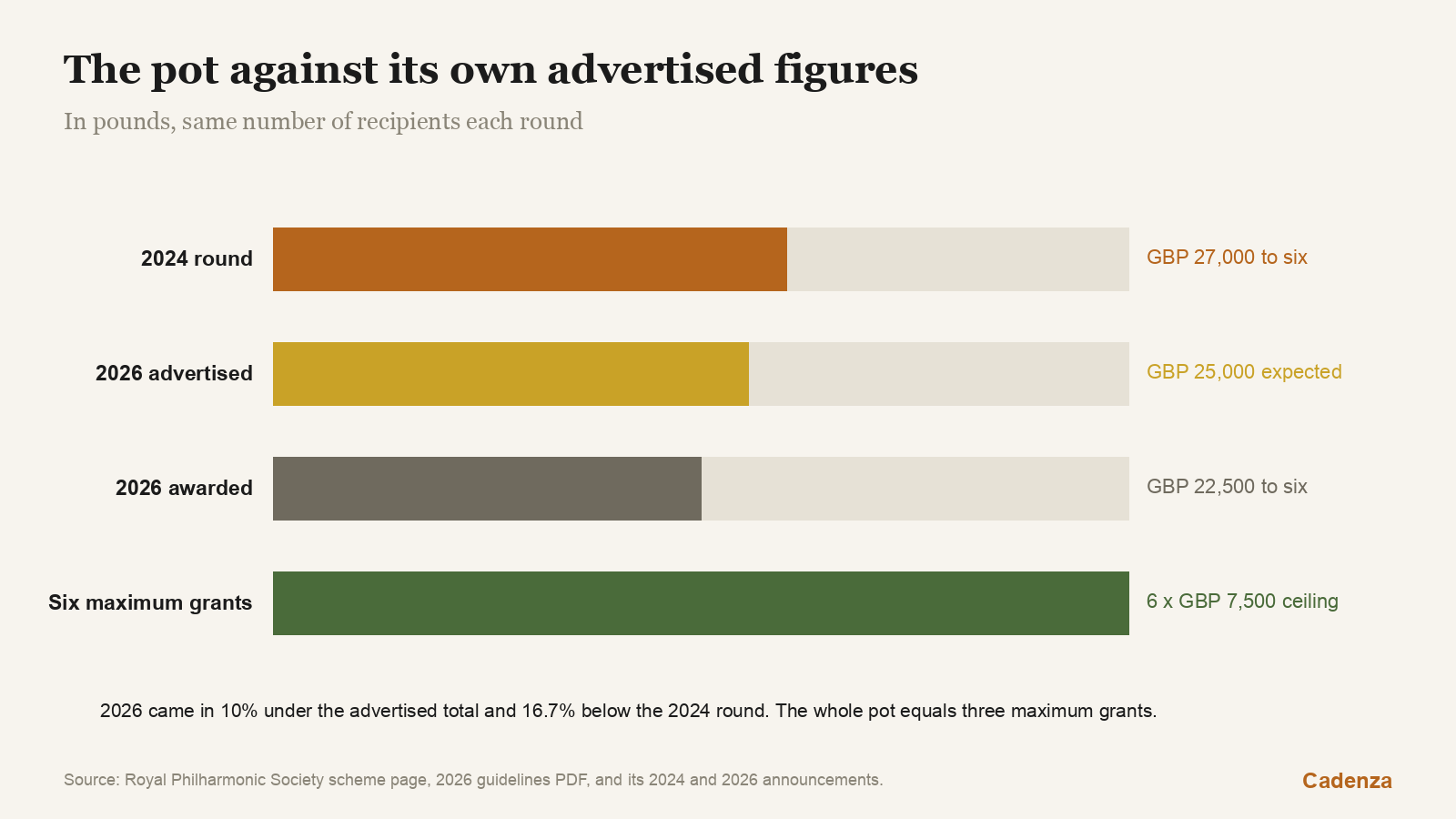
Set that against what the society told applicants to expect. Its scheme page and its 2026 application guidelines both said it expected to offer a total of £25,000. The award came in at £22,500, which is £2,500 short, exactly ten per cent under the advertised figure.
The guidelines also set the grant range from as little as £500 up to £7,500. Six grants at that ceiling would cost £45,000. The actual pot is £22,500, or exactly half of that, which means the whole 2026 round is worth precisely three maximum grants. Structurally, at most three of the six can be funded at the headline rate.
The two-year comparison is the one to watch. The 2024 round was worth £27,000, also to six musicians. The 2026 round is £22,500 to six musicians, so the same number of people are sharing £4,500 less, a fall of 16.7 per cent in cash and more than that once inflation is applied. There is no clean 2025 figure to put between them, because the society announced its 2025 Isserlis awards jointly with its Instrument Purchase Grants as a single sum of over £48,000 to twenty-nine young musicians. That total reconciles against the published lists, which is how Cadenza satisfied itself that no Isserlis-only 2025 figure was ever disclosed. So 2024 is the correct comparator.
None of which is a reason for a young musician to skip the form. Three thousand seven hundred and fifty pounds is a term in Copenhagen or a serious block of lessons in Lübeck, and the society has now funded seventy-two awards since 1980.
A society in the middle of an expansion
That number carries its own surprise. Of the seventy-two awards the scheme has made in forty-six years, twenty-four have come in the last four, as the society moved from occasional single-instrument rounds to annual cohorts of six. One third of the scholarship's entire output has happened since 2023.
The society has a second fund worth noting alongside it. On 20 August, exactly twenty-one days before the Isserlis announcement, it named the 2026 recipients of the RPS Ambache Fund, £16,000 of grants supporting the performance of music by historic women composers. Those six are not six individual soloists. The society describes them as six performers, ensembles and organisations, and they are Antonio Oyarzabal, Audiovisability, Ian Tindale, the Philharmonia Orchestra, Samantha Ege and The Bubblyjock Collective.
The Ambache scheme page had told applicants to expect a total of £16,000 likely split between three or four recipients. The society funded six instead, which is better for breadth and means the average award, £2,666.67, landed below the £3,000 floor applicants had been told to expect. Two schemes, £38,500, twelve awards in three weeks.
A year ago every one of these was a form
Each of these six names began as an application, and the guidelines that set the £500 to £7,500 range are the same document the next cohort will read. The scheme is open to anyone aged fifteen to twenty-five who lives and can work in the UK, of any nationality, and it pays for study anywhere except here.
Cadenza carries the competitions and schemes with open deadlines, free to musicians, on its competitions board, and current orchestral vacancies on its jobs board.
If you are applying. Read the society's own application guidelines rather than the news page. They are the document that carries the grant range, the residence and right-to-work conditions, and the rule that study within the UK cannot be funded. Note that a term-length exchange and a ten-day summer academy are both fundable, which the announcement's language does not make obvious.
The question the society will be asked next is about the trend line rather than this year's six. The pot has fallen from £27,000 to £22,500 across two rounds with the same number of recipients, and both of its schemes this summer landed below the figures applicants were told to expect. Will the 2027 round be advertised at a number the society can actually pay?
Sources: the Royal Philharmonic Society's own pages, read on 11 and 12 September 2026: the 2026 Isserlis announcement, the study abroad scheme page, the 2026 application guidelines PDF, the full list of recipients since 1980, the 2024 announcement, the 2025 combined announcement, the 2026 Ambache Fund announcement and the Ambache scheme page. Individual recipient pages for Bridget Yee, George Winter, Jaren Ziegler, Nina Martin, Olivia Clark and Sophia Kannathasan. The destination tally, the averages and the year-on-year comparison are Cadenza's arithmetic from the society's own published lists.
Cover photograph: the Grosser Saal of the Musikhochschule Lübeck, 2024. CVComposer, CC BY-SA 4.0, via Wikimedia Commons. Charts by Cadenza.
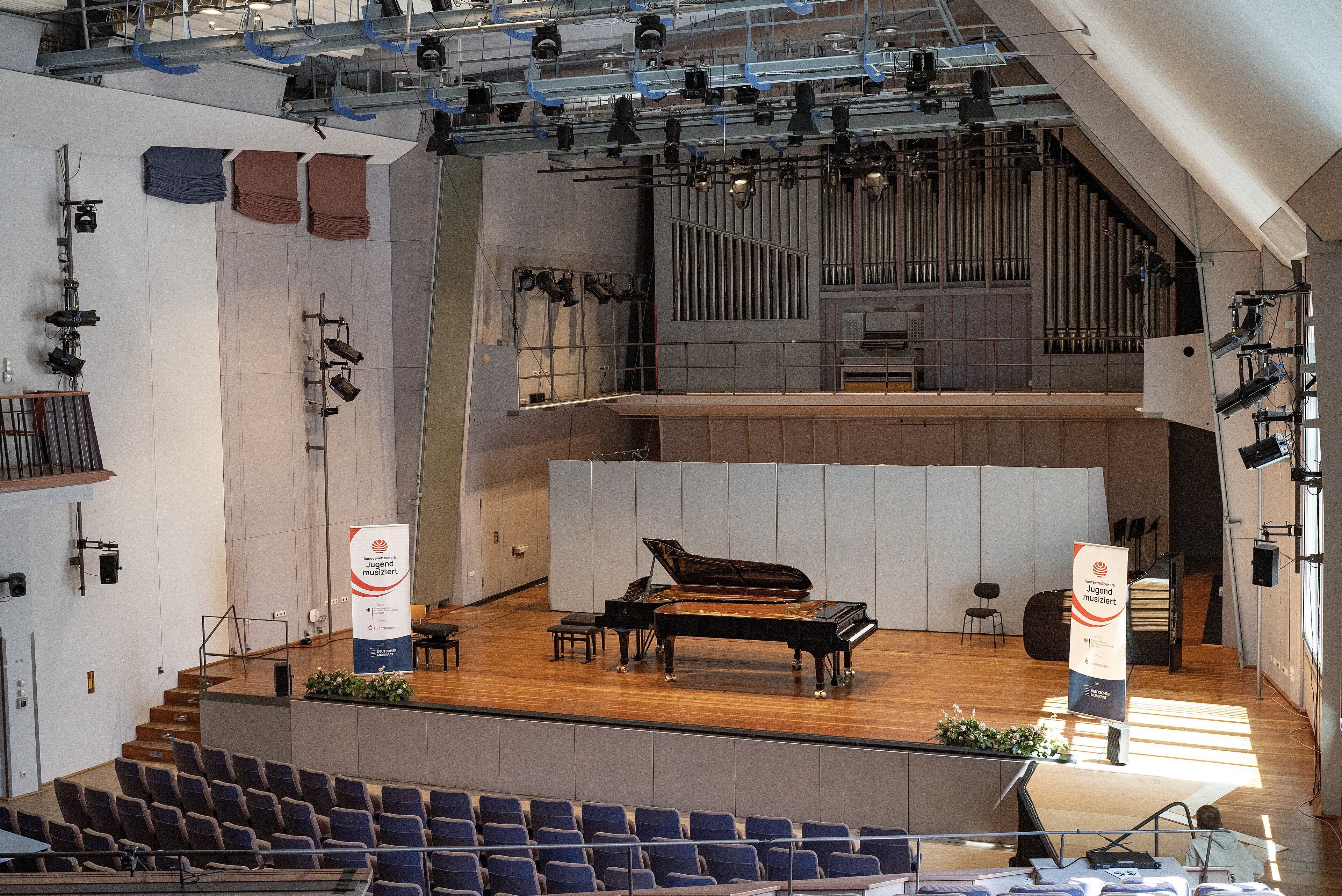
Cover photograph: The Grosser Saal of the Musikhochschule Lübeck, where one of the 2026 RPS Isserlis Scholars will work with Heime Müller, photographed in 2024. CVComposer, CC BY-SA 4.0, via Wikimedia Commons.
Comments
Sign in to join the discussion.