On the evening of Tuesday 8 September, at half past seven, in the Salón Dorado of the Teatro Colón in Buenos Aires, two men signed a document. Fulvio Macciardi, Superintendent of the Fondazione Teatro di San Carlo in Naples, and Gerardo Grieco, Director General of the Ente Autárquico Teatro Colón. Italy's foreign minister, Antonio Tajani, presided.
The agreement runs for five years and renews automatically. It covers co-productions, the exchange of artists and of stage crew, programmes for young talent, the touring of productions, and joint cultural promotion. A twinning commission will plan the work, and the Italian government's Neapolis 2500 national committee will contribute to the first joint activities through the Neapolis Fund.
Neither theatre has published anything about it. Cadenza checked both. The San Carlo's own site is behind a bot wall that returns a security check rather than a page, and the Colón's newsroom has not carried it. Everything below comes from the Italian foreign ministry, the Italian wires and the two theatres' own historical pages.
The ten-year plan inside the five-year deal
The most consequential line in the coverage is one nobody has led on. Macciardi frames this not as a five-year agreement but as the start of a runway to the San Carlo's tercentenary, with preparations beginning in 2027.
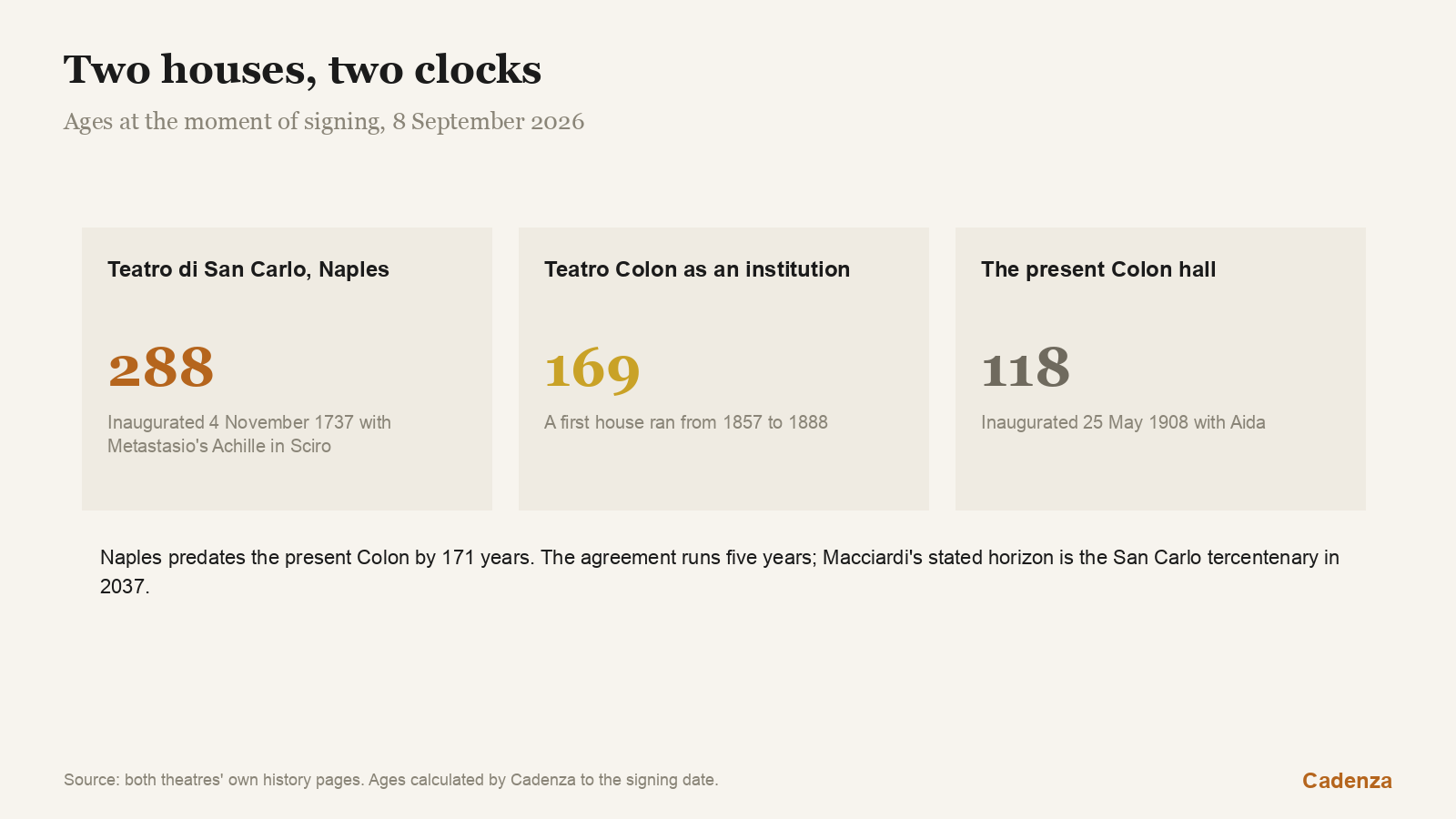
The Teatro di San Carlo was inaugurated on the evening of 4 November 1737, the sovereign's name day, with Metastasio's Achille in Sciro. Add 290 years and you get 2027. Add 300 and you get 2037. Macciardi's horizon is exactly double the term of the document he signed, which means the agreement as drafted expires five years before the event it is being built towards, unless the automatic renewal does the work.
Grieco's promise is nearer. He has said the bespoke co-production is a dream that could take shape by 2029, with an unforgettable premiere, and that it will be a new production. Measured against a five-year term beginning in September 2026, 2029 sits comfortably inside it with two years to spare. If it slips, the renewal clause becomes load-bearing.
The angle that does not survive the dates
This deal has been described as a pact between two of the oldest opera houses in the world. That is true of Naples and not of Buenos Aires.
The Colón's own website is clear about its history. A first Teatro Colón operated from 1857 to 1888. The present hall was inaugurated on 25 May 1908 with Aida. So at the moment of signing the San Carlo was 288 years old, the Colón's present building 118, and the Colón as an institution 169.
Naples predates the current Colón by 171 years and its predecessor by 120. The San Carlo is roughly two and a half times the age of the house it has just twinned with.
The Colón, to its credit, does not claim otherwise. It positions itself by importance and acoustics rather than age, and the list of peers it names on its own site includes four houses older than itself. That is the more interesting relationship. A house that opened in 1737 has tied itself to a hall built in the twentieth century and famous for how it sounds, and each is bringing something the other cannot manufacture.
What is actually being exchanged, in order
Cadenza's own starting assumption was that the craft exchange was the substance and the co-productions were decoration. Both signatories say the opposite, and so does the text.
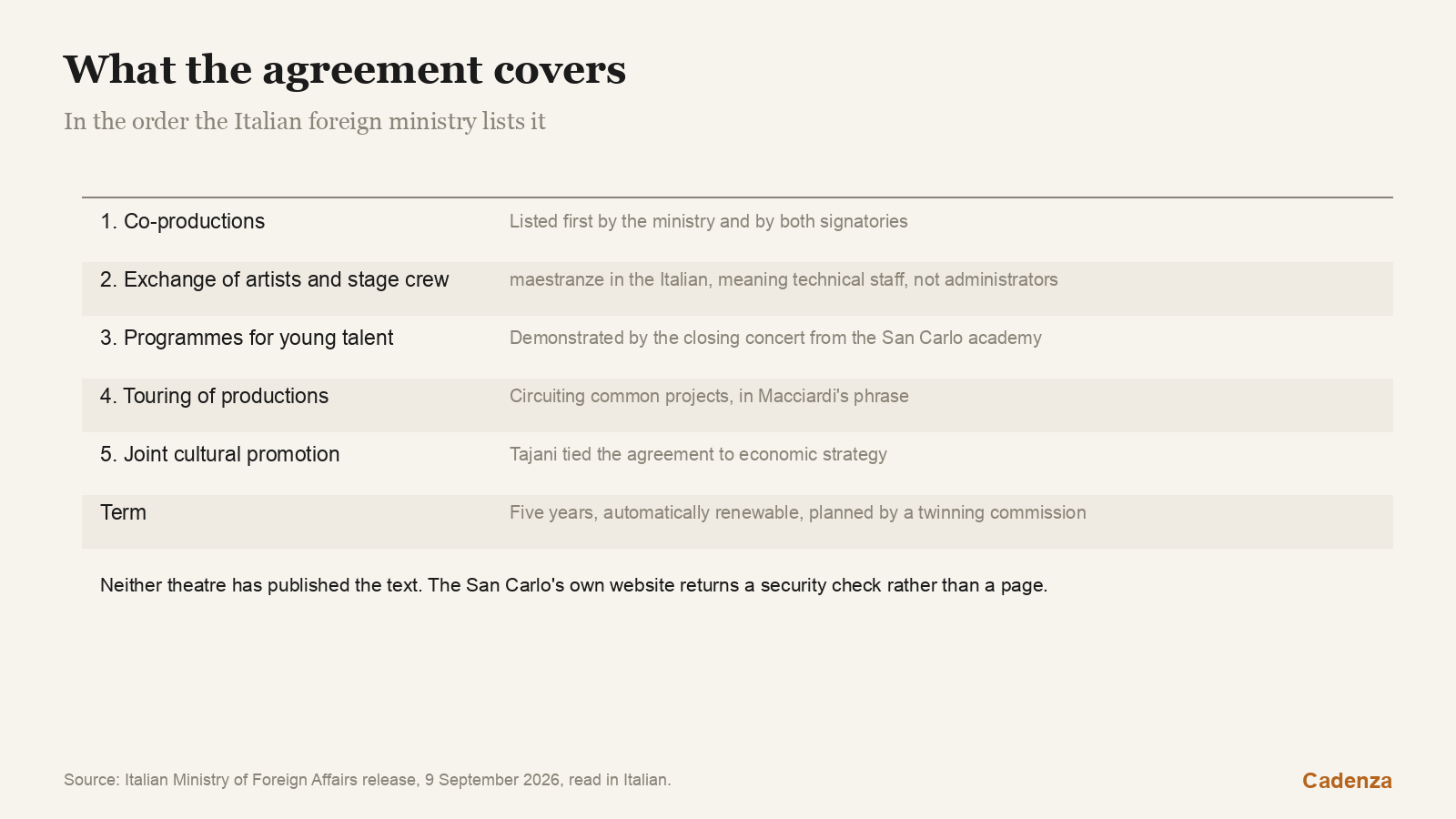
The ministry's own list puts co-productions first and the exchange of artists and stage crew second. Macciardi's own account describes the reciprocal presence of artists, stage crew and productions, and the circuiting of common projects. The craft element is real and it is unusual to see it written into a cultural agreement at all, but it is not the headline the parties themselves are offering.
The Italian original is worth a note here, because the English loses something. The planning body is a Commissione di gemellaggio, a twinning commission, and the people being exchanged alongside the singers are maestranze, which means the stage crews and technical staff rather than administrators. Opera houses swap singers constantly and almost never swap the people who build and run the shows.
One assumption to drop: there is no evidence that the two theatres' academies are the mechanism. No release, no wire report and no statement from either side says so. What is documented is that the evening closed with a concert called Nápoles y el Sonido del Mundo, given by young artists of the Accademia del Teatro di San Carlo with three named soloists, which is a demonstration of the young-talent strand rather than a description of how it will run.
Who Grieco is, and why that matters to the deal
The Colón's signature was put there by someone relatively new to the building. Gerardo Grieco became Director General of the Ente Autárquico Teatro Colón on 1 November 2024, and before that he ran Uruguay's SODRE, the state broadcaster's cultural arm in Montevideo, which operates its own orchestra and auditorium.
That biography is relevant to what has been signed. An administrator who has run a state cultural body in a smaller South American market, and who is now two years into the region's most famous opera house, has reason to value exactly the clauses this agreement contains. Touring, co-production and the loan of technical staff are how a house without a Europe-sized budget acquires Europe-sized productions. The five-year term with automatic renewal outlasts most cultural-ministry cycles on either side, which is the point of drafting it that way.
Macciardi's position is the mirror image. The San Carlo is a foundation rather than a city body, it is approaching an anniversary that will need international partners, and a signed exchange with Buenos Aires gives it a South American platform without the cost of building one.
The room, and why the guest list matters
The signing was not a two-theatre affair. Alongside Tajani, Italy's education minister Giuseppe Valditara was present, and the head of the Buenos Aires city government, Jorge Macri, spoke. The Colón is an autarchic body of the city, so its presence at that level is structural rather than ceremonial.
Tajani himself tied the cultural agreement explicitly to economic strategy, which is a useful corrective to reading this as a pure craft exchange. This is cultural diplomacy, paid for out of an anniversary fund, signed on a ministerial visit, and the theatres are the instrument as much as the beneficiaries.
The anniversary is a year early in its own law
Neapolis 2500 has a statutory basis: article 14 of Italy's 2024 omnibus decree establishes the national committee and dates the founding of ancient Neapolis by settlers from Cumae.
Run the law's own dating forward and the 2,500th anniversary of that traditional founding falls on 21 December 2026. The programme was celebrated in 2025. The law is a year early by its own arithmetic, and the Italian government then chose to extend the programme into 2026 as an international-projection strand, which is the strand this agreement sits in. So the signing is, in a slightly accidental way, closer to the real anniversary than the celebration was.
One figure in circulation should be handled carefully. The committee publicises an endowment of seven million euros. The founding statute assigns it one million. Cadenza could not reconcile the two, and has not printed the larger number as fact.
A year ago it was a listing
Every co-production this agreement eventually produces will reach musicians as an audition notice, a chorus call or a fixed-term contract in one of two cities. The young-artist strand runs through the San Carlo's own academy, which recruits publicly.
Cadenza carries opera and orchestral vacancies, free to musicians, on its jobs board, and competitions with open deadlines on its competitions board.
If you are following this. The document to watch is not either theatre's website, neither of which has published it. It is the Italian foreign ministry's release, which carries the terms, and the Neapolis 2500 committee's accounts, which will show whether the Neapolis Fund money for the first joint activities actually moves. The first testable milestone is Grieco's 2029 premiere.
The question both houses will be asked next is why neither of them has said anything. An agreement of this size was announced by a foreign ministry and two wire services, and the Teatro di San Carlo's own website cannot currently be read by the public at all. When will either theatre publish the text it signed?
Sources: the Italian Ministry of Foreign Affairs' release of 9 September 2026 for the terms, the twinning commission and the Neapolis Fund; ANSA for Grieco's full quote and the closing concert; Agenzia Cult for the advance schedule that fixes the date and time; OperaWire; the Teatro Colón's own history pages for the 1857 to 1888 first house and the 25 May 1908 inauguration; the Teatro di San Carlo's 4 November 1737 inauguration; and article 14 of Italy's 2024 omnibus decree for the statutory basis of Neapolis 2500 and its allocation. The ages, intervals, anniversary arithmetic and the 2037 reconciliation are Cadenza's calculations.
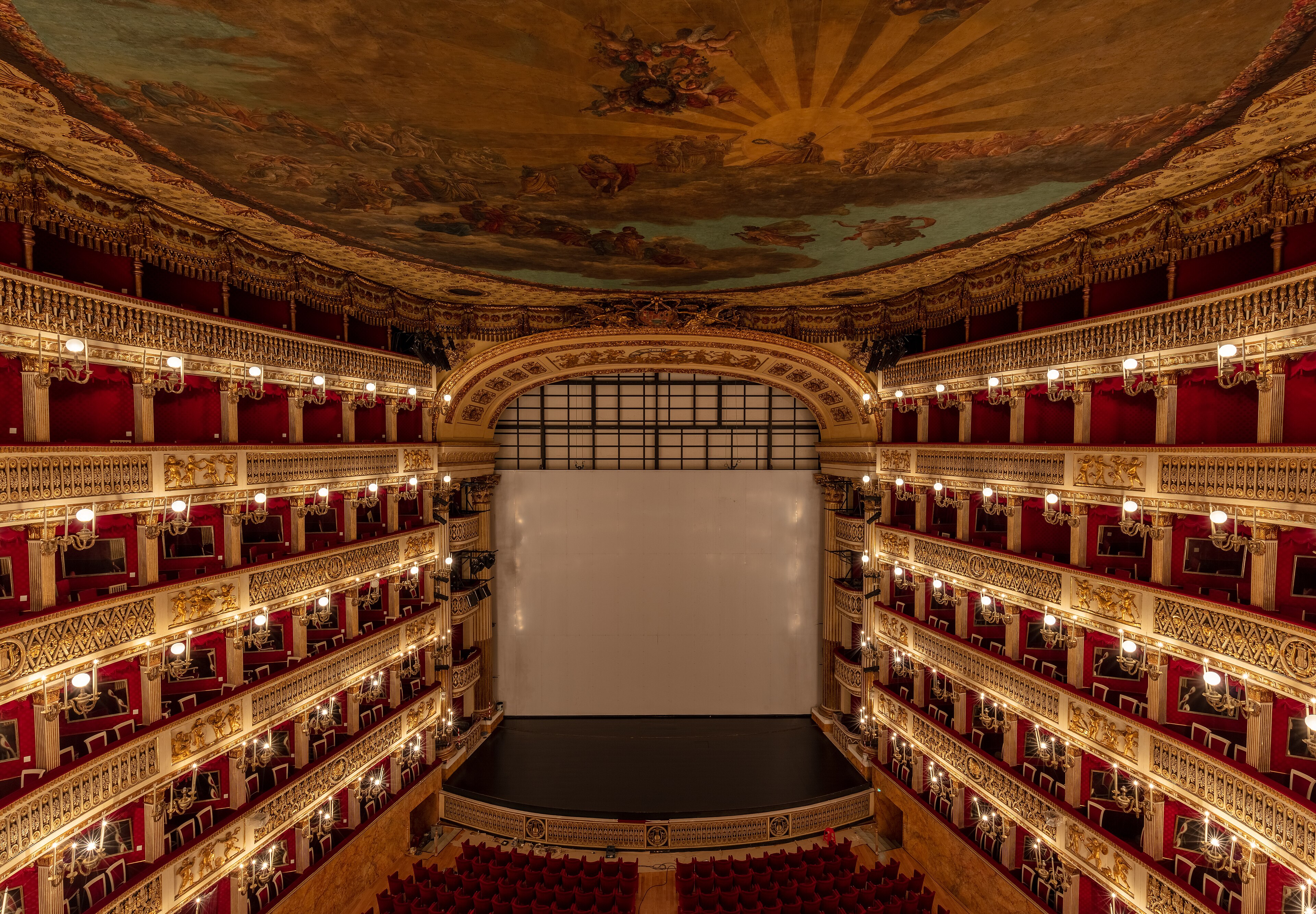
Cover photograph: the auditorium of the Teatro di San Carlo, Naples, 2023. Diego Delso, CC BY-SA 4.0, via Wikimedia Commons. Charts by Cadenza.
Cover photograph: The auditorium of the Teatro di San Carlo in Naples, inaugurated in 1737 and the older of the two houses in this agreement, photographed in 2023. Diego Delso, CC BY-SA 4.0, via Wikimedia Commons.
Comments
Sign in to join the discussion.