
On 12 September 2026, the San Francisco Opera is scheduled to open its season with Verdi's Simon Boccanegra. Eleonora Buratto and Amartuvshin Enkhbat are cast. The orchestra has said it will not play that night unless a contract is agreed first.
Its contract expired on 31 July. According to the musicians, as reported by the San Francisco Chronicle on 27 August, management's opening proposal amounted to a 26 per cent pay cut, a return to 2015 wages, later revised to a 20 per cent cut, or 2018 pay. The company disputes that description: it told the Chronicle that its latest proposal is a five-year framework which would gradually change the structure of the orchestra's compensation while keeping annual earnings at current levels. A mediator has joined the talks. The company’s statement says that, "as we have already been doing with all of our employees, artists and labor organizations," it must find a contract that "better aligns with the economic realities of the Company."
This is the second time in six years that the San Francisco Opera has asked its orchestra to take less; the first, in 2020, was a pandemic revision of a running contract that cut pay by half. Between the two, the company's own filings show net assets rising, officer compensation rising, and a structural gap that no reduction in musicians' wages is large enough to close. The economic reality the company invokes is real. It is also not one the orchestra created, and the arithmetic says it is not one the orchestra can fix.
The first time: fifty per cent
In September 2020, with the War Memorial Opera House closed by the pandemic, the orchestra agreed to a contract modification that cut pay by 50 per cent for the fall season, with deep but graduated cuts over the following two years, according to International Musician, the AFM's own publication. San Francisco Classical Voice later put the fall 2020 reduction at 44 per cent of the 2018–19 base, and International Musician reported that the company’s budget had been reduced from $78.6 million to $44 million. Four years later, in September 2024, the company described its position to San Francisco Classical Voice as "the impossibility of our overall financial model."
The musicians said then what they are saying now. As International Musician summarised their statement: had they rejected the cuts, they would immediately have been without income or health coverage, and they did not accept that their compensation should be tied to ticket sales while management was not sharing equally in the sacrifice.
Base pay was restored, gradually, to $110,467 by the 2023–24 season, according to the company as quoted by San Francisco Classical Voice. A union spokesperson’s response was that the growth had been "below the rate of inflation." Under the contract that has just expired, San Francisco Classical Voice reports, the guaranteed minimum for a section musician was $118,326.75 for a 24-week season, with $124,056.47 for an assistant principal and $152,705.94 for some principals.
The contract that arrived ten months late
The agreement that has just expired ran from 1 August 2024 to 31 July 2026. It was ratified on 26 June 2025 and announced on 30 June, eleven months after it took effect, and expired thirteen months after that, as Cadenza reported on 14 August. The joint release promised wage increases in each of its two years, enhanced retirement packages, and a healthcare redesign the parties described as producing "transformational financial savings without reductions in benefits or increases in costs to participants."
That announcement, the parties said, committed both sides to pursue a multi-year successor. Instead the successor negotiation opened with a proposal the musicians read as reversing eight years of the wage scale.
There is a precedent for the week the company is now in. In September 2024, with the orchestra out of contract, the opening of Un ballo in maschera began late while a temporary extension was agreed; the performance went ahead.
What the musicians said back
The orchestra's public letter, reproduced by OperaWire and Slipped Disc on 28 August, makes a claim the company rejects: "The San Francisco Opera is not a company in trouble." The company’s reply, given to San Francisco Classical Voice, is that "while the Opera is seeing incredibly positive trends in audience and donor growth," expense growth has outpaced revenue growth for decades, that drawing on the endowment to balance the budget has become unsustainable, and that it must "resolve a structural deficit of $15 million each year."
The evidence they cite is the company's own. Six productions have sold out in the past three years. Ticket sales and subscriptions are rising. Donations increased by $8 million over the previous year and exceeded the company's stated goal by $2.2 million. The number of "Producers Circle" donors, those giving $100,000 or more a year, has more than doubled since the pandemic.
The company describes its current offer as a five-year framework that would restructure compensation while holding annual earnings at current levels. The musicians’ reading is that a five-year freeze is a cut of roughly a fifth against local inflation, and that the framework also reduces the orchestra’s work weeks. Their statement of what they want, as quoted by Moto Perpetuo: "We are not walking away from the table." And: "There is nowhere we would rather be on September 12 than in the pit."
On 6 September they posted an update, reported the next day by OperaWire: "You might have read that SF Opera management has 'improved' their offer from a 20 percent wage reduction to a five-year wage freeze, but localized data of the past five years from the BLS suggests that this would effectively be a 20 percent cut against inflation." Their negotiations page puts the five-year rise in the Bay Area consumer price index at 19.5 per cent and says the proposal also cuts work weeks, by more in each year of the five.
What the company said
The company's fuller position, given to San Francisco Classical Voice on 1 September, is that the orchestra's contract "was designed for a volume of work that has not been economically feasible for many years", that balancing the budget by drawing on the endowment has become unsustainable, and that it has "shared a possible five-year framework with the Orchestra that would realize gradual changes to the structure of the Orchestra's compensation while keeping their earnings constant to current levels each year over the coming five years". The shorter statement, as reported by the Chronicle: "We must find a way through this with the Orchestra to find a contract that respects their extraordinary talents and better aligns with the economic realities of the Company."
On 1 September the company announced that the Opera Ball, the season-opening fundraiser scheduled for 12 September at City Hall, would move to 12 November. Shilvock, as quoted by OperaWire: "We feel that this is the best decision to ensure that this critical fundraising event can continue, free of any uncertainty, while at the same time giving negotiations the space needed to proceed ahead of what promises to be a beautiful opening of Simon Boccanegra on September 12."
The fundraiser has been moved out of the way of the dispute. The performance has not: the company says Simon Boccanegra "will continue as planned on September 12," and has not said how it would be presented if the orchestra does not play.
The economic reality, in the company's numbers
The phrase carries the company's whole argument, so here is what stands behind it.
The audited statements for the year ended July 2024, which Cadenza cited in August, show total operating expenses of $87.5 million against ticket sales of $15.4 million: 17.6 per cent. The Chronicle reported the following year at $82.6 million in expenses against $13.8 million in tickets, a structural deficit the company puts at about $15 million a year, and a multi-year commitment from Jensen and Lori Huang of $5 million annually. Net assets, the Chronicle reported, stood at $329.8 million.
The audited figures are not in dispute. The size of the structural deficit is the company’s own estimate; San Francisco Classical Voice notes that the Form 990 for the year to July 2025 shows $82.8 million of revenue against $89.1 million of expenses, a smaller gap than $15 million. Tickets cover about a sixth of the cost of running the company, and that share fell last year. The gap is real.
What the numbers do not say is who should close it.
Thirteen years of Form 990
The San Francisco Opera Association files a Form 990 every year. ProPublica's Nonprofit Explorer holds thirteen of them with extracted totals, for tax years 2011 through 2023, and all thirteen are below. They are public, and they describe an institution that has grown considerably wealthier across the same period in which its orchestra was cut in half and then asked to be cut again.
| Tax year | Total revenue | Total expenses | Net assets, year end | Officer compensation |
|---|---|---|---|---|
| 2011 | $62.9m | $70.8m | $184.5m | $1.83m |
| 2012 | $68.8m | $70.0m | $178.6m | $1.77m |
| 2013 | $69.7m | $67.5m | $187.8m | $1.86m |
| 2014 | $75.8m | $73.9m | $197.0m | $1.84m |
| 2015 | $101.7m | $79.2m | $212.7m | $2.09m |
| 2016 | $70.9m | $81.4m | $199.2m | $2.24m |
| 2017 | $102.4m | $77.8m | $233.0m | $2.04m |
| 2018 | $85.7m | $78.4m | $245.9m | $1.88m |
| 2019 | $86.0m | $77.9m | $249.6m | $2.39m |
| 2020 | $88.3m | $70.4m | $269.3m | $2.21m |
| 2021 | $79.2m | $52.2m | $340.9m | $2.33m |
| 2022 | $88.4m | $68.6m | $314.5m | $2.09m |
| 2023 | $85.3m | $98.4m | $312.4m | $2.48m |
Source: ProPublica Nonprofit Explorer, San Francisco Opera Association, EIN 94-0836240. "Officer compensation" is the Form 990 line for compensation of current officers, directors, trustees and key employees, aggregated; it is not one person's salary. The 2024 filing is on file but its totals are not yet extracted.
Three things stand out.
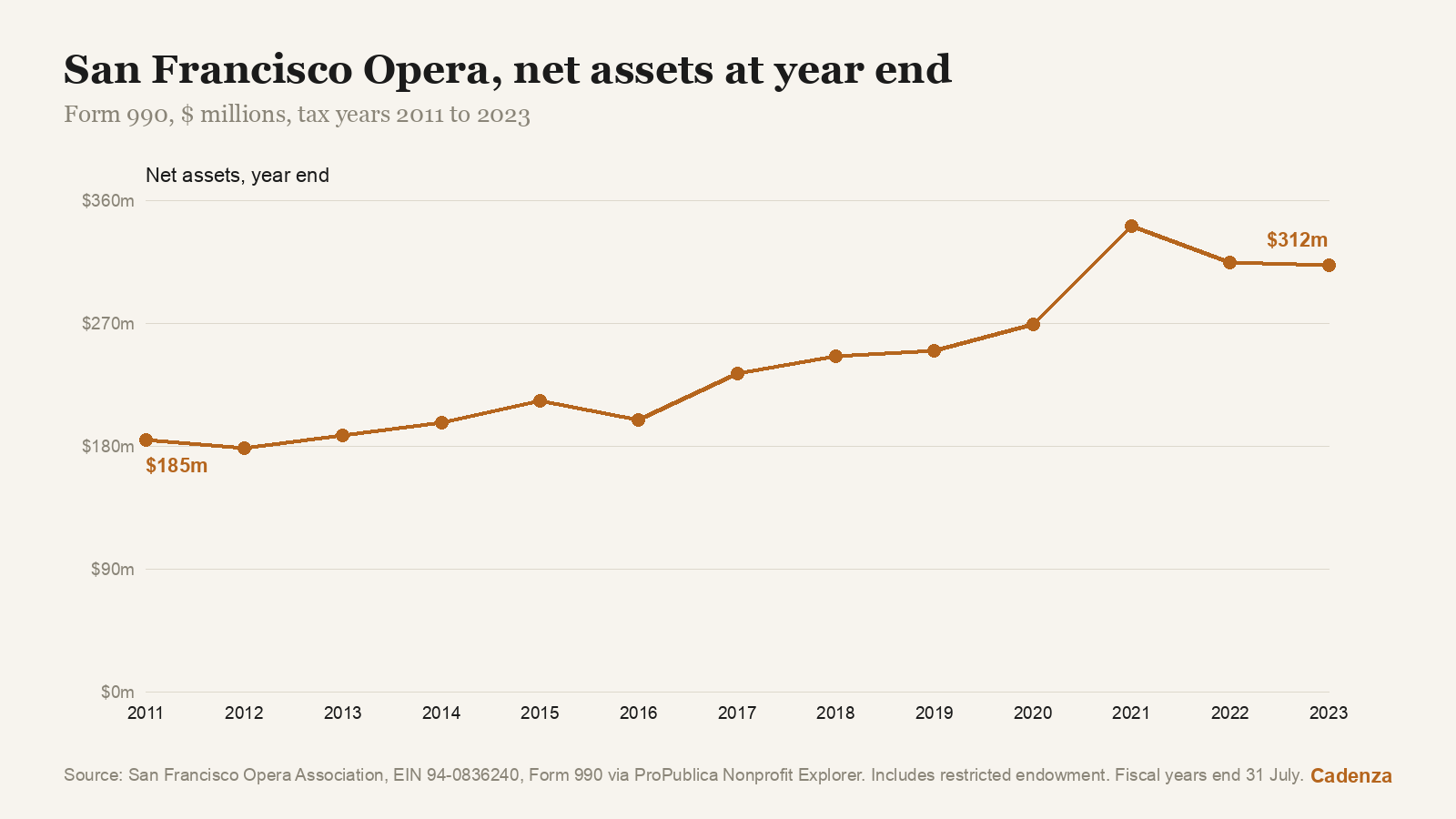
Net assets rose from $184.5 million to $312.4 million. That is a 69 per cent increase across the period, including the pandemic. In the 2021 tax year, when the orchestra’s rate had been cut by half and then by 42 per cent, net assets reached $340.9 million, the highest in the series. Much of that is restricted endowment, and an endowment cannot be spent as if it were cash. But it is the same balance sheet the company points to when it describes itself as a stable institution to donors, and it is the balance sheet a $15 million operating gap sits inside.
Officer compensation rose from $1.83 million to $2.48 million. A 35 per cent increase over twelve years, and the highest figure in the series is the most recent one. In the 2020 and 2021 tax years, which span the shutdown and the orchestra’s deepest cuts, the officer line was $2.21 million and $2.33 million, below the $2.39 million of 2019 but nothing like the halving the musicians absorbed. The line aggregates officers, directors, trustees and key employees, so it cannot show what any individual gave up.
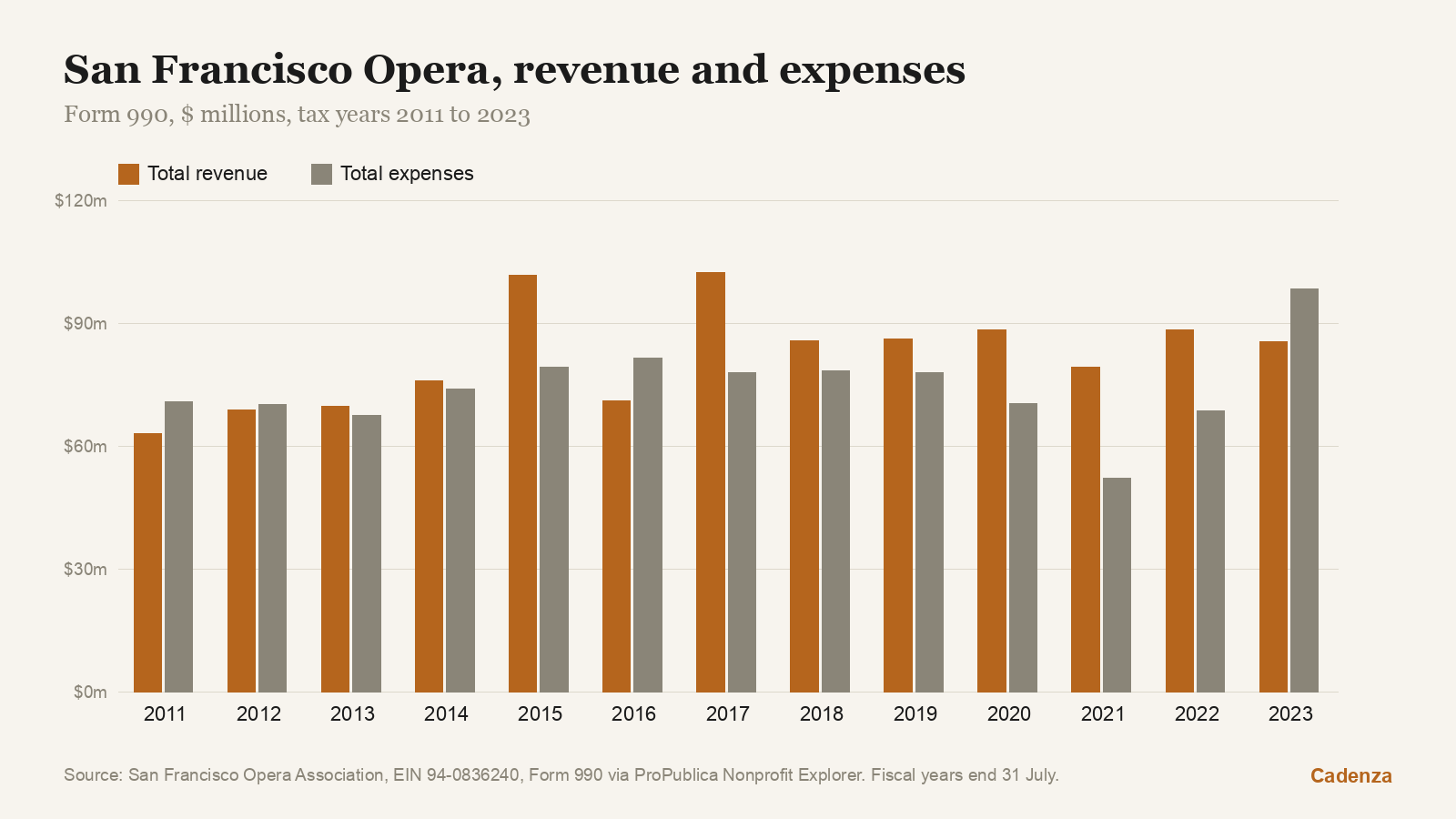
The 2023 tax year shows expenses of $98.4 million against revenue of $85.3 million. That is a $13 million shortfall, consistent with the $15 million structural deficit the company now cites. It is the centennial season of 2022–23, a year in which the orchestra’s rate was still 17 per cent below scale under the pandemic revision; full restoration came the following season. The deficit reappeared before the orchestra’s pay did. The 2021 tax year, when expenses fell to $52.2 million, is the counter-evidence. That year the company’s revenue exceeded its expenses by $27 million. The house was dark for the whole of it.
Six operas where there were twelve
The musicians’ letter says the company mounted twelve productions a season in 2008. It now mounts six, and the 2026–27 season will be the third consecutive six-opera season, which the Chronicle described as the company's new normal when the season was announced. Shilvock's stated reason was the structural imbalance in the arts sector, where costs rise faster than income, which he said had prevented the company from restoring the season to eight productions.
The musicians' answer, in their letter, is that repeated cuts to the number of productions have not solved the company's financial problems, and that they want a partnership with management to expand rather than reduce: more performances, longer runs, audience-growth initiatives.
Both sides are describing the same curve from opposite ends. Fewer productions mean fewer performances to sell, which means less ticket revenue, which the company then cites as the reason it cannot afford more productions. An orchestra on a reduced season cannot earn its way out of a reduced season. It can only be paid less for it.
What a 20 per cent cut actually buys
The company has not published the orchestra's total payroll, so the size of the saving cannot be computed from outside. What can be computed is whether it is the right size for the problem.
For a section musician on the expired contract’s guaranteed minimum of $118,326.75, a 20 per cent cut would be roughly $23,700 a year, and the union has said publicly that the base was already trailing inflation.
For the company, the audited FY2024 statements put production, music and artistic costs together at $67.5 million: 77 per cent of all operating expenses. The orchestra is one line inside that figure. For a 20 per cent orchestra cut to close a $15 million gap on its own, the orchestra's payroll would have to be $75 million, more than the company's entire artistic budget. It is not, and it cannot be.
So whatever the proposal saves, it cannot by itself close the deficit. The orchestra’s is the contract that happens to be open now, and the company says it has sought comparable changes from all of its employees, artists and labour organisations. The Huang gift, at $5 million a year, is worth a third of the stated gap on its own.
What can responsibly be said now
Four facts are documented. The agreement expired on 31 July. The musicians have stated they will not open the season unless a contract is agreed first. A mediator is in the room. The fundraiser has moved. The percentages are each side's characterisation of a document neither has published.
Last month the Boston Symphony's musicians and management extended an expiring agreement by 48 hours and reached a deal inside the window. San Francisco's agreement expired five weeks ago. There is no window left, only a date.
The question
In 2020 the company said its financial model was impossible, and the orchestra paid for that impossibility with half its income. Six years later the model is unchanged, the season is half what it was in 2008, the balance sheet is $128 million larger than it was in 2011, the officer line is at its highest in the thirteen years of filings ProPublica has extracted, and the company has returned to the orchestra with a proposal the musicians value as another fifth and the company describes as a freeze.
The question for the San Francisco Opera's board is not whether the deficit is real. It is why, in an institution with $330 million in net assets, a $5 million annual gift, a doubling of its largest donors and six sold-out productions, the proposal on the table asks the people who play the music to hold still for five years while the deficit is resolved around them.
Sources: San Francisco Chronicle, 27 August 2026, via Yahoo News; OperaWire, 28 August 2026; Slipped Disc, 28 August 2026; Moto Perpetuo, 28 August 2026; OperaWire, 1 September 2026; International Musician, 1 November 2020; San Francisco Classical Voice, 1 September 2026 and its earlier reporting on the 2020 contract revision, the 2024 opening night and the restored base; OperaWire, 7 September 2026; San Francisco Opera Orchestra negotiations updates; San Francisco Opera press release, 1 September 2026; San Francisco Chronicle reporting on the 2026–27 season announcement; ProPublica Nonprofit Explorer, EIN 94-0836240; San Francisco Opera Association audited financial statements, year ended July 2024; Cadenza, 14 August 2026.
Cover photograph: The stage of the War Memorial Opera House, San Francisco. Andreas Praefcke, public domain, via Wikimedia Commons.
Comments
Sign in to join the discussion.