This is an editorial analysis — commentary built on the Federal Court of Australia's published judgment in Gillham v Melbourne Symphony Orchestra Pty Ltd [2026] FCA 891, the court's public online file, trial reporting by ABC News and The Guardian, the MSO's own press releases and annual reporting, Limelight, the Associated Press, The Times and The Strad, alongside institutional records for every precedent cited. Where we draw conclusions we say so; where we cite facts we number them against the 42-source record at the end. One boundary governs everything below: the underlying allegations Jayson Gillham made about Israel and journalists in Gaza were not adjudicated by the court, and this article does not adjudicate them either. Jayson Gillham and the Melbourne Symphony Orchestra are each offered unedited space to respond.
If you read nothing else — the whole thing in one breath.
On 10 July 2026, the Federal Court of Australia dismissed pianist Jayson Gillham's case against the Melbourne Symphony Orchestra — producing the rarest thing in a quarter-century of politics colliding with the classical stage: a fully litigated judgment. The court vindicated one narrow principle: a presenter controls its own stage, and acting over the unauthorized use of that stage is not unlawful discrimination against political belief. Everything else in the record convicts the MSO's management: 3 complaints about Gillham's remarks became 487 complaints about the cancellation; a promised independent review shrank until it was contractually forbidden from finding anyone responsible; the musicians voted no confidence; the managing director left; and the crisis year closed with a ≈A$3.3 million total deficit the orchestra must never pretend was Gillham's bill alone.
Then we tracked 17 precedents across 25 years — Barenboim's Wagner encore, Zimerman's Disney Hall speech, Lisitsa's cancelled Rachmaninoff, Gergiev, Netrebko, the 20-year-old Malofeev, and the mirror image of them all: Ghent demanding an Israeli conductor prove his politics before he could appear. The pattern is brutal and consistent. The artists' careers mostly survived. The institutions absorbed the damage. And the rule that emerges is the one this industry keeps refusing to write down: an artist may not commandeer a presenter's stage, and a presenter may not commandeer an artist's conscience.
| Figure | What it represents |
|---|---|
| 3 → 487 | Complaints about the remarks vs. about the cancellation |
| [2026] FCA 891 | Judgment for the MSO, 10 July 2026 |
| ≈A$3.3M | MSO FY2024 total deficit — not a Gillham-only bill |
| 17 / 25 yrs | Precedents tracked across classical music's culture wars |
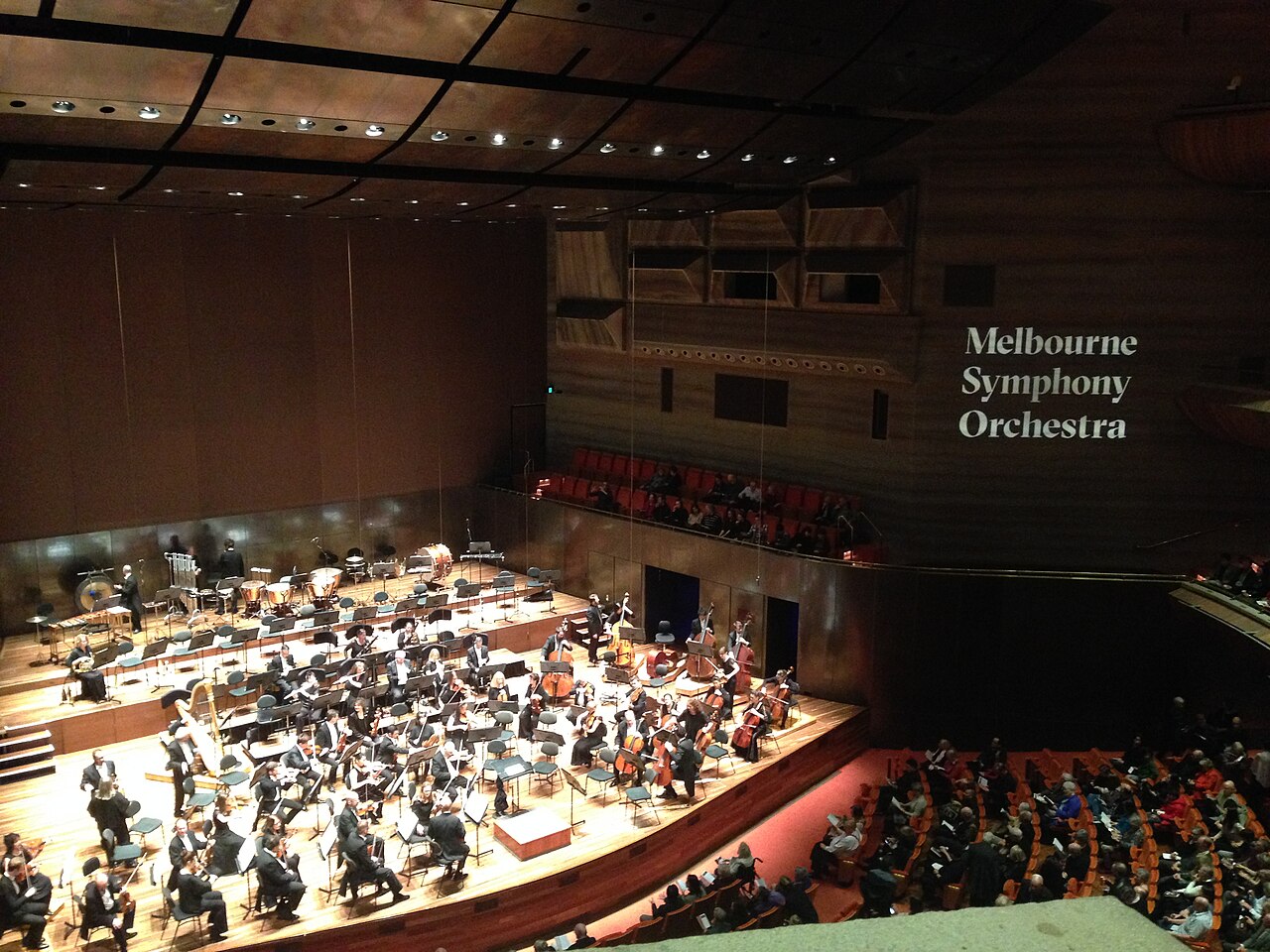 The Melbourne Symphony Orchestra in Hamer Hall — the stage at the center of one of the only fully litigated judgments in classical music's 25-year culture war. Photo: Philip Mallis, CC BY-SA 2.0, via Wikimedia Commons.
Jayson Gillham lost his Federal Court case against the Melbourne Symphony Orchestra. The judgment supports a rule the arts business urgently needs: an artist may not commandeer a presenter's stage, and a presenter may not commandeer an artist's conscience. We tracked the ruling, the money, the governance implosion, and 25 years of classical music's political double standards — including where the artists, institutions and works ended up.
By the Cadenza Editorial Board · 21 July 2026
Editorial note: This analysis is based on records available through 21 July 2026. The Federal Court's public online file was current to 16 July 2026 and displayed no appeal filing at press time.
The verdict before the verdict
There are two ways politics takes over a concert hall.
The first begins when an artist accepts an institution's invitation, takes possession of its stage, and then changes the event without agreement. The concert becomes a vehicle for a speech, accusation, dedication or political intervention the presenter did not knowingly choose to host.
The second begins when the institution looks beyond the concert and turns an artist's nationality, associations, offstage speech, political silence or refusal to recite an approved position into a condition of employment.
Abuse one: the artist commandeers the stage
Undisclosed intervention. The host bears the contractual, security, reputational and financial consequences.
Abuse two: the institution commandeers the conscience
Offstage speech punishment, nationality guilt, compelled denunciation or silence treated as misconduct.
The first is a problem of stage control. The second is a problem of ideological control. Classical music has spent years pretending they are the same. They are not.
Jayson Gillham's Federal Court defeat is the moment the distinction became impossible to avoid. Gillham had every right to criticize Israel, advocate for Palestinian journalists, produce benefit concerts and make his case anywhere he controlled the platform. What he did not automatically possess was the right to turn a Melbourne Symphony Orchestra recital into a geopolitical intervention carrying the MSO's name, audience, donor relationships, contractual obligations and security responsibilities.
But the Melbourne Symphony's legal victory does not make its management heroic. The organization removed Gillham, described the removal as an error, sought a path back, cancelled the full concert on security advice, lost the confidence of its musicians, lost its managing director, narrowed the review it had promised, renewed its board and spent almost two years in litigation. [3, 7, 6]
The MSO was right about one principle: it controlled its stage. It was disastrous at almost everything required to exercise that control responsibly.
What the Federal Court actually decided
The court did not decide whether Gillham's claims about Israel and journalists in Gaza were true. Justice Graeme Hill expressly declined to enter that dispute. It did not declare concert halls politics-free, abolish artists' expressive interests or create a universal rule allowing every presenter to punish every political remark.
This was a Fair Work general-protections and adverse-action case involving an independent contractor. Gillham relied on a claimed workplace right connected to political belief under Victorian law. The court rejected that legal construction, treated the orchestra's actions separately, and found that the political content of Gillham's belief was not a substantial and operative reason for the MSO's conduct. The accepted reason was the anticipated effect on the orchestra's business and reputation. [1, 2, 3]
The judgment established:
- Gillham's claims were dismissed.
- The state-law right did not operate as the claimed federal workplace right.
- The initial cancellation was adverse action; the other alleged acts were not treated identically.
- Political belief was not found to be a substantial and operative reason.
- The court accepted evidence of a practice requiring approval for sensitive political statements from a host's stage.
- The court found the MSO would have acted similarly toward equivalent pro-Israel advocacy with comparable anticipated consequences.
The judgment did not establish:
- Whether Gillham's underlying claims were true or false.
- That artists possess no expressive rights.
- That concert halls must be apolitical.
- That every unapproved statement justifies cancellation.
- That the MSO's policy was perfectly consistent.
- That management handled the crisis competently.
The defensible legal conclusion is narrower and stronger than the slogan: in this case, the court accepted that a presenter could act over an artist's unauthorized use of its stage without unlawfully discriminating against the artist's political belief.
The official public-interest file was last updated on 16 July 2026 with judgment and post-judgment orders. Gillham said he was considering the findings. [1, 4]
What was disclosed — and what was not
The work at the center of the dispute was Witness, a short composition by Connor D'Netto dedicated to journalists killed in Gaza. Precision matters: it should not be described as a composition Gillham secretly inserted at the final second. The MSO described it as a late addition that was performed. Gillham nevertheless acknowledged that he initially withheld his plan because he feared the orchestra might refuse it. The political remarks accompanying the work were not disclosed or approved in advance. [3]
His remarks did not merely explain tempo, harmony or the composer's biography. He accused Israel of targeted assassinations of journalists and characterized those killings as war crimes designed to prevent the documentation of other alleged crimes. The court did not adjudicate those allegations. That is precisely why advance disclosure mattered: the more serious and disputed the accusation, the less plausible the claim that institutional consent was irrelevant.
A guest artist does not acquire the orchestra's editorial voice merely by sitting at its piano. The artist supplies the performance; the institution supplies the event. Both possess legitimate interests. Neither can erase the other.
The MSO had authority. It did not have a process.
Trial reporting showed how quickly the orchestra's internal response became emotional and improvised. A senior executive discussed cancellation before receiving the exact text of Gillham's remarks. That evidence did not prove political discrimination — the court rejected the claim — but it undercut any suggestion that management calmly applied a mature, pre-existing protocol.
The public sequence was equally unstable:
| Date | What happened |
|---|---|
| 11 Aug 2024 | Gillham's undisclosed remarks from an MSO-presented stage |
| Aug 2024 | Next appearance cancelled; removal then called an error; full concert cancelled on security advice |
| 17 Aug 2024 | Musicians vote no confidence in management [7] |
| 26 Aug 2024 | Managing director steps down; Peter Garrett appointed to lead a broad review [8] |
| 29 Nov 2024 | Garrett out; KPMG governance review; board overhaul; Richard Wigley incoming CEO [6, 5] |
| Feb–Jul 2025 | Edgar Myer becomes chair; five new non-executive directors [10, 11] |
| 30 Aug 2025 | Protesters halt the MSO's BBC Proms concert, citing the Gillham dispute [42] |
| 10 Jul 2026 | After a three-week trial, judgment for the MSO — [2026] FCA 891 [2, 3] |
The complaint count captures the backlash without deciding the merits. The court heard of one written and two verbal complaints about the original remarks, followed by 487 complaints concerning the cancellation. Those numbers are not polling. They show that management expanded a contained stage dispute into a far larger institutional controversy. [3]
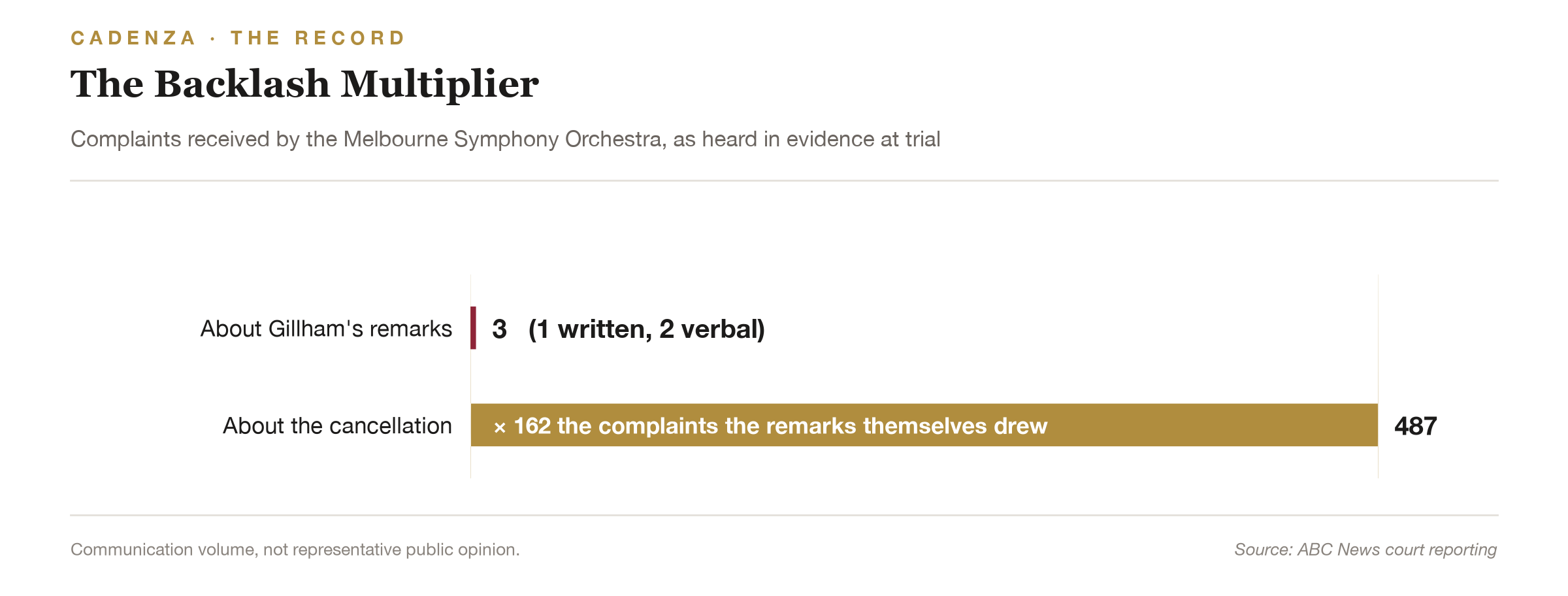 The backlash multiplier, drawn from evidence heard at trial: the cancellation generated 162 times more complaints than the remarks it punished. Communication volume, not representative polling.
The musicians' no-confidence vote was not merely a referendum on Gillham. Their complaints included poor communication, insufficient accountability, declining morale and decisions imposed without meaningful consultation. The incident did not create every internal problem; it exposed them. [7]
The review story is especially revealing. Peter Garrett was initially announced to lead a broad external review of policy, freedom of expression and the events. Delays ended his involvement. KPMG proceeded under terms stating that it would make no findings about any event or person and would direct its recommendations solely toward governance enhancement. [8, 6, 5]
A governance review can improve systems. A review designed not to determine responsibility cannot answer who made the critical decisions or whether their judgment was sound.
The financial year in which the crisis exploded
The MSO's 2024 reporting showed an underlying operating deficit of approximately A$1.94 million and a total deficit of approximately A$3.3 million. Ticket sales were reported down 11%. The organization reported approximately A$689,000 in case-management and response costs and A$954,000 in restructuring and separation costs. [12]
| Metric (MSO FY2024) | Figure | Caution |
|---|---|---|
| Total deficit | ≈ A$3.3 million | Not the cost of the Gillham case alone |
| Underlying operating deficit | ≈ A$1.94 million | Underlying label matters |
| Case management and response | ≈ A$689,000 | Broader than a single legal bill |
| Restructure and separation | ≈ A$954,000 | May cover several personnel changes |
| Ticket sales | −11% | No single-cause attribution |
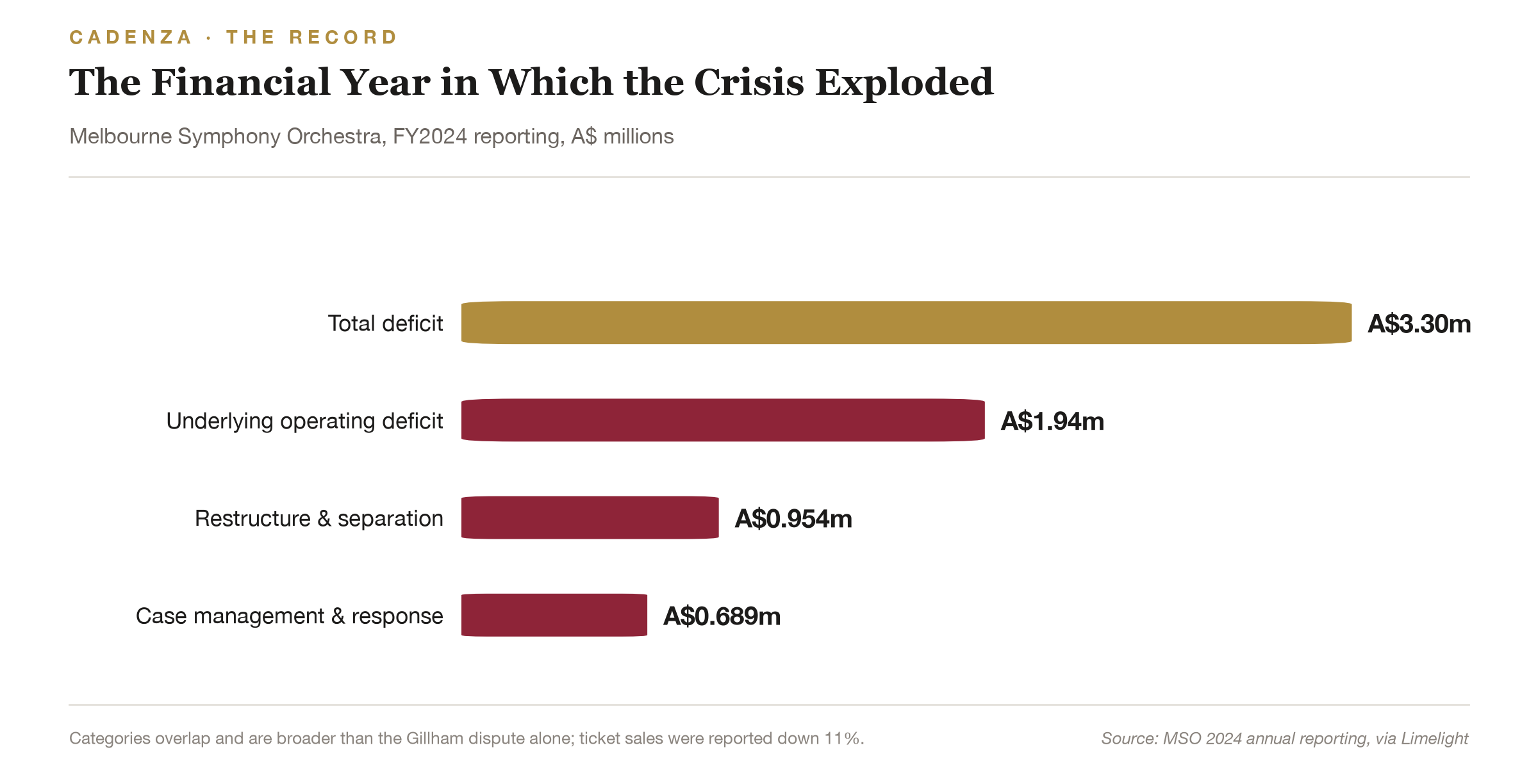 The financial year in which the crisis exploded. These categories overlap and are not a clean calculation of the Gillham dispute alone — which is precisely why the propaganda version of this chart should not be drawn.
Those numbers must not be turned into propaganda. The A$689,000 category is broader than a single legal bill. The A$954,000 may cover multiple employees and restructuring decisions. Ticket performance also reflected inflation and structural pressure across the arts sector. The correct conclusion is not "Gillham cost the MSO A$3.3 million." It is that a financially difficult year became inseparable from crisis response, leadership change and litigation.
The institution has since installed Richard Wigley as CEO, Edgar Myer as chair, added five non-executive directors and announced a 120th-anniversary season with 29 commissions, including 26 world premieres, while freezing ticket prices. [5, 10, 11, 9]
The MSO survived. The unresolved question is whether it learned the difference between possessing authority and using it competently.
The historical tracker: not one culture war, but five
Gillham's case is not the first time politics entered a classical stage — classical music has a cancel culture, and we have mapped it before. But this is one of the very few episodes to end in a fully litigated judgment. To understand what it does — and does not — justify, Cadenza tracked major documented precedents across 25 years.
| Year | Case | Category | Institutional response | Where now |
|---|---|---|---|---|
| 2001 | Barenboim / Wagner | Artist alters event | Audience debate; performance proceeds | Conducting the Divan, Aug 2026 |
| 2001 | BSO / Klinghoffer | Repertoire withdrawal | Cancelled | Opera revived in Florence, 2026 |
| 2006 | Deutsche Oper / Idomeneo | Security retreat | Reinstated with security | Production precedent endures |
| 2009 | Zimerman / Los Angeles | Artist stage speech | Presenter lets recital continue | Paris recital, Oct 2026 |
| 2010 | Jerusalem Quartet / Wigmore | Protest disruption | Protesters removed; concert continues | Quartet touring |
| 2011 | Israel Philharmonic / Proms | Protest disruption | Broadcast suspended; hall concert continues | Institution continues |
| 2013 | Kennedy / Proms | Stage speech + broadcast | Live radio kept; TV edit removed | 39-date UK tour, 2026 |
| 2014 | Met / Klinghoffer | Distribution control | Stage retained; cinema relay cancelled | Opera revived in Florence |
| 2015 | Lisitsa / Toronto | Offstage-speech cancellation | Paid but did not perform | Touring internationally |
| 2017 | Dudamel / Venezuela | State retaliation | Youth-orchestra tour lost | NY Philharmonic director, 2026 |
| 2022 | Gergiev | Political-association cancellation | Western roles lost | Mariinsky + Bolshoi |
| 2022 | Netrebko | Political association / contract | Met relationship ended | Major European dates |
| 2022 | Malofeev | Nationality / loyalty pressure | Engagements lost | Salzburg, Sun Valley, Lucerne |
| 2024 | Gillham / MSO | Artist stage speech | Cancelled; MSO wins court case | Independent Australia tour |
| 2025 | Volkov / Proms | Artist stage speech | No reported sanction | CBSO principal guest |
| 2025 | Shani / Ghent | Compelled political clarity | Concert cancelled | Munich chief conductor |
| 2025 | MSO / Proms protest | Protest disruption | Performance resumes | MSO under renewed leadership |
The tracker is not a claim to have found every local protest, private settlement or unindexed cancellation. It is a map of the cases that most clearly establish the boundaries.
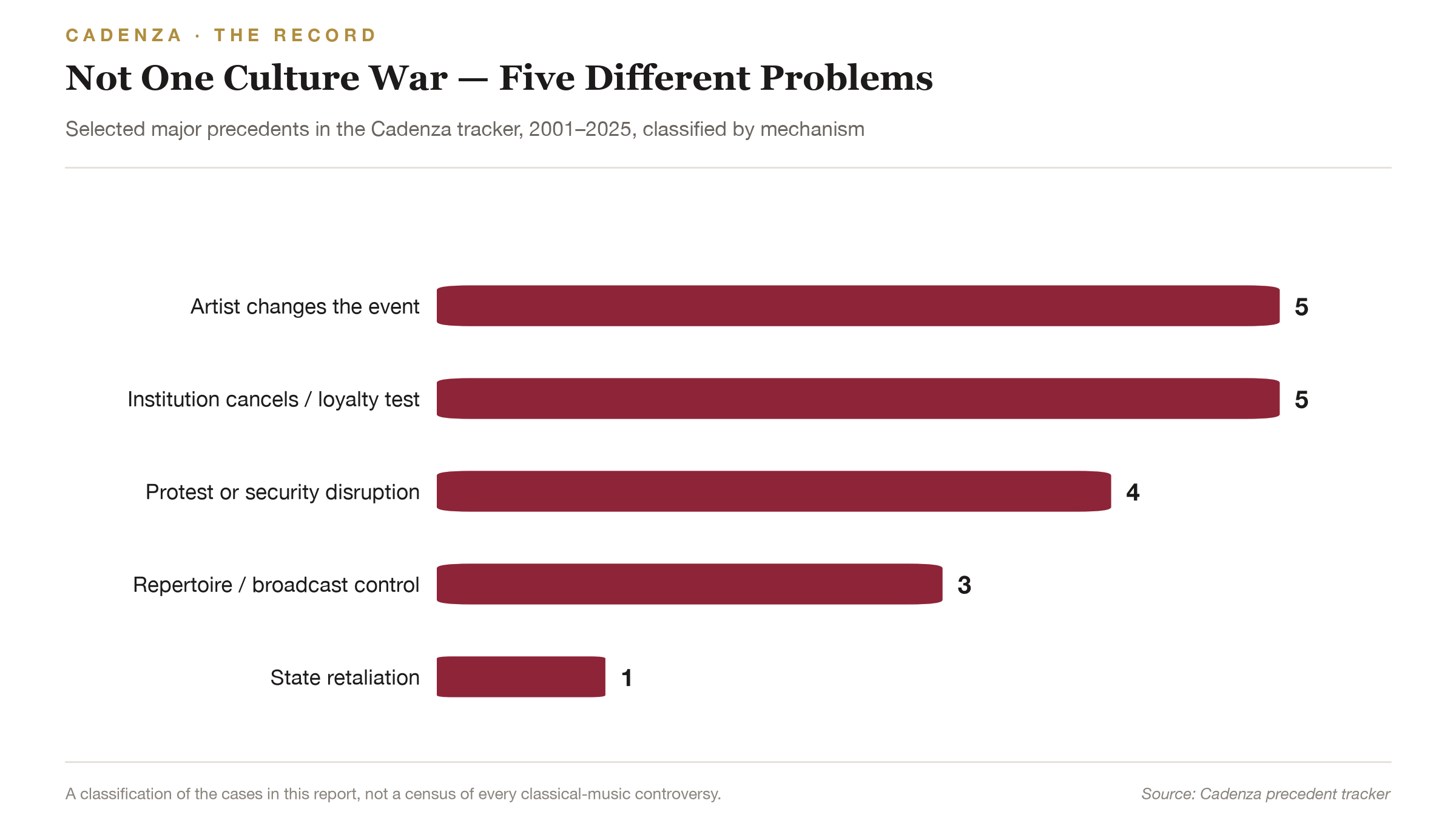 Not one culture war — five different problems. A classification of the selected cases in this report, not a census of every classical-music controversy.
1. Daniel Barenboim and Wagner in Jerusalem — 2001
Barenboim had agreed not to include Wagner in the announced Israel Festival program. After completing the agreed concert, he proposed a Wagner encore and opened a long argument with the audience. Some listeners left; most remained. He told the audience to direct anger at him rather than the orchestra or festival. [14]
Why it matters: Barenboim crossed an institutional boundary, but he completed the contracted program, disclosed the departure openly, offered objectors a chance to leave and assumed personal responsibility. That does not make the decision unobjectionable. It demonstrates alternatives to concealment.
Where now: Barenboim disclosed Parkinson's disease in 2025 and appears less frequently, but the West-Eastern Divan Orchestra lists him conducting four August 2026 concerts with Clara-Jumi Kang and Yo-Yo Ma. [15]
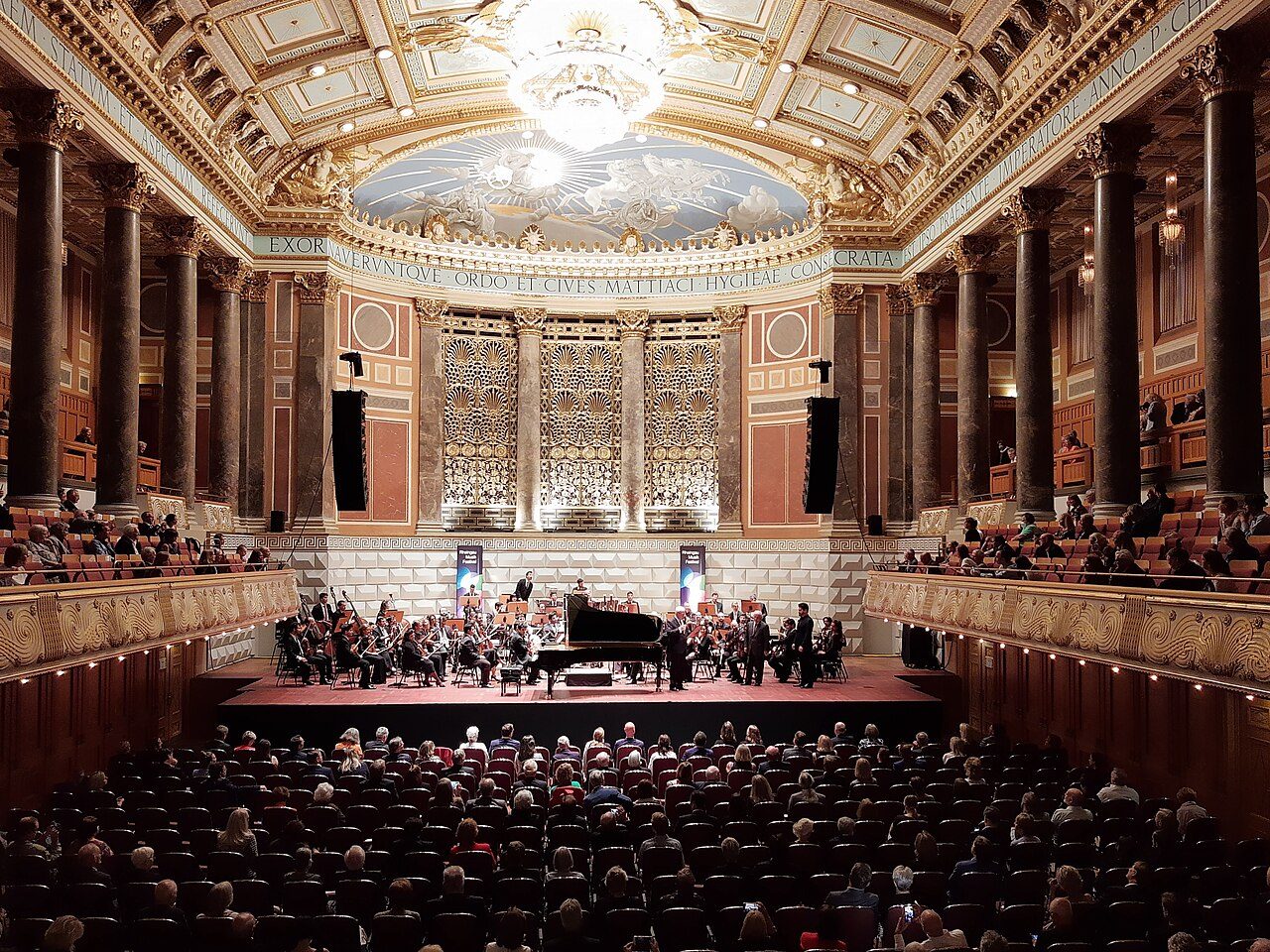 Barenboim with the West-Eastern Divan Orchestra — the ensemble he co-founded with Edward Said to seat Israeli and Arab musicians side by side. The man who broke the Wagner boundary in Jerusalem also built classical music's most enduring argument against loyalty tests. Photo: Gerda Arendt, CC BY-SA 4.0, via Wikimedia Commons.
2. The BSO, the Met and The Death of Klinghoffer — 2001, 2014, 2026
After September 11, the Boston Symphony — an institution now consumed by a governance crisis of its own — cancelled planned choruses from John Adams's The Death of Klinghoffer, influenced by the immediate context and the personal loss of a Tanglewood Festival Chorus member. Adams objected that management was protecting audiences from difficult art. [16]
In 2014 the Metropolitan Opera kept staged performances but cancelled the global Live in HD cinema transmission, separating local performance from worldwide institutional amplification. [26]
Why it matters: The cases were not artist hijackings. Institutions themselves withdrew or limited agreed work under external pressure. They show that editorial control includes programming and distribution — and that such control can still be cowardly or overbroad.
Where now: In April 2026 Florence's Maggio Musicale Fiorentino opened its festival with a new Klinghoffer production directed by Luca Guadagnino. Controversial work often outlives the managers who try to make it disappear. [17]
3. Deutsche Oper Berlin and Idomeneo — 2006
Deutsche Oper cancelled a production of Mozart's Idomeneo because an added scene showing the severed heads of Muhammad, Jesus, Buddha and Poseidon was considered a security risk. After political criticism and a new assessment finding no concrete danger, performances were reinstated under heightened security. [18]
Why it matters: Security is a real duty, but speculative threat cannot become automatic veto power. The sequence should be assess, mitigate, secure and cancel only when performance cannot reasonably proceed.
4. Krystian Zimerman in Los Angeles — 2009
Before the final work of a Walt Disney Concert Hall recital, Zimerman condemned American military policy and plans for a missile-defence shield in Poland. Roughly 30 to 40 listeners walked out; others booed or cheered. The presenter let the recital continue. [19]
Why it matters: Non-intervention is an institutional choice. A presenter can let the artist speak and allow the audience to judge. Tolerance in one hall, however, does not create an artist's entitlement against every other host.
Where now: Zimerman remains one of the world's most selective pianists and is scheduled for an October 2026 recital at the Philharmonie de Paris. [20]
5. The Jerusalem Quartet at Wigmore Hall — 2010
Pro-Palestinian activists bought tickets and disrupted a live BBC Radio 3 broadcast of the Jerusalem Quartet. Protesters were removed, the broadcast was interrupted and the quartet completed the concert. [21]
Why it matters: Protest outside is expression. Buying access to prevent everyone else hearing the concert is coercive disruption. A ticket provides a seat, not a veto.
Where now: The Jerusalem Quartet remains active internationally and maintains a current concert schedule. [22]
6. The Israel Philharmonic at the BBC Proms — 2011
The BBC refused demands to cancel the Israel Philharmonic's appearance. Coordinated protesters repeatedly interrupted the performance; security removed demonstrators, Radio 3 suspended the live broadcast, and the orchestra continued in the hall. [23]
Why it matters: The BBC protected the physical performance while acknowledging that the broadcast had become unusable. Stage control here served artistic freedom rather than suppressing it.
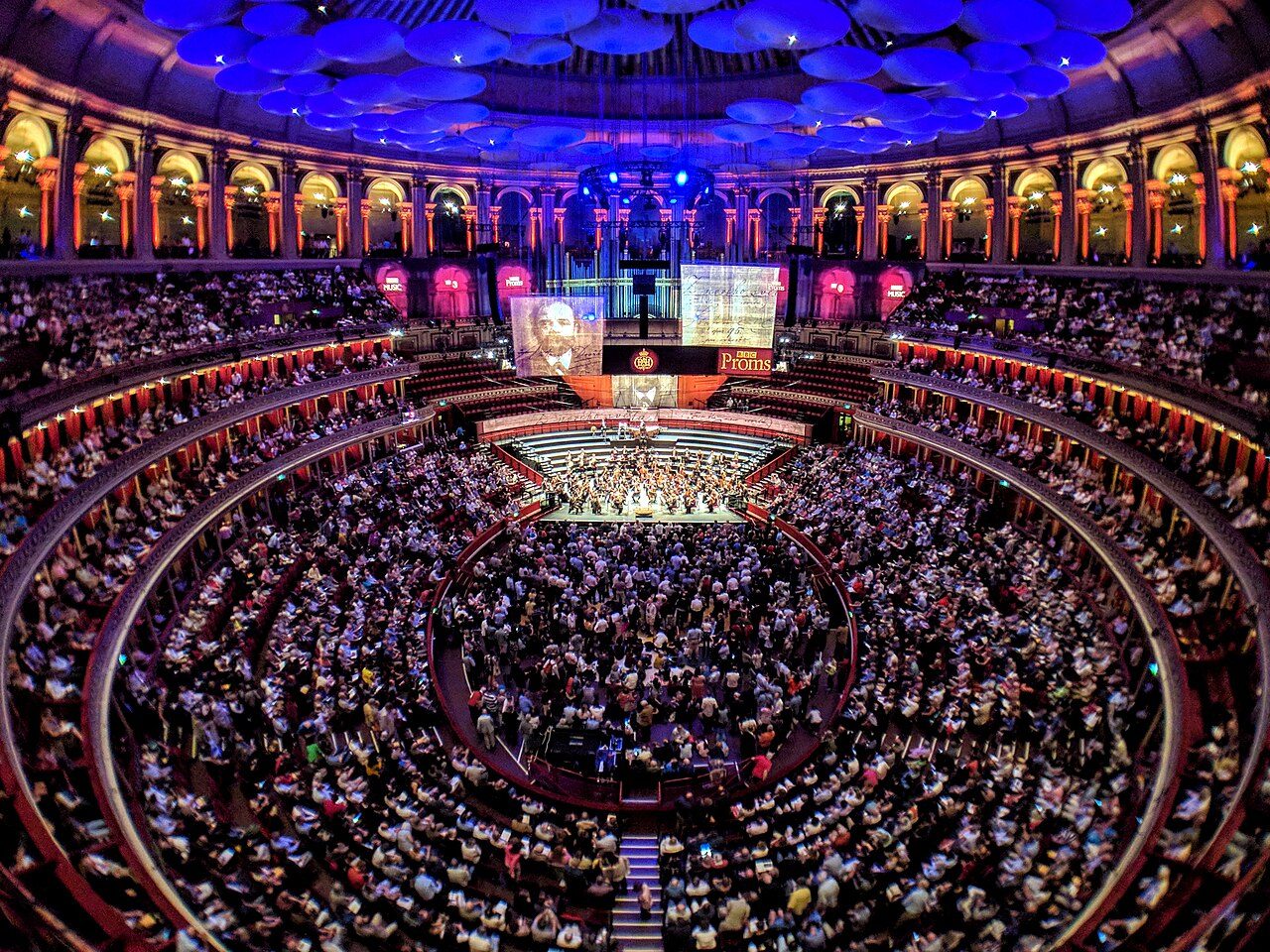 The Royal Albert Hall during the BBC Proms — the stage where the Israel Philharmonic played through coordinated disruption in 2011, where Nigel Kennedy tested the broadcast boundary in 2013, and where the MSO's Gillham crisis followed it in 2025. Photo: Ed g2s, CC BY-SA 4.0, via Wikimedia Commons.
7. Nigel Kennedy at the BBC Proms — 2013
After playing with the Palestine Strings, Kennedy made a remark invoking "apartheid" in connection with Israel. It went out live on Radio 3; the BBC removed it from a delayed television broadcast, saying it was outside the editorial remit of the Proms. [24]
Why it matters: Permission, endorsement, rebroadcast and permanent distribution are separate editorial decisions. An institution need not treat the live moment and every later use identically.
Where now: At 70, Kennedy undertook a 39-date 2026 UK tour, his first large-scale tour in more than 15 years. [25]
8. Valentina Lisitsa and the Toronto Symphony — 2015
The Toronto Symphony removed Lisitsa from Rachmaninoff performances because of pro-Russian and anti-Ukrainian-government social-media activity. The orchestra said its stage should be for great musical works rather than offensive opinions. Lisitsa said she had planned no political remarks during the concert and was paid despite being removed. [27]
Why it matters: "Our stage is not a political platform" is coherent when it governs conduct onstage. It becomes ideological employment control when used to punish lawful speech elsewhere that would not alter the concert.
Where now: Lisitsa continues to list international performances on her official schedule. [28]
9. Gustavo Dudamel and Venezuelan state retaliation — 2017
After Dudamel criticized violence and repression in Venezuela, President Nicolás Maduro attacked him publicly and a planned United States tour by the National Youth Orchestra of Venezuela was cancelled. The power came from a state-connected system capable of punishing dissent by controlling musicians and travel. [29]
Why it matters: This is much closer to political censorship than a private presenter declining undisclosed content. The word "censorship" should not be stretched until state retaliation and editorial control become indistinguishable.
Where now: Dudamel begins his inaugural 2026-27 season as Music and Artistic Director of the New York Philharmonic in September 2026. [30]
10. Gergiev, Netrebko and Malofeev after the invasion of Ukraine — 2022
Western institutions severed relationships with Valery Gergiev — whose case Cadenza has profiled at length — after he refused demands to distance himself from Vladimir Putin and the invasion. The Metropolitan Opera ended its relationship with Anna Netrebko after requiring a repudiation of her public support for Putin. Canadian presenters cancelled the 20-year-old Russian pianist Alexander Malofeev despite his anguish over the war and concern that stronger statements could endanger relatives. [31, 33, 35]
Why it matters: These are not morally identical cases. Gergiev was a senior institutional leader with a long public association with Putin. Malofeev was a young artist treated as politically suspect partly because of nationality. Netrebko's contractual rights and political history created a third, litigated middle ground.
A defensible policy can consider the conduct and representative role of a major institutional leader without turning every Russian passport into evidence of complicity. Nationality alone is never enough; silence is not automatically endorsement.
Where now: Gergiev leads the Mariinsky and Bolshoi in Russia. Netrebko returned to the Royal Opera House and lists 2026 engagements in Verona, Naples and Barcelona. Malofeev's official schedule includes Salzburg, Sun Valley and Lucerne in August 2026. [32, 34, 36]
11. The Jerusalem Quartet and Concertgebouw — 2024
Amsterdam's Concertgebouw initially moved or withdrew Jerusalem Quartet concerts amid announced demonstrations and security concerns. A performance later proceeded with adjusted logistics and heightened security. [37]
Why it matters: The institution found an alternative to surrendering the calendar. When Israeli or Jewish artists face threats, the default should be to manage the threat before rewarding it with veto power.
12. Jayson Gillham and the Melbourne Symphony — 2024 to 2026
Gillham made undisclosed political remarks from an MSO-presented stage, the orchestra reacted chaotically, and the dispute ended in a three-week trial and a judgment for the MSO. The court accepted stage-control and institutional-consequence reasoning, not a general ban on political expression. [1, 3]
Where now: Gillham returned to Australia for a July 2026 independently produced two-piano tour with Palestinian-Jordanian pianist Iyad Sughayer. The MSO is under new executive and board leadership and is presenting its 120th-anniversary season. [13, 9]
13. Ilan Volkov at the BBC Proms — 2025
Israeli conductor Ilan Volkov delivered a prepared statement criticizing his government's conduct in Gaza, discussing Palestinian suffering and Israeli hostages, and calling for action. Reporting described both heckling and applause. Public sources reviewed for this report did not establish whether the intervention was disclosed to the BBC or orchestra in advance. [38]
Why it matters: If approved, it was curated programming and materially different from Gillham. If unapproved, the BBC made a different discretionary choice. Different responses do not prove discrimination, but unexplained differences invite suspicion.
Where now: Volkov becomes the City of Birmingham Symphony Orchestra's Principal Guest Conductor for 2026-29 and remains embedded in British orchestral life. [39]
14. Lahav Shani and the Ghent loyalty test — 2025
Flanders Festival Ghent cancelled a Munich Philharmonic concert under Israeli conductor Lahav Shani, referring to his leadership of the Israel Philharmonic and insufficient clarity about his distance from the Israeli government. The festival denied that nationality or personal integrity was the basis; officials and cultural figures condemned the decision as discriminatory. [40]
Why it matters: Shani is the mirror image of Gillham. Gillham sought freedom to speak without advance institutional approval. Ghent required an Israeli conductor to speak with sufficient political clarity as a condition of appearing. One seeks freedom from consent; the other imposes a loyalty test.
Where now: Shani begins as chief conductor of the Munich Philharmonic in September 2026 while remaining Music Director of the Israel Philharmonic. [41] Munich did not blink; the reputational cost of the loyalty test was absorbed by the festival that imposed it, not the conductor it targeted.
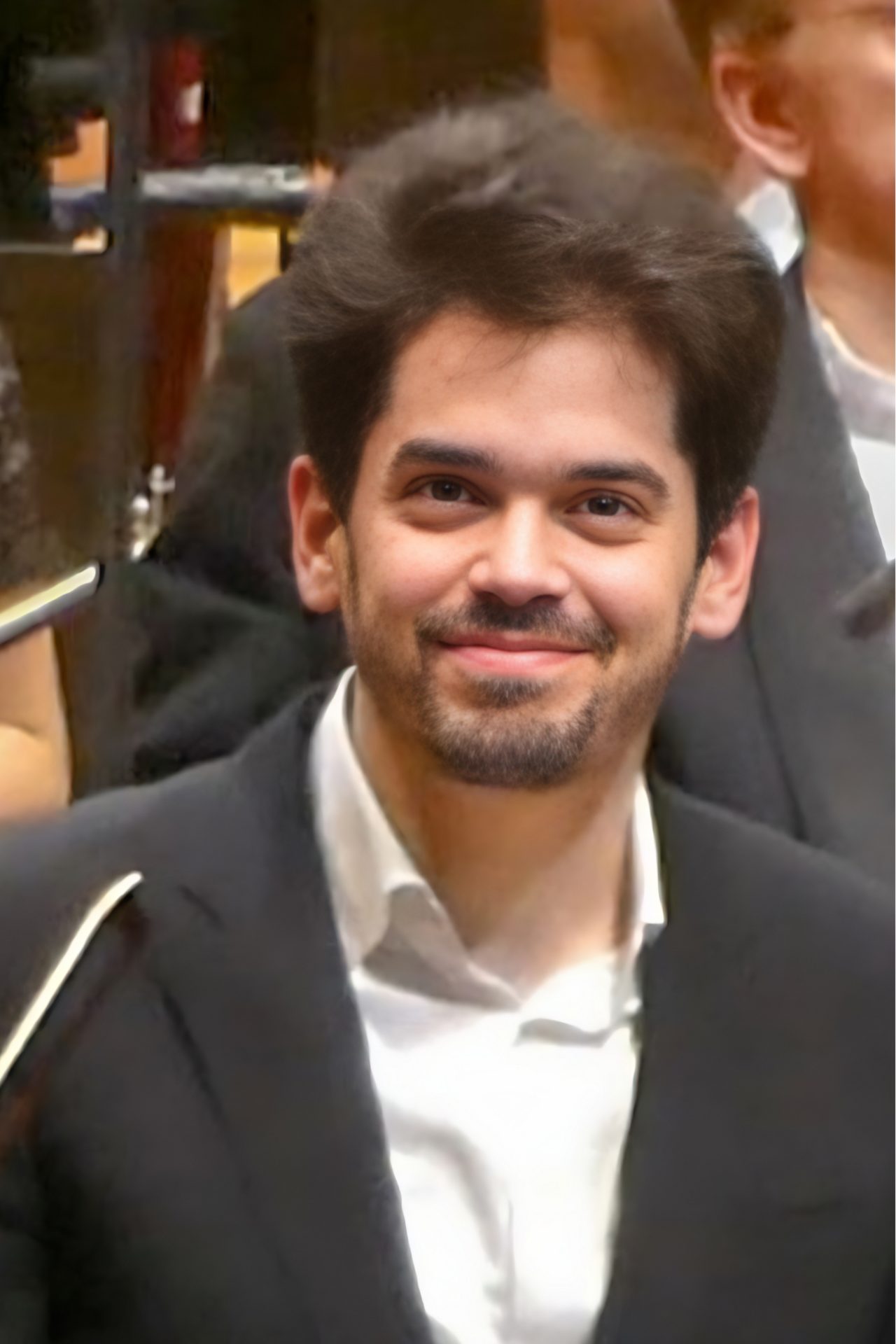 Lahav Shani at the Philharmonie de Paris, 2024. Ghent demanded he clarify his politics before he could conduct Mahler; Munich answered by putting him at the head of one of the world's great orchestras. Photo: Apollinaire, CC BY 4.0, via Wikimedia Commons.
15. The controversy follows the MSO to the Proms — 2025
During the MSO's 2025 BBC Proms appearance, pro-Palestinian protesters halted the concert for more than ten minutes and explicitly connected their demonstration to the Gillham dispute. [42]
Why it matters: A management decision intended to contain reputational risk became a transnational symbol. The institution did not merely fail to end the controversy; it carried it into another hall and another broadcast.
The brutal where-are-they-now pattern
The careers and works mostly survived. The institutions absorbed the reputational damage.
| Who | Where they ended up |
|---|---|
| Gillham | Lost at trial; returned with an independent Australian tour |
| MSO | New CEO, new chair, board renewal, 120th-anniversary season |
| Barenboim | Health-limited, but scheduled with the West-Eastern Divan in August 2026 |
| Zimerman | Still a rare-event pianist on major European stages |
| Kennedy | At 70, back on a 39-date UK tour |
| Lisitsa | Still touring, increasingly outside institutions that rejected her |
| Dudamel | Beginning the New York Philharmonic era |
| Gergiev | More powerful in Russia, much less present in the West |
| Netrebko | Absent from the Met, back across leading European stages |
| Malofeev | Touring major festivals after being judged politically at age 20 |
| Volkov | New CBSO principal guest conductor |
| Shani | Beginning in Munich, still leading the Israel Philharmonic |
| Jerusalem Quartet | Still touring despite recurring disruption campaigns |
| Klinghoffer | Revived in Florence as a festival centerpiece |
Cancellation frequently redistributes an artist's market rather than ending a career. The organization, meanwhile, is left with legal costs, confused policies, donor questions, divided musicians and a public record that outlives the executive who made the decision.
Israel and the politics of exceptional permission
There is a reason so many of these cases converge on Israel. The conflict is historically and emotionally overwhelming; it combines terrorism, war, civilian suffering, nationalism, antisemitism, anti-Arab racism, diaspora identity and competing narratives of survival.
Artists are not wrong to care. Institutions are not wrong to engage. But parts of the arts sector increasingly behave as though criticism of Israel occupies a special category in which ordinary consent rules may be suspended.
The implied argument is that the accusation is too urgent for advance approval, the audience's discomfort proves the speech's necessity, and institutional concern is censorship. Yet when an Israeli artist appears, the logic can reverse: silence becomes complicity, nationality becomes evidence, and employment becomes conditional on denunciation.
Stated plainly: much of the sector's loudest advocacy for artistic freedom found its limit at exactly the moment the artist on the stage was Israeli. The Jerusalem Quartet needed protesters removed to finish a concert. The Israel Philharmonic needed its broadcast suspended. Malofeev lost his engagements at 20, treated as suspect largely by nationality. Shani was handed a political questionnaire in place of a program. No coherent theory of artistic freedom produces those outcomes while simultaneously insisting that an unapproved accusation from a host's stage must be beyond consequence.
Gillham: I must be free to speak without advance institutional approval.
Ghent, to Shani: You may not appear unless your political position is sufficiently clear.
A viewpoint-neutral classical world rejects both propositions.
- An artist may criticize Israel.
- An Israeli artist is not required to denounce Israel to earn a stage.
- An institution may program Palestinian work and testimony.
- A guest may not secretly conscript that institution into advocacy.
- An orchestra may condemn Hamas terrorism and call for hostages' release.
- That does not grant unlimited power to punish every artist who criticizes the Israeli government.
- A presenter may mourn Palestinians killed in Gaza.
- That does not make every Israeli musician an envoy of the government.
Consistency is not silence. It is the same rule when the politics are reversed.
The policy every orchestra now needs
1. Disclose material interventions. Statements about active wars, governments, alleged crimes or elections require advance notice. Routine thanks and musical context do not.
2. Apply the same rule in reverse. Pro-Israel and pro-Palestinian speech, or pro- and anti-government speech, go through the same process.
3. Protect offstage freedom. Lawful speech elsewhere is presumptively the artist's own. A higher threshold may apply to continuing institutional leaders.
4. No loyalty oaths. Do not compel Russian, Israeli, Palestinian or any other artists to recite a politically approved declaration.
5. Use proportionate consequences. Clarification, disclaimer, discussion, broadcast editing and future-contract decisions exist between total permission and immediate cancellation.
6. Manage security before surrendering. Identify the threat, assess mitigation and cancel only when performance cannot reasonably proceed.
7. Executives obey the policy too. Management cannot issue selective political messages while claiming stage neutrality against artists.
The verdict
Jayson Gillham had free speech. He did not have a free Melbourne Symphony Orchestra stage.
The Melbourne Symphony had editorial authority. It did not have competent leadership of the crisis.
Barenboim crossed an agreed boundary but confronted the audience openly and assumed responsibility. Zimerman spoke and the presenter let the audience decide. Kennedy spoke live and the BBC edited the later broadcast. Lisitsa was punished for speech elsewhere. Malofeev was treated as politically contaminated by nationality. Gergiev lost Western leadership positions because of a long public political relationship. Netrebko became the subject of contracts, arbitration and litigation. Shani was required to prove political distance from his country. The Jerusalem Quartet and Israel Philharmonic faced protesters seeking to stop the music itself. Dudamel faced state retaliation.
These are not one controversy. They are distinctions the classical-music business has refused to articulate.
An artist may not commandeer a presenter's stage. A presenter may not commandeer an artist's conscience.
No secret interventions. No nationality guilt. No compelled denunciations. No protesters acquiring veto power through disruption. No management claiming neutrality it does not practice.
Gillham lost because the court found that the MSO acted over the use of its platform and anticipated consequences, not because of his political belief. Ghent failed because it treated an Israeli conductor's political silence as disqualifying. Those outcomes are not contradictory. They are the same principle seen from opposite directions.
Artists have voices. Institutions have stages. Neither owns the other.
Sources
- Federal Court of Australia — Gillham v Melbourne Symphony Orchestra: Online File (updated 16 July 2026)
- Federal Court of Australia — Gillham v Melbourne Symphony Orchestra Pty Ltd [2026] FCA 891 (10 July 2026)
- ABC News — Judge hands down verdict in Jayson Gillham and Melbourne Symphony Orchestra trial (10 July 2026)
- The Guardian — Pianist Jayson Gillham "very disappointed" after losing MSO discrimination case (11 July 2026)
- Melbourne Symphony Orchestra — Board and governance update (29 November 2024)
- ABC News — Peter Garrett no longer leading MSO review, orchestra undergoes board overhaul (29 November 2024)
- ABC News — Musicians vote no confidence in Melbourne Symphony Orchestra (17 August 2024)
- The Guardian — MSO boss steps down and Peter Garrett appointed to lead review (26 August 2024)
- Melbourne Symphony Orchestra — MSO announces Season 2026 (13 August 2025)
- Melbourne Symphony Orchestra — Edgar Myer takes the helm as new Chair of MSO Board (10 February 2025)
- Melbourne Symphony Orchestra — The MSO welcomes five new Non-Executive Directors (11 July 2025)
- Limelight — MSO posts hefty loss in 2024 Annual Report (9 June 2025)
- Jayson Gillham — Gillham / Sughayer Australian tour (July 2026)
- The Guardian — Barenboim stirs up Israeli storm by playing Wagner (9 July 2001)
- West-Eastern Divan Orchestra — Summer 2026 Concerts (2026)
- The New Yorker — Hijack Opera Scuttled (19 November 2001)
- The Guardian — The Death of Klinghoffer at Maggio Musicale Fiorentino (19 April 2026)
- The Guardian — Did the Deutsche Oper jump too soon? (30 October 2006)
- The Guardian — Polish pianist stops show with anti-US tirade (28 April 2009)
- Philharmonie de Paris — Krystian Zimerman, Piano Recital (17 October 2026)
- The Guardian — West Bank reaches Wigmore Hall (30 March 2010)
- Jerusalem Quartet — Concerts (2026)
- The Guardian — Israel Philharmonic Orchestra Proms disrupted by pro-Palestinian protest (1 September 2011)
- The Strad — BBC removes Nigel Kennedy political comment from Proms broadcast (2013)
- Cheltenham Festivals — Nigel Kennedy, Virtuoso tour (2026)
- The Guardian — New York's Met cancel The Death of Klinghoffer simulcast (18 June 2014)
- The Guardian — Ukraine-born pianist's Toronto concert cancelled over pro-Russia remarks (10 April 2015)
- Valentina Lisitsa — Upcoming concerts (2026)
- NPR / Texas Public Radio — Venezuelan President cancels Gustavo Dudamel's youth orchestra tour to U.S. (21 August 2017)
- Gustavo Dudamel — Announcing the inaugural season as Music & Artistic Director of the New York Philharmonic (10 March 2026)
- The Guardian — Munich Philharmonic fires Valery Gergiev after Putin ultimatum (1 March 2022)
- Mariinsky Theatre — Valery Gergiev (2026)
- Metropolitan Opera — Anna Netrebko withdraws from Met performances (3 March 2022)
- Anna Netrebko — Schedule (2026)
- CityNews — Montreal Symphony removes Russian pianist Alexander Malofeev (March 2022)
- Alexander Malofeev — Performances (2026)
- The Concertgebouw — Jerusalem Quartet concert this Saturday at the Concertgebouw (16 May 2024)
- The Times — Conductor Ilan Volkov: Why I had to condemn Israel at the BBC Proms (11 September 2025)
- City of Birmingham Symphony Orchestra — Ilan Volkov appointed Principal Guest Conductor, 2026-29 (8 October 2025)
- Associated Press — Belgian festival's decision to cancel a concert led by an Israeli conductor draws criticism (14 September 2025)
- Munich Philharmonic — Lahav Shani, Chief Conductor from September 2026 (2026)
- The Guardian — Melbourne Symphony Orchestra performance in London interrupted by pro-Palestine protesters (30 August 2025)
Methodology. The 17-case tracker, the 42-source ledger and every statistic above are maintained as structured data behind this article. The financial figures deliberately distinguish the MSO's total deficit, underlying operating deficit, case-management category, restructure/separation category and ticket-sales movement — none is described as the cost of the Gillham case alone. The Federal Court's public online file was checked on 21 July 2026; it was current to 16 July 2026 and displayed no appeal filing.
Right of reply. As with every Cadenza investigation, any institution or individual named here — including Jayson Gillham, the Melbourne Symphony Orchestra, Flanders Festival Ghent, the BBC and the artists discussed — is offered unedited space to respond. Corrections are made promptly and visibly.
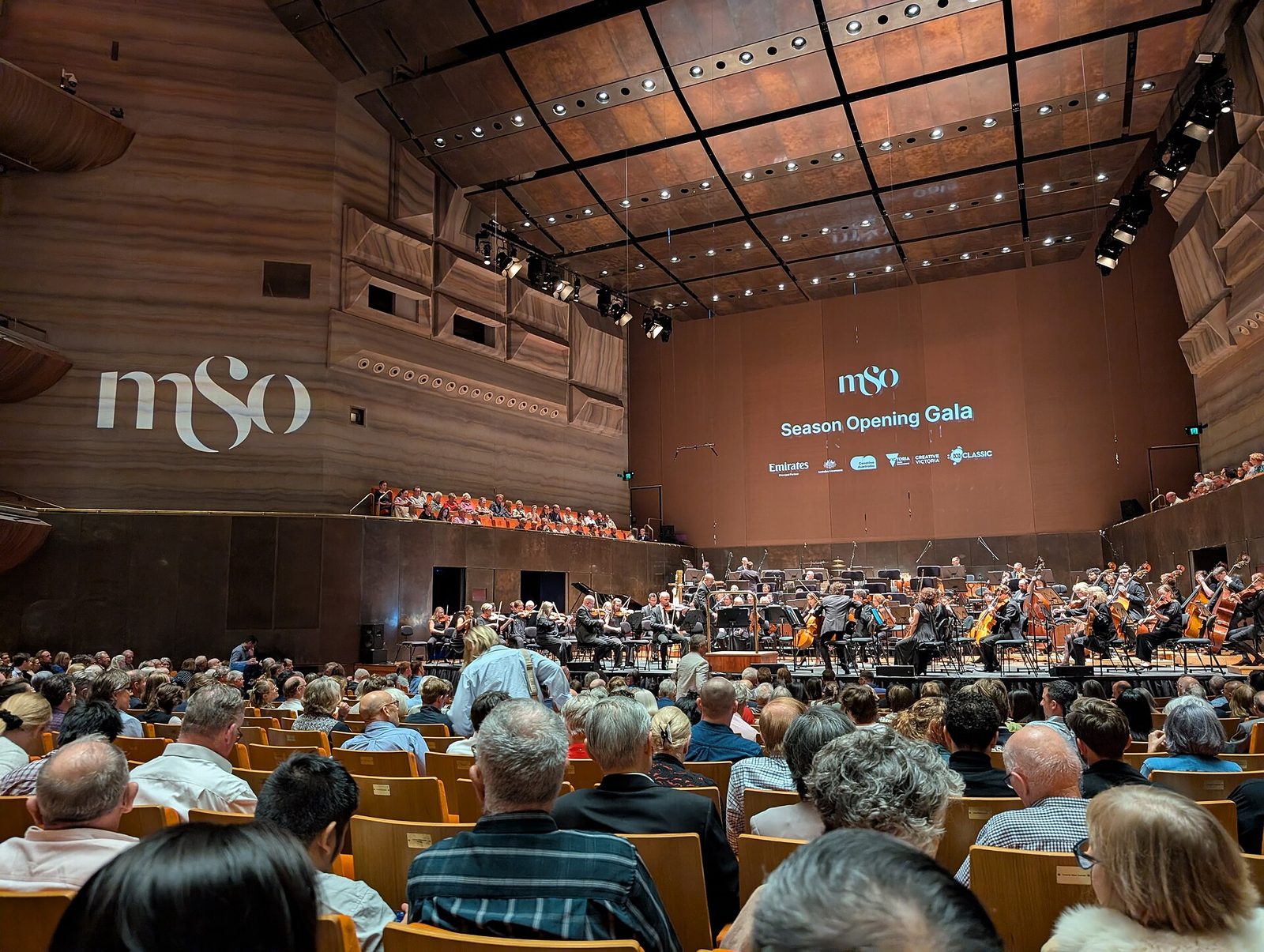
Images: cover — the interior of Hamer Hall at the Melbourne Symphony Orchestra's 2026 Opening Gala (Philip Mallis, CC BY-SA 4.0); the Melbourne Symphony Orchestra in Hamer Hall (Philip Mallis, CC BY-SA 2.0); the Royal Albert Hall at the BBC Proms 2017 (Ed g2s, CC BY-SA 4.0); Daniel Barenboim with the West-Eastern Divan Orchestra (Gerda Arendt, CC BY-SA 4.0); Lahav Shani at the Philharmonie de Paris (Apollinaire, CC BY 4.0) — all via Wikimedia Commons. Charts: Cadenza, from the structured data behind this article.
Related Cadenza coverage: Classical music has a cancel culture — here's what it actually is · The Most Dangerous Conductor in the World · the Boston Symphony governance crisis · Meloni's conductor and La Fenice.
Comments
Sign in to join the discussion.