The Toronto Symphony Orchestra told its annual general meeting on 22 September 2026 that it had "once again ended its fiscal year with a surplus". Its release that day put the figure at "an operating surplus of approximately $34,000" for the year that closed on 30 June 2026. It said the result raised the orchestra's accumulated surplus "to nearly $1 million", and it described that as "its strongest financial position ever". The orchestra also reported that its board had extended the contract of its chief executive, Mark Williams, by five years, and that Colleen Sexsmith had succeeded Tom Smee as chair.
The release links the orchestra's audited financial statements for the year, and they carry the exact figures. The auditor, a member firm of Ernst & Young Global Limited, signed its report in Toronto on 17 August 2026. Its opinion is that the statements "present fairly, in all material respects" the orchestra's financial position, results of operations and cash flows, in accordance with Canadian accounting standards for not-for-profit organizations. Revenue was $38,539,310. Expenses were $38,505,057. The difference, which the statements call the excess of revenue over expenses, was $34,253.
The line that moved is in note 10. Single-ticket revenue rose from $8,638,190 to $11,031,382, which is $2,393,192 more in a year and, on Cadenza's arithmetic, an increase of 27.7 per cent. That one line accounts for 53.4 per cent of the $4,478,115 by which total revenue grew.
Cadenza set out the orchestra's 2025 accounts on 7 September 2026, in its piece on the 407 ETR sponsorship. What follows is the year after, taken from the new statements, which print 2025 as their comparison year.
The document
| Statement of operations, year ended 30 June | 2026 ($) | 2025 ($) | Change ($) | Change |
|---|---|---|---|---|
| Ticket sales and other performance fees | 17,315,132 | 13,704,957 | +3,610,175 | +26.3% |
| Fundraising (excluding bequests and funds raised for the Foundation) | 7,799,078 | 6,504,156 | +1,294,922 | +19.9% |
| The Toronto Symphony Foundation | 7,024,923 | 6,052,954 | +971,969 | +16.1% |
| Government grants | 5,402,573 | 5,343,496 | +59,077 | +1.1% |
| Bequests | 769,131 | 1,853,621 | −1,084,490 | −58.5% |
| Toronto Symphony Volunteer Committee | 100,000 | 100,000 | 0 | 0.0% |
| Other | 128,473 | 502,011 | −373,538 | −74.4% |
| Total revenue | 38,539,310 | 34,061,195 | +4,478,115 | +13.1% |
| Production | 26,017,022 | 22,414,413 | +3,602,609 | +16.1% |
| Marketing | 5,058,639 | 4,811,498 | +247,141 | +5.1% |
| Administration | 4,597,370 | 4,210,323 | +387,047 | +9.2% |
| Fundraising | 2,832,026 | 2,565,053 | +266,973 | +10.4% |
| Total expenses | 38,505,057 | 34,001,287 | +4,503,770 | +13.2% |
| Excess of revenue over expenses | 34,253 | 59,908 | −25,655 | −42.8% |
| Net assets at 30 June | 959,302 | 925,049 | +34,253 | +3.7% |
Figures as printed in the audited statements. Years are the orchestra's fiscal years, which end on 30 June. The changes and percentages are Cadenza's arithmetic, with percentages rounded to one decimal place. The revenue rows and the expense rows each sum to their printed totals.
Revenue grew 13.1 per cent and expenses grew 13.2 per cent, so the surplus shrank: from $59,908 to $34,253, a fall of 42.8 per cent. Set against revenue, the surplus is 0.089 per cent, or 89 cents per $1,000 taken in. The year before it was 0.176 per cent, and in 2024 it was 0.165 per cent, on the figures in the 2025 statements. On those figures, the orchestra finished within two-tenths of one per cent of break-even in each of the three years.
The box office line
| Ticket sales and other performance fees (note 10) | 2024 ($) | 2025 ($) | 2026 ($) | 2025 to 2026 |
|---|---|---|---|---|
| Single tickets | 8,870,596 | 8,638,190 | 11,031,382 | +27.7% |
| Subscriptions | 3,024,380 | 3,528,937 | 3,880,347 | +10.0% |
| Other performance fees | 1,376,366 | 1,537,830 | 2,403,403 | +56.3% |
| Total, as printed | 13,271,343 | 13,704,957 | 17,315,132 | +26.3% |
The 2024 column is from the 2025 audited statements. Its three rows, as printed, sum to $13,271,342, one dollar less than the printed total, which Cadenza takes to be rounding in the statements themselves. The subscription rise is 9.96 per cent before rounding.
Three things follow from the table. The jump came after a dip: single-ticket revenue in 2025 was 2.6 per cent below 2024, so over the two years the rise is 24.4 per cent, not 27.7. Subscriptions grew more slowly, by $351,410, and the box office as a whole now carries more of the orchestra: the ticket and performance line was 40.2 per cent of revenue in 2025 and 44.9 per cent in 2026. Of the $4,478,115 by which revenue grew, $3,610,175, or 80.6 per cent, came through that line.
And the smallest row has the steepest rise. Other performance fees went up by $865,573, or 56.3 per cent, to $2,403,403. The notes to the statements do not say what these fees were for. The orchestra's European tour, scheduled for 27 January to 9 February 2026, fell inside the fiscal year, but the statements do not connect the two, and Cadenza does not either.
What the orchestra says, and what the ledger can check
The release describes the audience in the orchestra's own terms: "Subscription sales reached 105% of the annual goal, single-ticket sales were the highest in the TSO’s history, and overall attendance averaged 90% capacity, breaking the record set the previous year." Williams's letter to the community puts it slightly differently: "Subscription sales surpassed last year’s performance by 10%, and single tickets sales broke the TSO record."
The audited figures can be set against one of those claims. The letter's 10 per cent is consistent with the audited subscription revenue, which rose 9.96 per cent, though the letter does not say whether it is counting dollars or subscriptions. The rest are the orchestra's to make. The two sets of audited statements Cadenza read go back to the 2024 fiscal year, so they cannot show whether 2026 was the highest single-ticket year in the orchestra's history. The subscription goal behind "105%" is not published in the release, the letter or the statements. Neither is a count of seats, so the "90% capacity" cannot be recomputed from those documents. The release also does not say whether "single-ticket sales" means tickets or dollars. The audited figure is revenue, in dollars, and this article claims no more than that: it does not say that more single tickets were sold.
The letter gives one ticket count, "nearly 250,000 tickets across all our events". The orchestra's release of 21 October 2025 on the previous year said it had issued "more than 230,000 tickets in 2024/25". Both are round figures. On Cadenza's arithmetic the gap between them is under 20,000, and no exact change can be worked out from them.
That 2025 release is a useful view from a year earlier. It reported "a surplus of just under $60,000", credited "record-breaking ticket sales", and said that the orchestra "has reported a surplus in every year of the last decade except for fiscal year 2020". In that year's audited accounts the ticket and performance line rose 3.3 per cent, with subscriptions up 16.7 per cent and single tickets down 2.6 per cent. In 2026 the pattern reversed, and single tickets did the lifting.
"The response from audiences this season was extraordinary. Thousands more people chose to make the TSO part of their lives, telling us that what we do continues to resonate in our city and far beyond," Williams said in his address to the meeting, as the release prints it.
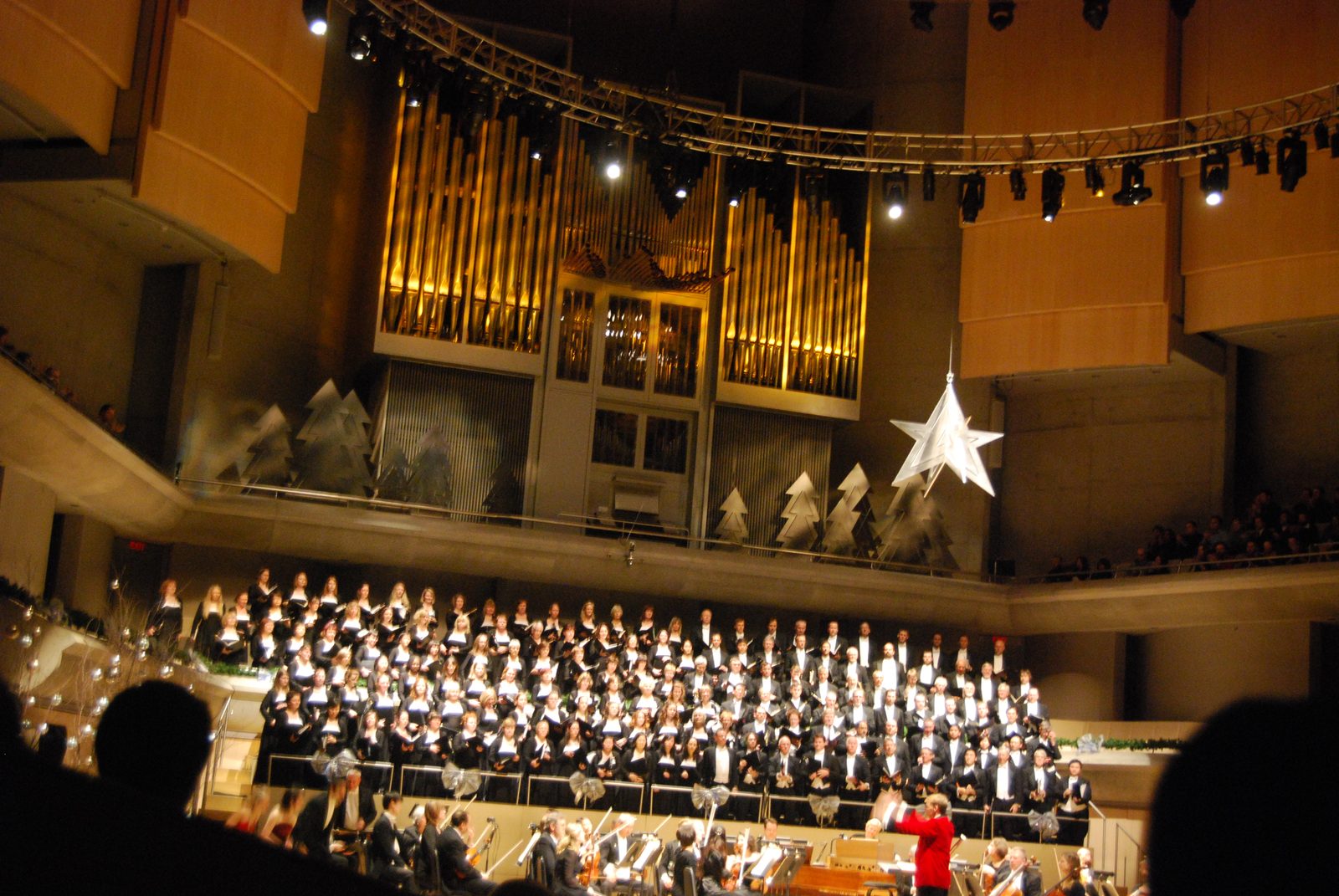
The stage of Roy Thomson Hall in December 2008, in a picture its author titled Messiah by Mendelssohn Choir & TSO: the choir in rows, the orchestra and a conductor below, the organ and Christmas decorations behind. It is from 2008, not from the season these accounts cover. missbossy, CC BY 2.0, via Wikimedia Commons.
Where the money went
Production costs rose by $3,602,609, or 16.1 per cent, to $26,017,022, which was 67.6 per cent of the year's expenses. On Cadenza's arithmetic, the extra money that came in through the ticket and performance line, $3,610,175, and the extra money spent on production differ by $7,566. The statements do not link the two lines, and the near match is Cadenza's observation, not the orchestra's. Marketing rose 5.1 per cent, administration 9.2 per cent and fundraising costs 10.4 per cent.
Two revenue lines fell. Bequests dropped by $1,084,490, or 58.5 per cent, to $769,131, and other revenue, which the notes describe as royalties and other miscellaneous income, fell by $373,538 to $128,473. Together that is $1,458,028 less than the year before. The single-ticket rise alone was larger. Fundraising rose by $1,294,922, or 19.9 per cent, and the distribution from the Toronto Symphony Foundation by $971,969, or 16.1 per cent, to $7,024,923.
Public money was close to flat. The Canada Council grant was $2,250,000 in each of 2024, 2025 and 2026, and the Toronto Arts Council grant was $1,220,000 in each of the three years. The Ontario Arts Council paid $1,862,909 in 2024 and 2025 and $1,912,109 in 2026, a rise of $49,200. Government grants in total rose 1.1 per cent, and their share of revenue fell from 15.7 per cent to 14.0 per cent.
Behind the balance
The orchestra's net assets were $959,302 at 30 June 2026. The 2025 statements give the figure at the start of the 2024 fiscal year as $811,348, and the three surpluses since, $53,793, $59,908 and $34,253, add $147,954 to reach it. The release's "nearly $1 million" is $40,698 short of a million. On Cadenza's arithmetic, the accumulated surplus equals 2.5 per cent of a year's expenses at the 2026 rate, a little over nine days of spending.
Larger sums sit outside the orchestra's accounts. The Toronto Symphony Foundation is a separate legal entity, and the statements say its net assets and income are not included in them, but note 12 prints its balances, with the 2026 column marked unaudited. As the 2026 statements print them, the Foundation's net assets rose from $77,131,707 to $82,163,286. Its endowment fund rose 14.4 per cent to $59,412,137, its general fund rose to $7,329,024, and its restricted fund fell from $19,122,482 to $15,422,125. The two sets of statements do not agree on the starting point: the 2025 statements, which marked their own 2025 column unaudited, had put the Foundation's net assets at 30 June 2025 at $77,176,764 and its restricted fund at $19,175,557. Its distribution to the orchestra was 18.2 per cent of the orchestra's revenue in 2026. The 2025 statements give the 2024 distribution as $4,914,673, so the payment has grown 42.9 per cent in two years.
The orchestra also has a demand credit facility of $9,200,000, supported by guarantees from the Foundation in the amount of $4,200,000 and from the City of Toronto to a maximum of $5,000,000. The statements show $139 of interest on it in 2025, and add: "No interest was incurred in 2026."
Cash moved the other way. The orchestra's cash fell by $264,947 to $2,987,156, and its operating activities used $15,676 of cash, after providing $2,429,696 the year before. In the cash-flow statement, the change in deferred contributions, which the notes define as government operating grants and other contributions attributable to future fiscal periods, added $2,245,581 to operating cash in 2025 and took away $420,435 in 2026. Advanced ticket sales, which the balance sheet lists among current liabilities, stood at $4,054,871 at 30 June 2026, against $4,046,356 a year earlier; the statements recognise ticket revenue at the date of the performance.
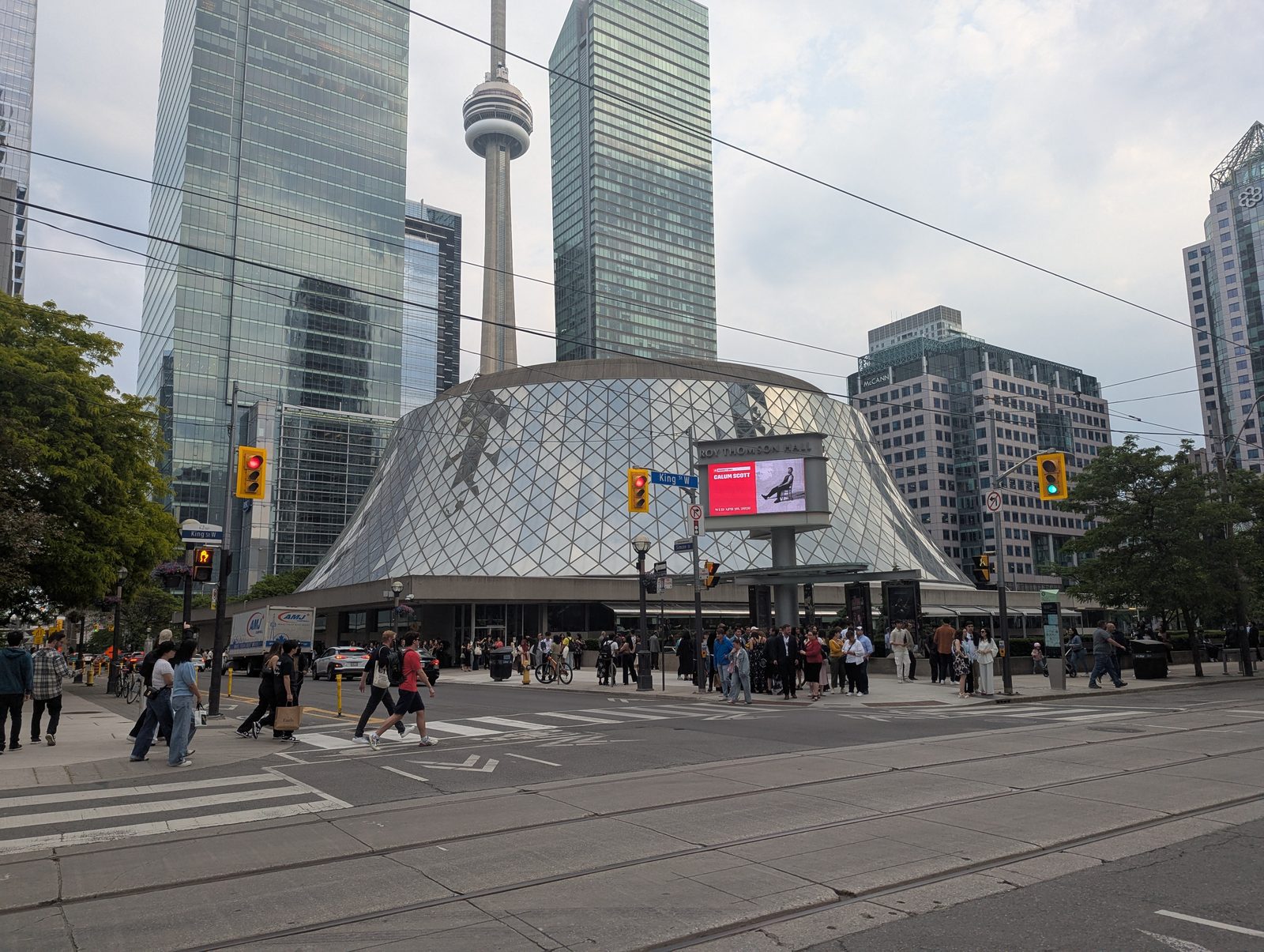
Roy Thomson Hall on 13 June 2025, its glass-clad exterior at a corner of King Street, with the CN Tower behind. Daniel from Glasgow, CC BY 2.0, via Flickr and Wikimedia Commons.
Who runs it
The orchestra announced Williams's appointment on 12 January 2022. He was then Chief Artistic and Operations Officer at The Cleveland Orchestra, and the announcement said he would begin as chief executive "in April, 2022". At the 2026 meeting the orchestra reported that the board had "unanimously approved a five-year extension of Mark Williams’s contract as the TSO’s Beck Family CEO". His current five-year term concludes on 15 April 2027, and the second runs through 15 April 2032. If he serves it, that is about ten years in the post. In his letter Williams writes: "Financial strength is not an end in itself." Of the year's result, he says: "Results like this cannot be taken for granted".
Smee concluded a two-year term as chair and a decade on the board at the meeting, and he signed the statements as board chair, alongside Helen Killoch for the finance and audit committee. The release prints his departing remarks, which begin: "Over the past decade, I have watched the TSO grow in artistic ambition, deepen its connection to our community, strengthen its financial foundation, and earn its place among the world’s leading orchestras."
Sexsmith, the former vice-chair, has been elected for a three-year term. The release describes her as having "a distinguished track record of non-profit board leadership", and quotes her: "We enter this next chapter with outstanding artistic leadership, a strong financial foundation, growing audiences, and an ambitious vision for the TSO’s role in our city and beyond." Two directors left, Ross Kerr after nine years and Noelle Richardson after ten. The release welcomes one incoming director, Rami Thabet. Williams's letter welcomes three new directors, Kristin Blakely, Thabet and Councillor Rachel Chernos Lin, and Blakely and Chernos Lin already appear on the board list, which is marked as of 30 June 2026.
Gustavo Gimeno, the music director, writes in his own letter on the same page that 2025/26 was his sixth season in the post, and he chooses one word for it: "joyful". The release lists the season's highlights: a gala with Lang Lang, the 100th anniversary of TSO School Concerts, the world premiere of the Young People's Concert She Holds Up the Stars with Red Sky Performance, the Lunar New Year concert Year of the Horse, and the season finale, Beethoven's Ninth Symphony, a performance of which was live-streamed to the screens at Sankofa Square in partnership with the Luminato Festival. The orchestra's tour announcement, which its newsroom page dates 23 January 2026 although its text says individual tickets to the 2025/26 performances would be released in July 2025, called the European trip a "14-day tour spanning eight cities in six countries", its ninth tour of Europe, and Gimeno's "first intercontinental tour with the orchestra". The 2026 release describes it as "a highly successful European tour that brought the orchestra to eight cities in six countries, including its first-ever appearances in Spain".
For musicians
The notes carry the players' side of the ledger. The orchestra and its musicians ratified a contract for fiscal years 2025 to 2027, and the orchestra is committed to about $11,800,000 in fees to contracted musicians and related pension payments for fiscal 2027. The 2025 statements had put that fiscal 2027 figure at about $11,500,000. The orchestra pays 10 per cent of the musicians' minimum basic fee into the Musicians' Pension Fund of Canada, and those contributions rose 5.4 per cent to $976,426. Agreements with guest artists and conductors for fiscal 2027 come to about $4,911,000, against about $4,022,000 committed for fiscal 2026 a year earlier, a rise of 22.1 per cent on Cadenza's arithmetic. Orchestral jobs and auditions are listed on cadenza.work/browse. Cadenza's earlier coverage of the orchestra's players is in The Ledger, Week Two, published on 6 September 2026.
The case against this article
The audited figures measure money, not people. A 27.7 per cent rise in single-ticket revenue could come from more tickets, higher prices or both, and the statements do not say which. The superlatives are the orchestra's own, and this article reports them as its claims. The Foundation's 2026 balances are marked unaudited. The surplus is real but small, and the orchestra's cash position moved the other way. And the 56.3 per cent rise in other performance fees is unexplained in the documents Cadenza read.
The question
The Toronto Symphony publishes its revenue to the dollar and its audience in round numbers: "nearly 250,000 tickets", "90% capacity", single-ticket sales "the highest in the TSO’s history". When it reports on the 2026/27 year, will it publish the counts behind those phrases, tickets sold and seats available, so that a 27.7 per cent rise in revenue can be read for what it is: more listeners, higher prices, or both?
Sources
- Toronto Symphony Orchestra, release on the 2026 annual general meeting, 22 September 2026: the surplus, accumulated surplus and audience claims, the season highlights, the chief executive's extension and the board succession, and the quotations from Williams, Smee and Sexsmith.
- The Toronto Symphony, audited financial statements for the year ended 30 June 2026, auditor's report dated 17 August 2026: every 2026 and 2025 figure in the tables and in the sections on expenses, the balance, the Foundation, the credit facility and the musicians' commitments.
- The Toronto Symphony, audited financial statements for the year ended 30 June 2025, auditor's report dated 14 August 2025: the 2024 comparison figures, the 2024 Foundation distribution, the net assets at the start of the 2024 fiscal year and the commitments as stated a year earlier.
- Toronto Symphony Orchestra, 2025/26 Annual Letter to the Community: Looking Back on the 2025/26 Season: the letters from Williams, Smee and Gimeno, the ticket and subscription figures, and the new directors.
- Toronto Symphony Orchestra, Board of Directors, lists as of 30 June 2026.
- Toronto Symphony Orchestra, release on the 2025 annual general meeting, 21 October 2025: the 2025 surplus, the tickets issued in 2024/25, "record-breaking ticket sales" and the decade of surpluses.
- Toronto Symphony Orchestra, release announcing the 2026 European tour, page dated 23 January 2026: the scheduled dates, the eight cities in six countries, the ninth European tour and Gimeno's first intercontinental tour with the orchestra.
- Toronto Symphony Orchestra, announcement of Mark Williams as chief executive, 12 January 2022.
- Wikimedia Commons, Roy Thomson Hall Main Hall 2024, by Canmenwalker, CC BY 4.0 (cover).
- Wikimedia Commons, Messiah by Mendelssohn Choir & TSO, by missbossy, CC BY 2.0.
- Wikimedia Commons, Roy Thomson Hall, 13 June 2025, by Daniel from Glasgow, CC BY 2.0.
- Cadenza, the Toronto Symphony's 407 ETR sponsorship, 7 September 2026: earlier coverage, linked for context; no figure here is taken from it.
- Cadenza, The Ledger, Week Two, 6 September 2026: earlier coverage, linked for context; no figure here is taken from it.
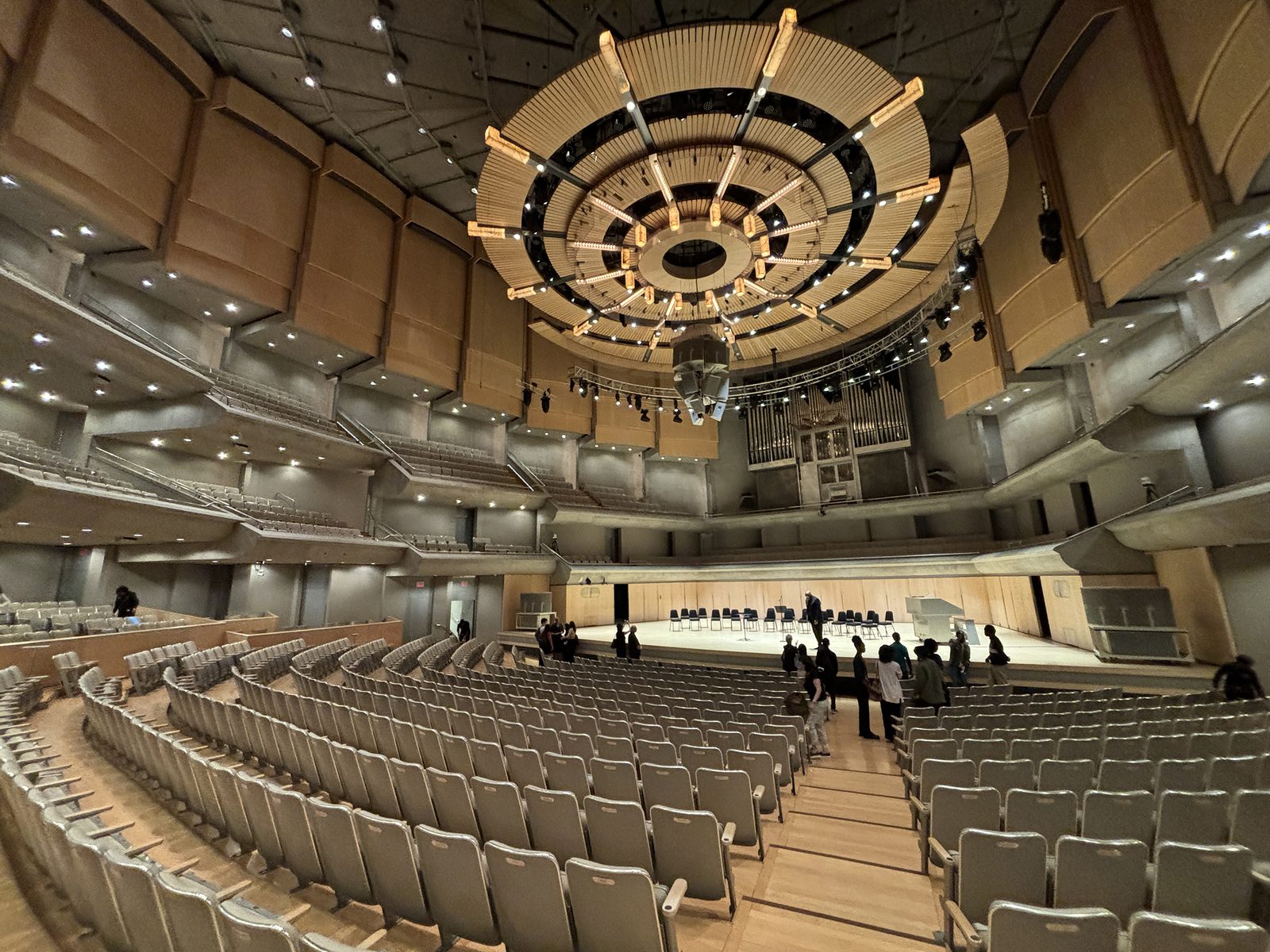
Cover photograph: The main hall of Roy Thomson Hall, Toronto, in 2024, seen from the stalls with the ringed canopy hanging over the stage and the organ behind it, the seats almost empty. Canmenwalker, CC BY 4.0, via Wikimedia Commons.
Comments
Sign in to join the discussion.