
No, Trump Didn’t Call Your Trumpet a National-Security Threat. The Tariff Story Is Stranger.
Finished brass instruments are not on the current Section 232 metals annex. But strategic-metal tariffs, overlapping trade actions and the closure of an American brass factory reveal the real policy test.
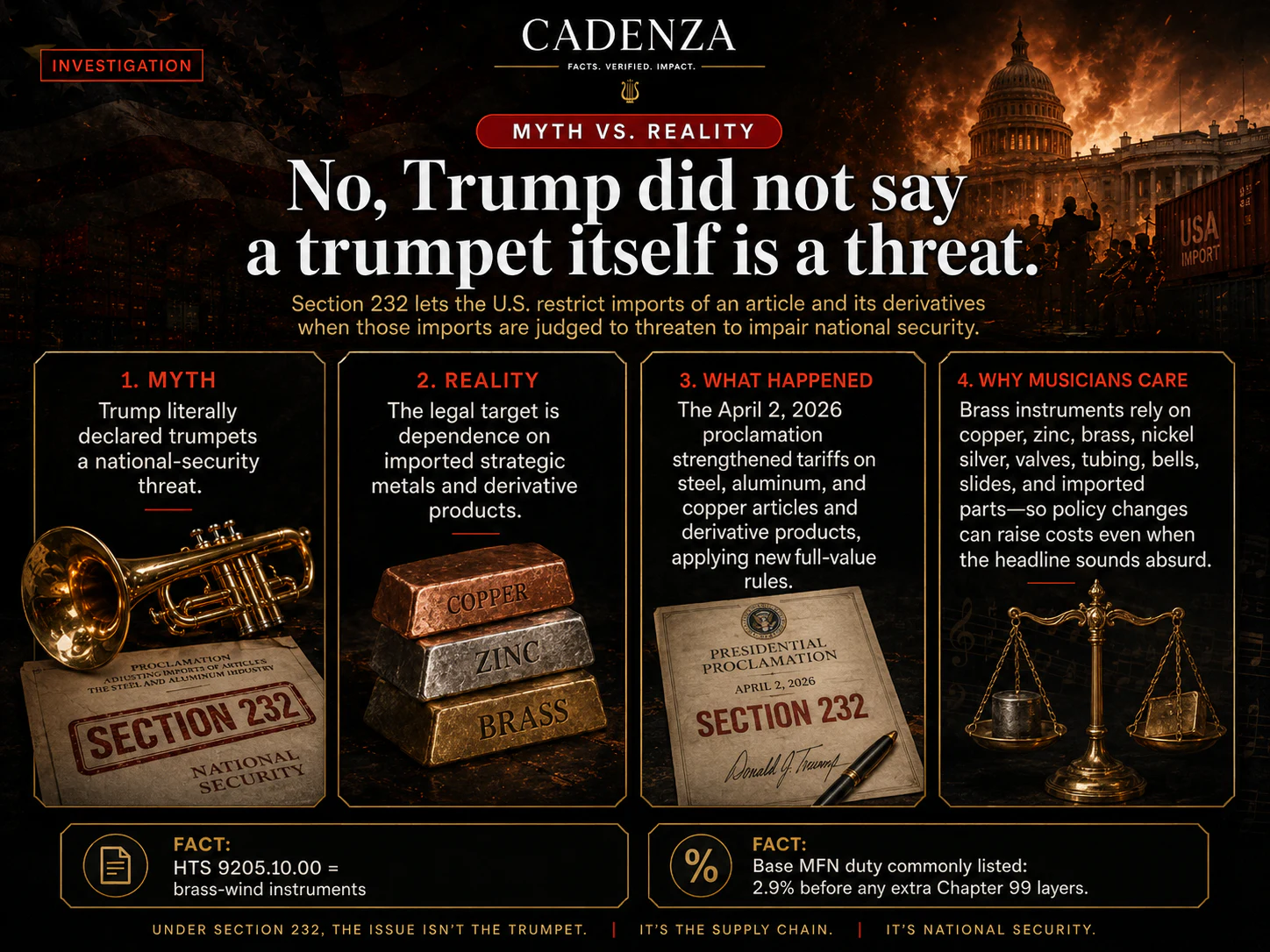
That wording is ragebait, not a literal quotation.
Cadenza found no HTS 9205.10.00 listing in the April 2026 metals annex.
Materials, parts, origin countries, Section 301 actions and factory decisions create the actual burden.
Open article contents
Editorial standard Part I — Eight digits and one viral lie 1. The trumpet becomes 9205.10.00 2. Why the false headline felt believable 3. What Cadenza found—and did not find 3A. The document trail, one instrument at a time 3B. Why fact-checking the meme strengthens the indictment 3C. The line between a fact-check and an investigation 3D. A note about official numbers Part II — The national-security tariff machine 4. Section 232 was designed to make industrial capacity a security issue 5. The Trump timeline: from metal content to full value 6. Section 232 is only one machine 6A. NAMM’s numbers need context—and attention 6B. The music industry is unusually exposed to global sourcing 6C. The tariff burden is not evenly distributed inside music 6D. Revenue is not resilience Part III — What a trumpet is actually made of 7. The bell is brass; the supply chain is not simple 8. A note begins long before the musician breathes 9. “Made in America” is not one fact 9A. The annex is the law’s map, not a mood board 9B. The fifteen-percent threshold is not a universal safe harbor 9C. Full customs value changed the stakes 9D. The rolling list is a standing source of uncertainty 9E. Why the trumpet is a perfect customs trap 9F. Copper is strategic; brass is a partnership with zinc 9G. Nickel silver contains no silver 9H. Valve material is a strategic detail at human scale 9I. Silver and gold finishes show why full-value tariffs can overreach 9J. The supply chain is acoustic because consistency is acoustic Part IV — The factory that makes the contradiction impossible to ignore 10. Eastlake: the plant that closed while Washington promised reshoring 11. John Paulson and the politics of offshoring 12. What the Eastlake closure actually moved 12A. Elkhart was once an industrial ecosystem, not a logo 12B. A factory closure has a long acoustic tail 12C. The $13 million question 12D. Tariffs and ownership incentives are not the same thing 12E. “Professional production stays” is not a complete answer Part V — America still makes great horns 13. The makers who complicate the decline narrative 14. A professional horn is not a school-rental fleet 15. The American manufacturing paradox 15A. Bach: an American name with a segmented production story 15B. Getzen: proof that student production can remain domestic 15C. Edwards: high-value craft and the economics of specialization 15D. Schilke: a factory as an acoustic institution 15E. S.E. Shires: modular production and local fitting 15F. Yamaha: the foreign competitor is also a manufacturing benchmark 15G. The missing middle Part VI — The school-band tax 16. The first note is the most price-sensitive note 17. Rental fleets hide the tariff until they cannot 18. Why beginner instruments matter to American professional makers 18A. The low-brass problem is bigger than the trumpet problem 18B. Marching bands and drum corps operate on fleet economics 18C. Youth orchestras and conservatories face a different substitution problem 18D. Public procurement magnifies uncertainty 18E. The participation effect is the missing national statistic 18F. Music education is not an incidental consumer category Part VII — What the tariff can do to the price 19. A tariff is charged at the border, not at the music store 20. Four scenarios, not four predictions 21. Why the final number may be higher—or lower 22. The unseen price: uncertainty Part VIII — Parts, repairs and the life after purchase 23. The trumpet is not finished when it leaves the factory 24. Small shops cannot build a customs department 25. Used instruments become strategic inventory 25A. Classification can change when the instrument is disassembled 25B. Country of origin is not the flag on the box 25C. Traceability favors large firms 25D. Enforcement risk changes the product before the duty does 25E. The traveling musician is a customs edge case 25F. Repair abroad can create a new value question Part IX — The administration’s best case 26. The case for Trump is stronger than “tariffs good” 27. Why primary metal matters to a trumpet maker 28. The USITC evidence: protection did produce more metal Part X — The case against the machine 29. Protection upstream can become punishment downstream 30. The duty is paid by an American importer 31. A tariff can preserve an industry or preserve a price umbrella 32. The retaliation problem Part XI — Can America reshore the trumpet? 33. The answer is yes—and not by tariff alone 34. A realistic onshoring program for band instruments 35. The procurement lever 36. Why the Eastlake workforce should have been the pilot Part XII — A global instrument is not an un-American instrument 37. Japan, Germany, Taiwan and the limits of the China frame 38. Imports can complement domestic production 39. Allied sourcing deserves a different debate 39A. A blanket exemption is not costless 39B. A tariff-rate quota could protect capacity and access 39C. An exclusion tied to American production could reward the right behavior 39D. School access can be protected directly 39E. The repair economy deserves formal status 39F. Transparent origin labeling would let consumers participate 39G. The five-year test Part XIII — The military irony 40. The trumpet has always served national security 41. Military procurement cannot rescue the commercial market alone 42. The patriotic instrument and the imported reality Part XIV — Their words against the record 43. Exhibit one: “national-security threat” 44. Exhibit two: “American manufacturing” 45. Exhibit three: John Paulson 46. Exhibit four: Conn Selmer’s commitment 47. Exhibit five: music is not a security risk 48. Exhibit six: tariffs rebuild production Part XV — The accountability ledger 49. What the White House should answer 50. What Conn Selmer should answer 51. What John Paulson should answer 52. What NAMM should answer 53. What American makers should answer Part XVI — Myth, reality and the limits of certainty 54. Myth: Trump called trumpets a national-security threat 55. Myth: Section 232 puts a 25 or 50 percent tariff on every brass instrument 56. Reality: musical instruments face a substantial tariff burden 57. Reality: U.S. brass manufacturing still exists 58. Reality: significant U.S. brass capacity also moved offshore 59. Unknown: the exact retail price effect on every horn 60. Unknown: whether tariffs will ultimately create more domestic instrument production Part XVII — The policy verdict 61. The viral story was wrong. The warning was not. 62. Tariffs without capacity are a tax on aspiration 63. National security begins with knowing what is actually on the list 64. The final question 64A. What success would look likeAt the border, a trumpet stops being music.
It becomes 9205.10.00.
The code is dry. The object is not. A trumpet can announce a president, bury a soldier, open a symphony, begin a jazz solo or produce the first unstable note of an eleven-year-old child. Customs does not hear any of that. Customs sees a brass-wind instrument, an origin country, a declared value and whatever layers of trade law Washington has attached to the shipment.
That is where the viral claim begins: Trump says your trumpet is a national-security threat.
He did not say those words. Cadenza found no speech, proclamation or official statement in which Donald Trump called a trumpet, trombone, French horn, euphonium, tuba or other finished brass instrument a threat to the United States. Cadenza checked the controlling Section 232 proclamation, the White House’s 58-page metals annex and the Harmonized Tariff Schedule line for brass-wind instruments. HTS 9205.10.00 does not appear in the annex reviewed for this article. The literal headline is false.
The machinery that made it believable is real.
The White House officially says imports of steel, aluminum and copper—and selected products derived from them—threaten to impair national security. It has built a tariff architecture with 50 percent duties on many covered metal articles, 25 percent duties on selected derivatives, special lower tiers for designated equipment and products made with qualifying American metal, and a rolling process capable of adding more derivative products. Musical instruments and their parts also sit inside overlapping Section 301, country-specific and other Chapter 99 measures. 2345
NAMM says American music-products companies paid approximately $1.34 billion in tariffs in 2025. It reports that the average effective tariff rate on U.S. musical-instrument imports reached 15.9 percent in 2025 and 16.6 percent in the first quarter of 2026. It says wind-instrument imports fell 27 percent in 2025, with the decline concentrated in student-grade products bought by schools, community programs and families. Those are industry claims, not figures independently audited by Cadenza, but they describe a sector already paying before any finished trumpet is added to a Section 232 annex. 81014
Then comes the contradiction that turns a tariff story into an industrial-policy investigation.
While the administration presented tariffs as a tool for rebuilding American manufacturing, Conn Selmer closed its Eastlake, Ohio, brass plant at the end of June 2026. The company said professional French-horn production would move to Elkhart, Indiana, while tuba, sousaphone and student/intermediate French-horn production would move offshore. Reuters reported that most of the displaced work was headed to China. The plant’s ultimate owner, John Paulson, is a major Trump ally and donor who had publicly criticized American companies for closing factories and sending jobs abroad. 22232425
So this is not an article about a trumpet plotting against America.
It is about a government that describes industrial dependence in the language of national security; a trade system that taxes the materials, components and countries surrounding musical instruments; an industry warning that beginner access is being squeezed; and an American factory closing while the political class celebrates reshoring.
The question is not whether a trumpet is a weapon.
The question is whether Washington’s tariff machine is rebuilding the capacity it invokes—or merely making the first note more expensive.
Editorial standard
This is an investigation and an argument, but it begins with a correction.
The phrases “national-security threat” and “threaten to impair the national security” have specific legal and administrative meanings under Section 232 of the Trade Expansion Act. They refer to findings about imports of an article and its derivatives, domestic capacity, industrial resilience, defense requirements, economic welfare, skills and investment. They do not mean that a physical object has been accused of hostile intent. 14041
For clarity, this article separates five categories:
- Established fact: a statute, proclamation, tariff code, official filing, public company statement or attributable report.
- Attributed claim: what the White House, NAMM, a company, a union, a worker or another named source says.
- Cadenza analysis: conclusions drawn from documented sequences or comparisons.
- Illustrative modeling: price scenarios that show arithmetic, not forecasts.
- Unknown: matters the public record does not establish.
The article does not say that Section 232 currently imposes a 25 or 50 percent duty on finished trumpets under HTS 9205.10.00. It does not say every imported component is covered. It does not say tariffs are the sole reason instrument prices rise, imports fall, or factories move. It does not claim that all foreign manufacturing is exploitative or that all domestic manufacturing is strategically necessary.
It does say that policy cannot be evaluated by slogans alone. The relevant test is the result: whether a trade regime strengthens the American makers it invokes, whether it reduces dependency without destroying access, whether it creates capacity rather than only cost, and whether its exceptions reflect coherent industrial priorities.
Part I — Eight digits and one viral lie
1 The trumpet becomes 9205.10.00
The trumpet has announced wars, coronations, presidential arrivals, military funerals, jazz revolutions, championship parades and the first uncertain note of generations of schoolchildren. In the Harmonized Tariff Schedule of the United States, all of that history is compressed into eight digits:
9205.10.00 — Brass-wind instruments.
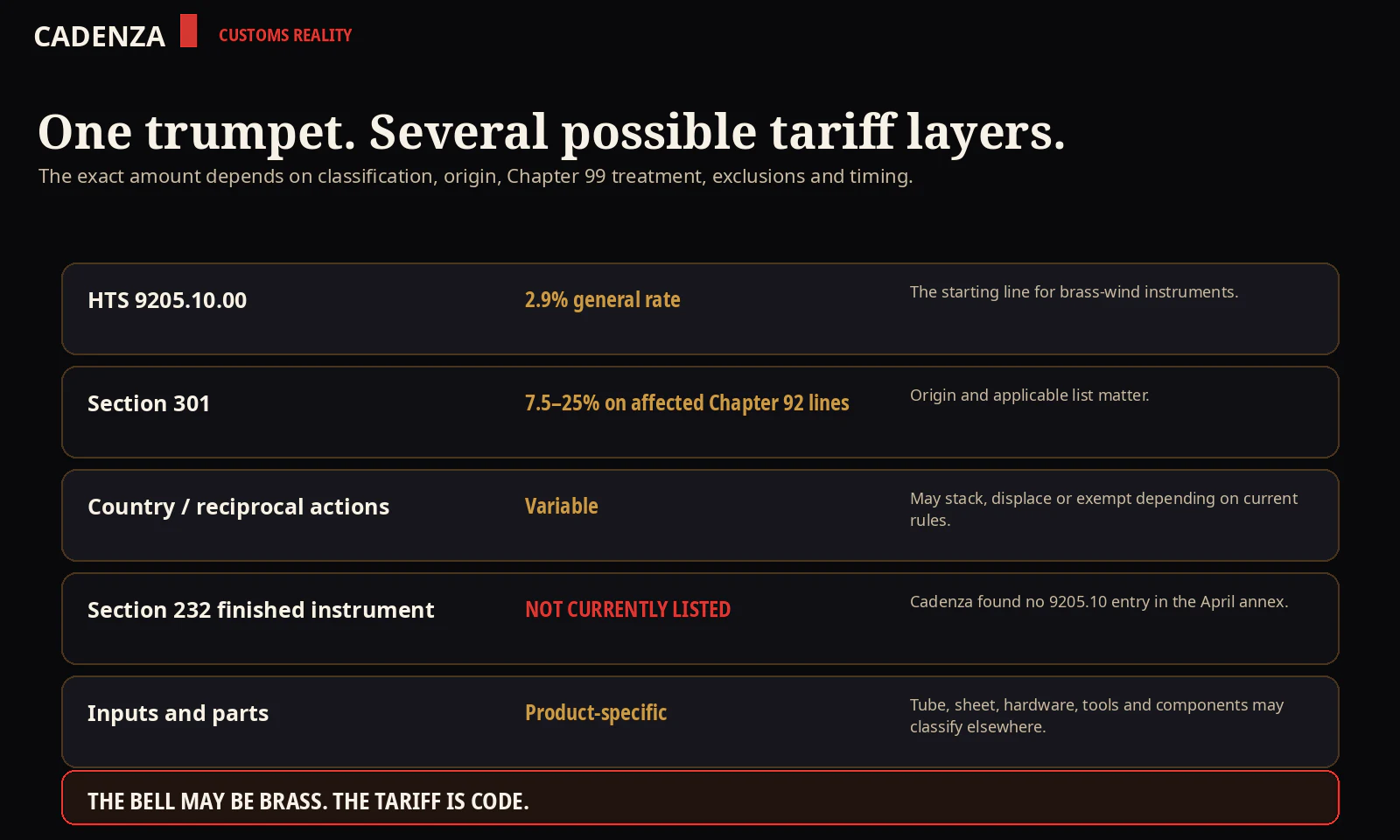
The general Column 1 duty shown by the U.S. International Trade Commission is 2.9 percent. The line sits in Chapter 92, the chapter for musical instruments and their parts and accessories. Beneath it are statistical breakouts for instruments valued not over $10 and instruments valued over $10. The code is material-neutral in a legal sense: it classifies a category of wind instrument, not a geopolitical theory about copper. 7
This matters because tariffs are not imposed on vibes. They are imposed through classifications, country of origin, customs value, special-program eligibility and Chapter 99 overlays. A headline can call “the trumpet” a national-security threat. Customs must identify the code.
Cadenza reviewed the April 2, 2026, proclamation and the accompanying 58-page annex that lists the products placed in the revised Section 232 metals architecture. We searched the annex for 9205, 9205.10, 9209, brass-wind, and musical instrument. Those musical-instrument lines do not appear. The annex contains extensive lists of steel, aluminum and copper articles; derivative products; machinery; equipment; vehicle parts; appliances and other categories. It does not currently list the finished brass-wind instrument line. 2446
That is the controlling fact.
A finished trumpet imported under HTS 9205.10.00 is not, merely because it is made largely of brass, automatically subject to the April 2026 Section 232 full-value metals duty. Material composition alone does not move an unlisted finished product into the annex. Classification and the scope language matter.
The correction should be stated without hesitation:
Donald Trump did not declare your trumpet a national-security threat, and the finished trumpet tariff line is not currently on the Section 232 metals list.
That does not end the story. It starts it.
2 Why the false headline felt believable
The false version spread because every part of it resembled something the government had actually said.
The White House called imported steel, aluminum and copper a “national-security threat.” It said derivative articles substantially made from those metals would face full-value tariffs. It authorized a rolling process for adding derivative products when officials determine that imports undermine the policy’s national-security objectives. A trumpet is visibly metallic. Brass is primarily copper and zinc. Trumpets contain steel, nickel-silver alloys, Monel or other valve materials, solder, plating and hardware. The leap from metal instrument to metal tariff felt intuitive. 2337
Trade policy in 2025 and 2026 also changed rapidly enough to make absurd claims seem plausible. Rates shifted. Exemptions moved. Different authorities overlapped. Section 232, Section 301, reciprocal or country-based measures and legacy duties could stack or displace one another depending on the product and origin. NAMM maintained a continuously updated explainer because its members could not treat yesterday’s tariff schedule as tomorrow’s. 1314
The language amplified the confusion. In ordinary English, “national-security threat” suggests missiles, sabotage, espionage or hostile states. In Section 232, Congress instructed officials to consider a much broader field: national-defense production, domestic industrial capacity, human and material resources, the availability of raw materials, investment, skills, unemployment, government revenue and the relationship between economic welfare and national security. The statute is built to convert industrial weakness into a security question. 140
A trumpet is not a missile. But the law does not require a product to be a missile.
The legal theory can run like this:
- Copper, aluminum or steel is essential to defense and critical infrastructure.
- Excess dependence on imported metal can weaken domestic capacity.
- Derivative products can allow foreign producers to bypass duties on primary metal.
- Therefore, imports of selected derivative products can undermine the original national-security remedy.
- Those derivatives may be added to the tariff scope even when their civilian use is obvious.
The viral claim failed at step five: the administration did not put HTS 9205.10.00 in the current annex. But the machinery that made the claim believable is real.
3 What Cadenza found—and did not find
A precise investigation needs a precise finding.
We found:
- The White House explicitly describes imported steel, aluminum and copper as posing national-security threats and invokes Section 232 to adjust those imports. 235
- The April 2026 proclamation applies full-customs-value tariffs to listed metal articles and derivatives, with rates that generally include 50 percent and 25 percent tiers and other specified treatment. 23
- The proclamation authorizes the Secretary of Commerce and the U.S. Trade Representative to add additional derivative articles on a rolling basis when they jointly determine that imports undermine the national-security actions. 2
- Trumpets, trombones, horns, tubas, euphoniums, cornets and related finished brass-wind instruments generally fall under HTS 9205.10.00. 7
- That line does not appear in the April 2026 annex reviewed by Cadenza. 446
- Musical instruments nevertheless face other tariff layers, especially Section 301 duties and country-specific measures, and their U.S. manufacturers may buy imported raw materials and components affected elsewhere in the tariff schedule. 891314
- NAMM is actively lobbying for relief for Chapter 92 products, components and raw materials. 8910
We did not find:
- A statement by Trump saying that a trumpet, trombone, horn or tuba is itself a national-security threat.
- A current White House annex entry placing finished brass-wind instruments under the Section 232 metals duties.
- Public evidence that Commerce has completed a musical-instrument-specific Section 232 investigation.
- A government finding that school-band instruments, orchestral brass or musician-owned trumpets are strategically dangerous.
What could change:
The scope is not frozen forever. The April proclamation terminated earlier product-inclusion processes but authorized the Commerce Secretary and USTR to include additional derivatives on a rolling basis. The July aluminum proclamation continued to direct monitoring and allowed further implementation through federal notices and technical corrections. A future addition would require an official act, not an internet meme. 26
The correct newsroom rule is therefore:
Do not say a product is covered until the applicable HTS line, Chapter 99 note, proclamation, federal notice and origin rules establish that it is covered.
That rule is less entertaining than the meme. It is also how importers avoid penalties.
3A The document trail, one instrument at a time
The safest way to understand the story is to follow the documents in order.
Document 1: the statute
Section 232 does not name copper, steel, aluminum or musical instruments. It creates a process. Commerce investigates an article. The Secretary consults Defense and other officials, assesses defense and industrial factors, reports to the President, and recommends action or inaction. If the President concurs that imports threaten to impair national security, the President may adjust imports of the article and its derivatives. 14041
The phrase “and its derivatives” is the bridge from raw material to downstream products.
Document 2: the metal findings
The Trump administration relied on earlier findings for steel and aluminum and a 2025 finding for copper. The April 2026 proclamation restated that those metals were being imported in quantities or circumstances that threatened to impair national security. 2
The finding is about the metal industries and their strategic role. It is not a finding about every object containing those metals.
Document 3: Proclamation 11021
The April 2, 2026, proclamation reorganized the regime. It moved listed products toward full-value calculation, set rate tiers, removed certain products, established treatment for partners and U.S. metal, and created new authority for rolling derivative additions. 2
This is the source of the administration’s broad language and the legal action.
Document 4: the annex
The annex identifies the tariff provisions. It is where the viral claim fails. The musical-instrument codes at issue are absent. 446
A reporter who reads only the fact sheet may see “derivative articles substantially made of copper.” A reporter who reads the annex sees which derivative articles the government actually listed.
Document 5: the tariff schedule
The USITC schedule places brass-wind instruments at 9205.10.00 and shows the ordinary general rate. 7
The tariff schedule is the link between the physical horn and the proclamation. Without it, the story has no product classification.
Document 6: the June modification
The June proclamation adjusted categories and the U.S.-metal threshold. It did not announce that Chapter 92 had been added. 542
Document 7: the July aluminum incentive
The July proclamation created an investment mechanism for approved primary-aluminum onshoring plans. It did not add trumpets. 6
Document 8: NAMM’s filings
NAMM’s 2026 comments focus heavily on Section 301 and other tariff burdens on musical instruments, parts and materials. The association does not need the false Section 232 claim to establish harm. Its numbers are already severe. 8910
The document trail produces a clean verdict:
- Section 232 national-security metal findings: yes.
- Current Section 232 listing for finished brass-wind instruments: no.
- Other significant tariffs on music products and inputs: yes.
- Industry campaign for relief: yes.
- American brass factory closure during the tariff push: yes.
That is the article.
3B Why fact-checking the meme strengthens the indictment
Some readers will see the correction as a retreat.
It is the opposite.
A false headline gives the administration an easy escape. Officials can say: trumpets are not on the Section 232 list, therefore the entire criticism is ignorant.
The accurate article removes that escape.
It says:
- We know the trumpet is not listed.
- We know the legal difference between a finished instrument and a metal derivative.
- We know which tariff authorities are actually affecting Chapter 92.
- We know the industry’s documented burden.
- We know what happened at Eastlake.
- We still find a serious contradiction between the manufacturing promise and the manufacturing result.
Accuracy makes the argument harder, not softer.
3C The line between a fact-check and an investigation
A fact-check asks whether Trump declared trumpets a threat.
An investigation asks why the claim arose, which policies actually affect the instrument, who benefits, who pays, what domestic capacity remains, and whether the policy achieved its stated purpose.
The first answer takes one paragraph.
The second requires the supply chain.
That is why this article does not stop after saying “false.” A false meme can point toward a true institutional failure. The newsroom’s job is to discard the meme and follow the failure.
3D A note about official numbers
White House capacity-utilization figures, NAMM tariff totals and company investment estimates are attributed to the institutions publishing or reporting them. Cadenza has not independently audited every underlying dataset.
Where possible, this article uses government research to test the direction of the claims. The USITC found that earlier Section 232 tariffs increased protected metal production and prices while reducing downstream output. That evidence supports both the administration’s claim that protection can raise domestic metal output and critics’ claim that downstream manufacturers can be harmed. 18
The article does not convert advocacy data into certainty. It uses it as evidence with a named source.
Part II — The national-security tariff machine
4 Section 232 was designed to make industrial capacity a security issue
Section 232 is older than the modern global supply chains now testing it. Congress enacted the Trade Expansion Act in 1962. The statute authorizes a Commerce investigation into the effect of imports of an article on national security. If Commerce finds that the article is entering in quantities or circumstances that threaten to impair national security, and the President concurs, the President may adjust imports of the article and its derivatives. 141
The breadth lies in the factors Congress told officials to consider. The law does not limit national security to the quantity of material the Pentagon buys directly. It directs attention to domestic production required for defense; the capacity of domestic industries; raw materials, supplies and services; growth and investment; the impact of foreign competition; loss of skills; unemployment; and serious effects from displacement of domestic products. It also tells the government to recognize the close relationship between economic welfare and national security. 1
That is why Section 232 can reach far beyond an armored vehicle.
Supporters see this breadth as realism. A country that cannot smelt, roll, cast, fabricate, machine or repair critical materials may discover its vulnerability only after a crisis begins. Defense procurement depends on civilian factories, skilled workers, logistics networks, power systems and capital investment. A hollowed-out industrial base cannot be rebuilt at the speed of a declaration of emergency.
Critics see the same breadth as an invitation to convert almost any industrial complaint into a national-security claim. If unemployment, investment, market share and economic welfare are security factors, the line between trade protection and defense policy becomes elastic. That elasticity increases executive power and reduces the practical constraint imposed by the phrase “national security.”
The trumpet story sits exactly on that fault line.
No serious person needs to believe that a student trumpet is a military threat to understand why copper capacity matters to national defense. But once metal policy expands from primary commodities to derivative products, the government must decide where strategic necessity ends and ordinary civilian commerce begins. Those boundary decisions determine whether a tariff protects a smelter, taxes a manufacturer, raises the price of a school instrument, or does all three at once.
5 The Trump timeline: from metal content to full value
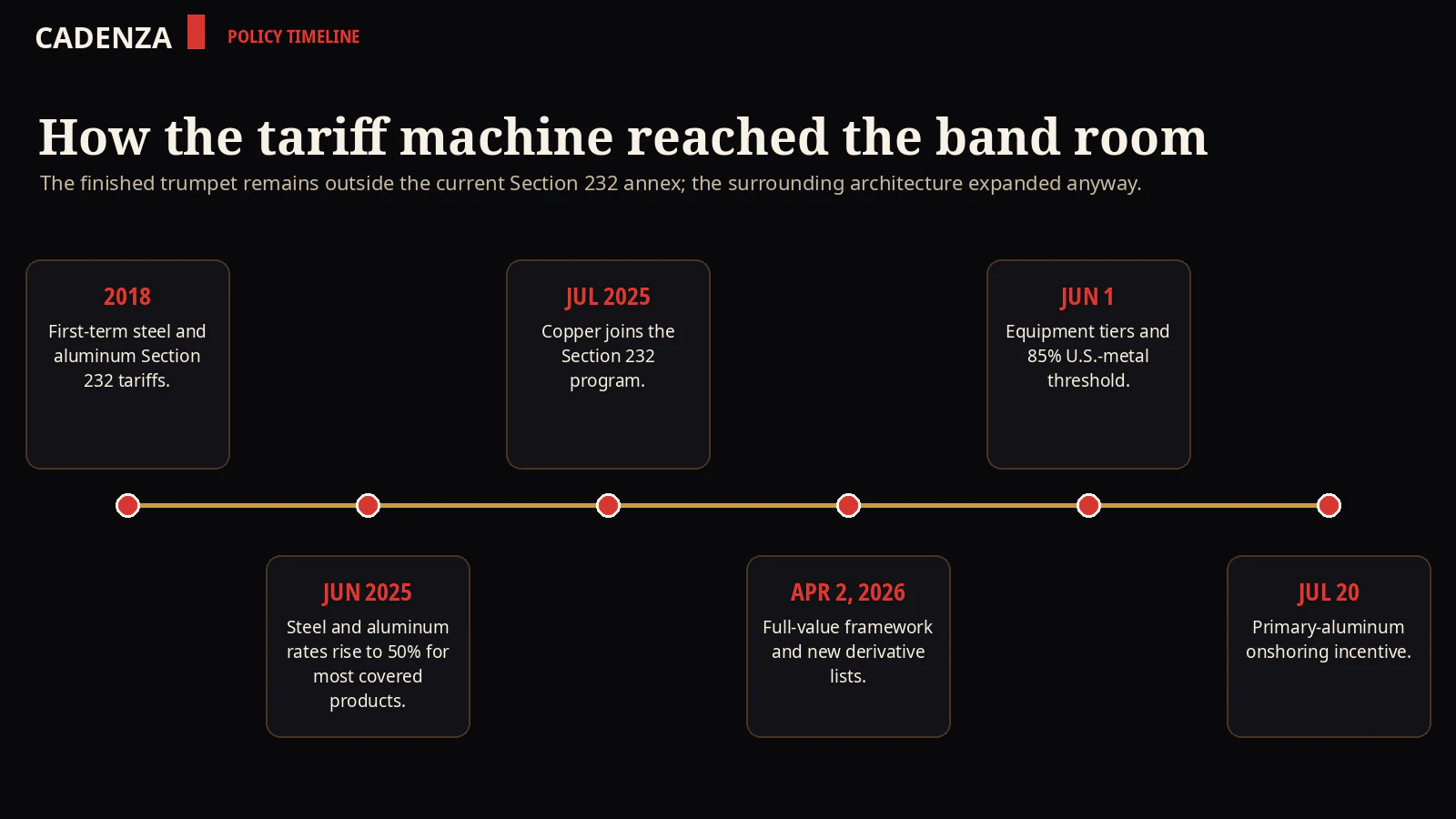
Trump’s first-term Section 232 tariffs on steel and aluminum began in 2018. The second administration expanded and tightened the system. In February 2025, it overhauled steel and aluminum treatment and removed many exemptions. In June 2025, it raised the additional tariff rate on steel and aluminum to 50 percent for most covered imports. In July 2025, it added copper to the Section 232 program. 243
Then came the April 2, 2026, proclamation.
The administration said the new structure would address undervaluation and evasion by applying duties to the full customs value of listed products rather than only the metal content in many cases. The White House summarized the framework as follows: many primary or nearly all-metal products at 50 percent; selected derivative articles at 25 percent; certain industrial and power equipment at a temporary 15 percent; lower treatment for qualifying products made with U.S. metal; and no Section 232 metals duty for certain listed goods outside metal chapters containing less than 15 percent covered metal by weight. 234
The June 1 proclamation modified parts of that structure. It added certain agricultural equipment and residential HVAC systems to the temporary 15 percent category, broadened treatment for some mobile industrial equipment, and lowered the threshold for metal to qualify as “entirely” American from 95 percent to 85 percent of the weight of the relevant metal content. 542
The July 20 aluminum action added an investment incentive: companies with approved plans to build, refurbish or expand U.S. primary-aluminum capacity could receive reduced tariff treatment for corresponding volumes of imported primary aluminum, subject to Commerce approval and enforcement. 6
The sequence shows the administration’s governing idea. Tariffs are not only a border charge. They are leverage intended to change capital investment, sourcing, production location and the composition of downstream goods.
That is the theory.
The challenge is transmission. A tariff on primary copper may encourage U.S. copper investment. It may also raise the input cost of a U.S. valve maker. A tariff on a listed derivative may discourage circumvention. It may also make a finished American product less competitive if its producer imports the covered part while a foreign finished product enters under a different tariff line. A reduced rate for American metal may encourage traceability. It may also create an administrative burden that small firms cannot afford.
Trade policy reaches the trumpet not through one dramatic decree, but through dozens of such transmission channels.
6 Section 232 is only one machine
The biggest factual mistake in the viral discussion is to treat “the tariff” as one thing.
For a brass instrument, the final duty can depend on several layers:
- the ordinary HTS rate;
- special rates under a trade agreement;
- Section 301 duties tied to country and tariff list;
- country-specific or forced-labor-related actions;
- Section 232 treatment if the exact product or imported component is listed;
- antidumping or countervailing duties in relevant categories;
- exemptions, exclusions, origin rules, de minimis changes and customs valuation.
HTS 9205.10.00 shows a 2.9 percent general rate. That is the beginning of the calculation, not always the end. NAMM said in July 2026 that Section 301 duties on Chapter 92 products ranged from 7.5 to 25 percent depending on the applicable list. Its broader filings said the average effective tariff rate on U.S. musical-instrument imports reached 16.6 percent in the first quarter of 2026. 78
USTR also opened Section 301 investigations in 2026 into structural excess capacity across sixteen economies and into sixty economies’ failures to prohibit and enforce bans on forced-labor goods. In July, USTR announced final forced-labor-related action affecting sixty economies. NAMM said Chapter 92 was not included in a later exemption list despite its comments requesting relief. 141617
That means a truthful headline cannot be reduced to “Section 232 puts 25 percent on trumpets.” It does not.
A truthful headline can say that Trump’s tariff machine has reached the musical-instrument industry. NAMM’s filings, USTR proceedings and import data make that plain. The burden is cumulative, origin-specific and unstable—precisely the kind of system in which a small retailer, repair shop or maker can be harmed before a consumer understands which legal authority raised the invoice.
The distinction matters for accountability. If a dealer raises the price of a Chinese student trumpet, the reason may be Section 301 or a country measure, not Section 232. If a U.S. factory pays more for imported metal tubing, the relevant code may be in a metal chapter. If a German professional trumpet arrives under 9205.10.00, its tariff stack may differ from a Chinese instrument. If a U.S. maker imports a valve block separately, that part may classify differently from the finished horn.
The instrument is one object on a music stand. At the border, it is a set of legal questions.
6A NAMM’s numbers need context—and attention
NAMM’s July filing provides the clearest industry-wide snapshot available in the public record reviewed by Cadenza.
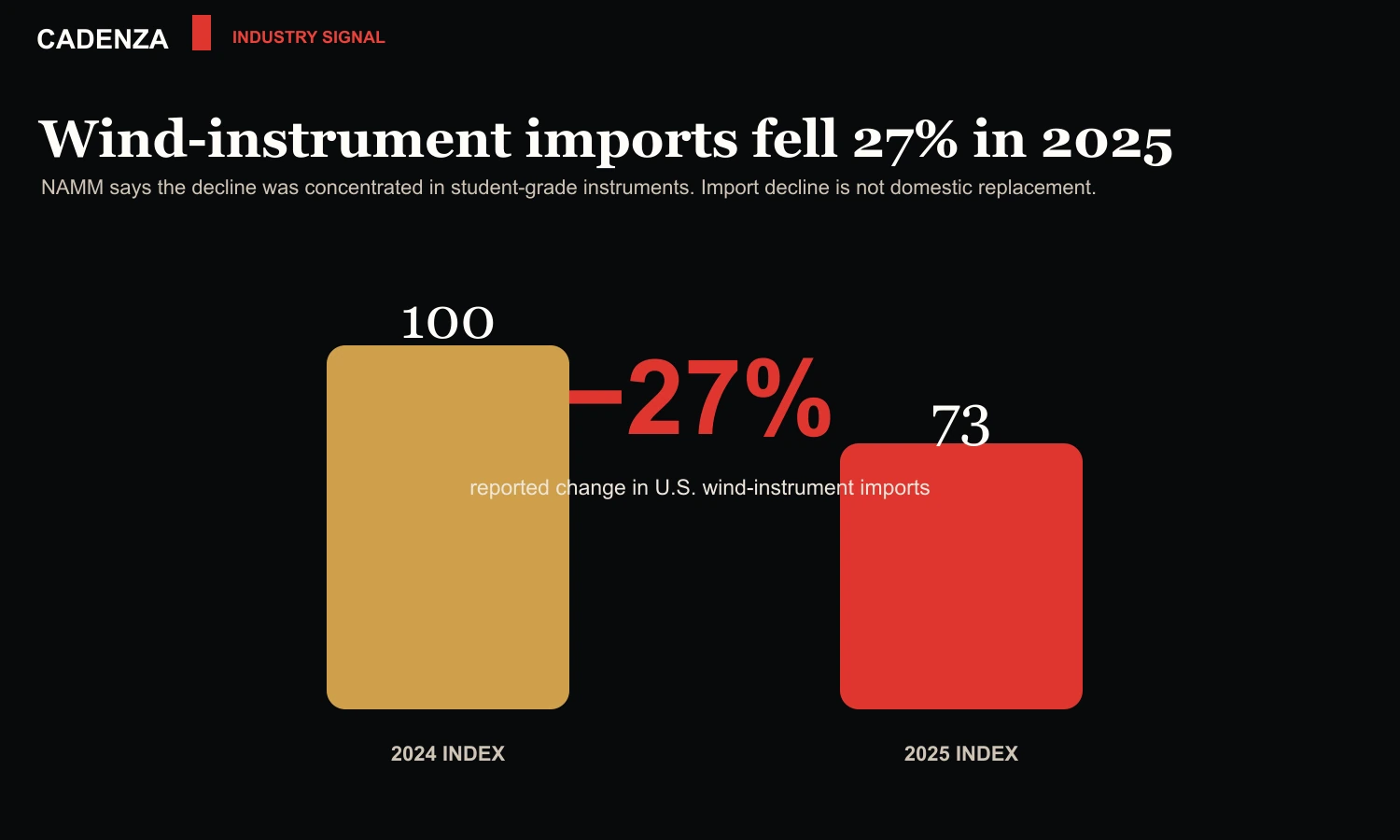
It says U.S. music-products companies paid approximately $1.34 billion in tariffs in 2025. It cites Peterson Institute analysis placing the average effective tariff rate on U.S. musical-instrument imports at 15.9 percent for 2025 and 16.6 percent in the first quarter of 2026. It reports that wind-instrument imports fell 27 percent in 2025 and piano imports fell 20.3 percent, with declines concentrated in student-grade products. 8
These figures do not isolate brass instruments. They combine categories and tariff authorities. They do not tell us how much of the tariff was absorbed by foreign suppliers, importers or retailers. They do not prove that participation fell by the same percentage as imports.
They do establish that the industry’s tariff problem is not a hypothetical created by a social-media joke.
A $1.34 billion annual burden is large relative to a U.S. music-products market NAMM values at about $9 billion. The comparison is not a clean percentage of sales—tariffs and market-value figures measure different things—but it shows the order of magnitude. 9
The import decline is equally important. A fall in student-grade instruments can mean fewer units available, higher prices, inventory normalization or substitution. Policymakers should demand the decomposition rather than celebrate the decline automatically.
6B The music industry is unusually exposed to global sourcing
NAMM said in April 2025 that China accounted for 43 percent of music-products industry imports and Vietnam 26 percent, shares far above those countries’ portions of overall U.S. imports at the time. 12
That concentration makes the industry vulnerable to country-based tariffs and policy shocks.
It also makes rapid reshoring difficult. The existing distribution, tooling and supplier base is not spread evenly across dozens of interchangeable countries. Moving production can require new quality systems, molds, dies, materials, worker training and dealer confidence.
A tariff can make concentration painful. Diversification makes it safer. The transition between those states is where businesses fail.
6C The tariff burden is not evenly distributed inside music
A digital software product has no imported bell. A used violin may cross the border under a different regime. A guitar maker faces tonewood and hardware questions. A piano contains wood, iron, steel, felt and thousands of parts. A brass maker depends heavily on metal fabrication.
Even within brass, exposure differs:
- an American custom trumpet maker importing limited inputs;
- a U.S. brand importing finished student instruments;
- a dealer importing Japanese professional horns;
- a repair shop ordering small parts;
- a school buying through a domestic rental company;
- a musician carrying a personal instrument across a border.
Industry-wide averages conceal these differences.
The correct policy response therefore requires product-level and business-model-level data. The current public debate mostly offers slogans and aggregate numbers.
6D Revenue is not resilience
Tariffs generate government revenue. That revenue can be described as money returned to the country.
For the importer, it is a cost. For resilience, the question is what the revenue finances.
If tariff receipts support general spending while the affected instrument factory closes, the border charge has not automatically created capacity. If receipts fund tooling, apprenticeships, school procurement and raw-material infrastructure, the policy becomes more coherent.
The administration has not announced a dedicated Chapter 92 reinvestment mechanism.
A tariff dollar collected from a school trumpet does not become a trumpet factory unless policy makes the connection.
Part III — What a trumpet is actually made of
7 The bell is brass; the supply chain is not simple
“Brass instrument” sounds like a complete materials declaration. It is not.
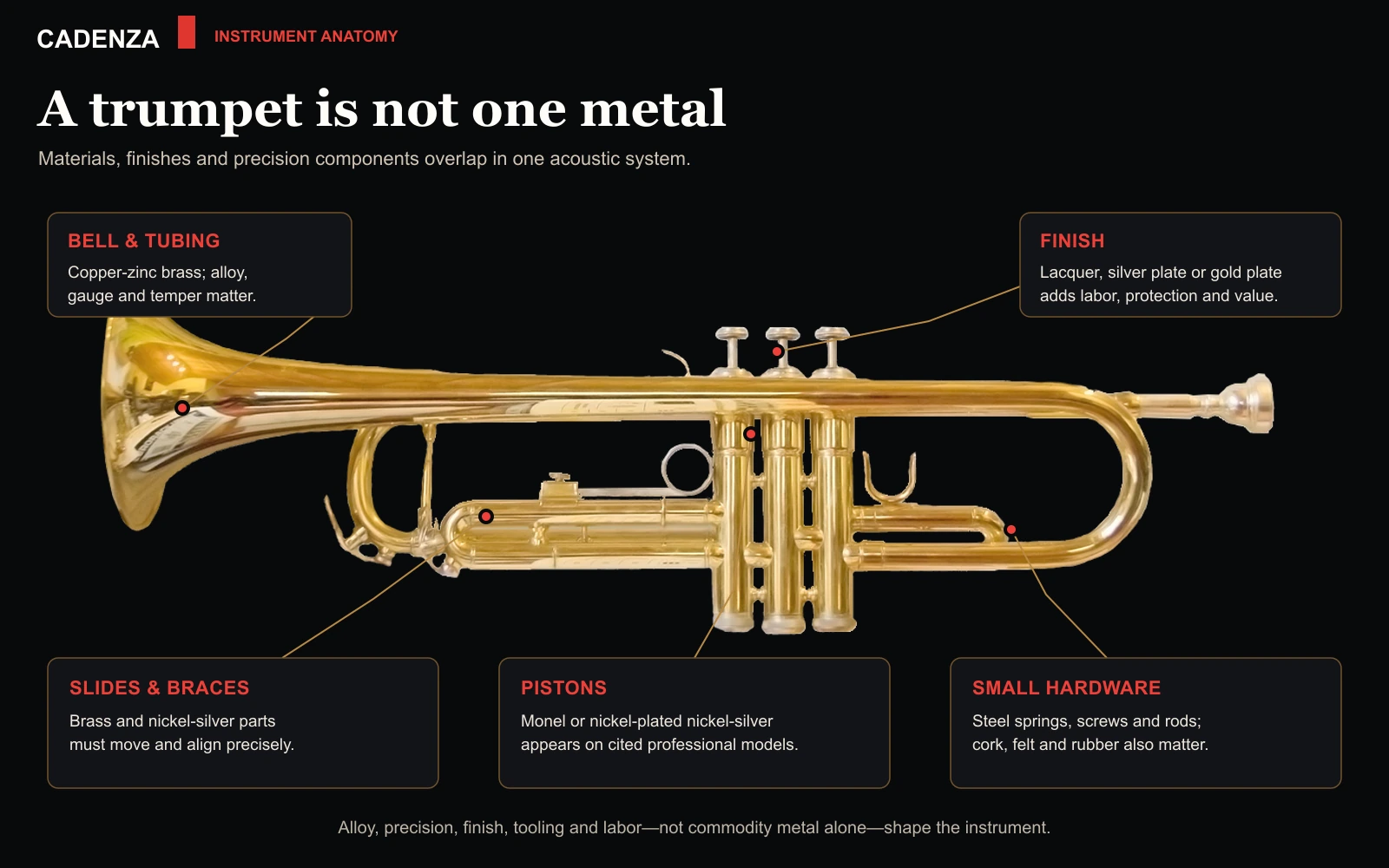
The principal body of a trumpet is usually brass, an alloy of copper and zinc. Yamaha’s manufacturing guide describes a traditional one-piece bell beginning with a fan-shaped sheet of brass roughly 0.5 millimeters thick, composed of about 70 percent copper and 30 percent zinc. The sheet is formed, joined, hammered and spun over a mandrel by skilled workers. 37
That bell is only one system.
A modern trumpet may include:
- yellow-brass, gold-brass or red-brass tubing and bell stock;
- nickel-silver slide components or braces;
- Monel, nickel-plated nickel-silver or other piston materials;
- steel springs, screws, rods and wire;
- solder and brazing alloys;
- silver, lacquer or gold finishes;
- cork, felt, rubber, plastic and case materials;
- a mouthpiece made from brass, stainless steel, titanium, plastic or another material.
Bach’s student BTR302S, for example, advertises an Elkhart-made nickel receiver and red-brass leadpipe assembly, brass inner and nickel-silver outer slide tubes, Monel pistons and silver plate. Getzen’s custom trumpets describe hand-lapped nickel-plated nickel-silver pistons, nickel-silver balusters and one-piece hand-hammered bells. 2830
The instrument is therefore not simply “copper.” It is a compact assembly of metals, surface treatments, precision interfaces and labor.
This is why tariff exposure can be indirect. The finished instrument’s code may be outside the Section 232 list while an imported tube, spring, screw, sheet, wire, plating chemical, machine tool or piece of production equipment faces a different duty. The cost can enter before final assembly. It can also enter through the factory’s supplier, making the tariff invisible to the maker until the supplier changes a quote.
The White House’s strategic-metal argument is easiest to understand at the smelter and hardest to administer at the instrument bench. A primary-metal tariff targets a broad commodity. A trumpet maker buys a specification: hardness, thickness, temper, consistency, surface quality, machinability and acoustic performance. The existence of domestic copper does not guarantee the immediate availability of every suitable semi-finished input at the required scale and price.
That is not an argument against domestic capacity. It is an argument for knowing which capacity is missing.
8 A note begins long before the musician breathes
Consider the path of a professional trumpet.
Copper and zinc are mined, concentrated, refined and alloyed. Sheet and tubing are produced to tolerances. Bell blanks are cut. Tubes are drawn. A bell may be formed from one piece or two. A leadpipe is shaped. Valve casings are machined and aligned. Pistons are fitted to tolerances measured more like precision engineering than decorative metalwork. Slides must move while sealing air. Solder joints must be clean and strong. The instrument is polished, plated or lacquered, assembled, leak-tested, aligned and played.
Every stage contains knowledge that cannot be conjured by a tariff rate.
The United States still possesses world-class brass-instrument skill. Getzen says every trumpet in its range, from advanced student to custom professional models, is crafted in Elkhorn, Wisconsin. Edwards says its production team operates inside the Getzen facility and uses a selected group of experienced workers. Schilke says its trumpets are created one at a time in its Chicago-area factory, with its i Series 100 percent built by Schilke craftsmen in Melrose Park, Illinois. Conn Selmer markets Bach’s C190 line as handcrafted by artisans in Elkhart, Indiana. S.E. Shires operates a factory and showroom in Holliston, Massachusetts. 272932343536
Those facts defeat a lazy claim that America cannot make brass instruments.
They do not prove that America can currently make every brass instrument, at every price point, in the quantities required by school rental fleets, marching programs, community bands, orchestras and the global market.
A professional trumpet and a rental-fleet trumpet solve different economic problems. A hand-hammered bell can justify labor hours that a $30-a-month rental instrument cannot. A boutique maker can fit an artist by appointment; a school supplier may need thousands of durable units before August. A domestic plant can excel at high-value instruments while imported student lines maintain access at the entry level.
That layered market is what blunt tariffs risk flattening.
9 “Made in America” is not one fact
Getzen has long been unusually explicit about domestic content. In a 2010 company post, Brett Getzen argued that loose public understanding of “Made in America” allowed some firms to import major subassemblies and perform enough domestic work to market the final product as American-made. He wrote that the company’s then-student 390 trumpet contained about 97 parts, 73 made in Elkhorn and the remaining parts made elsewhere in the United States. 31
The post is old and should not be treated as a current bill of materials for every model. Its larger point remains important: country-of-origin claims can conceal radically different supply chains.
There is a spectrum:
- raw material mined, refined and fabricated domestically;
- components made domestically from imported raw material;
- major subassemblies imported and finished domestically;
- instrument assembled domestically from mixed-origin parts;
- finished instrument imported under an American brand;
- foreign brand imported through a U.S. distributor.
Tariffs affect each model differently.
A company near the first end may benefit from protection against a low-priced finished import but still pay more for an unavailable alloying input or production machine. A company near the middle may face duties on components. A company importing finished instruments may pass costs to dealers and families. A U.S. dealer selling Japanese, German or Taiwanese professional horns may have no domestic substitute that feels, plays or sounds identical to the musician.
Policy rhetoric often collapses all of this into a binary: American or foreign.
The trumpet refuses the binary. Its bell may be American, its piston material imported, its plating domestic, its machine tool European, its case Asian and its owner a public-school student whose family does not care about tariff theory because the rental payment is due Friday.
9A The annex is the law’s map, not a mood board
The April proclamation is dramatic. The annex is operational.
That distinction is easy to miss because presidential fact sheets describe categories in ordinary language—metal articles, derivative products, industrial machinery—while customs enforcement works through tariff provisions and legal notes. A product can be made mostly of steel and remain outside a particular derivative list. Another product with less obvious metal content can be listed because the administration decided it was important to the remedy.
The annex runs for 58 pages and modifies Chapter 99 of the tariff schedule. It groups covered articles, products removed from prior coverage, goods receiving particular rates, and rules for metal content and partner-country treatment. It includes products far beyond raw ingots and coils. That is why importers cannot infer coverage by looking at an object. 4
For musicians, the practical rule is brutal in its simplicity:
The bell may be brass. The tariff is code.
This is also why the phrase “brass instruments are included because brass contains copper” is not sufficient. Brass is indeed a copper-zinc alloy. But finished instruments are classified in Chapter 92. Unless the relevant Chapter 92 line is included or another scope rule reaches it, the material fact does not itself create a Section 232 duty.
The same principle works in the opposite direction. A music stand, case latch, machine, display fixture or repair tool may not be a musical instrument at all for customs purposes. It may fall in a covered steel or aluminum provision. The music industry can therefore face Section 232 costs without the trumpet code appearing in the annex.
That is one reason NAMM’s advocacy speaks of products, components and raw materials. The industry’s legal exposure is distributed across the tariff schedule. 813
9B The fifteen-percent threshold is not a universal safe harbor
The April framework includes a rule for certain listed products outside Chapters 72, 73, 74 and 76: if they contain less than 15 percent aluminum, steel or copper by weight, they are not subject to specified Section 232 duties. 24
It is tempting to turn that into a universal rule:
“Anything under 15 percent metal is safe; anything over 15 percent is taxed.”
That is wrong.
The threshold applies within the scope created by the proclamation and annex. It is not a free-standing tariff on every object in America. A product must first be among the relevant listed goods or otherwise brought within scope.
This matters because a trumpet is likely well above 15 percent covered metal by weight, but that observation still does not place HTS 9205.10.00 on the list. The threshold is a limitation on covered listed products, not a trigger for unlisted products.
The difference may sound technical. It is the difference between fact and a false invoice.
9C Full customs value changed the stakes
Earlier versions of the Section 232 steel and aluminum system often calculated the additional duty on the value of the covered metal content rather than the entire finished product. That approach created administrative complexity and opportunities for low declared metal values.
The April 2026 proclamation shifted listed products into a full-customs-value framework. The White House said the change would prevent tariffs from being calculated against an artificially low foreign metal price and ensure the rate reflected the value of the imported article. 23
For a highly engineered product, the difference can be enormous.
Imagine a listed machine with $2,000 of steel inside a $20,000 customs value. A 25 percent duty on steel content is $500. A 25 percent full-value duty is $5,000. The tariff no longer follows only the raw metal. It taxes design, labor, electronics, software and other value embodied in the imported product.
That is why music-industry concern cannot be dismissed as hysteria. If a Chapter 92 product were added as a derivative and assigned full-value treatment, the duty could apply to the whole instrument rather than a customs estimate of copper content. The current annex does not do that to finished brass-wind instruments. The authority and precedent make the hypothetical economically serious.
9D The rolling list is a standing source of uncertainty
The April proclamation ended prior inclusion procedures and replaced them with authority for the Commerce Secretary and USTR to add derivatives on a rolling basis when they jointly determine that imports undermine the national-security measures. 2
That design has advantages. It allows the government to respond when importers shift from a tariffed metal product to an untariffed downstream product. It reduces the time between circumvention and enforcement.
It also means the product boundary can move.
A manufacturer considering a five-year investment must ask not only what the tariff is today but whether a product or input could be added tomorrow. A retailer must decide how much inventory to hold. A foreign supplier must decide where to locate finishing. A school bid may be written months before delivery.
The uncertainty is not an accidental side effect. It is part of the leverage. The possibility of future inclusion can change sourcing before a tariff is imposed.
For journalists, that means every article must be date-stamped. “Not currently listed” is the accurate formulation. “Exempt forever” is not.
9E Why the trumpet is a perfect customs trap
The word brass creates three different meanings at once:
- a family of instruments defined by sound production and tradition;
- an alloy, usually copper and zinc;
- a colloquial label for military or institutional authority—“the top brass.”
Trade policy operates only on the second and on legal product classification. The public hears all three.
A saxophone is often made of brass but is not normally grouped with trumpets and trombones as a “brass instrument” in musical pedagogy because the sound begins with a reed. A French horn is a brass instrument even if a particular component uses another alloy. A fiberglass sousaphone can remain a brass-wind instrument by musical and tariff classification even though its bell is not brass.
Material, acoustical family and customs heading overlap imperfectly.
That mismatch is fertile ground for viral misinformation. It is also a reminder that industrial policy designed by broad material category can interact strangely with products whose identity is cultural and functional rather than chemical.
9F Copper is strategic; brass is a partnership with zinc
A trumpet bell demonstrates a limit in the policy vocabulary.
The administration’s Section 232 framework covers copper, steel and aluminum. Traditional yellow brass is roughly 70 percent copper and 30 percent zinc. 37
A domestic copper strategy therefore addresses only part of the alloy. The maker also needs zinc, controlled alloying, rolling or drawing, consistent temper and appropriate dimensions. The United States can expand copper mining or smelting without automatically creating affordable domestic musical-brass sheet.
This does not weaken the national-security rationale for copper. It shows why raw-material policy must be connected to semi-finished manufacturing.
A mine is not a bell.
Between them sit refineries, alloy producers, mills, distributors, quality systems and small-volume specialty orders. If any link remains foreign or uneconomic, the trumpet maker remains dependent.
9G Nickel silver contains no silver
Instrument terminology can mislead trade analysis in another way.
“Nickel silver” is generally a copper-nickel-zinc alloy. The name refers to appearance, not silver content. Makers use it for slide components, braces, valve parts and other areas where hardness and wear matter.
A customs or policy analysis based on product names rather than composition can therefore fail. “Silver-plated” indicates a finish; “nickel silver” indicates an alloy; “gold brass” usually indicates a higher-copper brass, not gold content.
The instrument industry uses language developed around craft and performance. Tariff administration uses chemical composition and classification. Translating between them requires technical knowledge.
9H Valve material is a strategic detail at human scale
A trumpet’s piston must move rapidly, seal air and resist corrosion. Manufacturers use materials and coatings selected for wear, dimensional stability and feel. Bach identifies Monel pistons on the BTR302S; Getzen describes nickel-plated nickel-silver pistons in its custom series. 2830
A valve problem can make a $5,000 instrument unusable even if the bell is perfect.
This is how supply-chain resilience actually works: the failure of a small component can stop the entire product. Industrial policy focused only on tonnage can miss the low-volume precision part that becomes the bottleneck.
A credible onshoring map should therefore identify:
- valve materials and plating;
- springs and guides;
- precision tubing;
- solder and brazing alloys;
- bell sheet;
- rotary-valve components;
- finishing chemicals;
- specialized machine tools.
The strategic unit is not always the metal. Sometimes it is the tolerance.
9I Silver and gold finishes show why full-value tariffs can overreach
A silver-plated trumpet contains value far beyond the weight of silver. The finish requires preparation, labor, chemicals, equipment and quality control. A gold-plated instrument adds further value.
If a finished product were ever brought into a full-value metals tariff because of one covered material, the duty could tax all of that non-metal value as well. That is the logic of the April restructuring for listed products. 23
The government’s argument is anti-evasion: foreign producers should not minimize the declared value of metal inside an expensive finished article. The downstream objection is proportionality: a metal remedy can become a tax on craftsmanship and design.
The current absence of 9205.10.00 from the annex avoids that problem for finished brass instruments. The possibility explains why NAMM and importers watch rolling derivative additions closely.
9J The supply chain is acoustic because consistency is acoustic
To a commodity buyer, two sheets of brass meeting a nominal specification may appear interchangeable.
To an instrument maker, small differences in thickness, hardness, grain, surface and forming behavior can affect production yield and instrument response. A material that cracks during spinning, springs back after bending or varies between batches creates cost even if its price is lower.
Reshoring therefore requires qualification. A domestic supplier must not only exist; it must produce material the factory can use consistently.
This is why abrupt tariffs can cause disruption before substitution. The maker cannot change a critical input the way an office changes printer paper. New material may require prototypes, tool adjustments, acoustic testing and player approval.
Time is part of capacity.
Part IV — The factory that makes the contradiction impossible to ignore
10 Eastlake: the plant that closed while Washington promised reshoring
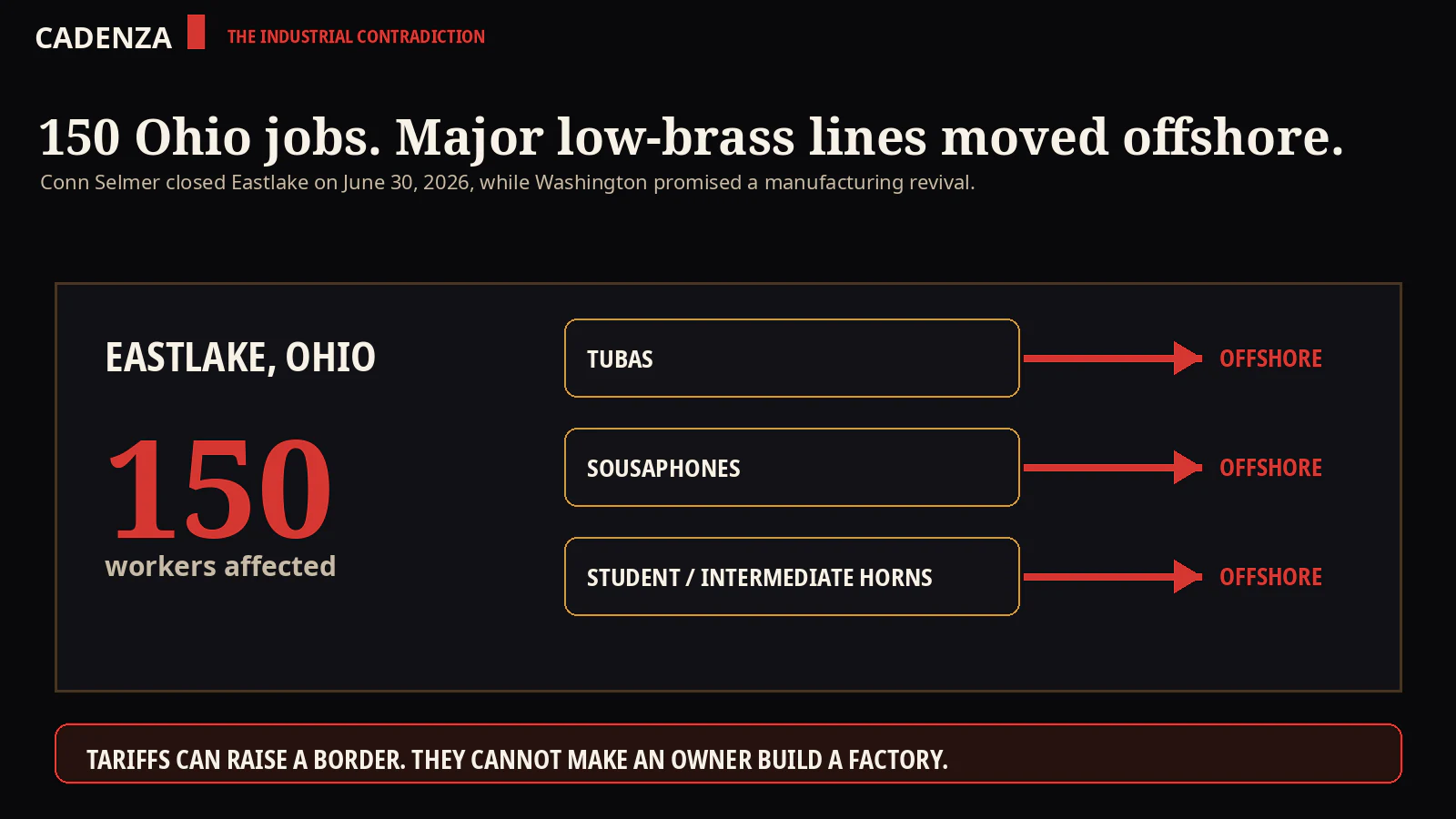
On June 30, 2026, six decades of brass-instrument production ended at Conn Selmer’s factory in Eastlake, Ohio.
The company had announced the plan in January. Its official statement called the decision tentative at first and said it was subject to negotiation with the union. If finalized, Conn Selmer said professional French-horn production would move to its Elkhart brass factory, while tuba, sousaphone and student/intermediate French-horn production would transition offshore. The company described the consolidation as a way to improve competitiveness and concentrate U.S. operations in one professional-brass factory and one percussion factory. It also called itself the largest manufacturer of band instruments in the United States and emphasized its 150-year commitment to American manufacturing. 22
The closure ultimately affected about 150 workers. Reuters reported that Conn Selmer’s chief executive told employees that production of tubas, sousaphones and some French horns—nearly all of the Eastlake output—would shift to China. Ideastream documented the plant’s final days and the local history embedded in the operation. 2325
The story would be significant under any president. Under Trump, it became a test of the central promise behind the tariff program.
The White House says tariffs are necessary to reduce reliance on foreign manufacturing, encourage domestic production capacity, train workers and rebuild industries essential to the defense base. Conn Selmer said closing Eastlake and shifting major lines abroad would improve competitiveness. Both statements can be economically intelligible in isolation. Together they expose the gap between national industrial rhetoric and company-level incentives. 222
A tariff can change the relative price of an import. It cannot force a privately owned manufacturer to maintain an aging plant if the company concludes the investment is uneconomic. It cannot guarantee that a protected upstream metal industry yields a viable downstream musical-instrument factory. It cannot preserve a workforce after equipment, orders and know-how move.
This is why Eastlake belongs at the center of the article rather than in a sidebar.
The country was not merely losing an abstract “manufacturing job.” It was losing workers who knew how to build low brass and horns—products that the administration’s own national-security framework would recognize as embodiments of industrial skill, tooling and domestic capacity if they were tanks, turbines or transformers.
No tariff fact sheet counted the loss of the Eastlake skill base.
11 John Paulson and the politics of offshoring
The owner-level politics made the closure more combustible.
Conn Selmer is part of Steinway Musical Instruments, controlled by billionaire investor John Paulson. Paulson was one of Trump’s prominent Wall Street supporters and fundraisers. The Guardian reported that in a 2024 CNBC interview Paulson criticized American producers closing factories and offshoring, saying the country needed to protect American jobs and manufacturing. Workers and union representatives later invoked that rhetoric as they tried to save Eastlake. 24
Reuters reported that employees sought to pressure Paulson through his Trump relationship and appealed for intervention. Their effort failed to stop the closure. The article described workers who had voted for Trump and believed his manufacturing agenda should have aligned with their campaign. 23
The contradiction is not that a Trump supporter made a business decision. Political donors do not surrender control of their companies.
The contradiction is that the public rationale for tariffs is often moralized: loyal capital versus globalist offshoring, American workers versus corporate betrayal, domestic factories versus Chinese dependence. When a politically connected owner chooses offshore production anyway, the administration’s theory confronts the behavior of its own allies.
Cadenza cannot establish from public records that Paulson personally directed every operational detail, that tariffs caused the closure, or that presidential intervention would have been lawful or wise. The company said it was pursuing competitiveness. Reuters reported that chief executive John Fulton told workers maintaining the operation would require substantial investment. Those facts belong in the record. 2223
But the question remains unavoidable:
If the tariff program cannot make domestic brass production competitive inside a company owned by one of the President’s closest financial allies, what exactly is the mechanism by which it will reshore the rest of the industry?
That is not a rhetorical trick. It is the industrial-policy test.
The administration might answer that tariffs need time; that Eastlake reflected decisions made before the latest framework; that professional-horn work remained in the United States; that primary-metal capacity is a prerequisite for downstream rebuilding; or that no policy can save every plant. Those are serious answers.
They do not erase the symbolism of the date: the Ohio factory closed in the same year the White House strengthened full-value national-security tariffs on metals and celebrated a manufacturing resurgence.
12 What the Eastlake closure actually moved
Precision matters here too.
Conn Selmer did not announce the end of all U.S. brass manufacturing. It said professional French-horn production would transfer to Elkhart. Bach professional-trumpet production remains associated with Elkhart. Conn’s official materials continue to present the company as an American manufacturing leader. 222627
The loss was concentrated but meaningful:
- tuba production;
- sousaphone production;
- student and intermediate French-horn production;
- most Eastlake employment;
- a physical plant and localized workforce built over decades.
Those categories matter because low brass is expensive, bulky and central to schools, marching programs, community ensembles and ceremonial bands. A sousaphone is not a disposable consumer gadget. A tuba can remain in a school inventory for decades, passing through many students and repeated repair cycles. Moving production offshore changes not just origin labels but lead times, parts flows, repair relationships, institutional purchasing and the resilience of supply.
There is also a structural irony. The product lines most likely to require scale and price discipline—the lines serving students and institutions—are the ones moving offshore. The highest-value professional work is more capable of remaining domestic because its margin can support skilled labor.
That pattern is not unique to Conn Selmer. It is the basic divide in much of musical-instrument manufacturing.
Tariffs may protect the premium domestic segment while making the entry segment more expensive. If fewer children begin because student instruments cost more, the future market for premium domestic instruments shrinks. The policy can therefore support the top of the pyramid while weakening its base.
NAMM made exactly that pipeline argument to USTR: reduced access to beginner instruments threatens the ecosystem that ultimately sustains U.S.-made professional products. 910
Eastlake turns that abstract warning into a factory address.
12A Elkhart was once an industrial ecosystem, not a logo
Conn’s own history says that by 1905 its Elkhart factory had helped make the city synonymous with global band-instrument manufacturing. 26
That status was not created by one brand. Elkhart became a cluster: instrument companies, toolmakers, platers, case makers, suppliers, repair knowledge, schools and workers moving between firms. A cluster lowers the cost of specialized labor and makes experimentation easier. If one factory needs a bell spinner, a toolmaker or a plating expert, the skill may exist nearby.
Consolidation and offshoring reduced that density over decades. Brands survived after plants closed. Production moved between Elkhart, Elkhorn, Eastlake and foreign suppliers. The name on a bell could preserve heritage while the industrial geography changed beneath it.
The distinction matters because tariffs often protect products, while clusters are made of relationships.
A tariff can make an imported horn more expensive. It cannot recreate the supplier who retired, the plating line that was dismantled or the worker who changed industries. Rebuilding a cluster requires patient demand and institutions that preserve craft across business cycles.
12B A factory closure has a long acoustic tail
When a plant closes, the immediate measure is jobs. The longer measure is product knowledge.
Workers know which fixture drifts, which bend wrinkles, which bell blank cracks, which solder sequence prevents stress, which model needs extra alignment and which tolerance looks acceptable on paper but fails in the hands of a player.
Some of that knowledge can be documented. Much of it is tacit.
The loss appears later:
- replacement parts change;
- model consistency shifts;
- repair technicians adapt;
- dealers hold old inventory;
- musicians search for earlier serial numbers;
- tooling is scrapped or shipped;
- a design becomes a brand name rather than a living production method.
This is why the Eastlake decision cannot be evaluated only as a cost saving. It changed the location and ownership of know-how.
12C The $13 million question
Reuters reported that Conn Selmer’s chief executive told workers that roughly $13 million would be needed to keep the Eastlake facility operational. 23
Cadenza has not reviewed the underlying capital plan. The figure may include building work, equipment, environmental compliance, modernization, operating losses or other costs. It should not be treated as independently verified.
But take the number at face value for the policy test.
The federal government uses tariffs that can shift billions of dollars across industries. It created an aluminum investment incentive tied to domestic capacity. A $13 million gap is not inherently too large for an industrial-policy intervention—especially if the plant preserved 150 jobs, specialized skills and nationally significant product lines. 6
The government might have concluded the investment was unjustified. The company might have refused conditions. The plant might not have been viable even after support.
The unanswered question is whether anyone built the case.
Was there a Commerce review? A state-federal package? A loan guarantee? A worker buyout proposal? A procurement commitment? A request from Paulson? A proposal from the union?
The public record cited here does not show a transparent process.
12D Tariffs and ownership incentives are not the same thing
Tariff policy assumes owners will respond to price signals by investing domestically.
Owners may respond differently:
- import from a country with lower treatment;
- reclassify or redesign products;
- move only final assembly;
- raise prices;
- reduce product variety;
- acquire a domestic brand without expanding its plant;
- wait for policy reversal;
- exit the category.
The state’s objective is capacity. The owner’s objective is return.
Those objectives can align. They do not align automatically.
Eastlake demonstrates why industrial policy needs enforceable commitments. A tariff benefit available to an owner should be tied, where lawful, to measurable domestic investment, employment or production. Otherwise the public pays more while capital remains free to leave.
12E “Professional production stays” is not a complete answer
Conn Selmer’s decision preserved professional French-horn production domestically by moving it to Elkhart. That deserves acknowledgment. 22
It also reveals a hierarchy.
High-margin professional work is culturally prestigious and economically easier to retain. Student and low-brass lines are more exposed to price competition and scale. If public policy preserves only the premium segment, the country can claim heritage while depending abroad for the instruments that create future musicians.
A resilient industry needs both:
- the artisanal top;
- the accessible base.
The trumpet market cannot survive as a museum of elite craftsmanship disconnected from school demand.
Part V — America still makes great horns
13 The makers who complicate the decline narrative
Any article that says American brass manufacturing is dead is wrong.
In Elkhorn, Wisconsin, Getzen says its entire trumpet range is crafted in the United States, from advanced-student models to custom professional instruments. The company emphasizes hand-lapped valves, hand-hammered bells and in-house craft. Edwards, its sister company, builds custom trumpets and trombones through a specialized production team in the same facility and has long publicly emphasized U.S. production. 29303233
In Melrose Park, Illinois, Schilke says its trumpets are created one at a time at its Chicago-area factory and that its i Series is 100 percent built by Schilke craftsmen. 3435
In Elkhart, Conn Selmer markets Bach’s C190 C-trumpet line as handcrafted by its artisans. The city’s identity remains inseparable from band-instrument production; Conn’s own history says the factory helped make Elkhart synonymous with global instrument manufacturing by the early twentieth century. 2627
In Holliston, Massachusetts, S.E. Shires maintains a factory, showroom and fitting operation for trumpets, trombones and euphoniums. 36
These manufacturers demonstrate that the United States retains:
- bell making;
- valve and rotor work;
- slide construction;
- precision fitting;
- plating and finishing;
- acoustic design;
- play testing;
- repair knowledge;
- brand power and artist relationships.
That base is not trivial. It is exactly the kind of accumulated industrial knowledge that Section 232 tells policymakers to consider when assessing loss of skills and investment.
The policy question is not whether the base exists. It is whether the current tariff architecture expands it.
14 A professional horn is not a school-rental fleet
The surviving American makers tend to be strongest where craftsmanship, customization and brand reputation command higher prices.
A professional musician may spend thousands of dollars on an instrument selected over hours of testing. The instrument can be a career tool used for decades. A custom maker can justify small batches, handwork, direct fittings and skilled labor.
The student market behaves differently.
A school dealer needs instruments that are:
- affordable enough for monthly rental;
- durable enough to survive buses, lockers and beginners;
- standardized enough for fleet maintenance;
- available in large numbers before the school year;
- supported by predictable parts and repair;
- replaceable when enrollment changes.
The cheapest imported trumpet is not equivalent to a professional American trumpet. They are not substitutes in the way two brands of nails might be substitutes. Raising the imported student horn’s price does not automatically cause a family to buy a custom domestic horn. It may cause the family to rent, choose another activity, buy used, borrow from a school, accept a lower-quality marketplace instrument, or do nothing.
This is the central demand problem in the reshoring argument.
Tariffs work most cleanly when domestic production can expand into the same market segment. If domestic capacity exists only at a higher specification and price, the tariff can reduce quantity more than it redirects demand.
NAMM’s reported 27 percent decline in wind-instrument imports during 2025 is therefore ambiguous. It could reflect pre-buying, inventory adjustment, lower demand, higher prices, tariff uncertainty, exchange rates, supply changes or multiple causes. It is not proof that 27 percent of imported horns were replaced by American production. NAMM said the decline was concentrated in student-grade instruments, which makes an access contraction at least as plausible as a reshoring gain. 89
A serious administration would measure both sides:
- How much domestic student-instrument capacity was added?
- How many school purchases were deferred?
- Did rental prices rise?
- Did repair shops extend the life of old fleets?
- Did U.S. makers invest in entry-level lines?
- Did retailers reduce inventory?
- Did participation fall?
Without those answers, “imports fell” is not a complete victory statement.
15 The American manufacturing paradox
The trumpet industry reveals a paradox at the heart of industrial policy.
American manufacturers often rely on imported inputs. Imported student instruments can create future customers for American professional instruments. Foreign makers support American dealers, repair technicians, educators, artists and distributors. American makers export into markets that may retaliate. The same tariff can protect one line, tax another and shrink a third.
NAMM’s 2025 statement said the U.S. music-products industry’s import concentration differed sharply from the economy as a whole: China represented 43 percent of industry imports and Vietnam 26 percent, compared with much lower shares of overall U.S. imports. The organization argued that the supply chain had been built over generations and could not simply be replicated domestically. 12
That argument should not be accepted without examination. Industries routinely describe their supply chains as irreplaceable when they mean replacement would be costly. Costly is not impossible. A credible reshoring program may deliberately accept transitional expense.
But transition requires more than punishment at the border.
It requires:
- tooling finance;
- worker training;
- stable demand;
- predictable rates over years, not weeks;
- access to appropriate sheet, tube, wire and plating inputs;
- environmental permits;
- supplier development;
- procurement commitments;
- automation where appropriate;
- repair and parts ecosystems;
- export competitiveness.
The Trump administration’s July 2026 aluminum investment incentive at least recognizes that tariffs alone may not create capacity. It offers reduced import treatment tied to approved onshoring plans for primary aluminum. 6
A comparable instrument-manufacturing strategy does not yet appear in the public record.
There is no trumpet onshoring plan, no national bell-spinning apprenticeship, no school-instrument procurement guarantee, no valve-block investment credit, no published map of missing capacity and no transition fund for the Eastlake workforce.
There are tariffs.
15A Bach: an American name with a segmented production story
Vincent Bach is among the most powerful names in trumpet history. Conn Selmer’s current professional C190 campaign places the instrument squarely in Elkhart: “From Elkhart, Indiana, to the world’s stage,” with the series handcrafted by company artisans. 27
The student side is more complicated. The BTR302S page describes an Elkhart-made receiver and red-brass leadpipe assembly and identifies a mix of brass, nickel silver, Monel and silver plating. It does not state on that page that every part and every manufacturing step occurs in Elkhart. 28
That difference is not an accusation. It is a model of the modern industry.
A brand can preserve domestic design, critical subassembly work and professional production while using a broader global supply chain for student lines. The result may be commercially rational: put scarce American labor into the products that can support it, while using international production to reach the rental market.
Tariff policy then pulls the company in opposite directions. A duty on foreign student instruments can protect domestic production in theory, but it can also increase the cost of the brand’s own globally sourced line. A duty on imported inputs can hit Elkhart production. Retaliation can hit exports of American professional horns.
The public should therefore ask manufacturers for model-level origin disclosure rather than brand-level patriotism.
15B Getzen: proof that student production can remain domestic
Getzen is the strongest counterexample to the claim that entry and step-up brass must be made abroad.
Its official site says all Getzen trumpets—from custom professional instruments to its advanced-student line—are crafted in Elkhorn, Wisconsin. The company’s older origin essay described an unusually deep domestic parts base for a student trumpet. 2931
That does not establish that Getzen could immediately supply the entire American school market. It establishes something more useful: the production model exists.
The policy question becomes why it remains unusual.
Possible answers include labor cost, scale, dealer relationships, tooling, financing, brand positioning and the price expectations created by imported alternatives. A tariff might narrow the price difference. A procurement guarantee might create volume. An apprenticeship subsidy might reduce the labor bottleneck. A raw-material exclusion might protect margin.
Getzen is therefore not merely a company profile. It is evidence that the debate should move from “can it be done?” to “what prevents it from scaling?”
15C Edwards: high-value craft and the economics of specialization
Edwards operates under the Getzen umbrella and says its production team is located inside the Getzen facility, with experienced craftspeople selected for professional instruments. 32
The company’s model is deliberately specialized. Musicians schedule fittings, combine components and buy instruments designed for exacting professional use. This creates a close relationship between factory knowledge and performer demand.
That model is resilient in one sense: its product is differentiated enough that price is not the only factor. It is vulnerable in another: the market is small, exports matter, and skilled labor is difficult to replace.
A policy that raises imported input costs or invites retaliation can harm a company that is already doing what the administration says it wants—building high-value products in the United States.
The correct industrial-policy question is not whether Edwards deserves protection from all competition. It is whether the tariff structure distinguishes an American downstream manufacturer from a foreign producer of the upstream input it needs.
15D Schilke: a factory as an acoustic institution
Schilke’s materials emphasize one-at-a-time production in its Chicago-area factory and 100 percent domestic build for its i Series. 3435
A trumpet factory of this kind is more than an assembly point. It stores design judgment: how bell taper, alloy, wall thickness, leadpipe geometry, bracing and valve fit interact. Those decisions are difficult to patent in a way that preserves the full craft. They live in workers, fixtures, test routines and institutional memory.
Section 232’s emphasis on loss of skills is directly relevant. If such a factory disappears, the country does not merely lose units of output. It loses a problem-solving community.
That is the strongest cultural argument for domestic manufacturing. The value is not only the number of horns. It is the capacity to invent and adapt them.
15E S.E. Shires: modular production and local fitting
S.E. Shires’ Holliston factory and showroom represent another American model: modular professional instruments, direct fitting and component choice. 36
A player may compare bells, leadpipes, slides and valves to build a configuration. The factory’s domestic presence shortens the feedback loop between artist and maker. It also supports repairs and modifications.
This kind of company is unlikely to replace a mass student-rental line on its own. It can, however, anchor a cluster of suppliers, technicians and training.
Industrial policy often chases scale and overlooks clusters. A small high-skill firm can matter because it keeps knowledge, equipment and careers alive.
15F Yamaha: the foreign competitor is also a manufacturing benchmark
Yamaha complicates protectionist rhetoric because it is not merely a low-cost importer. Its manufacturing literature documents sophisticated bell forming, skilled handwork and a global atelier system connecting technicians and artists. 3738
A tariff may make a Yamaha trumpet more expensive in America. It does not transfer Yamaha’s production system to Wisconsin.
To compete, American policy must support quality, consistency, research and training—not only raise the border price.
Foreign excellence can be a threat to domestic market share and a benchmark for domestic improvement. Treating every import as equivalent obscures that difference.
15G The missing middle
The U.S. brass sector has premium domestic makers and imported entry products. The strategic gap is the middle: scalable, repairable, school-ready instruments made domestically at a price institutions can sustain.
This is where policy should concentrate.
The government does not need every trumpet to be American. It needs enough capacity that the country is not dependent on a narrow set of foreign factories for the entire beginner pipeline. It needs domestic parts, repair and surge capability. It needs a route for a student instrument to be made profitably without pretending American labor costs equal foreign labor costs.
The missing middle is an industrial design problem. Tariffs can alter the equation. They cannot solve it alone.
Part VI — The school-band tax
16 The first note is the most price-sensitive note
A professional player often knows the exact instrument desired and may wait months for it. A beginner does not know whether the trumpet will last beyond October.
That uncertainty makes entry-level music unusually sensitive to price.
A family deciding whether a child will join band is not evaluating an isolated product. It is evaluating rental payments, reeds or valve oil, a music stand, lessons, transportation, uniforms, activity fees and the possibility that the child quits. A school district is balancing instruments against teacher positions, buses, technology, special education, building needs and every other budget claim.
A tariff increase does not need to double an instrument’s retail price to matter. It only needs to push the monthly rental beyond the threshold at which a family says no, or reduce the number of instruments a district can replace.
NAMM says approximately 25 million children participate in school music programs. The figure is industry-supplied, but it establishes the scale of the downstream audience. 8
The tariff burden is also regressive in a practical sense. A wealthy family can absorb a higher rental, purchase used or buy a better instrument. A well-funded suburban program can maintain a fleet. A low-income family and a district with old inventory have fewer alternatives.
The result may not appear as a line called “tariff impact” in a school budget. It appears as:
- one more repaired horn instead of a replacement;
- fewer tubas available;
- a child placed on percussion because no trumpet remains;
- a rental company tightening approval or raising monthly rates;
- a director buying a lower-tier marketplace instrument;
- a parent declining the activity.
These are small decisions multiplied across thousands of programs.
17 Rental fleets hide the tariff until they cannot
The school-instrument market often distributes cost over time.
A dealer buys inventory, rents instruments monthly, services them, credits part of the rent toward ownership and rotates returned instruments into future seasons. That model can delay the visible price effect of a tariff. A dealer may absorb a duty in margin, use pre-tariff inventory, extend depreciation or raise rates gradually.
The delay can create political illusion. Consumers may not see an immediate 16.6 percent price increase even if the average effective tariff rate on imports reaches that level. Retail pricing depends on customs value, distributor margin, freight, inventory timing, exchange rates, competition and the willingness of each layer to absorb cost.
Economic research on earlier tariffs supports caution. The U.S. International Trade Commission found that importers bore nearly the full cost of the 2018–2021 Section 232 and Section 301 tariffs at the border, with import prices rising roughly one-for-one with tariff rates on average. It also found that the Section 232 metal tariffs increased domestic steel and aluminum production but reduced output in downstream industries that used those metals. 18
A Federal Reserve study similarly found that manufacturing industries more exposed to tariff increases experienced relative employment reductions because protection was offset by higher input costs and retaliation. 19
Retail pass-through can be slower or incomplete because dealers compress margins. That does not make the cost disappear. It moves the pain to the dealer, supplier or manufacturer and may eventually emerge as fewer locations, less inventory, reduced service, lower wages or delayed investment.
For music education, the dangerous period is not necessarily the first price change. It is the second and third school year, after old inventory is exhausted and smaller businesses have had time to fail.
18 Why beginner instruments matter to American professional makers
The industry is a funnel.
Millions encounter music in school. A smaller group continues through high school. Fewer study seriously. Fewer still become professionals, teachers, repair technicians, composers, conductors, engineers or lifelong customers. The American-made professional trumpet sits near the narrow end of that funnel.
The entry-level imported horn often sits at the wide end.
This is why NAMM told USTR that reduced access to beginner instruments threatens the pipeline sustaining U.S.-made professional instruments. 9
The logic is straightforward:
- Fewer affordable entry instruments mean fewer beginners.
- Fewer beginners mean fewer advancing players.
- Fewer advancing players mean a smaller future market for step-up and professional instruments.
- A smaller market weakens dealers, educators, repair shops and domestic makers.
Tariff advocates might answer that domestic student production could replace imports and preserve the funnel. Getzen’s history shows that domestic student manufacturing is possible. The question is price, scale and time. 2931
If the government wants the funnel to become more American, it needs to help build the wide end before taxing the imported version out of reach.
That could mean domestic procurement preferences paired with capital grants, shared tooling, workforce programs and guaranteed school demand. It could mean temporary exclusions for instruments that lack a domestic substitute. It could mean targeted relief for raw materials used by American makers. It could mean a phased schedule tied to measurable capacity milestones.
A blanket slogan—“tariffs will bring it back”—is not a plan for a sixth-grade band room.
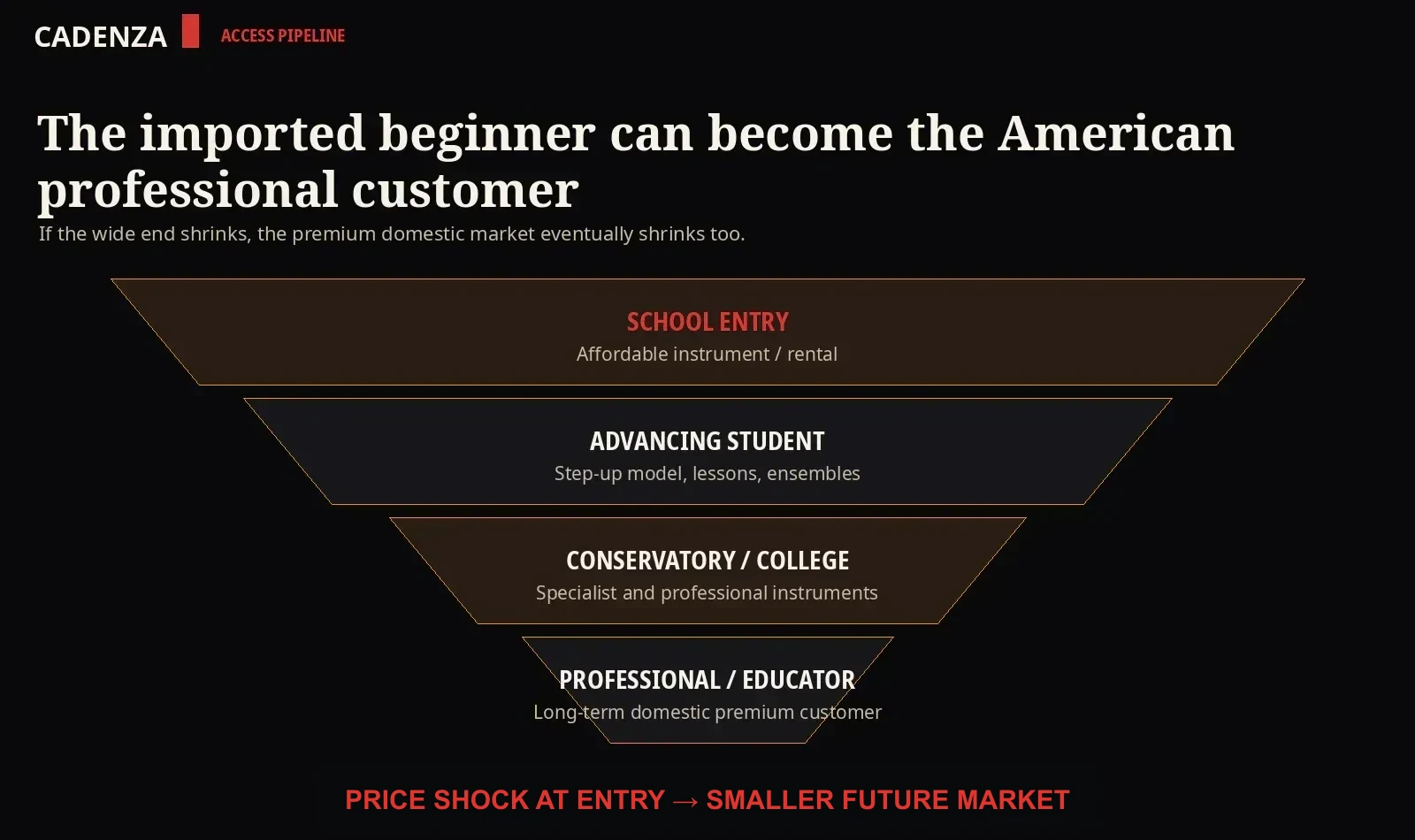
18A The low-brass problem is bigger than the trumpet problem
The trumpet is the perfect headline because everyone recognizes it. The largest budget shock may sit lower in the band.
Tubas, euphoniums, sousaphones and French horns cost more to manufacture, ship, store and repair. Schools often own them because family purchase is unrealistic. A single price increase can therefore remove an entire instrument from a program rather than merely raise one family’s bill.
The Eastlake closure concentrated exactly in these categories. Tuba and sousaphone production went offshore; student and intermediate French-horn production followed. 2223
That creates a policy loop:
- American low-brass production contracts.
- Schools become more dependent on imports.
- Tariffs raise the cost of those imports.
- Higher prices are cited as a reason to reshore.
- The domestic factory that might have provided the capacity is already closed.
A country can escape that loop only by investing before the skills and tooling disperse.
18B Marching bands and drum corps operate on fleet economics
Marching organizations buy in sections. A trumpet line may need matched models. A sousaphone section may require instruments rugged enough for outdoor use and uniform enough for visual and musical consistency. Cases, harnesses, mouthpieces and replacement parts multiply the order.
A tariff-induced increase that appears modest per instrument becomes large across a fleet. Ten $75 border-cost increases equal $750 before margin. Ten $1,000 increases on imported tubas equal $10,000.
Programs may respond by:
- extending replacement cycles;
- reducing section size;
- buying used;
- mixing models;
- shifting cost to participants;
- reducing travel or instruction.
None of those outcomes appears in a customs report. They appear in the quality and accessibility of the program.
18C Youth orchestras and conservatories face a different substitution problem
Advanced students are more model-specific than beginners. A conservatory player may need a C trumpet, piccolo trumpet, flugelhorn or orchestral horn with characteristics unavailable in a school fleet. The relevant market includes American, Japanese and European makers.
A tariff can therefore function less like an incentive to buy American and more like a professional-training fee. If the required instrument is foreign and no close substitute exists, the student pays.
That burden can compound existing inequality in elite music education, where instruments, lessons, travel and auditions already require substantial resources.
18D Public procurement magnifies uncertainty
School purchases often require bids approved months in advance. A distributor may quote before a shipment enters the country. If a tariff changes before delivery, one of four things happens:
- the dealer absorbs the difference;
- the district pays a change order;
- the order is canceled;
- the dealer refuses to quote far ahead.
All four weaken procurement.
Stable rules matter as much as rates because public institutions cannot reprice instantly. A district is not a hedge fund. It cannot trade tariff risk.
18E The participation effect is the missing national statistic
NAMM reports import declines and says approximately 25 million children participate in school music programs. What the public still lacks is a timely national measure connecting instrument prices to participation. 8
Policymakers should track:
- beginner enrollment by instrument;
- rental approvals and defaults;
- average monthly rental by region;
- school fleet age;
- repair backlog;
- instrument-to-student ratios;
- canceled purchase orders;
- price differences by income and district.
Without those data, government can celebrate tariff revenue while missing the child who never enters the band room.
18F Music education is not an incidental consumer category
A trumpet sold to a beginner is not merely entertainment spending. It is access to an educational program recognized in federal law as part of a well-rounded education. NAMM’s advocacy is self-interested—it represents merchants—but the downstream institution is public education. 15
That does not automatically justify an exemption. Many socially useful products face tariffs.
It does justify a higher standard of analysis than the government applies to an ordinary luxury good.
If the purpose of trade policy is national strength, the policy should account for the institutions that train discipline, collaboration, ceremony and cultural literacy. A country can protect metal capacity while protecting music access. The absence of a published plan to do both is a policy choice.
Part VII — What the tariff can do to the price
19 A tariff is charged at the border, not at the music store
The simplest tariff graphic is also the most misleading:
$1,000 trumpet + 25 percent tariff = $1,250 retail price.
That arithmetic may be wrong because the tariff is generally applied to customs value, not the eventual retail price. Customs value can be materially lower than retail. Freight, distribution, dealer margin, financing, warranty, service and sales tax come later. Other tariff layers may stack. A distributor may absorb some cost or mark it up. A retailer may change margin. The foreign seller may reduce price. Exchange rates may move.
For that reason, Cadenza’s models use illustrative landed/customs values, not claimed retail forecasts.
Suppose an importer brings in a student trumpet with a customs value of $300. A 10 percent additional duty adds $30 at the border; 15 percent adds $45; 25 percent adds $75. If the importer and dealer preserve percentage margins, the eventual retail increase can exceed the duty. If they compress margins, it can be less. If several duties stack, it can be more.
The same arithmetic grows with a larger instrument. A tuba with a $4,000 customs value faces $1,000 in additional border cost under a hypothetical 25 percent layer. Shipping and inventory carrying costs are already substantial. The dealer must either raise the price, accept a lower return or decline to stock it.
These examples are not claims that Section 232 currently adds 25 percent to a finished trumpet. It does not, under the present annex. They show why NAMM’s concern about Chapter 92 and cumulative tariffs is economically plausible.
20 Four scenarios, not four predictions
Cadenza modeled four representative import values.
Scenario A — Student trumpet
- Illustrative customs value: $300
- 10 percent additional duty: $30
- 15 percent additional duty: $45
- 25 percent additional duty: $75
A $75 border increase can become a larger retail difference after distribution, or a smaller visible difference if margins absorb it. On a rental fleet of 1,000 instruments, the direct border-cost difference at 25 percent is $75,000 before financing and service.
Scenario B — Intermediate trombone
- Illustrative customs value: $900
- 10 percent: $90
- 15 percent: $135
- 25 percent: $225
The customer may see the increase at the step-up moment, when a family is deciding whether a student’s progress justifies a better instrument.
Scenario C — Professional trumpet
- Illustrative customs value: $2,500
- 10 percent: $250
- 15 percent: $375
- 25 percent: $625
At the professional level, brand and model substitution is limited. A player choosing a specific Japanese or European instrument may pay rather than switch, making pass-through easier.
Scenario D — Imported tuba
- Illustrative customs value: $4,000
- 10 percent: $400
- 15 percent: $600
- 25 percent: $1,000
Institutional buyers feel this immediately. A district replacing four tubas could lose the budget for a fifth instrument, cases or repairs.
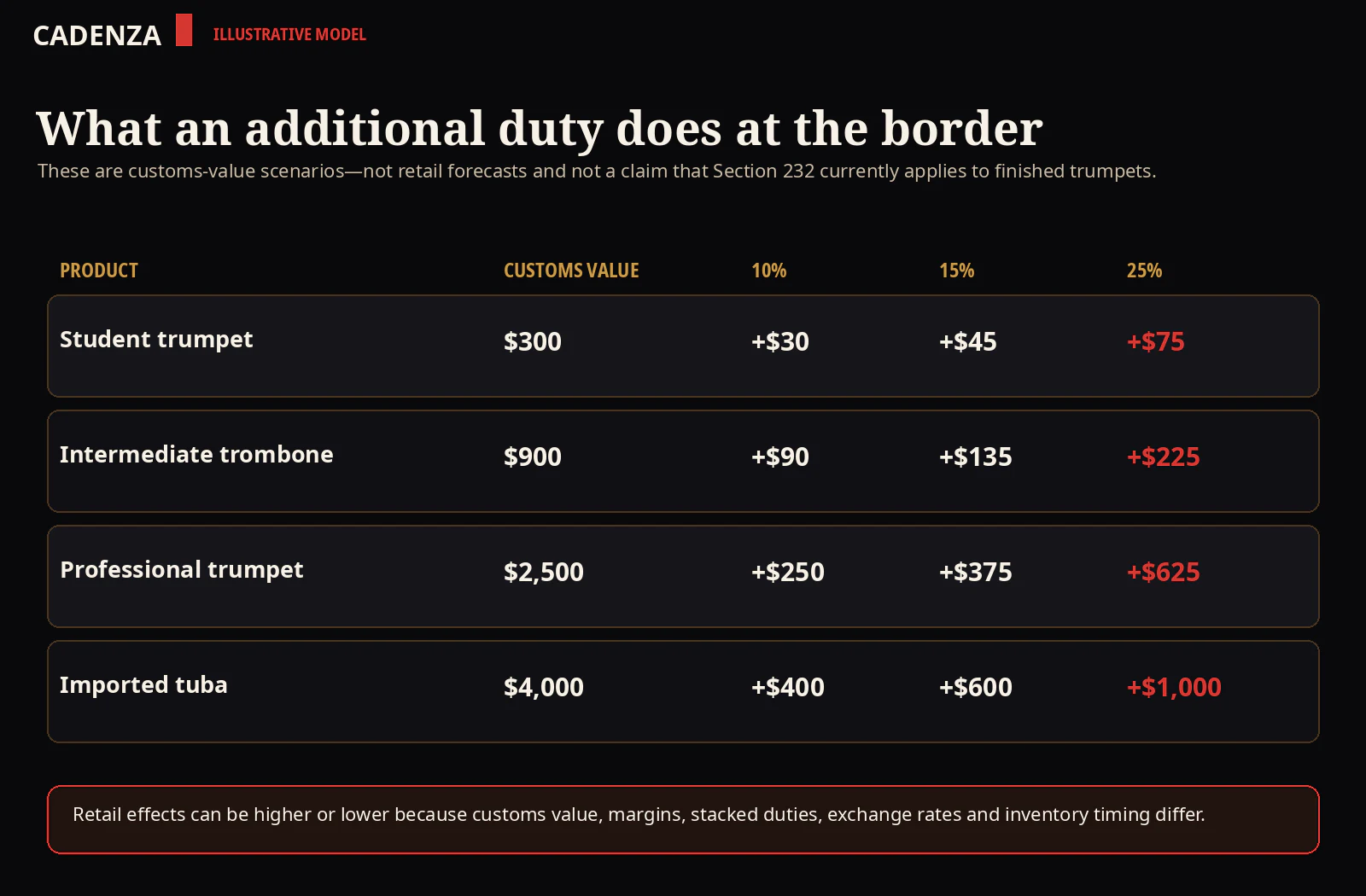
21 Why the final number may be higher—or lower
The tariff itself is only one variable.
The final price can be higher because:
- duties stack;
- distributors apply normal percentage margins to a higher cost base;
- financing costs rise;
- low volume increases per-unit freight and handling;
- suppliers reprice components;
- uncertainty encourages inventory buffers;
- retaliatory tariffs weaken export volume, raising domestic unit costs.
The final price can be lower because:
- the foreign manufacturer reduces its price;
- the importer absorbs margin;
- the dealer uses older inventory;
- exchange-rate movement offsets part of the duty;
- the product qualifies for a trade-agreement or other exception;
- the tariff does not apply to the exact classification.
Studies of the 2018 tariffs generally found high pass-through at the border, but newer work emphasizes that foreign exporters may absorb a meaningful share in some conditions and that transaction scale, invoicing and market structure matter. 2021
The honest conclusion is not that every trumpet becomes exactly 25 percent more expensive.
It is that tariffs create a real cost shock whose allocation depends on the supply chain—and the people with the least bargaining power are often schools, small dealers and individual musicians.
22 The unseen price: uncertainty
Businesses can plan for a high stable tariff more easily than for a tariff that changes between purchase order and delivery.
An instrument order may be placed months before shipment. Brass products can require production slots, ocean freight, customs clearance and dealer allocation. A rate change during that interval can turn a profitable order into a loss.
Uncertainty produces defensive behavior:
- importers delay orders;
- dealers buy ahead;
- manufacturers quote shorter validity periods;
- distributors add contingency margins;
- schools face expired bids;
- small firms hold more cash;
- products disappear temporarily.
NAMM repeatedly emphasized unpredictability in its statements and maintained compliance updates for members. 13
This cost does not appear in the tariff schedule. It appears in behavior.
The most damaging tariff may be the one a company fears but cannot price.
Part VIII — Parts, repairs and the life after purchase
23 The trumpet is not finished when it leaves the factory
A brass instrument is a durable machine that requires a service economy.
Valves wear. Slides dent. Water keys break. Springs fatigue. Corks compress. Solder joints fail. Lacquer deteriorates. Silver tarnishes. Leadpipes corrode. Cases crack. School instruments are cleaned, straightened, aligned and returned to service year after year.
The repair shop depends on parts and materials:
- replacement pistons or rotors;
- valve guides;
- springs and screws;
- braces and ferrules;
- water-key assemblies;
- slide tubes;
- bell and bow sections;
- solder, abrasives and polishing supplies;
- ultrasonic cleaning equipment;
- imported specialty tools.
Some parts classify under Chapter 92; others may classify by material or function. Tariff exposure therefore fragments the after-market just as it fragments original production.
A school can postpone buying a new tuba by repairing an old one. That makes repair capacity a buffer against tariff shock. But if parts rise in price or become harder to source, the buffer weakens.
The repair technician is industrial policy in an apron.
24 Small shops cannot build a customs department
A large manufacturer can retain brokers, trade lawyers and compliance staff. A two-person repair business cannot.
The administrative burden of tariff complexity matters because classification mistakes carry risk. Importers must identify the correct HTS line, origin, Chapter 99 provision and documentation. Full-value Section 232 rules, U.S.-metal thresholds and rolling inclusion authority increase the need for traceability.
For a global manufacturer, that can mean software and supplier declarations. For a small mouthpiece maker importing a machine blank or a repair shop ordering a specialized part, it can mean a broker fee large relative to the shipment.
This is one reason the $800 de minimis threshold historically mattered to small music businesses and individual musicians. When de minimis treatment narrows or disappears for particular origins or modes, the smallest shipments become formal import transactions. NAMM’s tariff explainer warned members about the resulting disruption to accessories and small international shipments. 13
The policy may be justified on enforcement or fairness grounds. But its fixed compliance cost is regressive by firm size.
A multinational can spread a customs specialist over thousands of entries. A boutique maker spreads the same legal question over twelve mouthpieces.
25 Used instruments become strategic inventory
When new instruments become more expensive or unpredictable, used instruments gain value.
That can be healthy. A well-made trumpet can serve multiple players. Repairing and recirculating instruments is economically and environmentally sensible. Strong used markets also preserve access.
But used supply is not infinite. An old student horn may need more repair than it is worth. A school fleet can be extended only so long before corrosion, damage and obsolete parts become decisive. Higher used prices can also shift cost onto families.
A tariff regime that reduces new entry-level imports may create a short-term repair boom and a long-term inventory shortage.
This is the kind of delayed effect that a one-year trade statistic misses.
25A Classification can change when the instrument is disassembled
A complete trumpet and a shipment of trumpet parts may not enter under the same provision.
A bell, leadpipe, valve section, mouthpiece, case, stand or machine tool can have a different classification and a different tariff stack. The legal treatment may also depend on whether the parts form an unfinished complete article under customs rules or remain independently classifiable components.
That creates strategic and compliance questions:
- Is it cheaper to import a complete instrument or subassemblies?
- Does domestic finishing change origin?
- Does a separate case receive different treatment?
- Can a U.S. maker document the origin of metal content?
- Does a repair part qualify under Chapter 92 or a material heading?
A tariff intended to encourage domestic production can inadvertently encourage minimal assembly if the rules reward it. Strong origin standards can prevent that, but they increase documentation cost.
25B Country of origin is not the flag on the box
Customs origin is governed by legal rules about where a product is made or substantially transformed. Brand headquarters, distributor location and marketing language do not decide it.
A trumpet sold by an American company can be foreign-origin. A foreign-owned company can make an instrument in the United States. A U.S. factory can use foreign components without changing the final origin result. A product shipped from one country can originate in another.
This is why the public debate should demand model-level disclosure:
- country of final manufacture;
- country of major subassemblies;
- domestic value share where known;
- location of critical craft processes;
- source of warranty and parts support.
Without that information, consumers cannot use purchasing decisions to support domestic capacity intelligently.
25C Traceability favors large firms
The April and June rules reward qualifying American metal and require information about where aluminum was smelted and cast, steel melted and poured, or copper smelted and cast. 25
That traceability serves a policy purpose. It distinguishes genuine U.S. content from superficial assembly.
It also favors firms with sophisticated supply-chain systems.
A large company can require supplier certificates, audit data and integrate origin fields into enterprise software. A small brass maker may buy limited quantities through distributors that cannot provide smelter-level information. The small firm can use American metal in spirit and still fail the paperwork test.
Any onshoring policy for music products should include shared compliance resources, standardized supplier certificates and technical assistance for small manufacturers.
25D Enforcement risk changes the product before the duty does
Customs penalties, shipment delays and broker disputes can be more damaging than the tariff itself.
A small importer facing ambiguous classification may choose not to carry the product. A manufacturer may redesign a component to fall outside a listed line. A dealer may stop importing low-volume specialist instruments because the compliance cost exceeds expected profit.
The consumer sees reduced choice. The customs entry records only what still arrives.
This is another reason import decline is not automatically evidence of successful substitution. Some trade disappears because the transaction becomes too risky.
25E The traveling musician is a customs edge case
Professional instruments cross borders for tours, auditions, repairs, sales and trials. A musician carrying a personally owned trumpet is not the same transaction as a dealer importing inventory, but documentation still matters.
Temporary admission procedures, carnets, proof of prior ownership and repair declarations can determine whether customs treats the instrument as returning personal property, a temporary import or merchandise. A player who sells an instrument abroad or returns with a newly purchased horn creates a different customs event.
Higher and more complex tariffs increase the stakes of mistakes. A musician can face delay, a bond requirement or an unexpected assessment at the exact moment the instrument is needed for work.
This is not evidence that touring trumpets are subject to Section 232. It is evidence that the broader border environment matters to the profession.
The ideal policy would publish plain-language guidance for:
- musicians traveling with personal instruments;
- instruments sent abroad for repair;
- trial instruments crossing temporarily;
- orchestras transporting fleet instruments;
- students returning with instruments bought overseas;
- dealers using carnets for trade shows.
Trade complexity is often discussed as a corporate problem. For a musician, the corporation is a case with a handle.
25F Repair abroad can create a new value question
An American-owned instrument sent overseas for restoration may return with added foreign value. Customs treatment can depend on the applicable repair provisions and documentation. If the work is not declared correctly, the returning owner may be assessed as though the instrument were a new import.
This is another reason tariff policy should be accompanied by practical guidance. The goal of rebuilding domestic capacity is not advanced by penalizing a musician who lacked access to a specialized repair locally.
At the same time, the need to send instruments abroad can reveal a domestic skill gap. Government support for repair training would reduce both customs friction and industrial dependence.
Part IX — The administration’s best case
26 The case for Trump is stronger than “tariffs good”
The serious pro-tariff argument begins with the fact that industrial capacity is not a normal consumer good.
Markets optimize for cost, speed and return under ordinary conditions. National security asks whether the system survives extraordinary conditions: war, sanctions, pandemic, shipping disruption, coercion or the collapse of a supplier. A country may rationally pay more for domestic capacity that it hopes never to need in an emergency.
Section 232 reflects that logic. It tells the government to consider defense requirements, domestic capacity, raw materials, skills, investment and economic welfare. 1
The White House says decades of foreign subsidies, overcapacity, weak trade enforcement and offshoring left American steel, aluminum and copper industries vulnerable. It cites improved domestic capacity utilization and new investment as evidence that tariffs work. The April proclamation said steel capacity utilization had risen from about 72.3 percent in 2017 to about 77.2 percent, and aluminum from about 39 percent to about 50.4 percent. 2
USTR’s 2026 structural-excess-capacity investigation extended the concern beyond metals. It argued that foreign state intervention, subsidies, suppressed demand, state-owned enterprises, weak labor or environmental protections and subsidized lending can create production detached from market demand, displacing U.S. investment. 1644
The administration’s strongest point is that cheap imports can be artificially cheap.
If a foreign government subsidizes energy, credit, land, exports or state-owned production, the American price signal is distorted. Consumers enjoy a lower price while domestic capacity disappears. By the time the geopolitical cost becomes visible, the skills and machinery are gone.
Eastlake itself can be read as evidence for this case. If Conn Selmer found it cheaper to move production to China, tariff advocates can say the market was already broken. The answer is not to accept the closure as efficient; it is to change the economics until domestic production returns.
27 Why primary metal matters to a trumpet maker
A trumpet manufacturer is not a defense contractor simply because it buys brass. But it shares an upstream industrial base with defense, power, transportation, electronics and construction.
Copper matters to electrical systems, communications, vehicles and munitions. Aluminum matters to aerospace, transportation and energy. Steel is foundational to machinery and infrastructure. USGS tracks these materials and the country’s import reliance as part of its annual mineral-security record. A disruption in those materials would reach far beyond music. 39
The White House argues that strengthening primary and semi-finished metal production produces resilience across many downstream sectors. The July aluminum incentive specifically tied reduced tariff treatment to investment plans for new, refurbished or expanded U.S. primary-aluminum capacity. 6
From that perspective, the fact that a trumpet is civilian does not make its input prices irrelevant. Higher input prices may be the transitional cost of rebuilding a domestic system that benefits the country overall.
Tariff critics often demand that every downstream user be exempt. If too many exemptions are granted, the policy can be circumvented through derivatives and the primary-metal remedy loses force. A foreign producer can ship the metal embodied in a finished product instead of as sheet or bar.
This is the strongest logic for derivative tariffs.
The hard question is selection. A transformer, a bulldozer, a can of food, an appliance and a trumpet all embody metal. Their strategic significance and domestic substitute capacity are not the same.
28 The USITC evidence: protection did produce more metal
The 2023 U.S. International Trade Commission report complicates simple anti-tariff claims.
For 2018–2021, it estimated that Section 232 tariffs reduced imports of affected steel products by 24 percent, increased U.S. steel prices by 2.4 percent and increased U.S. steel production by 1.9 percent. It estimated that aluminum imports fell 31 percent, U.S. aluminum prices rose 1.6 percent and domestic aluminum production rose 3.6 percent. 18
Protection therefore did what protection is supposed to do in the protected industries: reduce imports, raise domestic prices and increase domestic output.
The same report found costs downstream. It estimated that production in downstream industries using steel and aluminum was $3.5 billion lower in 2021 because of the tariffs, with average downstream prices higher and output lower. 18
That is not a finding that tariffs “failed.” It is a finding that they redistributed activity.
The political decision is whether the strategic value of additional metal capacity exceeds the downstream cost—and whether policy can reduce that cost without reopening the loopholes it was designed to close.
A serious Cadenza article must grant this. The White House is not inventing the possibility that tariffs increase domestic metal output. Government evidence says they did.
The article’s criticism is narrower and more demanding: Where is the downstream strategy for industries such as musical instruments that use the protected inputs, retain valuable U.S. craftsmanship and serve public education?
Part X — The case against the machine
29 Protection upstream can become punishment downstream
A tariff on imported metal helps a domestic metal producer by raising the competitor’s cost. The same price increase becomes an input cost for a downstream manufacturer.
That downstream manufacturer then faces several possibilities:
- raise its price;
- absorb the cost;
- redesign the product;
- source domestically at a higher or lower price;
- move production;
- reduce employment;
- stop making the product.
The Federal Reserve study of the 2018–2019 tariffs found that U.S. manufacturing industries with greater tariff exposure experienced relative employment reductions because the benefit of import protection was outweighed by higher input costs and retaliation. 19
For an American trumpet maker, the risk is obvious. A tariff on a foreign finished trumpet may provide protection. A tariff on imported tubing, sheet, machinery or components may increase cost. A retaliatory tariff can make the American trumpet more expensive abroad. The net effect depends on the company’s exact supply chain.
This is why NAMM’s request covers instruments, components and raw materials—not merely the final product. 89
30 The duty is paid by an American importer
Tariff politics often says the foreign country pays.
Legally, the duty is collected from the importer of record. Economically, the burden can be shared among the foreign producer, importer, distributor, retailer and customer through price and margin changes.
Research on the 2018 tariffs found high pass-through to U.S. import prices. The USITC concluded that U.S. importers bore nearly the full cost on average because import prices rose with the tariffs. Amiti, Redding and Weinstein similarly found almost complete pass-through into domestic prices of imported goods during the 2018 episode. Newer research identifies conditions under which foreign exporters absorbed more of the burden, but it does not support the claim that the cost simply vanishes abroad. 182021
For a music dealer, “who pays” is not theoretical. The customs entry must be funded before the instrument is sold. The working-capital requirement arrives even if the dealer cannot immediately raise prices.
The tariff may eventually be paid by:
- the importer through lower margin;
- the foreign factory through a price concession;
- the dealer through lower margin;
- the school through a higher bid;
- the family through higher rent;
- the worker through reduced hiring;
- the customer who never buys and therefore disappears from the data.
The last payer is easy to miss.
31 A tariff can preserve an industry or preserve a price umbrella
Protection creates room under the price ceiling.
A domestic maker can use that room to invest, expand and reduce cost. It can also raise price without expanding output. Which outcome occurs depends on competition, capacity, finance and expectations.
If domestic brass makers believe the tariff will disappear after an election or court decision, they may not invest in a new plant. If demand is too small or fragmented, they may use the protection to maintain existing operations. If skilled labor is scarce, output may not respond quickly. If school buyers cannot afford the new price, the market may shrink.
This is why the design of industrial policy matters more than the theatrical size of the rate.
A 50 percent tariff sounds decisive. A five-year purchase commitment, apprenticeship program and equipment tax credit may do more to create a valve-making line.
The White House’s aluminum onshoring program moves toward this logic by conditioning benefits on investment plans and milestones. 6
The music-products industry has not received an equivalent instrument-specific compact.
32 The retaliation problem
American professional brass instruments are export products.
Getzen, Edwards, Schilke, Bach and other American brands sell to musicians and dealers abroad. Retaliatory tariffs or foreign demand shocks can harm those companies even as U.S. tariffs protect them at home.
NAMM’s July 2026 filing asked USTR not only to reduce U.S. Section 301 duties on Chapter 92 but also to pursue reciprocal reductions of Chinese retaliatory tariffs on American-made professional instruments. 8
This is the two-front problem:
- imported student instruments become more expensive in the United States;
- American professional instruments become more expensive abroad.
The first weakens the pipeline. The second weakens the premium domestic manufacturer.
A policy advertised as pro-American manufacturing can therefore squeeze both ends of the same industry unless negotiations, exclusions and export access are coordinated.
Part XI — Can America reshore the trumpet?
33 The answer is yes—and not by tariff alone
America can build trumpets. It already does.
The question is whether it can expand production across price levels and product categories quickly enough to replace imports without reducing access.
The obstacles are concrete:
Skilled labor
Bell spinning, valve fitting, slide alignment, soldering, buffing and play testing are learned crafts. Some tasks can be automated; the final quality still depends on experience. The Eastlake closure did not merely remove payroll. It dispersed workers whose skills were specific to instrument production.
Tooling
Mandrels, dies, fixtures, draw benches, lathes, polishing systems, plating lines and inspection equipment require capital. Vintage tooling can be irreplaceable; new tooling must be designed and validated.
Environmental and safety compliance
Plating, finishing, solvents, metal dust and wastewater require controls. Domestic compliance is a public benefit, but it raises capital and operating cost.
Supplier scale
A maker needs small quantities of highly specific materials, while metal mills prefer large orders. A domestic copper industry does not automatically produce the exact tube, sheet and temper a small instrument factory needs.
Demand certainty
A company will not build a student-instrument plant because a tariff might last eighteen months. It needs confidence in school demand and policy stability.
Distribution and service
Production without dealers, rental systems, parts and repair support does not solve the school market.
These constraints do not make reshoring impossible. They define the work.
34 A realistic onshoring program for band instruments
A serious policy could contain six linked elements.
1. Capacity map
Commerce should identify which Chapter 92 products have meaningful domestic capacity, which have partial capacity and which lack a scalable U.S. substitute. The map should include parts and raw materials, not just finished instruments.
2. Time-limited targeted exclusions
Products without a domestic substitute should receive temporary relief conditioned on review. The exclusion should narrow as verified capacity comes online.
3. Investment support
Tax credits, low-cost loans or grants should support tooling, plating modernization, automation, environmental controls and facility expansion.
4. Workforce transfer
Displaced Eastlake workers and other experienced craftspeople should be offered paid relocation, apprenticeship-lead roles and training grants. Skills are a strategic asset only if policy preserves the people who hold them.
5. School procurement guarantees
Federal or state programs could commit to multi-year purchases of qualifying domestic student instruments, giving manufacturers the demand certainty needed to invest.
6. Export relief
Trade negotiations should reduce retaliatory barriers on American professional instruments.
That program would be more complex than a tariff. It would also be more likely to produce a factory.
35 The procurement lever
The United States already uses domestic-content preferences in public procurement. A carefully designed school-instrument program could use the government’s purchasing power to create scale without imposing the full cost on families.
Imagine a five-year competitive contract for domestically produced student trumpets, trombones, horns and low brass, paired with grants to high-need districts. Manufacturers would receive predictable volume. Schools would receive instruments. Taxpayers would see the cost directly rather than through an opaque tariff.
There are risks. Procurement can favor incumbents, reduce model choice or produce expensive compliance. Domestic-content rules can be gamed. But these are design problems, not reasons to prefer a blunt tax.
A tariff asks every importer to pay and hopes a factory appears.
A procurement program orders the factory’s product.
36 Why the Eastlake workforce should have been the pilot
If the administration wanted a demonstration project for musical-instrument reshoring, Eastlake offered one.
The plant had workers, equipment, product lines, a union, a known owner, an established brand and national political attention. The company reportedly argued that keeping the operation required major investment. That is precisely the kind of gap an industrial policy claims to bridge. 23
A rescue might still have failed. The plant may have required more capital than its output justified. Its equipment or building may have been unsuitable. Demand may have been insufficient. Public money should not preserve every facility indefinitely.
But the public record does not show a federal onshoring package, conditional loan, procurement commitment or worker-transfer program built around the closure.
The administration celebrated tariffs while the factory shut.
That is why the trumpet is a useful test. It is small enough to see the mechanism and symbolic enough that the contradiction cannot hide.
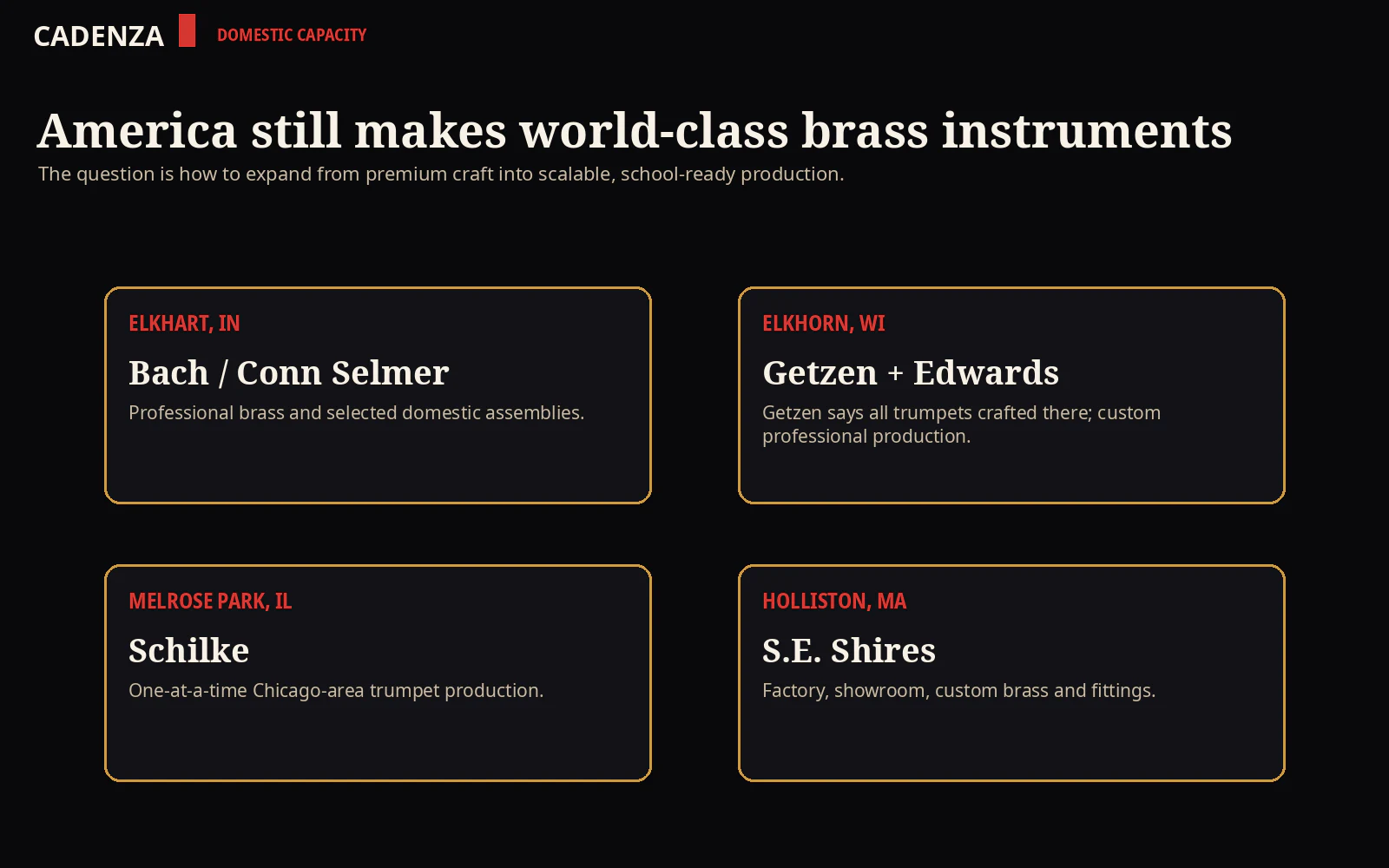
Part XII — A global instrument is not an un-American instrument
37 Japan, Germany, Taiwan and the limits of the China frame
The U.S. brass market is not a simple America-versus-China contest.
Professional and student instruments enter from Japan, Germany, Taiwan, France, the United Kingdom and other countries. Yamaha’s brass manufacturing and artist-development network is rooted in Japan and global ateliers. European firms produce models with distinct acoustic traditions. Taiwan’s music-products industry supports major brands and supply networks. American players choose among these instruments for sound, response, ergonomics, tradition and availability—not only price. 3738
Trade agreements and country-specific actions mean those origins can receive different treatment. The June 2026 proclamation created special calculations for specified partners and qualifying U.S.-metal content. Section 301 measures differ by country and investigation. 5
A professional player cannot always substitute an American model for a foreign one without artistic cost. Instruments are not fungible commodities. Two C trumpets with similar dimensions can respond differently enough to change a musician’s performance.
Industrial policy should respect that reality while still supporting domestic production.
38 Imports can complement domestic production
A U.S. dealer selling a Japanese trumpet is an American business. The salesperson, repair technician, freight company, insurer, teacher and performer are part of the domestic economy.
An American manufacturer using a German machine tool or Japanese valve material is still an American manufacturer. A foreign brand maintaining a U.S. distribution center creates domestic employment. A school importing student horns can create future demand for an American professional model.
None of this means origin is irrelevant. It means value chains are layered.
The administration is correct that supply-chain concentration creates risk. NAMM itself documented heavy dependence on China and Vietnam. 12
But resilience is not the same as autarky.
A resilient industry may require:
- multiple foreign sources;
- strong domestic premium production;
- strategic domestic component capacity;
- repair and recycling;
- inventory reserves;
- transparent origin data;
- allied-country sourcing;
- the ability to surge production when needed.
The choice is not global dependence or total self-sufficiency. The real choice is whether the country builds redundancy intelligently.
39 Allied sourcing deserves a different debate
Section 232 applies national-security reasoning even to close allies, though proclamations can create special treatment. That has always been one of its most contested features.
If the strategic concern is dependence on adversarial states, a Japanese or European trumpet is not the same policy problem as a supply chain concentrated in a coercive competitor. If the concern is domestic capacity regardless of ally, then even allied imports can displace U.S. production.
The administration’s June framework implicitly acknowledges distinctions by providing specific treatment for certain trade partners and U.S.-metal content. 542
A musical-instrument policy could do the same:
- prioritize domestic manufacturing;
- maintain allied supply diversity;
- target unfair subsidies and forced labor;
- avoid taxing products with no realistic domestic substitute;
- protect school access.
That would be industrial strategy rather than tariff maximalism.
39A A blanket exemption is not costless
NAMM asks for broad relief for musical instruments, components and materials. The cultural case is strong. The anti-circumvention problem is real.
Suppose the government exempts every finished product in Chapter 92 while maintaining high tariffs on metal inputs. A foreign producer could receive cheaper metal, manufacture the full instrument abroad and enter under the exempt musical-instrument line. The American maker would pay higher protected domestic metal prices or duties on imported inputs. The exemption could make the foreign finished instrument more competitive relative to the American one.
That is the opposite of the intended result.
A better exemption must distinguish among:
- finished products with no domestic substitute;
- imported inputs used by U.S. manufacturers;
- products where meaningful U.S. capacity exists;
- low-value student instruments serving education;
- luxury or specialist products;
- components vulnerable to circumvention.
The design may be complicated. The market is complicated.
39B A tariff-rate quota could protect capacity and access
One alternative is a tariff-rate quota.
A defined volume of student instruments or critical components could enter at a lower rate, with higher duties above the quota. The quota could be sized to maintain school access while domestic capacity develops. It could decline as U.S. output rises.
Risks include allocation favoritism, gaming and administrative burden. But the tool directly recognizes that an abrupt cutoff can harm users before domestic supply exists.
39C An exclusion tied to American production could reward the right behavior
A U.S. manufacturer could receive an exclusion for imported inputs or complementary student models if it meets domestic investment, employment and production commitments.
That structure would resemble the logic of the July aluminum onshoring incentive: tariff relief in exchange for a credible domestic-capacity plan. 6
For example, a company might receive lower treatment on imported student trumpets while it builds a U.S. valve or assembly line, trains workers and commits to a production schedule.
The relief would be earned, monitored and revocable.
39D School access can be protected directly
Trade policy does not need to carry the entire education burden.
Congress or states could fund instrument grants that offset tariff-driven increases for high-need districts. The program could prioritize repairable instruments, domestic content, long warranties and parts availability.
Direct support has an advantage over an exemption: the public can see who receives the subsidy and what it buys.
It also has a political disadvantage: it appears in a budget. Tariffs hide cost at the border.
39E The repair economy deserves formal status
A resilient instrument policy should treat repair as manufacturing infrastructure.
Repair extends the life of fleets, reduces import demand and preserves technical skill. Grants for ultrasonic cleaners, dent machines, ventilation, apprenticeships and parts inventory could produce immediate resilience at relatively low cost.
The government routinely supports recycling and maintenance in strategic sectors. School instruments should not be dismissed because their strategic value is cultural rather than military.
39F Transparent origin labeling would let consumers participate
The administration’s political theory assumes Americans want to buy domestic products. They cannot do so accurately without clear information.
A voluntary or standardized label could disclose:
- final country of manufacture;
- U.S. value percentage range;
- location of bell, valve and slide production;
- origin of major components;
- repair-parts commitment.
The label should be audited and model-specific.
This would not replace tariffs. It would make the market signal real.
39G The five-year test
Any instrument trade policy should publish measurable goals for 2031:
- U.S. student-brass production capacity;
- number of domestic brass-manufacturing jobs;
- average school-rental cost;
- domestic parts availability;
- export volume of American professional instruments;
- number of apprentices trained;
- share of high-need schools with adequate fleets;
- tariff burden paid by Chapter 92 businesses.
Without targets, success will be declared through anecdotes.
With targets, the country can ask whether the tariff machine made more trumpets—or merely made trumpets more expensive.
Part XIII — The military irony
40 The trumpet has always served national security
The trumpet’s relationship to the state is older than modern tariffs.
Trumpets and bugles signaled movement, alarm, assembly and command. Military bands remain part of ceremonial life, diplomacy, recruitment, remembrance and morale. “Taps” accompanies military funerals. Fanfares announce authority. Brass sound is embedded in the theater of the nation.
That history makes the viral headline irresistible: the instrument used to announce the state has been declared a threat by the state.
The headline is false. The irony survives.
The current policy treats strategic metal capacity as national security while a domestic brass factory closes. It does not list the trumpet as a Section 232 derivative, yet the broader tariff system raises costs across the music-products industry. The government maintains military bands whose instruments come from the same global and domestic supply networks under pressure.
The national-security question should therefore be reversed:
Is a country more secure when school bands shrink, repair networks weaken and specialized manufacturing skills disappear?
Section 232 itself tells the government to consider loss of skills and investment. 1
Cultural capacity is not the same as weapons capacity. But a nation’s institutions, ceremonies, education and skilled crafts are part of the social infrastructure security is supposed to protect.
41 Military procurement cannot rescue the commercial market alone
The armed forces buy instruments and employ musicians, but military demand is too small and specialized to sustain the entire student and commercial brass industry.
A factory needs volume. School programs, colleges, community ensembles, churches, drum corps, orchestras and individual consumers create that volume. Military orders can support a line; they cannot replace the civilian funnel.
This is another reason the “national security” label can mislead. Protecting an upstream metal because it is essential to defense does not automatically preserve the civilian industries that transform it into culturally important products.
A government that wants both must design for both.
42 The patriotic instrument and the imported reality
The trumpet is among the most patriotic-sounding objects in American life. It is also global.
Its modern design reflects European inventions. Jazz transformed it through African American genius. American makers built industrial empires in Elkhart and elsewhere. Japanese and European firms refined new models. Taiwanese and Chinese production expanded access. Musicians cross borders with cases that customs officers treat as temporary imports, personal effects or merchandise depending on circumstances.
There is no purely national trumpet.
There can be a strong American trumpet industry.
The difference between those ideas is the difference between culture and propaganda.
Part XIV — Their words against the record
43 Exhibit one: “national-security threat”
Their words: The White House says imported steel, aluminum and copper pose national-security threats and that tariffs are necessary to strengthen domestic manufacturing, reduce reliance on foreign production, expand capacity and train workers. 23
The record: Finished brass-wind instruments under HTS 9205.10.00 are not in the April 2026 annex. 4746
The question: Why did the administration not clearly communicate the boundary between covered metal derivatives and ordinary finished goods, leaving industries to navigate a system in which an absurd viral claim felt credible?
44 Exhibit two: “American manufacturing”
Their words: The administration presents tariffs as a central tool for reshoring and protecting American workers. 216
The record: Conn Selmer closed Eastlake and moved major brass lines offshore; Reuters reported most of the work was headed to China. 2223
The question: What did the tariff program, Commerce Department or White House do to preserve or replace that specific capacity?
45 Exhibit three: John Paulson
Their words: Paulson publicly criticized U.S. producers that close factories and offshore, according to the Guardian’s account of his 2024 remarks. 24
The record: A company he controls closed a 150-worker Ohio brass plant and moved most production abroad. 2324
The question: Does “America First” bind owners when domestic production is expensive, or only governments and consumers?
46 Exhibit four: Conn Selmer’s commitment
Their words: Conn Selmer said it remained deeply committed to U.S. manufacturing and would concentrate professional brass production in Elkhart. 22
The record: It also offshored tuba, sousaphone and student/intermediate French-horn production. 22
The question: How much of the company’s future unit volume, component value and employment will actually remain domestic?
47 Exhibit five: music is not a security risk
Their words: NAMM says music making presents no national-security risk and musical products should be exempt from tariffs. 11
The record: The finished trumpet is not on the Section 232 annex, but Chapter 92 remains exposed to other tariff actions and was excluded from at least one exemption list NAMM sought. 814
The question: Is broad Chapter 92 relief justified, or should relief be limited to products and inputs without scalable domestic substitutes?
48 Exhibit six: tariffs rebuild production
Their words: The White House cites new steel, aluminum and copper investment and higher capacity utilization. 23
The record: USITC found increased output in protected metal industries and reduced output downstream. 18
The question: Where is the published plan for sharing the gains while preventing downstream cultural manufacturers from becoming collateral damage?
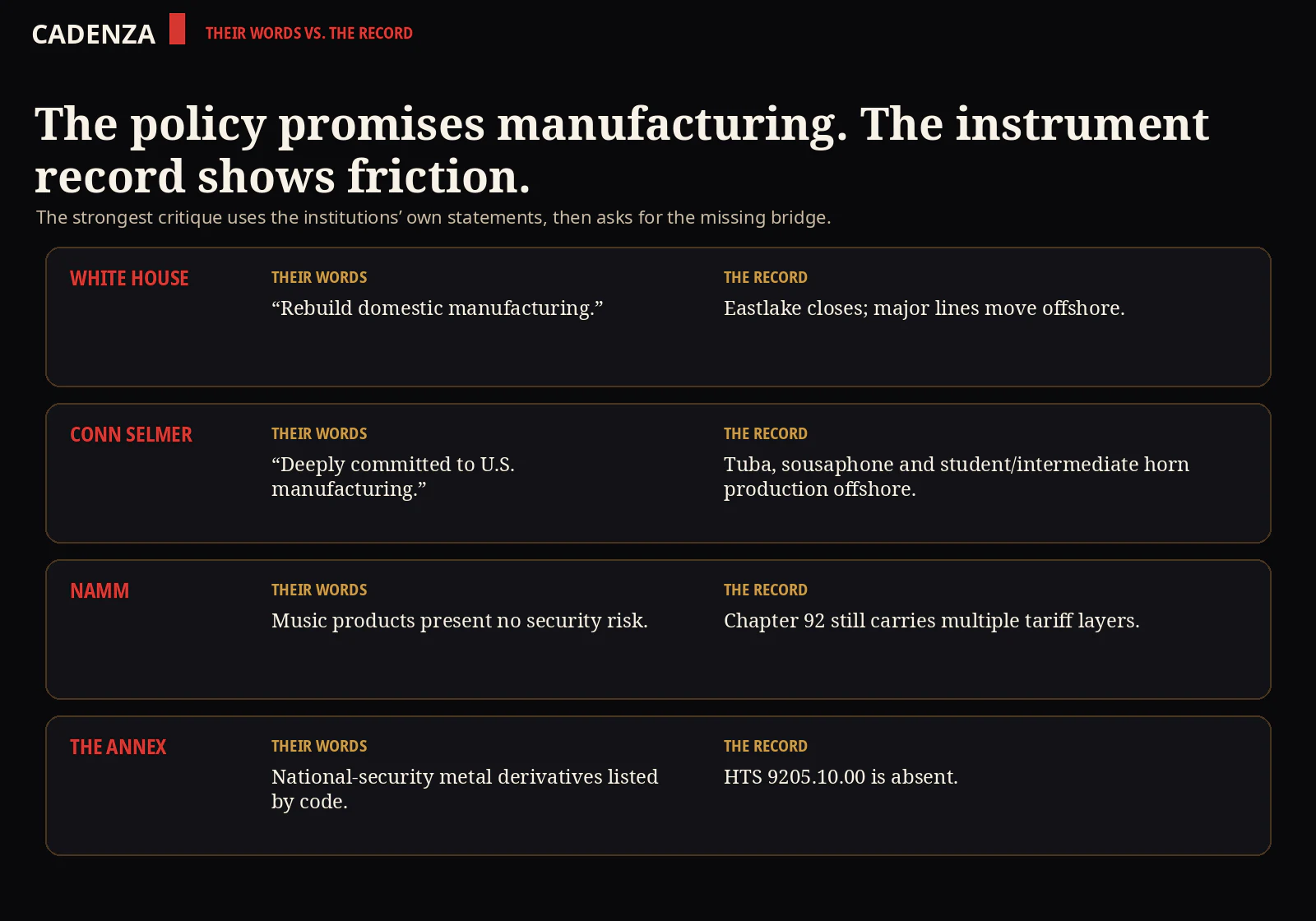
Part XV — The accountability ledger
49 What the White House should answer
- Does the administration agree that HTS 9205.10.00 is not currently included in the Section 232 metals annex?
- Has Commerce or USTR considered adding any Chapter 92 product to the rolling derivative list?
- What analysis has the administration conducted on tariffs’ effects on school music, rental fleets and small music retailers?
- What instrument-manufacturing capacity has been added since the 2025 and 2026 tariff changes?
- Did the administration engage Conn Selmer, John Paulson, the UAW or Ohio officials regarding Eastlake?
- Why was there no publicly announced onshoring plan for the plant?
- Will the administration support exclusions for musical instruments, components or raw materials lacking domestic substitutes?
- Will it publish a downstream-impact assessment for Chapter 92?
50 What Conn Selmer should answer
- Which Eastlake product lines are now produced in which countries?
- How many U.S. jobs were retained through the Elkhart transfer?
- What investment would have been required to keep Eastlake open, and how was that figure calculated?
- What public assistance, tariff relief or procurement support did the company seek?
- How much of each affected instrument’s value is now produced in the United States?
- What is the company’s definition of “deeply committed to U.S. manufacturing”?
- How will the closure affect parts availability and repair support for schools?
- Did tariffs on inputs or finished imports affect the closure decision?
51 What John Paulson should answer
- What role did he play in the decision to close Eastlake?
- How does the decision align with his public opposition to offshoring?
- Did he ask the Trump administration for assistance or policy changes to keep production domestic?
- Would he support publishing an onshoring plan for the affected product lines?
52 What NAMM should answer
- What share of the reported $1.34 billion tariff burden fell specifically on Chapter 92, brass instruments and brass parts?
- What portion of the 27 percent decline in wind-instrument imports represented lower school purchases rather than inventory normalization?
- Which brass-instrument inputs are unavailable at commercial scale in the United States?
- Which Chapter 92 lines have no meaningful domestic substitute?
- What targeted relief would protect access without weakening legitimate anti-circumvention policy?
53 What American makers should answer
- What additional volume could they produce within one, three and five years?
- What capital and workforce constraints prevent expansion?
- Which imported inputs are essential?
- Could they produce student instruments at scale with procurement guarantees?
- What policy stability would be required before investing?
Part XVI — Myth, reality and the limits of certainty
54 Myth: Trump called trumpets a national-security threat
False.
Cadenza found no such statement. The legal findings concern imports of aluminum, steel and copper and listed derivative products. The finished brass-wind instrument line is not in the April 2026 annex. 24746
55 Myth: Section 232 puts a 25 or 50 percent tariff on every brass instrument
False under the current annex.
The rates apply to listed products and depend on classification, origin and other rules. A trumpet’s material composition does not by itself make the finished instrument covered.
56 Reality: musical instruments face a substantial tariff burden
Supported by industry filings and tariff schedules.
NAMM reports an average effective tariff rate of 16.6 percent on U.S. musical-instrument imports in the first quarter of 2026 and says Chapter 92 Section 301 duties range from 7.5 to 25 percent depending on the list. 8
57 Reality: U.S. brass manufacturing still exists
Clearly true.
Getzen, Edwards, Schilke, Bach/Conn Selmer and S.E. Shires publicly document U.S. production. 2729323436
58 Reality: significant U.S. brass capacity also moved offshore
Clearly true for the Eastlake product lines.
Conn Selmer said tuba, sousaphone and student/intermediate horn production would transition offshore; Reuters reported most Eastlake work would move to China. 2223
59 Unknown: the exact retail price effect on every horn
The effect depends on customs value, origin, classification, stacked duties, margins, exchange rates and timing. Cadenza’s scenarios are illustrative, not predictions.
60 Unknown: whether tariffs will ultimately create more domestic instrument production
The current evidence shows pressure, advocacy, import decline and one major plant closure. It does not yet establish the long-term net effect on U.S. instrument output.
Part XVII — The policy verdict
61 The viral story was wrong. The warning was not.
The internet wanted a story about an authoritarian government afraid of a trumpet.
The documents tell a different story.
The Trump administration did not place the finished trumpet on its Section 232 national-security list. It created a much broader trade architecture in which strategic metals, selected derivatives, countries and supply chains are treated as security problems. That architecture is already raising costs across the music-products industry through multiple authorities. NAMM is fighting for exclusions. Wind-instrument imports have fallen. Schools and families occupy the price-sensitive end of the market. American makers face both protection and input costs.
And the most politically connected brass story of the year is not a new American factory.
It is the closure of Eastlake.
62 Tariffs without capacity are a tax on aspiration
A tariff can buy time for a domestic industry.
It cannot guarantee the industry uses the time.
It can increase primary-metal output.
It cannot automatically create a student-trumpet line.
It can punish an import.
It cannot train a bell spinner.
It can make offshoring less attractive.
It cannot prevent a Trump ally from doing it.
That is the lesson of the trumpet.
If the administration wants to claim the instrument as a victory for American manufacturing, it must show the factory, the workers, the tooling, the school contracts and the output—not merely the tariff.
63 National security begins with knowing what is actually on the list
The first responsibility of serious reporting is not to amplify the funniest version.
It is to read the annex.
The trumpet is not there.
That fact should embarrass anyone who published the viral claim as literal truth. It should also embarrass a tariff system so complex and rhetorically inflated that the claim sounded plausible to informed musicians and businesses.
Clear policy should not require a 58-page annex, multiple proclamations, Chapter 99 cross-references, origin certifications and a trade lawyer to determine whether a child’s instrument has become collateral in a national-security action.
Complexity is sometimes unavoidable. Opacity is not.
64 The final question
The United States has every right to protect strategic materials and rebuild industrial capacity.
It also has an obligation to know what it is protecting, what it is taxing and what it is losing.
A trumpet is a sheet of copper-zinc alloy transformed by machinery, labor, breath and culture. It is a product, an educational tool, a professional instrument and a national symbol. Its supply chain connects mines, mills, factories, repair benches, school budgets and concert halls.
That makes it an excellent test of industrial policy.
Not because the trumpet threatens America.
Because the way America treats the trumpet reveals what its policy is actually for.
The finished horn is not on the national-security list. The factory still closed. The student still pays. The tariff machine keeps playing.
64A What success would look like
The administration should be judged by outcomes that can be measured without a campaign slogan.
Success would mean more domestic brass capacity, not merely fewer imports. It would mean an Eastlake replacement or equivalent output, not only a higher customs bill. It would mean American makers expanding at the student, intermediate and professional levels. It would mean stable access for schools, a stronger repair workforce, transparent origin data and export markets open to American horns.
A tariff program could plausibly contribute to that result. It has not established the result simply by existing.
By 2031, the public should be able to compare:
- U.S. unit production by brass-instrument category;
- domestic employment and apprentice completion;
- student rental prices after inflation;
- school fleet adequacy;
- domestic component capacity;
- Chapter 92 tariff payments;
- American instrument exports;
- the location of production moved from Eastlake.
If those indicators improve, the trumpet may become evidence that industrial policy worked.
If imports fall, prices rise and factories still leave, the trumpet will have served a different purpose: announcing failure with perfect clarity.
Appendix A — Chronology
1962
Congress enacts the Trade Expansion Act. Section 232 authorizes national-security investigations and presidential adjustment of imports when an article and its derivatives threaten to impair national security. 141
March 2018
Trump imposes first-term Section 232 tariffs on steel and aluminum after Commerce investigations.
February 2025
The second Trump administration restructures steel and aluminum tariffs and removes many country and product exemptions.
June 2025
Trump raises steel and aluminum Section 232 rates to 50 percent for most covered imports. 43
July 2025
Copper enters the Section 232 tariff program.
January 7, 2026
Conn Selmer announces a tentative decision to close Eastlake, transfer professional French-horn production to Elkhart and move tuba, sousaphone and student/intermediate horn production offshore. 22
March 11, 2026
USTR begins Section 301 investigations into structural excess capacity across sixteen economies. 16
April 2, 2026
Trump signs Proclamation 11021, restructuring full-value tariffs on listed steel, aluminum, copper and derivative products. The accompanying annex does not list HTS 9205.10.00. 2446
April 6, 2026
The revised Section 232 full-value structure becomes effective for covered entries. 2
April 17, 2026
Reuters reports on Eastlake workers’ failed attempt to use John Paulson’s Trump ties and the administration’s manufacturing promises to stop the closure. 23
May 8, 2026
NAMM’s president testifies before USTR regarding tariff effects on music products, entry-level instruments and American manufacturers. 910
June 1, 2026
Trump modifies the metals regime, including treatment for specified equipment and the threshold for qualifying American metal. 542
June 30, 2026
The Eastlake plant closes. 25
July 7, 2026
NAMM announces two additional USTR filings seeking relief for Chapter 92 products and inputs. 8
July 20, 2026
Trump creates a primary-aluminum onshoring incentive tied to approved U.S. investment plans. 6
July 23, 2026
USTR announces final action in forced-labor Section 301 investigations affecting sixty economies. 17
August 12, 2026
Cadenza completes its annex and tariff-line fact check. Finished brass-wind instruments remain absent from the April Section 232 annex reviewed for this article.
Appendix B — Classification and calculation cautions
- HTS 9205.10.00 covers brass-wind instruments and shows a 2.9 percent general rate. 7
- Parts and accessories may classify under different Chapter 92 provisions or under their own material/function headings.
- Country of origin can change applicable Chapter 99 duties and preference eligibility.
- A product is not subject to Section 232 merely because it contains a covered metal; it must fall within the scope established by the relevant proclamation, annex and notes.
- The April 2026 proclamation includes a less-than-15-percent metal-weight threshold for certain listed products outside metal chapters; it is not a general exemption for every product in the tariff schedule. 24
- Rates and exemptions can change through proclamations, Federal Register notices, USTR actions and customs guidance.
- Importers should obtain product-specific advice from a licensed customs broker or trade counsel.
Appendix C — How Cadenza tested the headline
Cadenza used the following sequence:
- Identified the legal authority invoked by the viral claim: Section 232.
- Reviewed the April 2, 2026, presidential proclamation.
- Reviewed the White House fact sheet.
- Reviewed the 58-page annex listing covered and specially treated HTS provisions.
- Searched for 9205, 9205.10, 9209, “brass-wind” and “musical instrument.”
- Confirmed the USITC classification and general rate for 9205.10.00.
- Reviewed subsequent June and July proclamations for scope changes.
- Reviewed NAMM’s 2025–2026 tariff advocacy and USTR filings.
- Separated Section 232 from Section 301 and other tariff layers.
- Traced the Eastlake manufacturing story through company statements and independent reporting.
The conclusion is date-bounded. A future proclamation or Federal Register notice could change the scope.
Appendix D — Visual methodology
The hero and explanatory exhibits are editorial illustrations, not documentary photographs. Donald Trump is shown in a constructed magazine composition with tariff papers and a trumpet; the image does not depict an actual event.
All political imagery is labelled Editorial illustration.
Sources & documentary record
Primary government records, tariff schedules and company materials are prioritized. Advocacy data and independent reporting are identified by source type. Trade rules were rechecked August 14, 2026.
-
1
19 U.S.C. § 1862 — Safeguarding national security Legal Information Institute, Cornell Law School · current text accessed 2026-08-12 · statute
-
2
Strengthening Actions Taken to Adjust Imports of Aluminum, Steel, and Copper Into the United States The White House · 2026-04-02 · primary
-
3
Fact Sheet: President Donald J. Trump Strengthens Tariffs on Steel, Aluminum, and Copper Imports The White House · 2026-04-02 · primary
-
4
Annexes I-A, I-B, II, III and IV to Proclamation 11021 The White House · 2026-04-02 · primary
-
5
Further Adjusting the Tariff Regimes for Imports of Aluminum, Steel, and Copper into the United States The White House · 2026-06-01 · primary
-
6
Further Strengthening Actions Taken to Adjust Imports of Aluminum into the United States The White House · 2026-07-20 · primary
-
7
Harmonized Tariff Schedule search result for 9205.10.00 — Brass-wind instruments U.S. International Trade Commission · accessed 2026-08-12 · primary
-
8
NAMM Files Two Formal Comments With U.S. Trade Representative Seeking Tariff Relief for Musical Instruments NAMM · 2026-07-07 · industry
-
9
NAMM President and CEO John Mlynczak to Deliver Oral Testimony Before the USTR Section 301 Committee NAMM · 2026-05-04 · industry
-
10
Oral Testimony: USTR Section 301 Excess Capacity Hearing NAMM · 2026-05-03 · industry
-
11
NAMM Statement on Universal Tariffs — updated May 12, 2025 NAMM · 2025-05-12 · industry
-
12
NAMM Statement on Universal Tariffs NAMM · 2025-04-03 · industry
-
13
Tariffs Explained NAMM · updated 2026 · industry
-
14
New Tariffs, New Legal Ground NAMM · 2026-07 · industry
-
15
NAMM Advances Industry Advocacy in Washington, D.C. NAMM · 2026-05-14 · industry
-
16
USTR Initiates Section 301 Investigations Relating to Structural Excess Capacity Office of the United States Trade Representative · 2026-03-11 · primary
-
17
USTR Takes Action in Forced Labor Section 301 Investigations Office of the United States Trade Representative · 2026-07-23 · primary
-
18
Certain Effects of Section 232 and 301 Tariffs Reduced Imports and Increased Prices and Production in Many U.S. Industries U.S. International Trade Commission · 2023-03-15 · government research
-
19
Disentangling the Effects of the 2018-2019 Tariffs on a Globally Connected U.S. Manufacturing Sector Board of Governors of the Federal Reserve System · 2019-12 · research
-
20
The Impact of the 2018 Trade War on U.S. Prices and Welfare National Bureau of Economic Research · 2019-03 · research
-
21
The Incidence of Tariffs: Rates and Reality National Bureau of Economic Research · 2026-01; rev. 2026-02 · research
-
22
Conn Selmer Announces Tentative Decision to Close Eastlake, Ohio Manufacturing Plant Conn Selmer · 2026-01-07 · company
-
23
A Trump pledge is falling flat as Ohio musical instrument plant closes Reuters · 2026-04-17 · reporting
-
24
Trump donor who criticized offshoring to close Ohio plant and move work to China The Guardian · 2026-02-16 · reporting
-
25
Recalling Conn-Selmer's legacy in Eastlake as instrument plant closes Ideastream Public Media · 2026-06-29 · reporting
-
26
Conn — Over a Century of Excellence Conn Selmer · accessed 2026-08-12 · company
-
27
Bach C190 Trumpet Series — From Elkhart, Indiana, to the world's stage Conn Selmer · accessed 2026-08-12 · company
-
28
Bach BTR302S Student Premium Trumpet Conn Selmer · accessed 2026-08-12 · company
-
29
Trumpets — crafted in Elkhorn, Wisconsin Getzen · accessed 2026-08-12 · company
-
30
Custom Series Trumpets Getzen · accessed 2026-08-12 · company
-
31
Elkhorn, Wisconsin No Longer a Part of the United States! Getzen · 2010-12-13 · company commentary
-
32
Our Story Edwards Instrument Co. · accessed 2026-08-12 · company
-
33
Made in the USA Edwards Instrument Co. · 2009-01-29 · company commentary
-
34
Schilke Handcrafted Trumpets Schilke Music · accessed 2026-08-12 · company
-
35
i Series Trumpets — 100% built in Melrose Park, Illinois Schilke Music · accessed 2026-08-12 · company
-
36
S.E. Shires Factory and Showroom S.E. Shires Co. · accessed 2026-08-12 · company
-
37
How a trumpet is made: making the bell Yamaha Corporation · accessed 2026-08-12 · company educational
-
38
About Yamaha Ateliers Yamaha USA · accessed 2026-08-12 · company
-
39
Mineral Commodity Summaries 2026 U.S. Geological Survey · 2026-02-06; version 1.3 May 2026 · government research
-
40
Fact Sheet: Section 232 Investigations — The Effect of Imports on National Security U.S. Department of Commerce · 2017-04-20 · primary
-
41
Section 232 of the Trade Expansion Act of 1962 Congressional Research Service / Congress.gov · 2026-02-12 · government research
-
42
Fact Sheet: President Donald J. Trump Updates Tariffs on Steel, Aluminum, and Copper Imports The White House · 2026-06-01 · primary
-
43
Fact Sheet: President Donald J. Trump Increases Section 232 Tariffs on Steel and Aluminum The White House · 2025-06-03 · primary
-
44
USTR Fact Sheet on Structural Excess Capacity and Production in Manufacturing Sectors Office of the United States Trade Representative · 2026-03 · primary
-
45
Cadenza visual methodology and editorial-illustration disclosure Cadenza Editorial · reviewed 2026-08-14 · methodology
-
46
Cadenza fact-check methodology: search of Proclamation 11021 annexes for HTS 9205 and 9209 Cadenza Editorial · 2026-08-12 · methodology
- 47UAW letter asking Commerce to add brass instruments to Section 232 copper tariffsUnited Auto Workers · 2026-05-14 · union primary record
- 48Conn Selmer WARN notice for the Eastlake plant closureOhio Department of Job and Family Services · received 2026-04-09 · company primary record
Comments
Sign in to join the discussion.