The Concurso Internacional de Piano Premio Jaén has been running since the 1950s. Its 67th edition finished this year, and the pianist who won it is a 29-year-old from Japan called Ayumu Ibaraki.
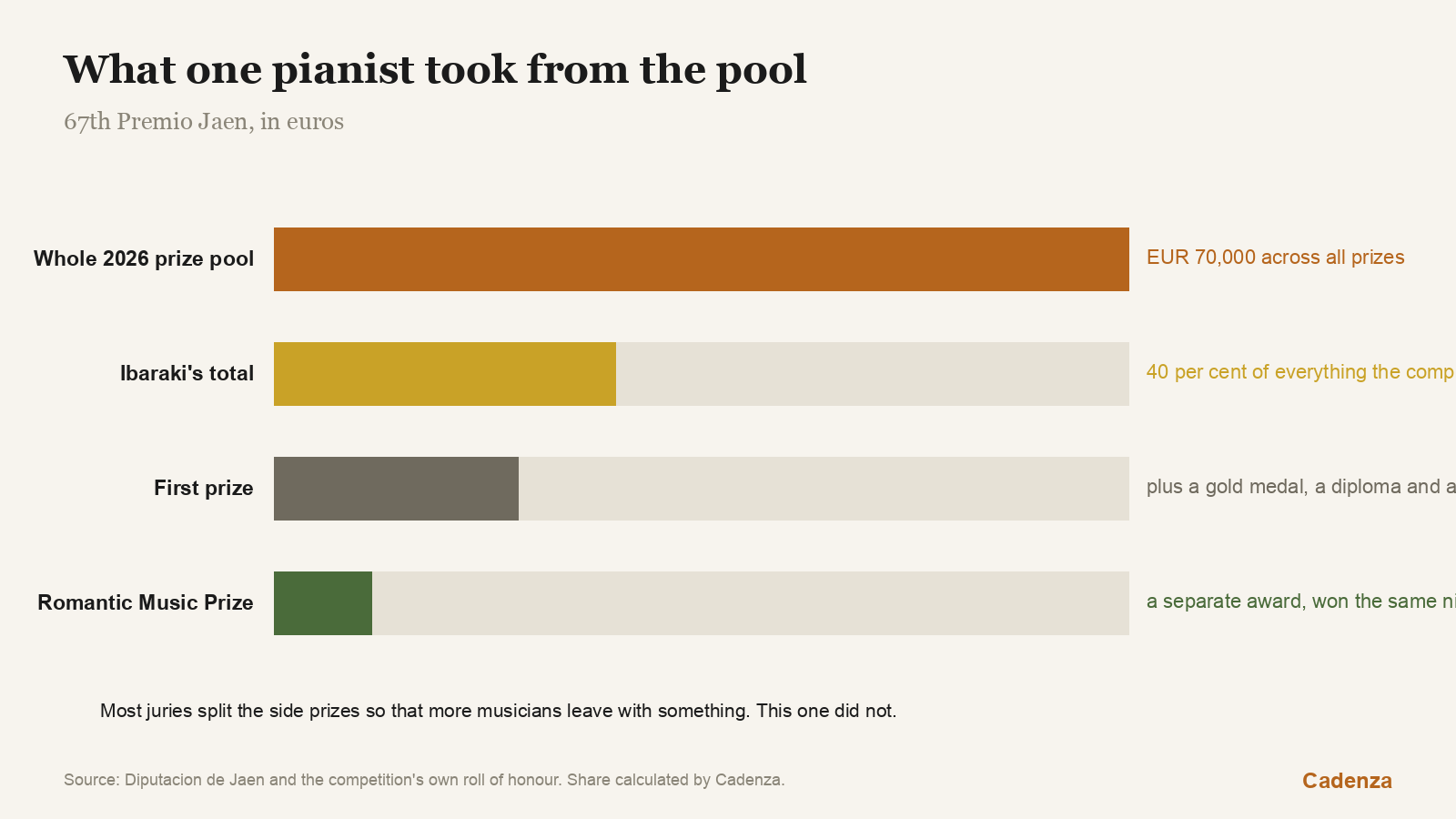
He took the first prize: €20,000, a gold medal, a diploma and a tour of five concerts. He also took the separate Romantic Music Prize, worth €8,000, on the same night.
Twenty-eight thousand euros from a total prize pool of €70,000. One pianist, in one evening, took 40 per cent of everything the competition had to give.
The arithmetic of winning two prizes at once
Competitions that run named side prizes alongside their main placings are common, and the side prizes usually spread the money. A jury can give first prize to one player and the best-Romantic-repertoire prize to another, and most do, because it means two musicians leave with something.
Jaén's jury did not split them. The same pianist was judged the best overall and the best in the Romantic repertoire, and the effect on his year is substantial: €28,000 is more than most competition first prizes pay on their own, and nearly twice the €15,000 that both the Enescu and the ARD competitions paid their winners this month.
There is also a five-concert tour attached, which for a pianist at this stage is worth more than a proportion of it in cash. A tour is dates in a diary, an audience, and something a promoter can look at.
He beat forty-seven other people
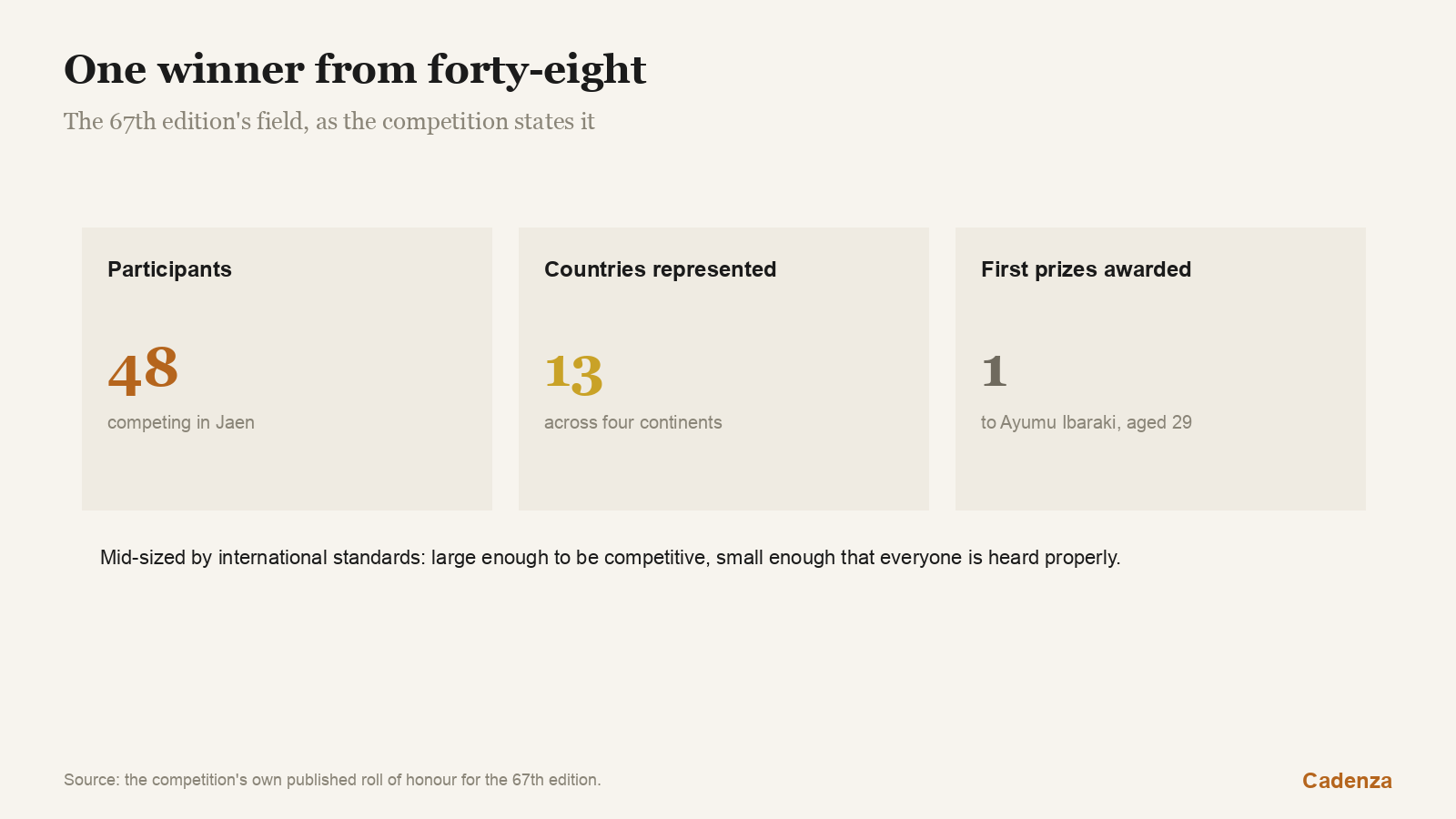
The 2026 edition drew 48 participants from 13 countries across four continents.
That is a mid-sized field by international standards and it is the right size to be genuinely competitive. Forty-eight players is large enough that the jury hears a real spread of standards, and small enough that everyone gets properly heard rather than eliminated on a recording.
Set it against the funnels Cadenza has run this week and it sits in the middle. Liechtenstein's conducting competition took 173 applications and invited nine. The Enescu cello section took 234 applications and invited fifty, of whom 41 played. Jaén had 48 people actually competing.
Fifth in sixty-seven editions
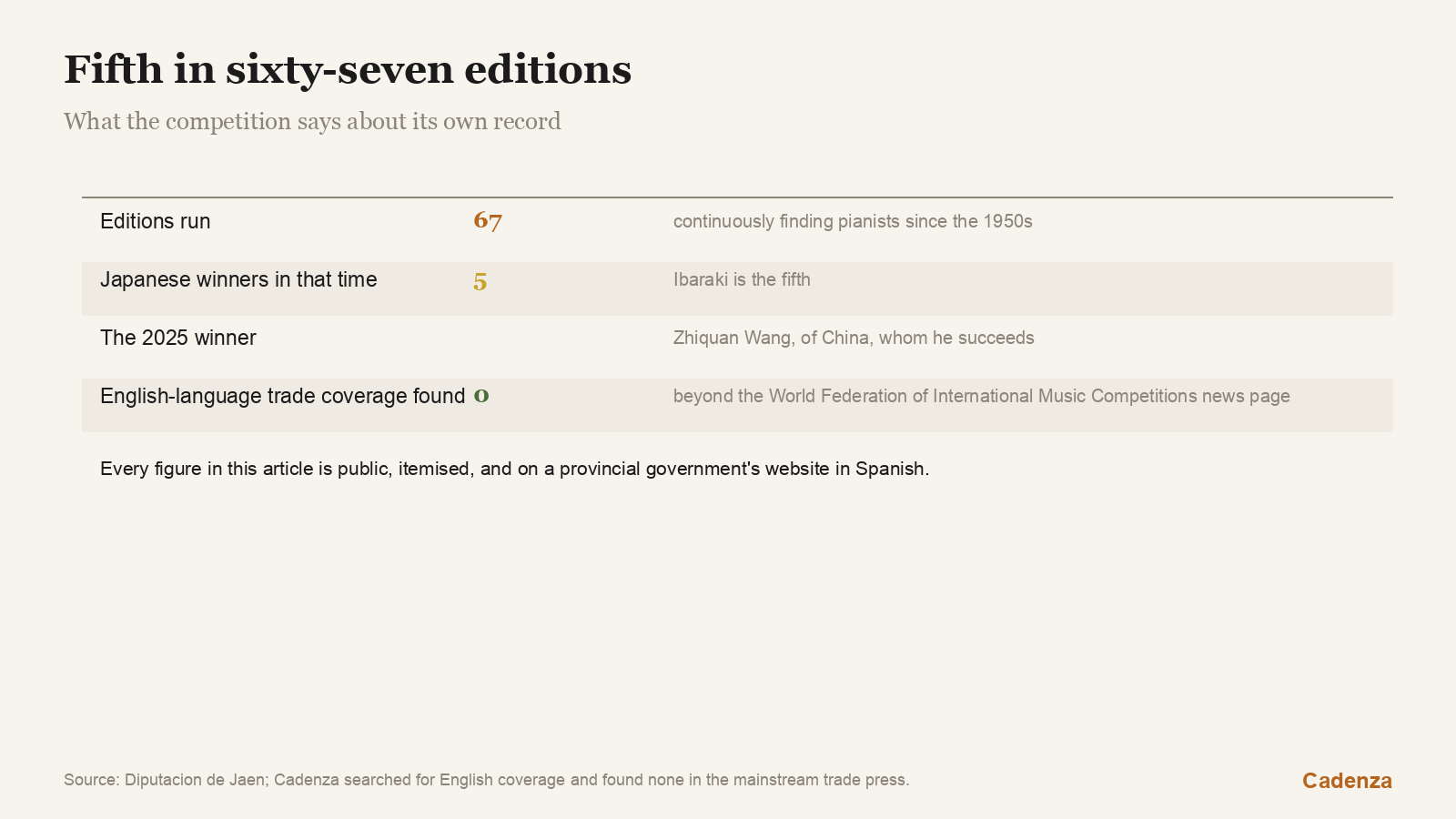
The competition's own announcement makes a point of this, and it is the detail worth carrying. With this win Ibaraki becomes the fifth Japanese musician to put his name on the Premio Jaén roll of honour.
Five in sixty-seven editions is a useful measure of how long these institutions are, and how slowly a national record accumulates in them. The competition has been finding pianists continuously since the 1950s, and in all that time it has produced four previous Japanese winners. He succeeds a Chinese winner, Zhiquan Wang, who took the 2025 edition.
Long-running competitions publish this kind of thing about themselves and nobody reads it. A roll of honour going back sixty-seven years is a dataset on where pianists have come from, decade by decade, and Cadenza has not found anyone who has mined it.
The coverage gap here is real
Cadenza has been careful this week about claiming that a result has no English-language coverage, having had one such claim collapse under a spot-check. This one was tested.
Ibaraki's win is reported by the Diputación de Jaén, the provincial government that runs the prize, on its own news pages and its dedicated competition site. It has been carried by the EFE wire, by the Fundación Unicaja and by Infobae, all in Spanish. It appears on the World Federation of International Music Competitions news page, and on a release from the Lucerne University of Applied Sciences and Arts, where Ibaraki studies with Benjamin Moser.
What Cadenza could not find is any mainstream English-language classical outlet reporting it. A €20,000 first prize plus €8,000, a gold medal and a five-concert tour, at a competition in its 67th edition, and the trade press in English has not carried it.
That is the gap this newsroom exists to close, and it is worth being precise about what it is. The information is public. It is on a provincial government's website, in Spanish, with the prize amounts itemised and the participant count stated. It simply has not been read.
There is a practical consequence for the pianist. A promoter in London or New York searching his name in English finds very little, which means the win does less work for him abroad than it should. The prize is real, the tour is real, and the record of it in the language most international promoters read is close to empty.
What a five-concert tour is actually worth
The cash gets the headline and the tour is the part that changes a year, so it is worth valuing properly.
Five concerts is not a career, but it is five programmes prepared and performed to a paying audience, five reviews possible, and five promoters who have now seen the player work. For a pianist without management, that is the commodity that is hardest to buy and impossible to win by practising. Prize money can be spent in a year. A tour generates the next engagement, or it does not, and either way the pianist finds out.
It is also why comparing competitions on cash alone misleads. The Enescu and the ARD each paid their winners EUR 15,000 this month, and the ARD's package includes prize-winners' concerts with professional orchestras. Jaen pays more in cash and adds a five-concert tour. A pianist choosing between entry fees should be reading for the engagements, not the euros.
Cadenza has made that point three times this week from three different directions, and it holds each time. Liechtenstein's conducting prize attaches a concert in 2028. The German instrument fund attaches no cash at all and loans a three-hundred-year-old instrument instead. What competitions give is more varied than their headline figures suggest.
Where he trains
Ibaraki was born in 1997 and studies at the Lucerne University of Applied Sciences and Arts with Benjamin Moser.
That places him in the same pattern Cadenza has traced twice this week. A Japanese pianist training in Switzerland and winning in Spain, alongside a Ukrainian pianist training in Austria and winning in Japan, and a Royal Philharmonic Society scholarship scheme sending half its awards to German-speaking Europe over four years. The map of advanced piano training has a centre, and it is not in the countries producing the players.
Benjamin Moser is worth naming rather than leaving as a line of biography. A teacher whose student wins a 67-year-old competition outright, taking the Romantic repertoire prize alongside it, has done something specific and visible. Competition reporting almost always names the winner and omits the teacher, which makes the teaching invisible and the talent look spontaneous. It rarely is.
A year ago it was an entry form
The Premio Jaén publishes its call, its prize structure and its full roll of honour, and it will run a 68th edition. The prize amounts, the gold medal and the five-concert tour are all in the competition's own published terms, which is more than many competitions disclose before you enter.
Cadenza carries competitions with open deadlines, free to musicians, on its competitions board, and orchestral vacancies on its jobs board.
If you are entering piano competitions. Look at the side prizes as carefully as the placings. Jaén's Romantic Music Prize is €8,000, which is more than many competitions pay for second place, and it is awarded on repertoire rather than on overall ranking. That means a pianist whose strength is concentrated in one repertoire area can target it specifically. Note also that this competition states its participant count and its prize pool publicly, so you can calculate your own odds before paying anything.
The question the English-language trade press will be asked next is about itself rather than about Jaén. A 67-year-old competition awarded €28,000 and a five-concert tour to one pianist, published every figure on a government website, and no English outlet reported it. How many other results are sitting in plain sight in the wrong language?
Sources: the Diputación de Jaén's own announcement of the 67th edition result, read in Spanish, which carries the €20,000 first prize, the gold medal, the diploma, the five-concert tour and the statement that Ibaraki is the fifth Japanese musician to join the winners' list; the competition's own roll of honour for the 67th edition, which gives his age as 29 and states the field of 48 participants from 13 countries and four continents, and which carries the separate €8,000 Romantic Music Prize; the Fundación Unicaja report for his birth year of 1997; and corroboration from the EFE wire and Infobae. His study with Benjamin Moser at the Lucerne University of Applied Sciences and Arts is confirmed by that institution's own release. Cadenza searched for mainstream English-language classical coverage of this result and found none beyond the World Federation of International Music Competitions news page. The share of the prize pool and the comparisons with other 2026 competitions are Cadenza's arithmetic.
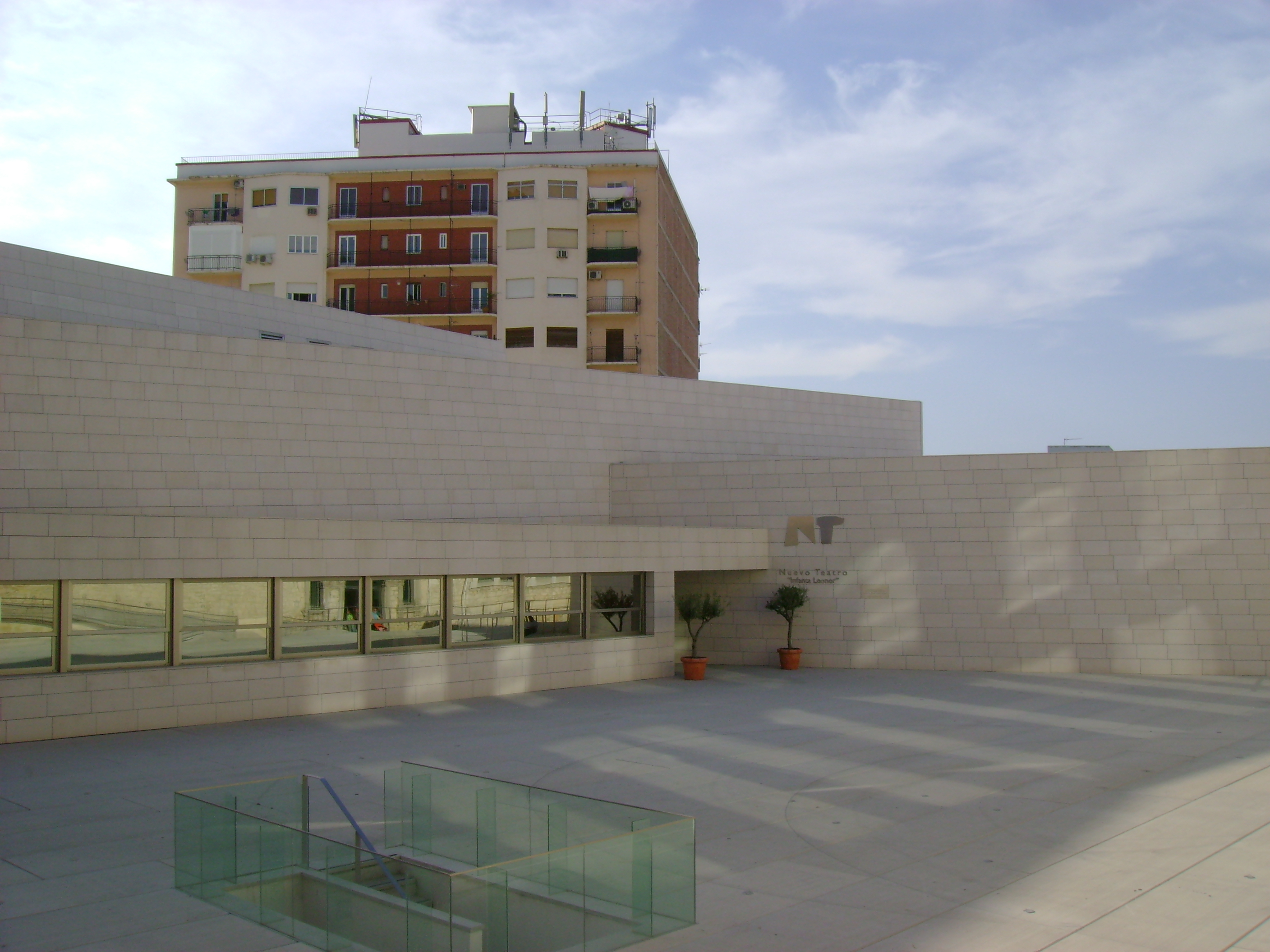
Cover photograph: the Teatro Infanta Leonor, Jaén, 2009. Kordas, CC BY-SA 3.0, via Wikimedia Commons. Charts by Cadenza.
Cover photograph: The Teatro Infanta Leonor in Jaén, Spain, home of the Concurso Internacional de Piano Premio Jaén, photographed in 2009. Kordas, CC BY-SA 3.0, via Wikimedia Commons.
Comments
Sign in to join the discussion.