Liechtenstein has about forty-one thousand residents and, since June, its own international conducting competition. The first edition ran from 25 to 29 June 2026 in Vaduz, and the numbers it published are the most useful thing about it.
One hundred and seventy-three conductors applied, from thirty countries. Nine were invited to compete. Three reached the final. One won.
Filippo Barsali won. The prize is 30,000 Swiss francs, and it comes with an invitation to conduct the Liechtenstein Symphony Orchestra during its 2028 season.
The funnel, which the competition publishes and nobody has framed
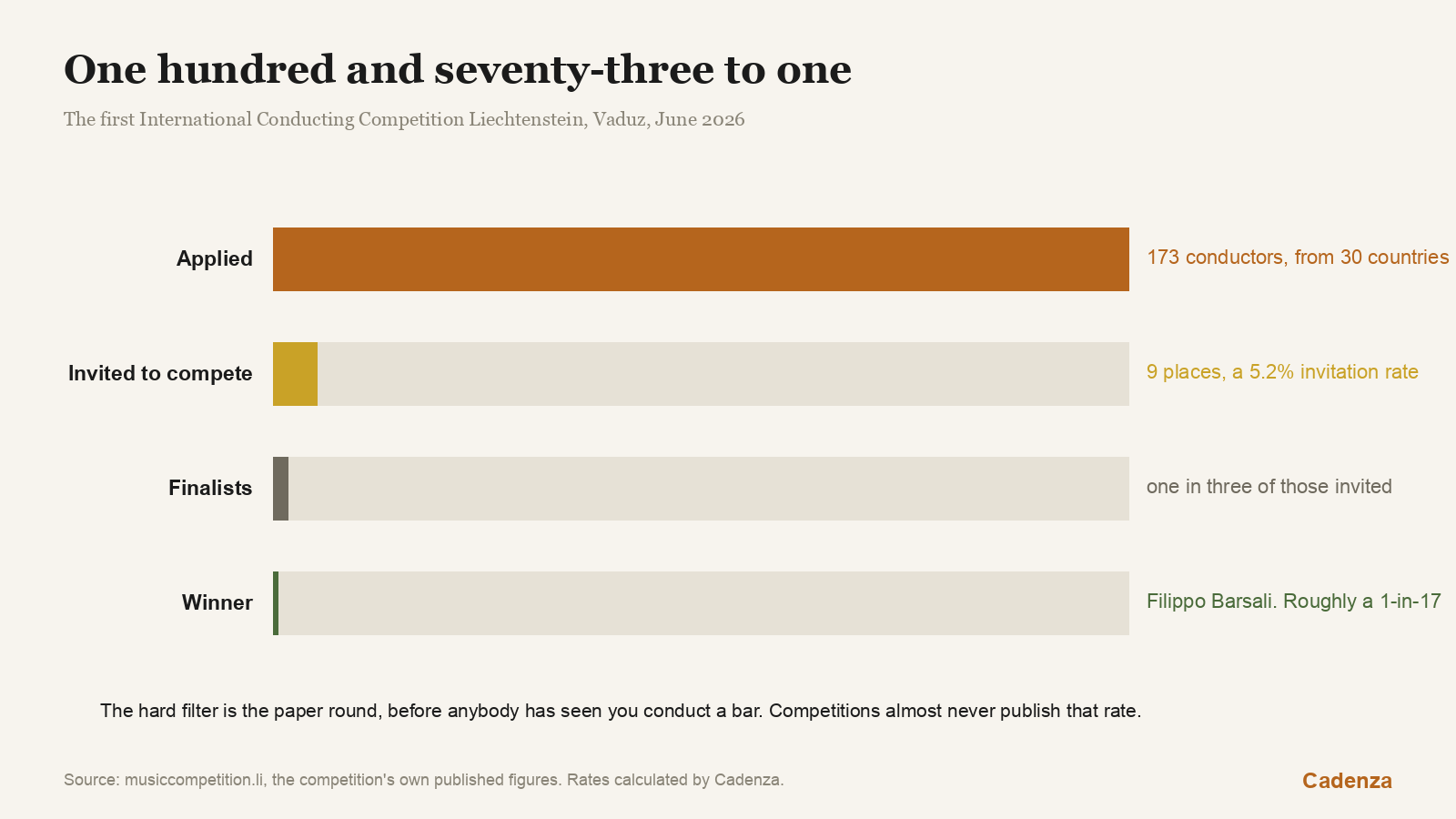
Work through it and the shape is brutal in a way conducting competitions rarely admit.
Getting invited at all was a 5.2 per cent proposition: nine places from 173 applications. Once invited, reaching the final was a one-in-three chance. Once in the final, winning was another one-in-three. Multiply it out and the first prize was roughly a one-in-173 outcome from the moment an application was submitted.
That is the number worth carrying, because it is the honest answer to the question every young conductor asks: what are my chances? For this competition, in its first year, the answer was about half a per cent.
The 5.2 per cent invitation rate is the part that matters most, and it is the part competitions almost never publish. The hard filter is the paper round, before anybody has seen you conduct a bar.
What he actually won, and what he did not
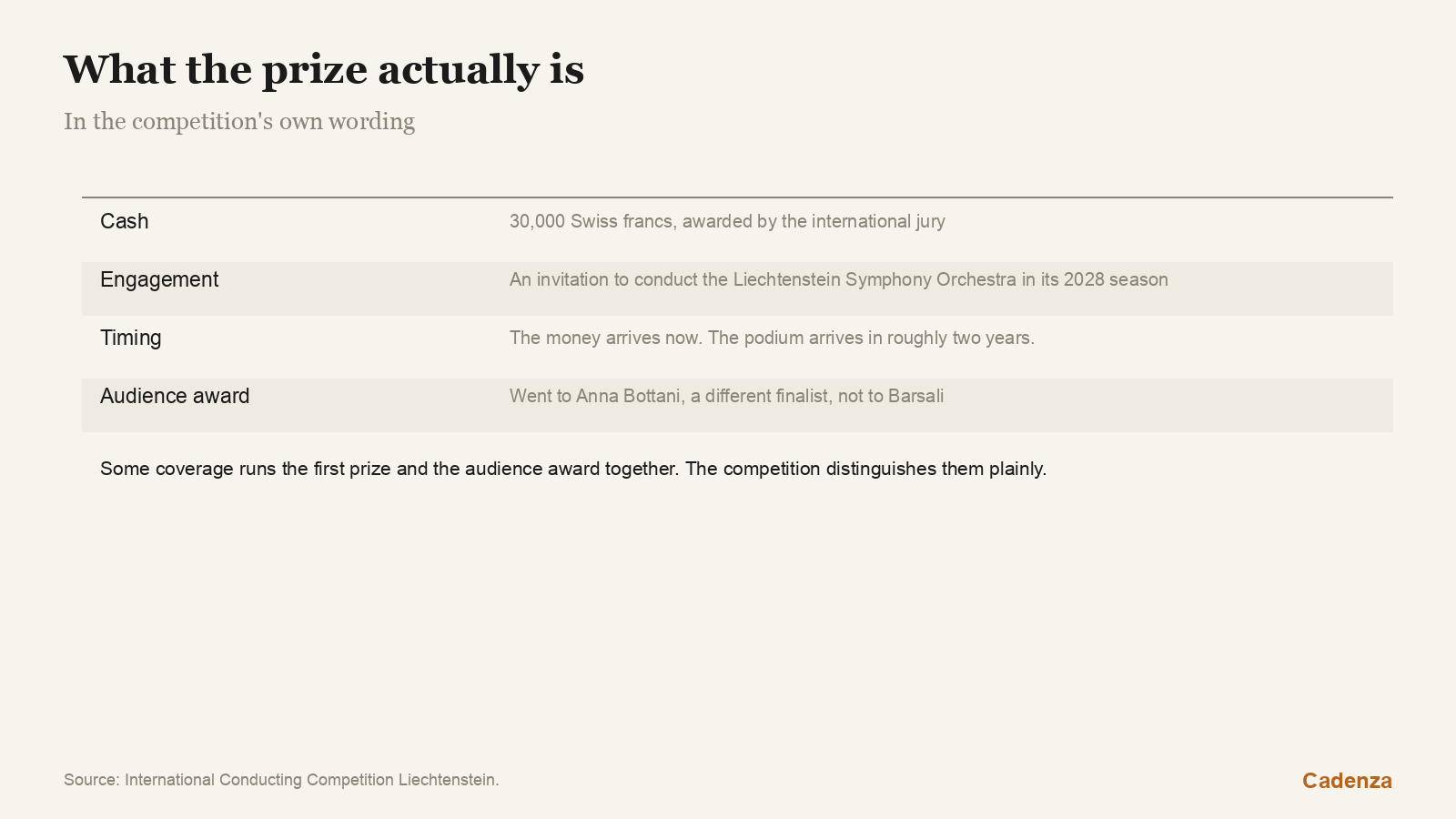
The competition's own wording is that the international jury awarded the prize for Liechtenstein's first conducting competition to Barsali, that it is worth 30,000 Swiss francs, and that it includes an invitation to conduct a concert with the Liechtenstein Symphony Orchestra during the 2028 season.
Two precise points, because coverage of competitions routinely blurs both.
The audience award did not go to Barsali. It went to Anna Bottani, one of the other two finalists, and the competition says so plainly. Some accounts have run the two together.
And the guest-conducting invitation is dated to the 2028 season, not to next year. So the cash arrives now and the podium arrives in roughly two years. For a conductor at this stage that gap is not a complaint, it is a planning fact: the prize buys time before it buys an engagement.
Barsali's own reaction, in the competition's release, was that the competition was a fantastic experience, that the award means a great deal to him, and that above all it gives him the feeling he is on the right track and motivates him to continue with even greater conviction.
Where he came from
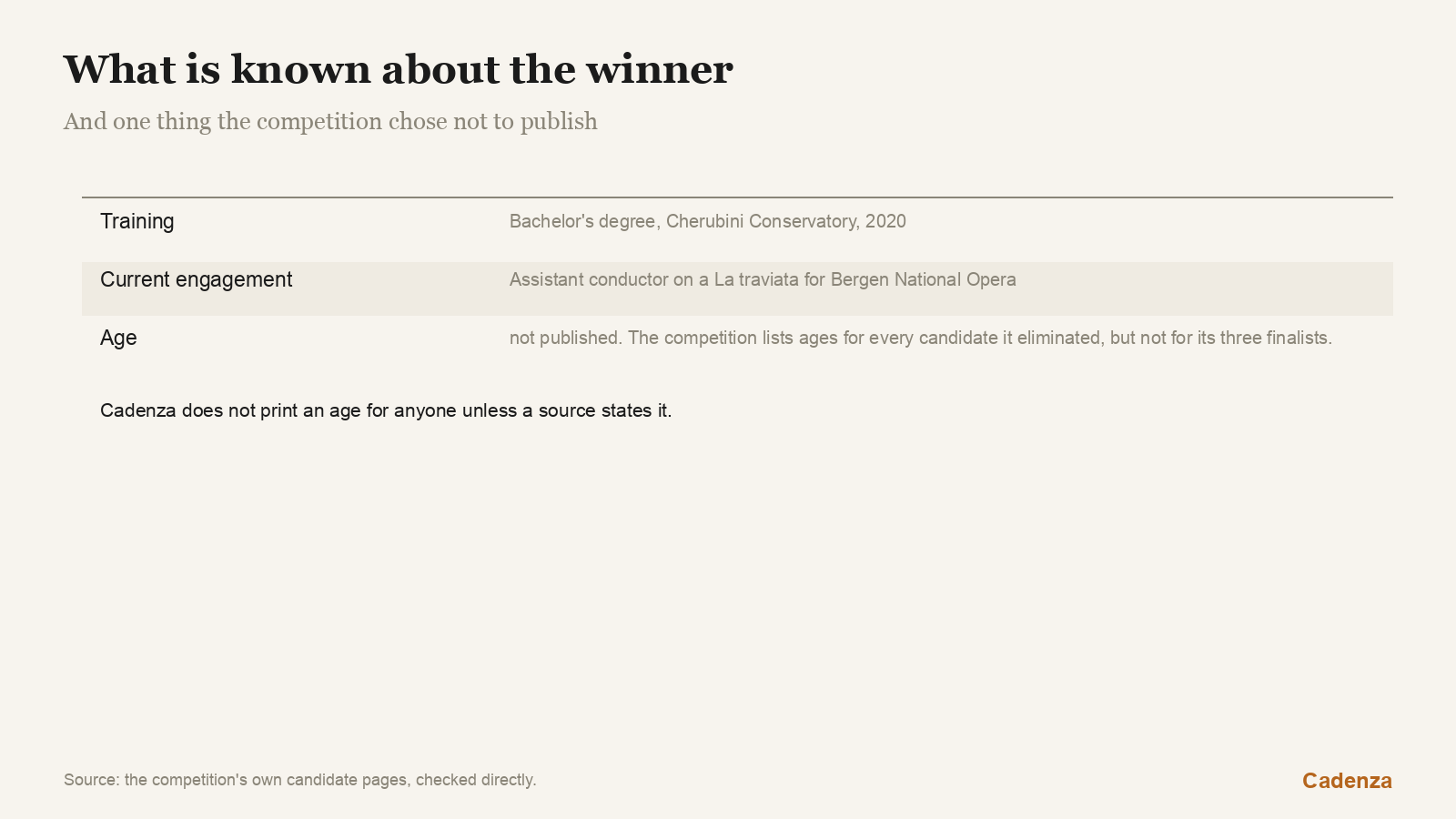
Barsali took a bachelor's degree at the Cherubini Conservatory in 2020, and has an assistant-conductor engagement on a La traviata with Bergen National Opera.
Cadenza is not printing an age for him, and the reason is worth stating because it says something about how competitions present people. The competition's own website lists ages for every non-finalist candidate, in the form of a nationality and an age. For the three finalists, including Barsali, the ages are omitted. Whether that is deliberate or an oversight, the effect is that the further you get, the less the competition tells you about you.
An orchestra in a country of forty-one thousand
The Liechtenstein Symphony Orchestra is the body attached to the prize, and the principality's resident population was 41,237 at the end of 2025, on its own statistics office's figures. A country of that size running an international conducting competition is the interesting institutional fact underneath the result.
A competition is one of the cheapest ways for a small country to buy a place in an international profession. It costs a jury, a hall, an orchestra for a few days and a prize fund, and it returns 173 applications from thirty countries in a first year. Set the 30,000 francs against what it would cost Liechtenstein to be noticed by 173 conductors any other way and the arithmetic is obviously favourable.
The risk in a first edition is that nobody applies. That risk did not materialise, and 173 applications from thirty countries is a strong first year by any measure. It also means the second edition will be harder to get into than the first, which is the pattern every new competition follows once word travels. Anyone who was considering applying and did not is looking at worse odds next time.
The 2028 date on the guest engagement tells you something about how a small orchestra plans. Seasons at that scale are built years ahead and there is little slack, so a prize concert has to be slotted into a gap that exists rather than created. It is a reminder that the prize is a real commitment of the orchestra's own programming, not a certificate.
Why a 5.2 per cent invitation rate should be published everywhere
Cadenza has now run the funnel arithmetic on three separate 2026 competitions, and the pattern across them is the useful output.
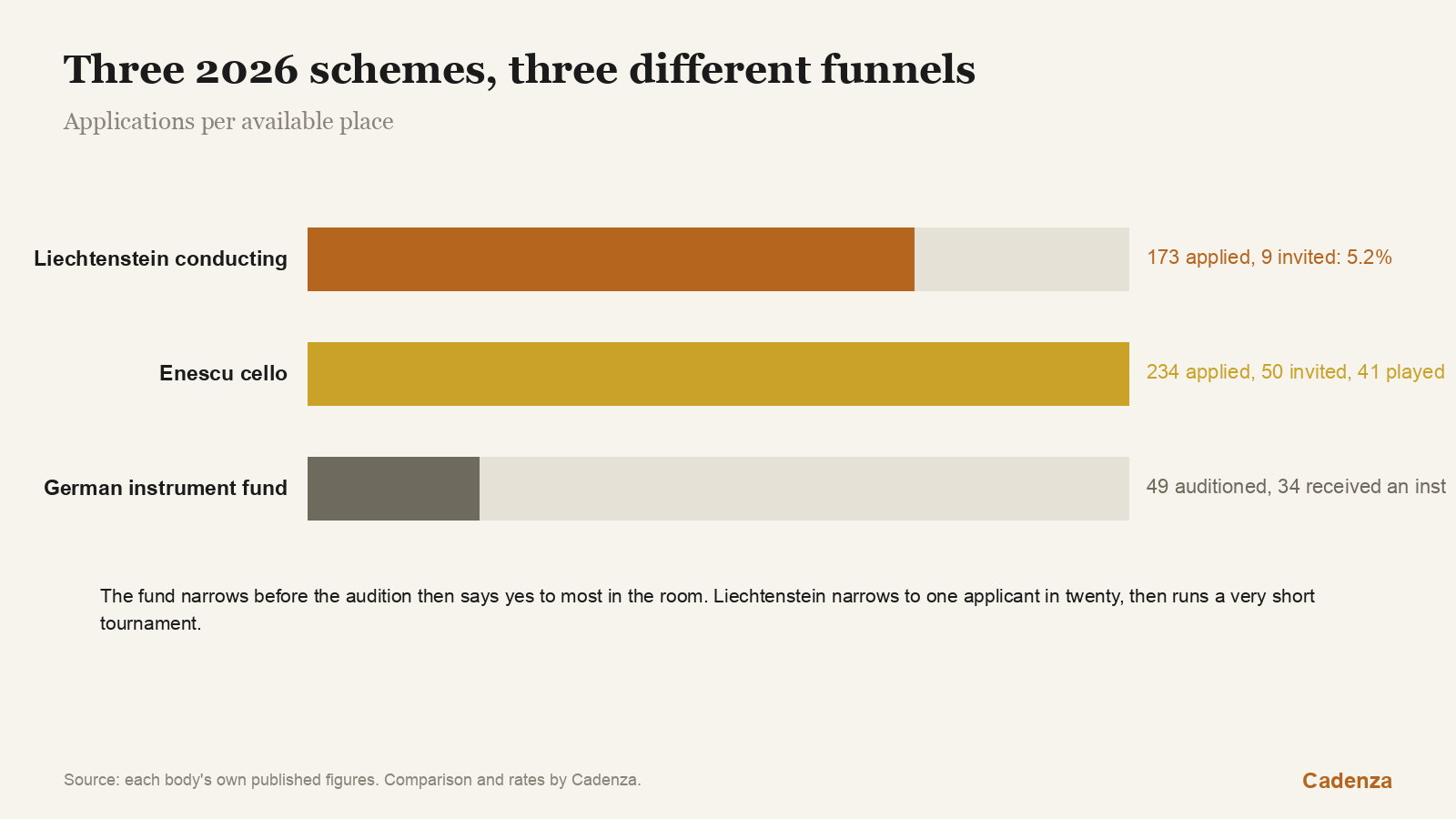
The Enescu competition's cello section drew 234 applications, invited fifty and had forty-one actually play. The German instrument fund auditioned forty-nine players and loaned out thirty-four instruments. Liechtenstein drew 173 and invited nine.
Those three are doing genuinely different things. The instrument fund narrows before the audition and then says yes to most of the people in the room. The Enescu narrows to about one applicant in five and then runs a tournament. Liechtenstein narrows to one in twenty and runs a very short tournament.
None of that is visible from a results announcement. It is only visible if somebody adds up the applications, and most competitions publish the figure once, in a press release, and never again.
What 173 applications actually cost the applicants
There is a second arithmetic here that competitions never run, and it is the one that decides whether a young conductor can afford the circuit at all.
One hundred and sixty-four people applied and were not invited. Whatever the application required of them, in time, in video preparation, in fees where fees apply, produced nothing at all. That is not a criticism of Liechtenstein, which cannot invite 173 conductors to a five-day competition in a country of forty-one thousand people. It is the structure of the thing.
For the nine who were invited, the calculation flips. A five-day competition in Vaduz means travel, accommodation and a week out of whatever work pays the rent, against a one-in-nine chance at 30,000 francs and a one-in-three chance of reaching a final that is itself a CV line. Most conductors at this stage take that bet repeatedly, across several competitions a year, which is why the invitation rate is the number that governs a career rather than the prize.
The useful comparison is with the German instrument fund covered separately by Cadenza this week. That scheme puts its filter at the point of selection for the audition and then loans instruments to roughly seven of every ten people who show up. Liechtenstein filters at the paper stage and then runs a tournament among nine. Both models are defensible. Only one of them tells an applicant, in advance, roughly what their chances are, and neither publishes it on the application page.
A year ago it was a call for applications
Every one of those 173 applications went in months before anybody conducted anything, and a first-edition competition is the one moment when the field is smallest and the odds are best. The second edition will draw more.
Cadenza carries competitions with open deadlines, free to musicians, on its competitions board, and conducting and orchestral vacancies on its jobs board.
If you are applying to a conducting competition. Ask for the invitation rate before you pay the fee, because that is where the real filter sits and it is almost never advertised. Liechtenstein's was 5.2 per cent. Check also when the attached engagement actually falls: this prize's concert is in the 2028 season, two years after the cash. And read the finalist list rather than the winner announcement, because reaching a final of three from 173 is itself a result worth putting on a CV.
The question the competition will be asked next is the friendliest kind. It published its full funnel in its first year, which most competitions never do. Will it also publish the ages of its finalists, as it already does for everyone it eliminates?
Sources: the International Conducting Competition Liechtenstein's own site, musiccompetition.li, for the result, the prize of 30,000 Swiss francs, the 2028 guest-conducting invitation, the audience award to Anna Bottani, Barsali's quoted reaction, and the full funnel of 173 applications from thirty countries, nine invited conductors and three finalists. Barsali's Cherubini Conservatory bachelor's degree of 2020 and his Bergen National Opera assistant engagement were confirmed separately, and the competition's own candidate pages were checked for the finalists' ages, which are not given. The invitation rate, the compounded odds and the comparison with the Enescu competition and the Deutscher Musikinstrumentenfonds are Cadenza's arithmetic from each body's published figures.
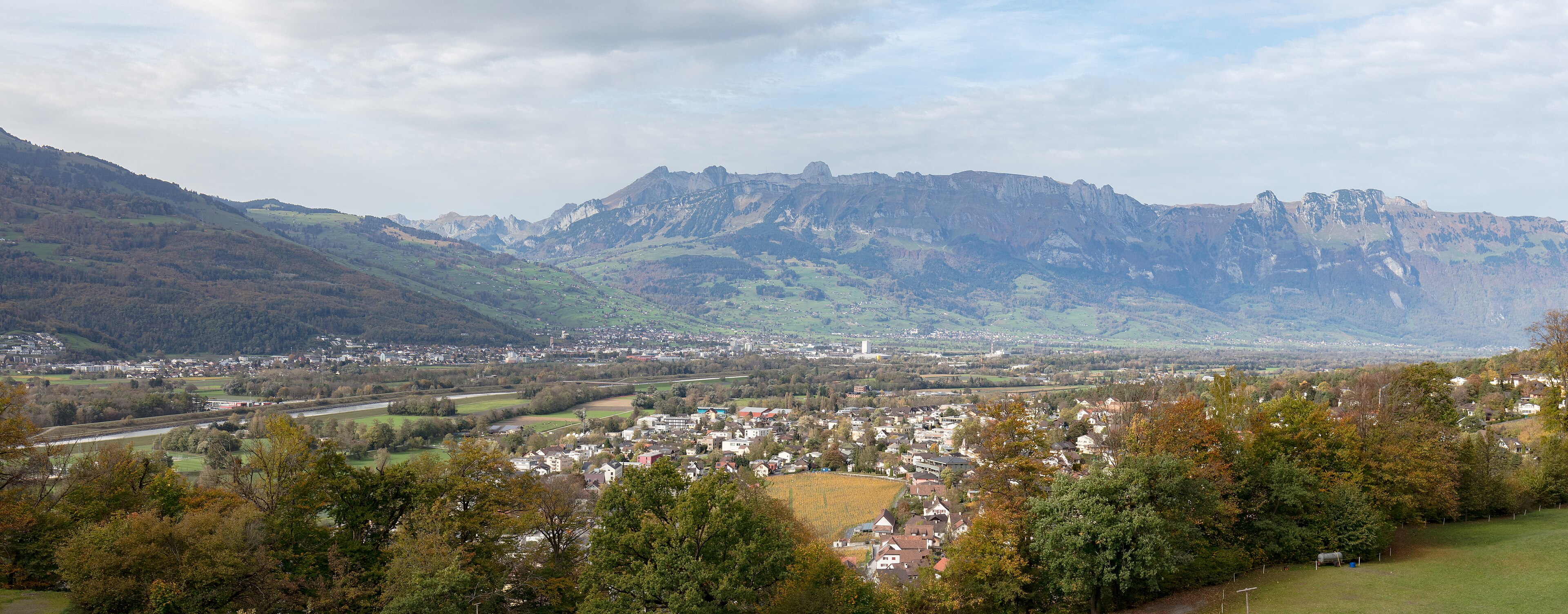
Cover photograph: Vaduz, Liechtenstein, 2022. Diego Delso, CC BY-SA 4.0, via Wikimedia Commons. Charts by Cadenza.
Cover photograph: Vaduz, Liechtenstein, where the principality's first international conducting competition was held in June 2026, photographed in 2022. Diego Delso, CC BY-SA 4.0, via Wikimedia Commons.
Comments
Sign in to join the discussion.