The St Louis Symphony Orchestra has appointed Bridget Conley its Principal Tuba and the holder of the Lesley A. Waldheim Chair, for the 2026-27 season. She arrives directly from a fellowship with the New World Symphony in Miami Beach.
That last clause is the story. A named principal chair in a major American orchestra is not usually anybody's first professional job, and the step from a training fellowship into one, with no intervening orchestra in between, is a route very few players get.
There is also only one tuba in an orchestra. Every other principal has a section behind them.
The route, which skipped a step
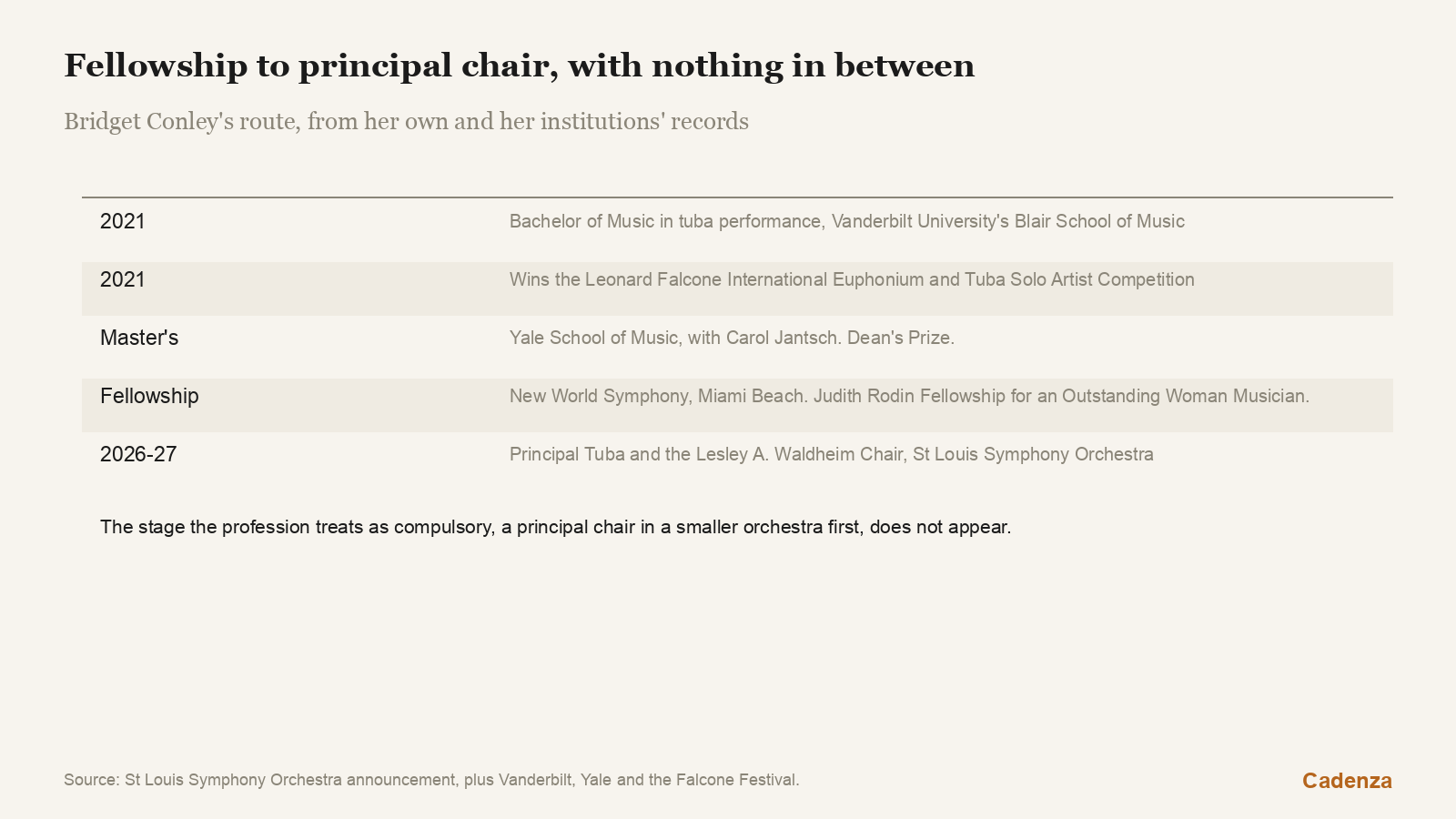
Conley took a Bachelor of Music in tuba performance at Vanderbilt University's Blair School of Music in 2021, then a Master of Music in performance at the Yale School of Music, where she studied with Carol Jantsch and received the Dean's Prize. From there she went to the New World Symphony, where she held the Judith Rodin Fellowship for an Outstanding Woman Musician. From there, St Louis.
The conventional path for a brass player runs differently. A fellowship, then a section seat or a principal chair in a smaller regional orchestra, then several audition cycles, then a shot at a major-orchestra principal post. Each of those stages typically takes years, and most players never complete the sequence.
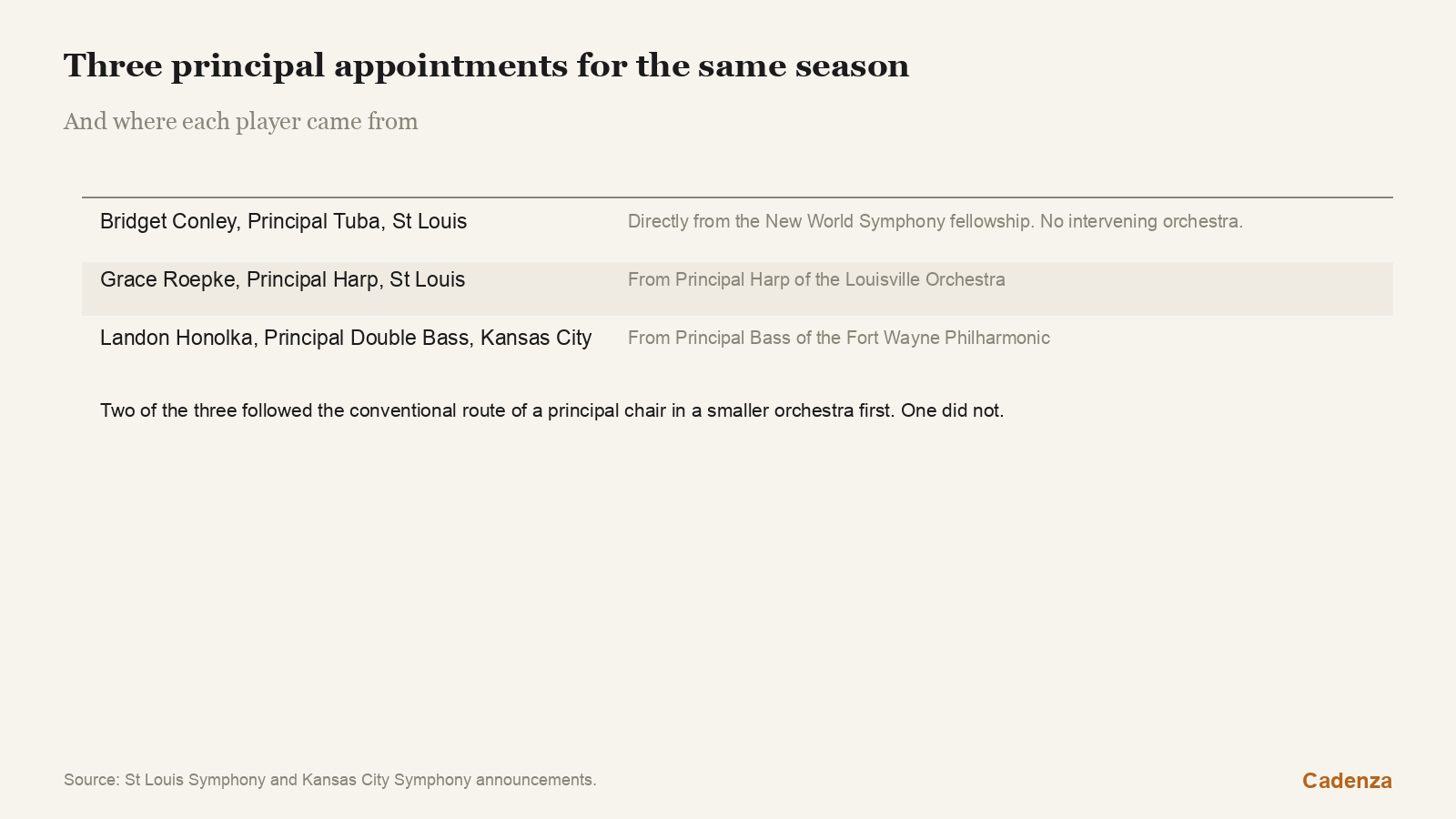
Compare it with two other appointments the same orchestra and its neighbours announced for the same season. Landon Honolka becomes Principal Double Bass of the Kansas City Symphony for 2026-27, stepping up from Principal Bass of the Fort Wayne Philharmonic. Grace Roepke becomes Principal Harp and holder of the Elizabeth Eliot Mallinckrodt Chair at St Louis, stepping up from Principal Harp of the Louisville Orchestra.
Both of those are the normal shape: a principal chair in one orchestra leading to a principal chair in a larger one. Conley's is the unusual shape.
What her prize money was worth against what training costs
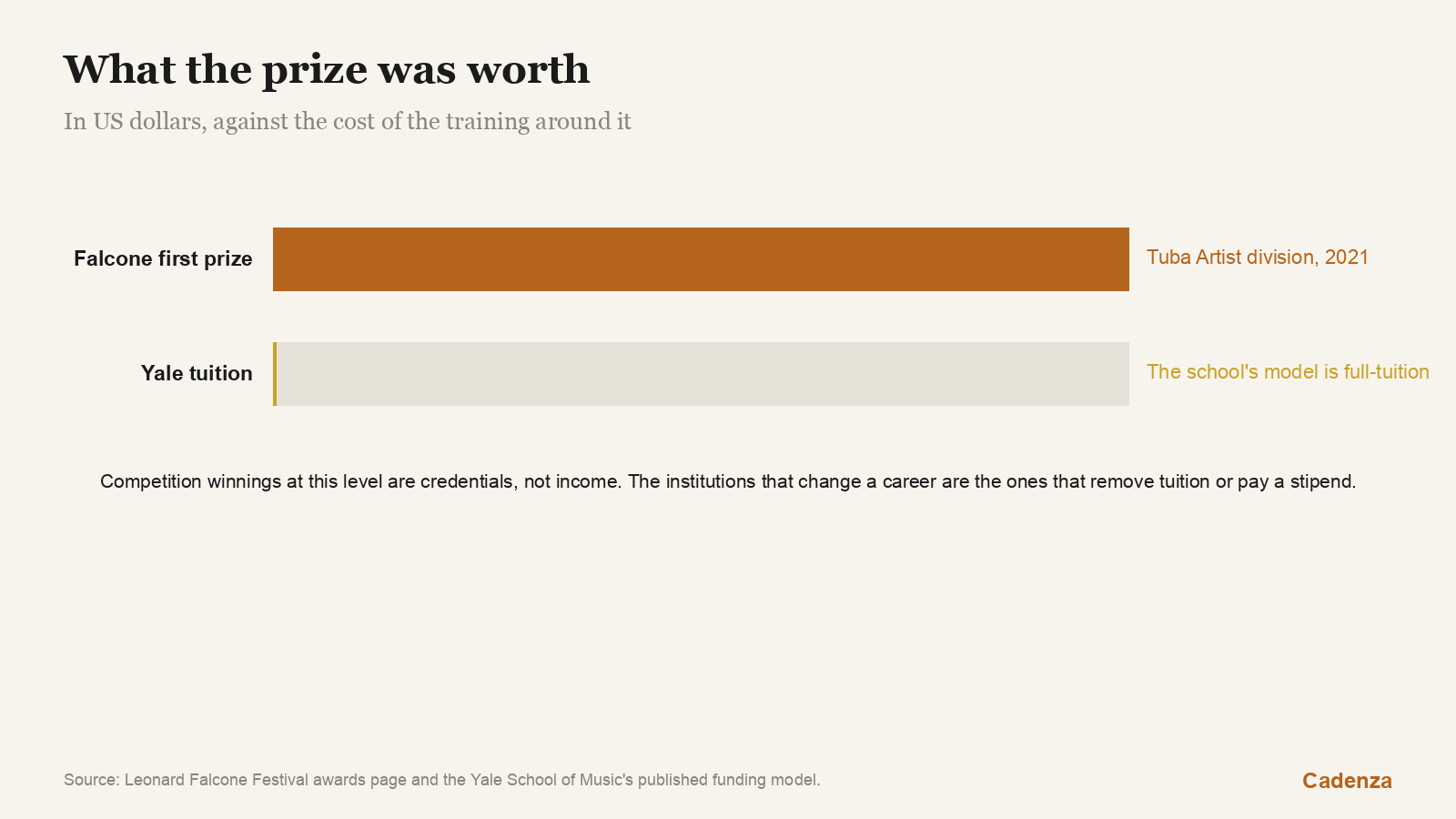
As a soloist, Conley won the 2021 Leonard Falcone International Euphonium and Tuba Solo Artist Competition. The Tuba Artist division first prize is $2,800, on the festival's own published awards.
That is a real win and a real line on a CV, and it is also a useful measure of the gap every brass student lives inside. Two thousand eight hundred dollars is roughly a set of professional mouthpieces and a flight to an audition. It is not a semester anywhere.
The Yale School of Music is the interesting comparison, because it removes the gap rather than narrowing it. Yale's model is full-tuition scholarships for every student in the school. So the most expensive single item in Conley's training, a graduate degree at a leading conservatory, cost nothing in tuition, while the prize that marked her out as a soloist paid less than a month's rent in most American cities.
For a student mapping a route, that contrast is the practical lesson. Competition winnings at this level are credentials, not income. The institutions that actually make the difference are the ones that remove tuition and the ones that pay a living stipend, which is what a fellowship is.
The instrument that has no section
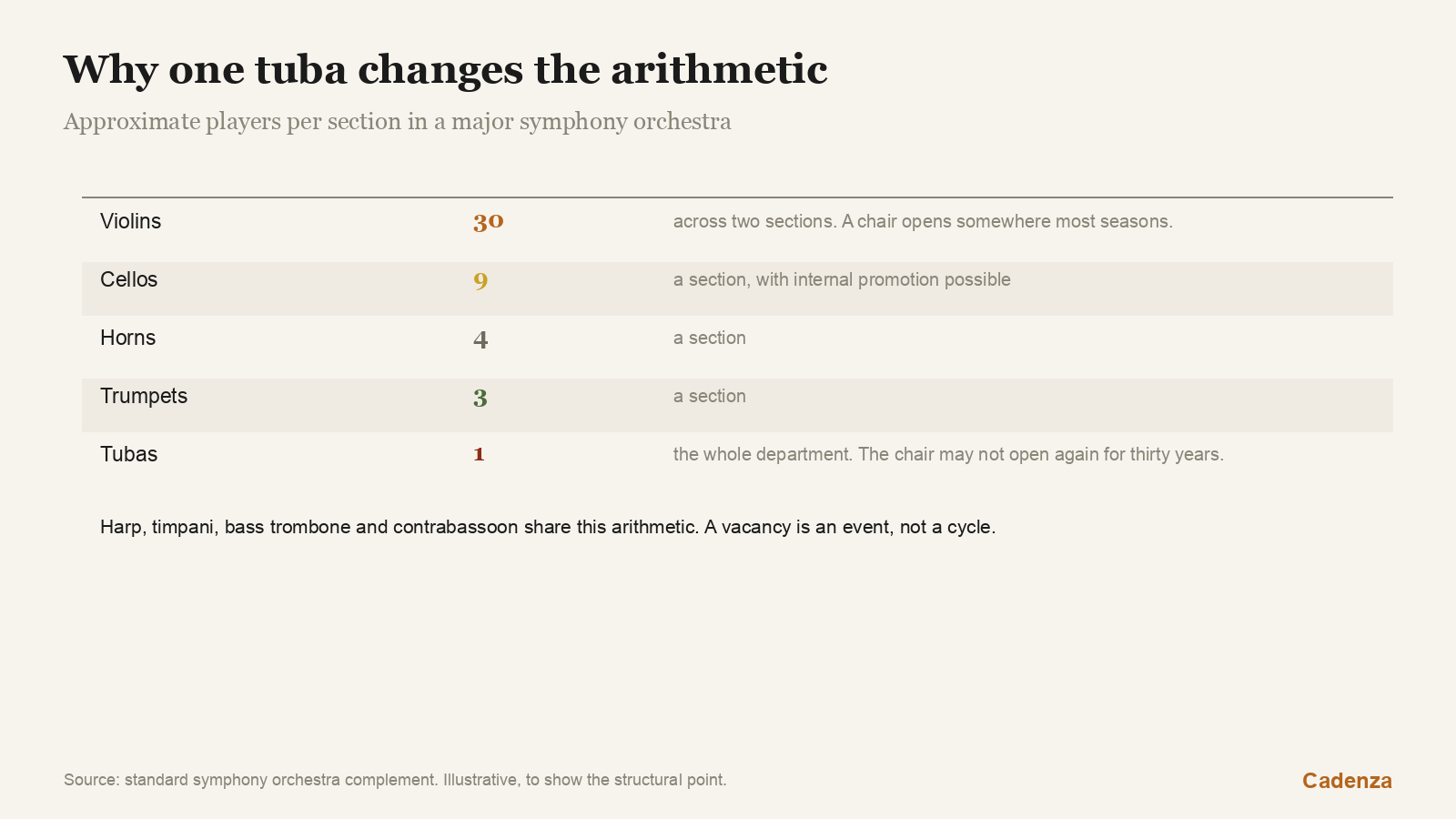
A tuba player's career arithmetic is unlike anyone else's in the orchestra, and it is worth spelling out because it explains why this appointment matters so much more than the equivalent string appointment.
A major orchestra carries one tuba. It carries perhaps thirty violins across two sections, eight or nine cellos, four horns, three trumpets. When a violin chair opens, another violin chair will open somewhere within a season or two. When the tuba chair opens, it is the only one in that building, and it may not open again for thirty years.
So the pool of professional orchestral tuba jobs in any country is a two-digit number, and a vacancy is an event. Conley has won one of them at the start of her career, and the person who holds a chair like this at twenty-something may hold it for four decades.
That is also why the step she skipped is so rarely skipped. With so few chairs, the usual route is to take whatever seat exists anywhere and wait. Going straight from a fellowship into a principal tuba chair in a major orchestra requires the vacancy and the readiness to coincide exactly.
What she does besides play
Conley is a co-founder of Sisters in Sound, which produces free arrangements and recordings of music by early women composers for brass ensemble.
That is worth more than a line of biography, because the repertoire problem it addresses is specific and real. Brass ensembles play almost entirely arrangements, since the original repertoire is thin and recent, and the arrangements that exist were overwhelmingly made from a canon that excluded women. Producing free arrangements attacks the bottleneck at the point where it actually binds, which is a conductor or a student ensemble looking for something playable at no cost.
It is also the kind of work that tends to go unmentioned when an appointment is announced, and the orchestra's own release did mention it. That is a small editorial choice by a press office and it is the right one. A section player's advocacy work is usually invisible until they are senior enough for it to be safe, and printing it alongside the appointment signals that St Louis considers it part of what it hired.
Her teacher at Yale is worth naming again for the same reason. Carol Jantsch won the principal tuba position of the Philadelphia Orchestra in February 2006, while she was still at university, which is the closest comparable example most tuba players could name of the step Conley has just taken. A student who learns from someone who did it has a template for it.
What a named chair actually means
Both St Louis appointments come with a named chair, and the naming is not decoration. A named chair is an endowed position: a donor has given the orchestra a sum whose investment income pays some or all of that seat's cost in perpetuity. Conley holds the Lesley A. Waldheim Chair; Roepke holds the Elizabeth Eliot Mallinckrodt Chair.
For the player the practical consequence is security. An endowed chair is funded from a separate stream rather than from the annual operating budget, which is the part of an orchestra's finances that gets cut in a bad year. In a sector where Cadenza has this month covered a school district eliminating a strings class and an orchestra rebuilt after bankruptcy, that distinction is worth understanding before you sign anything.
It also tells a young player something about where to look. An orchestra that has endowed its tuba chair has decided that seat is permanent, which makes the vacancy worth relocating for in a way that a one-year contract is not.
A year ago it was an audition notice
Every one of these chairs began as a posted vacancy with an excerpt list attached, and the tuba chair in a major orchestra is posted perhaps once in a generation. The fellowship that led to it is also an application with a deadline.
Cadenza carries current orchestral vacancies, free to musicians, on its jobs board, and competitions with open deadlines on its competitions board.
If you play a one-per-orchestra instrument. Tuba, harp, timpani, bass trombone and contrabassoon all share this arithmetic, and it changes how you should plan. Watch fellowships as seriously as you watch auditions, because a funded fellowship keeps you playing at professional standard during the years when no chair is open anywhere. Both of the St Louis appointments announced for this season went to players who already held the equivalent chair elsewhere or came from a major fellowship, which tells you where the orchestra was looking.
The question St Louis will be asked next is about the route rather than the player. It has just filled a principal chair directly from a training fellowship, skipping the regional-orchestra stage that the profession treats as compulsory. Will the orchestra say what it saw in the audition that made the missing decade unnecessary?
Sources: the St Louis Symphony Orchestra's own announcement of its new musicians for 2026-27, which carries Conley's appointment as Principal Tuba and holder of the Lesley A. Waldheim Chair, her New World Symphony fellowship and Judith Rodin Fellowship, her 2021 Leonard Falcone competition win, her co-founding of Sisters in Sound, and Grace Roepke's appointment as Principal Harp; the Leonard Falcone Festival's own awards page for the $2,800 Tuba Artist first prize; the Kansas City Symphony's own announcement of its six new musicians for 2026-27 for Landon Honolka; and Conley's degrees and teacher as given by the Vanderbilt Blair School of Music, the Yale School of Music and her own biography. Carol Jantsch's own February 2006 Philadelphia appointment, made while she was still at university, was verified separately. No age is published for Conley in any of those sources, so none is given here. The comparisons between career routes and the prize-against-tuition arithmetic are Cadenza's.
Cover photograph: the New World Center, Miami Beach, 2011. JD Lasica, CC BY 2.0, via Wikimedia Commons. Charts by Cadenza.
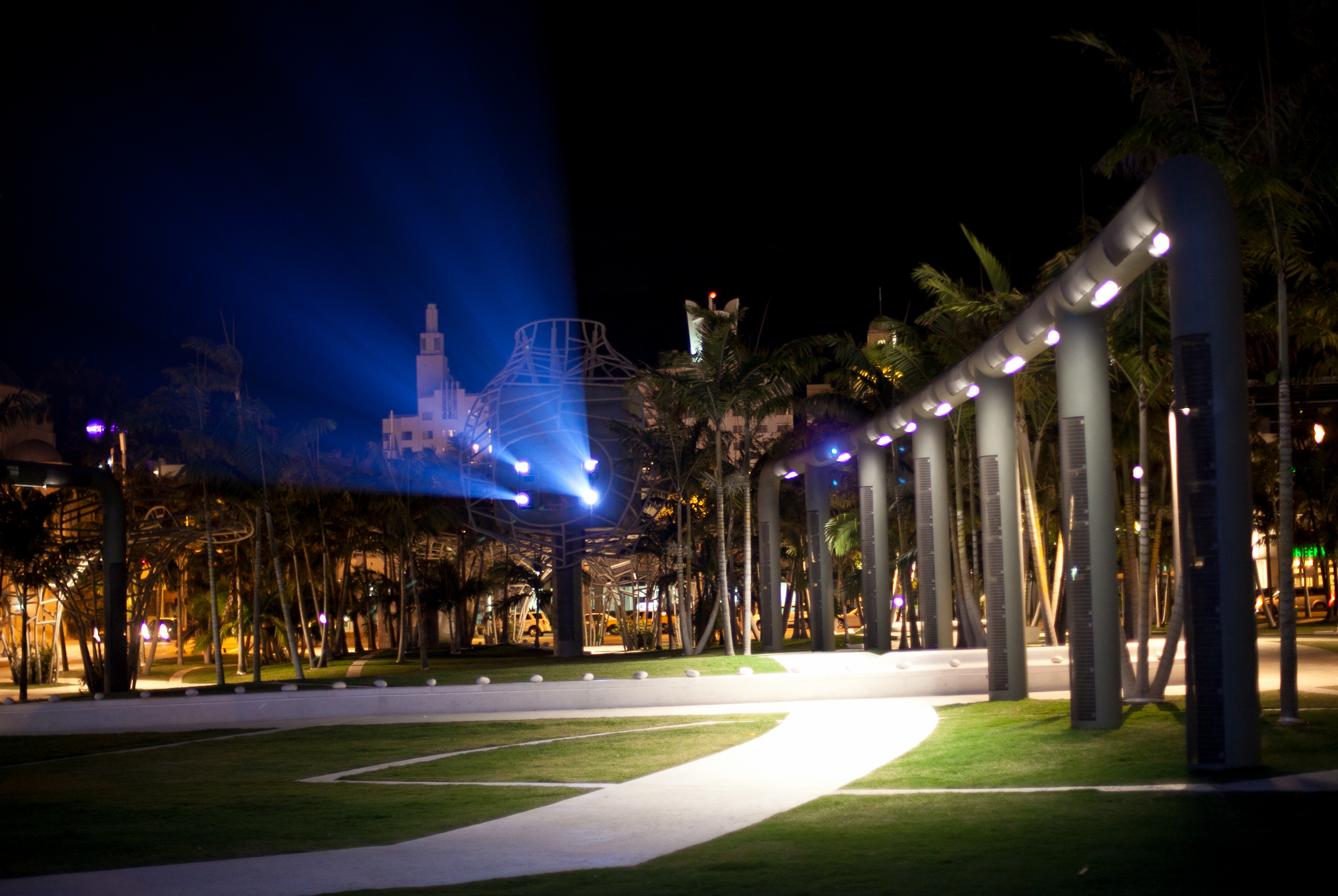
Cover photograph: The New World Center in Miami Beach, home of the New World Symphony, where Bridget Conley held a fellowship before her St Louis appointment, photographed in 2011. JD Lasica, CC BY 2.0, via Wikimedia Commons.
Comments
Sign in to join the discussion.