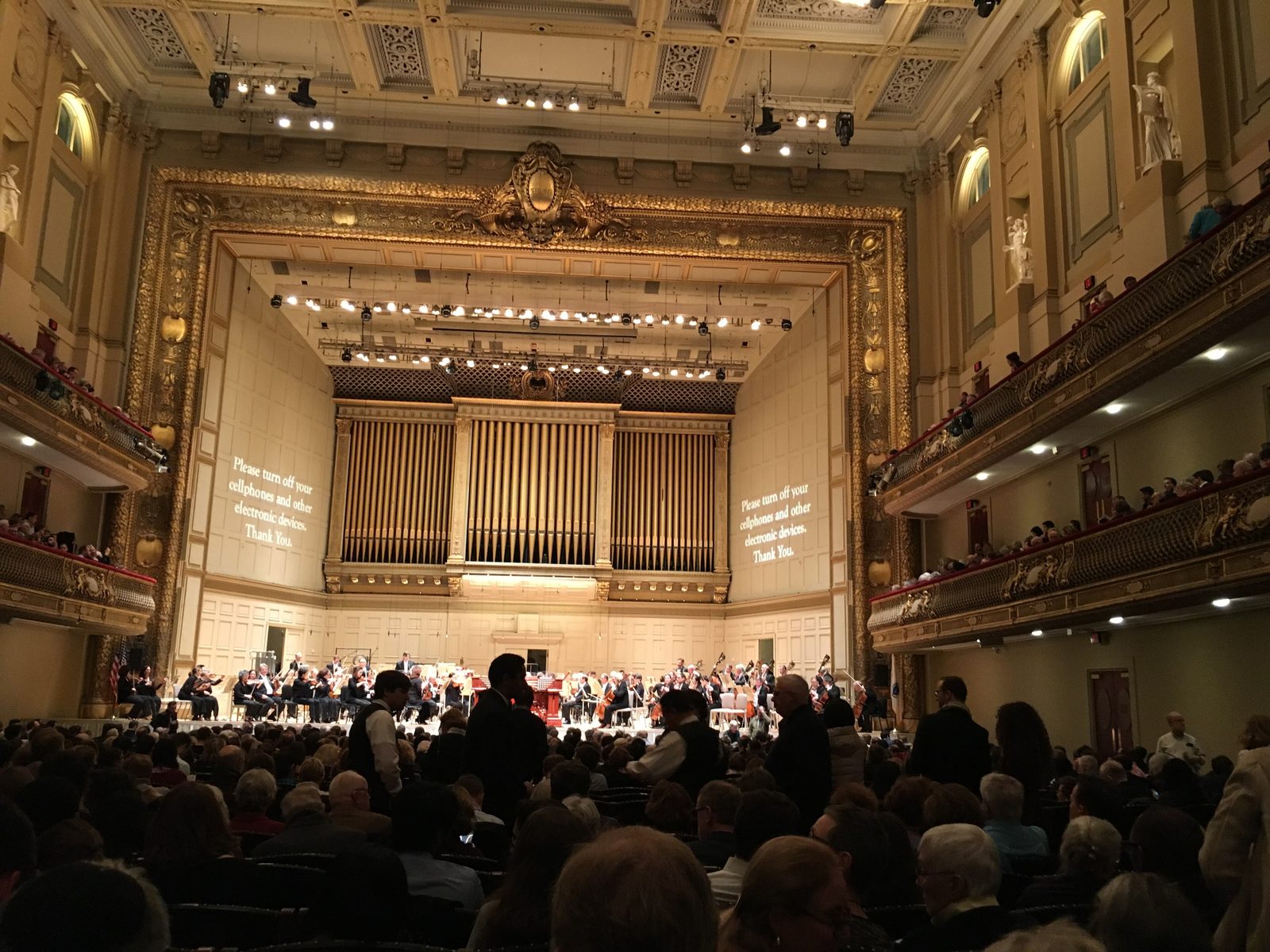
On Saturday 22 August 2026, the musicians of the Boston Symphony Orchestra voted unanimously to authorise a strike. It would have been the first in an institution founded in 1881. Their contract was due to expire at 11:59 p.m. the following night. On Sunday the parties extended it by 48 hours. On Tuesday 25 August the musicians ratified a new three-year agreement, and the orchestra's press office issued a release headed Boston Symphony Orchestra Approves New Three-Year Labor Agreement.
The economic terms were published within hours: four per cent annual raises, four and a half in the third year, a guaranteed base salary rising to $230,000 and a guaranteed pension of $94,000, which the Boston Globe reported as the highest in the field. What both sides chose to put in their own statements, though, was a governance clause. The musicians now have, in the words of their players' committee chair, "a critically enhanced role in the engagement of titled conductors, including the music director."
Read on its own, that is a line from a press release. Read against the last six months, it is the musicians of the Boston Symphony converting the thing done to them in March into a thing that is now governed by written rules, and doing it with the only instrument a contract gave them.
Seventy-two hours
The Boston Musicians' Association statement on 22 August, reproduced by Slipped Disc, was three sentences long. The first two were fact: a unanimous vote to authorise the first strike in the orchestra's history, and a contract expiring at 11:59 p.m. on 23 August. The third was the accusation: "In spite of the turmoil of the last six months caused by BSO leadership's decision to terminate the Orchestra's music director, they have failed to agree to a collective bargaining agreement that would begin to restore the trust that they have destroyed and offer a fair contract to the musicians who are the heart and soul of the BSO."
Note the order. The grievance named first is not pay. It is the termination of the music director, and the word chosen for what leadership did to trust is "destroyed."
WBUR reported that the union represents more than 90 musicians, that the parties had been negotiating a three-year contract, and that management had declined the union’s proposal to engage a professional mediator. Chief executive Chad Smith's response the same day: "We respect the musicians' right to take this step as part of the negotiating process. Our focus remains on the negotiations and the ongoing constructive conversations. We are committed to reaching an agreement with competitive pay and benefits that enhances collaboration with the Players."
On Sunday 23 August, the Associated Press reported that the parties had extended the expiring agreement by 48 hours. On Tuesday 25 August, the AP reported the ratification. The orchestra's own release put the agreement's term at 26 August 2029; the Boston Globe reported that the musicians ratified it by 94 per cent. The season opens on 17 September, with Nelsons conducting Yo-Yo Ma in Elgar's Cello Concerto.
The clause
Here is what each party chose to say, in its own voice, about what the agreement contains.
Todd Seeber, chair of the BSO Players Committee: the agreement "guarantees the musicians a critically enhanced role in the engagement of titled conductors, including the music director."
The joint statement: it "creates a precedent-setting partnership between musicians and management in artistic planning" and "establishes a truly collaborative process in the search for our next music director."
David Rufino, president of the Boston Musicians’ Association: the deal guarantees "musicians a meaningful role engaging collaborators and planning repertoire."
Chad Smith: the agreement "deepens our collaboration with the musicians and strengthens their role in the artistic planning process."
Barbara Hostetter, chair of the board of trustees: "As stewards of an institution built and sustained across generations, we have a responsibility to leave the BSO stronger than we found it."
Five statements, one subject. Not one of them mentions the money, which was reported the same day and was substantial. The players' committee chose to lead with governance; management chose to follow. Whatever the wage settlement was, both sides agreed that the story was the search.
Why this clause, and why it had to be fought for
On 6 March 2026 the orchestra's board decided not to renew Andris Nelsons after thirteen seasons. Cadenza's investigation into the decision documented a reported 32–0 trustee vote taken before the musicians were informed, a chief executive whose official orchestra profile presents the Nelsons extension as a first-year investment in the orchestra’s artistic future, and who then defended ending it, and an explanation resting on the phrase "future vision" that the board has declined to elaborate on since. The musicians’ opposition was immediate and, by the standards of orchestral labour relations, unprecedented in its language. Principal flute Lorna McGhee called the decision not to renew Nelsons "a form of artistic suicide." Double bassist Tom Van Dyck wrote to the board that the breakdown in trust was "in all likelihood irreparable."
None of that gave the musicians leverage over the decision, because nothing in their contract touched a sitting music director’s renewal. They held five of eleven seats on the successor search committee; they had no vote at all on whether Nelsons stayed. They could object, resign, weep on the record, and they did.
A strike authorisation is a bargaining instrument, and the musicians used it precisely. Their statement of 22 August did not say the pay offer was inadequate. It said leadership had failed to offer a contract "that would begin to restore the trust that they have destroyed." The remedy for destroyed trust is not a wage increase. It is a rule that governs the destroying act. Slipped Disc, citing a person briefed on the contract, reported that it contains a section on how the termination or non-renewal of titled conductors will happen in future; the parties have not published that language.
On 21 August the musicians held a minority of seats on a search committee whose recommendation the board could set aside. On 25 August they held half of it, with a two-thirds threshold of their own. That is what changed, and it is a great deal.
The ledger the board was negotiating from
The orchestra’s own Form 990 filings, as extracted by ProPublica’s Nonprofit Explorer, describe the institution across the five years leading to this contract. Cadenza’s orchestra finances dataset covers the year after them.
| Tax year | Total revenue | Total expenses | Net assets, year end | Officer compensation |
|---|---|---|---|---|
| 2019 | $95.9m | $109.8m | $496.3m | $1.65m |
| 2020 | $92.5m | $82.8m | $535.0m | $1.66m |
| 2021 | $89.9m | $64.0m | $661.8m | $1.48m |
| 2022 | $116.0m | $98.6m | $581.7m | $1.52m |
| 2023 | $93.2m | $110.6m | $587.1m | $2.73m |
Source: Boston Symphony Orchestra Inc., EIN 04-2103550, Form 990, as extracted by ProPublica's Nonprofit Explorer. "Officer compensation" is the aggregate Form 990 line for current officers, directors, trustees and key employees, not one salary.
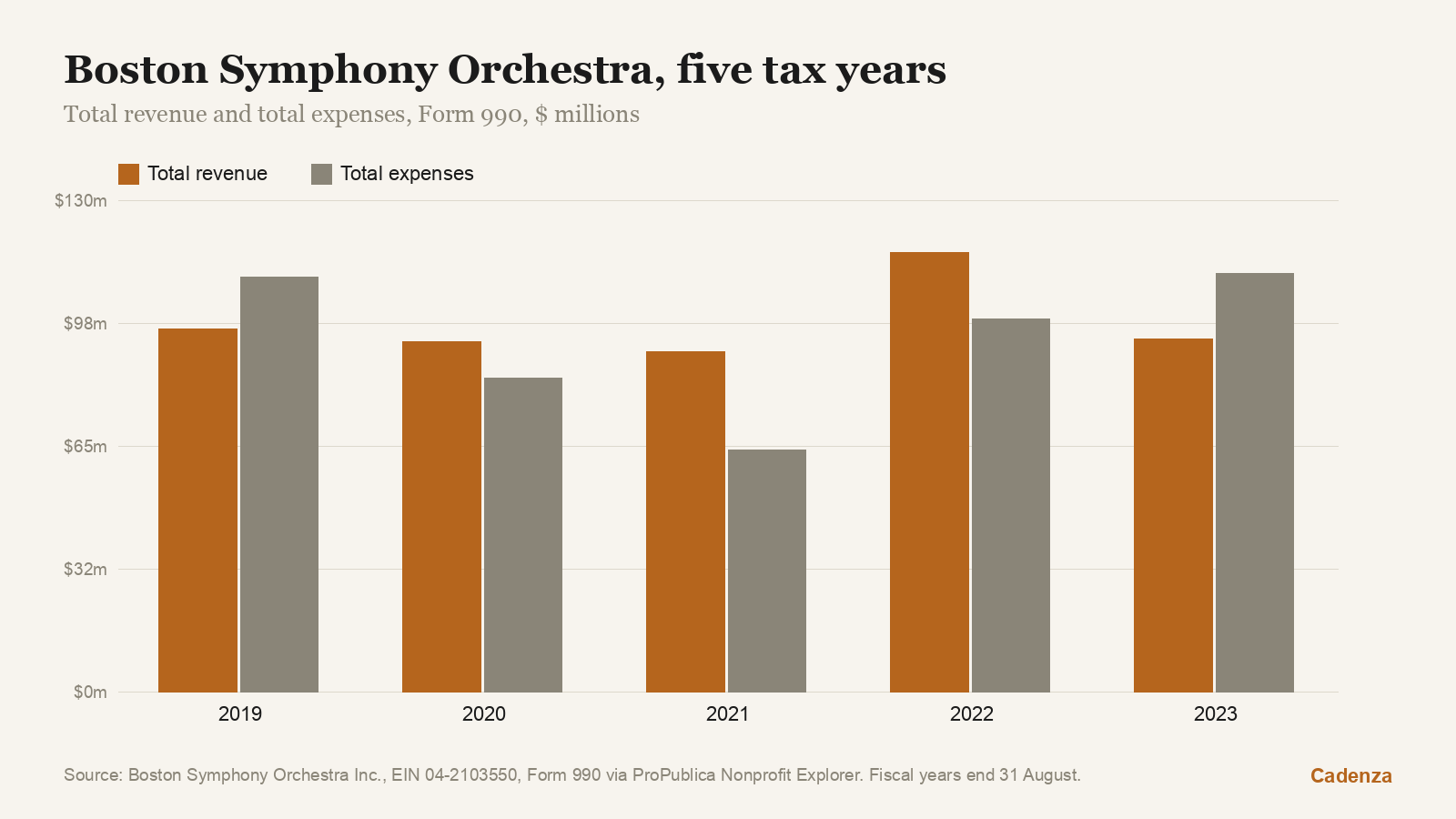
Two lines matter to this negotiation.
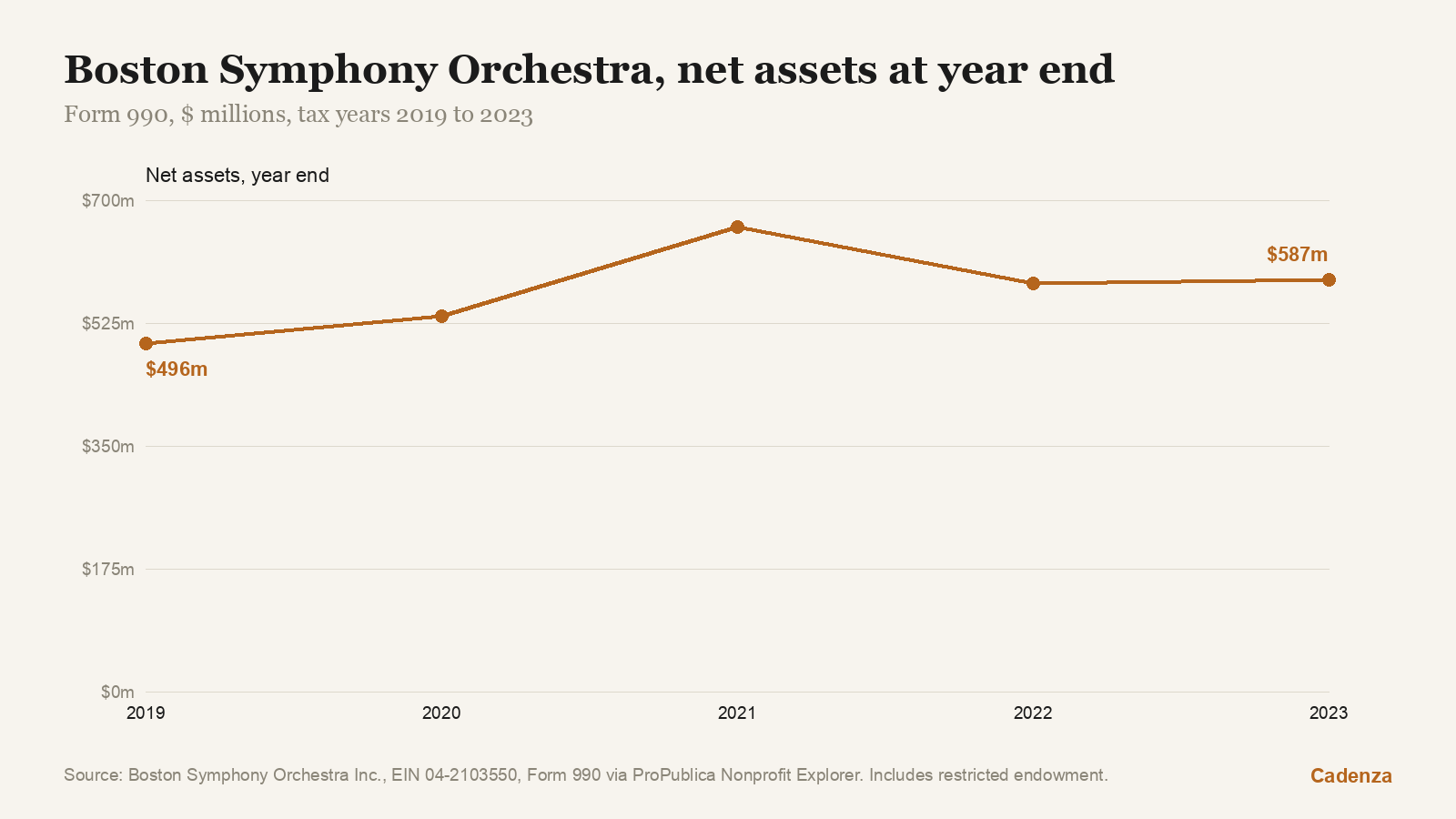
The 2023 tax year shows expenses of $110.6 million against revenue of $93.2 million, a $17 million operating shortfall, on a balance sheet of $587 million. That is the "structural deficit" and "depleted reserves" the board's letter to subscribers invoked in March, and it is the backdrop against which the musicians were asked to accept whatever wage settlement they accepted. It is also a balance sheet that grew by $91 million between 2019 and 2023, pandemic included.
Officer compensation rose from $1.52 million in 2022 to $2.73 million in 2023, an increase of 79 per cent in a single year. The orchestra’s fiscal 2023 ended on 31 August 2023, and it was a year of turnover in the chief executive’s office: Gail Samuel resigned, and Jeffrey Dunn served as interim chief executive from January 2023 until Chad Smith arrived from Los Angeles in the early autumn, which is to say in fiscal 2024. The Form 990 line aggregates officers, directors, trustees and key employees, and Schedule J itemises it. Fiscal 2023 was also the year the orchestra swung from a $17.5 million surplus to a $17.4 million deficit, a movement of $34.9 million, and the year before the board removed a five-time Grammy winner citing a future vision it has declined to describe.
The musicians did not have to cite any of this at the table. Their statement cited trust. But it is worth setting down that the institution which spent six months telling the public it could not afford its past was, by its own filings, holding $91 million more in net assets than in 2019, though $75 million less than at its 2021 peak, and paying its officers more than in any year on record.
What the contract does not do
Three things remain outside it.
The board's last word. The orchestra says the search begins this autumn; its release describes the parties as "focused on the BSO's next chapter, beginning with the start of the 2026-2027 season and the Music Director search this fall." The mechanism is public too. The committee will have twelve members, six of them players, up from five of eleven, and a candidate must clear a two-thirds threshold on each side to qualify. But the board has retained authority over the final appointment, restricted to the candidates the committee has qualified. The musicians can now determine who is eligible. They cannot determine who is chosen.
The full text. The economic terms are known; the agreement itself is not public. Slipped Disc, citing a person briefed on it, reported five pages and more on an Artistic Liaison Committee covering guest conductors, artistic partnerships, Pops programming and scheduling, at least one meeting a year between players and the board, and the section on how titled conductors may be removed in future. Chad Smith keeps sole final authority over the appointment of a chief artistic officer. None of that language has been released.
The trust. The musicians said it was destroyed. A contract can require a process. It cannot require the thing the process exists to protect. The first test is the search, and the second is whether a board that voted 32–0 in March will accept a shortlist it did not draw up alone.
What the contract did not settle
The agreement ended the labour dispute. It did not end the argument about March. On the day of the ratification the BSO Patron Action Network, the campaign that has been leaving red flowers in Symphony Hall since the spring, told WBUR that "Andris Nelsons has not been reinstated as music director" and that the chief executive "has still failed to provide any transparency around his future vision." On 1 September the campaign's George Whiting sent an open letter to Hostetter and Smith demanding a written answer to six questions first put on 30 April, citing more than 4,200 signatures on its petition.
There is one more date worth writing down. The orchestra closed its 2026 books on 31 August. On its normal filing timetable those results will not be public until July 2027, which means the first full financial year of the Nelsons decision will stay invisible until the search that decision triggered is over.
The question
The Boston Symphony's board declined to renew a five-time Grammy winner on a Friday afternoon, in a vote its musicians say they learned of only afterwards, and has spent six months declining to say more than that the two sides were "not aligned on future vision." It has now signed an agreement in which those people are guaranteed a role in choosing his replacement. The board did not offer that role in March, when it would have cost nothing. It agreed to it in August, three days after the first strike authorisation in the orchestra's history and three weeks before the new season opened.
The question is not whether the musicians won something. They did. The question is what it says about the board of the Boston Symphony Orchestra that they had to.
Sources: Boston Symphony Orchestra release, 25 August 2026; Boston Globe, 25 August 2026; EarRelevant, 26 August 2026; Slipped Disc, 26 August 2026 and 3 September 2026; WBUR, 25 August 2026; WBUR, 22 August 2026; Boston Musicians' Association statement via Slipped Disc, 22 August 2026; Associated Press via Boston.com, 23 August 2026 and 25 August 2026; BSO press room; ProPublica Nonprofit Explorer, Boston Symphony Orchestra Inc., EIN 04-2103550; Cadenza, "Boston Is on Fire. Its Orchestras Are Dying." and "The BSO Investigation".
Cover photograph: Symphony Hall, Boston, home of the Boston Symphony Orchestra. ArnoldReinhold, CC BY 3.0, via Wikimedia Commons.
Comments
Sign in to join the discussion.