At 8:18 on the morning of Monday 7 September 2026 Classic FM announced that its listeners could pay to make the adverts go away. Classic FM Plus, sold through Global Player, the app of its parent company Global, removes the ad breaks from Classic FM and its two sister stations, Classic FM Calm and Classic FM Movies, "whether you're listening to live radio, Replay or Catch-up". The price is stated in one sentence: "Subscriptions start at £4.99 a month, or £49.99 a year, and include Classic FM, Classic FM Calm, and Classic FM Movies."
That is the whole announcement. What it does not say is what the audience is worth, what an hour of silence costs, or how the price sits against everything else a British listener can pay for classical music. Those numbers are public, and they are below.
The document
The launch page lists what a subscriber gets beyond the absence of adverts: "one free entry to Cash Call every week", a 15 per cent discount in the merchandise store, "priority access to events", and "an exclusive, subscriber-only newsletter". It lists where it works: "across the UK via Global Player on mobile, laptop, Alexa smart speakers, Apple CarPlay, Android Auto, and Apple TV". It does not mention DAB or FM; on the page's own terms the subscription lives in the app, and nothing is said about the broadcast signal. It names three stations and no others, so Global's other brands are not part of this product as described.
The two sister stations turn two this week. Classic FM Calm and Classic FM Movies launched on Thursday 12 September 2024 as part of what Classic FM's announcement called "the biggest single launch in UK radio history", twelve stations at once, available on Global Player and, in Greater London, on DAB+.
The audience, from RAJAR
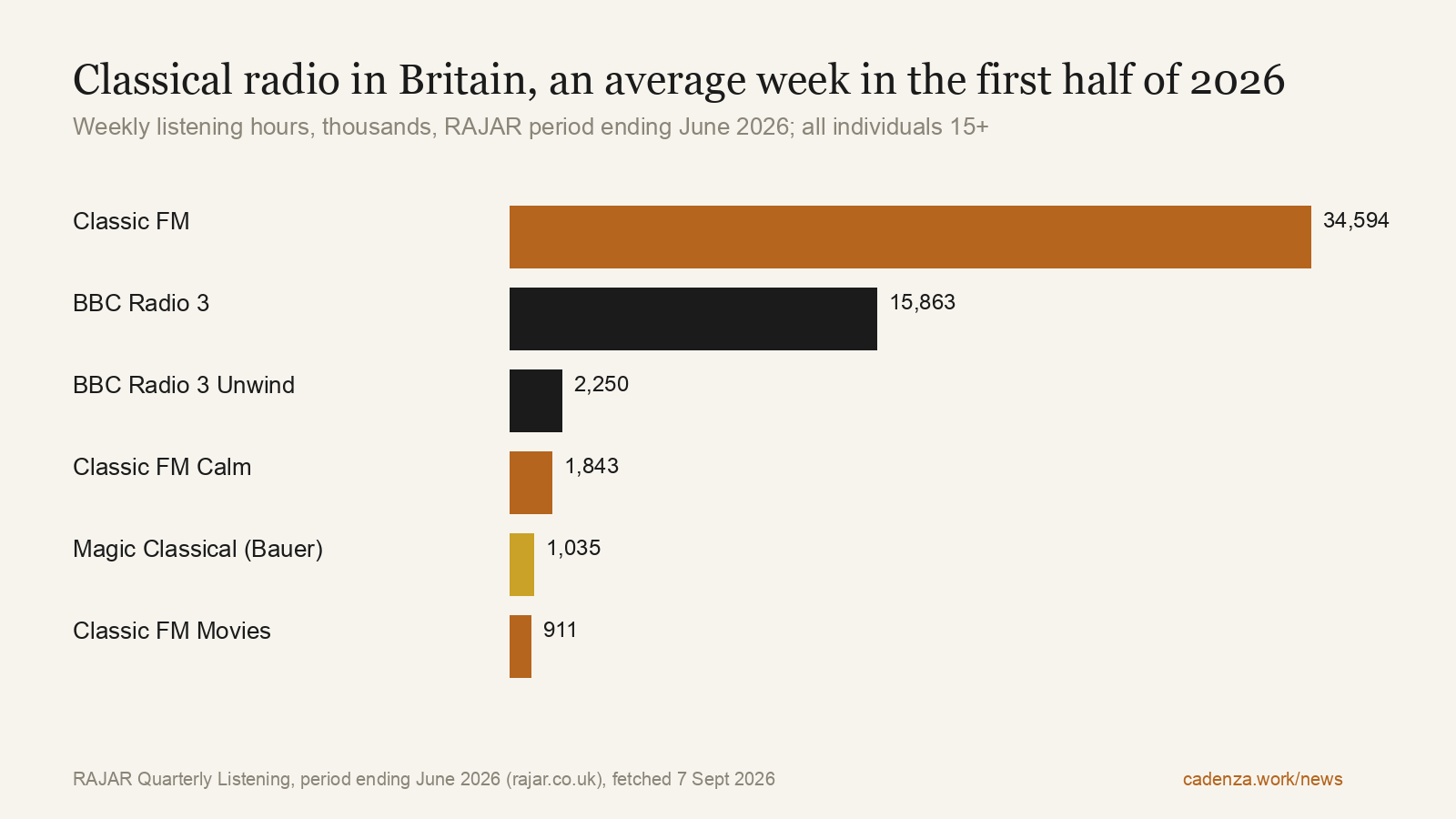
RAJAR, the UK radio industry's audience measurement body, publishes a Quarterly Listening table for every measured station. The latest period ends in June 2026, on a base of 59,047,000 adults aged 15 and over. These are the Classic FM and Radio 3 rows, with Bauer's Magic Classical, the only other classical station on the table.
| Station | Weekly reach | Hours per listener per week | Weekly hours (000s) | Share of all listening |
|---|---|---|---|---|
| Classic FM | 4,286,000 | 8.1 | 34,594 | 3.4% |
| Classic FM Brand (UK), as RAJAR labels it | 4,514,000 | 8.4 | 37,750 | 3.7% |
| BBC Radio 3 | 1,881,000 | 8.4 | 15,863 | 1.5% |
| BBC Radio 3 Unwind | 408,000 | 5.5 | 2,250 | 0.2% |
| Classic FM Calm | 358,000 | 5.1 | 1,843 | 0.2% |
| Classic FM Movies | 153,000 | 6.0 | 911 | 0.1% |
| Magic Classical (Bauer) | 159,000 | 6.5 | 1,035 | 0.1% |
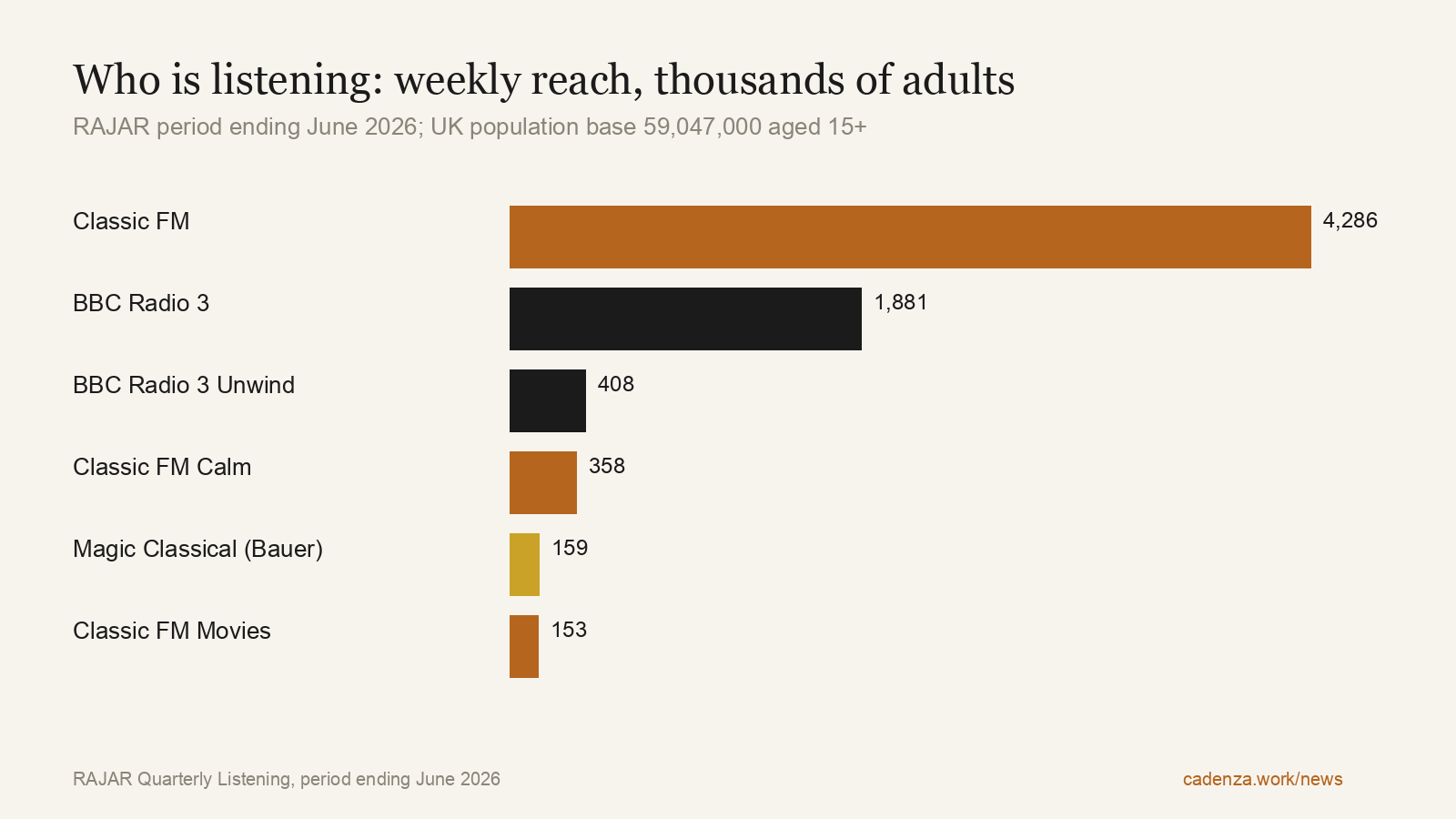
Two readings of those figures are on the record. Global's own release of 6 August put its whole portfolio at 29 million weekly listeners, 283 million hours and a 27.5 per cent share, and its Classic FM advertiser page rounds the brand to "4.5m weekly listeners". An outside reading is Adam Bowie's quarterly RAJAR analysis, which has Classic FM's reach up 2.8 per cent on the quarter but down 3.2 per cent on the year, and hours up 3.5 per cent on the quarter and down 3.9 per cent on the year; Radio 3 was down 3.4 per cent on the year to 1.9 million, though its wider brand, with Unwind, was up on the quarter. Both readings are of the same table. The audience is large, stable within a few per cent, and slightly smaller than a year ago.
The arithmetic of silence
Take Classic FM alone, since it carries 92 per cent of the brand's hours. Its listeners average 8.1 hours a week, which over a month of 4.33 weeks is about 35 hours. At £4.99 a month, an ad-free hour costs the average listener about 14 pence; at the annual price of £49.99, which is £4.17 a month, it costs about 12 pence. A listener who has the station on for the whole of a working day, as some do, pays proportionately less, and a listener who dips in for the drive home pays proportionately more. The annual plan is a 16.5 per cent discount on twelve monthly payments.
The other direction of the sum is the one Global will be doing. Every one per cent of Classic FM's 4,286,000 weekly listeners who subscribe is 42,860 people, worth about £2.14 million a year in gross subscription revenue at the annual price, or £2.57 million at the monthly one, before VAT and app-store commission. Five per cent would be over £10 million. We have no figure for what those listeners' advertising exposure is worth to Global now, and Global, a private company, does not publish station-level revenue, so we cannot say at what take-up the subscription beats the adverts it replaces. At the average listener's hours, the price works out at about fourteen pence an hour of uninterrupted music.
What everything else costs
Classic FM Plus enters a market with published prices. The nearest comparison is Bauer's Rayo Premium, which offers "ad-break free listening" to Bauer's broadcast stations, Magic Classical among them, plus "dozens of subscriber-only stations", for £3.99 a month after a 30-day trial. The two big streaming services are not radio but are where much of the paid listening to classical recordings now happens: Apple Music is £11.99 a month for an individual, and Apple presents Apple Music Classical as part of that subscription; Spotify Premium Individual is £12.99 a month after its trial. And the BBC's classical output, Radio 3, Radio 3 Unwind and everything on BBC Sounds, costs nothing beyond the television licence, which is £180 a year, or £15 a month, for any household that watches live television or iPlayer; radio alone needs no licence.
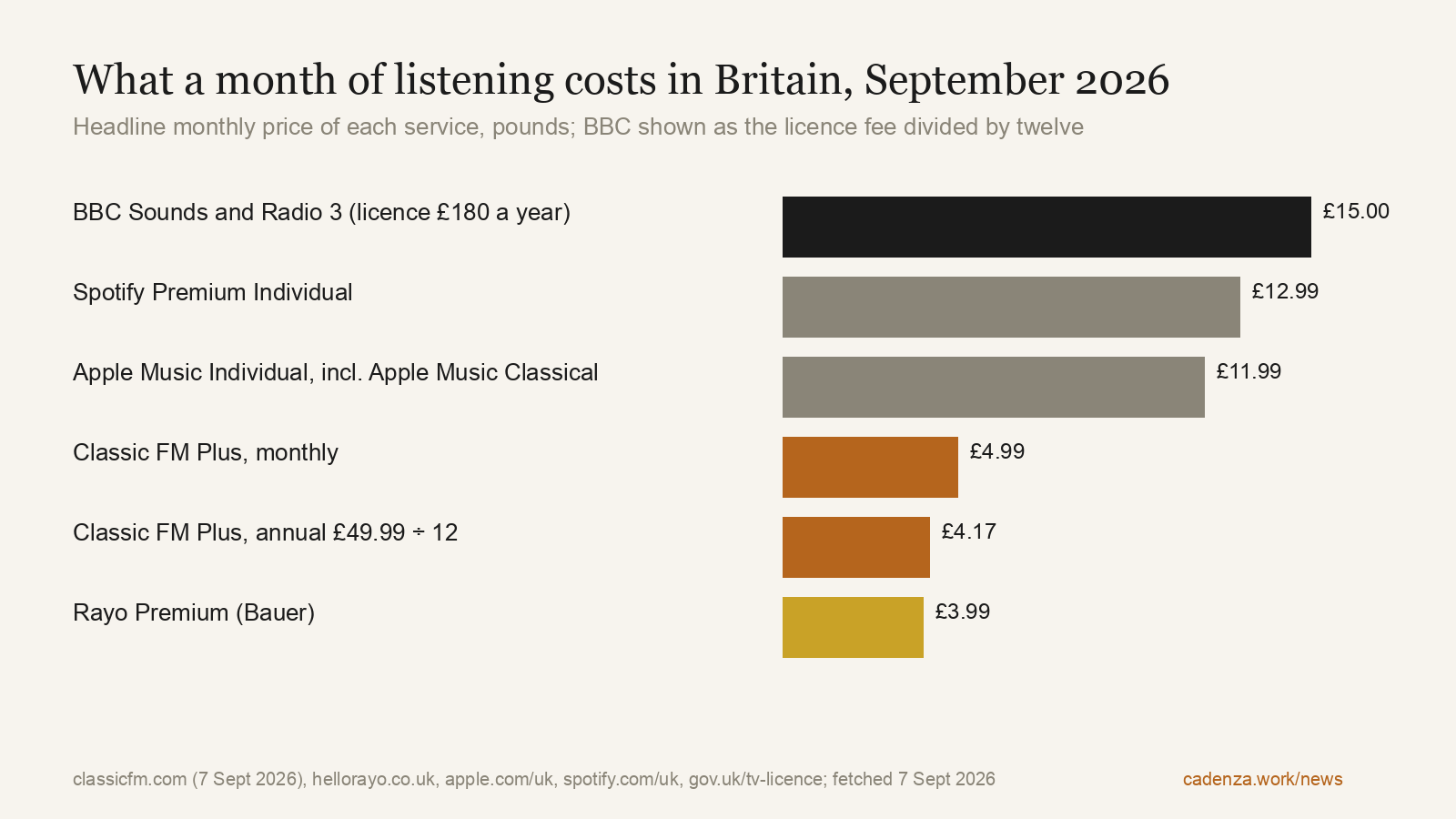
So the ladder, per month, runs £3.99 for Rayo Premium, £4.17 or £4.99 for Classic FM Plus, £11.99 for Apple Music, £12.99 for Spotify, and £15 for the licence fee that funds Radio 3, which is not a like-for-like charge but is the sum a household pays. Classic FM has placed itself a pound above its commercial rival and between a third and two-fifths of the price of the streamers, for a product that is not a catalogue but a schedule: the same shows, the page says, minus the breaks.
For musicians
The reason this belongs on a careers site is that Classic FM's 34.6 million weekly hours are, by RAJAR's count, the most listening any classical station in Britain receives, and broadcast use of recordings is what PPL, the collecting society, licenses and pays out on: "hundreds of millions of pounds" a year to performers and record companies, in its own description. The one hint at what fills the gaps is the page's phrase "even more great music to discover", which in an ad-free hour means the minutes the adverts used to fill. Whether those minutes go to more music, more talk or more promotion is something the schedule will show and RAJAR will not. Readers who make records will want to know, and the schedule, not the press release, is where the answer will appear.
If you subscribe
- Where. Global Player, on phone, laptop, Alexa, CarPlay, Android Auto and Apple TV, UK only. The launch page says nothing about the FM and DAB signal.
- What. Classic FM, Classic FM Calm and Classic FM Movies, live, Replay and Catch-up, without ad breaks.
- Price. £4.99 a month or £49.99 a year, the annual price saving £9.89 on twelve months.
The case against this article
The per-hour and take-up figures are our arithmetic on RAJAR's averages, and averages hide the spread: the listener who hears 30 hours a week and the one who hears two are both in the 8.1. RAJAR's reach figures are survey estimates with a margin of error the table does not print. As of 7 September Global had published no subscriber target, no revenue forecast and no statement on how the ad-free minutes are filled, so nothing in this piece should be read as Global's projection. The comparison prices are headline monthly rates on 7 September 2026 and each service bundles different things; the licence fee is a household charge for television and the BBC as a whole, not a price for Radio 3. We did not include Idagio, the classical streaming service, because its published prices are in dollars and we could not confirm a sterling rate. Classic FM Plus is a commercial product; this is not a recommendation to buy it.
The question
Global has told its listeners the price. It has not told the industry the numbers that matter: how many sign up, and what the station does with the minutes in each hour that used to belong to advertisers. The first RAJAR period that could show whether ad-free listening moves the reach figures is the one ending in December 2026, published in the new year, and because Classic FM's figures are six-month weighted the first fully post-launch number is the one ending in March 2027. Until then the only fact is the one on the launch page, silence at Classic FM now has a price.
Related: The Odds, our investigation into orchestral jobs and graduates. Jobs, auditions and calls are on cadenza.work/browse.
Cover photograph: Weekly listening hours for Britain's classical radio stations, RAJAR period ending June 2026. Chart by Cadenza from RAJAR's Quarterly Listening table..
Comments
Sign in to join the discussion.