The soloist you heard last week almost certainly does not own the instrument they played on.
A great violin costs more than a house and often more than a career will ever earn, so the instruments are held by foundations, arts councils, collectors and trusts, and they are lent — for three years, for seven, for as long as somebody is judged worth lending to. A player's relationship with a Stradivari is a tenancy.
Two institutions do this at scale and publish what they hold. The Sasakawa Music Foundation in Tokyo, which ran the project for most of its life under the name Nippon Music Foundation, states its position in one sentence: it "has now come to own 22 instruments made by Antonio Stradivari and Bartolomeo Giuseppe Guarneri del Gesù and loans them gratis to young promising musicians and internationally active musicians regardless of their nationalities." It began in 1994.
Twenty of those 22 are Stradivari. One foundation, one city, twenty.
What is in the Tokyo collection
We counted the published list on 7 September 2026: 18 violins, three cellos and one viola, twenty by Stradivari and two by Guarneri del Gesù, spanning 1666 to 1740. Our total matches the foundation's own figure of 22.
The instruments are not anonymous stock. The foundation describes the 1714 "Dolphin" as one of the top three violins Stradivari made, alongside the 1715 "Alard" and the 1716 "Messiah"; it was once owned and played by Jascha Heifetz. The foundation says the 1666 "Alumnus Amati" is the earliest known Stradivari still carrying its original label, which describes the maker as a pupil of Nicolò Amati. The 1736 "Muntz" carries a label on which Stradivari wrote d'anni 92 — 92 years old — the year before he died.
There are two instruments called "Muntz" and that is not an error in our count. The foundation owns a 1736 Stradivari and a 1736 Guarneri del Gesù with the same nickname, because both passed through the same Muntz family of Birmingham.
Four of the 22 are the Paganini Quartet: a 1680 violin, a 1727 violin, a 1731 viola and a 1736 cello, all owned by Niccolò Paganini in the nineteenth century. The foundation calls it one of only six surviving quartets assembled from Stradivari instruments, acquired from the Corcoran Gallery of Art in Washington in 1994, and lends the four as a set — so a string quartet, not a soloist, borrows it.
One instrument has a standing arrangement worth knowing about. Since 1997 the 1708 "Huggins" Stradivari has gone to the first prize winner of the Queen Elisabeth Competition in Belgium, held until the following violin session. For a violinist, that is part of what winning is worth, and it is not a cheque.
The count nobody had run
Canada's Musical Instrument Bank publishes something rarer than a collection: a complete record of who has borrowed what, going back nearly forty years. We counted it from the Canada Council's own cumulative list of winners, read on 7 September 2026.
| Loans recorded | 136 |
| Different instruments lent | 32 — 22 violins, 9 cellos and a bow |
| Distinct musicians | 89 |
| Loan periods covered | 19, from 1987– to 2023–2026 |
| Musicians who borrowed more than once | 33, of whom 32 in more than one loan period |
| Ownership | 12 owned by the Council, 20 lent to the Council by donors |
Two figures need care. The 32 is every instrument ever lent, not what the bank holds today — the Council's own description is that it "consists of more than 20 magnificent instruments", and its current list includes a 1590 Gasparo da Salò viola that has never been lent and so never appears here. And the 89 is after merging three musicians who appear under two spellings each: Andrea and Andréa Tyniec, Jessica Linnebach and Linneback, Yi-Jia Suzanne and Susanne Hou. Counted as printed, the list gives 92 names for 89 people.
The first loan on the list is Denis Brott, taking the 1706 Brott-Turner Tecchler cello from 1987, with no end year printed. Brott is one of the people who founded the bank: the Canada Council credits its 1985 establishment to a $100,000 bequest from the Barwick family and the fundraising of the businessman William Turner and the cellist Denis Brott, both of Montréal. The first fixed-term loan is Scott St. John on the 1717 Windsor-Weinstein Stradivari, 1989 to 1994.
What 136 loans actually show
Thirty-three of the 89 borrowed more than once, and 32 of those in more than one loan period. Judy Kang, Cameron Crozman and Kerry DuWors appear four times each; eight more appear three times. This is the most useful thing in the data for a student: the bank is not a lottery you enter once. More than a third of everyone who has ever held one of these instruments came back and won again.
The bank has roughly doubled in twenty years. Loans per cohort run 10 in 2003–2006, 12 in 2006–2009, 14 in 2009–2012, 18 in 2012–2015, 22 in 2015–2018, 21 in 2018–2022 and 22 now. The instruments are not being played less.
The great names are a minority. Of the 32 instruments lent, five are Stradivari. The rest are Gagliano, Vuillaume, Guadagnini, Pressenda, Tononi, Montagnana, Celoniatus, Tecchler, Gand, Scarampella, Rocca, Landolfi, Gragnani, Grancino, Oddone, Chanot, a Guarneri del Gesù, a Spanish Guillami cello and an Adam bow. A career is far more likely to be built on a nineteenth-century Vuillaume than on a Strad, and the bank's own record says so.
The 2018 cohort is strange and unexplained. It appears as three overlapping periods — 2018–2020, 2018–2021 and 2018–2022 — where every other cohort is a single block. Neither the Council nor the list says why.
Both doors closed this spring, a fortnight apart
Canada's competition is triennial and its deadline was 1 April 2026. Tokyo's Category A and B window ran 1 March to 15 April 2026. They closed fourteen days apart, in the same spring, and between them they account for most of the instruments a young player could realistically hope to be lent.
If you missed them, you missed them by five months, and the Canadian competition does not come round again soon.
| Sasakawa Music Foundation, Tokyo | Canada Council Musical Instrument Bank | |
|---|---|---|
| Holdings | 22 instruments, 20 of them Stradivari | "More than 20" today, the Council's own figure; 32 different instruments lent since 1987 |
| Cost to the musician | Loaned "gratis". Travel and accommodation are the player's own | The Council's published guidelines put routine care on the recipient, along with travel to the annual evaluation and repair |
| Who can apply | Category A: violinists 35 or under on 1 September 2026. Category B: a stated purpose — a recording, a competition, a debut or anniversary concert. Category C: musicians performing mainly in Japan | Professional classical musicians from Canada |
| Loan length | 2 to 7 years for Categories A and B combined; up to a year for Category C | Three years |
| Last window | 1 March – 15 April 2026, closed | Deadline 1 April 2026, closed. Triennial |
| Founded | Loan project began 1994 | Bank established 1985 |
What this does not prove
The Canadian list is a record of loans, not of instruments in play: an instrument can sit unlent between cohorts, and several do.
There are lenders we have not counted — instrument funds in Germany, Austria and Australia, the Stradivari Society in Chicago, and private patrons who publish nothing at all. The instruments above are the ones two institutions have put on the public record, which is exactly why they can be counted.
And a warning about the counting itself, since we are asking you to trust it. The obvious way to read this PDF is wrong in four separate ways: it garbles the column order and merges two laureates into one cell, it loses six instrument names that wrap across lines and silently reassigns their loans to whatever came before, it drops the two loans whose dates are not printed as a plain year range — including Brott's, the very first one — and it counts three people twice. Our first attempt made all four mistakes and produced 134 loans, 90 musicians and 26 instruments. Every one of those numbers was wrong. The source PDF, the layout extract, the corrected script and its output are in Cadenza's repository; run it and attack it.
If you want one of these instruments
- Sasakawa Music Foundation, Tokyo: Categories A and B are violin-only. Category A is for players 35 or under; Category B needs a stated purpose. The 2026 window has closed and the foundation publishes the next on its own site; recent ones have opened in the spring.
- Canada Council Musical Instrument Bank: professional classical musicians from Canada, triennially, three-year loans. The 1 April 2026 deadline has passed.
- Win the Queen Elisabeth: the violin session's first prize carries the 1708 "Huggins" until the following violin session. The 2027 session is for voice, and its application window opens in October.
- Look at what the prize actually contains. Some competitions carry an instrument loan rather than cash, and it is often the more valuable half. Cadenza lists competitions, academies and programmes on its jobs and programmes board, free to musicians.
The 2023–2026 loans are expiring as you read this. Twenty-two instruments, twenty-one musicians, three years, and then they go back. The competition that decides who plays them next already closed, on 1 April, and most of the people who will spend this winter practising for the following one do not yet know the bank exists.
Sources, read on 7 September 2026: Sasakawa Music Foundation, About Instrument Loan Project and Instruments; Canada Council for the Arts, Musical Instrument Bank, its Musical Instrument Bank website and its cumulative list of winners (PDF), counted by Cadenza. The count, the source and the script are in the repository.
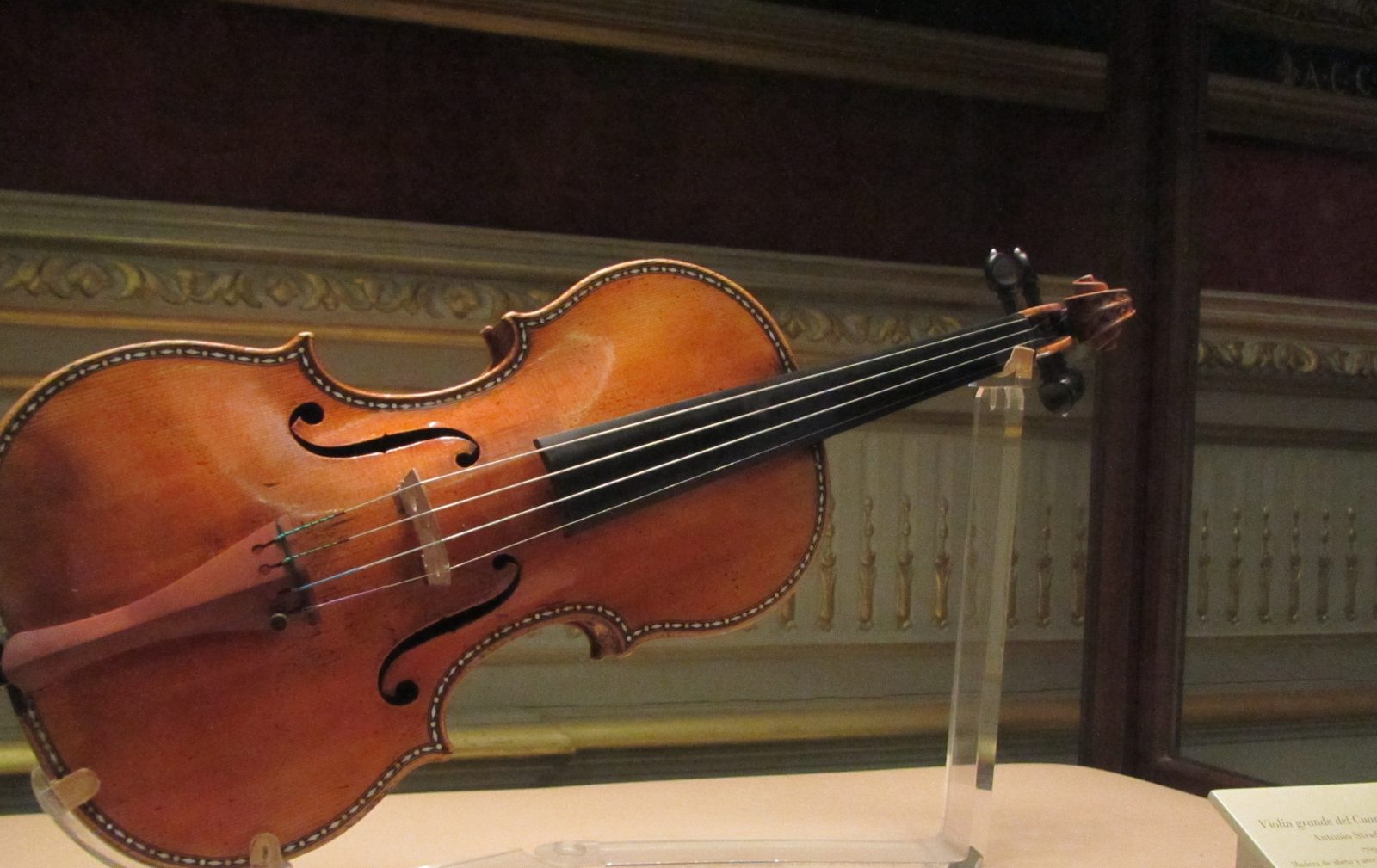
Cover photograph: A Stradivarius violin in the Royal Palace, Madrid, photographed in 2013. Σπάρτακος, CC BY-SA 3.0, via Wikimedia Commons.
Comments
Sign in to join the discussion.