Three decisions were announced from one table in Tel Aviv on Sunday 6 September 2026, and each of them is a career story of a kind the opera business rarely produces in a single afternoon. The Israeli Opera extended the contract of its music director, Dan Ettinger, by four years. It promoted Shirit Lee Weiss, who joined the company in 2009 and has run its casting since 2024, to the post of artistic director for opera. And it hired Martin Engstroem, the Swede who founded the Verbier Festival, as senior international artistic adviser, part of what the company calls a new structure. The general director, Tali Barash-Gottlieb, called it the opening of the company's 41st season. The season itself runs from 16 October 2026 to 15 July 2027: seven productions, 64 performances by our count of the company's own listings, one world premiere.
The three names matter to working musicians for different reasons. Ettinger's is a tenure decision, the kind that tells an orchestra and chorus who will be in front of them for years to come. Weiss's is a promotion from inside, and her previous job was the one every singer who has auditioned in Tel Aviv knows: director of casting. Engstroem's is a bridge. He has spent more than thirty years putting young players in front of the world at Verbier, and the company says his brief includes expanding "the visibility and professional opportunities available to young and established Israeli artists abroad".
The document
The company's press release, published by MidnightEast on 6 September and marked as lightly edited, and its Hebrew and English season release carried by Nora Davidovich on 7 September set out the structure. Weiss "will lead the ongoing artistic planning and development of the operatic programme"; Ettinger "will lead the musical work and performance excellence of the company's productions"; Engstroem "will contribute his experience, artistic perspective and extensive international relationships". Future seasons will come from a four-person Repertoire Committee: Barash-Gottlieb, Weiss, Ettinger and Engstroem.
| Person | What changed | What the release says about the road here |
|---|---|---|
| Dan Ettinger, music director | "Extended ... for four additional years" | Began at the company as chorus master, later house conductor; music director since January 2018 (OperaWire reported in August 2017 that he would succeed Daniel Oren "starting in January"); also music director of the Israel Symphony Orchestra Rishon LeZion, the opera's orchestra; general music director of the Stuttgart Philharmonic 2015–2024; "until recently" music director of the Teatro di San Carlo, Naples; conductor laureate of the Tokyo Philharmonic |
| Shirit Lee Weiss, artistic director for opera | New post, filled from within | Stage director; began her career in the United States; at the Israeli Opera since 2009; director of casting and artistic coordination since 2024; artistic director of the Meitar Opera Studio since 2017; house directing credits include Iolanta, Die Entführung aus dem Serail, Bluebeard's Castle, The Barber of Seville and The Magic Flute |
| Martin Engstroem, senior international artistic adviser | New post | Born Stockholm 1953; founded the Verbier Festival with Avi Shoshani in 1991, launched 1994 (the festival's own history gives the same two dates, 1991 for setting the wheels in motion and 1994 for the launch); vice-president of artists and repertoire at Deutsche Grammophon 1999–2003; first working visit since the announcement, to Israel at the end of September |
Ettinger's own statement in the season release is the one worth keeping, because it describes a music director's job in one paragraph: "Balance is the name of the game. Balancing enjoyment and fulfilment with innovation and challenge; original Israeli work with the rich range of the operatic tradition; discovering new talent while supporting the development of our Israeli singers and welcoming international soloists, through a casting process that is thorough, relevant and personal; nurturing the Opera Chorus and the Opera Orchestra, the Israel Symphony Orchestra Rishon LeZion, and further establishing both as Israel's leading operatic ensembles, performing at an international level." He closes the repertoire paragraph with a pun on the season's premiere: "Mozart, Rossini and Verdi meet Gounod and Bizet, while Britten takes us to Canaan."
The season, from the company's own listings
The 2026–27 season page lists seven productions. Each production page carries its performance dates, conductor, director and language, and, where there is one, the producing or co-producing house. We counted the dates.
| Production | Dates | Perfs | Conductor | Director, production | Sung in |
|---|---|---|---|---|---|
| Mozart, The Magic Flute | 16–29 Oct 2026 | 10 | Dan Ettinger; Rotem Nir on 26 and 29 Oct | Nikolaus Habjan; based on the Oper Dortmund production | German |
| Britten, Peter Grimes | 20–30 Nov 2026 | 8 | Alexander Joel | Mariusz Treliński; co-production with Teatr Wielki – Polish National Opera | English |
| Verdi, Un ballo in maschera | 1–13 Jan 2027 | 10 | Carlo Montanaro | Leo Muscato; production of Teatro dell'Opera di Roma | Italian |
| Gounod, Faust | 5–17 Feb 2027 | 9 | Dan Ettinger | Stefano Poda; co-production with Teatro Regio Torino and Opéra de Lausanne | French |
| Rossini, Il barbiere di Siviglia | 4–16 Apr 2027 | 11 | Matteo Beltrami; Rotem Nir on 9, 10 and 11 Apr | Barbe & Doucet; new production | Italian |
| Yonatan Cnaan, Outcast, world premiere | 31 May–8 Jun 2027 | 5 | Rotem Nir | Ido Riklin, who also wrote the libretto | Hebrew, Arabic and English |
| Bizet, Carmen | 2–15 Jul 2027 | 11 | Dan Ettinger | Jean-Louis Grinda | French |
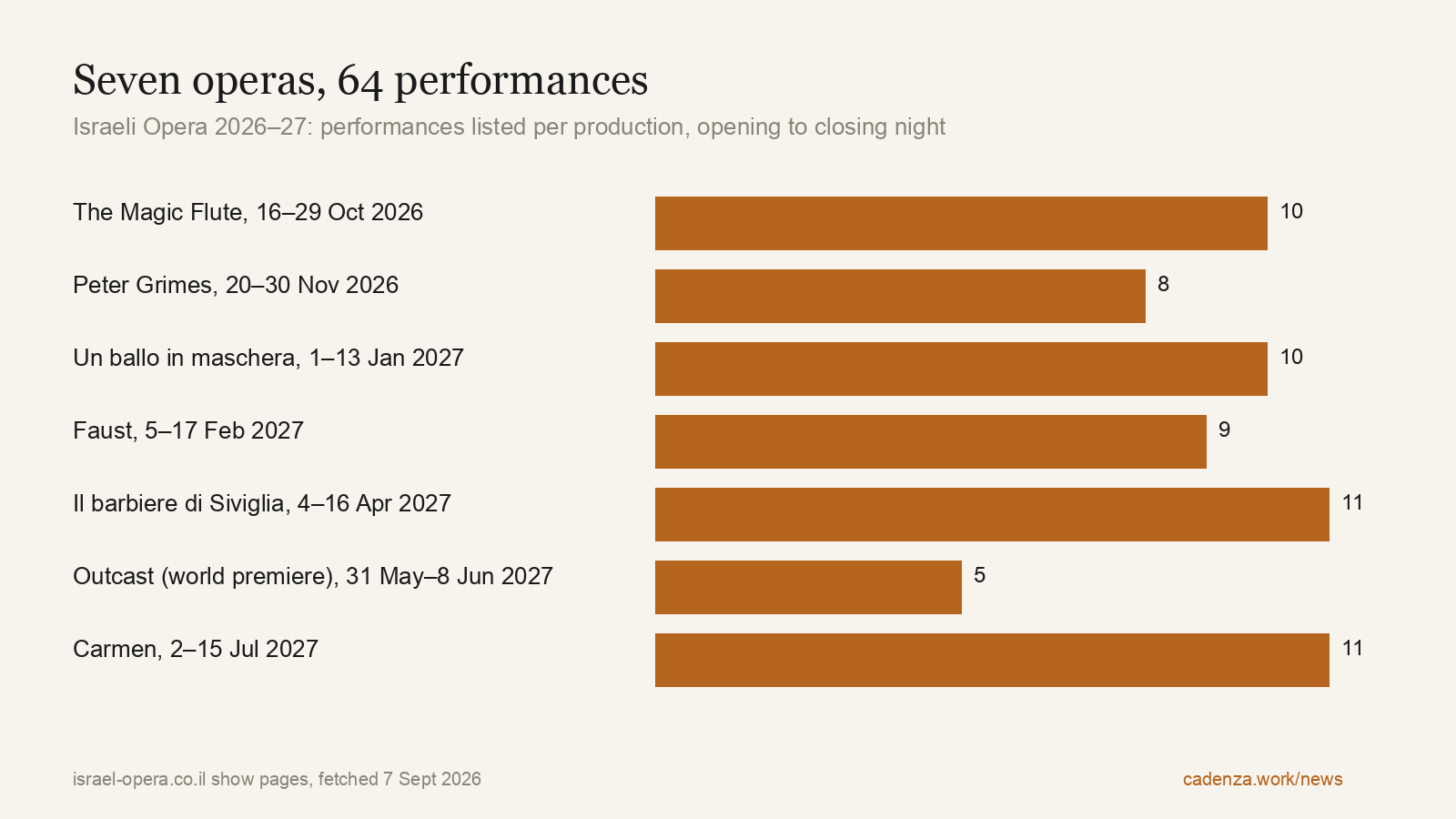
Two rows carry the season's weight. The Magic Flute "was originally scheduled to be presented as part of the Israeli Opera's 40th anniversary season and was postponed due to the war", the release says; it now opens this one. And Outcast is the company's new Israeli opera: Tiberias in 1938, a singer named Bahiyya between two communities, a score by Yonatan Cnaan, whose Theodor the company staged earlier, and a libretto and staging by Ido Riklin, who wrote Theodor and directed last season's premiere of Josef Bardanashvili's The Dybbuk. Five performances, three languages, and the production page thanks a sponsor, "Sano – Diti and Alex Landsberg", for its support.
The conductor's share is visible in the table. Ettinger is listed for three of the seven productions, 30 of the 64 performances, of which Rotem Nir takes two Magic Flutes. Nir, who appears in three of the seven listings, has the premiere and three of the eleven Barbers. Itay Berckovitch is chorus master on the six pages that name one; the Ballo page lists no chorus credit. Four productions come from or with other houses, in Dortmund, Warsaw, Rome, Turin and Lausanne; two are newly created, the Barber and the premiere; the seventh, Grinda's Carmen, is listed without a co-producer.
What a seat costs
The company sells subscriptions of five, six or seven operas in five price levels, A to E, and says a subscription seat is "approximately 20% lower than the full price". The 2026–27 order form on the Hebrew site and the English form both give the five-opera prices below; last season's are from the 2025–26 season page.
| Price level | 5 operas, 2025–26 | 5 operas, 2026–27 | Per opera now | Change |
|---|---|---|---|---|
| A | ₪1,915 | ₪1,980 | ₪396 | +3.4% |
| B | ₪1,690 | ₪1,750 | ₪350 | +3.6% |
| C | ₪1,325 | ₪1,440 | ₪288 | +8.7% |
| D | ₪1,050 | ₪1,085 | ₪217 | +3.3% |
| E | ₪775 | ₪800 | ₪160 | +3.2% |
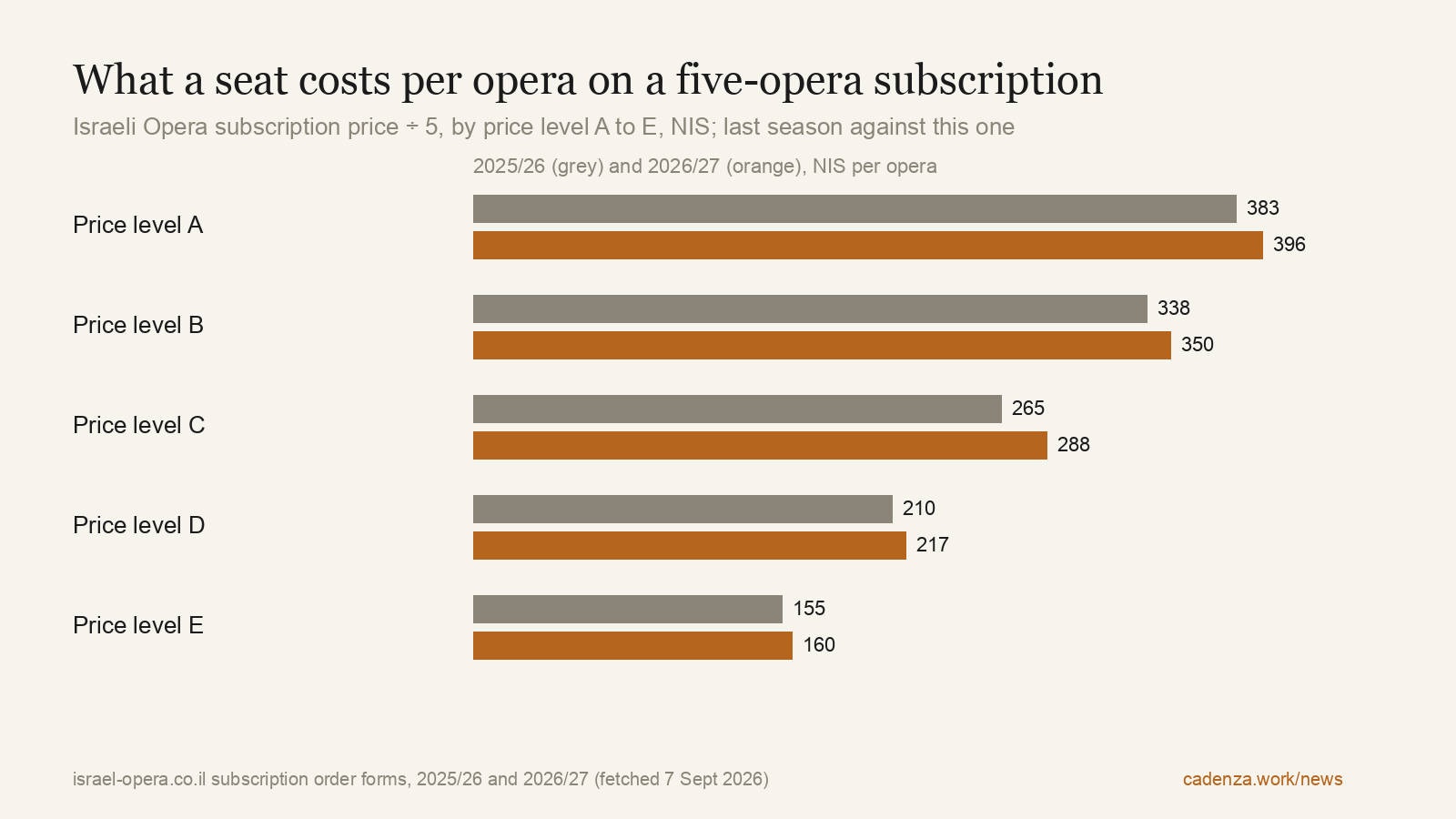
The spread is the point. A level-E subscriber pays ₪160 an opera to hear the same Peter Grimes as the level-A subscriber at ₪396, though not from the same seat; the company's own note on its ticket page warns that "due to the horseshoe structure typical of opera houses, there may be partial visibility from certain seats on levels 3, 4, and 5". Four of the five levels rose between three and four per cent on last season; level C rose nearly nine. The seven-opera price is where the company's two documents disagree: the Hebrew web form prints ₪2,772, ₪2,450, ₪2,016, ₪1,519 and ₪1,120 for A to E, the English PDF prints ₪2,772, ₪2,205, ₪1,813, ₪1,365 and ₪1,008. We have used the five-opera figures, on which both agree, and readers ordering seven should ask the subscriptions office which table applies.
Around the performances the company lists the things that cost nothing: a 30-minute introductory lecture in the auditorium an hour before each opera, and talkbacks "several times during each production", admission free.
The studio behind the casting director
Weiss's other job since 2017 is the one that connects this announcement to a young singer's calendar. The Meitar Opera Studio is the company's two-year programme for "outstanding young Israeli opera singers, graduates of music academies", funded by the Zvi and Ofra Meitar Family Foundation and named scholarship donors. Its page lists every cohort back to 2000. The 2025–26 studio has eight singers: six sopranos, a mezzo and a bass. Cohorts since 2002 have run between six and ten singers; the 2010–11 list reaches eleven names only by including a pianist and a guest tenor. The press release says Engstroem will "meet artists from the company and singers from the Meitar Opera Studio" on his September visit, which for eight people is a considerable first week of term. The studio is on Cadenza's programmes board; the company's page gives an email for enquiries about joining.
Weiss's own words in the release are about what the house should be: "An opera house built on excellence, originality, curiosity, and courage – one that nurtures singers and creators and gives new voices a stage."
If you go
- Tel Aviv, Friday 16 October 2026. The Magic Flute opens the season at the Tel Aviv Performing Arts Center, 19 Shaul Hamelech Boulevard; ten performances to 29 October, Ettinger conducting except 26 and 29 October.
- Tel Aviv, 20–30 November 2026. Treliński's Peter Grimes, eight performances, Alexander Joel conducting, sung in English.
- Tel Aviv, 31 May–8 June 2027. Outcast, world premiere, five performances.
- Subscriptions. Five to seven operas, ₪800 to ₪2,772 depending on level and count; the English order form says payment is "available in up to 5 equal installments with no interest".
The case against this article
The extension is "four additional years"; no source states the end date of Ettinger's current contract, so we have not printed a year. Performance counts are our own tally of the dates on each production page on 7 September and can change. The seven-opera prices disagree between two of the company's documents, as noted. Weiss's previous title is "director of casting and artistic coordination" in the company's release; Slipped Disc wrote "head of casting". We have not printed Engstroem's age; Slipped Disc gives 73, the release gives only his birth year. The company's pages spell the librettist "Ricklin"; its release, which we follow, spells "Riklin". The Outcast page's own synopsis places the action in 1936 while its summary and the release say 1938. The postponement of The Magic Flute is described in the company's words; we have not reported anything about the circumstances beyond them. The Meitar cohort counts come from the studio page's lists and depend on how the page groups names; the 2025–26 figure of eight is a straight count.
The question
A repertoire committee of four is a small room, and it now contains the general director, the artistic director, the music director and a man whose festival and academy have been launching careers since 1994. The first season it shapes should be 2027–28; this one was already built. The measure of Engstroem's post, on the company's own terms, is opportunities for Israeli artists abroad and co-productions coming in. The Meitar page lists the studio's alumni back to 2000. Where those eight singers are in 2028 will say more about Sunday's announcement than anything said at the table.
Related: The Odds, our investigation into orchestral jobs and graduates. Studios, competitions and auditions are on cadenza.work/browse.
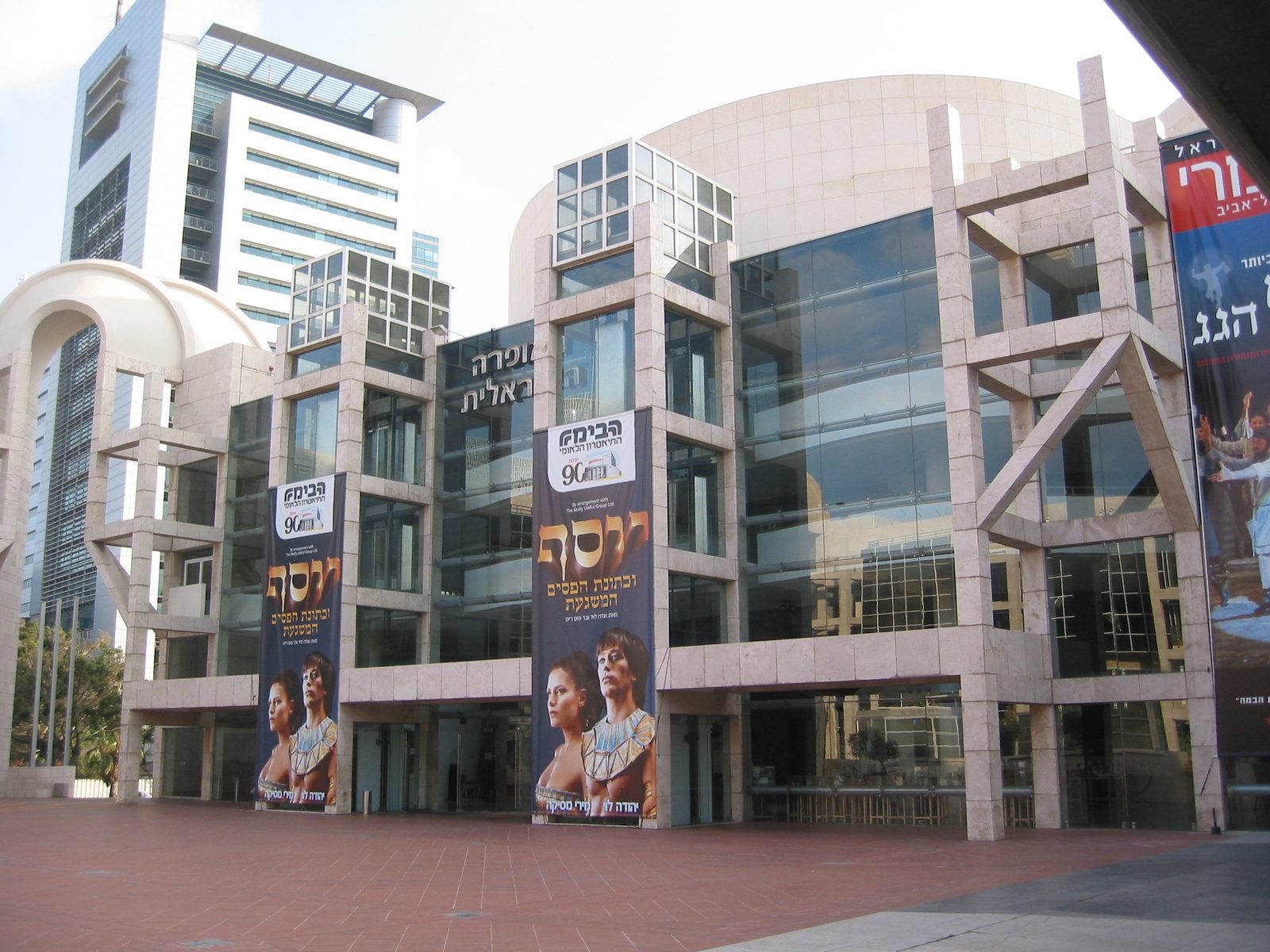
Cover photograph: The Tel Aviv Performing Arts Center on Shaul Hamelech Boulevard, home of the Israeli Opera, in July 2007. Photograph by User:Sambach, public domain, via Wikimedia Commons..
Comments
Sign in to join the discussion.