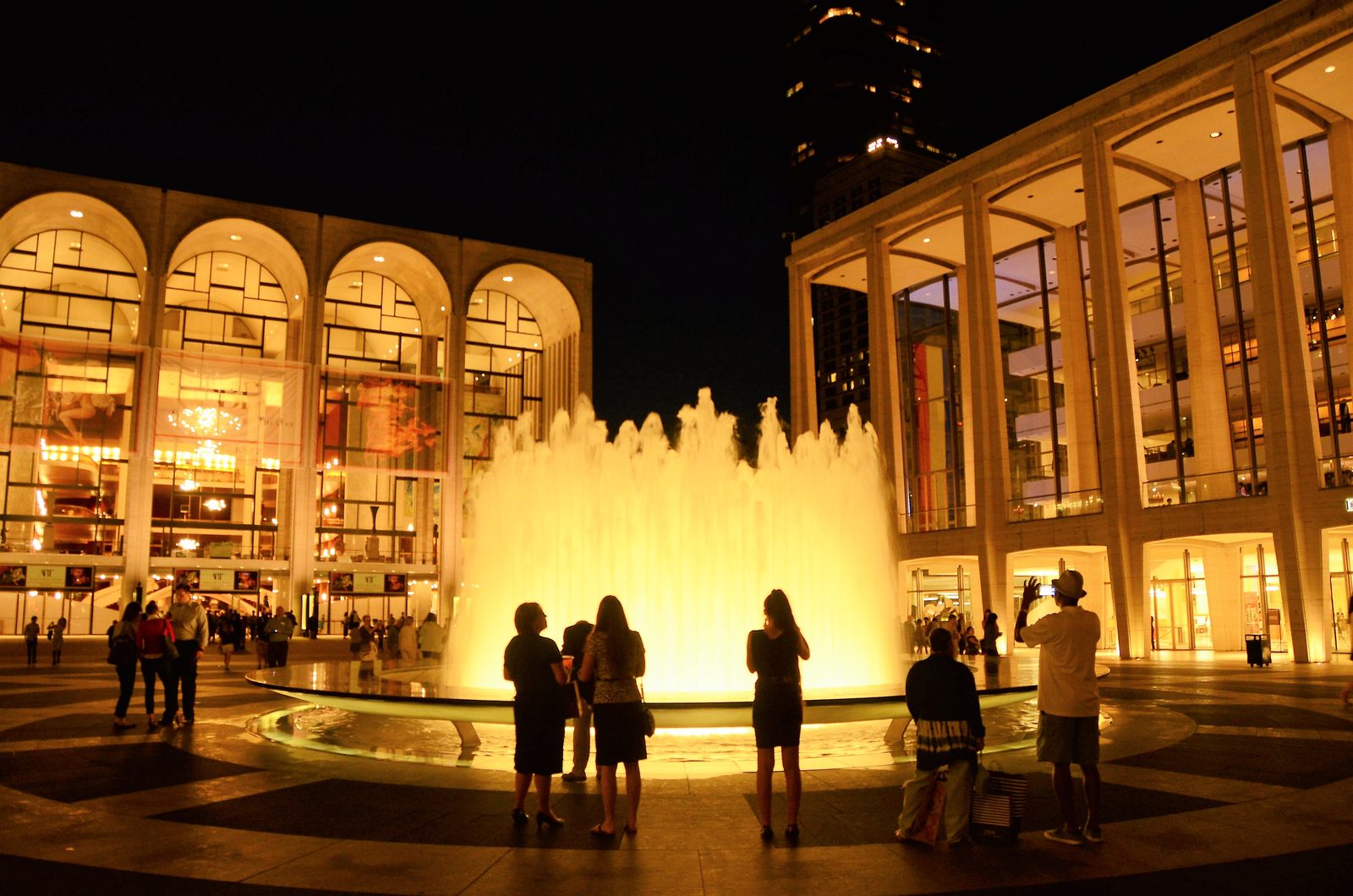
Lincoln Center was built in the 1960s with its back to Amsterdam Avenue. The plaza and the fountain face east, toward Broadway and the money; the west side, where Damrosch Park and the Guggenheim Bandshell sit, was closed off from the street by a wall that runs from five feet high at 62nd Street to twenty feet at 65th. On one side of the wall, the Metropolitan Opera. On the other, the Amsterdam Houses, a public housing development that predates the center.
On 11 May 2026 Lincoln Center broke ground on the project that removes the wall. The Stavros Niarchos Foundation Lincoln Center West Initiative, a $335 million capital project, rebuilds the Amsterdam Avenue side of the campus as a public park with gardens, a fountain, new entrances, and at its centre the Baron Theater, a 2,000-seat outdoor venue that Lincoln Center describes as its first new freestanding theater in more than fifty years and that is intended for free performances. It opens in the summer of 2028.
This is the biggest good-news construction story in American classical music this year, and the reason it is good news is not the theater. It is the wall.
What is being built
The facts, from Lincoln Center's groundbreaking announcement, the Governor's office, and the amNY and 6sqft reports that covered the groundbreaking:
| Element | Detail |
|---|---|
| Cost | $335 million, of which New York State contributed $10 million |
| Lead funders | The Stavros Niarchos Foundation and the Baron Family Foundation, $75 million each; the theater is named for Judy and Ron Baron. Private donors, the Lincoln Center board, the state and the city make up the rest |
| The theater | The Baron Theater, 2,000 seats, outdoor, replacing the Guggenheim Bandshell |
| The plaza | The John and Susan Hess Family Plaza |
| The gardens | The Stavros Niarchos Foundation Gardens, with flowering trees |
| The fountain | The Starr Foundation Fountain, with mist and water jets |
| The wall | Removed along Amsterdam Avenue, from 5 feet at 62nd to 20 feet at 65th |
| Design | Hood Design Studio, landscape; Weiss/Manfredi, design architect; Moody Nolan, architect of record |
| Groundbreaking | 11 May 2026 |
| Opening | Summer 2028 |
The street-level changes are the ones a resident of the Amsterdam Houses will notice first: new sidewalks, a rebuilt bus waiting area, shade, benches and lighting where there was a blank wall.
The sentence that explains the project
Mariko Silver, Lincoln Center's president and chief executive, said it plainly at the groundbreaking, as quoted by 6sqft: "The west side of Lincoln Center's campus has, for too long, sent a message of exclusion—but today, we are proud to break ground on a project that will change that."
Governor Kathy Hochul, whose state put in $10 million, in the release from her office: "By investing in this transformative redevelopment, we're opening up world-class arts and performance spaces to the surrounding community, creating new opportunities for free programming." In the same release, State Senator José M. Serrano, who chairs the Senate's cultural affairs committee, called it "an exciting new chapter" for the campus.
Institutions do not usually admit that their architecture sent a message of exclusion. Lincoln Center did, in a press conference, and then put $335 million behind the correction. That is the part of the story worth recording.
Why a free outdoor theater
Damrosch Park has hosted Lincoln Center's summer programming for decades, most recently Summer for the City, on a temporary stage erected each summer because the ageing Guggenheim Bandshell no longer suited the programming. The Baron Theater is the permanent version: 2,000 seats, purpose-built, and, according to the announcement, intended to host free performances.
Two thousand free seats in a purpose-built theater in Manhattan is a large number. For comparison, the Richard Bradshaw Amphitheatre in Toronto, whose free series Cadenza wrote about today, seats about 120 and has recorded 236,000 attendances in twenty years. A 2,000-seat free venue, programmed across New York summers, could reach that number in a few seasons.
The design logic is the same one that made the St. Louis Symphony's rebuilt hall work: a building is a machine for admitting people, and the question is how many it admits and how easily. Lincoln Center's east side admits people who already know the way in. The west side, from 2028, admits the people who live across the street.
What comes down and what goes up
The wall is the symbol, and the announcement's emphasis on it is deliberate. The physical programme, though, is mostly addition. The gardens add, by Lincoln Center's count, 50 percent more trees than the park has now. The fountain gives the west side a water feature to answer the one on Josie Robertson Plaza. The new entry points add, for the first time, a way onto the campus directly from Amsterdam Avenue, rather than by the ramps from West 62nd Street or the side entrance on 65th.
A person standing at the corner of Amsterdam and 65th in 2028 will look at a garden and a theater where they now look at twenty feet of concrete. That is the whole project in one sentence.
The timeline and the caveat
The groundbreaking was on 11 May 2026, and the opening is scheduled for the summer of 2028, which means two summers of construction on the west side while Summer for the City continues elsewhere on campus. Lincoln Center has published the design team and the cost; it has not, as far as Cadenza can find, published the programming plan for the Baron Theater or how the free performances will be allocated between Lincoln Center's own presentations and the resident companies. That is the question to ask in 2027.
The honest measure of the project will not be the ribbon-cutting. It will be who is in the 2,000 seats on an August night in 2028, and whether the people from the Amsterdam Houses, whose view is about to change, are among them.
Sources: Lincoln Center, groundbreaking announcement, 11 May 2026; Office of Governor Kathy Hochul, release of 11 May 2026; amNY, Lincoln Center outdoor space and access improvements; 6sqft, Lincoln Center breaks ground on accessible performance park; Time Out New York; Symphony magazine, League of American Orchestras.
Cover photograph: Josie Robertson Plaza at Lincoln Center, New York. The West Initiative reworks the campus behind it, on Amsterdam Avenue. TROMDOC, CC BY-SA 4.0, via Wikimedia Commons.
Comments
Sign in to join the discussion.