John Coltrane was born in Hamlet, North Carolina, on 23 September 1926. In 2026 the date fell on a Wednesday, and his estate is marking the year with a global celebration it calls COLTRANE 100.
Two days later, on Friday 25 September, the Monterey Jazz Festival opens its 69th edition on the Monterey County Fairgrounds in California. Its ticket release of 2 September lists among the weekend's highlights "centennial celebrations of the births of Miles Davis and John Coltrane".
Both men were born in 1926. Davis came first, on 26 May in Alton, Illinois, which made him 120 days older. The estate's official biography of Coltrane puts the pair in one sentence: "They had been born the same year and grown to be so different in temperament."
The detail worth adding is in the record books. Monterey heard Coltrane twice before Davis ever played there, both times within a day of Coltrane's birthday. On 26 September his son plays the same fairgrounds, and on the night of 27 September two members of Davis's 1960s rhythm section close the Arena as a duo, which the festival says they have never done anywhere.
Two men, one year
| Miles Davis | John Coltrane | |
|---|---|---|
| Born | 26 May 1926, Alton, Illinois | 23 September 1926, Hamlet, North Carolina |
| Died | 28 September 1991, aged 65 | 17 July 1967, aged 40 |
| First played Monterey | 1963 | 1960 |
| Centenary set, 2026 | Herbie Hancock and Ron Carter, For Miles, 27 September, 7:45 pm | Ravi Coltrane Quartet, Centennial Celebration, 26 September, 4:00 pm |
By the estate's account they shared a bandstand for four years, with Coltrane in Davis's group from 1955 through 1959, apart from nine months in 1957 when Davis fired him. Those years took him from local obscurity to national renown. By the end of 1959 he was 33 and, in the biography's words, "itching to go his own way".
So when Monterey first booked him, he came as a leader.
Monterey heard Coltrane first
The session discography of Coltrane published by Jazzdisco dates his first Monterey set to Saturday 24 September 1960, the day after his 34th birthday. He brought a quartet with McCoy Tyner on piano, Steve Davis on bass and Billy Higgins on drums, and played My Favorite Things among three tunes.
Twenty-seven days later, on 21 October 1960, Coltrane recorded My Favorite Things for Atlantic at Atlantic Studios in New York. By then Elvin Jones had the drum chair. Monterey heard the tune before the record did.
He came back on Friday 22 September 1961, the day before he turned 35, with a sextet that added Eric Dolphy on alto saxophone and bass clarinet and Wes Montgomery on guitar.
| First visit | Second visit | |
|---|---|---|
| Date | Saturday 24 September 1960 | Friday 22 September 1961 |
| Against his birthday | One day after | One day before |
| Band | Quartet: Tyner, Steve Davis, Higgins | Sextet: Dolphy, Tyner, Montgomery, Reggie Workman, Elvin Jones |
| Tunes listed | Naima, My Favorite Things, Equinox | My Favorite Things, Naima, So What / Impressions |
DownBeat's festival preview mentions only 1960. The discography and the festival lineup list collected on Wikipedia both have him back in 1961.
One more detail is worth noticing. Against the tunes from both Monterey nights, in the column where a label and catalogue number would go, the discography marks them "rejected". It lists no issued record of either night.
Coltrane died on 17 July 1967, less than seven years after that first Monterey set. He was 40.
26 September: the son, and a 27-year-old
Ravi Coltrane's quartet plays the Arena on Saturday 26 September from 4:00 to 5:15 pm, under the title Centennial Celebration. That is three days after his father's hundredth birthday, and 66 years after his father's first set on the same fairgrounds, which was also on a Saturday. Ravi Coltrane, in DownBeat's phrase, "nods to the 100th anniversary of his father".
The festival's biography describes him as the second son of John and Alice Coltrane, born on Long Island and named after Ravi Shankar. He was raised in Los Angeles, where the family moved after his father's death. He leads the effort to restore the John Coltrane Home in Dix Hills, Long Island, and presides over reissues of his parents' recordings.
Later that night the tribute passes to a younger player. Isaiah Collier plays Collier Plays Coltrane at the Pacific Jazz Café on 26 September from 8:45 to 10:15 pm. The festival gives his age as 27, seven years younger than Coltrane was on his first Monterey night. DownBeat lists it as "a Coltrane tribute by fiery saxophonist Isaiah Collier".
27 September: For Miles
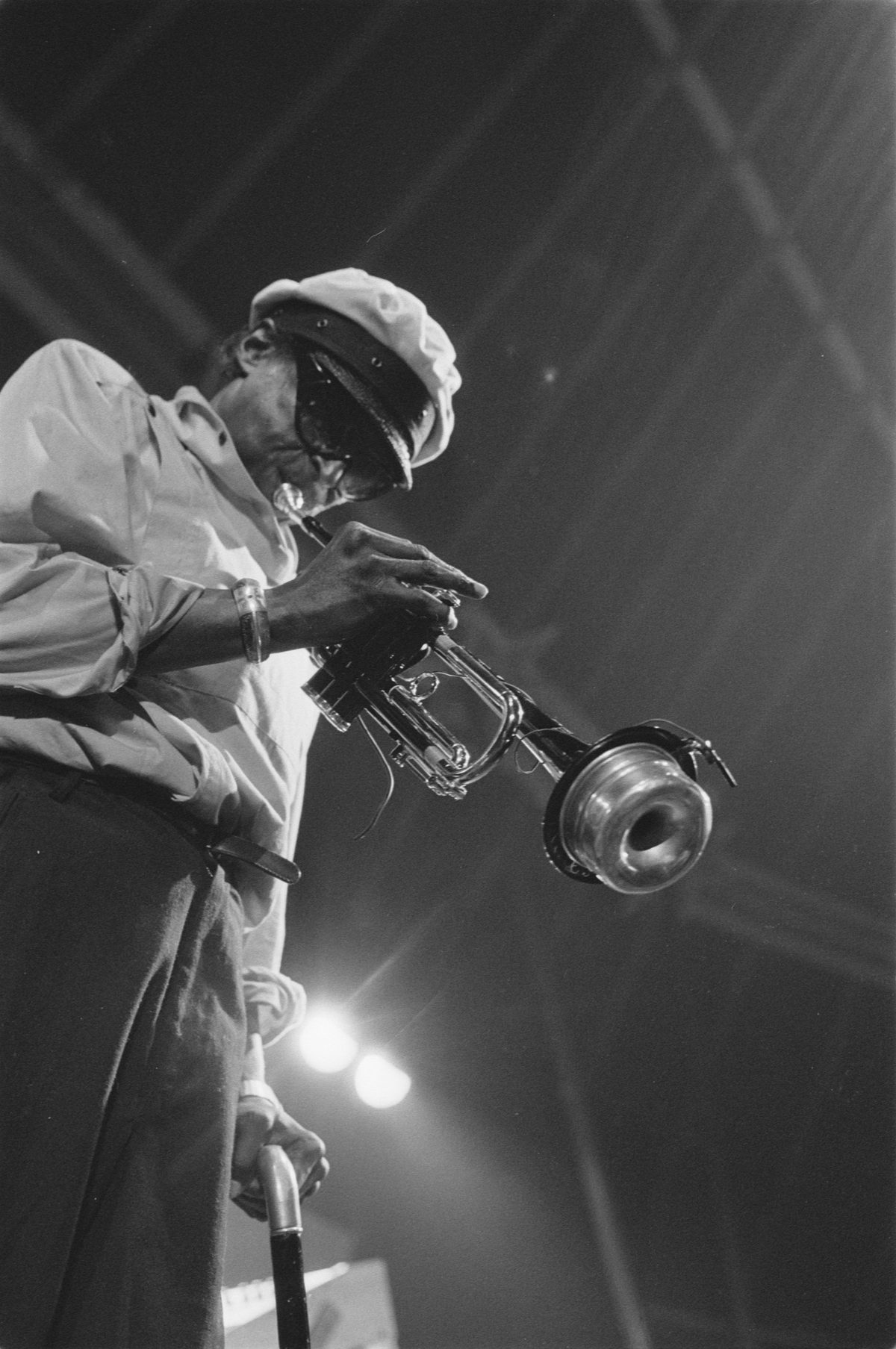
The last Arena set of the weekend, on Sunday 27 September from 7:45 to 9:00 pm, is Herbie Hancock and Ron Carter, For Miles. The festival bills it as the pair's first duo performance ever, a one-night-only event to celebrate the 100th anniversary of Davis's birth. It gives their ages as 86 and 89.
It is also a return. The festival's own history of the pair, published in June, traces the loop.
| Year | Hancock and Carter at Monterey | What survives |
|---|---|---|
| 1963 | Davis's festival debut, with George Coleman and Tony Williams | Released in 2007 as Live at the 1963 Monterey Jazz Festival |
| 1964 | Davis's quintet with Wayne Shorter, who had joined weeks before the 18 September set | The festival's archive has no recording |
| 1992 | The V.S.O.P. alumni group with the late trumpeter Wallace Roney, at the 35th festival, honouring Davis after his death on 28 September 1991 | No archival sound; video in bits and pieces from a backstage camera |
| 2026 | For Miles, as a duo | Nothing announced beyond an on-site simulcast when Cadenza read the festival's pages on 25 September |
Carter remembers the first one. "The air was heavy with the excitement of the anticipation of the new group," he recalled in the festival's June story, describing "an electric feeling in the audience".
The festival calls the 1964 set the second live show of the "Second Great Quintet". Richard Hadlock, reviewing it for the San Francisco Examiner, called Hancock, Carter and Williams "an exciting and venturesome rhythm section, one of the best Davis has ever had", in the passage the festival quotes.
Carter's account of the duo format is a joke with a sum in it. There is a saying, he says in the same story, "it takes two to tango, three to swing". Then: "So that's one-and-a-half for me and one-and-a-half for Herbie."
Hancock's statement is longer and plainer: "I am very much looking forward to having fun playing with one of my dearest friends the immensely talented Ron Carter celebrating our old boss who we admire deeply, Miles Davis at the Monterey Jazz Festival".
Cadenza's arithmetic: 63 years since their first Monterey set with Davis, 34 since their last together there. The set is scheduled to end at 9:00 pm Pacific on 27 September, three hours before the 35th anniversary of Davis's death begins at midnight.
Two more Davis threads run through the weekend. Carter leads his Foursight Quartet on the Ray Drummond West End Stage on Friday 25 September at 9:00 pm. On Sunday 27 September from 3:00 to 4:15 pm, on the Tim Jackson Garden Stage, the drummer Gregory Hutchinson brings Kind of Now, his Davis project released on 3 April, with Ambrose Akinmusire, Ron Blake, Gerald Clayton, Emmanuel Michael and Reuben Rogers billed.
The rest of "Only in Monterey"
"Only in Monterey" is the 2026 theme. Programmes like the Hancock and Carter reunion, the lineup consultant Jason Olaine told DownBeat, "are not going to happen anywhere else. If you're there, you're there. And if you're not there, you're going to wish you were."
Charles Lloyd, Forest Flower at 60. The set before For Miles, on Sunday 27 September from 6:00 to 7:15 pm, is the Charles Lloyd Quartet marking the 60th anniversary of Forest Flower, recorded at Monterey in 1966. The festival says Forest Flower, Live at Monterey sold over one million copies. Lloyd was born in Memphis on 15 March 1938, so he was 28 when he made it and is 88 as of September 2026. DownBeat reports that Brian Blade is in the quartet and that Gerald Clayton appears with Lloyd.
The festival has dedicated the set to Jack DeJohnette, the drummer in the quartet Lloyd formed in 1965 with Keith Jarrett and Cecil McBee. DeJohnette died on 26 October 2025, at 83, DownBeat reported. He connects more of the weekend's bill than one dedication can say. He played in Davis's band from 1969 to 1972, on Bitches Brew among others, and he recorded In Movement with Ravi Coltrane and Matthew Garrison.
Wynton Marsalis, last Monterey set as leader. The Jazz at Lincoln Center Orchestra opens the Arena on Friday 25 September from 7:00 to 8:15 pm, with Cécile McLorin Salvant as guest. The festival says the 25 September set will be Marsalis's "final appearance at Monterey as the leader of this influential big band".
His week ran through the centenary. On Wednesday 23 September, Coltrane's birthday, the orchestra was billed at the Hollywood Bowl, with the saxophonist Lakecia Benjamin opening with a celebration of Coltrane's centennial. On Thursday 24 September, at the festival's Jazz Legends Gala at Spanish Bay, Marsalis was due to receive Monterey's 17th Jazz Legends Award, first given in 2007. Earlier recipients named by the festival include Herbie Hancock and Charles Lloyd, who both play the Arena on Sunday 27 September. "There's a lot of love between Monterey and Jazz at Lincoln Center," Olaine told DownBeat. "There's a symbiosis."
Meshell Ndegeocello, America 250. The festival's 2026 commission premieres in the Arena on Saturday 26 September at 7:00 pm. DownBeat calls it her festival debut.
The Monterey Surprise. A band of current players stands in for the bill of the first festival in 1958: Akinmusire, Melissa Aldana, Salvant, Clayton, Larry Grenadier and Blade, on the Ray Drummond West End Stage on the afternoon of Saturday 26 September. The schedule lists 2:15 pm; the text on the set's own page says 2pm. Clayton told DownBeat, in its preview of 8 September, that the set would nod to "Sonny Rollins and Max Roach and Dizzy and Louis and Dave Brubeck … that's what's so great about Monterey. Everybody's been there."
The Bad Plus, farewell. The band's farewell-tour set, from 7:15 to 8:30 pm on 27 September on the West End Stage, overlaps For Miles. Its statement on the festival page is signed "Reid and Dave", the founding members Reid Anderson and Dave King: "Twenty-twenty-six will be the final year of The Bad Plus."
A debut at home. Janice Perl, a vocal teacher from a Monterey musical family who leads the festival's Regional All-Star Vocal Ensemble, plays the Courtyard Stage on Saturday 26 September from 2:15 to 3:15 pm. "I've never performed at the festival," she told Carmel Magazine.
What the festival's own numbers say
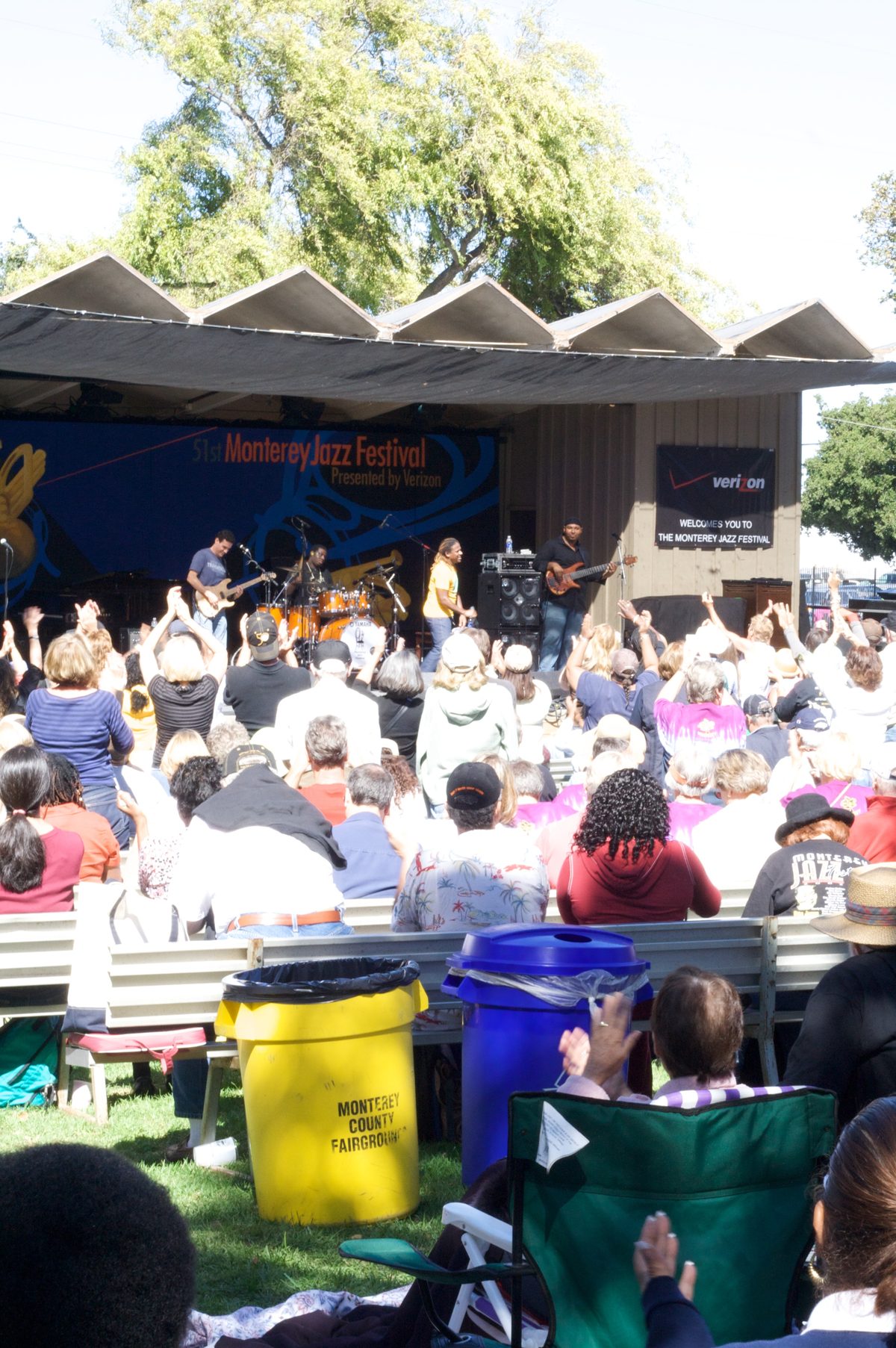
Jimmy Lyons and the San Francisco Chronicle critic Ralph Gleason put on the first Monterey Jazz Festival from 3 to 5 October 1958, with money raised through $100 donations. Billie Holiday was on the bill, in her only Monterey performance. The festival calls itself the longest continuously running jazz festival in the world and counts nearly 3,000 performances across 69 years.
| 2026, by the festival's count | |
|---|---|
| Performances | 74 |
| Stages | 5 |
| Hours of music | nearly 30 |
| Vendors | 70 |
| Site | 20 acres of the Monterey County Fair & Event Center |
| Arena shows promised in the release | 13 |
| Arena shows in the published schedule | 12 (two on 25 September, five on 26, five on 27) |
The 70th festival is in 2027. With support from Montage Health, the festival is putting new chairs on the Arena floor ahead of it.
The team is new. DownBeat reports that the 2026 lineup was assembled by Olaine, who also programmes Jazz at Lincoln Center, the adviser Gerald Clayton and the managing director Bobbie Young. The festival's leadership page, as Cadenza read it on 25 September, lists a managing director and no artistic director. Tim Jackson was general manager and artistic director from 1992 to 2023; the Garden Stage now carries his name, and on Saturday 26 September at noon he and Clayton face off in a DownBeat Double Blindfold Test at the Pacific Jazz Café. Olaine told DownBeat that ticket sales have rebounded after a slump that followed Jackson's final festival in 2023.
Where some of the bill began: a high-school band
Every year since 1971 the festival has formed the Next Generation Jazz Orchestra from high-school musicians across the United States. Clayton directs it. Cadenza counted the published 2026 roster: 20 members from seven states, four of them in the band for a second time. They are school students, so this piece does not name them. They play the Arena on 27 September at 1:45 pm, and the West End Stage with the bassist Rufus Reid on 26 September at 7:15 pm.
Some of the festival's 2026 bill started there. The festival names Akinmusire, its 2026 artist-in-residence, and Grenadier as alumni. Joshua Redman was a member in 1986, and in 1996 he became the first alumnus to serve as the festival's artist-in-residence, and again in 2011. DownBeat reports that Olaine and Clayton both played the festival as high-school students.
Cadenza carries auditions, calls and competitions, free to musicians, on its competitions board and its jobs board, from open calls to the kind of prize a French sextet won at Getxo.
If you go
The festival. Friday 25 to Sunday 27 September 2026, Monterey County Fair & Event Center, 2000 Fairground Road, Monterey. Tickets at montereyjazz.org or on 888.248.6499. Sales are final. Tickets, parking and food are cashless; the FAQ says cash is accepted only at arts and crafts vendors and programme sales.
Prices. Before the festival's announced rise on 21 September, three-day Arena packages started at $465 and single Arena days cost $110 for 25 September and $215 for 26 or 27 September. Three-day Grounds passes were $230, and single Grounds days $65 for 25 September and $90 for 26 or 27 September. The festival had not printed the new prices on its ticket or FAQ pages when Cadenza checked on 22 and 25 September.
Grounds or Arena. A Grounds ticket covers the four Grounds stages plus simulcasts of the last two Arena shows each night in the Monterey Room. On 27 September that means Lloyd and For Miles. Ravi Coltrane's 4:00 pm set on 26 September is not among the simulcasts. Collier, Hutchinson and Carter's Foursight set are all on Grounds stages.
Children and discounts. Every Arena seat needs a full-price ticket, whatever the age. On the Grounds, under-twos are free and children from two to 12 need a youth ticket. Military and student discounts on Grounds tickets are walk-up only at the fairgrounds box office from 23 September, with ID, four per military ID and one per student ID.
Getting in. The festival box office at the fairgrounds is open from 10am to 9pm on 25 and 26 September and from 10am to 8pm on 27 September. Gates open at 3pm on 25 September and at 11am on 26 and 27 September. A clear-bag policy applies. Fairgrounds parking and the Premier Club were both listed as sold out when Cadenza checked on 25 September. Parking at Monterey Peninsula College, 980 Fremont Street, comes with a shuttle; its passes were sold online only until 24 September, and from 25 to 27 September they are sold at the MPC Lot A shuttle tent.
If you cannot go. SiriusXM's Real Jazz channel is giving every Wednesday in September 2026 to Coltrane, from 2 to 30 September, his birthday on 23 September among them. The estate lists the Tiberi tapes, private recordings of Coltrane and his bandmates made in Philadelphia and New York clubs in the early 1960s by the saxophonist Frank Tiberi; its Coltrane 100 page, read on 25 September, gives 6 November as the release date of the CD and LP sets.
The festival's own account of Hancock and Carter at Monterey has two holes in it: no recording in its archive of the 1964 set, and no archival sound of 1992. Its visitor rules forbid audio or video recording devices and ask the audience not to film on their phones. So the question belongs to the festival, and it needs an answer before 7:45 pm on Sunday 27 September: is anyone recording For Miles, or will it join 1964 and 1992 as a Hancock and Carter night at Monterey of which the festival's archive keeps no sound recording?
Sources: from the Monterey Jazz Festival, all read in full: the 2 September ticket release (dates, the "centennial celebrations" wording, the festival's counts, address, phone line, prices and discounts, Marsalis's last appearance as leader, the 1966 recording of Forest Flower, the commission, the 2027 chairs); the schedule, re-read on 22 and 25 September (set times, the twelve Arena sets, the simulcasts); the artist pages for Hancock and Carter, Ravi Coltrane, Isaiah Collier, Charles Lloyd, Gregory Hutchinson, the Jazz at Lincoln Center Orchestra, Meshell Ndegeocello, the Monterey Surprise and The Bad Plus (billing, biographies, ages, the DeJohnette dedication, the Jazz Legends Award, the NGJO alumni, the band's statement); the June story Only in Monterey: Herbie Hancock and Ron Carter Reunite (the 1963, 1964 and 1992 sets, Davis's death on 28 September 1991, the archive gaps, the ages of 86 and 89, Hadlock's review as quoted there, the Carter and Hancock quotations); and the history, leadership, FAQ (which also confirms the fairgrounds as the site since 1958), tickets, ensembles, NGJO roster and education programmes pages (the founding, Jackson's tenure, the team, visitor rules, parking, the NGJO, Joshua Redman). The roster count is Cadenza's.
Paul de Barros's DownBeat preview of 8 September 2026, Monterey Jazz Fest to Feature a Host of Firsts, for the lineup team, the Olaine and Clayton quotations, the ticket rebound, Coltrane's 1960 appearance, Ndegeocello's debut and Lloyd's band; DownBeat's DeJohnette obituary for his death and his years with Davis. Britannica for Coltrane's full date and place of birth. The Coltrane estate's biography, home page and Coltrane 100 page for his birth, his years with Davis, his death, the centenary, SiriusXM and the Tiberi tapes; the Miles Davis estate for Davis's birth. The Jazzdisco Coltrane discography for the Monterey dates, bands, tunes and label entries and the Atlantic session, with 1961 also in Wikipedia's festival lineup list. The Hollywood Bowl for the 23 September concert as billed; Carmel Magazine for Janice Perl. Day counts and ages at death are Cadenza's arithmetic. The piece previews a festival that runs from 25 to 27 September 2026, so no review is cited.
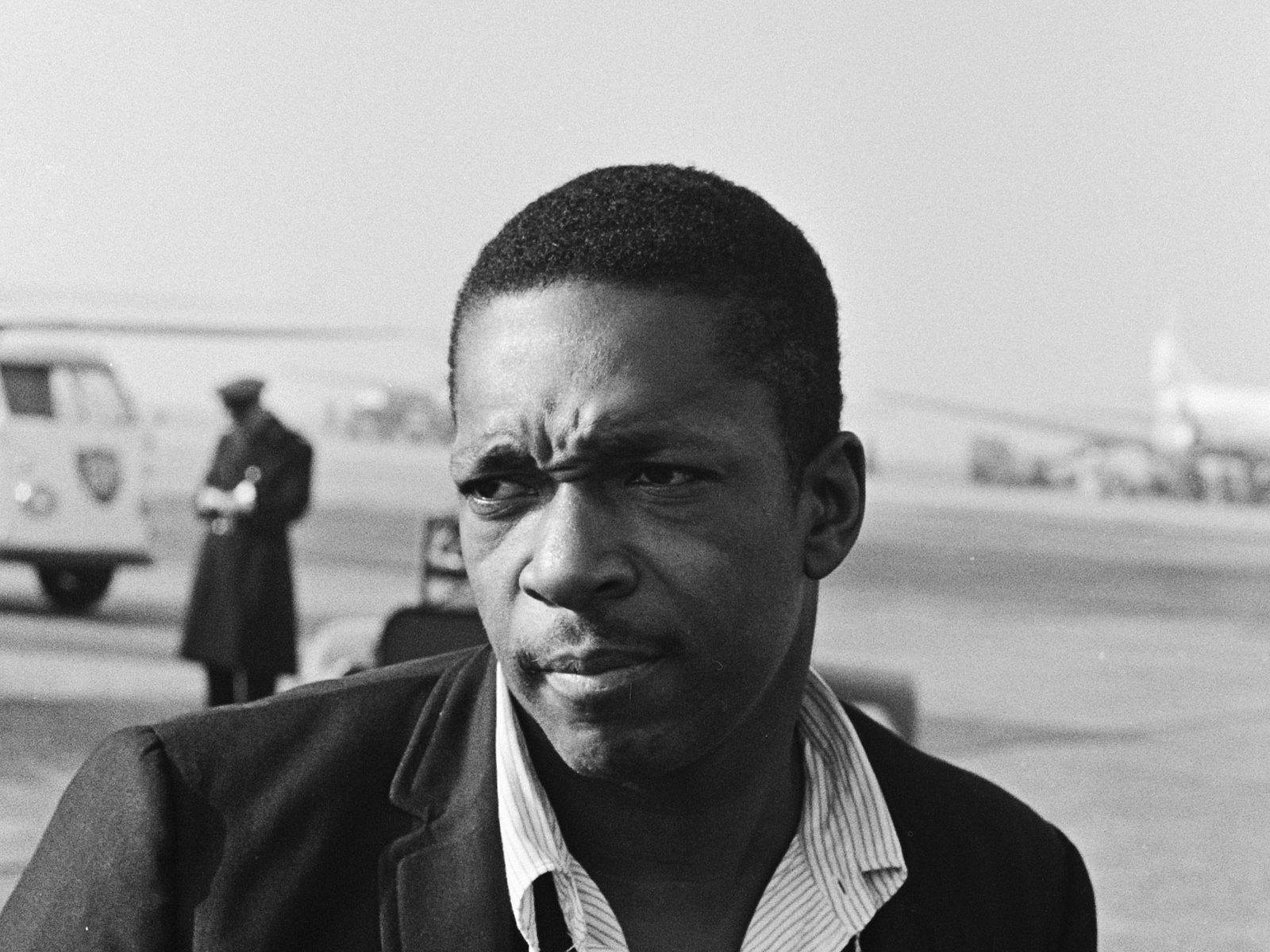
Photographs: John Coltrane at Schiphol, 26 October 1963, by Hugo van Gelderen / Anefo, Nationaal Archief, CC0, via Wikimedia Commons (cropped). Miles Davis at the North Sea Jazz Festival in The Hague, 15 July 1984, by Rob Bogaerts / Anefo, Nationaal Archief, CC0, via Wikimedia Commons. A grounds stage at the 51st Monterey Jazz Festival on the Monterey County Fairgrounds, 20 September 2008, by Kazuho Okui, CC BY 2.0, via Wikimedia Commons.
Correction, 25 September 2026: the festival now lists Gregory Hutchinson's Kind of Now set on 27 September at 3:00 to 4:15 pm; this article gave the time the festival listed on 22 September, 2:45 to 4:00 pm. The practical details now give the box office hours for 25 to 27 September and say that Monterey Peninsula College parking passes, which could be bought online only until 24 September, are sold at the MPC Lot A shuttle tent from 25 to 27 September. The article said the festival is cashless; its FAQ says tickets, parking and food are cashless but cash is accepted at arts and crafts vendors and programme sales. The closing paragraph said that nobody could hear the 1964 and 1992 sets again; the festival's June story says only that its archive has no recording of the 1964 set and that no archival sound of the 1992 set exists.
Cover photograph: John Coltrane arriving at Schiphol Airport in the Netherlands on 26 October 1963. Hugo van Gelderen / Anefo, Nationaal Archief, CC0, via Wikimedia Commons (cropped).
Comments
Sign in to join the discussion.