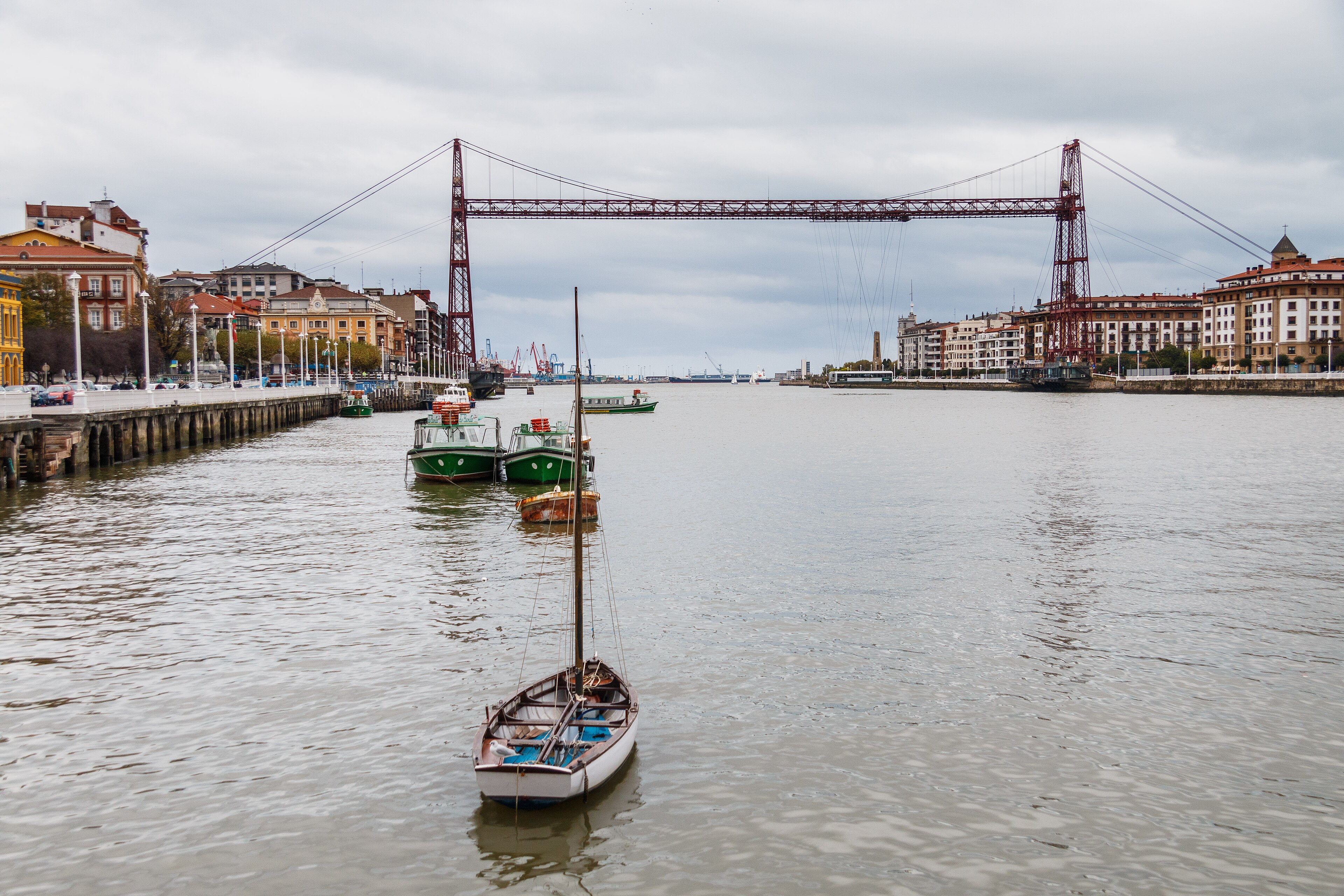
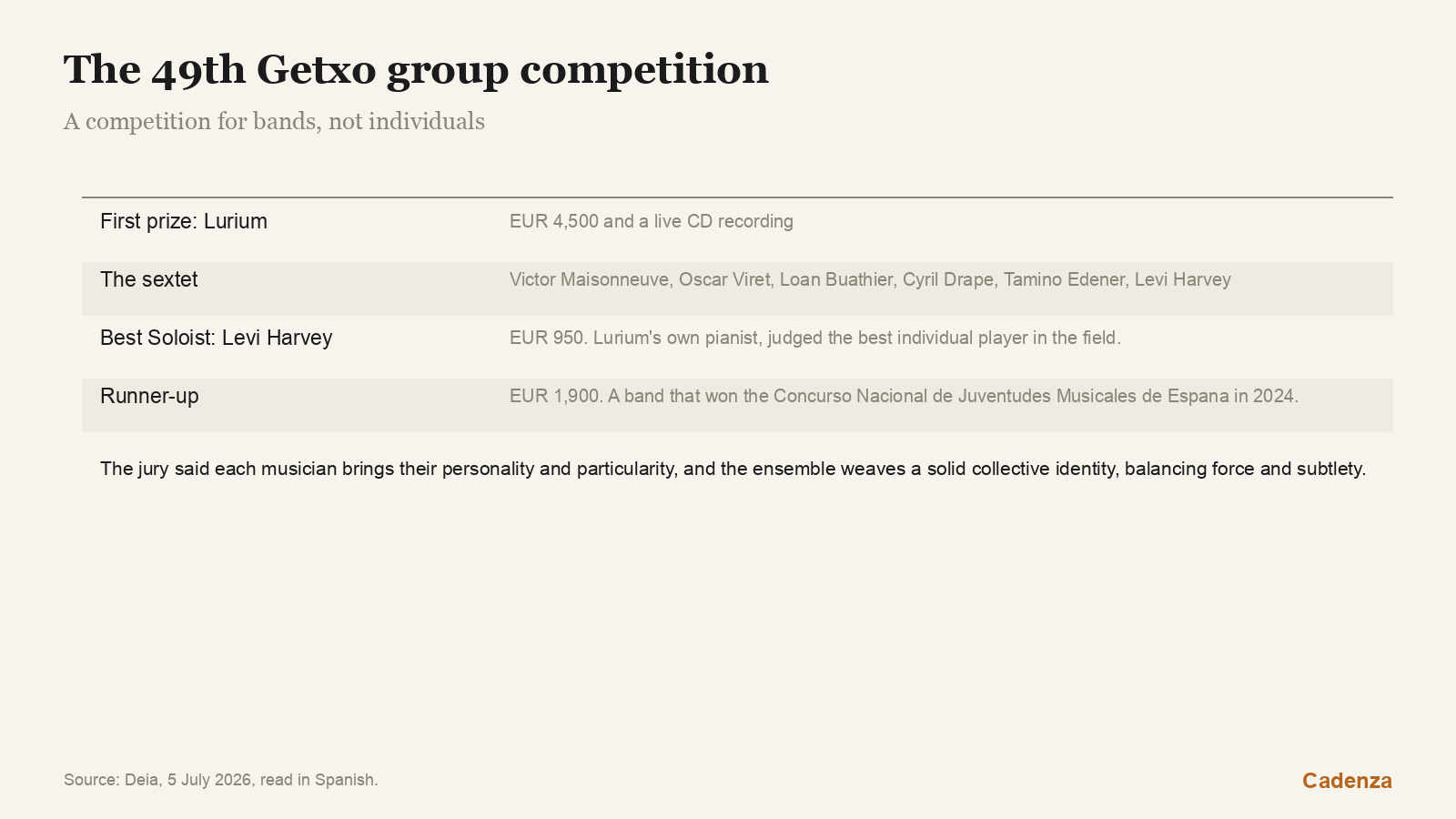
The Getxo Jazz Festival sits on the Nervión estuary in the Basque Country, and its 49th edition ran a competition for bands rather than for individuals. A French sextet called Lurium won it.
First prize is €4,500 and a live CD recording. Then the group's pianist, Levi Harvey, won Best Soloist as well, worth a further €950.
The sextet is Victor Maisonneuve, Oscar Viret, Loan Buathier, Cyril Drapé, Tamino Edener and Levi Harvey.
A competition for bands, which is rarer than it sounds
Almost every music competition Cadenza has counted this week judges individuals. The Enescu judged cellists. The Premio Jaén judged pianists. The Takemitsu award judged single scores by single composers.
Getxo judges groups, and so does the York early music competition Cadenza wrote about earlier today. Both are unusual, and both run into the same structural problem: if you reward a band, how do you recognise the individual inside it who was extraordinary?
York solved it this year by inventing a new individual Jury Prize, which went to a viol player who appeared in two competing ensembles. Getxo solves it the other way, by running a Best Soloist award alongside the group prize. In 2026 both went to the same band, which is the cleanest possible outcome: the jury judged Lurium the best group and Lurium's pianist the best individual player in the whole field.
The jury's own reasoning, in Spanish, was that each musician brings their personality and particularity, and that the ensemble weaves a solid collective identity, nourished by spontaneous interactions and a constant search for the balance between force and subtlety. That is a description of a band rather than of six players, which is presumably the point of judging bands.
The purse, and a figure that does not add up
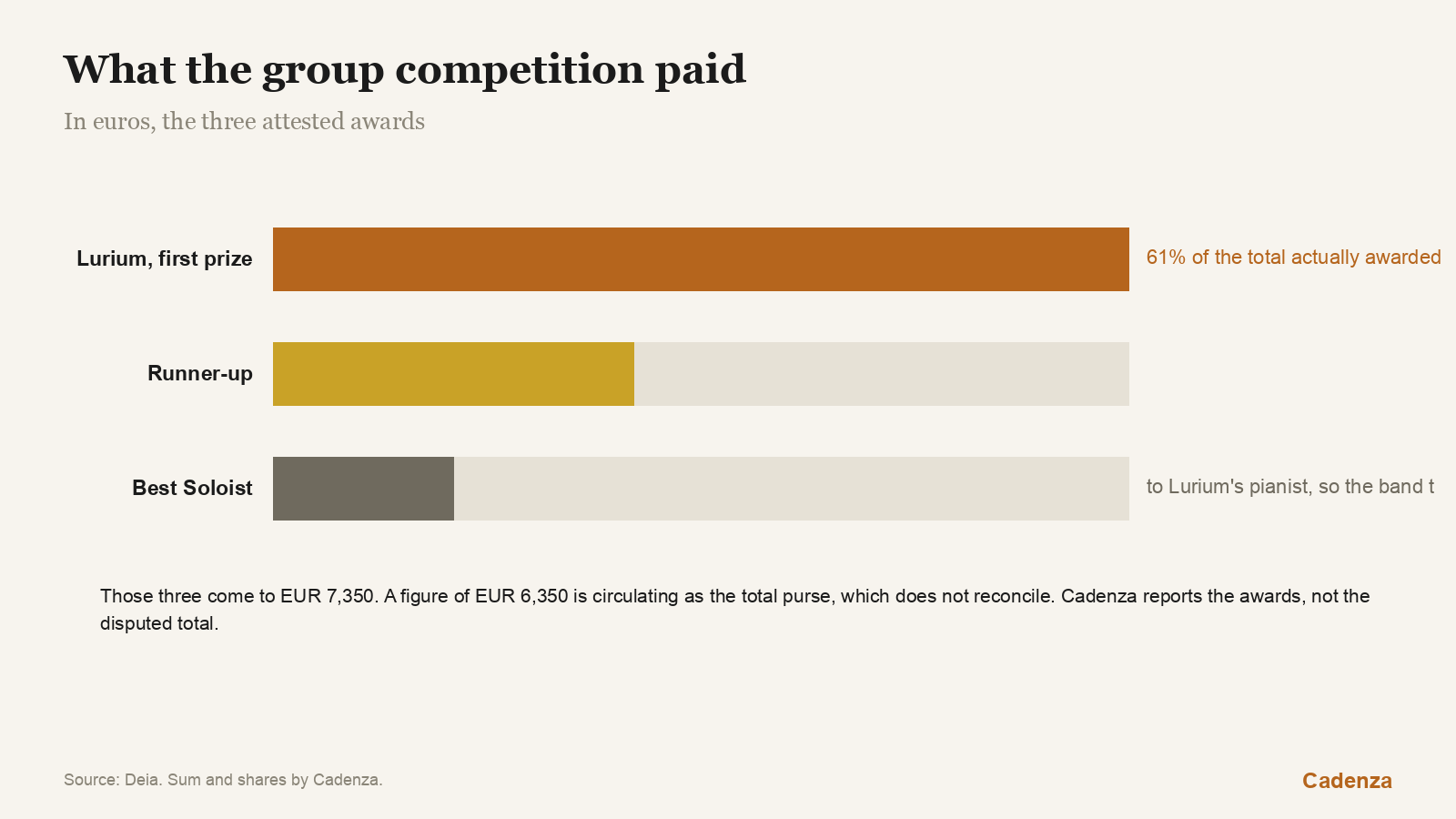
The awards in the group competition were €4,500 to Lurium, €1,900 to the runner-up, and €950 for Best Soloist.
Those three come to €7,350.
Cadenza's own research pass recorded a figure of €6,350 as the total group-competition purse, sourced to a festival announcement in January 2026. That does not reconcile with the three awards actually paid, which exceed it by €1,000. Either the January figure described a different or provisional allocation, or one of the two numbers is wrong. Cadenza is publishing the three individual award amounts, which are directly attested, and flagging the total rather than asserting it.
This is a small thing and it is exactly the sort of small thing that gets copied from outlet to outlet for years. A prize total is the easiest number in a competition report to state without checking, because it looks like arithmetic rather than a claim.
Lurium's €4,500 is 61 per cent of the €7,350 actually awarded, and with Harvey's soloist prize the band took €5,450 between them, or 74 per cent of everything the competition paid out.
The live CD is the part that lasts
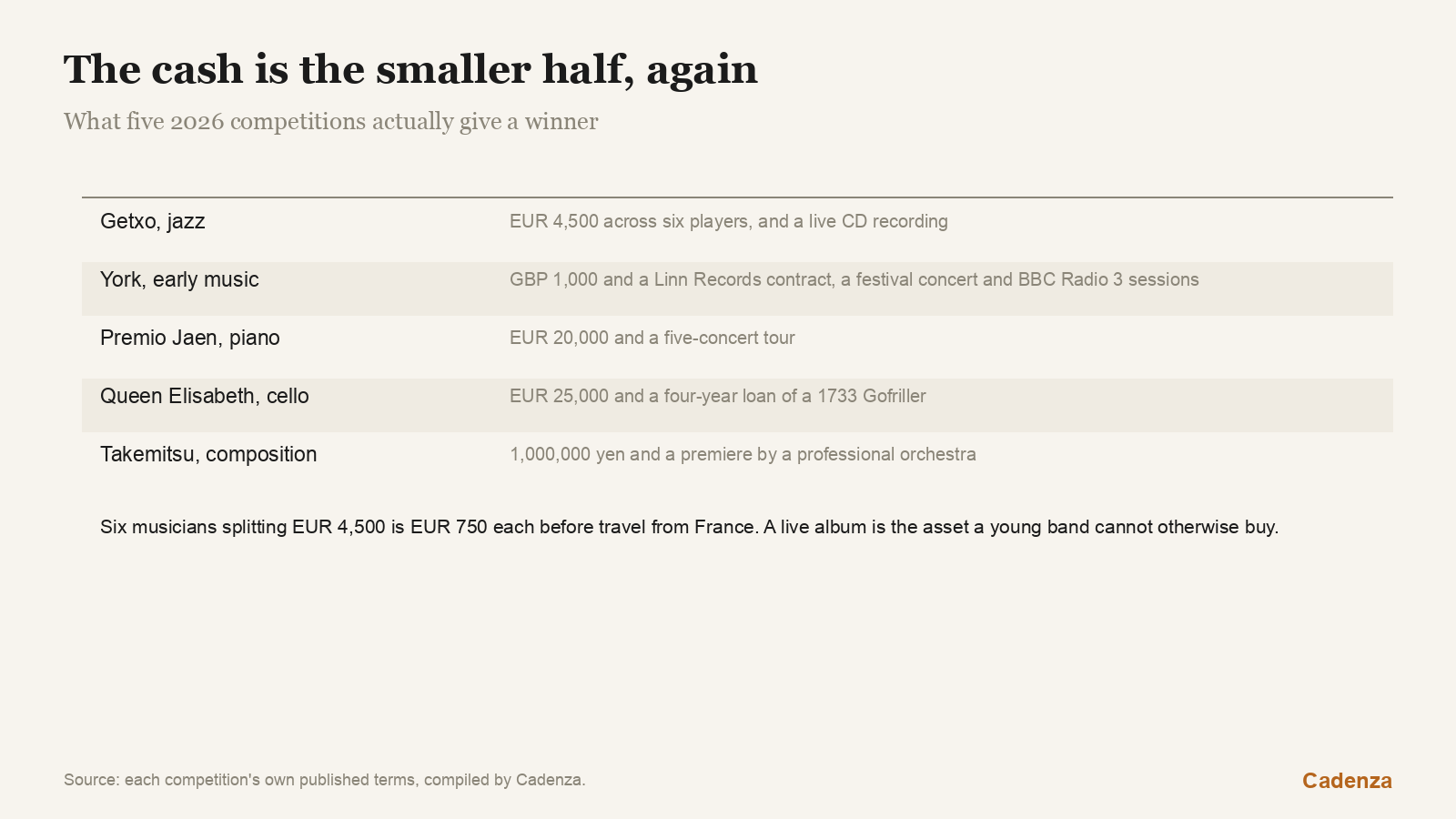
A live recording attached to a group prize is worth more to a band than the cash, for the same reason Cadenza has given four times this week about other competitions.
Six musicians splitting €4,500 is €750 each before anybody has paid for travel from France to Bizkaia. A live album is a document of the band as it actually sounded on a particular night in front of an audience, and for a young group it is the single hardest asset to acquire. Studio time costs money the band does not have. A festival recording costs them nothing and arrives with the festival's name attached.
That pattern now holds across every competition Cadenza has examined in the past two days. York gives a Linn Records contract. Jaén gives a five-concert tour. Brussels gives a four-year loan of a 1733 cello. Tokyo gives a composer an orchestra. Getxo gives a band a record. In every case the cash is the smaller half of the prize.
One thing to check before you copy the runner-up's name
The source reporting this result is not internally consistent about the second-placed band's name, which is worth flagging for anyone writing it up.
It gives the band as the Cristopher Pérez Quartet in one place and the musician as Christopher Pérez two sentences later, with and without an h. Cadenza cannot resolve which the festival itself uses without the festival's own list, so this article names the placing and the prize and leaves the spelling to be confirmed.
What is attested is that the runner-up had already won a national title, the Concurso Nacional de Juventudes Musicales de España, in 2024. A band that wins a national competition and then places second at an international one two years later is on exactly the trajectory these competitions exist to produce.
Why a Basque festival matters to a French band
Getxo sits on the coast at the mouth of the Nervión, downstream from Bilbao, and its festival is in its 49th year, which means it predates most of the musicians competing in it by a decade or more.
A festival that has run for nearly half a century in one place develops something a larger event cannot buy, which is a local audience that turns up for unknown bands. The competition is the mechanism: people come to hear groups they have never heard of, because the festival has earned the assumption that the groups will be good. Cadenza does not have the number of bands that competed in 2026, and is not guessing at one.
For a French sextet, that is a room full of listeners in another country who arrived willing to be convinced. It is also, at 49 editions, an institution about to reach a fiftieth anniversary, which tends to concentrate a festival's attention on its own history and its own alumni.
What a live festival recording actually involves
Since the recording is the larger half of this prize, it is worth being concrete about what a band receives, because it is not the same thing as a studio album.
A live festival record is captured in one pass, in front of an audience, usually from the house desk with additional close microphones. There is no second take and no overdubbing. What the band played that night is what comes out, including the tempo they actually took and the solo that did or did not come off.
For a young group that is a mixed blessing and mostly a gift. The risk is obvious: one uneven night becomes the permanent document. The advantage is that a live recording captures the thing a studio usually removes, which is the interaction between players reacting to each other and to a room. The jury's own description of Lurium, praising spontaneous interactions and a balance between force and subtlety, describes exactly the quality that survives a live capture and often dies under studio conditions.
It also arrives with a festival's name on the sleeve, which for a band nobody has heard of is the difference between a self-released file and a credential.
A year ago it was an application form
Lurium applied to a competition in another country, travelled to the Basque coast and played for a jury and a local audience. The 50th edition will follow.
Cadenza carries competitions with open deadlines, free to musicians, on its competitions board, and current vacancies on its jobs board.
If you are in a band considering this. Group competitions are rarer than solo ones and the odds are therefore structurally different, since you are competing against a handful of ensembles rather than hundreds of individuals. Check whether there is a separate soloist award, because as Getxo shows this year a band can take both. And weigh the recording: a live festival CD is an asset you cannot otherwise buy at this stage, and it is worth more than the per-head share of the cash.
The question Getxo will be asked next is the friendliest possible one, and it applies to the whole sector. Its three group-competition awards come to €7,350, and a figure of €6,350 is circulating as the total purse. Will the festival publish a single itemised prize list for its 50th edition, so nobody has to reconcile it?
Sources: Deia, published 5 July 2026 and read in Spanish, which names all six members of Lurium, the first prize of €4,500 with a live CD recording, the €1,900 runner-up award, Levi Harvey's €950 Best Soloist prize, the jury's quoted reasoning, and the runner-up's 2024 Concurso Nacional de Juventudes Musicales de España title. That report is itself inconsistent on the runner-up's given name, rendering it both Cristopher and Christopher, so this article does not print a spelling. A figure of €6,350 for the total group-competition purse, attributed to a January 2026 festival announcement, does not reconcile with the three attested awards and is therefore reported as unresolved rather than stated. The percentages and the €7,350 sum are Cadenza's arithmetic.
Cover photograph: the Vizcaya Bridge over the Nervión estuary at Getxo. Ebaki, CC BY-SA 4.0, via Wikimedia Commons. Charts by Cadenza.
Cover photograph: The Vizcaya Bridge over the Nervión estuary at Getxo in the Basque Country, where the Getxo Jazz Festival holds its group competition. Ebaki, CC BY-SA 4.0, via Wikimedia Commons.
Comments
Sign in to join the discussion.