Roman Fediurko was born in Kyiv in 2004. He is 21, he studies in Graz with Milana Chernyavska, and in the space of roughly six months he has won one major international piano competition outright and reached the podium of another.
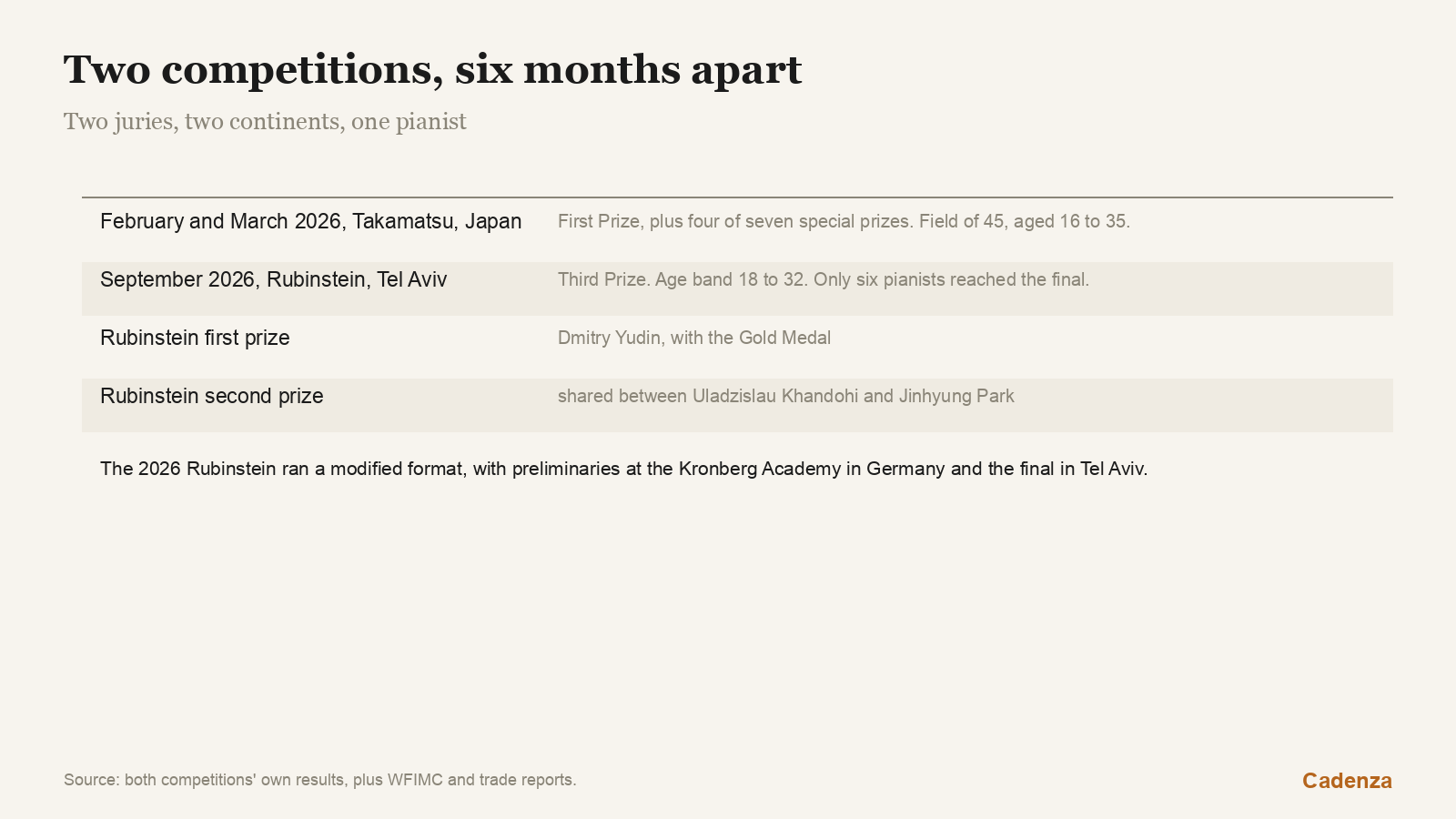
In February and March he took First Prize at the 6th Takamatsu International Piano Competition in Japan. In September he took Third Prize at the 18th Arthur Rubinstein International Piano Master Competition, whose final was played in Tel Aviv.
Two international results in one year at that level is unusual. What he did inside the first of them is more unusual still.
Four of the seven extra prizes
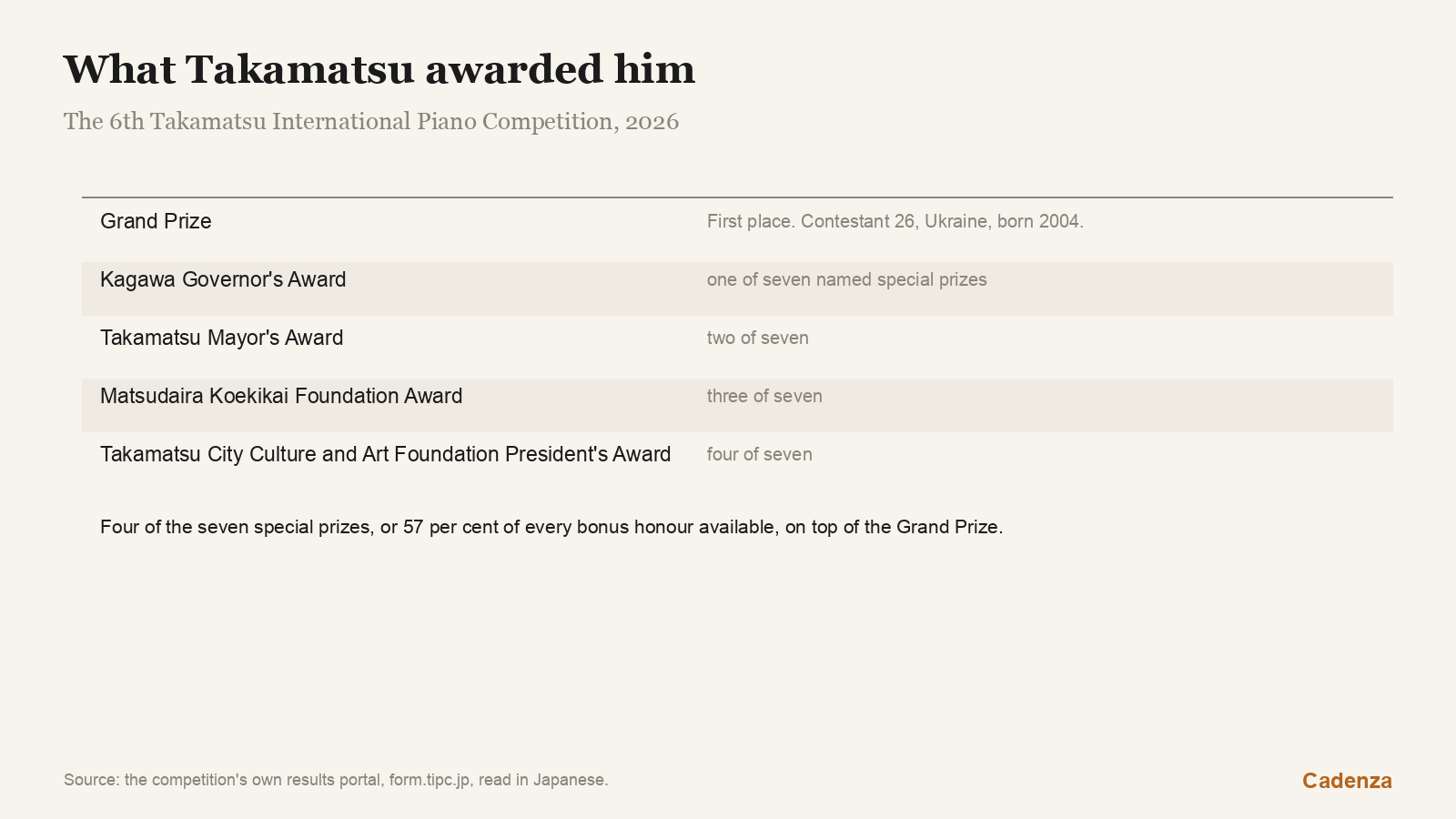
Takamatsu awards a Grand Prize and seven separately named special prizes. Fediurko took the Grand Prize and four of the seven: the Kagawa Governor's Award, the Takamatsu Mayor's Award, the Matsudaira Koekikai Foundation Award and the Takamatsu City Culture and Art Foundation President's Award.
One competitor taking the majority of every bonus honour available is not how these things usually distribute. Special prizes exist partly so that a jury can recognise several players, and partly so that local institutions each get to name a laureate. When one pianist collects 57 per cent of them alongside the main prize, the panel and the city have effectively said the same thing four separate ways.
Cadenza took this from the competition's own results portal, in Japanese, which lists him as contestant number 26, nationality Ukraine, born 2004, age 21, advanced through rounds one to three, first place. That is the kind of record most competitions do not publish and it is the reason this article can be specific.
He was near the bottom of the age range and won anyway
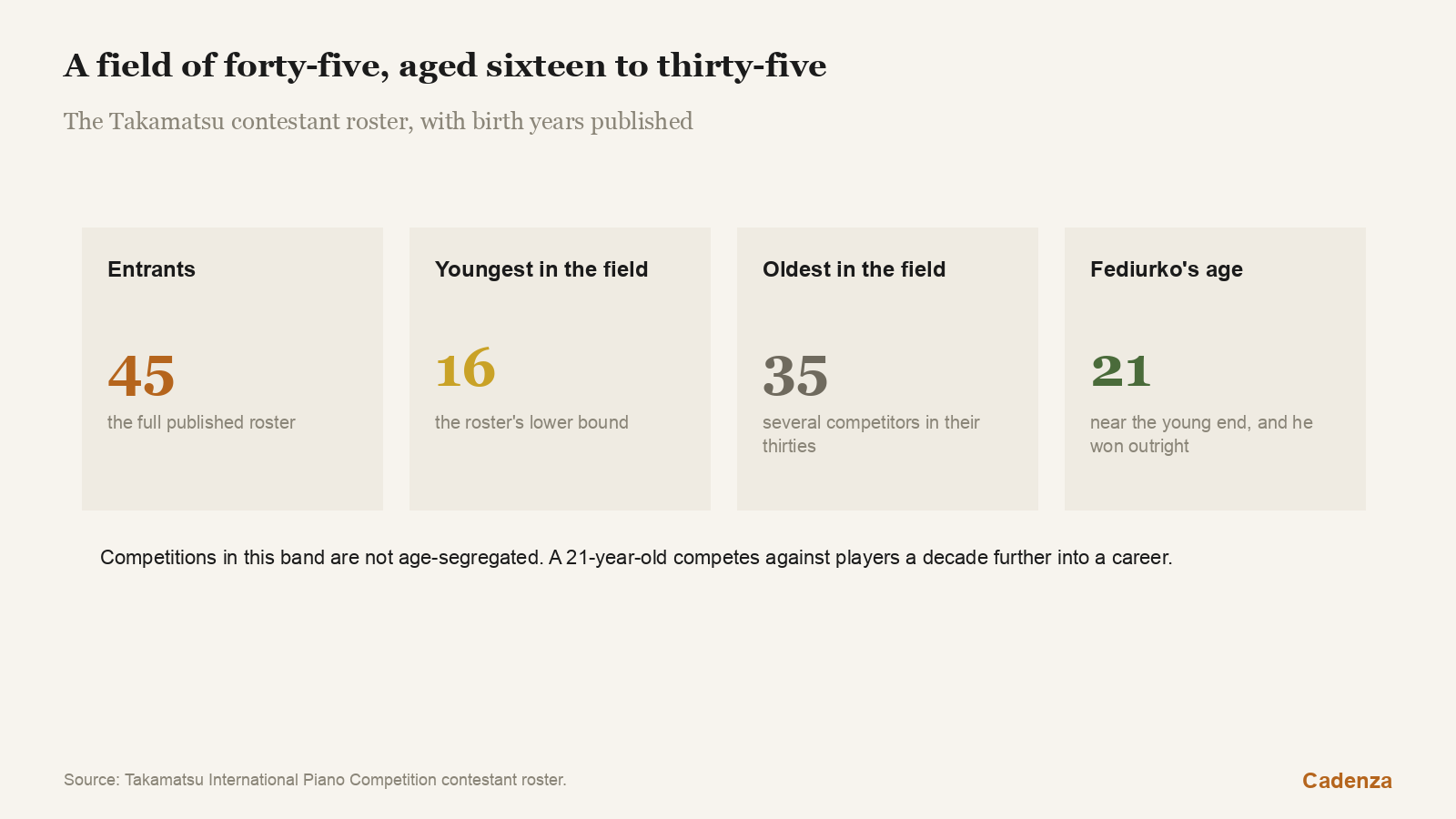
The Takamatsu contestant roster lists 45 entrants, with ages running from 16 to 35 and several competitors in their thirties.
That spread matters, because piano competitions in this band are not contests between peers. A 21-year-old and a 34-year-old are separated by a decade of professional playing, of learning how to hold a concerto together under pressure, of knowing what a jury is listening for. The older competitors in a field like that are usually the ones with conservatoire teaching posts and concert diaries already.
Fediurko was among the youngest in the entire field and won it outright.
Six months later at the Rubinstein, whose age band runs from 18 to 32, he again sat near the young end and placed third. The Rubinstein's 2026 edition ran a modified format, with preliminaries at the Kronberg Academy in Germany and the final in Tel Aviv, and only six pianists reached that final. First prize and the gold medal went to Dmitry Yudin, with second prize shared between Uladzislau Khandohi and Jinhyung Park.
What the two results are worth next to each other
A competition win is a single jury's verdict on a single week. That is the standard and fair caveat, and it is why one result never settles anything about a player.
Two results, from two juries, on two continents, within six months, is a different kind of evidence. The panels in Takamatsu and Tel Aviv shared no obvious membership and heard him in different repertoire under different formats. Both put him on the podium. For a pianist at 21 that is the most useful thing a CV can contain, because it removes the argument that a win was a fluke of one room.
It is also a punishing way to spend a year. Preparing two full competition programmes to that standard, travelling to Japan and then to Germany and Israel, and playing concertos with two different orchestras, is close to a full professional season compressed into competition conditions with no fee attached.
What the Rubinstein final tells you about the odds
The 2026 Rubinstein is worth a paragraph of its own, because its shape was unusual and it changes how a third prize there should be read.
Only six pianists reached the final. That is a small final by the standards of a competition of this standing, and it was the product of a modified format that ran the earlier rounds at the Kronberg Academy in Germany before moving to Tel Aviv. A six-player final means the third prize is a top-three placing in a field already cut to six by two juries in two countries.
The prize money at the top of that competition is substantial. The Arthur Rubinstein Award and Gold Medal carry 40,000 dollars, with a further 10,000 dollars for the winner's career enhancement fund, so 50,000 dollars in total went to Dmitry Yudin.
The other notable feature of the result is that the second prize was shared. Two pianists splitting a silver medal is not the norm, and across eighteen editions since 1974 a shared placing is a rare enough event to be worth recording. It also means the 2026 podium holds four names rather than three.
One small thing about how his name appears
Cadenza checked the trade coverage against the competitions' own records and found a detail worth flagging for anyone searching for him.
The Violin Channel's report on the Rubinstein result renders his surname as Rediurko in its body text, while spelling it correctly in the headline and photo caption. It is a single transposed letter and an easy slip, but it means a search on the misspelling returns the article and a search on his actual name may not.
Small errors like that are how an early-career musician's results quietly fail to accumulate. A jury remembers a player. A search engine remembers a string.
It is a fixable problem and worth a minute of anyone's time. A musician with a result to their name should search their own surname periodically and ask outlets to correct misspellings, because the trade reports are what a promoter finds first and they are what an algorithm indexes. The competition's own roster is the authority, and in this case it spells the name correctly and gives a contestant number to cite alongside it.
Kyiv, Graz, and where a Ukrainian pianist trains now
Fediurko was born in Kyiv and is based in Graz, studying with Milana Chernyavska at the university there.
That route is worth noting without over-reading it. Cadenza wrote this week about the Royal Philharmonic Society's scholarship awards, where German-speaking Europe took half of all destinations across four years. A Ukrainian pianist studying in Austria and competing in Japan and Israel is part of the same picture: the map of where advanced training happens has a strong centre of gravity in German-speaking Europe, and it draws players from well outside it.
What the Takamatsu portal shows about the field supports that. A 45-strong roster spanning 16 to 35 and drawn internationally is a competition functioning as a clearing house, where players from everywhere meet a jury that most of them will never otherwise play for.
A year ago it was an entry form
Both of these results began as applications, months apart, each with a programme to prepare and a fee to pay. Takamatsu publishes its full contestant roster with birth years, which is exactly the transparency Cadenza has spent this week asking other competitions for.
Cadenza carries competitions with open deadlines, free to musicians, on its competitions board, and orchestral vacancies on its jobs board.
If you are entering piano competitions. Read the contestant roster before the results. Takamatsu's tells you the field was 45 players aged 16 to 35, which is the single most useful fact for deciding whether to enter, and almost no competition publishes it. Note also that competitions in this band are not age-segregated, so a 20-year-old is competing against players a decade further into a career. That is not a reason to stay away. It is a reason to know what you are walking into.
The question the trade press will be asked next is smaller than the one for the competitions. Two juries on two continents put the same 21-year-old on the podium within six months, and the report on the second result misspelled his name. Will the outlets covering competition results check the spelling against the competition's own roster before publishing?
Sources: the Takamatsu International Piano Competition's own results portal at form.tipc.jp/results, read in Japanese, which lists Fediurko as contestant 26, nationality Ukraine, born 2004, age 21, first place, and which carries the full 45-strong contestant roster with birth years and the seven named special prizes; the World Federation of International Music Competitions report of 2 March 2026, which states his birth in Kyiv, his base in Graz and his study with Milana Chernyavska; and the Arthur Rubinstein International Piano Master Competition result as reported by moto-perpetuo and The Violin Channel, the latter being where the surname misspelling appears in the body text. The share of special prizes, the age-range comparison and the six-month interval are Cadenza's arithmetic.
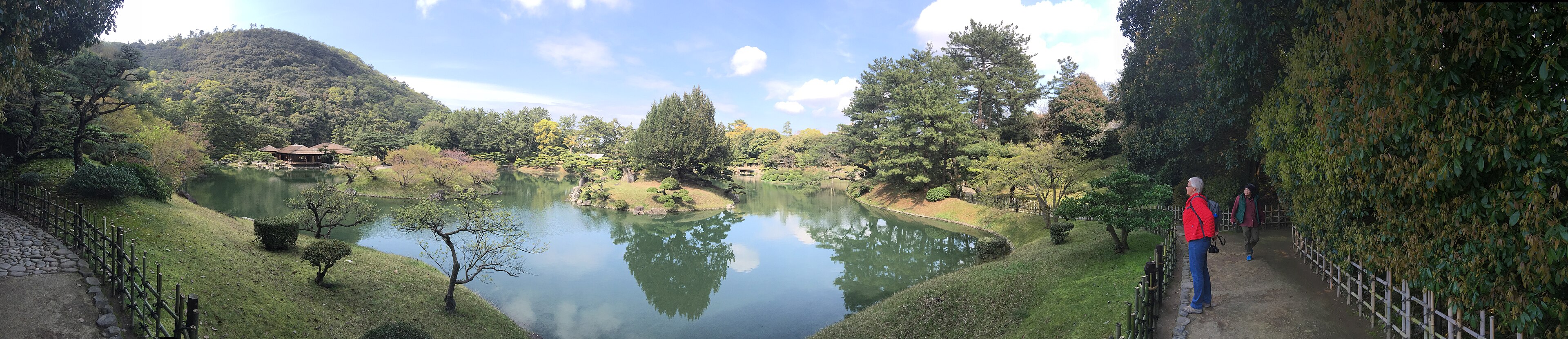
Cover photograph: Takamatsu, Kagawa Prefecture, April 2015. IMBiblio, CC BY-SA 2.0, via Wikimedia Commons. Charts by Cadenza.
Cover photograph: Takamatsu, Kagawa Prefecture, where Roman Fediurko won the 6th Takamatsu International Piano Competition in 2026, photographed in April 2015. IMBiblio, CC BY-SA 2.0, via Wikimedia Commons.
Comments
Sign in to join the discussion.