Open chapter guide
What this investigation found¶
The public record does not support a single global prevalence rate for abuse in classical-music education. It supports something different and, in institutional terms, deeply consequential: the same structural risks recur across systems that otherwise differ in country, law, age group and governance.
The recurring architecture is visible in official sources. One-to-one tuition can be unusually intense and private. The teacher may be revered, physically involved in instruction and connected to future opportunities. Students may live away from home or depend on the institution for immigration status, scholarships, housing and professional access. Complaints can be broken into separate administrative files. A resignation can end the employer’s immediate problem without ending the person’s access to students. A receiving institution may obtain the résumé but not the warning.
This article follows seven handoffs: private studio, youth and summer program, specialist school or pre-college division, conservatory, festival or competition, professional threshold, and exit or re-entry. At every handoff it asks the same question:
What information moved with the person—and what was left behind?
THE HANDOFF NO ONE AUDITS¶
A serious classical musician can spend fifteen years moving through a system that knows almost everything about the musician and astonishingly little about the adults who move alongside them.
The system can preserve the name of a teacher’s teacher across generations. It can remember who studied with whom in Vienna, Moscow, Paris, Philadelphia or London. It can trace a bowing tradition, an orchestral school, an embouchure lineage or a conducting genealogy across a century. It can rank competition results, archive recital programs, circulate recordings and repeat a recommendation until one teacher’s private opinion becomes an international professional fact.
But when a teacher leaves one institution after a serious concern, the next institution may receive no comparable record.
That is the pipeline problem.
It does not begin at conservatory. It begins much earlier, often when a child enters a private studio because a parent has been told that one particular teacher can open the next door.
The child’s first dossier quickly grows. Repertoire. Examination results. Youth-orchestra seating. Competition prizes. Summer-program admissions. Video recordings. Teacher recommendations. Scholarship offers. Masterclass invitations. Conservatory auditions. Festival placements. Substitute work. The entire education is a chain of endorsements.
At each stage, talent is documented and transmitted.
At each stage, safeguarding may start over.
The private teacher may have no institutional employer. The summer program may run for three weeks and rely on visiting faculty. The pre-college division may sit inside a university but operate under different rules from the college. The boarding school may supervise a child’s entire life while an outside instrumental teacher appears only for lessons. The conservatory may treat the principal professor as the student’s artistic home. The festival may assume the professor’s permanent institution has already vetted the person. The orchestra may ask for an informal recommendation from the same network that trained the applicant.
No single organization sees the whole route.
A warning that does not become a criminal charge may remain inside one personnel file. A studio transfer may be recorded as a matter of fit. An intimate message may be handled by student affairs. A parent’s concern may be filed without the language of misconduct. A teacher may resign before a finding. A festival may never know there was an investigation. A new employer may call a personal reference selected by the candidate rather than the official office that holds the record.
The student keeps moving.
The adult keeps moving.
The information does not.
Consider the ordinary route of a talented twelve-year-old. The child studies privately, wins a place in a summer academy, then enters a specialist school or pre-college program. A teacher recommends a conservatory. The conservatory professor recommends a festival. A festival conductor recommends an audition. A former professor calls an orchestra. The musician’s opportunities move through personal trust.
Now imagine that, somewhere in that route, a concern is raised.
The private teacher sends messages that make the student uncomfortable. The summer-program director hears a vague complaint but the session ends. The specialist school permits a studio change without recording the reason centrally. The conservatory receives a report but the professor resigns. A festival later hires the professor as a guest artist because the curriculum vitae is impeccable and the references are personal. The next student sees only the title, the biography and the list of successful alumni.
This hypothetical sequence is not presented as a disguised account of any one person. It is a map of the vulnerabilities documented in the records examined for this investigation.
Britain’s Independent Inquiry into Child Sexual Abuse found that specialist music schools combine unusually high levels of one-to-one tuition, repeated contact with the same tutor, legitimate physical contact, boarding, revered teachers and intense career pressure. It warned that children might avoid complaints because a teacher could influence their future education and career.
Curtis Institute’s independent investigation recorded a parallel fear: former students perceived that they remained at the school at the discretion of the major teacher, creating a chilling effect on reporting because dismissal could feel possible at any time.
Berklee’s president disclosed in 2017 that eleven faculty members had been terminated over thirteen years for sexual harassment and/or assault. The public crisis also exposed a hiring process in which personal references had been contacted without the previous university’s official human-resources record being checked.
Juilliard’s later outside review led to a termination and a broader prohibition on faculty-student relationships, but the institution released a summary rather than the full report, leaving the public dependent on what the institution chose to disclose.
The Royal Conservatory of Music in Toronto is now conducting a historical process across an institutional boundary of its own: the conservatory was operated by the University of Toronto before 1991, so understanding the past requires records and responsibility to move between organizations.
Germany has gone a step further at the sector level. Twenty-two music academies are participating in an independent 2026 study that will examine not only reported experiences but whether individual artistic tuition and small-group teaching contain distinctive risk and protective factors.
These are not identical cases. The evidentiary status differs sharply. Britain’s record includes convictions, civil findings and a statutory inquiry. Curtis published an independent report and accepted its conclusions. Berklee’s record combines institutional disclosure, court documents and journalism. Juilliard published a summary of an external review. Toronto’s investigation is active and must not be prejudged. Germany’s study is research, not an accusation against every academy.
The common thread is not guilt.
It is architecture.
The same educational model repeatedly concentrates authority in personal relationships, moves students across temporary and permanent institutions, and relies on reputation as both currency and evidence. It produces exquisite artistic continuity. It can also produce continuity of risk when information about concerns travels more slowly than the people involved.
The central failure is therefore larger than the closed studio door.
The door is only the first chamber.
The deeper danger lies in the handoff: from family to private teacher, private teacher to program, program to school, school to conservatory, conservatory to festival, festival to profession, and one employer to the next. Every handoff creates an opportunity to reset the adult’s history while preserving the adult’s prestige.
Classical music has built a global system for authenticating talent. It has not built an equally reliable system for transmitting safeguarding facts.
A receiving institution may know the candidate studied with a celebrated teacher, won a chair in a major orchestra and taught prizewinners. It may not know that students previously requested transfers, that a complaint remained unresolved when employment ended, or that a former institution considered the person ineligible for rehire.
This asymmetry is the core of the investigation.
No responsible reform can eliminate one-to-one teaching, artistic mentorship or the international movement of musicians. Nor should it. Those are among the strengths of the field.
The task is to stop treating every transition as a clean slate.
A student should not have to become the only person carrying the warning from one institution to another. A parent should not have to search old newspaper archives to discover why a teacher left a previous post. A festival should not be able to outsource responsibility to a home institution it never contacted. A conservatory should not be able to close an investigation because the employee resigned. An orchestra should not accept an informal recommendation as a substitute for an official employment check when the job includes authority over students or young artists.
The question this article asks at every stage is simple:
What did the next institution receive?
If the answer is only the résumé, the pipeline is functioning exactly as designed for prestige—and failing exactly where safety begins.
Childhood instruction; often no durable employer record.
Guest faculty and short contracts.
A minor’s identity and training become institutionally dependent.
Major teacher plus evaluation, scholarship and continuation power.
Temporary authority with long professional reach.
Informal references and network calls shape work.
The biography travels; the warning may not.
THE PEDAGOGY BEFORE THE SCANDAL¶
The conservatory model is not dangerous because it is demanding. It is vulnerable because its educational strengths and its safeguarding risks are often built from the same materials.
One-to-one instrumental and vocal tuition offers attention that ordinary classrooms cannot. A teacher can hear tiny technical changes, adapt language to one body, follow artistic development over years and help a student find an individual voice. Students consistently describe that relationship as central to professional formation. The problem is not intimacy itself. The problem begins when intimacy is treated as a substitute for accountability.
Research on conservatoire teaching has been warning about this tension for years. Helena Gaunt’s studies of teachers and students found that one-to-one tuition could be both extraordinarily productive and unusually isolating. Teachers described intense, complex relationships conducted largely outside peer observation. Students valued trust in a principal teacher but also described benefits from having more than one teacher, because multiple perspectives reduced dependence on a single authority. (Gaunt, 2007; Gaunt, 2010)
The newer research is blunter. The four-year European project Conservatory Cultures examined how higher-music-education institutions in Estonia, Finland and Hungary handled bullying and harassment. Its 2025 synthesis found that having formal procedures and organizational bodies did not eliminate the difficulty of making complaints inside institutions where artistic, academic and professional relationships overlap. (Werner et al., 2025)
The Association Européenne des Conservatoires’ PRIhME project begins from an institutional admission rather than an external accusation: systemic inequalities in power relations are embedded in most higher-music-education institutions. Its toolkit asks whether students feel safe speaking out when professors may shape their professional networks and future success. It recommends clear complaint systems, neutral support, transparent codes, safer spaces and collaboration between institutions. (AEC PRIhME; Power Relations Toolkit)
A 2026 Australian study of twenty women working in classical music described the master–apprentice culture as a cycle that can normalize sexist and abusive pedagogy and carry it from education into employment. The study does not establish prevalence across Australia, and it should not be read as doing so. Its importance is analytical: participants described a professional culture in which a revered teacher’s artistic judgment, access and network could make resistance feel career-threatening. (Gibson, 2026)
The traditional model concentrates at least six kinds of authority in one relationship.
- Technical authority: the teacher defines what the body, sound and technique should do.
- Evaluative authority: the teacher may influence juries, grades, continuation and casting.
- Economic authority: the teacher may affect scholarships, assistantships, paid work and access to instruments or travel.
- Narrative authority: the teacher can define whether the student is gifted, difficult, unstable, lazy or “not ready.”
- Network authority: the teacher supplies introductions, references and informal calls.
- Emotional authority: the teacher may become the person who appears to understand the student’s ambition better than family or peers do.
None of those powers is inherently abusive. Combined, they create a relationship in which ordinary boundaries can become difficult to negotiate and ordinary remedies can feel impossible to use.
Touch is pedagogical—and therefore must be governed¶
Music teaching is embodied. A brass teacher may demonstrate breath expansion. A string teacher may alter a wrist or shoulder. A singer may work on ribs, jaw, tongue or pelvic alignment. Conductors, actors and dancers operate with similarly physical vocabularies.
The existence of legitimate touch does not make boundaries unknowable. It makes explicit boundaries more important.
A defensible touch protocol begins before contact: explain the technical purpose, ask permission, describe where contact will occur, offer a non-contact alternative and treat consent as revocable without artistic penalty. It also recognizes that the student’s apparent agreement is shaped by power. A first-year student may say yes because the person asking controls the studio, not because the student feels free to choose.
The British statutory inquiry identified necessary physical contact as one of the particular safeguarding challenges in specialist music schools. Interlochen’s current policy, described in its 2026 report, restricts employee touch to specified areas and prohibits backrubs between adults and students. Juilliard responded to its 2023 review with broader relationship restrictions and had already required one-to-one lessons to occur on campus and installed windows in teaching-studio doors, according to NPR’s account of the school’s reforms. (IICSA; Juilliard/NPR)
Those measures point to a broader principle: physical transparency is not hostility to art. It is an institutional acknowledgment that pedagogy should not depend on secrecy.
Subjective excellence can hide objective power¶
Conservatories evaluate qualities that cannot be reduced to a standardized test. Tone, phrasing, interpretation, stage presence, imagination and professional readiness involve judgment. That subjectivity is artistically necessary. It also creates room for power to disguise itself as taste.
A student who raises a concern may later hear that an opportunity was lost for musical reasons. The decision may be legitimate. It may also be impossible to review because no rubric, second assessor or conflict disclosure exists. The more the institution relies on unrecorded artistic discretion, the harder retaliation is to identify and the easier it is for everyone involved to deny that it occurred.
The solution is not to bureaucratize every artistic decision. It is to ensure that no single person can quietly control all of them. Students need multiple evaluators, documented criteria, conflict rules, appeal routes and the practical ability to leave a studio without losing a degree, scholarship or professional future.
Guardrail: observable rooms and periodic second-teacher review.
Guardrail: explain, ask, document and allow refusal.
Guardrail: written criteria, multiple evaluators and appeal.
Guardrail: independent adviser and regular boundary review.
Guardrail: conflict disclosure and alternative references.
CONSENT IS NOT ENOUGH WHEN AUTHORITY IS NOT EQUAL¶
A great deal of institutional confusion begins with the wrong question: Were both people adults?
That question matters in criminal law, but it does not resolve the ethical or institutional problem inside a conservatory. A graduate student can be twenty-eight years old and still depend on a professor for a degree jury, scholarship renewal, teaching assistantship, premiere, recommendation, festival nomination and entry into a small professional network. A post-graduate fellow can have years of professional experience and still be unable to refuse an invitation from the person who controls the fellowship. A young artist can be legally capable of consent while remaining professionally incapable of withdrawing it without risk.
Age of consent is a legal floor. It is not a complete safeguarding policy.
The central institutional question is whether one person holds authority that can materially affect the other person’s education, income, immigration status, housing, artistic opportunities or reputation. Where that authority exists, a sexual or romantic relationship is not simply a private matter. It creates a conflict inside the educational system itself.
The conflict can operate even without an explicit threat. The teacher does not have to say, “Stay with me or lose the scholarship.” The student already knows who writes the recommendation. The teacher does not have to promise a solo in exchange for intimacy. The student already knows who chooses the cast. The power is ambient. It is built into the relationship before either person speaks.
This is why an institution can have a relationship that both participants describe as consensual and still have a serious governance failure.
There are at least four different categories that policy must keep separate:
- A minor and an adult. The institution’s duty is categorical protection. A child cannot be converted into an equal professional partner by talent, maturity, artistic intensity or the adult’s claim that the relationship was loving.
- An adult student and a person with direct authority. The teacher grades, supervises, casts, funds, recommends or evaluates the student. The conflict is immediate and should be prohibited.
- An adult student and a person with indirect but foreseeable authority. The person may sit on juries, control a department, direct a festival, allocate professional work or influence the student through a close network. Disclosure and recusal are not optional administrative details; they are the minimum conditions for protecting the student’s education.
- Adults without educational or professional authority over one another. Ordinary workplace and harassment rules still apply, but the specific gatekeeping conflict may not.
These categories are not identical. Treating them as identical can be unfair. Treating them all as private romance can be dangerous.
Juilliard’s 2023 policy change illustrates the point. After its outside review, the school said it would prohibit sexual or romantic relationships between faculty and students more broadly; its prior rule had distinguished undergraduate students from some graduate students. The change recognized that graduate status does not erase educational dependency. The public record did not make every adult relationship abusive. It acknowledged that the institution should not place a student in the position of proving coercion after allowing a conflicted relationship to develop. (Juilliard/NPR)
A credible policy should therefore do more than prohibit a professor from dating a student currently enrolled in the professor’s class. It should cover the real map of authority:
- principal teachers and studio faculty;
- department chairs and deans;
- conductors, directors and coaches who control casting;
- jurors and examiners;
- faculty who nominate students for festivals, competitions or paid work;
- supervisors of assistantships and fellowships;
- guest artists who acquire temporary authority;
- anyone with access to confidential complaints or disciplinary decisions;
- and former teachers during a defined period when recommendations and professional dependency remain active.
The former-teacher problem is especially difficult. Graduation changes a legal status faster than it changes a network. A professor may continue to write references, broker auditions and shape a former student’s reputation for years. A blanket lifelong prohibition may be neither workable nor proportionate in every setting. But a policy that treats graduation day as the instant disappearance of power is fiction.
Institutions should use a documented cooling-off period, conflict disclosure and independent review where continuing professional authority exists. The person with greater institutional power—not the student—should carry the duty to disclose and step away from decisions.
The same principle applies when a relationship ends.
A student should not have to remain in the same studio after a breakup. The former partner should not control the student’s jury, grade, assistantship, casting, reference or complaint. The institution should not ask the less powerful person to solve the conflict by leaving the program, forfeiting a scholarship or changing career direction. Academic continuity is part of safeguarding.
This is not an argument that adult students have no agency. It is an argument that agency cannot be evaluated honestly without examining the cost of saying no, the cost of ending the relationship and the cost of reporting it.
Institutions should also resist a second error: using the language of power imbalance to bypass evidence and fair process. A relationship prohibition can be enforced without treating every allegation as proved. The school can separate the participants, preserve the student’s education, document conflicts, investigate specific conduct, provide the accused person an opportunity to respond and classify the outcome accurately.
Due process and power analysis are not enemies.
The purpose of a strong rule is to reduce the number of cases in which an institution must later decide whether a student’s apparent consent was genuine, pressured, manipulated or strategically reinterpreted by a person who controlled the record.
A music school should not wait for a student to prove coercion after the institution has allowed one person to control the lesson, the opportunity and the relationship.
Talent or apparent maturity never removes the adult’s duty.
Grades, juries, scholarships, casting or supervision make consent professionally compromised.
Festival, department and network power can remain material even without a current class.
Harassment, coercion and retaliation rules still apply.
The more powerful person leaves grading, casting, references and complaint decisions.
THE EVIDENCE LADDER: WHAT IS PROVED, FOUND, ALLEGED OR STILL UNDER REVIEW¶
An article this broad can become irresponsible in two opposite ways.
The first is sensationalism: merging every allegation, conviction, rumor and institutional apology into one undifferentiated scandal. That approach creates heat but destroys accuracy. It can wrongfully imply guilt, erase due process and make genuine findings easier to dismiss.
The second is institutional euphemism: treating each case as an isolated historical tragedy, surrounding it with statements about present-day values, and refusing to ask why the same mechanisms recur across places that share the same educational model.
Cadenza rejects both.
This investigation uses an evidence ladder.
The Interlochen report, examined in Cadenza’s previously published investigation, belongs primarily in categories four and seven. Sanghavi Law Office conducted an external investigation, interviewed approximately 150 unique people and reviewed available files, but expressly stated that it did not determine whether the historical conduct occurred as reported. Its value lies in the volume and consistency of accounts, the institutional records it assembled, the responses and nonresponses of accused adults, and the patterns it identified. Its limits must remain visible in every sentence.
The Curtis report belongs in category four, and Curtis’s public response belongs in category five. Independent investigators found St. John’s account credible; Curtis accepted the report and said the school had failed her.
The Chetham’s material includes several categories simultaneously: criminal convictions, a civil finding, and a statutory national inquiry’s findings about institutional response.
The Royal Conservatory of Music belongs in category six. It has acknowledged historical allegations and announced an independent investigation. No conclusion should be assigned in advance.
Berklee’s 2017 crisis rests on investigative reporting, court documents, public statements and the president’s disclosure that eleven faculty members had been terminated over thirteen years for sexual harassment and/or assault. That disclosure is an institutional fact. Individual allegations still require individual labels.
Juilliard released a public summary of an independent investigation and terminated composition professor Robert Beaser after finding credible evidence that he interfered with individuals’ academic work, had an unreported relationship that violated policy and misrepresented facts. Beaser denied sexually harassing anyone and disputed the characterization of his conduct. The public summary did not state that investigators had made a finding of sexual harassment against him, a distinction that must be preserved.
Germany’s current work is not an abuse-case inventory. It is institutional research into power, discrimination, sexualized violence, prevention and sanctions. Its inclusion here is important because it acknowledges that risk can be structural even before a specific case reaches a courtroom.
The result is not a claim that every conservatory is unsafe, every master teacher abusive or every private lesson suspect.
It is a documented argument that the dominant training model contains predictable risk factors, that multiple institutions failed in strikingly similar ways, and that reforms are credible only when they reduce concentrated power rather than merely update policy language.
SEVEN HANDOFFS WHERE POWER GROWS AND INFORMATION DISAPPEARS¶
The conservatory pipeline is not a single institution. It is a sequence of authority transfers.
A parent entrusts a child to a private teacher. A private teacher recommends a residential program. A summer program points toward a specialist school. A school routes the student to a conservatory professor. The professor controls access to festivals and competitions. Festivals and juries connect the student to the profession. The profession sends successful artists back into teaching, often as prestigious freelancers whose institutional ties are multiple and temporary.
Each transfer can be entirely healthy. Each can also create a new place for accountability to dissolve.
1. Childhood private instruction: the pipeline begins outside the institution¶
Many musicians encounter the highest-intensity form of music education before entering any conservatory or specialist school.
A private teacher may work from a home, a rented studio, a church, a community school or a university office after hours. The teacher may be employed, self-employed or simultaneously attached to several organizations. Parents often choose the teacher through reputation: a principal player recommends a former student; a competition winner credits a mentor; another parent says the teacher gets children into the right program.
The arrangement can be transformative. It can also sit outside the reporting systems that govern schools.
There may be no human-resources department, no designated safeguarding lead, no institutional code, no central attendance record and no independent person to whom a child can report. The teacher may control the physical space, schedule and communication channel. Lessons may involve legitimate touch related to posture, breathing, hand position or bodily release. The same teacher may become the family’s authority on what sacrifice is necessary for success.
This is the first asymmetry: the adult is professionally legible, while the safety system is not.
A biography can list orchestral appointments, degrees and famous pupils. It rarely lists whether the teacher has completed child-safeguarding training, follows a consent-based touch policy, permits parents to observe, uses transparent communication or has ever been restricted by a prior institution.
The answer is not to treat every private studio as suspicious. It is to stop pretending that artistic reputation is itself a safeguarding credential.
For minors, the minimum protective architecture should include observable teaching spaces, clear parent access, written communication policies, explained and revocable consent for touch, boundaries around transport and overnight activity, and an external route for concerns when the teacher has no institutional employer.
Without that architecture, the first gatekeeper in a child’s career may also be the least supervised.
2. Youth orchestras and summer programs: temporary institutions, permanent influence¶
The second handoff often occurs when a young musician leaves the weekly studio for an intensive program.
Youth orchestras, camps, academies and summer festivals compress months of ambition into days or weeks. Students live, rehearse and travel together. Guest conductors, coaches and faculty arrive from multiple employers. The program may rely on seasonal counselors, visiting artists and temporary housing. A famous teacher may teach only two masterclasses but acquire immediate authority because the invitation itself signals prestige.
Short duration can create a dangerous assumption: that the program does not need to know what the home institution already knows.
The home institution may assume the festival has vetted the guest. The festival may assume the permanent employer has done so. A freelancer may have no single home institution at all. Background checks, where required, reveal certain criminal records; they do not reveal unresolved boundary concerns, quiet resignations, private settlements, studio-transfer patterns or a previous employer’s decision not to rehire.
Temporary programs also create jurisdiction problems. Which institution receives a complaint about a visiting professor? Who preserves the record after the program closes? Who informs the professor’s permanent employer? Who supports the student after everyone returns to different countries? Does the festival continue an investigation once the artist’s engagement has ended?
The answer cannot be “the contract is over.”
An institution’s duty to understand a safety concern should not expire with the final concert.
3. Specialist schools and pre-college divisions: artistic identity becomes institutional dependency¶
At the third handoff, music stops being an activity and becomes the organizing structure of a child’s life.
Specialist schools and pre-college programs select unusually committed young musicians. The prestige can be life-changing. So can the dependency.
In boarding environments, children depend on adults for housing, transport, permission, medical care and daily welfare. International students may be far from family and unfamiliar with local systems. A young musician may believe that a place in the school is the only route to the career. Families may have reorganized finances and geography around the opportunity.
Britain’s national inquiry described boarding schools as environments where dependence on adults can facilitate grooming. It identified additional music-school risks: repeated one-to-one tuition, physical contact, renowned freelance teachers, intense competition, emotional pressure and fear of being labeled difficult by adults who influence future education and employment.
The student’s world narrows at the same moment the teacher’s power expands.
A child who wants to change teachers may fear losing the school. A student who reports a boundary concern may fear being returned home, losing a scholarship or becoming known as unmanageable. A teacher may function as instructor, recruiter, sponsor, evaluator and career prophet.
That combination is not inevitable. It is a design choice.
Schools can separate the decision to retain a student from the wishes of one instrumental teacher. They can guarantee confidential studio transfers. They can forbid adults from hosting individual minors at home, require observable lessons, centralize boundary concerns and ensure that boarding records, transport permissions and artistic departments are reviewed together rather than in isolation.
The public inquiry in Britain demonstrates why those controls must be active, not ceremonial.
The international student carries an additional layer of dependency¶
The specialist-school and conservatory pipeline is international by design. Young musicians cross borders because a particular teacher, orchestra, scholarship or institution may exist in only one place. That mobility is celebrated as evidence of seriousness. It can also multiply dependency.
Britain’s statutory inquiry noted that the specialist music schools it examined included overseas boarders who could be far from home and family. Distance is not itself a cause of abuse. It changes the student’s available exits. A student may not know the local reporting system, may be studying in a second language, may rely on the institution for housing and immigration documents, and may believe that leaving a teacher means leaving the country. (IICSA)
The same dependency can affect adult conservatory students. A scholarship may be tied to a studio. Visa sponsorship may depend on continuous enrollment. Emergency housing may not exist outside campus. Parents may be thousands of kilometres away and unfamiliar with the institution’s hierarchy. The student may fear that a complaint will be interpreted through cultural stereotypes, translated poorly or disclosed to a government, sponsor or family.
A safeguarding system for an international institution should therefore include more than translated policy PDFs. It should provide:
- an adviser independent of the student’s department;
- reporting and support in more than one language;
- written guarantees that a protected studio change will not automatically jeopardize scholarship, housing or immigration support;
- emergency accommodation and travel planning;
- clear rules for contact with sponsors, parents or guardians;
- access to external legal and advocacy resources;
- and a process for transferring the student to another qualified teacher without requiring the reported person’s approval.
The vulnerable condition is not nationality. It is institutional dependence combined with distance from ordinary support.
A global conservatory recruits internationally. Its duty of care must travel just as far.
4. The conservatory: the major teacher can become private government¶
At conservatory, the student may be legally adult and still remain structurally dependent.
The principal teacher controls the weekly lesson and may influence juries, repertoire, ensemble placement, competitions, scholarships, introductions and references. The professor may be the reason the student enrolled. Losing the studio can feel equivalent to losing the institution.
Curtis’s 2020 investigation captured the danger with unusual clarity. Former students described a perception that they remained at the school at the discretion of their major teacher, creating a chilling effect because dismissal could feel possible at any time.
The problem is larger than formal authority.
A professor does not need the legal power to expel a student if the student reasonably believes the professor can make continued study or future work impossible. In a subjective field, retaliation can be disguised as artistic judgment: the sound lacks maturity, the interpretation lacks depth, the student is not ready, the personality is not suited to the profession.
Those judgments may be sincere. The institution still has a duty to ensure that one person cannot use them without review after a conflict or complaint.
No single teacher should control admission, continuation, grading, scholarship and professional access. Students need multiple evaluators, written criteria, protected studio transfers and references that do not depend entirely on the person reported.
The conservatory’s prestige does not reduce the need for checks. It increases it.
5. Festivals, masterclasses and competitions: the shadow campus¶
The fifth handoff moves the student into a temporary professional world.
A festival can look like a school, an employer, a conference and a social network at the same time. Students receive coaching, perform for juries, travel with faculty, attend receptions, live in shared housing and compete for future invitations. A masterclass may place a student physically and emotionally before an admired artist in front of an audience. A competition juror may later become a teacher, employer or agent.
These spaces are powerful because they are transitional. They are also hard to govern because authority is distributed.
The artistic director chooses faculty. A host institution supplies rooms. A sponsor funds prizes. A separate organization manages housing. Guest teachers remain employees elsewhere. Participants may include minors, university students and professionals under the same program name.
When a concern arises, every entity can believe another one owns it.
The student, meanwhile, understands that the festival is not a disposable summer. It is part of the career. A complaint may seem to end not only the current experience but access to an entire network of teachers, jurors and conductors.
Every temporary program should therefore answer in advance: Who is the safeguarding authority? Which code governs guest faculty? Where are records kept after the event? Who contacts a permanent employer? Do investigations continue after departure? What happens when the accused person is a donor, trustee, juror or visiting star rather than an employee?
Prestige cannot be permitted to enter on a guest badge and leave responsibility at the door.
6. The professional threshold: informal trust becomes employment¶
The sixth handoff converts education into work.
Classical music’s early-career economy is intensely relational. Substitute lists, assistantships, ensemble calls, chamber projects, teaching referrals and festival returns often begin with a message: Who is good? Who is reliable? Whom do you trust?
The answer frequently comes from a former teacher.
That informal network can be generous and efficient. It can also make retaliation invisible. A student who reports a powerful professor may never know why a call does not come, a recommendation cools or a festival invitation disappears. The British inquiry heard that children could fear being seen as difficult because teachers held influence over future careers. The same fear does not vanish at graduation.
The professional threshold also returns performers to education. A successful musician may teach at several schools, coach a youth orchestra, appear at a festival and maintain a private studio. Each institution sees a fragment of the role. None may hold the complete safeguarding picture.
Anti-retaliation policy must therefore extend beyond grades and campus jobs. It should cover references, juries, casting, substitute lists, recommendation calls and access to institutional opportunities. Schools should be able to provide independent references when the principal teacher is involved in a complaint. Professional organizations should document conflicts when jurors and teachers overlap.
A field cannot rely on informal trust for hiring and then act surprised when informal silence follows it.
7. Exit and re-entry: the biography survives the concern¶
The final handoff occurs when an adult leaves.
Resignation, retirement, non-renewal, medical leave, personal reasons and mutual agreement can describe radically different realities. The public biography may remain unchanged. The official file may be confidential. The investigation may stop because employment ended. A new institution may call a personal reference rather than the former employer. Private teaching can continue without any employer at all.
This is where the pipeline turns circular.
The person returns as a teacher, juror, guest artist, conductor, trustee, donor or mentor. The next institution receives the prestige accumulated across the earlier stages. Unless lawful information-sharing exists, it may receive none of the risk record.
A resignation is not a safeguarding outcome.
It is a handoff.
The institution that accepts the departure still has to decide whether an investigation will be completed, whether records will be preserved, whether regulators or child-protection authorities must be notified, what official references will say, whether the person is eligible for rehire and whether any future organization needs information to protect students.
The documentary cases that follow show what happens when those questions are postponed, fragmented or answered only after another survivor comes forward.
Keep boundary and complaint records outside the teacher’s private files.
Preserve complaints, rehire status and guest-faculty restrictions.
Transfer substantiated employment information through lawful channels.
Complete investigations even when a person resigns.
Verify eligibility and conflicts before access.
Use structured references rather than informal reputation alone.
Do not let biography, freelance status or a new country reset the record.
BRITAIN: WHEN A NATIONAL INQUIRY EXAMINED THE MUSIC-SCHOOL MACHINE¶
The strongest public evidence that these failures are structural, not merely anecdotal, comes from Britain’s Independent Inquiry into Child Sexual Abuse.
The inquiry examined four English specialist music schools supported through the government’s Music and Dance Scheme: Chetham’s School of Music, the Yehudi Menuhin School, Wells Cathedral School and the Purcell School for Young Musicians. All four had allegations of sexual abuse involving students and adults working at the institutions.
The inquiry’s conclusion was direct. Specialist music schools present particular safeguarding challenges because they combine boarding, one-to-one tuition, repeated contact with the same tutor, legitimate physical instruction, renowned freelance teachers, intense competition and extraordinary career pressure. Children may revere teachers who hold real influence over future education and employment. Fear of being seen as difficult can suppress complaints.
In other words, the inquiry identified the same pipeline risks visible across the records examined here: private authority, boarding dependency, career pressure and failed handoffs between institutions.
Chetham’s: when “the Director of Music was the School”¶
Michael Brewer served as Chetham’s director of music for twenty years. A former headteacher told the inquiry that Brewer possessed complete autonomy over music and that, in practical terms, “the Director of Music was the School.”
That sentence should be read as a governance failure, not a compliment.
No employee responsible for children should become institutionally synonymous with the institution. When a person’s prestige, department and identity merge with the school, oversight begins to feel like disloyalty. Colleagues may hesitate. Governors may defer. Students may understand that the adult before them is more powerful than the rules around him.
Brewer groomed and sexually abused Frances Shorney when she was fourteen and fifteen. He was convicted in 2013 of indecent assaults committed while she was under sixteen and sentenced to six years in prison. The trial judge described him as a predatory sex offender and emphasized the extent of his power and influence.
The institutional history before the conviction is a study in how risk survives a departure.
In 1994, Brewer acknowledged to Chetham’s leadership that a personal relationship with a seventeen-year-old pupil had crossed a professional boundary. The governing body accepted his immediate resignation, ending the internal inquiry. He faced no disciplinary action. The public explanation was retirement due to ill health. Brewer later described that public explanation in court as a cover-up; the former headteacher denied that there had been a cover-up.
Brewer continued to receive his full salary for months. He remained connected to Chetham’s as an adviser and continued working with young people as artistic director of the National Youth Choir. Chetham’s did not notify the choir, the local authority or the government system responsible for identifying adults unsuitable to work with children, despite the inquiry’s finding that a statutory duty to notify existed.
This is the quiet-exit problem in its most recognizable form.
The institution ended its immediate discomfort. The adult’s access to young people continued. The information necessary for another organization to protect children did not travel with him.
A resignation is not a safeguarding outcome. It is an employment event.
The safeguarding question begins after the resignation: Who is told? What is preserved? Is the investigation completed? Are references restricted? Does a regulator receive the facts? Are students supported? Can the adult continue teaching privately?
Chetham’s answers in 1994 were catastrophic.
Christopher Ling: the warning that did not cross an ocean¶
Christopher Ling taught violin at Chetham’s before leaving in 1990 for a post at the University of Miami. He took a small group of girls from Chetham’s with him as pupils.
That same year, a student disclosed long-term sexual abuse. Police identified eight girls who alleged abuse beginning when they were between nine and fifteen. The inquiry described a reward-and-punishment system used to facilitate abuse, much of it during private tuition at Ling’s residence, weekend teaching and holiday music courses.
The prosecution did not proceed at the time, in part because authorities were wrongly advised about extradition. Once it became clear Ling would not be prosecuted, Chetham’s did not conduct its own investigation, did not review child-protection arrangements, did not notify children’s services or the education department, did not contact Ling’s American employer and did not offer counseling to affected children.
One former pupil summarized the institutional response in five words: it was as if it had not happened.
The inquiry later noted the absurdity of the school saying it did not know where Ling worked when he had left for Miami with pupils from Chetham’s.
This was not an information problem. It was a responsibility problem.
The failure to notify an overseas institution shows how easily classical music’s international mobility can become a safeguarding gap. Teachers cross borders for appointments, festivals, residencies and masterclasses. Students follow them. National reporting systems stop at the border. Professional reputation travels without friction; risk information often does not.
Decades later, Operation Kiso identified twelve women alleging abuse by Ling as children. Authorities sought his extradition to face seventy-seven charges relating to eleven complainants. In 2015, as U.S. Marshals arrived with an arrest warrant, Ling died by suicide.
No trial occurred. The allegations were not adjudicated in criminal court. The institutional failure not to warn his employer was nonetheless a finding of the national inquiry.
Operation Kiso: forty-seven alleged perpetrators reported¶
Greater Manchester Police launched Operation Kiso after Brewer’s conviction and a wave of disclosures involving Chetham’s and the Royal Northern College of Music.
Forty-seven alleged perpetrators were reported to police, thirty-five associated with Chetham’s. Some accused adults were dead. Four men faced criminal charges for offenses involving Chetham’s pupils.
Nicholas Smith pleaded guilty to indecently assaulting a fourteen- or fifteen-year-old pupil and was sentenced to eight months. Malcolm Layfield was acquitted of rape but admitted at trial that he had sexual intercourse with multiple female students, the youngest seventeen, conduct he described as shameful. Charges against Wen Zhou Li were withdrawn before criminal trial for evidential reasons; in 2021, a civil court found that Li sexually assaulted a fifteen-year-old pupil and exploited the opportunities created by being both her teacher and educational guardian. Chetham’s was ordered to pay damages.
Those legal outcomes are different and must remain different. A guilty plea is not an acquittal. A civil finding is not a criminal conviction. An admission of sexual relationships with students is not a finding of rape.
Together, however, they show an institution where the boundaries between teacher, guardian, recruiter and gatekeeper repeatedly created access.
The Yehudi Menuhin School: separate warnings that failed to become a pattern¶
The inquiry examined historical allegations at the Yehudi Menuhin School and more recent concerns involving an unnamed tutor.
In one sequence, a student complained that a tutor made sexualized and inappropriate comments during one-to-one lessons. She was moved to another teacher, and the tutor received a verbal warning. Years later, another student alleged he attempted to kiss her. The allegation was found unsubstantiated, but restrictions were imposed on when and where he could teach.
Around the same period, police elsewhere possessed an older allegation that the same tutor had a sexual relationship with a sixteen-year-old pupil at another specialist school in the 1980s. The police discovered he was teaching at the Menuhin School but failed to pass the information along. The school therefore investigated the newer concern without access to potentially relevant historical context.
A later parent reported that the tutor had an overly close relationship with her child, wanted to photograph her, excluded the father from private lessons, gave hand massages and appeared to exercise power over her. The student was moved. The concern was not referred to the local safeguarding authority. The tutor soon resigned over an unrelated contractual issue.
This is what fragmented knowledge looks like.
One school knows about comments. Another former student has made a historical allegation. Police know where the teacher works but fail to tell the school. A parent sees a pattern. Each piece, alone, can be minimized. Together, they describe a risk picture no single actor possesses.
A modern safeguarding system must be designed to connect low-level concerns across time and institutions. That does not mean treating every complaint as proof. It means refusing to investigate each warning as if no other warning could exist.
Wells Cathedral: evidence that rapid action is possible¶
A fair investigation must identify institutions that acted more responsibly, because comparison reveals what failure was not inevitable.
At Wells Cathedral School, staff had raised concerns about Julien Bertrand’s closeness to a pupil and his boundary violations. Those earlier concerns were handled too informally. But when the pupil disclosed sexual abuse in 2005, the deputy head immediately reported the allegation to police. Bertrand was arrested the same day. The school suspended him, barred him from the grounds, offered counseling, informed parents without identifying the pupil and reviewed its safeguarding policies and training.
Bertrand was later convicted of sexual offenses involving that pupil and another boy and sentenced to six years.
Wells’s response after disclosure does not erase the missed opportunities before it. It demonstrates that institutions can act swiftly, communicate with families, support the student and use an incident to change systems.
The inquiry also described a designated safeguarding lead at Wells who kept dated records of low-level concerns about another employee, escalated them to senior leaders, and helped produce formal warnings, mentoring and restrictions on access to boarding areas. That is the opposite of a complaint disappearing into a department chair’s memory.
The lesson is not that paperwork prevents abuse. It is that disciplined recordkeeping allows a pattern to become visible before it becomes a catastrophe.
The Purcell School: when disbelief came from the top¶
The inquiry’s examination of the Purcell School exposes a different form of danger: leadership that treated safeguarding concerns as threats to authority.
In 2009, an allegation was made that a staff member had an inappropriate sexual relationship with a student under eighteen. The case did not lead to prosecution because the student would not support it and the allegation was classified as unfounded. The school required further safeguarding training but imposed no discipline, did not monitor the employee’s subsequent contact with students and kept no records of the allegation or response.
Five years later, another under-eighteen student made a similar allegation involving sexual messages. The local authority considered the allegation substantiated, while police found insufficient evidence to prosecute because the student would not provide evidence. The staff member resigned before a disciplinary meeting. The later headteacher referred the matter to the Disclosure and Barring Service and retained records.
The contrast between 2009 and 2014 is the difference between institutional amnesia and institutional accountability.
The inquiry also examined a case in which a student reported an inappropriate relationship with a young staff member. Headteacher Peter Crook told police he believed fantasy and exaggeration featured heavily in the student’s account. The staff member admitted the relationship and accepted a police caution for sexual touching while in a position of trust.
The child was telling the truth. The headteacher’s instinct was to discredit her.
That is a profound safeguarding failure because leaders set the emotional price of reporting. A student who sees a headteacher characterize another student as imaginative or dishonest learns that credibility is not neutral. It belongs to the adult until the adult confesses.
The inquiry separately documented concerns about Crook’s own explicit sexual conversations with Year 9 boys at his private accommodation. An independent review recommended a final written warning and probation. Governors chose not to discipline him. He later resigned under a compromise agreement. A 2018 review concluded that he had made a serious error of judgment, that the case raised questions about safeguarding culture, that the chair of governors had not acted impartially and that the failure to discipline him was a misjudgment.
Governance failed because loyalty and conflict of interest displaced independent judgment.
The British conclusion is bigger than Britain¶
The inquiry did not conclude that music causes abuse. It concluded that the way specialist music education is organized creates additional risk.
Private tuition. Repeated contact with one revered teacher. Physical instruction. Children far from home. Adults whose artistic reputations exceed their teaching qualifications. A closed professional world. Career pressure. Emotionally charged competition. Fear of being called difficult.
Those features exist far beyond the four English schools.
They appear in American pre-college divisions, European conservatories, summer festivals, youth orchestras, private studios and international masterclasses. They apply differently to children and adults, but the power logic remains: when one person’s approval determines access to a small profession, a student’s theoretical right to complain can become practically unusable.
Britain’s inquiry gave the music world a structural diagnosis.
The shame is that institutions across the world can still describe the same risk factors as if they are discovering them for the first time.
GUILDHALL: WHEN THE ROOM ITSELF BECAME PART OF THE CRIME¶
Evidence status: criminal conviction, sentencing remarks and contemporaneous reporting.
The abstract phrase “closed-door teaching” can sound metaphorical. The criminal case against Philip Pickett showed that it can also describe physical architecture.
Pickett taught at the Guildhall School of Music and Drama for more than two decades. In 2015, an Old Bailey jury convicted him of two rapes and two indecent assaults committed against two schoolgirls and a young woman between the late 1970s and early 1980s. He was sentenced to eleven years in prison. The court heard that attacks occurred in soundproof practice rooms. In sentencing, the judge emphasized the combination of trust, awe, teacher power, student vulnerability and rooms from which a cry could not be heard. (ITV court report; Guardian report)
The case matters to the pipeline argument for three reasons.
First, the setting was not incidental. Practice rooms are designed for acoustic isolation. That is essential for teaching and rehearsal. Without windows, scheduling records, observation rights or credible reporting routes, the same isolation can eliminate witnesses.
Second, the authority was pedagogical. One victim was told that removing clothing was connected to breathing instruction. The abuse did not arrive dressed as an unrelated encounter; it exploited the language and trust of teaching.
Third, the professional biography continued for decades. Pickett became an internationally known performer and director. A student entering his studio later would have seen prestige, not the history that eventually reached a criminal court.
Guildhall said after the verdict that it was shocked and welcomed the convictions. Reporting also documented that a family had raised a concern decades earlier and that the school’s response did not prevent Pickett’s continued career. The legal record does not justify treating every practice room as dangerous. It justifies treating room design, scheduling and institutional memory as safeguarding questions rather than facilities details.
A transparent studio is not a surveillance chamber. It is a space in which privacy for artistic work is balanced against the fact that a student may be alone with a person who controls access, evaluation and reputation. Windows, occupied corridors, digital schedules, limits on private-home teaching, and a right to bring an observer are mundane controls. Their value is precisely that they do not require anyone to predict which celebrated teacher will misuse trust.
CURTIS: WHEN THE MAJOR TEACHER COULD FEEL BIGGER THAN THE SCHOOL¶
The Curtis Institute of Music’s 2020 investigation is one of the clearest American records of how a conservatory’s educational structure can suppress disclosure.
Curtis commissioned outside attorneys Gina Maisto Smith and Leslie Gomez to examine allegations of abuse, most prominently violinist Lara St. John’s public account involving Jascha Brodsky, her major teacher. The investigators interviewed approximately thirty people. Curtis published the report without editing it and accepted its conclusions.
The report found St. John’s account credible: that Brodsky raped and repeatedly sexually abused her during the 1985–86 academic year, when she was fourteen.
Curtis also reported approximately two dozen other accounts of inappropriate conduct spanning more than half a century. Those accounts varied in nature and evidence. Their shared theme was institutional power.
Students believed their place at Curtis remained at the discretion of the major teacher. They understood there was a real possibility of dismissal at almost any time. That belief created what the school itself called a chilling effect on reporting.
The phrase “major teacher” understates the reality.
At a small, elite institution, the major teacher can be the student’s artistic world. The teacher may determine repertoire, technique, juries, ensemble roles, recommendations and introductions. A young musician admitted after years of auditions may reasonably believe that conflict with the teacher is conflict with the institution itself.
That is not merely a cultural impression. Curtis historically placed all students on probation throughout their enrollment. The school later abolished the policy and acknowledged that it never should have existed.
Probation turned artistic education into conditional belonging.
A student considering whether to report abuse had to weigh the report against the possibility that the accused teacher could influence whether the student remained at one of the most selective conservatories in the world. The institution may not have intended that structure to protect misconduct. The structure nevertheless made silence rational.
Curtis’s response was unusually direct. The board apologized. It said the school had failed at multiple opportunities to respond meaningfully to St. John, provide support and help her heal. It acknowledged that its responses reinforced the impression that it did not care.
That language matters because institutions often apologize for pain without admitting failure. Curtis did both.
It also announced reforms aimed at power rather than publicity: a trauma-support fund, external reporting options, a dedicated Title IX coordinator, training focused on the unique power differentials at Curtis, an ombuds office, more teachers and student choice, the end of continuous probation, stronger misconduct policies, mandatory employee reporting and annual public outcome reports summarizing misconduct reports and resolutions.
Those measures do not prove that every problem is solved. They create a standard against which progress can be tested.
Annual outcomes reporting is particularly important. Most conservatories publish policies but no data showing whether the policies are used, how long cases take, what findings result or what sanctions follow. A process invisible in operation cannot earn trust merely because it is elegant on paper.
Curtis’s historical failure and reform belong in the same story.
The institution deserves scrutiny for what happened. It also demonstrates what a more credible reckoning looks like: publish the report, accept the findings, name the structural power imbalance, apologize without euphemism, fund support and create measurable transparency.
The next question is whether those reforms survive leadership changes and whether students experience the promised redistribution of power in practice.
THE TRAVELING PROFESSOR: STEPHEN SHIPPS AND THE GEOGRAPHY OF AUTHORITY¶
The pipeline is easiest to misunderstand when each institution is viewed as a separate island.
Stephen Shipps’s documented career shows why that view is inadequate.
In November 2021, Shipps pleaded guilty in federal court to transporting a minor across state lines with the intent to engage in sexual conduct. In April 2022, a federal judge sentenced him to five years in prison and ordered him to pay $120,000 in restitution. The criminal case concerned conduct in 2002. The conviction is not an allegation, an institutional finding or a retrospective policy review. It is the highest evidentiary category used in this article: a criminal disposition in federal court. U.S. Department of Justice guilty-plea release; sentencing release.
The federal record also describes the professional geography surrounding him.
From 1989 to 2019, Shipps was a violin professor at the University of Michigan School of Music, Theatre & Dance. He directed its Strings Preparatory Program, which taught musicians from elementary-school age through high school. The Justice Department also listed faculty appointments at Indiana University, the North Carolina School of the Arts, the University of Nebraska–Omaha and the Banff Centre in Canada, together with teaching at summer music programs in the Czech Republic, Germany and the United Kingdom.
Those institutions and countries are included here because the federal government placed them in the public employment record. Their appearance does not establish that every institution knew of criminal conduct, received a complaint, failed to act, or was connected to the offense of conviction. Cadenza found no basis for making that claim, and this article does not make it.
The significance is structural.
One professor could teach children, university students and young professionals; hold permanent and temporary appointments; cross state and national borders; and accumulate authority through the combined prestige of every institution on the biography. A student encountering that biography would not see a fragmented set of employers. The student would see a single, internationally validated authority.
The Justice Department stated the power dynamic plainly when Shipps pleaded guilty: prominent music professors at prestigious and competitive programs can possess tremendous influence and the ability to make or break careers. That description does not turn every famous teacher into a risk. It identifies why ordinary workplace assumptions fail in the conservatory world.
A young musician may meet the same adult in several roles:
- private teacher;
- pre-college program director;
- university professor;
- summer-course faculty member;
- festival coach;
- competition juror;
- international recommender.
Each role can be administered by a different organization. Each organization may complete a background check, review a résumé and call selected references. None automatically receives a complete history of concerns that did not become a conviction, a public finding or a formally shared restriction.
The federal record also describes a pre-college strings program and earlier faculty appointments.
A prestigious biography can span age groups as well as institutions.
The employment map does not establish what any institution knew.
Criminal disposition is kept separate from employment history.
Prestige compounds; accountability fragments¶
The traveling-professor model creates four distinct problems.
1. A biography is cumulative, while the risk record is local¶
Every appointment strengthens the public case for trust. The teacher can list universities, festivals, orchestras, students and prizes in one paragraph. A concern, by contrast, may remain inside one office, one jurisdiction or one confidential process.
2. Temporary programs inherit reputation without inheriting records¶
A summer academy may hire a guest for two weeks because a permanent university has already conferred prestige. The university may assume the festival has its own safeguards. If the guest is self-employed or internationally mobile, no single employer owns the full career record.
3. The same authority reaches minors and adults¶
The rules can change abruptly when a student turns eighteen, enrolls in higher education or studies privately. Yet the teacher’s practical power may remain the same. A professor who can affect scholarships, recommendations and employment does not become less influential because the student has crossed a legal age threshold.
4. Cross-border movement defeats informal warning systems¶
Musicians often describe the field as small. Legally and institutionally, it is not small at all. It crosses countries with different privacy laws, employment rules, professional regulators, criminal-record systems and definitions of regulated activity. Informal whisper networks may warn some insiders while excluding families, international students and newcomers.
The answer is not an international blacklist of untested accusations. That would destroy due process and invite serious error.
The answer is a lawful portability system with defined evidence categories: completed findings, eligibility for rehire, required regulatory referrals, restrictions on work with minors, and official reference channels that cannot be bypassed by personal praise.
The Shipps record shows the scale of the pathway.
It also shows why a safeguarding system that ends at the boundary of one employer is too small for the career it is meant to govern.
THE DUAL APPOINTMENT: WILLIAM PREUCIL AND THE POWER LOOP BETWEEN SCHOOL AND STAGE¶
The traveling professor moves authority across institutions.
The dual appointee can hold several institutions inside one professional identity at the same time.
William Preucil was concertmaster of the Cleveland Orchestra and a distinguished violin professor at the Cleveland Institute of Music. He also held a long-running visiting appointment at Furman University. To a young violinist, those titles were not separate lines on a curriculum vitae. Together they formed a single promise: study with the concertmaster, enter the professional network, learn how the audition world works, and move closer to an orchestral career.
After public allegations in 2018, the Cleveland Orchestra retained Debevoise & Plimpton to conduct an independent investigation. Investigators interviewed more than seventy people. According to the findings released by the orchestra and reported by NPR and Ideastream, the investigation concluded that Preucil engaged in sexual misconduct or sexually harassing behavior with at least twelve female musicians while employed by the orchestra and received indirect reports involving at least eight additional women. The report said Preucil admitted sexual contact with three female students during or after lessons, denied other alleged conduct and declined to answer some questions. The Cleveland Orchestra fired him. NPR report carried by Colorado Public Radio; Ideastream summary.
Preucil resigned from the Cleveland Institute of Music after the allegations became public, while the orchestra’s investigation continued. Furman ended his appointment. The organizations did not all occupy the same procedural position: one was the employer that commissioned and completed the outside investigation; another was a conservatory where he taught; another was a visiting appointment. The sequence demonstrates why responsibility cannot be tied only to the last active contract.
Educational power shapes whether a student can continue.
Professional power shapes the career waiting outside school.
The institution may divide the roles into separate policies and files.
Institutional findings are not described as a criminal conviction.
One person, several kinds of leverage¶
The Cleveland investigation’s structural conclusion belongs at the center of this series: the conduct it substantiated was enabled by positions of power within the orchestra and the broader classical-music world.
That power can be split across apparently separate roles:
- The orchestra title provides rank, visibility, prestige and access to professional work.
- The conservatory title provides students, private lessons, juries, evaluations and recommendations.
- The visiting appointment extends the network to another institution and another student population.
- The festival or masterclass invitation turns permanent prestige into temporary access.
- The personal reference carries the whole combined reputation into the next audition or job.
A student may therefore be unable to isolate the educational relationship from the professional one. Changing teachers can feel like leaving an orchestra network. Refusing a social invitation can feel like refusing mentorship. Reporting can appear to threaten not only a grade but the opinion of a person whose colleagues sit on audition committees and whose former students occupy jobs across the field.
The outside investigators found that fear of career consequences was reasonable given Preucil’s standing, even where they could not confirm every claimed act of retaliation. This is a critical distinction. Power does not require a written threat. In a subjective labor market, the title itself can communicate the consequence.
The governance test for dual-role artists¶
Institutions frequently celebrate joint appointments because they connect the classroom to the profession. That artistic benefit is real. It does not remove the need to govern the combined authority.
A serious dual-appointment protocol should answer:
- Which institution receives a complaint involving conduct that crosses the roles?
- Which institution leads the investigation, and which must cooperate?
- Can a resignation from one appointment end fact-finding relevant to another?
- Are restrictions imposed simultaneously across lessons, rehearsals, juries, recommendations and guest work?
- Can the student change teachers without losing scholarship, ensemble position or access to an alternative reference?
- Does the conservatory know whether the orchestra has imposed discipline, and vice versa, where lawful and necessary?
- Who tells festivals, youth programs or other employers that rely on the joint title?
The wrong answer is that each organization handles only conduct that happened on its own property.
The power was never confined to one property.
The title followed the artist into every room.
BERKLEE: ELEVEN TERMINATIONS, STUDENT PROTESTS AND THE COST OF SECRECY¶
Berklee College of Music is not a classical conservatory in the narrow sense. Its programs span jazz, contemporary performance, production, songwriting and other fields. But the 2017 crisis at Berklee belongs in this investigation because it exposed the same structural ingredients: one-to-one mentorship, teacher influence over opportunity, informal professional networks, quiet departures and students who could not tell whether the institution’s private processes were protecting them.
After a Boston Globe investigation reported allegations that students had been assaulted, groped or pressured into sex by teachers, students organized a walkout and silent march to Berklee’s performance center. More than four thousand people signed a petition demanding that the school address the allegations directly and explain how misconduct cases were handled.
At the campus forum, then-president Roger Brown disclosed that Berklee had terminated eleven faculty members over the previous thirteen years for sexual harassment and/or assault.
The number was not an estimate by critics. It was an institutional disclosure.
Each termination represented conduct the institution itself judged serious enough to end a faculty appointment. Berklee did not itemize the cases publicly, so the public could not see their nature or scale. Students were being asked to trust a zero-tolerance system whose outcomes they could not see.
The Globe’s reporting focused attention on professors who left after complaints and later appeared elsewhere in music education. The evidence and responses differed by case, and no departure should be described more broadly than the record supports. The systemic question was nevertheless unavoidable: what information followed the teacher?
Berklee said that when one institution requested a reference concerning a former professor, it provided a termination letter explaining the reason for departure. Another institution said the professor arrived with positive references but did not identify who supplied them. The episode showed how multiple versions of the same employment history can coexist: the official record, the private recommendation and the biography presented to students.
The crisis also exposed the danger of checking personal references without checking institutions.
Berklee hired bassist Steve Kirby after he had left the University of Manitoba amid a public controversy over sexual-harassment allegations. Brown later acknowledged that Berklee contacted two references before hiring him but did not contact official sources such as the previous university’s human-resources department. Berklee placed Kirby on leave after being alerted by reporters and later terminated him following its investigation. Kirby had denied the allegations reported in Canada.
The hiring failure was not that a background check failed to reveal a hidden conviction. It was that the process relied on people selected to recommend the candidate rather than the institution that possessed the employment history.
That distinction matters throughout music.
Artists are hired because other artists trust them. A respected player says a colleague is brilliant, generous and beloved by students. Those statements may be sincere. They do not answer whether the former employer documented complaints, imposed restrictions, reached findings or considered the person eligible for rehire.
Personal references answer, “Is this person talented and collegial?”
Safeguarding requires the institution to ask, “Is there information we need before placing students under this person’s authority?”
Students at Berklee also challenged confidentiality around settlements and departures. Confidentiality can protect survivors who do not want public exposure. It can also prevent communities from understanding whether the institution recognized a pattern. The answer is not to publish private survivor details. It is to publish anonymized outcome data: how many reports were received, how many were investigated, how long they took, what general findings resulted, whether employees left during review and what sanctions were imposed.
Curtis later committed to annual outcome reports. That model is not perfect, but it addresses the question Berklee students raised: how can a community evaluate a system it cannot see operating?
The Berklee forum mattered because leadership did not dismiss the scale as a few isolated incidents. Brown apologized, said the number was significant and pledged changes including a working group and expanded reporting access. Student pressure forced the institution to translate a private employment history into a public accountability question.
But public acknowledgment is only the beginning.
The lasting test is whether a school’s hiring process now reaches official former employers; whether investigations continue when faculty resign; whether substantiated findings are reflected in references; whether students receive outcome information consistent with privacy law; whether those who report are protected from artistic and professional retaliation; and whether leaders release data before a newspaper investigation makes secrecy impossible.
Berklee’s 2017 crisis produced one of the clearest numerical admissions in American music education.
Eleven terminations did not prove that Berklee was uniquely unsafe.
They proved that misconduct serious enough to remove faculty can accumulate inside an institution while the student body remains unable to see the scale.
That is not transparency.
That is trust demanded without evidence.
JUILLIARD: A TERMINATION, A POLICY CHANGE AND A REPORT THE PUBLIC COULD NOT READ¶
The Juilliard School’s 2022–23 investigation shows both the value and limitation of institutional response after media reporting.
After VAN Magazine published allegations concerning Juilliard’s composition department, the school placed former department chair Robert Beaser on leave and retained an outside law firm. Juilliard later announced that the investigation found credible evidence that Beaser engaged in conduct interfering with individuals’ academic work, maintained an unreported relationship that violated policy and repeatedly misrepresented facts. Juilliard terminated his employment.
Beaser, through counsel, denied sexually harassing anyone, disputed that he misrepresented facts and argued that the relationship had been known to the school and examined previously. Juilliard’s public summary did not state that investigators made a finding that Beaser committed sexual harassment. That distinction is essential.
The investigation also found credible allegations that the late composer Christopher Rouse made unwanted sexual advances and comments, but said they could not be fully investigated because he had died. It did not find that composer John Corigliano or the school operated a formal or informal policy excluding women from his studio, although it noted that he had taught far fewer women than men.
Juilliard’s response included terminating Beaser and expanding its prohibition on faculty-student romantic or sexual relationships to cover all students. The transparency problem remains.
Juilliard released a summary, not the full investigative report. The public therefore cannot assess the evidence, scope, interview methodology, prior institutional knowledge or reasoning in the same depth available in the Curtis and Interlochen reports.
Privacy may legitimately limit publication. But when an institution controls the summary of an investigation it commissioned, readers must distinguish transparency from disclosure on institutional terms.
The best practice is a public report written by independent investigators with necessary redactions, a clear evidentiary standard, the responses of accused individuals and an explanation of what the institution knew at each stage.
The distinction between a public summary and a public report is not cosmetic.
A summary tells the community what the institution selected as material. A full independent report—redacted where privacy requires—allows readers to evaluate scope, evidence, chronology, institutional notice, competing accounts and the investigators’ reasoning. Curtis published its outside report. Interlochen published the Sanghavi report. Juilliard did not publish the complete investigative record.
That does not make Juilliard’s announced findings false. It limits independent scrutiny.
For a school whose name itself can shape careers, transparency should not end at the sentence “we retained outside counsel.” The public needs to know whether prior complaints were combined, what policy governed relationships at the time, whether anyone discouraged reporting, how conflicts were handled, and why earlier processes did or did not resolve the concerns.
Juilliard’s expansion of its relationship prohibition was significant. A rule that bars faculty relationships only with undergraduates can leave graduate students exposed to the same academic and professional power. Age does not eliminate dependency. A twenty-six-year-old composer can still depend on a professor for readings, commissions, references and entry into a small professional network.
The correct question is not merely whether both people are adults.
It is whether one person holds educational or professional authority over the other.
TORONTO: AN ACTIVE INVESTIGATION THAT MUST NOT BE PREJUDGED¶
In April and May 2026, the Royal Conservatory of Music in Toronto issued statements after public allegations that the late pianist and teacher Boris Berlin sexually abused a former student in the 1980s and after others began sharing historical accounts involving children and young adults.
The RCM has said the process will be independent and arm’s-length, but as of publication it had not itself published the name of the investigator, the terms of reference, the period under review or an expected reporting date. Cadenza has asked for all four.
This is an active investigation. There are no published findings to summarize, and Cadenza will not write the conclusion before investigators do. Commissioning an external investigation is a meaningful procedural step; it is not a finding, and it does not resolve the separate question of how much of the final record will be made public.
The case nevertheless belongs in this article because it shows how the reckoning is moving through the music world in real time.
Historical allegations trigger familiar questions: Were concerns reported contemporaneously? What records survive? Who held authority? Did the teacher work with minors in private settings? Did students depend on the teacher for exams, competitions or professional access? Did the institution have a reporting structure capable of recognizing a pattern? Did ownership changes cause records or responsibility to fragment?
The Royal Conservatory’s future credibility will depend on the scope of the investigation. A narrow inquiry into one person will be easier. A serious inquiry will examine institutional knowledge, complaint handling, teacher movement, records retention, student support, reference practices and whether other adults were named.
It will also publish enough information for the public to evaluate the work.
An investigation is not accountability merely because it is independent. Accountability begins when the mandate is broad enough, survivors can participate safely, accused individuals can respond, records are preserved, findings are published and reforms follow the evidence.
The credibility of the process will depend on details that remain publicly incomplete: the written terms of reference; whether survivors helped shape the process; what historical periods and affiliated programs are covered; whether the investigator may examine institutional knowledge as well as individual conduct; whether records are preserved across the conservatory and university; how living accused individuals will be offered a response; and how much of the final report, evidence and institutional chronology will be published with necessary privacy redactions.
An institution can announce an independent investigation and still define it so narrowly that the most difficult questions remain outside scope.
The Toronto case therefore belongs in an accountability tracker, not a verdict column.
The next milestones are concrete: a public mandate, a documented preservation process, survivor protections, a workable timeline, a clear publication commitment and follow-through.
An independent investigator is a necessary beginning. Accountability will be measured by the scope, the evidence gathered, the fairness of the process, what is ultimately disclosed and what changes afterward.
GERMANY AND EUROPE: THE SECTOR HAS BEGUN TO STUDY ITS OWN POWER¶
Germany’s current national study represents a different form of reckoning.
Beginning in May 2026, twenty-two German music academies joined an independent, anonymous, cross-institutional study commissioned by the Rectors’ Conference of German Music Academies and conducted by the Institute for Applied Research and Project Consultancy in Munich. The study aims to measure the extent and forms of power abuse, examine institutional structures and evaluate existing prevention and sanction systems.
Crucially, it will examine individual artistic tuition and small-group teaching as potential sources of risk and protection.
That phrasing matters. It recognizes that abuse of power cannot be reduced to sexual assault or individual criminality. It can include arbitrary grading, humiliation, discrimination, career retaliation, coercive dependency, exclusion, favoritism and the use of artistic authority to control students.
The nationwide project follows earlier work at the University of Music and Theatre Munich, which commissioned an independent study of power abuse, discrimination and sexualized violence and published a seven-point response plan in 2024. The Munich work included qualitative interviews and an anonymous survey of university members. The institution framed transparency as an obligation arising from its past, not as proof that the problem was solved.
The European Association of Conservatoires has also spent years examining power through its PRIhME project. In 2023, a large majority of member institutions endorsed twenty-two recommendations addressing power relations in higher music education. The project called for clearer language, better complaint processes, care for people with less power, follow-through, transparency, safe spaces, fair assessment and institutional collaboration.
These efforts are significant because they challenge a common defense: that abusive power is too subjective to measure.
It is true that not every harmful interaction violates a law. Not every severe teacher is abusive. Not every disappointed student is a victim. Institutions must protect fair process for teachers as well as students.
But uncertainty is not an excuse for inaction.
Universities routinely evaluate artistic standards that cannot be reduced to objective measurements. They can also evaluate whether assessment criteria are communicated, whether teachers retaliate, whether complaints cluster around one studio, whether students know reporting channels, whether outcomes are consistent and whether a person under investigation retains control over the complainant.
Europe’s emerging framework treats power as an institutional variable.
That is progress.
The danger is that research becomes a substitute for enforcement. A study can identify patterns while individual students remain in studios with the same unchecked authority. A code of conduct can coexist with a complaint process no one trusts. A forum on respect can become performative if sanctions remain invisible.
The measure of reform is not how sophisticated the vocabulary becomes.
It is whether a student can challenge a professor and still have a career.
The European work also changes the vocabulary of the debate.
Instead of treating misconduct solely as an individual moral failure, the PRIhME project asks institutions to map who controls assessment, appointments, resources, information and artistic standards. That approach matters because many harmful environments never produce a criminal case. They produce favoritism, humiliation, sexualized pedagogy, retaliation, opaque grading and students who learn that success requires personal submission to a professor.
Power abuse is broader than sexual abuse. The categories must not be confused. But the structural remedies overlap: multiple evaluators, written criteria, independent reporting, student representation, transparent appointments, accessible studio changes and consequences that do not depend on a professor’s fame.
Germany’s nationwide study is valuable precisely because it may produce evidence before another institution is forced into a retrospective investigation decades later.
The difficult test will come after publication.
Will the academies release institution-level findings? Will they name common failures? Will they publish sanctions and timelines? Will powerful professors lose unilateral control? Will students be able to change studios without permission? Will anonymous survey evidence become measurable reform—or disappear into another conference document?
Research is not accountability until power moves.
Final public findings on cases, governance and structural risk.
Convictions and sentencing; physical teaching space formed part of the record.
Published report, accepted findings and reforms.
Eleven faculty terminations disclosed across thirteen years.
Public summary and policy change; full report not public.
Process announced in 2026; no findings should be assumed.
Twenty-two academies participating; results expected in 2027.
Published 2026; used here only for system lessons already reported by Cadenza.
France: an external door outside the institution¶
One European model changes the first decision a student must make.
The French Ministry of Culture operates an external reporting cell for students at national and territorial higher-education institutions in the culture sector, as well as ministry personnel. The service covers violence, discrimination, moral or sexual harassment, sexist behavior, threats and intimidation. Reports are handled by specialist lawyers, with psychological referral available. French Ministry of Culture reporting cell.
The system does not prove that every report will be resolved well, and an external contractor is not automatically independent merely because it sits outside the school. Authority, confidentiality, referral standards, survivor support and outcome transparency still matter.
But the architecture removes one immediate barrier.
The student does not have to decide whether a department chair, dean or celebrated professor is safe before seeking legal information and support. The first question can be “What happened?” rather than “Which person inside my institution can I afford to trust?”
France’s National Assembly also published a major 2025 inquiry into violence in film, audiovisual media, live performance, fashion and advertising. It was not a conservatory-abuse census and is not presented here as one. Its relevance is jurisdiction: it treats harm in the cultural workforce as a public-governance issue rather than a private matter for each arts organization. National Assembly Report No. 1248.
WHAT INTERLOCHEN ADDED TO THE GLOBAL RECORD—WITHOUT RETELLING THE STORY¶
Cadenza has already published a full investigation of Interlochen Center for the Arts and the 97-page report released by Sanghavi Law Office in July 2026.
This article will not repeat that work.
Interlochen matters here for a narrower reason: its report added unusually detailed evidence to several system-level questions already visible at Curtis, Chetham’s, Berklee and elsewhere.
First, it demonstrated how widely risk can spread when access is not limited to classroom faculty. The report recorded approximately seventy firsthand accounts alleging physical conduct of a sexual nature involving forty-seven adults connected to the institution, while expressly stating that investigators did not determine whether every historical account occurred as described. The adults held roles including faculty, administrators, residence staff, counselors, trustees, donors and visitors.
That breadth matters because many safeguarding systems are designed around employees. Interlochen’s history shows why the same boundaries must govern donors, trustees, visiting artists, guest teachers, conductors and adults who acquire access through prestige rather than payroll.
Second, the report documented recommendation letters written after institutional concerns or reports were known in particular cases. The contents and circumstances varied, and the report did not establish that every letter concealed misconduct. The sequence itself is devastating: administrators were capable of treating a teacher as serious enough to confront, place on leave or terminate while still treating the person as professionally recommendable.
That is the reference-letter problem in its purest form.
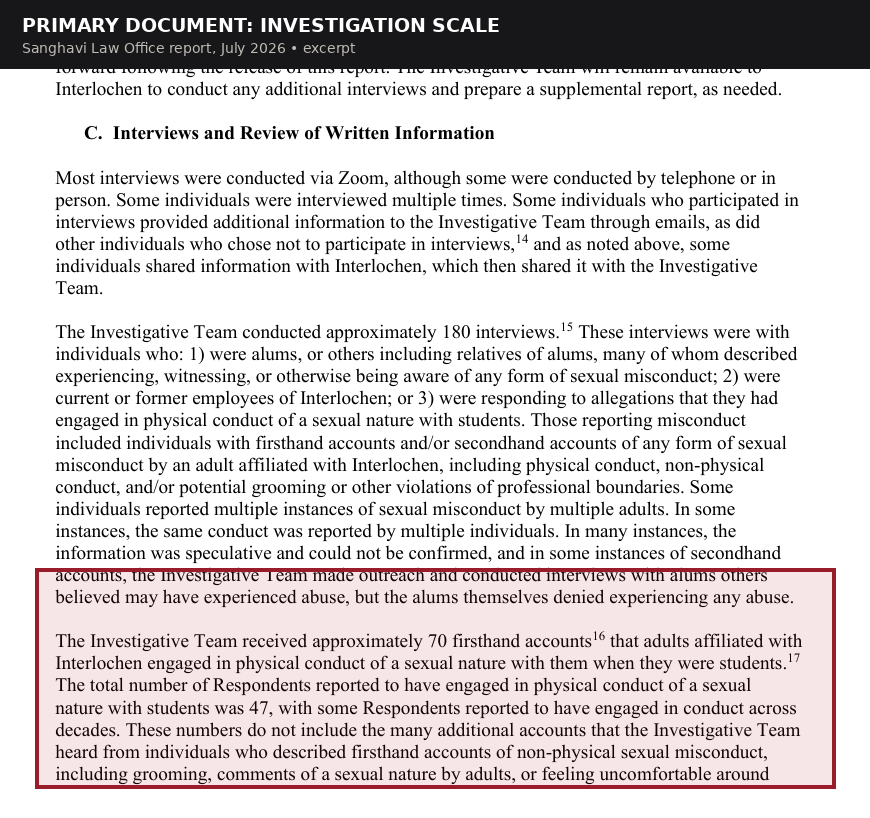
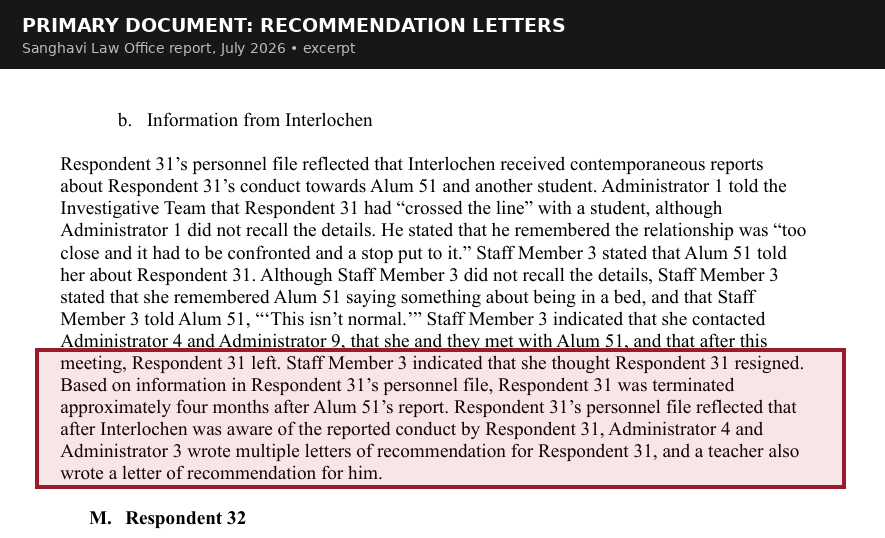
An institution may believe it is helping a colleague exit gracefully. The receiving institution sees endorsement. The students at the next destination see authority. The information gap is not neutral; it transfers risk.
Third, Interlochen’s report showed how supervision records can exist without protection. Alumni described students being signed out, returning late or staying at adult homes. A system recorded movement but did not always give staff the authority, information or institutional backing to stop access by senior adults.
Compliance without intervention is not safeguarding.
Fourth, the report made donor access impossible to treat as a side issue. Jeffrey Epstein was a donor, funded scholarships and a lodge, and was the subject of two alumni accounts of physical sexual conduct from people who met him through Interlochen-related connections. The report’s Epstein section was based on firsthand accounts collected by the investigators, not a wholesale incorporation of public litigation and reporting. Interlochen’s records did not reflect notice of misconduct, while one mother told investigators she had called to warn the institution and received no follow-up.
The conflict between an asserted warning and an absent institutional record illustrates the central problem of fragmented reporting: a phone call that dies at a switchboard never becomes institutional knowledge.
Fifth, Interlochen showed what a broad historical investigation can make visible—and what it still cannot resolve. The institution released a substantial report, apologized, turned names over to law enforcement, created a counseling fund, announced naming reviews and described modern safeguards. None of that identifies every accused adult publicly, reconstructs every purged file, shows where every departed employee went or determines accountability for every leader who handled a report decades ago.
Transparency can be meaningful and incomplete at the same time.
The full Interlochen article remains the place for the case files, named respondents, recommendation chronology, Epstein connection, institutional response and unresolved questions. Its role in this investigation is different.
Interlochen is not the whole story.
It is one of the clearest recent demonstrations that the same architecture can encompass the studio, the dorm, the donor office, the faculty home, the personnel file and the reference letter.
THE QUIET-EXIT MACHINE: WHEN THE PERSON LEAVES BUT THE RISK REMAINS¶
Across the records examined for this investigation, one mechanism recurs with particular force: the quiet departure.
An adult resigns, retires, is released at the end of a contract, leaves for health reasons or departs for “personal reasons.” The institution may feel it has removed the immediate risk. The disciplinary process stops. The public receives little information. Future employers request references and encounter neutral language. The teacher begins again elsewhere.
This is not unique to music. Music makes it unusually portable.
A teacher can leave a salaried conservatory post and continue privately the next morning. A performer can teach at festivals without a long-term contract. A masterclass invitation may require no centralized background review. Students follow famous teachers across cities and countries. A teacher’s name, recordings and lineage remain marketable even when an institution quietly ends the relationship.
The British inquiry documented two stark versions of the problem at Chetham’s, but the mechanism is not confined to one school or country.
Michael Brewer acknowledged in 1994 that a personal relationship with a seventeen-year-old pupil had crossed a professional boundary and resigned. The governing body accepted the resignation, which ended the headteacher’s investigation. The public explanation was retirement because of ill health. Brewer later described the public explanation in court as a cover-up; the former headteacher denied that there had been a cover-up. Brewer continued to receive salary for months and continued working with young people through the National Youth Choir. The school did not notify that organization, the local authority or the education department’s barred-list system, despite the inquiry’s finding that a statutory duty to notify applied.
Christopher Ling’s case showed how silence can cross an ocean. Ling left Chetham’s for the University of Miami in 1990. After a pupil disclosed abuse, police identified multiple girls who alleged sexual abuse. Once prosecution did not proceed at that time, Chetham’s conducted no internal investigation, made no safeguarding review, offered no counseling and did not contact Ling’s American employer. The inquiry recorded that the school said it did not know where he was teaching even though he had taken a group of pupils with him.
The point is not that every resignation conceals abuse. People resign for countless legitimate reasons. The point is that resignation is not a safeguarding outcome when unresolved facts matter to future students.
A departure can protect the institution’s immediate population while preserving the adult’s professional mobility.
The language of employment compounds the problem. “Resigned,” “retired,” “contract not renewed,” “personal reasons,” “mutual agreement” and “not eligible for rehire” can describe radically different realities. A later school may receive only dates and job title. A department chair may telephone a personal reference who praises artistry but knows nothing about a confidential human-resources record. A freelancer may avoid institutional checks entirely.
Music’s professional culture makes informal references unusually powerful. A conductor calls a professor. A professor calls a festival. A dean calls an old colleague. The person answering may have direct artistic knowledge and no access to the official file—or access to the file and legal instructions to say almost nothing.
The result is a safety system built on chance.
Did the receiving institution call the official employer? Did the former employer document the concern? Did the investigation finish before resignation? Was the person found responsible, merely accused, or never formally reviewed? Was there a legal duty to report? Did the work involve minors? Did the adult move internationally? Were private students still being taught during the review?
A serious system needs answers before the next appointment, not after the next disclosure.
That does not justify blacklists built from rumor. Due process matters. Unsubstantiated allegations cannot be treated as convictions. Privacy matters. Survivors may not want identifying details transmitted. Employment law differs across jurisdictions.
But those complexities do not justify automatic silence.
The minimum standard should be clear:
- investigations involving safety should continue after resignation where lawful and practicable;
- institutions should record whether a person left during a pending investigation;
- substantiated findings should be communicated through authorized, legally reviewed reference channels;
- references should come from official institutional offices, not only personal colleagues;
- eligibility for rehire should be documented and answerable;
- regulators and child-protection bodies should be notified whenever law or safeguarding duty requires it;
- festivals, youth orchestras and private-teaching programs should apply the same checks as degree-granting schools;
- cross-border moves should not erase institutional knowledge.
The adult’s privacy matters. So does the next student’s safety.
A neutral reference can be misleading when neutrality hides a risk-based decision. A positive reference can be dangerous when the writer omits known concerns. A completed investigation is better than a suspended one. A resignation should not end fact-finding when the facts affect children or future students.
Without reliable institutional information-sharing, survivors become the warning system.
They search faculty pages, discover former teachers at new schools and contact administrators themselves. The institution that held the records becomes silent. The person harmed becomes responsible for preventing future harm.
That transfer of responsibility is indefensible.
Open, completed, paused by resignation or outside jurisdiction.
Allegation, unsubstantiated concern, substantiated finding, admission or conviction must remain distinct.
Interim limits, no-contact terms, supervision requirements and return eligibility.
A direct institutional answer—not inference from neutral dates.
Child protection, police, regulators or professional bodies where law or duty applies.
A controlled channel that protects survivor identity and procedural fairness.
The next organization records its risk assessment and safeguards.
THE LAW STOPS AT THE CAMPUS GATE¶
The music pipeline crosses legal categories faster than safeguarding rules do.
A fourteen-year-old can study with the same adult in four different capacities: private pupil, summer-program participant, pre-college student and later conservatory undergraduate. The conduct may look continuous to the student. The legal obligations surrounding the adult can change at every stage.
The United States has a “pass the trash” rule—but not a universal music-sector system¶
Federal law requires states, state educational agencies and local educational agencies receiving covered federal funds to prohibit individuals or agencies from helping a school employee, contractor or agent obtain another job when they know, or have probable cause to believe, that the person engaged in unlawful sexual misconduct involving a minor or student, subject to defined exceptions. The provision is often described as a prohibition on “passing the trash.” (20 U.S.C. § 7926)
That is an important rule. It is not a global registry and it does not create one uniform reference system for private studios, independent festivals, orchestras, conservatories in every legal posture or freelance guest artists. Its coverage is tied to specified public educational actors and state implementation. A teacher’s path through classical music can easily move beyond that perimeter.
The gap is not an argument for reckless disclosure. Probable cause, completed findings, open investigations, exoneration, privacy, due process and defamation law matter. The gap is an argument for institutions to know which rules actually govern each handoff instead of assuming that another employer or background check has solved the problem.
England’s school system is more explicit about allegations—but higher education is a different world¶
England’s Keeping Children Safe in Education is statutory guidance for schools and colleges educating people under eighteen. It sets out safer recruitment, allegations-management, low-level-concern and reporting duties. The 2025 guidance remains in force until August 31, 2026; the 2026 version begins September 1. (Department for Education)
In the school safeguarding system, resignation is not supposed to make an allegation disappear. Local-authority guidance implementing the national framework states that investigations should be concluded, outcomes recorded and future references made accurately. Substantiated concerns can trigger consideration of referrals to the Disclosure and Barring Service or professional regulators. Unsubstantiated, unfounded, false and malicious allegations are treated differently because fairness requires those distinctions. (Sutton allegations guidance; Barking and Dagenham LADO guidance)
That framework demonstrates that privacy and information transfer are not mutually exclusive. A system can preserve categories, complete a process and control what enters a reference.
But conservatories and universities are not automatically governed as schools merely because they teach music, and many students are adults. Festivals can be charities, companies, university programs or informal projects. A visiting professor may be a contractor rather than an employee. A private teacher may have no organization behind them at all. The result is a patchwork in which the same artistic authority can move between strongly regulated and lightly regulated environments.
Background checks answer a narrower question than institutions often imply¶
A criminal-record or barred-list check is essential where law and role require it. It does not reveal every substantiated workplace finding, every pending investigation, every pattern of boundary concerns or every decision not to renew a contract. It cannot reveal conduct that was never reported. It should never be marketed as proof that a person is safe.
The most important question at appointment is often not “Did the background check clear?” It is “Did we contact the official employer, ask precise safeguarding questions, review gaps in the résumé, verify why the person left, and document the answer?”
Berklee’s 2017 crisis made that distinction visible. The school’s president acknowledged that, in hiring bassist Steve Kirby, personal references were contacted but official sources at the University of Manitoba were not. Reporting on the case described that as a consequential failure in the handoff. (Boston Globe/Boston.com; WBUR)
The lesson is not that references are infallible. It is that a candidate-selected reference is not the same thing as an institutional safeguarding check.
THE SAFEGUARDING REFERENCE: WHAT THE LAW REQUIRES—AND WHERE THE DUTY ENDS¶
A recommendation letter is designed to move opportunity.
A safeguarding reference must be designed to move risk information lawfully, accurately and with due process.
Those are different documents, and the classical-music pipeline often treats the first as culturally essential while leaving the second undefined.
England: resignation does not end the safeguarding process¶
The United Kingdom’s Disclosure and Barring Service gives employers and volunteer organizations a defined legal mechanism when an individual has been removed from regulated activity because of harm or risk of harm. The duty can apply when the person resigned, retired or left before removal. Updated DBS guidance states that organizations should investigate, gather evidence and complete disciplinary processes even after the person has left. A referral may still be required even when police, a local authority or another regulator has also been notified. DBS legal-duty guidance, updated April 2026; making barring referrals.
The Teaching Regulation Agency separately accepts reports of serious teacher misconduct in England, including sexual misconduct and serious failures to protect pupils, and states that a teacher can be reported after resignation or dismissal. Report serious teacher misconduct.
These systems are not perfect. Britain’s national child-sexual-abuse inquiry reported that the DBS did not receive the number of referrals it expected and that information-sharing between employers, regulators and inspectorates was incomplete. The existence of a duty did not guarantee compliance. IICSA final report, improving notifications to the DBS.
But the design principle is clear:
A person’s departure is not allowed to erase the safeguarding question.
The institution must decide what happened, preserve the evidence and make required referrals. The future employer does not have to rely entirely on the candidate’s chosen referees.
The United States: an important K–12 rule with a narrower perimeter¶
Federal law requires states, state educational agencies and local educational agencies receiving covered federal funds to maintain laws, regulations or policies prohibiting individuals or agencies from helping a school employee, contractor or agent obtain a new job—apart from routine transmission of administrative and personnel files—when they know or have probable cause to believe that the person engaged in unlawful sexual misconduct involving a minor or student, subject to defined exceptions. The provision is commonly described as a prohibition on “passing the trash.” 20 U.S.C. § 7926.
The law matters. It also demonstrates the perimeter problem.
Its statutory setting is elementary and secondary education. It is not a universal music-sector clearinghouse for university professors, conservatory contractors, private teachers, guest artists, competition jurors, festivals, orchestras or freelancers. State law, institutional policy, Title IX, criminal law, professional licensing and contract rules may cover parts of those relationships, but the field does not have one equivalent national music-specific mechanism following the teacher through every stage of the pipeline.
Guidance says investigations should be completed after departure.
It is not a universal conservatory or freelance registry.
Festivals, private studios and cross-border work can fall between systems.
Lawful transfer needs fact-specific legal review.
What a real safeguarding reference would contain¶
A safeguarding reference should not transmit rumor or confidential detail indiscriminately. It should answer narrow, authorized questions based on completed process and applicable law:
- Was the person found to have violated a sexual-misconduct, abuse, harassment or professional-boundary policy?
- Did the person resign or retire while a serious investigation was pending?
- Would the institution have dismissed or removed the person had they remained?
- Is the person eligible for rehire or return as a contractor, volunteer or guest?
- Were restrictions imposed on teaching minors, one-to-one work, residence access, travel or physical contact?
- Were referrals made to law enforcement, a child-protection body, a professional regulator or a barring authority?
- Who is authorized to answer follow-up questions?
The record must also preserve exonerating outcomes. Unfounded, false, malicious, unsubstantiated and substantiated are not interchangeable categories. A portability system without due-process categories would become a rumor machine.
The goal is neither silence nor indiscriminate disclosure.
It is accurate institutional memory.
Informal praise cannot be allowed to contradict the official file¶
Many organizations control formal references through human resources while allowing senior artists to make private calls. That creates two channels: the official channel may provide dates and title, while the influential colleague supplies the real recommendation.
A credible policy must govern both.
Employees and trustees should be prohibited from giving personal references that materially contradict completed findings, rehire status or safeguarding restrictions. Receiving institutions should be required to contact an official office, not only names selected by the candidate. Guest contracts should include permission for lawful safeguarding-reference checks. International appointments should identify which jurisdiction and institution owns the authoritative record.
Classical music already knows how to move reputation with extraordinary efficiency.
The task is to make verified safeguarding information at least as portable as praise.
THE DATA BLACK HOLE¶
Classical music can tell the public how many degrees it awards, how many students enroll, what programs are accredited and how much institutions spend. It cannot tell the public, on any comparable international basis, how many faculty were removed for misconduct, how many students changed studios after boundary concerns, how many investigations ended when someone resigned, or how often guest artists were barred from returning.
That absence is not proof of hidden wrongdoing. It is proof that the sector cannot measure its own safeguards.
The National Association of Schools of Music says it has approximately 597 accredited institutional members in the United States. Its Higher Education Arts Data Services surveys collect information including enrollment, degrees, budgets, faculty salaries and demographic composition. Cadenza could not locate a comparable public NASM dataset on sexual-misconduct reports, abuse-of-power complaints, studio transfers, sanctions, resignations during investigations or safeguarding outcomes. (NASM; HEADS data surveys)
That statement is deliberately limited. It does not mean NASM ignores every student-safety issue, and accreditation is not a police or Title IX system. It means the leading specialist accreditor’s public data architecture does not give students, parents, journalists or institutions a sector-wide safety denominator.
Curtis offers a useful counterexample at the institutional level. After its 2020 investigation, it committed to annual anonymized outcomes reports and continues to list reports through 2024–25. Those reports do not solve every transparency problem, and low annual numbers cannot be compared casually across campuses. They do establish a norm: an institution can tell the public what came to the Title IX office, how cases were handled and what outcomes followed without naming survivors. (Curtis Title IX)
Germany is attempting the sector-wide measurement that most countries lack. The 2026 independent study commissioned by the Rectors’ Conference covers twenty-two participating music academies, with an intended survey population of approximately 5,000 teachers and 19,000 students, plus qualitative case studies. The research is designed to examine manifestations of power abuse, institutional structures and the effectiveness of prevention and sanctions. Results are expected in spring 2027. (IPP project; HMTM 2026)
The same IPP project page notes that a student-led initiative had already collected more than 160 experience reports describing more than 600 incidents from teaching and rehearsal environments. Those are self-reported experiences, not adjudicated cases and not a prevalence estimate. Their importance lies in why the national study was commissioned: institutions recognized that anecdotes were accumulating without a common evidentiary frame.
A serious public standard would publish at least the following every year, in anonymized and non-identifying form:
- reports received, separated by type and role;
- matters involving minors;
- interim restrictions imposed;
- completed findings by outcome category;
- open cases and median duration;
- resignations or contract endings during review;
- studio-change requests and whether funding was preserved;
- retaliation reports;
- referrals to law enforcement, child-protection bodies or professional regulators;
- guest artists or contractors made ineligible for return;
- training completion and policy exceptions;
- reforms adopted after case review.
The purpose is not a league table. Raw counts would be distorted by institution size, reporting culture and definitions. The purpose is to make silence stop looking like evidence of safety.
ACCREDITATION IS NOT AN OMBUDSMAN¶
In the United States, the National Association of Schools of Music is the specialist accreditor for approximately 597 institutional members. It evaluates educational programs, publishes standards, conducts reviews and collects extensive sector data through Higher Education Arts Data Services.
That makes NASM an important part of the conservatory ecosystem.
It does not make NASM a national safeguarding ombudsman.
NASM’s own public procedures draw the line clearly. A person concerned about a member institution is told first to use the institution’s applicable procedures and attempt to reach agreement or mutual understanding. NASM does not act on unwritten or unsigned complaints. It says it assumes no responsibility for adjudicating isolated individual grievances and will not serve as a court of appeal in disciplinary matters, faculty appointments or dismissals. If a complaint is tied to active litigation involving the institution, NASM generally waits until the litigation is resolved. It considers substantially documented institutional conditions that may jeopardize the quality of the educational program or the general welfare of the music unit, or directly violate NASM standards, procedures or ethics rules. NASM: Expressing Concerns.
This is not evidence that NASM is ignoring its mandate. It is evidence of what the mandate is.
Accreditation asks whether an institution meets standards. An ombuds service receives, investigates or routes individual complaints. A regulator may impose a professional sanction. A police force investigates crime. A civil court resolves legal claims. An employer controls work. Those functions can interact, but they are not substitutes for one another.
It is not ordinarily a court or individual complaint tribunal.
A regulator can see patterns and act within a statutory mandate.
Private studio, festival, conservatory and professional work remain divided.
External reporting, protected teacher changes and outcomes data can become standards.
The public cannot see most accreditation dialogue¶
NASM’s third-party-comment process is open during designated periods in a comprehensive accreditation review and is limited to matters within published standards and rules. Eligible comments are provided to the institution for response. NASM states that third-party comments, institutional responses and related correspondence are not made public. NASM third-party-comment protocol.
Commission Action Reports are generally confidential unless the action is probation or revocation. NASM publishes summaries of commission actions and membership status, but not the detailed dialogue sent to most institutions. NASM Commission Action Reports.
Again, confidentiality can protect due process and encourage candid review. But it leaves the public unable to answer a basic sector question:
How often does a specialist accreditor encounter institutional safeguarding failures, and what changes follow?
NASM’s public Higher Education Arts Data Services describe enrollment, degrees, budgets, salaries, faculty and demographic information. Cadenza could not locate a comparable public NASM dataset for sexual-misconduct reports, abuse-of-power complaints, resignations during investigation, protected studio transfers, completed findings, retaliation reports or safeguarding reforms. That is a finding about public data availability—not proof that NASM collects none of the information internally and not an allegation against its member schools. If NASM or any member institution can identify such a dataset, Cadenza will publish it and correct this article; write to hello@cadenza.work. NASM; HEADS data surveys.
What accreditation could require without becoming a court¶
The choice is not between doing nothing and turning an accreditor into a criminal tribunal.
A specialist accreditor could require every institution to demonstrate that it has:
- an external reporting route independent of the major-teacher hierarchy;
- protected studio-change procedures preserving scholarship and degree progress;
- central review of patterns across HR, Title IX, student affairs, residence life and academic departments;
- a rule requiring investigations to continue after resignation when legally possible;
- official-reference controls and documented eligibility for rehire;
- governance for guest artists, contractors, festivals and pre-college programs;
- annual anonymized outcome reporting with common definitions;
- board-level review of serious cases, delays, retaliation and policy failure;
- a documented process for required referrals to police, child protection and professional bodies;
- evidence that students know and trust the system.
Accreditation could audit the architecture without deciding individual guilt.
The absence of a national ombudsman would remain. But the field’s principal educational standard-setter could make it much harder for an institution to maintain excellent curricula while operating an opaque safeguarding system.
Music accreditation already asks whether a school can teach harmony, history, performance and professional practice at an acceptable level.
It should also be able to ask whether a student can survive telling the truth.
THE SHADOW CAMPUS: FESTIVALS, MASTERCLASSES, COMPETITIONS AND PRIVATE TEACHING¶
Conservatories are visible institutions. The wider training economy is harder to see.
A student may spend the academic year under one code of conduct and the summer under another. A professor may hold a permanent conservatory title, teach privately, coach a youth orchestra, appear at three festivals and sit on a competition jury. A conductor may work with minors through an academy while being formally contracted only for a performance. A donor or trustee may meet scholarship students through an event rather than a classroom.
This is the shadow campus: the network of temporary, overlapping and semi-formal spaces where classical music actually reproduces itself.
It is not inherently disreputable. Many of the field’s greatest educational experiences occur there. Summer festivals create ensembles impossible during the year. Masterclasses expose students to different artistic ideas. Competitions provide money, recordings and visibility. Private teachers reach communities without conservatories.
But the shadow campus is where institutional assumptions multiply.
A festival may believe a guest artist’s home institution would have disclosed a serious concern. The home institution may believe the festival has its own screening. A competition may treat jurors as independent contractors. A private studio may rely on parental observation. A youth ensemble may focus background checks on permanent staff while celebrated guests move through for a single rehearsal.
Background checks are important and limited. They can identify certain convictions and regulatory records. They do not reveal a complaint that was never reported to police, an unresolved investigation, a pattern of students requesting transfers, a non-renewal after boundary concerns, a confidential settlement or a former employer’s internal decision that someone should not return.
That missing information cannot simply be made public. Allegations are not findings. Survivors may require confidentiality. Employment and privacy law place real limits on disclosure. A lawful system must preserve those protections.
The current alternative, however, often transfers the entire risk to the next student.
The public records examined for this investigation do not reveal a universal cross-institutional mechanism through which music schools, festivals, youth programs and professional organizations can exchange verified safeguarding information. Some jurisdictions have barred lists, licensing bodies, mandatory-reporting systems or child-protection registries. Their scope varies. Many adults in the pipeline are freelancers, guest artists or private teachers who move outside a single employer’s records.
The result is a system in which a teacher’s artistic history can be internationally portable while a serious institutional concern remains local.
A guest badge must not erase the code¶
Every organization should apply its professional-boundary rules to anyone who gains access through the institution: faculty, guest conductors, accompanists, jurors, donors, trustees, agents, volunteers, visiting alumni and artists in residence.
Status is not supervision.
The more famous the guest, the more likely students are to comply with invitations, private coaching, photographs, messages or off-campus meetings. The institution must decide the rules before the artist arrives, not after a complaint. Who may contact minors directly? Can a guest invite a student to a hotel or home? May a juror offer private lessons during a competition? Who approves transport? Are receptions supervised? Where can a student report a concern about the artistic director’s friend?
The answer cannot depend on whether the person receives a payroll check.
A short program needs a long memory¶
Temporary programs often close their offices after the final concert. Safeguarding records cannot disappear with the seasonal staff.
A festival should maintain a permanent reporting address, records-retention schedule and named safeguarding authority. A complaint received after the season should still trigger review. An investigation should not end because the guest contract expired. Where lawful and necessary, the permanent employer should be informed through official channels. The student should receive support after leaving the program, not merely while present on site.
Programs also need conflict rules for the artistic ecosystem itself. A teacher who sits on a competition jury should disclose current and former students. A conductor choosing fellows should disclose private teaching and financial relationships. A faculty member should not control both a complaint route and the opportunity the complainant seeks.
These are not attacks on artistic discretion. They are the minimum conditions for trusting it.
Private teaching cannot be the ungoverned remainder¶
When an institution restricts or removes a teacher, private teaching may continue.
This is one reason a quiet institutional departure can be an incomplete safeguarding response. Degree-granting schools control only their own rooms. They do not control a former employee’s home studio, online lessons, festival invitations or students who follow a teacher elsewhere.
Institutions cannot lawfully publish every accusation. They can complete investigations, make required reports, preserve records, answer official reference questions accurately, document rehire status and refuse to provide informal praise that contradicts the institutional file.
Parents and adult students also need better questions than “Who did this teacher study with?”
They should be able to ask whether lessons are observable, whether touch is explained and consensual, how communication is handled, whether the teacher carries safeguarding training, whether minors are transported alone, what external complaint route exists and which institution—if any—accepts responsibility for the studio.
Classical music has spent generations teaching families how to identify technical excellence.
It now needs to teach them how to identify safe authority.
THE DIGITAL STUDIO: PRIVATE LESSONS NOW FOLLOW THE STUDENT HOME¶
The traditional safeguarding image is a closed practice-room door. The modern equivalent may be a private message thread.
Online teaching can improve access. It allows a student to work with a specialist in another country, reduces travel, gives parents greater visibility and can create a reliable record of when lessons occurred. It can also extend the teacher–student relationship beyond any room, timetable or institutional network.
The risk is not that video lessons are inherently less safe than physical lessons. The risk is that institutions often regulate the scheduled lesson while leaving the surrounding digital relationship undefined.
A teacher can move a student from an institutional platform to a personal phone number. Technical feedback can continue late at night. Scores, recordings and photographs can be exchanged through disappearing-message applications. Social-media following can become personal surveillance. A guest teacher can retain direct access long after a festival ends. A student can be invited into a private group chat with no administrator, parent or colleague able to see the pattern.
Digital contact also blurs jurisdictions. The teacher may be in one country, the student in another and the institution incorporated in a third. A platform may retain data for only a limited period. A student may record a lesson without understanding local consent law. An institution may discover a complaint after messages have been deleted or an account has been closed.
A serious digital-boundary policy should answer concrete questions before the first lesson:
- Which platform and account must be used?
- Who can initiate direct contact with a minor?
- Must a parent, guardian or institutional account be included?
- Are disappearing messages prohibited?
- When may a teacher contact a student outside scheduled hours?
- May lessons be recorded, by whom, with what consent and for how long?
- Where are lesson dates, attendance and cancellations logged?
- What happens to messages and files when a teacher’s contract ends?
- How can the institution preserve relevant digital evidence after a report?
- Can a student block the reported person without losing access to assignments, recordings or recommendations?
The safest answer is not permanent surveillance. Students and teachers deserve privacy. Recordings can expose intellectual property, private homes, family members and sensitive conversations. A blanket recording requirement can create new harms.
The better model is controlled observability.
Institutional accounts should be used for institutional teaching. Minors should not be moved into secret one-to-one channels. Lesson metadata should be retained even when the content is not. Recording should require informed consent, a stated purpose, secure storage and a deletion schedule. Students should have a visible reporting link inside the platform. The institution should be able to impose a digital no-contact rule immediately and preserve relevant records when a complaint arises.
For private teachers outside an institution, families and adult students need an equivalent protocol. Communication boundaries should be agreed in writing. Parents should have access to scheduling and contact for minors. A teacher should not require a child to keep a personal message thread secret from caregivers. Technical feedback should remain professional, proportionate and connected to the lesson.
Digital systems can make safeguarding stronger because they can create dates, records and alternative witnesses. They can also make grooming easier because access becomes continuous and invisible.
The difference is governance.
A conservatory that has installed windows in studio doors but allows unregulated private messaging has protected the architecture and ignored the relationship.
Set channels, hours, recording consent, parent access and retention.
Log attendance; keep minors out of secret channels; offer a visible reporting route.
Retain metadata, preserve relevant evidence and end access when the role ends.
Technical feedback should not require secrecy or personal social-media access.
THE WORKFORCE HANDOFF: AFTER GRADUATION, THE COMPLAINT SYSTEM FRACTURES¶
The conservatory promises preparation for professional freedom.
That freedom can remove the last institution capable of receiving a complaint.
Classical musicians work through auditions, short contracts, substitute lists, festivals, touring projects, recording sessions, private teaching and informal calls. The person offering the work may also conduct, fix personnel, teach at a conservatory or sit on a competition jury. The worker may be self-employed even when one gatekeeper exercises enormous practical control.
The Independent Society of Musicians’ 2022 Dignity at Work 2 survey received 660 self-selected responses from people who work or had worked across the United Kingdom music sector. Sixty-six percent reported experiencing discrimination or inappropriate behavior at work; fifty-eight percent of the discrimination described was identified as sexual harassment; seventy-two percent of incidents were attributed to people with seniority or influence over the respondent’s career. Seventy-seven percent did not report officially. Among self-employed respondents, eighty-eight percent did not report, and ninety-four percent said there were no clear reporting procedures. ISM report and methodology; appendix.
The first United Kingdom Musicians’ Census used a different sample and methodology. A later report based on more than 2,500 responses found that fifty-one percent of women had experienced gender discrimination while working as musicians and thirty-three percent reported sexual harassment. Musicians’ Union summary.
These figures must not be added together, compared as if they share a denominator, or represented as a prevalence estimate for abuse inside conservatories. They are workforce surveys. The ISM sample was self-selecting. Their relevance is the reporting environment after the institutional pipeline releases the musician into freelance work.
The survey reported high levels of discrimination and non-reporting; it is not a population estimate.
Self-employed respondents described especially severe procedure gaps.
More than 2,500 responses; its percentages must not be added to or averaged with the ISM survey.
It does not measure abuse prevalence inside conservatories.
The threat changes shape¶
A student may fear a failed jury or a lost scholarship.
A freelancer may fear simply never being called again.
No written decision is necessary. The fixer does not have to explain why another player was booked. The conductor can prefer someone else. The contractor can describe the decision as chemistry, style, preparation, reliability or fit. In a subjective and episodic labor market, retaliation can disappear into normal professional judgment.
The ISM survey’s reasons for non-reporting included the belief that the behavior was simply part of the culture, the absence of anyone to report to and fear of losing work. That is the same power structure seen in the private studio, but without a dean, student handbook or formal appeal.
The ISM and the Equality and Human Rights Commission responded in 2024 with an orchestra-specific sexual-harassment toolkit. It addresses the unusual employment ecosystem of orchestras, including self-employed musicians, managers and fixers, and includes specific considerations for tours. ISM/EHRC orchestra toolkit.
The existence of a toolkit is not proof that the problem is solved. It is an acknowledgement that standard employee policies do not fit a workforce made of guests, deputies, extras, freelancers and short engagements.
The professional threshold is a safeguarding handoff¶
Conservatories should not treat graduation as the moment responsibility ends.
They should teach students how to:
- identify conflicts of interest between teachers, jurors and employers;
- document retaliation and informal exclusion;
- obtain alternative references;
- report conduct involving a guest artist or contractor;
- use union, legal and external reporting routes;
- understand the limits of confidentiality and defamation law;
- seek support without routing everything through a former professor.
Orchestras, festivals and presenters should accept reports from contractors, applicants and guests—not only employees. They should retain records after the engagement ends, publish a permanent reporting address and cooperate when the same person works for several organizations. Funders should require a common safeguarding clause and independent reporting route as a condition of support.
The core reform is portable protection.
The musician’s right to report must follow the musician from the school to the stage—even when the contract lasts one night.
THE CAREER GATE: WHEN EDUCATIONAL POWER BECOMES PROFESSIONAL POWER¶
The conservatory pipeline does not end at graduation. It changes vocabulary.
The professor becomes a reference. The festival coach becomes a personnel manager. The competition juror becomes a conductor. The conductor becomes a music director. The former student returns as an assistant, adjunct or substitute and enters the same network that once evaluated them.
This is why retaliation in music can be difficult to document and easy to fear.
An adverse grade leaves a record. An unanswered message does not. A failed jury can be reviewed. A substitute call that never arrives cannot. A professor may never say, “I am punishing you for reporting me.” The professor can simply stop recommending the student, describe the student as difficult or mention concerns about temperament in a private call.
The field’s subjectivity is not the problem by itself. Art requires judgment. The danger appears when the same person holds private knowledge, evaluative authority and network access without review.
A musician considering whether to report must therefore calculate consequences beyond campus:
- Will the teacher control the degree jury?
- Will a studio change become gossip?
- Will scholarship support survive?
- Will the teacher sit on a festival panel?
- Will the teacher be called for references?
- Will the next orchestra interpret silence as a warning about the student rather than the professor?
Institutions often define retaliation too narrowly. They look for dismissal, lowered grades or direct threats. In music, retaliation may be reputational and delayed. It may occur through people outside the institution. It may be impossible to trace back to a single decision.
A credible anti-retaliation system must therefore create alternatives to the professor’s network.
Students involved in complaints should have access to a reference committee, neutral juries, alternative teachers, protected festival nominations and documented review of sudden changes in casting or opportunity. The institution should contact receiving programs where necessary to prevent a student’s protected studio transfer from being mischaracterized. Scholarships and immigration support should not depend on continued contact with the person reported.
The profession also needs to stop using informality as an excuse for opacity.
Orchestras, ensembles, festivals and schools can preserve artistic discretion while documenting how candidates enter substitute lists, how conflicts are disclosed and who supplied references. A hiring panel should distinguish personal artistic endorsements from official employment checks. A juror should disclose a teacher-student relationship. A conductor should not be the only person controlling access to a young-artist program.
The music world often describes itself as a family.
Families can offer loyalty and care. They can also enforce silence, protect status and treat outside scrutiny as betrayal.
A profession should not ask young musicians to trust a family. It should build institutions worthy of trust.
THE PROFESSIONAL STAGE: THE RISK DOES NOT END WHEN THE DEGREE DOES¶
The strongest defense of the conservatory system is that students eventually leave it.
The weakest fact about that defense is that their teachers’ networks leave with them.
A professor can become a contractor, juror, conductor, agent, festival director, colleague or informal gatekeeper. A former student may continue to rely on that person for substitute work, introductions and references. The educational relationship ends on paper while the professional dependency becomes harder to see.
Workplace evidence from the wider cultural sector shows why that transition matters.
In 2025, the Norwegian research foundation Fafo repeated a survey of people working across film, television, theatre, music and gaming. Among those who responded, 41 percent said they had experienced sexual harassment at some point in their careers. Younger women were the most exposed group, and the report found that people were more likely to report harassment than in the comparable 2018 study. (Fafo 2025)
That number requires unusually careful handling. The survey covered several cultural fields, not music alone. Its 2025 response rate was eight percent, compared with thirty-nine percent in 2018. People with relevant experiences may have been more likely to participate. The result is not a population prevalence estimate for professional classical musicians, and it cannot be used to rank countries or institutions.
It is still important.
It documents substantial reported experience inside project-based cultural work and identifies the same conditions that matter in music: younger workers, social settings, unequal access to opportunity and career consequences that can discourage reporting. The earlier 2018 Fafo study found that many people who experienced sexual harassment did not report it because they feared effects on future careers and work opportunities. (Fafo 2018)
The professional music world intensifies some of those conditions.
Employment is fragmented. A musician may work for an orchestra this week, a festival next month, a recording project later in the year and private students between contracts. There may be no single employer able to see the pattern. Social and professional space overlap at rehearsals, receptions, tours, auditions, hotels and after-concert gatherings. A person with no formal supervisory title may still control work through reputation and calls.
The result is a reporting paradox.
A freelance musician may be told to report to the employer responsible for the current engagement. But the concern may involve someone whose influence spans several organizations. The current employer may investigate only what happened during its contract. A union may represent both people. A festival may close for the season. A conductor may not technically employ the musician. An agent may know the network but owe no safeguarding duty to a student or freelancer.
The complaint becomes smaller every time it crosses an organizational boundary.
This is where the conservatory pipeline becomes a professional pipeline. The same traits that once made a student dependent on a teacher—subjective judgment, private recommendation, prestige and scarcity—reappear in hiring.
Professional reform must therefore extend beyond campus policy.
Orchestras, opera companies, festivals, presenters, artist agencies, competitions and contractor networks should have interoperable minimum standards:
- one reporting route that remains open after a project ends;
- a named authority for guest artists and freelancers;
- conflict disclosures for jurors, conductors and hiring panels;
- documented official references separate from informal artistic endorsements;
- an anti-retaliation protocol that covers future calls and invitations;
- the ability to preserve and lawfully share verified restrictions or rehire status;
- support for complainants who are not employees;
- and public, anonymized outcome reporting that includes contractors as well as staff.
Unions and professional associations also have a role. They can offer independent advice, representation and sector-wide codes. But representation alone is not pattern recognition. A field needs a place where concerns across multiple short engagements can be identified without turning rumor into a blacklist.
That requires rules, evidence categories, privacy controls and due process.
The aim is not to create a secret global database of accusations. It is to stop each employer from pretending that a person’s professional history begins on the first day of the new contract.
The Norwegian survey does not prove that conservatories cause workplace harassment. It shows that graduation does not carry musicians into a world where power and sexual misconduct have disappeared. The student moves into a sector where work remains relational, temporary and reputation-driven.
A safeguarding system that ends at commencement is built for the photograph, not the career.
Mixed film, TV, theatre, music and gaming sample.
The result is not a population prevalence estimate for music.
The report also found reporting had become more common than in 2018.
Earlier Fafo work described concern about future work and opportunities.
WHY REPORTING FAILS EVEN WHEN A POLICY EXISTS¶
1. A student must report into the institution that controls the student’s future¶
Many conservatories tell students to report to a dean, department chair, Title IX office, safeguarding lead or human-resources unit. Those pathways may be legally sound and staffed by conscientious people.
The conflict is built into the direction of travel.
The student is asked to bring a complaint to the organization that employs the accused teacher, sells the teacher’s prestige, controls the student’s scholarship, owns the student’s transcript and may later provide the student’s professional references.
An institution does not need to threaten retaliation for the student to perceive the risk.
That is why independent reporting routes matter. Students need access to people outside the chain of artistic command: an ombuds office, external hotline, independent investigator, child-protection authority, union representative or advocate who does not report to the dean responsible for the faculty member.
The reporting system must also protect the student’s immediate educational life. A student cannot wait months for an investigation while attending weekly lessons with the person reported. The school must provide an immediate studio transfer, maintain scholarship and visa support, preserve ensemble opportunities and ensure the accused teacher has no role in juries, casting, recommendations or employment decisions affecting the complainant.
Without those guarantees, the institution offers a right to report and a reason not to use it.
2. “Low-level concerns” are kept low by organizational design¶
A student says a teacher’s hand remained too long on the body. Another says the teacher sent intimate messages. A parent says the teacher insists on private home lessons. A colleague notices that one student receives unusual attention. A residence employee records repeated late returns. A former student says the teacher pursued a relationship after graduation.
Each incident may be explainable. Together, they may describe grooming.
Institutions often fail because the information is separated by office, year and vocabulary. The department chair handles teaching style. Student affairs handles emotional distress. Human resources handles employment. Campus safety handles access. A counselor protects confidentiality. The board hears only completed cases. No one owns the pattern.
Centralized concern management is therefore essential.
Every boundary concern should enter a protected system with dates, context, action and follow-up. Access should be restricted, privacy respected and unsubstantiated reports clearly labeled. But the system must allow authorized safeguarding professionals to see recurrence.
The alternative is what appears repeatedly in historical investigations: the institution learns the pattern only after survivors compare experiences decades later.
3. Language launders risk¶
Institutional records often soften conduct as it moves upward.
A student reports sexual pressure. The department records an inappropriate relationship. Human resources records poor judgment. The board minutes record a personnel matter. The public statement records retirement for personal reasons.
At each stage, the language becomes safer for the institution and less useful for the next decision-maker.
This is not always deliberate concealment. Lawyers may advise caution. Privacy laws restrict disclosure. Facts may remain contested. Institutions should not state allegations as findings.
But precision is different from euphemism.
A responsible record can say: “The employee resigned while an investigation was pending into an allegation of sexual contact with a student; no finding was reached because the investigation was incomplete.” That is more accurate than “left for personal reasons.”
A responsible reference can distinguish an allegation, an investigation, a finding and eligibility for rehire. It does not need to defame anyone. It needs to stop pretending that silence is neutral.
4. Confidentiality can protect survivors—or protect institutions¶
Survivors may need privacy. They may not want a public process, police involvement or their identity shared beyond those necessary to ensure safety. Institutions must respect those choices to the extent law permits.
Confidentiality becomes suspect when it is imposed as the price of support, settlement, continued enrollment or departure.
A nondisclosure agreement can prevent a student from warning peers. A sealed settlement can prevent the public from understanding institutional patterns. A confidentiality clause can allow an accused adult to leave without future employers learning why.
Not every confidential agreement is coercive. Some survivors prefer them. The test is whose interests the secrecy serves.
Institutions should never prevent survivors from reporting to law enforcement, regulators, medical providers or future institutions at risk. They should not require silence about facts necessary for safety. They should publish anonymized aggregate outcomes so privacy does not erase accountability.
5. Investigations move slowly; careers move quickly¶
Academic investigations can take months. Music careers can change in a week.
A student loses a solo, misses a festival deadline or receives a damaging recommendation while a case is pending. The accused teacher continues adjudicating the student. Colleagues interpret the student’s studio change as evidence of weakness. Rumors fill the silence.
Interim measures are therefore not optional. They are the practical content of anti-retaliation policy.
The institution should identify every decision the accused adult can influence and remove that influence temporarily without presuming guilt. Neutral faculty should evaluate the student. Deadlines should be extended. A reference committee should replace the individual reference. The school should monitor adverse changes in grades, casting and opportunities.
Due process protects the accused from premature punishment. It does not require the complainant to remain exposed to power.
6. The student fears losing the dream more than the institution fears losing the gatekeeper¶
This is the emotional center of the problem.
Young musicians often arrive after a decade of sacrifice. Families have spent money they did not have. The student may have no alternative identity. Leaving the studio can feel like abandoning the self.
A prestigious institution can replace a student more easily than the student can replace the institution.
That imbalance explains why some people wait years or decades to disclose. The delay does not prove an account true. It also does not make delay irrational.
The music world must stop asking why a student did not risk everything at sixteen to confront a revered adult supported by an institution.
The harder question is why the institution built a system in which truth required that level of sacrifice.
REBUILDING THE PIPELINE: REFORM AT EVERY HANDOFF¶
A new policy cannot repair a system whose power remains unchanged.
The decisive test is not whether an institution can produce a modern safeguarding document. It is whether a student can refuse touch, change teachers, report a celebrated adult, preserve a scholarship, obtain a fair evaluation and continue a career without depending on the person reported.
Reform must follow the same route as the musician.
Stage 1: Make childhood private teaching observable and accountable¶
For minors, private instruction should operate under clear written boundaries even when the teacher is self-employed. Lessons should be observable by a parent or another authorized adult, or take place in rooms designed for visibility. Direct communication should include parents or use approved systems. Transport, overnight stays, alcohol and private social invitations should be prohibited or tightly controlled. Any physical contact should be explained, specific, pedagogically necessary and based on revocable consent.
Professional associations and community schools can provide external complaint routes and safeguarding training for independent teachers. Parents should receive a plain-language code, not merely a biography.
Stage 2: Give temporary programs permanent responsibility¶
Youth orchestras, camps, academies, festivals and competitions need a named safeguarding authority whose responsibility survives the season. Guest status must not create an exemption. Codes should apply to faculty, conductors, jurors, donors, trustees, volunteers and visiting artists. Records should be retained centrally. Complaints received after the event should still be investigated.
Every program should identify which institution will contact a guest’s permanent employer when a serious concern arises, subject to law and due process. A contract ending must not end fact-finding.
Stage 3: Separate teaching authority from institutional survival¶
No single professor should control admission, continuation, grading, scholarship and career access.
Conservatories and specialist schools should use multiple evaluators, written criteria and independent review for high-stakes decisions. Students must have an enforceable right to change studios without penalty, stigma or loss of aid. When a complaint concerns the major teacher, that person should be removed from juries, casting, recommendations and opportunity decisions affecting the complainant while the matter is assessed.
The institution should provide an alternative reference mechanism so that reporting does not become professional self-destruction.
Stage 4: Regulate touch and intimacy without destroying pedagogy¶
A blanket denial that physical teaching occurs is not credible. An unregulated tradition is not safe.
Teachers should explain the purpose and location of contact, ask permission, offer a non-contact alternative and stop immediately when permission is withdrawn. Consent must be renewed rather than assumed. Institutions should train faculty in age, disability, trauma, culture and power—not merely legal definitions.
Faculty-student romantic and sexual relationships should be prohibited whenever instructional, evaluative, supervisory, financial or career authority exists. The prohibition should include graduate students. Adulthood does not erase dependency.
Stage 5: Build reporting outside the artistic hierarchy¶
Students need a route that does not run through the department employing the person reported.
An external hotline, independent ombuds, safeguarding professional or outside investigator should be available. The institution must explain confidentiality honestly: who can keep information private, who is a mandated reporter and what circumstances require action.
Reporting must trigger immediate educational protections. A student cannot wait months while continuing lessons with the person reported or appearing before that person at juries.
Stage 6: Centralize patterns without turning allegations into verdicts¶
Boundary concerns often appear insignificant only because they are separated.
A secure central system should record reports, low-level concerns, studio changes, restrictions, investigations, actions and follow-up. Access should be limited. Unsubstantiated reports must be labeled accurately. Privacy must be protected. But authorized safeguarding staff must be able to see recurrence across departments, campuses and years.
The purpose is not to create a rumor database. It is to prevent five offices from each holding one fragment of the same pattern.
Stage 7: Make resignation the beginning of the handoff, not the end of the case¶
Investigations involving student safety should continue after resignation where lawful and practicable. The record should state whether the person left during a pending investigation, whether findings were reached and whether the person is eligible for rehire. Required reports to law enforcement, child-protection bodies or regulators must be made regardless of departure.
Official references should come from authorized institutional offices. Personal letters should not contradict or evade a known institutional record. Receiving employers should ask the former institution directly about eligibility for rehire and whether any safety-related investigation remained pending at departure, within the limits of applicable law.
Cross-border movement needs a protocol. Prestige already travels internationally. Verified safeguarding information must be able to travel lawfully as well.
Stage 8: Extend anti-retaliation into the profession¶
Anti-retaliation cannot stop at the transcript.
Institutions should monitor changes in grades, casting, scholarships, festival nominations and references after a report. Students should receive neutral evaluators and independent career support. Professional organizations should establish complaint routes for guest jurors, conductors and coaches whose influence operates across institutions.
A student who reports should not be required to leave the field to become safe.
Stage 9: Publish outcomes, not survivor identities¶
Transparency does not require exposing survivors.
Institutions can publish anonymized annual data: number and type of reports, general status, time to resolution, findings, sanctions, employees who departed during review and reforms implemented. Curtis’s annual-outcomes commitment offers one model. Public summaries should distinguish allegation, finding and unresolved matter.
A community cannot evaluate a process it never sees operating.
Stage 10: Preserve records longer than leadership memories¶
Historical investigations repeatedly encounter missing personnel files, purged records, contradictory recollections and public explanations that conceal the real reason for departure.
Safety-related records require retention schedules designed for the long latency of disclosure. They must survive leadership changes, mergers, ownership transfers and institutional renaming. Toronto’s current historical process illustrates why records may need to cross organizations decades later.
Stage 11: Put boards, donors and trustees inside the safeguarding system¶
Safeguarding is not a student-affairs function. It is governance.
Boards should receive regular anonymized reporting, audit compliance, review conflicts and ensure that star faculty, donors and trustees do not receive informal exemptions. Anyone with access to students must follow the same boundary rules. A donor’s financial importance does not reduce risk; it can increase the student’s sense of obligation.
Stage 12: Fund repair for the length of the harm¶
A crisis email and a short counseling offer are not repair.
Institutions that document historical failures should fund independent long-term therapeutic support, facilitate survivor-led dialogue where desired, preserve reporting routes for alumni and publicly track reforms. Support should not require silence or surrender of legal rights.
The essential principle is simple:
Power must be divided, records must survive, and responsibility must follow the person across the pipeline.
THE QUESTIONS EVERY SCHOOL, CONSERVATORY, FESTIVAL AND YOUTH PROGRAM SHOULD ANSWER PUBLICLY¶
Cadenza puts these questions on the record to every institution named in this article, and has sent them directly wherever the institution publishes a contact for editorial enquiries. Several publish only a web form; this page is the standing invitation to those. Every answer received will be published in full and unedited, and this article updated. Institutions should not need a scandal to answer them.
A school that cannot answer these questions has not proven that abuse is occurring.
It has proven that it does not yet know whether its safeguards work.
THE REFORM TEST: DOES POWER ACTUALLY MOVE?¶
Institutions prefer reforms that do not alter hierarchy.
They add annual training. They update a handbook. They create a reporting email. They appoint a committee. They say the culture has changed.
Some of those measures are necessary. None is sufficient.
The real test is whether power moves away from the individual gatekeeper and toward transparent systems.
Can the student obtain a second artistic opinion?
Can the student change studios?
Can a jury overrule the principal teacher?
Can a complaint be made outside the institution?
Can an accused professor affect the complainant’s career while a case is pending?
Can a resignation stop an investigation?
Can a department chair provide a glowing personal reference after the institution has made a misconduct finding?
Can a trustee bring a student to a private residence?
Can a donor contact a scholarship recipient directly?
Can an institution purge records before the student is old enough to understand what happened?
Can the public see whether anyone has ever been sanctioned?
If the answer to those questions remains unchanged, the reform is administrative. It is not structural.
A poster about consent on a wall outside a studio does not matter if the teacher inside still controls whether the student stays.
THE BLACK HOLE BETWEEN INSTITUTIONS¶
The most consequential absence in the conservatory pipeline is not another code of conduct. It is the absence of a reliable, lawful and evidence-sensitive mechanism for carrying safeguarding information across institutional borders.
A young musician can move from a private studio to a summer program, from a summer program to a specialist school, from a specialist school to a conservatory, and from a conservatory to a festival or orchestra. An adult can make many of the same moves. But the two travelers do not carry the same documentation.
The student carries everything. Transcripts follow. Audition recordings follow. Competition results follow. A teacher’s recommendation follows. Financial-aid history follows. Visa records follow. A reputation—good or bad—can follow through calls the student never hears.
The adult’s public biography can be far more selective. It may list appointments, awards, recordings, juries, students’ successes and celebrated colleagues. It may not reveal that a prior employer received a complaint, imposed a warning, restricted contact, opened an investigation, negotiated a departure or decided not to rehire. Some of that information cannot lawfully be disclosed without context, process or consent. Some of it should never be published because it remains untested. But between reckless disclosure and total institutional amnesia lies a large territory of responsible practice that the music field has barely built.
The field remembers lineage better than warning¶
Classical music is unusually good at informal transmission. Teachers know the traditions of other studios. Conductors ask trusted colleagues about players. Administrators call friends before making appointments. Festivals recruit from familiar networks. This is sometimes described as a small world, but “small” is not the important word. The important word is selective.
Informal information travels quickly when it concerns musical quality, temperament, reliability or prestige. Safeguarding information often travels slowly, incompletely or not at all. The result is not silence in an absolute sense. It is asymmetrical speech: reputational praise moves through official and unofficial channels, while serious concerns can become trapped behind privacy rules, fear of defamation, nondisclosure language, incomplete investigations, institutional embarrassment, turnover or simple failure to ask the right question.
That is why ordinary reference checking is inadequate. “Would you rehire this person?” is better than confirming dates, but it is still too blunt. A prior employer may answer yes because the concern was never substantiated, no because of unrelated performance issues, or nothing because counsel has instructed staff to provide neutral references. A meaningful safeguarding check requires precise questions, a defined process and a distinction between findings, restrictions, pending matters and rumor.
The objective is not to create a private blacklist. Blacklists are vulnerable to error, retaliation, bias and abuse. The objective is to prevent a departure from automatically destroying the institution’s memory and to prevent a new employer from believing that silence means safety.
Resignation must not erase the question¶
One of the most dangerous points in any institutional process occurs when the subject of a complaint resigns, retires, declines a new contract or simply stops accepting work.
Organizations may feel the immediate risk has ended because the person is gone. The complainant may feel safer. Leadership may prefer to avoid the cost and conflict of finishing an investigation. Lawyers may advise that jurisdiction or practical leverage has narrowed. Everyone may be exhausted.
But the pipeline has not ended. The adult may teach privately the next week, appear as a guest the next month or begin at another institution the next academic year. If the first organization closes the matter without preserving evidence, recording the procedural posture and deciding what it can lawfully say in response to a safeguarding inquiry, the next institution inherits uncertainty without knowing it exists.
A responsible system therefore separates three questions:
- Is the person still present here?
- Does this institution still have enough evidence and authority to complete a fair process?
- What must be preserved or disclosed if the person seeks access to another student population?
The first answer may be no while the second and third remain yes.
International movement multiplies the gap¶
Music careers are transnational by design. A teacher can work at a conservatory in one country, maintain a private studio in another, teach a festival in a third and adjudicate a competition online from anywhere. Different systems use different legal terms, reporting duties, employment categories, data-retention rules and evidentiary standards. A “faculty member” at one institution may be an independent contractor at another. A festival guest may have no durable personnel file. A masterclass may be hosted by a nonprofit, university, orchestra or private promoter with different safeguarding obligations.
The result is jurisdictional fragmentation. Each organization sees one engagement. The adult experiences a continuous career.
A serious reform agenda must therefore include contractor and guest-faculty screening, cross-border consent for safeguarding-specific references, record-retention rules calibrated to the long latency of abuse reporting, and protocols for responding when a prior institution reports an unresolved but serious matter. Those protocols must include due process. They must also acknowledge that “unresolved” does not mean “imaginary,” just as “reported” does not mean “proved.”
WHAT THE PUBLIC RECORD STILL CANNOT TELL US¶
This investigation can identify documented failures. It cannot honestly calculate the prevalence of abuse across conservatories or rank schools from safest to most dangerous.
That limitation matters. Public scandal counts are not prevalence data. An institution with more reports may be less safe, or it may have better reporting pathways, stronger record preservation, a larger historical review or a culture in which people now feel able to speak. An institution with no public cases may be exemplary, lucky, secretive, young, small, legally constrained or simply unexamined. The available record cannot distinguish those possibilities by itself.
There is no global denominator¶
No authoritative international body publishes the total number of minors and adults receiving private music instruction, the number living in specialist residential programs, the number attending short-term festivals, or the number taught by contractors rather than employees. Without a denominator, case counts cannot establish rates.
Nor is there a common reporting taxonomy. One institution may categorize unwanted touching as sexual misconduct, another as professional-boundary misconduct, another as a safeguarding concern and another as an employee-relations matter. A case can therefore move between statistical categories without the underlying conduct changing.
Published outcomes remain rare¶
Curtis’s commitment to anonymized annual outcome reporting is important because it creates a public record without exposing survivor identities. But this practice is not universal. Many institutions publish policies, contact details and general assurances without publishing how many reports were received, how long cases took, whether interim protections were used, how many matters ended after resignation, what sanctions resulted or whether retaliation was found.
A policy proves that words exist. Outcome data begins to show whether the system works.
Settlement and confidentiality obscure different things¶
Confidentiality is not inherently corrupt. Survivors may want privacy. Employees may have legal rights. Institutions may be prohibited from publishing personnel details. A fair process may require restrictions on what can be said while a matter is pending.
The problem begins when every form of confidentiality is treated as though it requires institutional silence about aggregate performance, process defects and historical learning. A school may be unable to name a person and still be able to report that a case existed, that interim measures were imposed, that an investigation was completed, that a policy gap was identified and that a reform followed.
Confidentiality should protect people. It should not make the system impossible to evaluate.
Private teaching remains the largest unmeasured territory¶
The most important teacher in a child’s development may never be employed by a school. Lessons may take place in a home, a rented room, a church, an online platform or a private studio. Parents may rely on prestige, referrals and competition results as proxies for safety. There may be no human-resources office, no ombuds, no designated safeguarding lead, no record-retention rule and no appeal if the relationship becomes coercive.
Private instruction is not a marginal exception. It is the entrance to the pipeline. Any reform that begins only when a student enrolls in higher education begins years too late.
Professional associations, unions, examination boards, youth-orchestra networks and lesson platforms should therefore define minimum safeguarding standards for adults teaching minors privately. Those standards should include observable settings, parental communication, consent around physical guidance, boundaries for messaging and transportation, procedures for off-site activity, background screening where lawful, insurance expectations and clear reporting routes independent of the teacher.
The profession does not publish enough about retaliation¶
Retaliation can be formal: a lost scholarship, a failed jury, removal from an ensemble, a hostile evaluation or termination. It can also be informal and nearly impossible to prove: calls not returned, auditions not offered, a student described as unstable, difficult or ungrateful, a recommendation that cools, a festival invitation that disappears.
In a field where employment is episodic and judgment is subjective, retaliation can look exactly like ordinary professional disappointment. That makes it more—not less—important to separate complaint handling from artistic assessment, document reasons for consequential decisions and provide independent appeal.
No serious safeguarding system can end at the campus boundary. A student who is protected during an investigation but quietly excluded from the profession afterward has not been protected.
THE CASE MATRIX: DIFFERENT RECORDS, RECURRING QUESTIONS¶
The institutions examined in this investigation do not share one evidentiary status. Britain’s statutory inquiry included convictions, civil findings, testimony and institutional evidence. Curtis commissioned an outside review and publicly accepted it. Berklee disclosed a number of faculty terminations but did not publish a complete historical investigation. Juilliard announced findings and a termination after an outside review but did not release the complete report. Toronto’s investigation remains active. Germany’s national research project has begun but has not yet published results. Interlochen’s outside investigators documented reports while expressly declining to adjudicate whether every incident occurred as described.
Those differences are essential. They prevent a simplistic league table of scandal.
Yet the same institutional questions recur:
- Who controlled the student’s academic survival?
- Who received the first warning?
- Was the information centralized?
- Could the student change teachers without penalty?
- Did the institution impose interim protections?
- Did the process continue after departure?
- What did later employers learn?
- Were outcomes published in anonymized form?
- Did reforms redistribute power or merely add training?
The repetition of those questions is the strongest evidence for a pipeline analysis. The cases are not identical. The vulnerabilities rhyme.
Full final report covering specialist-school cases and structural risks.
Convictions and sentencing reported publicly.
Full report published, accepted by the board, followed by annual outcomes reporting.
Aggregate terminations disclosed; no equivalent full historical report.
Institutional summary and termination; full report not public.
Process announced; no findings should be inferred.
Study underway across twenty-two academies; results pending.
Full report published; historical accounts documented without adjudicating each account.
THE PUBLICATION STANDARD CADENZA SHOULD DEMAND¶
The classical-music sector should not be asked merely whether it has a policy. Every school, conservatory, youth orchestra, festival, competition and major private-teaching platform should be asked to publish a standard accountability statement each year.
The statement should be independently reviewable and should answer, at minimum:
- How many safeguarding and sexual-misconduct reports were received?
- How many involved minors, students, employees, contractors, guest artists or donors?
- How quickly were interim protections considered and imposed?
- How many investigations were completed, pending or closed because jurisdiction ended?
- How many subjects resigned or retired while a matter was pending?
- Did the institution continue any investigation after departure?
- How many findings were substantiated under the institution’s stated standard?
- What range of sanctions was imposed?
- How many reports of retaliation were received and substantiated?
- How many students requested a studio change, and were academic or financial conditions affected?
- How many matters were referred to child-protection authorities, law enforcement, regulators or professional bodies?
- How are guest faculty, contractors and festival artists screened?
- What questions are asked of prior employers?
- What information will the institution provide when another organization conducts a safeguarding-specific reference check?
- How long are complaint, investigation and personnel records retained?
- What independent audit tested the system during the year?
- What policy failures were identified?
- What reforms were completed, delayed or abandoned?
- What survivor support was funded, and for how long?
- What role did the governing board play beyond receiving a presentation?
Institutions will reasonably argue that privacy law prevents some disclosures. The answer is not to publish identities. It is to publish systems data robust enough to expose delay, attrition, retaliation, resignation gaps and weak enforcement.
A model safeguarding reference¶
A normal employment reference is not enough for a person who will have direct or unsupervised access to minors or students. A safeguarding-specific reference should, within the law and with procedural fairness, ask whether:
- the applicant has been the subject of a substantiated finding relevant to student safety;
- the applicant was subject to restrictions on student contact;
- an investigation was pending when the applicant left;
- the applicant resigned or declined renewal during a safeguarding process;
- the institution would permit the person to resume the same level of unsupervised contact;
- any answer requires contextual explanation to avoid misleading the recipient.
The receiving institution must then have a written decision process. An unresolved matter should not become an automatic conviction. It should trigger proportionate inquiry, assessment and safeguards rather than willful blindness.
A model resignation rule¶
Every institution should state publicly that resignation, retirement or contract expiration does not automatically terminate a safeguarding investigation. The institution should decide whether it retains jurisdiction, whether evidence can be assessed fairly, whether external authorities must be informed, what records must be preserved and what it can lawfully disclose in a future safeguarding inquiry.
A model studio-change guarantee¶
Students must be able to request a change of teacher without proving misconduct and without losing scholarship support, delaying graduation or being forced to confront the teacher personally. The request itself should not be treated as evidence against the teacher. But repeated requests involving the same adult should be visible to an independent safeguarding function capable of identifying patterns.
A model touch protocol¶
Music cannot eliminate physical demonstration entirely. It can eliminate presumed access to a student’s body.
Before physical guidance, the teacher should explain the pedagogical purpose, identify the area of contact and ask permission in a way that allows refusal without embarrassment or penalty. Alternative demonstration should be available. Institutions should define prohibited areas and contexts, train both teachers and students, and treat consent as specific and revocable rather than implied by enrollment.
THE INVESTIGATION THAT STILL NEEDS TO BE DONE¶
A document review can establish structure. It cannot replace original reporting.
The next phase should build a cross-institutional database of public cases, positions, departures, references and subsequent employment. It should not begin with a list of accused people. It should begin with documents and defined evidentiary categories.
For each case, Cadenza should record:
- institution and program type;
- age and status of the affected person;
- employment or contractor status of the adult;
- nature of the public record;
- date of alleged conduct, first notice, investigation, departure and public disclosure;
- who controlled assessment, scholarship and recommendation;
- interim protections;
- whether the matter continued after departure;
- whether a reference was provided;
- subsequent institutions or private teaching documented in reliable sources;
- denials, responses and procedural outcomes;
- reforms announced and evidence of implementation.
The database should never treat absence of a public record as proof of safety or guilt. Its purpose would be to identify handoff failures, not manufacture suspicion.
The questions for boards and donors¶
Boards routinely receive financial dashboards. They should receive safeguarding dashboards with equal seriousness.
Trustees should be asked whether they can identify:
- the institution’s oldest unresolved safeguarding matter;
- the median time from report to interim-protection decision;
- every investigation closed because a subject departed;
- every positive or neutral reference issued while a relevant matter was pending;
- every exception granted to one-to-one, transportation, lodging or communication rules;
- every donor, trustee, guest artist or visiting dignitary given unsupervised student access;
- every pattern visible across studio-change requests, low-level concerns and informal complaints.
A board that cannot answer those questions does not govern safeguarding. It receives assurances about safeguarding.
The questions for accreditors and public funders¶
Accreditation and public funding shape institutional behavior. They should require more than a compliant policy manual.
Auditors should test real files, anonymized timelines, interim measures, record retention, contractor screening and post-resignation procedures. Public funders should require annual aggregate reporting and independent review. Specialist schools receiving public support should demonstrate that artistic excellence does not exempt them from ordinary child-protection expectations.
The questions for orchestras and festivals¶
Professional organizations are not downstream spectators. They are part of the training system. Their musicians teach. Their conductors lead academies. Their guest artists appear at festivals. Their brand confers legitimacy.
Orchestras and festivals should ask whether guest teachers have completed safeguarding checks appropriate to the population, whether private coaching is observable, whether travel and lodging rules are explicit, whether students can report outside the artistic chain and whether the organization will preserve and communicate relevant findings after a short engagement ends.
The pipeline ends only when the profession accepts responsibility for the educational power it exercises.
CONCLUSION: THE WARNING MUST TRAVEL AS FAR AS THE TALENT¶
Classical music does not suffer from a shortage of memory.
It remembers lineages, editions, traditions, premieres, teachers and schools. It can reconstruct the artistic ancestry of a performer across countries and generations. It knows which professor produced which concertmaster, which academy produced which soloist and which festival launched which career.
The field’s memory becomes unreliable only when the information is dangerous to power.
Then the record fragments.
A concern becomes a studio change. A studio change becomes a matter of fit. An investigation becomes a resignation. A resignation becomes personal reasons. A reference becomes dates and title. A new biography begins at the next institution.
The student remembers the whole sequence.
The institutions remember only their part.
That is the conservatory pipeline of abuse: not a claim that every teacher harms students or every school protects misconduct, but a system in which authority is intensely personal, careers are transmitted through reputation, and responsibility can dissolve at every handoff.
The British inquiry showed how one-to-one teaching, boarding, physical contact, revered faculty and career fear can combine. Curtis showed what happens when a major teacher is perceived to control whether a student remains. Berklee showed how serious faculty misconduct can accumulate behind private employment processes until students force the number into public view. Juilliard showed both the value of an external investigation and the limits of an institution-controlled summary. Toronto now faces the challenge of reconstructing a historical record across institutional ownership. Germany has begun the sector-wide work of asking whether the teaching model itself creates risks that policy has not resolved. Interlochen added a vast recent archive of alleged conduct, donor access, recommendation letters, reporting barriers and institutional records—already examined by Cadenza in full.
None of those records justifies panic about every private lesson.
They justify refusing to treat structural risk as an insult to the art.
The one-to-one relationship can remain central without remaining sovereign. Touch can remain part of pedagogy without being unexplained. Great teachers can retain artistic authority without controlling continuation, grading, scholarship and employment alone. Festivals can remain temporary without becoming memoryless. References can remain fair without becoming silent. Privacy can protect survivors without protecting institutional amnesia.
The field already knows how to build systems across borders when it cares enough.
Auditions are advertised internationally. Competition rules are standardized. Degrees are verified. Visas are processed. Background checks are obtained. Recordings are authenticated. Repertoire lists and jury results follow students everywhere. A conservatory can contact a professor on another continent within hours when it wants to recruit a prizewinner.
It can build a lawful route for verified safeguarding information too.
That route must distinguish allegations from findings. It must protect privacy and due process. It must avoid rumor, blacklists and institutional self-exoneration. It must also reject the fiction that saying nothing is neutral when another organization is about to place students under the same adult’s authority.
The standard should be the same at every handoff:
What did the institution know?
What did it do?
What record did it preserve?
What did it tell the next organization?
Who protected the student’s education while the case was reviewed?
Who remained responsible after the contract ended?
A great conservatory should not be measured only by the careers it launches.
It should be measured by whether a student can tell the truth without losing one.
The music was never the problem.
The problem was a pipeline that could move prestige around the world while leaving warnings behind.
The reform is not complete until the warning travels as far as the talent.
METHODOLOGY, LIMITS AND RIGHT OF REPLY¶
This is a document-based comparative investigation. Cadenza reviewed official inquiry material, institutional investigations and statements, public court reporting, statutory guidance, sector studies, peer-reviewed research and contemporary journalism. It did not conduct new survivor interviews for this edition and therefore does not present itself as a complete census of experiences.
The institutions and cases are not treated as directly comparable prevalence samples. A police count, an institutional termination number, an interview total and participation in a research study measure different things. Graphics in this article never convert them into a common rate.
The article distinguishes:
- criminal convictions;
- civil judicial findings;
- statutory-inquiry findings;
- independent institutional investigations;
- institutional admissions or apologies;
- active investigations without findings;
- documented allegations and journalistic findings;
- Cadenza’s structural analysis.
Living people criticized by name should receive a meaningful opportunity to respond before publication. Institutions should be asked to correct descriptions of current policy and investigation status. Responses should be appended without allowing public-relations language to erase findings in the underlying record.
The absence of a case from this article does not imply that an institution is safe or unsafe. The article follows records that are public, sufficiently documented and relevant to the pipeline thesis. Private settlements, confidential employment processes, unreported conduct and many national systems remain outside public view.
SOURCE DOSSIER¶
The HTML edition provides a source trail after each major case file. The principal records and research used in this investigation include:
- IICSA Residential Schools Investigation, including Music schools, specialist-school risks, leadership and recommendations.
- Curtis Institute Investigative Report and board response and annual outcomes reports.
- Berklee reporting from WBUR, Boston.com/Boston Globe and contemporaneous institutional statements.
- Juilliard’s 2023 institutional memo as reported by NPR and other national outlets; the full outside report was not publicly released.
- Royal Conservatory of Music statements on student safety and accountability and its independent investigation. The process remained active at publication.
- German sector research: Hanns Eisler announcement, IPP national project, HMTM study report and HMTM seven-point plan.
- AEC PRIhME project and Power Relations Toolkit.
- Peer-reviewed research: Gaunt 2007, Gaunt 2010, Ferm Almqvist & Werner 2024, Werner et al. 2025, and Gibson 2026.
- 20 U.S.C. § 7926 and England’s Keeping Children Safe in Education.
- NASM public accreditation and data resources and HEADS data surveys.
- Interlochen’s 2026 Sanghavi report and Cadenza’s full Interlochen investigation.
- Guildhall/Pickett court reporting from ITV and The Guardian.
Source library
Primary and high-quality sources are classified by type and status. Active investigations are never presented as findings; approximate counts retain the limits assigned by the original source.
Residential Schools Investigation Report
Independent Inquiry into Child Sexual Abuse
Open source ↗B.2 Music schools
Independent Inquiry into Child Sexual Abuse
Open source ↗C.3 Additional risks in specialist music schools
Independent Inquiry into Child Sexual Abuse
Open source ↗Investigative Report 2020 and Board Statement
Curtis Institute of Music
Open source ↗Title IX and Annual Outcomes Reports
Curtis Institute of Music
Open source ↗As Students Protest, Berklee Says 11 Faculty Members Have Been Fired
WBUR
Open source ↗Berklee president: 11 faculty members terminated in 13 years
Boston.com / Boston Globe
Open source ↗Juilliard fires former chair after sexual misconduct investigation
NPR / UPR
Open source ↗Student Safety and Institutional Accountability
The Royal Conservatory of Music
Open source ↗RCM Announces Independent Third-Party Investigation
The Royal Conservatory of Music
Open source ↗Study on Abuse of Power: Online Survey from 4 to 31 May
University of Music and Theatre Munich
Open source ↗Cross-University Study on Abuse of Power
Institute for Practice Research and Project Consulting Munich
Open source ↗Power Relations Toolkit
Association Européenne des Conservatoires
Open source ↗Sexual Harassment in Film, TV, Theatre, Music and Gaming 2025
Fafo Institute for Labour and Social Research
Open source ↗Sexual Harassment in Film, TV, Theatre, Music and Gaming
Fafo Institute for Labour and Social Research
Open source ↗External Investigation of Historical Abuse
Sanghavi Law Office / Interlochen
Open source ↗20 U.S.C. § 7926 — Prohibition on aiding and abetting sexual abuse
Cornell Legal Information Institute
Open source ↗Keeping Children Safe in Education
UK Department for Education
Open source ↗National Association of Schools of Music
NASM
Open source ↗Higher Education Arts Data Services Surveys
NASM
Open source ↗One-to-one tuition in a conservatoire: the perceptions of instrumental and vocal teachers
Psychology of Music
Open source ↗One-to-one tuition in a conservatoire: the perceptions of instrumental and vocal students
Psychology of Music
Open source ↗Master-apprentice power relations in higher music education
Research Studies in Music Education
Open source ↗Power relations in higher music education
TRIO
Open source ↗Power, dependency and safeguarding in one-to-one music tuition
Research Studies in Music Education
Open source ↗Music teacher's sex attacks were gross abuse of trust
ITV News
Open source ↗Guildhall music teacher Philip Pickett jailed for raping young students
The Guardian
Open source ↗Former University of Michigan Professor Pleads Guilty to Charges of Child Exploitation of a Minor
U.S. Department of Justice, Eastern District of Michigan
Open source ↗Former University of Michigan Professor Sentenced on Charges of Child Exploitation of a Minor
U.S. Department of Justice, Eastern District of Michigan
Open source ↗Cleveland Orchestra Fires Two Leading Musicians After Sexual Misconduct Investigation
NPR / Colorado Public Radio
Open source ↗After Miami Assault Allegation, Violinist Resigns From Cleveland Institute of Music
Ideastream Public Media
Open source ↗The legal duty to refer to DBS
Disclosure and Barring Service / GOV.UK
Open source ↗Report serious teacher misconduct
Teaching Regulation Agency / GOV.UK
Open source ↗Expressing Concerns
National Association of Schools of Music
Open source ↗Third-Party Comment
National Association of Schools of Music
Open source ↗Commission Action Report
National Association of Schools of Music
Open source ↗Dignity at Work 2: Discrimination in the Music Sector
Independent Society of Musicians
Open source ↗Musicians’ Census: Women in Music
Musicians’ Union and Help Musicians
Open source ↗Preventing Sexual Harassment at Work: A Toolkit for Orchestras
Independent Society of Musicians and Equality and Human Rights Commission
Open source ↗External Reporting Cell for Ministry Personnel and Culture-School Students
French Ministry of Culture
Open source ↗Report No. 1248 on Violence in Cinema, Audiovisual Media, Live Performance, Fashion and Advertising
French National Assembly
Open source ↗Living people and institutions criticized by name should receive a meaningful opportunity to respond before publication. Any response should be appended without allowing public-relations language to erase the underlying record.
Comments
Sign in to join the discussion.