
A five-year contract extension for a general director is a board saying, in the only language boards have, that it likes what it sees. On Tuesday 1 September 2026 the board of Chicago Opera Theater said it unanimously, extending Lawrence Edelson's contract through 2031, and its president, Allen Heinemann, said why in a sentence carried by OperaWire: "When Larry joined Chicago Opera Theater, the company was at a pivotal moment and facing significant financial pressures. In a remarkably short period of time, he worked closely with the board to steward the company's 50th anniversary with care and fiscal discipline while initiating a sustained effort to address longstanding structural financial challenges and strengthen our financial footing, all while reaffirming COT's distinctive role in Chicago's vibrant cultural landscape."
The company's own release says what changed: "Larry was originally engaged on a three-year contract, and the board is delighted to extend his tenure for an additional five-year term."
Boards rarely put figures on "financial pressures" and "financial footing". The company's tax filings do, because it is a registered charity, and they run to the fiscal year that ended on 31 August 2025, the second full year of Edelson's tenure. They are the document behind the decision.
The document
| Item | Detail | Source |
|---|---|---|
| Decision | "unanimous approval of a five-year extension of General Director Lawrence Edelson's contract through 2031" | OperaWire, 1 Sept 2026 |
| Tenure to date | General director since July 2023; his appointment, after a three-month nationwide search, was announced on 12 May 2023 | COT biography; Windy City Times |
| Before Chicago | Artistic and general director of Opera Saratoga, 2014–2022; founder, in 2005, of American Lyric Theater in New York, which he continues to run alongside COT | COT biography |
| Company | Founded as Chicago Opera Studio in 1973 by Alan Stone; first public production 1974; 50th anniversary season 2023–24; in 1999 the board merged the artistic director, music director and executive director posts into a single general director, though a separate music director was appointed again in 2017 | COT history |
| Pay | Edelson's reported compensation $150,815, including a $5,000 bonus, plus $13,273 in other compensation, for calendar 2024, on the return for the year to 31 August 2025 | Form 990, Part VII and Schedule J |
The release also sets out what the board says it is rewarding besides the numbers: the world premiere of Jasmine Arielle Barnes and Deborah D.E.E.P. Mouton's She Who Dared, the Chicago premiere of Kurt Weill and Georg Kaiser's Der Silbersee, the expansion of the Opera for All programme in Chicago Public Schools, and partnerships with the DuSable Black History Museum, Steppenwolf Theatre and the Illinois Holocaust Museum. It adds that Edelson and the board are conducting "an ongoing examination of Chicago Opera Theater's long-term strategic future", evaluating strategies for the company's "artistic, financial, and organizational sustainability".
Edelson's own line in the announcement is about the field rather than himself: "At a time when the performing arts sector is navigating profound change, I am especially thankful to serve an organization that is willing to ask fundamental questions—not only about what we should produce, but about how we can best serve our audiences, artists, and community."
The ledger
Chicago Opera Theater's Form 990s, read through ProPublica's Nonprofit Explorer, give the company's results for fiscal years ending 31 August. The fiscal 2023 figures below are those of the amended return the company filed on 7 October 2024, which restated revenue down by $89,619 and net assets down by $106,242 from its original July filing; ProPublica's extracted-data feed still carries the original. The fiscal 2024 and 2025 figures are taken from the returns themselves. The last two are full years of Edelson's tenure; fiscal 2023 is the "pivotal moment" the board president describes, since his first day was 1 July 2023, two months before that year closed.
| Fiscal year to 31 Aug | Revenue | Expenses | Net income | Net assets at year end |
|---|---|---|---|---|
| 2018 | 1,963,111 | 2,566,022 | −602,911 | 721,406 |
| 2019 | 2,598,863 | 2,898,716 | −299,853 | 421,554 |
| 2020 | 3,322,408 | 2,519,387 | +803,021 | 1,224,575 |
| 2021 | 2,733,025 | 2,378,350 | +354,675 | 1,579,250 |
| 2022 | 4,145,281 | 3,073,362 | +1,071,919 | 2,624,079 |
| 2023 | 2,599,908 | 3,465,399 | −865,491 | 1,882,062 |
| 2024 | 2,126,304 | 2,742,059 | −615,755 | 1,274,131 |
| 2025 | 2,219,740 | 2,593,165 | −373,425 | 904,593 |
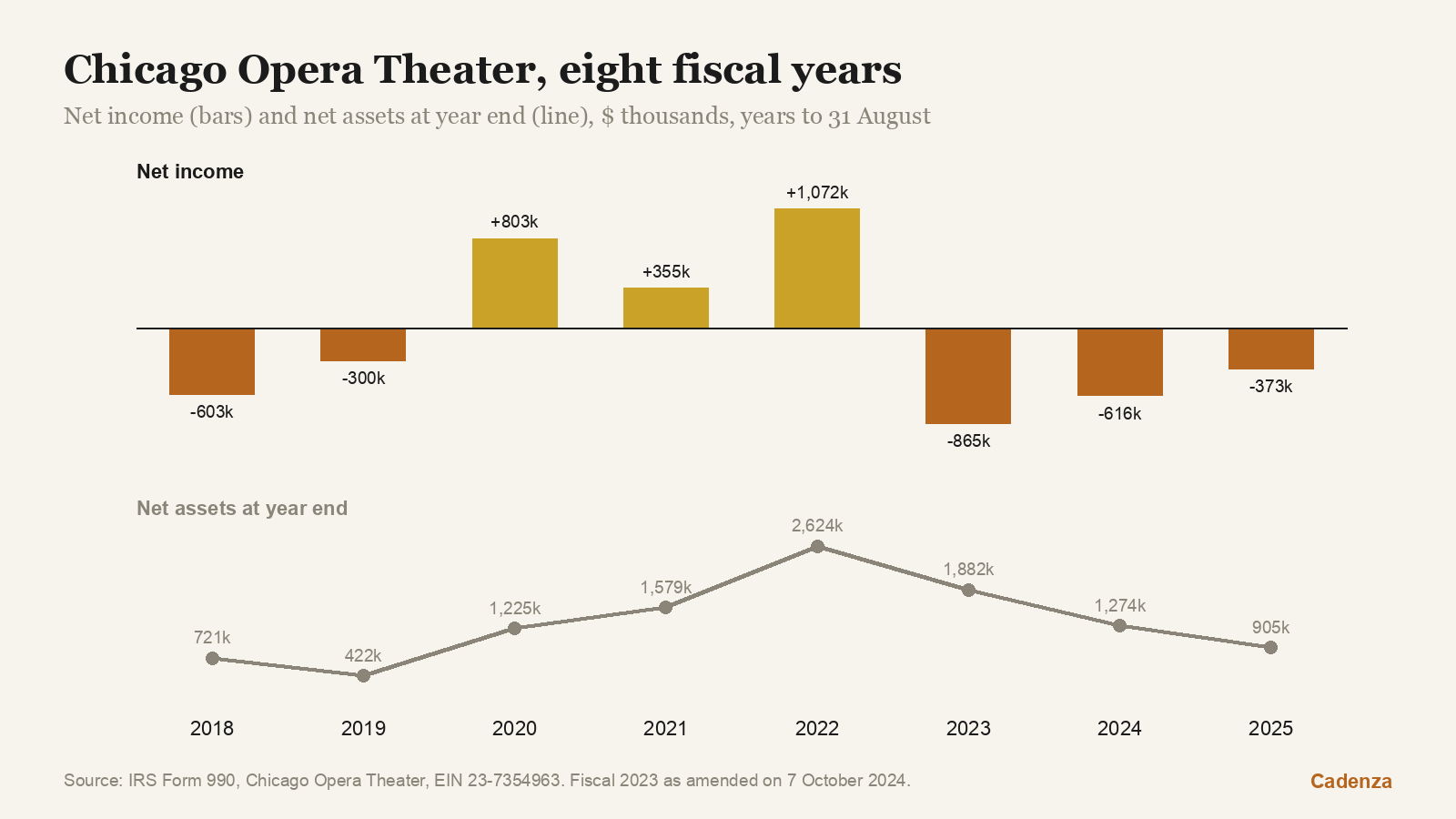
Read in order, the table tells the story the board told in words. Fiscal 2023 was the worst year in the run: expenses of $3.47 million against revenue of $2.60 million, a loss of $865,491, in the year that closed two months after Edelson arrived. The 50th anniversary season, 2023–24, was fiscal 2024, his first full year. In the two years since fiscal 2023, expenses have been cut from $3,465,399 to $2,593,165, a reduction of 25 per cent, while revenue has held between $2.1 million and $2.2 million; the loss has narrowed to $615,755 and then $373,425. That is the "fiscal discipline" and the "sustained effort" of the board's statement, in numbers.
The other half of the table is the reason the effort is not finished. Three losing years in a row have taken net assets from $2,624,079 at the end of fiscal 2022 to $904,593 at the end of fiscal 2025, a fall of 66 per cent. The company's total assets at that date were $1,310,211 against liabilities of $405,618. On the 2025 filing, contributions and grants were $1,982,359 of the $2.22 million revenue and programme service revenue, all of it ticket income, was $215,430, being $64,590 of season subscriptions and $150,840 of single tickets, under ten per cent. Chicago Opera Theater, like most companies of its kind, is a philanthropic organisation that also sells tickets, and its recovery depends on the first number as much as on the expense line.
Two things the filings also record. Form 990 pay is reported by calendar year: the 2024 return lists the then music director, Lidiya Yankovskaya, at $126,308 and Edelson at $72,115 for July to December 2023; the 2025 return lists Edelson at $150,815 and no music director among its officers and key employees, the company's history page describing 2023–24 as Yankovskaya's final season in the post. And the company has been here before: fiscal 2011 ended with net assets of minus $500,197, and by 2015 they were $2.17 million. The pattern of the company's finances since 2011 is a sawtooth, not a slope, and the current board is asking Edelson to draw the next upward stroke.
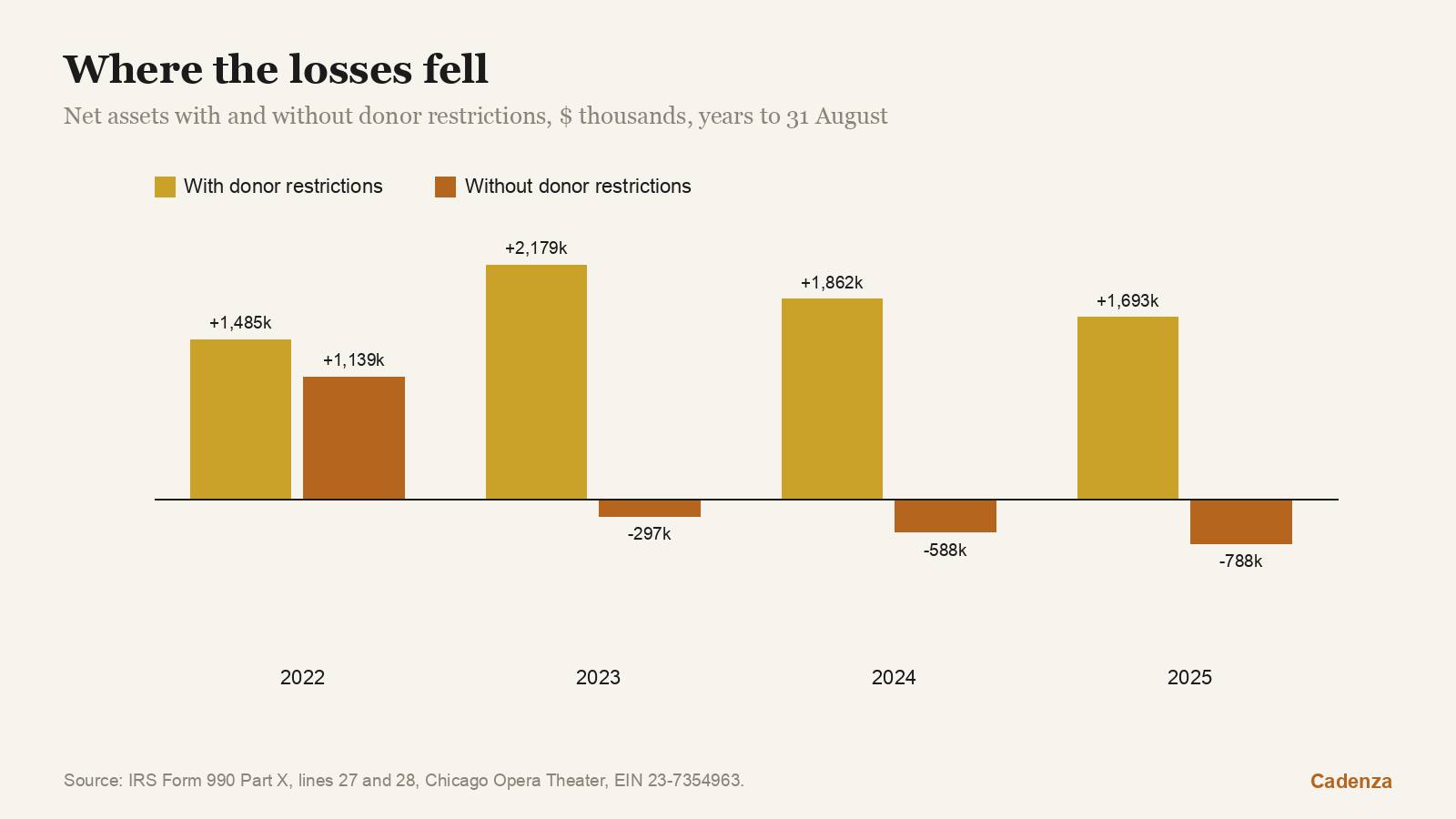
The balance sheet on the same returns divides net assets by restriction, and that division is the sharpest number in the filings. At 31 August 2025 the company held $1,692,665 in net assets with donor restrictions and a negative $788,072 without; the unrestricted position was a negative $296,841 at the end of fiscal 2023 and a negative $587,745 at the end of fiscal 2024. In plain terms, the unrestricted position has gone from a surplus of $1,138,587 at the end of fiscal 2022 to a deficit of $788,072 three years later, and the company's total net assets are positive only because of the restricted column. Over those same three years the restricted column rose slightly, from $1,485,492 to $1,692,665, and the endowment reported on Schedule D was not drawn down. The returns do not show restricted money being spent on general operations; they show the losses falling on the spendable side of the balance sheet.
 The returns also record the number of people who received a W-2 from the company falling from 230 in calendar 2022 to 198 in 2023 and 64 in 2024. That line counts everyone who received a W-2 in a calendar year, not a permanent staff, and the 2022 figure was itself a peak: the count for 2021 was 180. Over the same period the company's other salaries and wages fell by rather less, from $1,062,494 to $676,735, or 36 per cent against a 72 per cent fall in headcount, so the average payment per person more than doubled, from about $4,620 to about $10,574. No independent contractor was paid more than $100,000 in any of the three years, so the work did not simply move off the payroll. That pattern is what one would expect if the people who left were short-engagement artists rather than year-round employees, though the filings do not say so. Neither the returns' Schedule O nor the board's announcement explains either figure; they are the measure of what "strengthen our financial footing" still has to do.
The season the extension covers first
The 2026–27 season, on the company's own page, is two staged operas, two concerts and a workshop, all at the Studebaker Theater in the Fine Arts Building on Michigan Avenue, plus a free public conversation on 18 November at the Irish American Heritage Center.
| Date | Production | Notes |
|---|---|---|
| 18 Oct 2026, 3pm | Discovery Concert, music from and around Oscar Wilde | Pianist and music director Michael Banwarth, COT debut |
| 2, 5 and 6 Dec 2026 | Castelnuovo-Tedesco, The Importance of Being Earnest | Chicago premiere; new production directed by Brenna Corner, artistic director of Pacific Opera Victoria, conducted by Kamna Gupta, both COT debuts; completed in 1962 and first performed on 14 November 1972 in an RAI broadcast from Rome, four years after the composer's death; the company's page gives 1961 and 1962 |
| 7 Feb 2027, 3pm | Discovery Concert, Once Upon a Time, fairy tales in opera | Pianist and music director Yasuko Oura, returning |
| 19, 22 and 23 May 2027 | Philip Glass and Robert Moran, The Juniper Tree | Chicago premiere; 1985 opera to a libretto by Arthur Yorinks, staged in the year of Glass's 90th birthday; new production directed by Edelson himself, conducted by Brian DeMaris, president and general director of Arizona Opera, in his COT debut |
| 9 Aug 2027, 7pm | Inventing Oz (working title), Stacy Garrop | Piano-vocal workshop concert of the first commission under the "Chicago Sings" banner, to a libretto by Sam Norman; premiere projected for 2029 |
Single tickets for the operas are $150, $125, $100, $75 and $50 for reserved seating, plus an $8 handling fee per ticket, which memberships include for the whole season; concerts are $50 general admission. The company has replaced subscriptions for 2026–27 with what it calls memberships, which it describes as "like Subscriptions, but designed with greater flexibility, personalization, and freedom", with exchangeable tickets and member pricing across the season; the comparison page shows the tier prices only as graphics, but the individual membership pages give them in text, from $215 for the Bravo tier and $260 for Ovation.
The programme is the company's line of business as its history page defines it: works new to Chicago, contemporary American opera, and the Vanguard Initiative, a two-year residency for emerging composers established in 2018, whose first composer, Stacy Garrop, is now writing the Oz commission. The residency was launched in 2018 by Lidiya Yankovskaya, the music director whose post the company no longer fills. Six performances of staged opera, alongside three concerts and a free public conversation, is what $2.6 million of annual expenditure buys at this company, and the choice of two Chicago premieres rather than a repertory title is the choice the board has just endorsed for five more years.
For musicians
The filings and the season together say what kind of employer Chicago Opera Theater is in 2026: a company with roughly six opera performances and a handful of concerts a year, a payroll whose top line is the general director at $150,815, no music director among the officers on the latest return, and guest conductors and directors engaged by production, three of whom make company debuts this season, while the general director stages one of the two operas himself. For singers, the company's stated pitch is "identifying top-tier casts and creative talent at the beginning of grand operatic careers", in the words of its 2023 release; for composers, the Vanguard residency and the new commission are the openings. Opportunities at the company are posted on its own site; none is on Cadenza's board today.
The case against this article
The financial figures are read from the Form 990s themselves, not from ProPublica's extracted feed, which still carries the superseded fiscal 2023 return; the fiscal 2025 return was filed on 9 July 2026 and signed by the board president; the returns record that the company's statements are audited by an independent accountant and reviewed by an audit committee, and that they may be inspected at its office, but they are not published on its site; the 990's "net income" is simply revenue less expenses. The reasons for the 2023 loss are not stated in any filing and we have not asked the company; the 50th anniversary season is the board president's own framing. Net assets of $904,593 are the year-end figure, not a cash balance, and the company may have reserves or restricted funds the summary does not distinguish. Ticket prices are those on the company's page on 7 September and the membership comparison page gives its tier prices only as graphics, so those are taken from the individual membership pages. The board's statement is quoted here from OperaWire and appears in fuller form in the company's own release of 1 September. We put no questions to the company before publication. The music director's departure is dated from the company's history page and the two returns; the company's current artistic leadership structure beyond the general director is not described on its site.
The question
The board has given its general director until 2031 and the numbers have moved his way for two years. The line that has not moved yet is revenue, flat at $2.2 million, and the one that will decide the decade is net assets, which at $905,000 are about four months of the company's expenses on paper, though $1,692,665 of that carries donor restrictions and the spendable balance behind it is negative. The question for the next filing, due in the summer of 2027, is whether fiscal 2026 is the year the loss reaches zero, and whether it gets there by cutting further or by selling and raising more. The board has bet five years on the second.
Related: The Odds and the Israeli Opera's season ledger. Opera jobs, competitions and programmes are on cadenza.work/browse.
Cover photograph: The Fine Arts Building on Michigan Avenue, Chicago, whose Studebaker Theater is the venue for Chicago Opera Theater's 2026–27 performances, in February 2023. Photograph by AlexanderUtz, CC BY-SA 4.0 (creativecommons.org/licenses/by-sa/4.0), via Wikimedia Commons..
Comments
Sign in to join the discussion.