Cadenza spent this week trying to answer a simple question. Who actually won a classical music competition in 2026?
There is no list. Competitions announce their own results, in their own languages, on their own sites, and then the announcement scrolls off the front page. The trade press covers perhaps a dozen competitions properly and ignores several hundred. Nobody counts.
So we counted. Ten parallel searches, one per instrument family and region, each required to find the competition's own published result rather than a press report, and each followed by a second pass that refetched the source and tried to break the entry. Two hundred and one winners survived that process.
This is what a year of competition results looks like when somebody adds it up.
The distribution is not what the coverage suggests
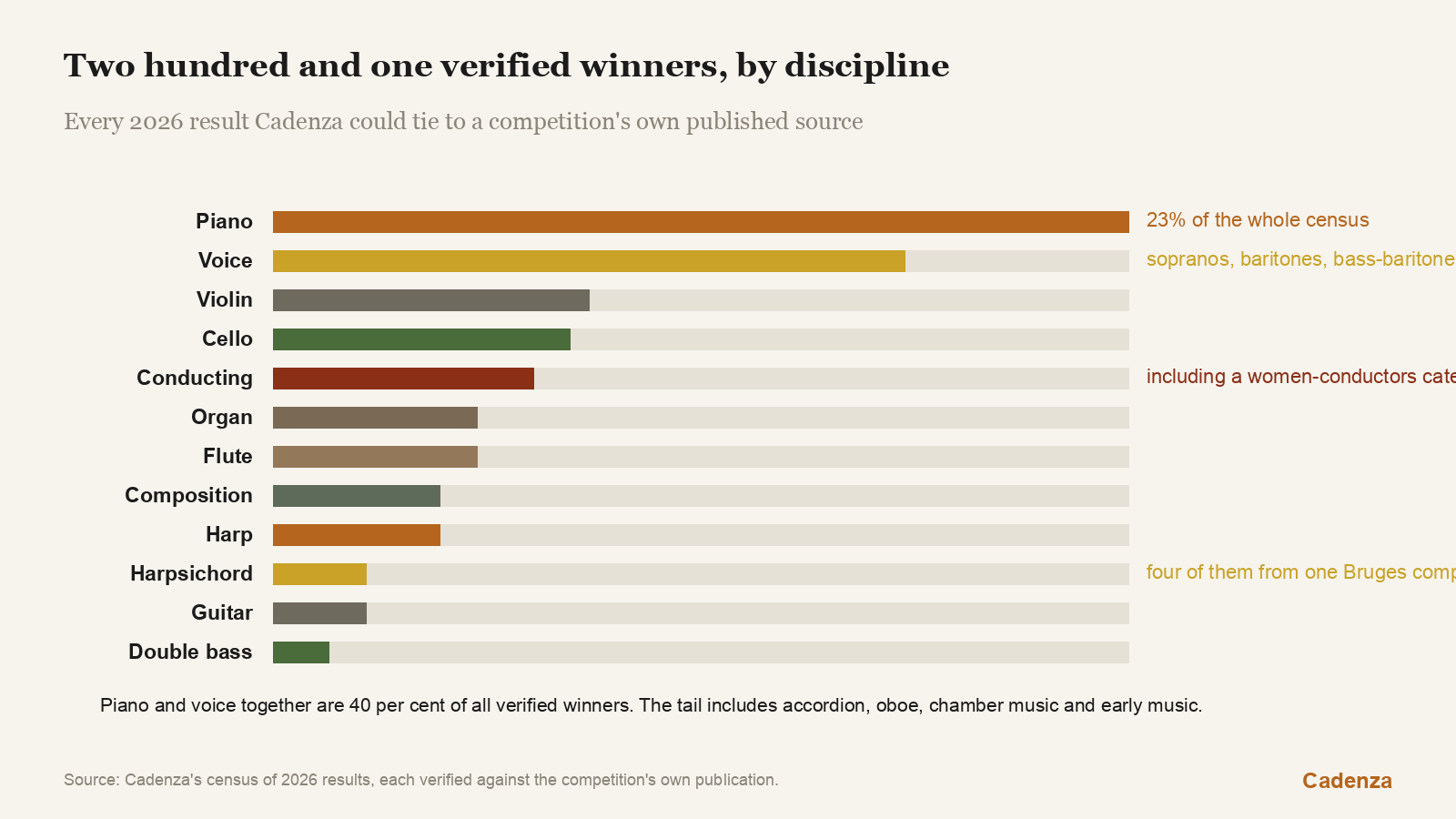
Piano accounts for 46 of the 201, or 23 per cent. Voice accounts for 34. Violin 17, cello 16, conducting 14. Then the tail: organ 11, flute 11, composition nine, harp nine, harpsichord five, early music five, guitar five, chamber music three, double bass three, oboe three.
Two things are worth saying about that shape.
The first is that piano and voice between them are 40 per cent of all verified winners, which is roughly what you would guess from reading the trade press. The coverage is not wrong about where the volume is.
The second is that the tail is longer and more populated than the coverage suggests. There were verified 2026 first prizes in harpsichord, accordion, guitar, organ, harp and double bass. A reader of English-language classical coverage this year would struggle to name a single one of them, not because they were not awarded but because nobody wrote them down.
The thing that is missing from two thirds of them
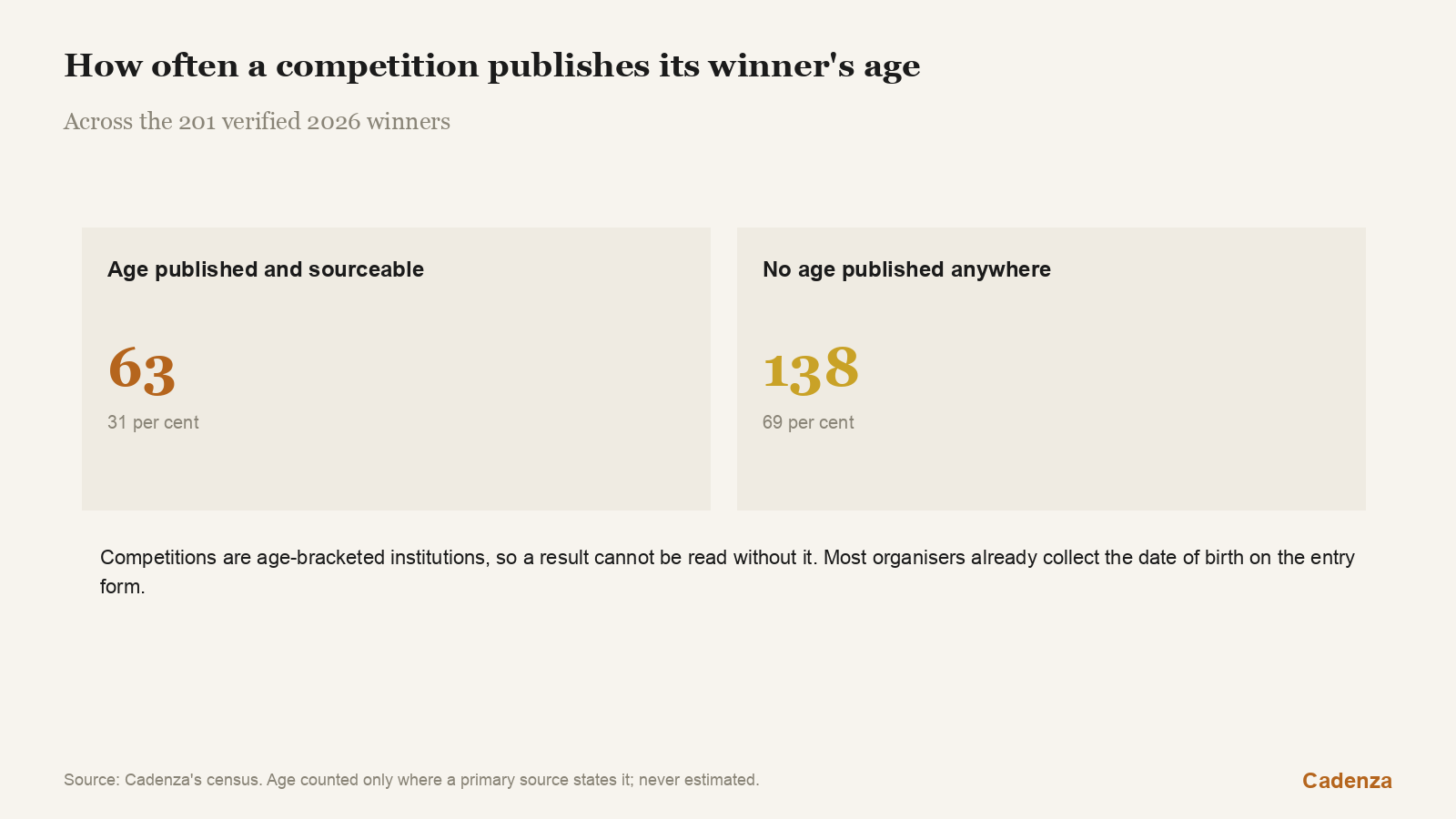
Of the 201 verified winners, 63 have an age that Cadenza could source. That is 31 per cent. For the other 138, no competition page, results PDF or laureate biography states how old the winner is.
That may sound like a minor gap. It is not, for two reasons.
Age is the single most useful piece of context for a competition result, because competitions are age-bracketed institutions. A first prize at 16 and a first prize at 32 are different achievements, won in different fields, against different competition. Without the age you cannot read the result.
It is also the fact most likely to be the point of the story. Cadenza has written twice this week about results whose whole significance is an age: a 12-year-old awarded the loan of a historic cello, and a 28-year-old orchestral principal beating a semi-final field whose youngest member was 14. Neither of those pieces would exist if the institutions had not published the ages.
The Liechtenstein conducting competition showed the pattern at its sharpest. Its site lists an age for every candidate it eliminated and omits the ages of its three finalists. The further you get, the less it tells you about you.
What verification actually removed
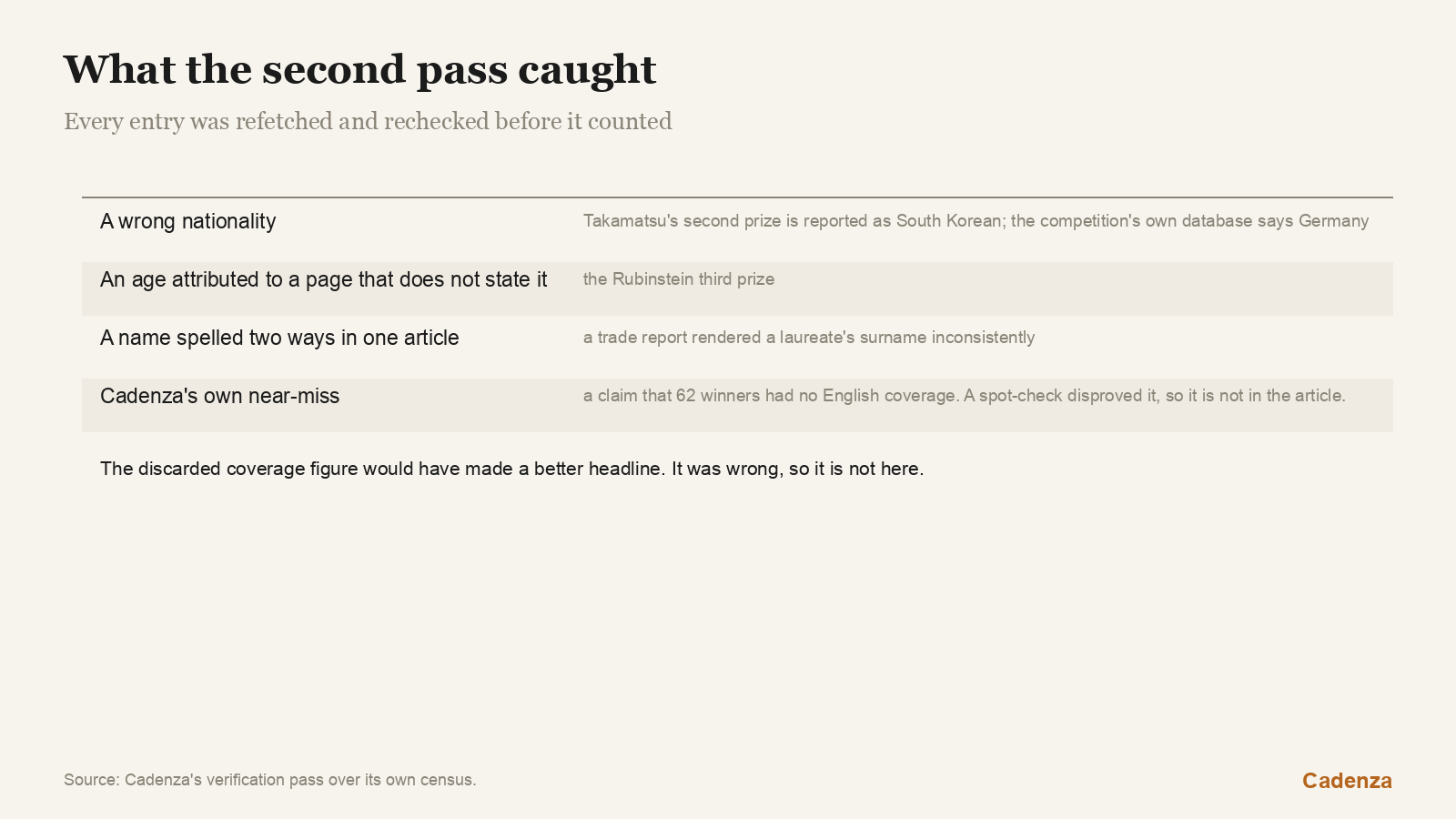
Every entry went through a second agent that refetched the primary source. That pass did real work, and it is worth being specific because it is the difference between a census and a list of rumours.
It caught a nationality that two separate press accounts had wrong. The Takamatsu competition's second prize winner is described everywhere as South Korean or as being from Berlin; the competition's own contestant database lists his nationality as Germany. It caught an age attributed to a source that does not state it, for the Rubinstein third prize. It caught a misspelled name in a trade report, where a laureate's surname was rendered two different ways in the same article.
And it caught one of Cadenza's own near-misses. The first pass reported that 62 of the 201 winners had no English-language coverage at all, which would have been the headline. A spot-check killed it. One of the names on that list was a Queen Elisabeth cello laureate who is covered by The Strad, The Violin Channel and several other English outlets. The coverage assessments were not reliable enough to publish, so this article does not publish them, and the census is smaller and duller for it.
That is the correct outcome. A number that would have made a better headline was wrong, and it is not in the piece.
What a census cannot do, stated plainly
Two hundred and one is not every 2026 winner. It is every 2026 winner Cadenza could tie to a primary source in a week, and the gaps are predictable ones.
Competitions whose results exist only as a social media post, or only inside a PDF that is not indexed, or only in a language none of the searches covered, are underrepresented. So are competitions that ran late in the year and have not announced yet, and those are recorded separately as pending rather than counted. National competitions in countries with small online footprints are almost certainly undercounted, which means the real distribution has an even longer tail than the one charted above.
The census also counts laureates, not just first prizes. A competition that publishes a full ranked list of twelve contributes more names than one that announces a single winner, which inflates the disciplines whose big competitions are transparent. The Queen Elisabeth cello list of twelve is a good example: the transparency is admirable and it also skews the count.
None of that makes the figures useless. It makes them a floor. Every number here is a minimum, and the direction of every error is the same: there are more winners than we found, in more disciplines, in more countries.
The competitions doing the most work
Several names recur across the census because they run multiple categories, and they are not always the famous ones.
The Concurso Internacional Premio Jaén, in its 67th edition, produced multiple verified piano laureates. The Toru Takemitsu Composition Award produced three. The MA Competition at the Bruges early music festival produced four harpsichord laureates. The Kathleen Ferrier Awards, in their 71st edition, and the London Handel Singing Competition both produced verified voice winners. The Queen Elisabeth cello competition produced a full laureate list of twelve.
Those long edition numbers are the quiet story. A 67th edition and a 71st edition mean these institutions have been finding musicians continuously since the 1950s. They have laureate lists going back decades, which is a resource nobody mines, and they will run again next year.
Why a census is worth doing at all
The practical value is for the musician deciding where to spend an entry fee.
A competition's own results page tells you who won. It does not tell you how many applied, how many were invited, what the prize actually pays after tax, when the attached engagement falls, or how old the winners tend to be. Cadenza has had to reconstruct each of those separately this week, for one competition at a time, from documents that were public but scattered.
Two hundred and one names is the beginning of something more useful than that: a base against which next year's results can be compared, and a list of the institutions actually handing out money and engagements rather than the ones with the best press operation.
A year ago every one of these was a call for entries
Each of the 201 began as an application, usually months earlier, usually with a fee. The competitions with the long edition numbers are the ones most likely to run again on schedule.
Cadenza carries competitions with open deadlines, free to musicians, on its competitions board, and orchestral vacancies on its jobs board.
If you are entering competitions next year. Read the laureate list, not the winner announcement. A competition that publishes every finalist with a birth year and a nationality is telling you what field you would be entering; one that publishes only a winner's name is not. Ask the organiser for the number of applications and the number of invitations, because those two figures decide your odds and are almost never on the entry page. And check whether prizes are quoted gross or net, since at least one major competition this year quotes its cash net of national tax.
The question the competition sector will be asked next is the cheapest possible reform. Two thirds of this year's verified winners have no published age, and most organisers already collect it on the entry form. Will they print it next to the name?
Sources: the census rests on each competition's own published results, fetched directly, across ten parallel searches covering piano, strings, voice, winds and brass, chamber music and conducting, organ and harp and guitar and percussion, Asia, Latin America and Iberia, the Nordics and eastern Europe, and composition and early music. Every entry was then refetched and rechecked by a second pass. Named in this article: the Queen Elisabeth Competition laureate list, the Takamatsu International Piano Competition's own results portal, the World Federation of International Music Competitions report on Takamatsu, the Arthur Rubinstein International Piano Master Competition results as reported by The Violin Channel, the Concurso Internacional Premio Jaén, the Toru Takemitsu Composition Award, the MA Competition at the Bruges early music festival, the Kathleen Ferrier Awards and the London Handel Singing Competition. English coverage of Queen Elisabeth cello laureates was confirmed via The Strad, which is how Cadenza discovered its own coverage figure was unsafe. All counts, percentages and the age-publication rate are Cadenza's arithmetic over the verified set.
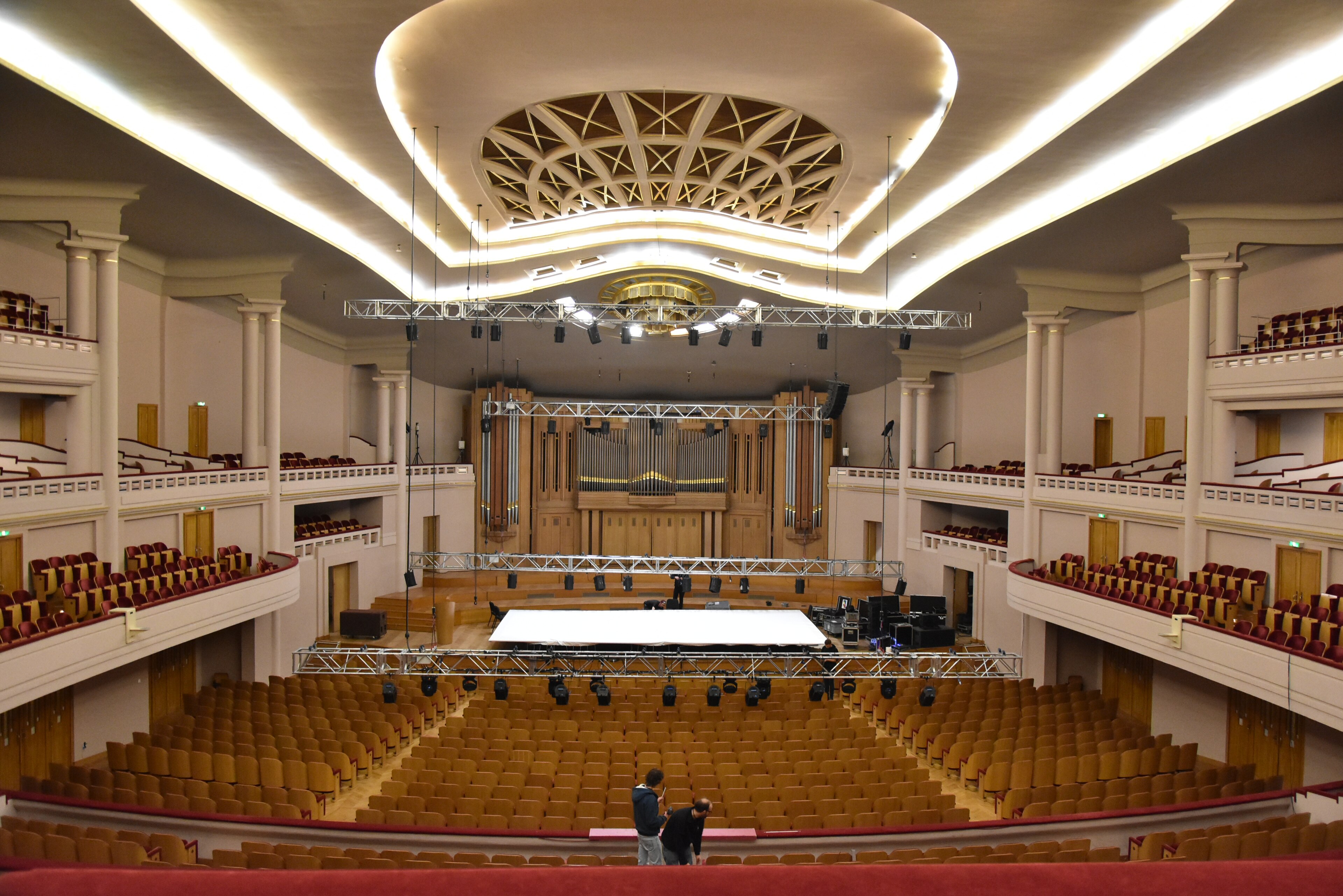
Cover photograph: the Henry Le Boeuf hall, Bozar, Brussels, January 2019. Paul Hermans, CC BY-SA 4.0, via Wikimedia Commons. Charts by Cadenza.
Cover photograph: The Henry Le Boeuf hall at Bozar in Brussels, where the Queen Elisabeth Competition finals are played, photographed in January 2019. Paul Hermans, CC BY-SA 4.0, via Wikimedia Commons.
Comments
Sign in to join the discussion.