This investigation examines what sixteen years of Hungarian cultural spending built, what it cost, and what a new government should do with it. Every figure is traceable to the numbered source register at the foot of this article. Three cautions travel with it. The HUF 889.9 billion / 103-project figure is the former government's stated expected-gross-value claim made in February 2022, not final audited expenditure. The National Cultural Fund matters are charges and administrative decisions, not convictions: those charged deny wrongdoing and the presumption of innocence applies in full. And where this article describes political capture of appointment structures, that is analysis supported by documented governance arrangements — it is not an accusation of criminal conduct against any individual. Right-of-reply questions were sent on 1 August 2026 to fifteen institutional press offices, including the culture and education ministries, the Prime Minister's Office, Fidesz, the European Commission, the Hungarian State Opera, Liget Budapest, the House of Music, the Museum of Ethnography, the Budapest Festival Orchestra, the National Cultural Fund, the Prosecution Service and the National Museum. Any replies will be published in full or summarised accurately.
Orbán lost an election. Hungary did not vote to become culturally smaller.
Cadenza Investigations · July 31, 2026
Hungary’s new government inherited restored opera houses, new museums, a national cultural district, expanded production infrastructure, regional projects, wage commitments and a state that had decided—sometimes extravagantly, sometimes opaquely, but unmistakably—that culture was worth building at scale.
The inheritance is politically contaminated. Some contracts deserve forensic audit. Some boards were designed to outlast elections. Some grants were allegedly diverted through networks of influence. Some independent institutions were made to beg while favored bodies received stability. The European Union’s concerns about procurement, prosecution and conflicts of interest were not invented. The new government has every right to investigate, recover any proven losses and restore fair competition.
But none of that gives Péter Magyar’s government the right to treat a theatre, museum, orchestra, academy or cultural campus as Fidesz property. None of it gives Brussels the right to become Hungary’s curator. And none of it changes the central fact: the buildings are real, the musicians are real, the collections are real, the audiences are real, and Hungarian taxpayers—not Viktor Orbán personally—paid for them.
The correct project is not de-Orbánization. It is de-partisanization without de-Hungarianization.
Audit every contract. Prosecute proven theft. Remove conflicts of interest. Reopen appointments. Publish the grants. Protect dissenters. But preserve the achievement.
A democratic transition should recover the state from a party. It should not make the country culturally smaller simply to prove that the party is gone.
The facts at a glance
- Péter Magyar’s Tisza party ended Orbán’s sixteen-year rule in April 2026 and entered parliament with a two-thirds majority. [S1][S2]
- Orbán-era governments said in February 2022 that they had launched 103 cultural investments with an expected gross value of HUF 889.9 billion, with roughly two-thirds outside Budapest. That is a government-reported programme total, not an independently audited final-spend figure. The same statement put the funding actually awarded so far at more than HUF 596 billion. [S7]
- The Hungarian State Opera reported record own revenue above HUF 8 billion in 2025, financing roughly one-third of operating costs of about HUF 25 billion. [S8][S9]
- The House of Music Hungary says it received more than three million visitors in its first years. The Museum of Ethnography says its new building has welcomed more than 1.3 million visitors. [S12][S14]
- The Council of the European Union approved a new €10 billion Hungarian recovery plan in July 2026, with payments tied to agreed milestones. [S5]
- In December 2022 the Council suspended €6.3 billion in commitments over risks involving public procurement, prosecutorial effectiveness and corruption. [S6]
- The money moved again twice: around €10.2 billion was released in 2023 after reforms under the previous government, and €16.4 billion was unlocked in May 2026 — reported as roughly €10 billion in recovery funds and more than €6.3 billion in cohesion funds. These are separate decisions and should not be totalled. [S4]
These numbers do not prove that every project was wise or every contract clean. They prove that the inheritance is too large to be reduced to a partisan slogan.
PART I — THE INHERITANCE
1. One election cannot erase sixteen years of concrete
Viktor Orbán lost power in April. Péter Magyar was sworn in on May 9. Tisza’s 141 seats in the 199-member National Assembly gave the new government the same constitutional weapon Orbán had used for years: the ability to alter the institutional order without opposition votes. [S1][S2]
The temptation was immediate. Magyar called on Orbán-era officeholders to resign. His government moved against the president. It began examining appointments, public media, foundations, procurement and the flow of public money. Some of that was overdue. An electoral defeat is not a certificate of innocence for the outgoing system.
But Hungary’s cultural inheritance cannot be evaluated through the emotional logic of regime change.
The marble staircase of the Opera House does not know who won the election. The Eiffel Art Studios do not cease to be useful because the government that financed them was defeated. The House of Music does not become architecturally invalid when Fidesz enters opposition. A museum collection does not change ownership because a minister changes offices.
That sounds obvious. It is not.
Post-authoritarian transitions often confuse three separate categories:
- The leader’s political legacy
- The state’s institutional machinery
- The public’s physical and cultural property
A democracy must be willing to dismantle the first where voters demand it, reform the second where it was captured, and preserve the third unless there is a compelling public reason not to.
The risk in Hungary is that all three are treated as one object called “the Orbán system.” That phrase may be politically useful. It is administratively dangerous.
A state that believes every predecessor’s project is poisoned will never build anything that lasts longer than an election cycle.
2. The construction campaign
Orbán’s governments made national culture a physical policy.
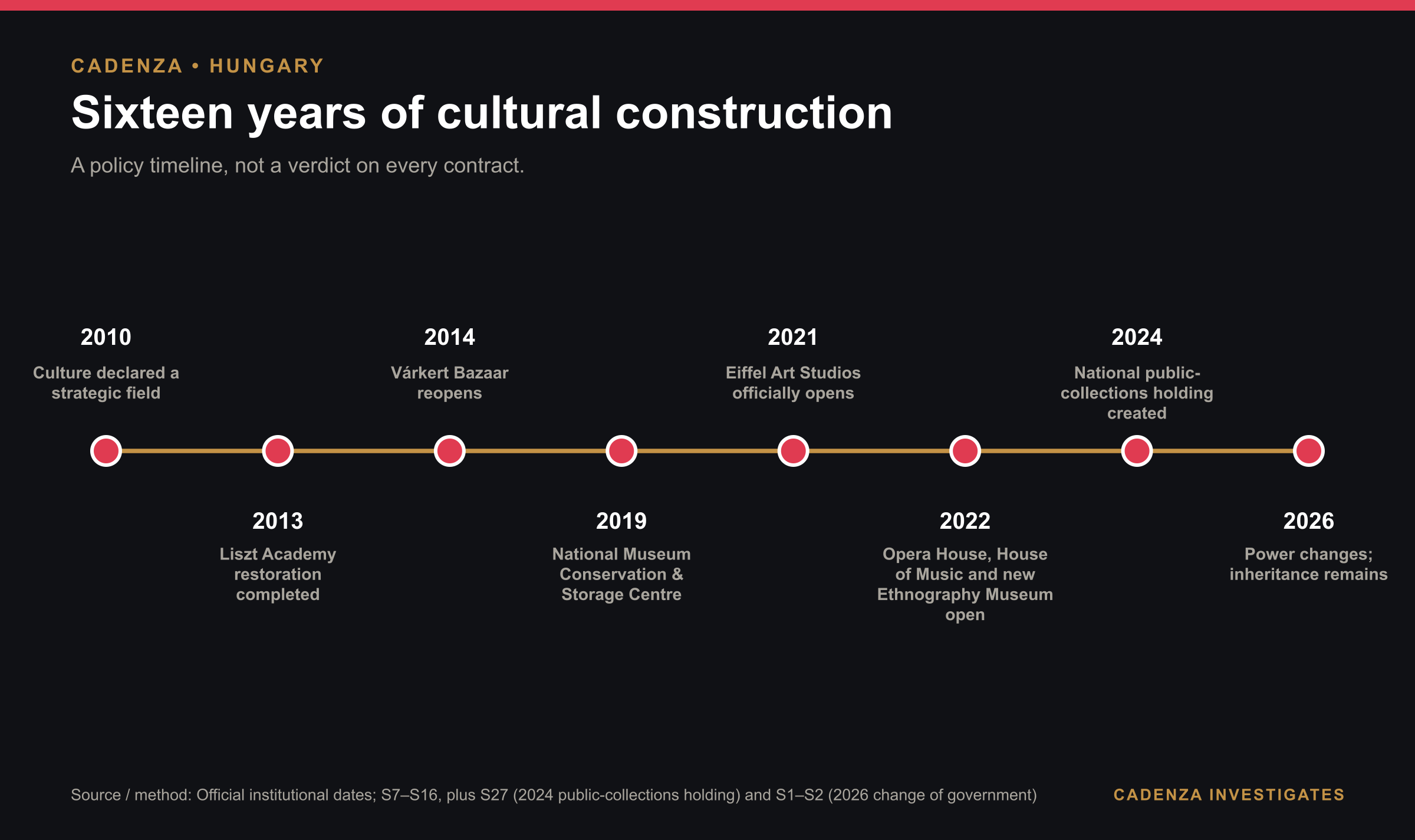
Sixteen years of Hungarian cultural construction, 2010–2026. A policy timeline, not a verdict on any individual contract.
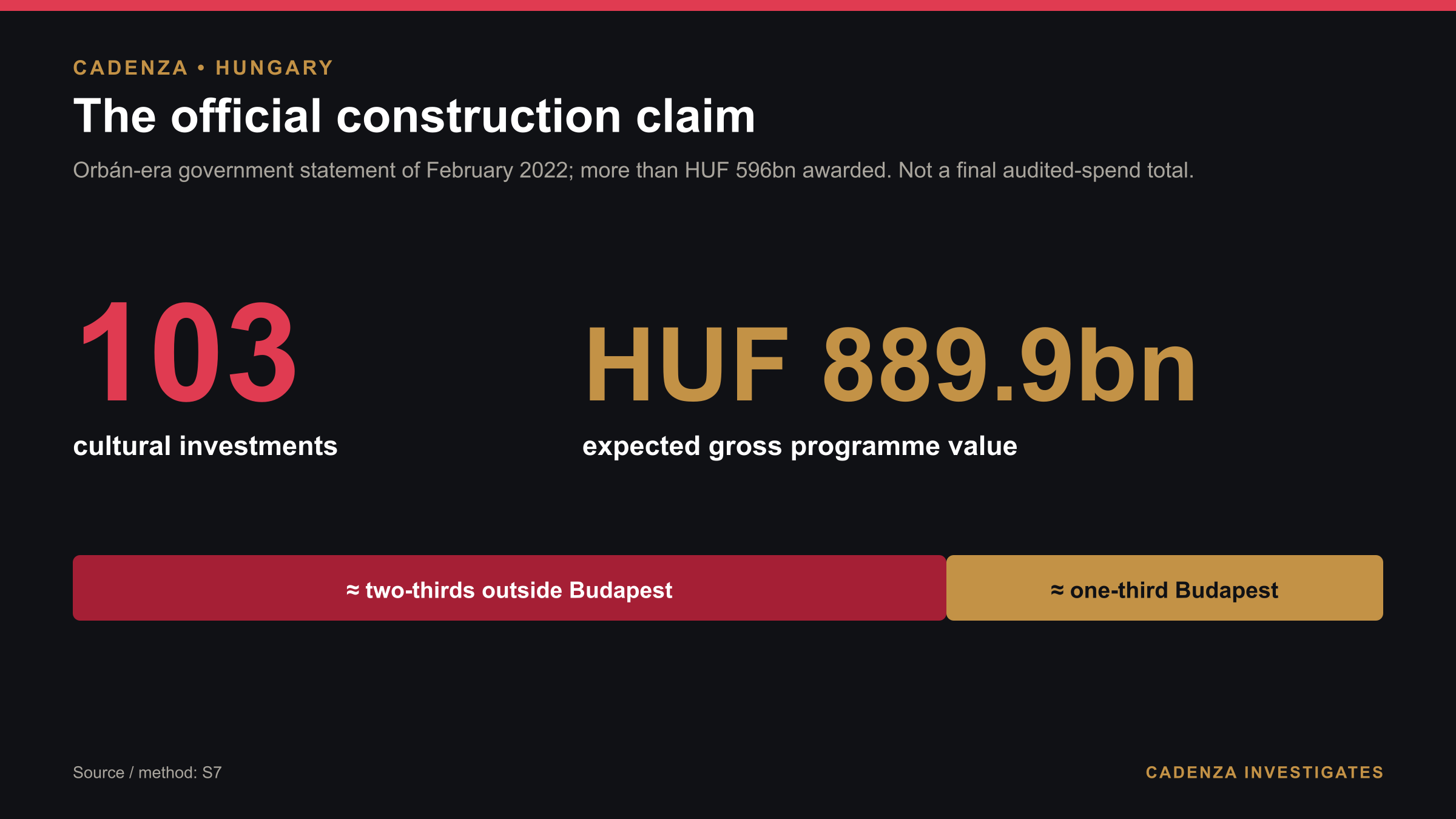
The government’s stated scale of cultural investment. The Orbán government's own stated expected-gross-value claim stated in February 2022. It is not final audited expenditure.
The official account is grand: 103 investments, HUF 889.9 billion in expected gross value, in a February 2022 statement, with roughly one-third in Budapest and two-thirds elsewhere. The programme included restorations, new venues, archives, museum projects, music institutions and regional developments. [S7]
The number must be handled carefully. It is an official programme figure, not a single audited invoice total. Some projects were still in preparation. Costs changed. Timelines moved. Not every project had equal artistic value. A government announcement is evidence of policy and ambition, not independent proof of efficiency.
Still, it marks a real difference in philosophy.
In much of Europe, cultural policy has become defensive: prevent closure, patch the roof, preserve a reduced orchestra, merge departments, hope that tourism fills the gap. Orbán’s Hungary often behaved as though culture were infrastructure—something a nation builds deliberately, visibly and expensively.
That produced excess. It also produced assets.
The Hungarian State Opera was restored. The Eiffel Art Studios gave the Opera a vast production, storage and rehearsal base. City Park gained the House of Music Hungary and a new Museum of Ethnography. The Liszt Academy, Várkert Bazaar and other historic sites were renovated. Regional projects were tied to the Modern Cities Programme. The state treated cultural buildings not merely as service facilities but as statements of national continuity.
There is a serious argument against that model: monumental projects can centralize money, reward connected contractors and confuse national prestige with political legitimacy.
There is also a serious argument for it: without state ambition, many historic institutions decay slowly enough that no single government is blamed.
Hungary must now retain the ambition while stripping away the party ownership.
3. What “pro-Orbán” can responsibly mean
To defend this inheritance is not to claim that Orbán donated it from his own pocket. It was built from Hungarian taxes, public borrowing, EU resources and state assets. The public owes no personal gratitude to a politician for spending public money.
Nor does defense require accepting every appointment, every nationalist slogan or every procurement decision.
A responsible defense means four things:
- admitting that the cultural construction campaign was unusually ambitious;
- recognizing that several institutions have demonstrated actual public use;
- refusing to destroy assets merely because they carry partisan associations;
- demanding a higher standard of proof before cancelling, purging or dismantling.
The article’s position is therefore not “Orbán was right about everything.”
It is this:
Hungary should preserve what worked, investigate what was corrupt, reform what was captured and stop anyone—Fidesz, Tisza or Brussels—from treating national culture as a spoil of victory.
That is a more demanding position than loyalty. It requires the new government to distinguish between a corrupt transaction and a successful institution, between a loyalist appointment and an accomplished professional, between ideological disagreement and administrative failure.
It also requires Orbán’s defenders to admit that political centralization can damage the very inheritance they want to protect.
PART II — THE PHYSICAL RECORD
4. The Opera House: not a slogan, an operating institution
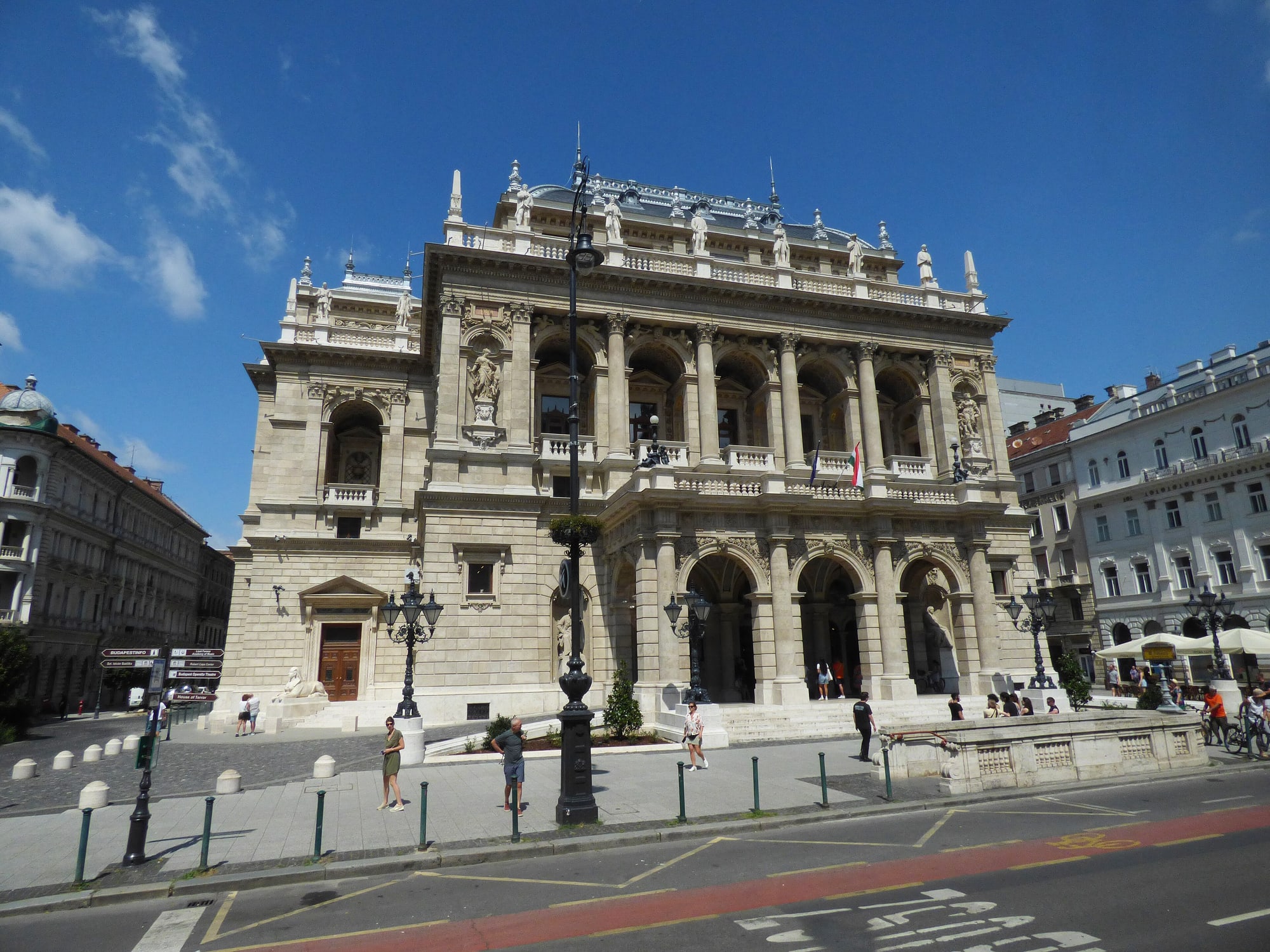
The Hungarian State Opera House, Budapest. Photograph: Jeremy Oakley, CC BY 2.0, via Wikimedia Commons.
The strongest argument for continuity is the Hungarian State Opera itself.
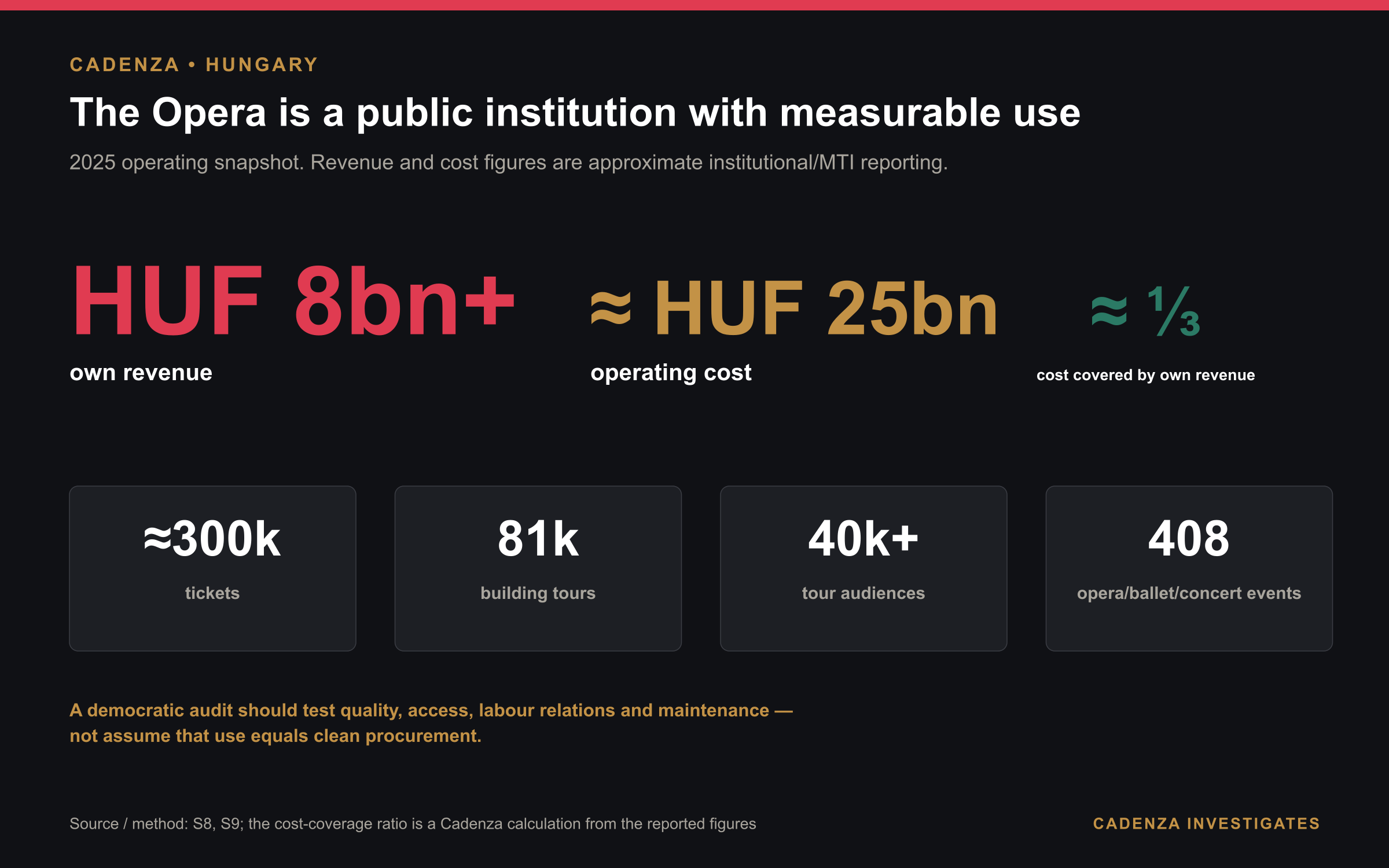
How the Hungarian State Opera actually operates. A 2025 operating snapshot from institutional and MTI reporting rather than audited accounts. Use measures quality, access, labour relations and maintenance — not procurement integrity.
Its restored Andrássy Avenue palace is not a concept rendering or an unfinished promise. It is open. It sells tickets. It employs artists and technicians. It stages opera, ballet and concerts. It receives tourists. It generates revenue.
The restoration was expensive and controversial. Independent reporting placed the final project around HUF 55 billion after delays and cost escalation. [S11]
That deserves scrutiny. Large heritage restorations are vulnerable to scope expansion, procurement inflation and the political pressure to deliver spectacle. A democratic government should publish the full project ledger, contract modifications, final claims and maintenance forecast.
But the correct question in 2026 is not whether the project should have been cheaper in 2018. It is whether the completed national asset should now be weakened because the political order changed.
The 2025 operating results provide a hard answer.
The Opera reported more than HUF 8 billion in own revenue—ticket sales, subscriptions, events, rentals, catering and building tours. Its operating cost was reported at about HUF 25 billion, meaning earned income covered roughly one-third of expenditure. It presented 255 opera performances, 117 ballet performances, 36 concerts, 398 large-scale and ten chamber performances across its venues, plus 45 guest performances. Nearly 300,000 tickets were sold at home, more than 40,000 people attended guest performances and tours, and 81,000 people took guided building tours. [S8][S9]
That does not make the Opera commercially self-sufficient. It should not be.
Opera is one of the most labour-intensive art forms on earth. It requires orchestras, choruses, dancers, soloists, coaches, costumes, workshops, lighting, stage machinery, archives and buildings that cannot be financed by ticket prices without excluding most of the public.
The meaningful question is whether the subsidy produces artistic and public value.
In 2025, the institution’s own revenue exceeded eight billion forints despite staff reductions. That is not evidence of a dead monument. It is evidence of a functioning national theatre with a mixed public-revenue model.
A new government should ask how to improve that model—not how to make the building symbolically less Orbán.
5. Eiffel Art Studios: the invisible infrastructure of spectacle
The Opera House is the beautiful part. The Eiffel Art Studios are the machinery behind it.
Opened in 2021 at a reported cost above HUF 33 billion, the complex converted a former railway engineering site into a large-scale production base with workshops, rehearsal areas, storage, studios and performance capacity. The official description covers 33,000 square metres of buildings and a three-hectare park. [S10]
This matters because cultural policy often overvalues the stage and undervalues everything that makes the stage possible.
Sets need to be built. Costumes need to be made and stored. Orchestras need rooms. Ballet companies need safe floors. Productions need technical rehearsal. Archives need climate control. Touring requires logistics. A great opera company cannot be run from a decorative auditorium alone.
The Eiffel investment was therefore strategically coherent even if parts of its procurement or design deserve audit.
The complex also exposes the central danger of revenge politics. A government seeking quick savings can make an institution appear efficient by cutting back-of-house capacity. The public may not notice immediately. The consequences arrive later as productions are outsourced, technical knowledge leaves, repertory narrows and maintenance becomes more expensive.
Hungary should not repeat the Western pattern of preserving the facade while hollowing out the workshop.
The test for the new government should be operational:
- What is the utilization rate of each major space?
- What production costs were reduced by consolidation?
- What storage or workshop capacity remains underused?
- What commercial rentals are possible without impairing the Opera?
- What long-term maintenance liabilities exist?
- Which services can support regional theatres and independent companies?
That is reform.
Selling, fragmenting or starving the complex because it was an Orbán-era project would be demolition disguised as modernization.
6. City Park: the triumph and the warning
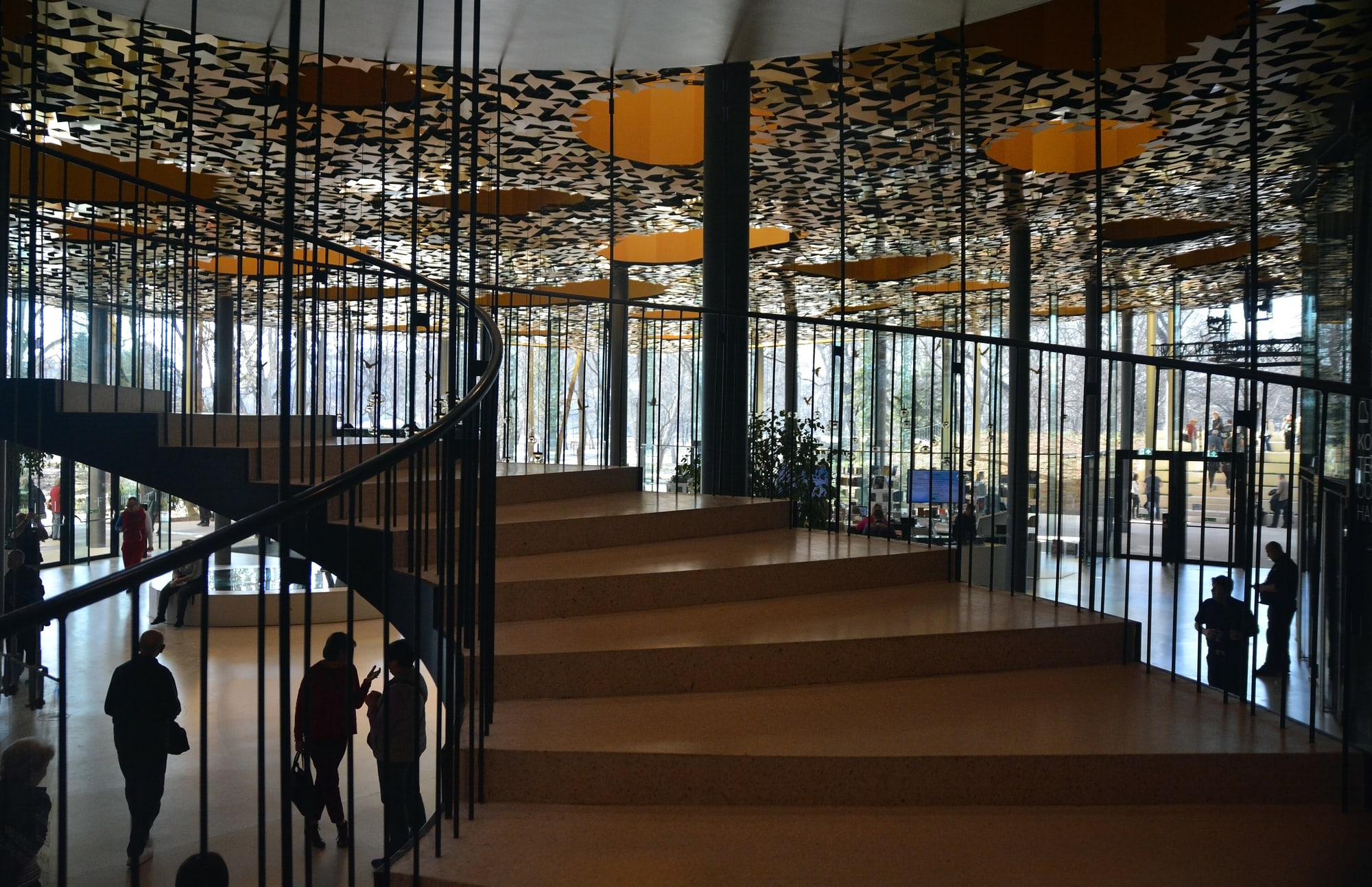
The House of Hungarian Music, City Park. Photograph: Veronika.szappanos, CC BY-SA 4.0, via Wikimedia Commons.
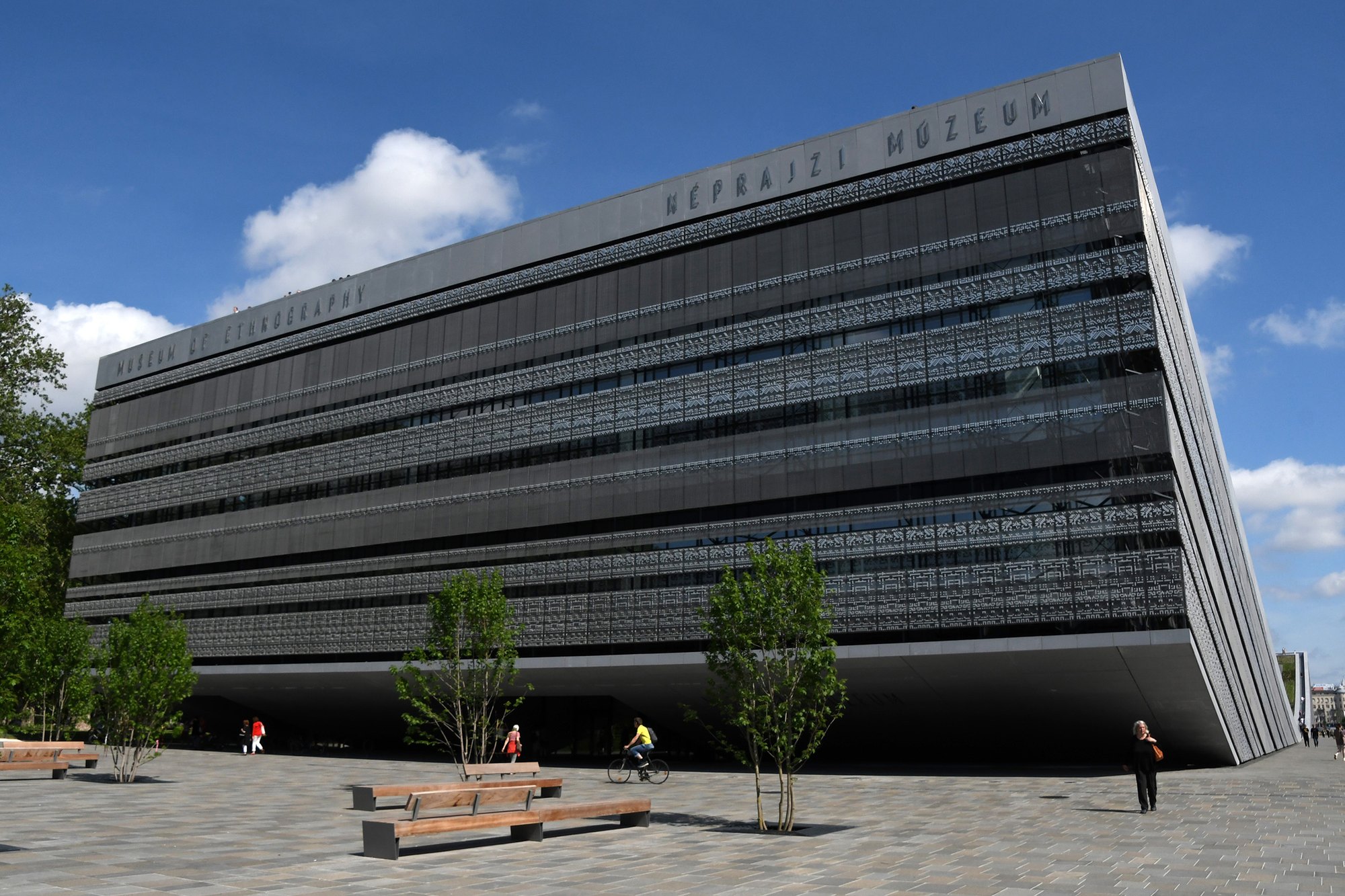
The Museum of Ethnography, Budapest, opened in City Park in 2022. Photograph: Pasztilla aka Attila Terbócs, CC BY-SA 4.0, via Wikimedia Commons.
Liget Budapest is the hardest case because it contains both the strongest evidence of public success and some of the strongest reasons for scepticism.
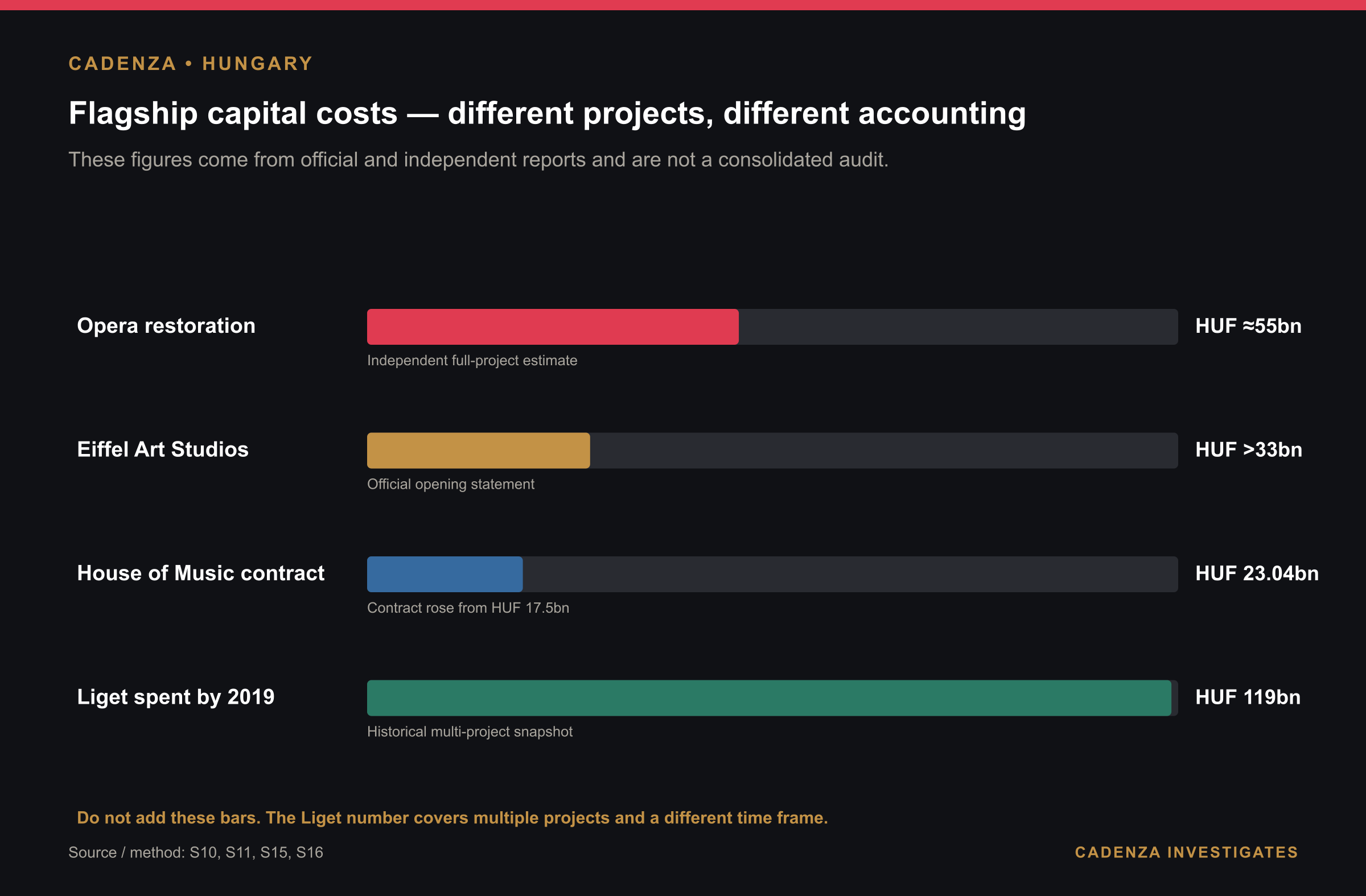
Flagship capital costs, project by project. Figures come from official and independent reports covering different projects and different years. They are not a consolidated audit and must not be added together.
The House of Music Hungary is an international architectural landmark. Liget Budapest says it has welcomed more than three million visitors since opening in 2022. [S12]
The Museum of Ethnography’s new building offers nearly 7,000 square metres of exhibition space. The museum says more than 1.3 million people have visited the new facility and that its permanent exhibition is three times larger than the institution’s former exhibition footprint. [S13][S14]
These are not negligible outcomes. They show that the project produced cultural destinations used by the public.
But success does not erase process.
Independent reporting in 2019 estimated that HUF 119 billion had already been spent on City Park developments and warned that the total could approach HUF 250 billion. That review traced major contracts and raised questions about cost growth and politically connected beneficiaries. [S15]
The House of Music contract itself reportedly rose from HUF 17.5 billion to more than HUF 23 billion. [S16]
A serious article must hold both facts simultaneously:
- the buildings can be artistically and publicly successful;
- the way they were commissioned and financed can still deserve investigation.
The lazy anti-Orbán answer is to treat public success as propaganda.
The lazy pro-Orbán answer is to treat attendance as proof that every contract was clean.
Neither is adequate.
The proper democratic response is forensic preservation:
- publish the full final cost by project;
- disclose all contract amendments and beneficial ownership;
- separate operating budgets from capital budgets;
- measure attendance, repeat visits, school participation and earned income;
- preserve the institutions while pursuing any provable wrongdoing connected to their construction.
A museum does not need to be demolished to prosecute an inflated invoice.
7. The audience test
Cultural arguments often become abstract because buildings are easy to photograph and difficult to evaluate.
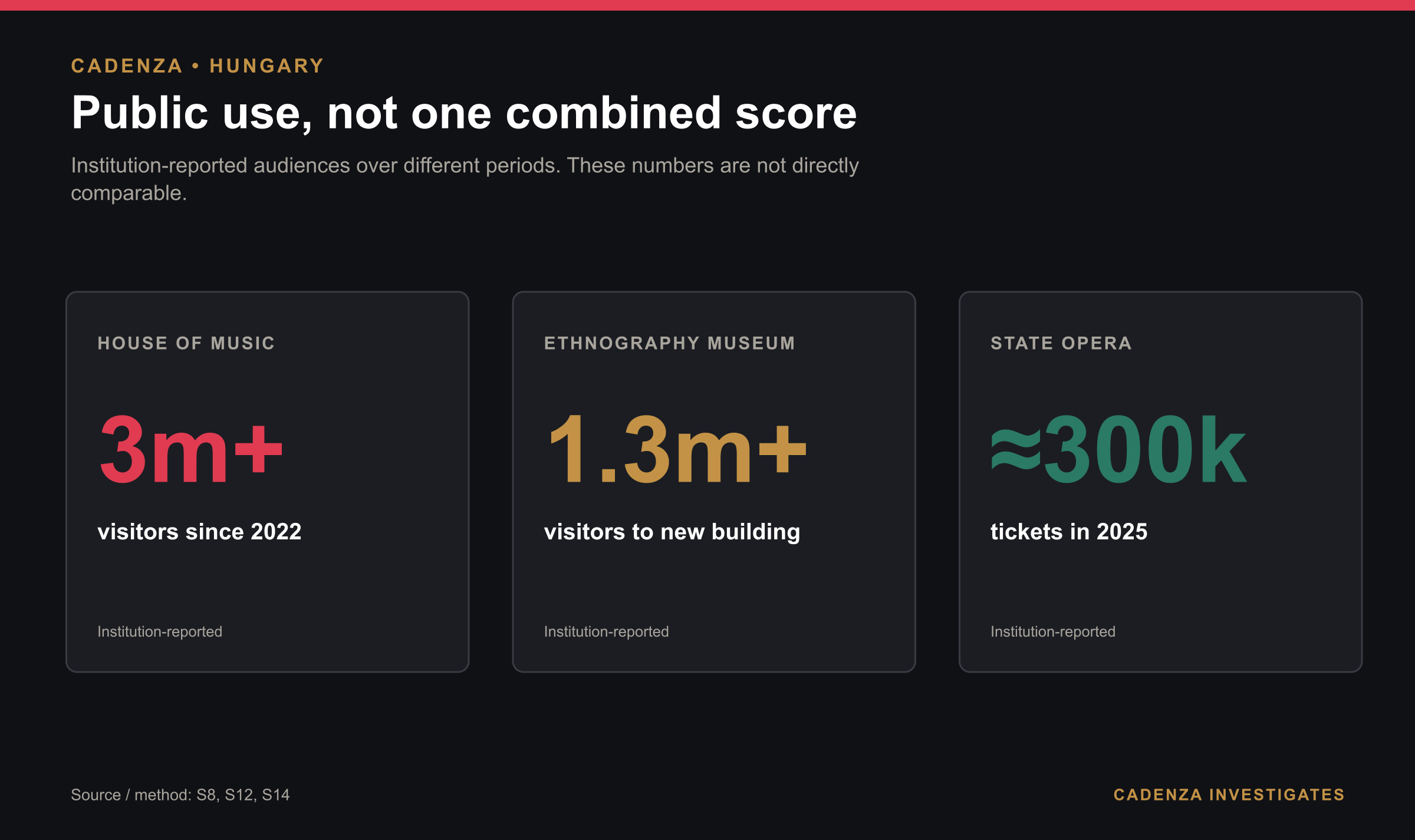
Public use of the new cultural institutions. Institution-reported audiences over different periods. The figures are not directly comparable with one another.
The audience test is imperfect but necessary.
The House of Music’s three million visitors, the Museum of Ethnography’s 1.3 million visitors and the Opera’s ticket, tour and touring figures indicate that these institutions are not empty political mausoleums. [S8][S12][S14]
Those figures are not directly comparable. They cover different periods, count different activities and come from the institutions themselves. They should not be added into a fake national attendance total.
But they establish a baseline:
- people came;
- programmes were delivered;
- public use extended beyond opening ceremonies;
- the state created assets with continuing operational relevance.
The new government should publish standardized annual data across major publicly funded institutions:
- attendance;
- school participation;
- free and reduced-price access;
- own revenue;
- public subsidy;
- cost per visitor or attendee;
- regional reach;
- international touring;
- commissioned Hungarian work;
- workforce numbers;
- capital-maintenance backlog.
Transparency is not anti-culture. It is how culture survives political change.
PART III — WHAT THE MODEL GOT RIGHT
8. Culture as national infrastructure
The deepest achievement of the Orbán era was not a particular building. It was a political assertion: culture is not an optional decorative sector to be trimmed whenever the economy slows.
That principle is worth defending even from people who reject Orbán’s politics.
Western governments frequently speak about creativity while leaving institutions to depend on unstable philanthropy, short-term project grants, municipal austerity and ticket prices. Hungary’s model was more direct. The state accepted that major cultural institutions require public capital, long timelines and political commitment.
In 2022, the government claimed that cultural spending represented 1.3 percent of GDP and that 103 projects worth HUF 890 billion had been launched over twelve years. It also said two-thirds of the programmes were outside Budapest. [S7]
The comparison with other countries was political rhetoric and should not be repeated as a settled European ranking without a common accounting method. Different countries classify heritage, broadcasting, education, tourism and local spending differently.
But the direction was real: Hungary chose to build.
That choice helped preserve skills that disappear when construction stops—stage engineering, heritage restoration, acoustic design, museum planning, archival systems, specialist fabrication and arts administration.
A country cannot recreate those capacities instantly after a decade of neglect.
9. Culture beyond the capital
The Orbán-era programme was not only a Budapest skyline project. The government’s own breakdown said roughly two-thirds of investments were outside the capital. [S7]
That claim should be audited project by project. Regional announcements often contain planning-stage investments, and the value of a project does not equal its cultural impact.
Still, the policy goal matters.
A national culture cannot consist solely of flagship buildings in Budapest. It requires municipal theatres, music schools, county museums, libraries, archives, dance companies, touring networks and affordable access.
The new government has announced or inherited support structures including a 15 percent wage increase for workers in the cultural sector from January 2026. The programme applies to tens of thousands of workers and matters precisely because culture is labour, not only architecture. [S17][S18]
The danger is that Magyar’s government will preserve visible national monuments while treating distributed cultural spending as an Orbán patronage network to be cut.
That would repeat the very centralization it claims to oppose.
Every regional project should be evaluated on use and governance—not partisan geography.
10. Institutional ambition
Hungary’s cultural programme also demonstrated a confidence missing from much European cultural administration.
The House of Music did not aspire merely to be an acceptable municipal venue. It aimed to become an internationally recognized cultural institution. The Opera restoration did not aim to be a minimal safety intervention. The Eiffel project did not aim to rent a few warehouses. The Museum of Ethnography did not aim to remain a constrained collection in an unsuitable building.
Ambition can become vanity. But timidity has costs too.
A small country with a major musical tradition faces a strategic choice. It can operate as a peripheral market importing prestige from larger capitals, or it can build institutions capable of producing, commissioning and exporting culture.
Orbán’s governments chose the second path.
The next government should improve the governance of that path rather than abandon it.
PART IV — WHAT THE MODEL GOT WRONG
11. When the state becomes the party
The strongest criticism of Orbán’s cultural policy is not that the state spent money. It is that state support was repeatedly entangled with party loyalty, personal networks and institutional dependence.
A national cultural strategy becomes unhealthy when leaders believe gratitude is part of the subsidy.
The opposite failure is just as documented: the elimination of the National Endowment for the Arts shows a state withdrawing from culture altogether, which solves the capture problem by destroying the thing that was captured.
Across post-2010 Europe the mechanisms of cultural patronage are familiar:
- long appointments;
- boards filled through political trust;
- grant systems with opaque priorities;
- foundations structured to outlast elections;
- independent institutions kept financially uncertain;
- criticism interpreted as disloyalty to the nation.
This is not a reason to abolish state cultural funding. It is a reason to constitutionalize fairness around it.
Hungary needs a system in which an artist can condemn the government and still compete for public support under published criteria.
If public money requires political silence, it is not cultural policy. It is patronage.
12. The foundation problem
The transfer of universities and public assets into public-interest trusts became one of the most consequential Orbán-era governance changes.
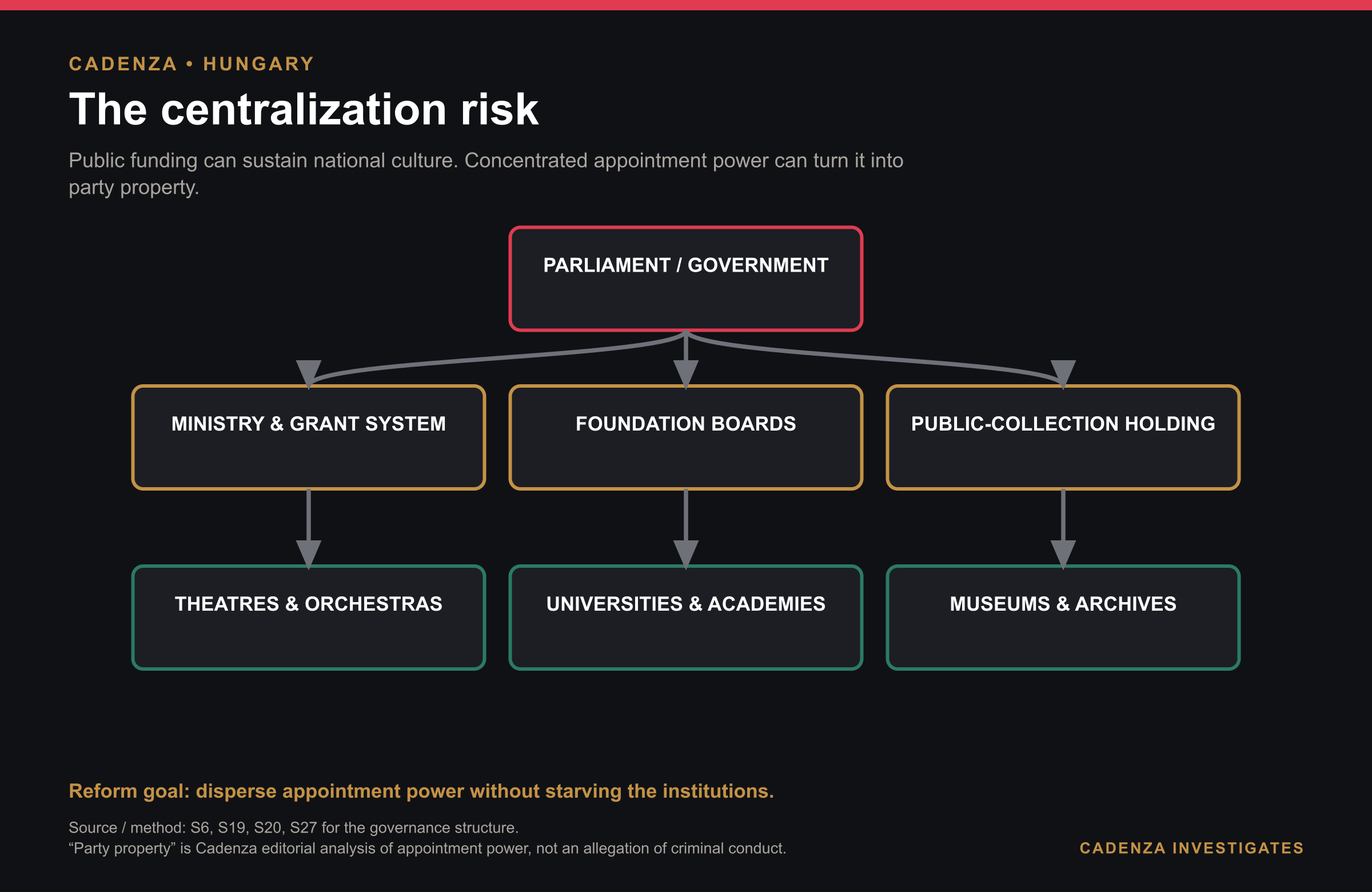
How appointment power flows through the cultural system. The structure shown is documented; the reading of it is not. “Party property” is Cadenza's editorial analysis of concentrated appointment power, not an allegation of criminal conduct against any individual or institution.
Supporters argued that the model created continuity, flexibility and insulation from daily ministerial politics. Critics argued that boards filled with government allies could control public assets beyond electoral accountability.
The European Commission and Council treated conflicts of interest around such trusts as a risk to the EU budget. New legal commitments with affected entities were restricted, and twenty-one Hungarian universities became entangled in the Erasmus and Horizon dispute. [S6][S19][S20]
Brussels was not deciding whether Hungarian universities should teach Bartók or Beethoven. It was addressing governance and financial-interest concerns.
That distinction matters.
The new government should not simply seize the foundations and fill them with Tisza allies. That would confirm that the institutions are political property.
The correct reform is structural:
- fixed, staggered terms;
- transparent selection;
- conflict-of-interest rules;
- published compensation;
- senate and faculty representation;
- independent audit;
- judicial review;
- restrictions on serving party officials;
- reversion clauses for public assets if governance standards fail.
The objective is not to return every institution to direct ministerial command. It is to make independence real rather than partisan.
13. The National Cultural Fund scandal
The strongest argument for audit arrived not as theory but as a criminal case.
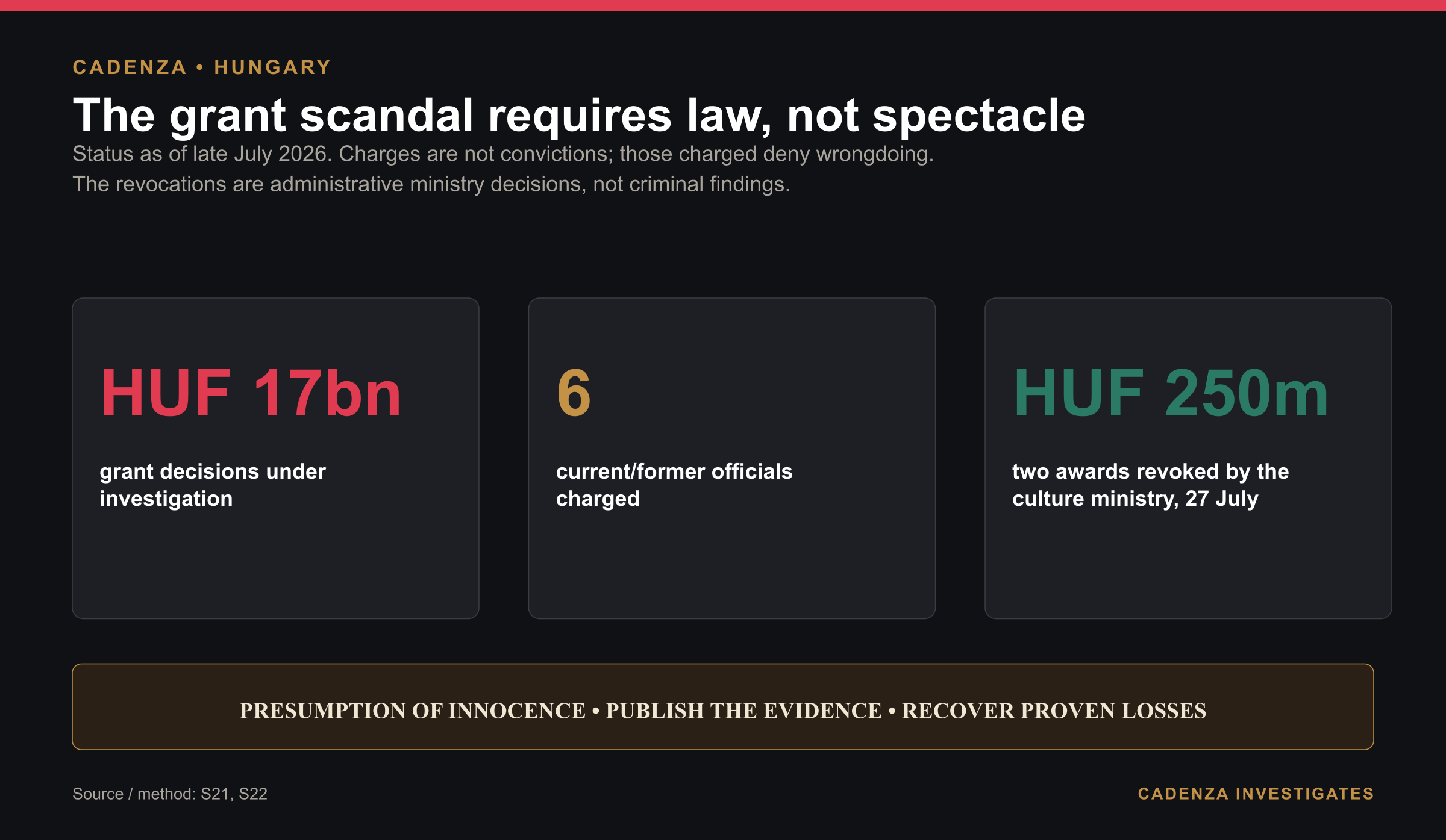
The National Cultural Fund investigation, as it stands. Status as of late July 2026. Charges are not convictions, and those charged deny wrongdoing. The award revocations are administrative decisions by the culture ministry, not criminal findings. The presumption of innocence applies in full to every person named or unnamed in this case.
In 2026, six current and former officials were charged in an investigation into the suspected misuse of about HUF 17 billion in National Cultural Fund grants. Reporting described suspected manipulation of applications and public funds. The six have denied wrongdoing, and Fidesz has accused the governing Tisza party of using legal means against it. These are allegations and ongoing proceedings, not final convictions. [S21][S22]
Separately from the criminal case, Culture Minister Zoltán Tarr said in July 2026 that the ministry had revoked two awards worth some HUF 250 million, saying the applications contained false information. That is an administrative decision by the minister, not a criminal finding, and the recipients have not publicly responded. [S22]
This is exactly why the new government must investigate.
It is also why it must resist spectacle.
A grant scandal can be used in two ways:
- to build transparent institutions;
- to justify replacing one patronage network with another.
The public needs a complete ledger:
- which programmes were affected;
- which applications were manipulated;
- which officials or intermediaries had authority;
- what money was paid;
- what money was stopped;
- what projects were legitimate but caught in the freeze;
- whether independent applicants were disadvantaged;
- what controls failed.
Until courts decide individual guilt, allegations must remain allegations.
But the policy failure is already visible: a system capable of being steered informally is not sufficiently protected.
14. Independent excellence cannot live on uncertainty
The Budapest Festival Orchestra is one of Hungary’s strongest international cultural brands and one of the clearest tests of whether public policy can support excellence without demanding obedience.
Iván Fischer has been publicly critical of Orbán. The orchestra has repeatedly faced funding uncertainty and political conflict. In 2025, Fischer described a gap of roughly HUF 700 million between expected and secured state support and said the ensemble depended on last-minute government decisions. [S23]
The details of any annual funding dispute can be debated. The principle cannot.
An internationally successful orchestra should not be made financially unstable because its music director criticizes the government. Nor should the new government reward it merely because Fischer opposed Orbán.
The answer is multi-year funding tied to published outputs and independent review.
The same rule should protect institutions across the political spectrum.
A conservative theatre and a liberal orchestra should both know the criteria before they apply.
15. The Opera itself became political ground
Even a successful institution can become trapped by political power and internal distrust.
In 2024, Opera employees staged a five-day strike over pay and the absence of a collective agreement. Management and the unions eventually signed a new agreement, but the conflict was followed by layoffs. Union representatives alleged retaliation; general director Szilveszter Ókovács denied that the dismissals were punishment for striking. [S24]
That dispute is not the current state of the institution. On 30 July 2026, the day before this investigation's dateline, the culture state secretary announced that a team of experts had arrived at the Hungarian State Opera to begin an examination of its legality, professional standards and efficiency. Cadenza takes no view on what that examination will find. It is precisely the kind of documented, procedural review this investigation argues for — and it is the opposite of the summary dismissal it argues against. The distinction matters: an audit that publishes its methodology and lets the institution answer is legitimate whoever ordered it, and a purge dressed as an audit is not.
The facts do not justify reducing the entire institution to one labour conflict. They do demonstrate why political loyalty is a useless test of management. A national opera house must be able to prove that it treats its workforce lawfully, negotiates in good faith and publishes enough information for outsiders to distinguish artistic necessity from administrative intimidation.
Cadenza has documented what that looks like elsewhere: the exile of English National Opera, a functioning company uprooted by a funding decision taken faster than any assessment of its consequences.
The new government should not retaliate against the Opera’s leadership for its relationship with the previous administration. It should evaluate management through:
- artistic results;
- finances;
- workforce relations;
- procurement;
- audience development;
- governance;
- professional conduct.
If leadership is changed, the process should be open, time-limited and internationally credible.
A purge would make the Opera more political, not less. An automatic extension would do the same.
PART V — BRUSSELS IS NOT HUNGARY’S CURATOR
16. What the European Union is entitled to demand
The European Union has a legitimate interest in whether its money is protected.
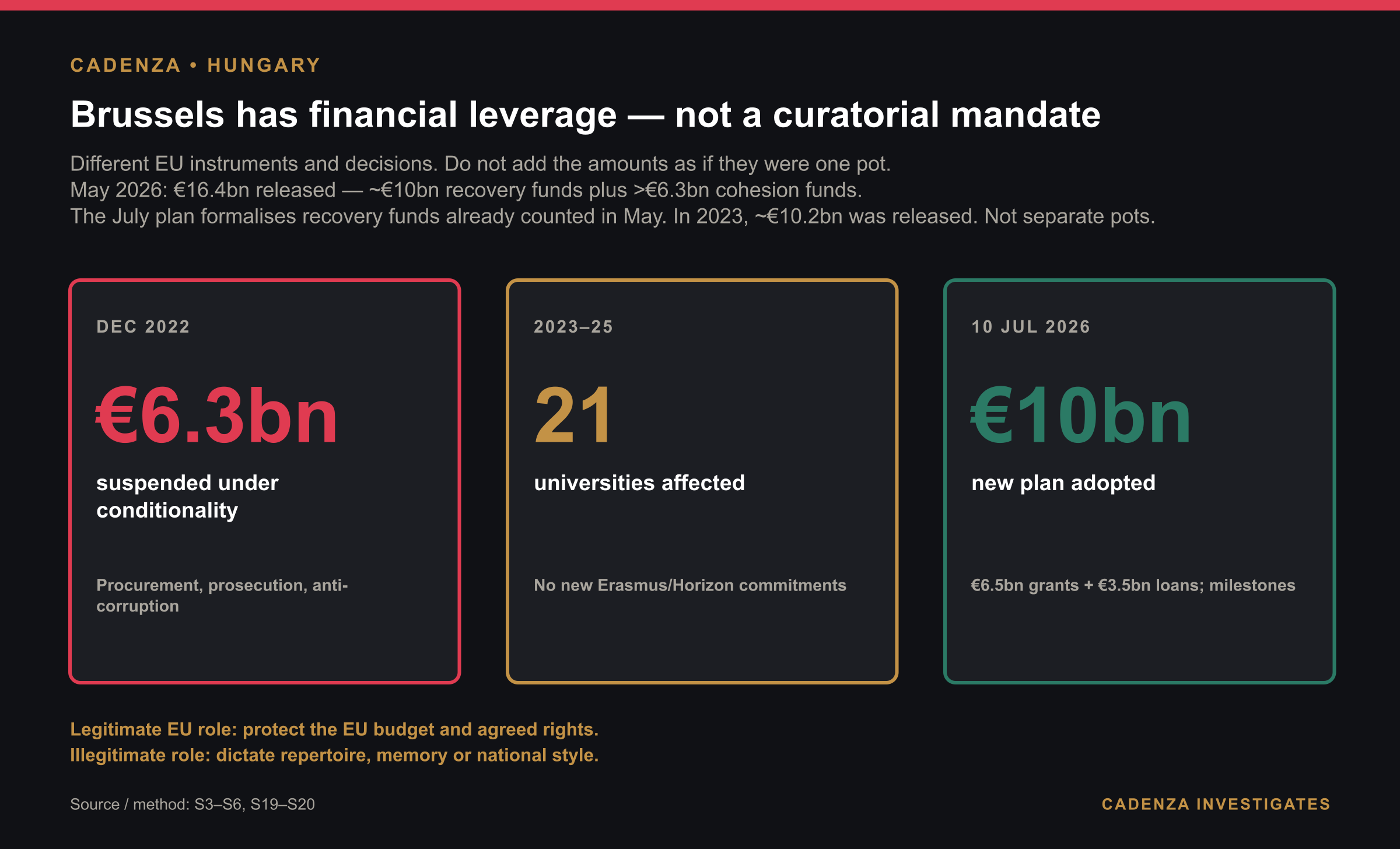
What financial leverage Brussels actually holds. The €6.3bn suspension, the release agreement and the new recovery plan are separate EU instruments and separate decisions. They are not additive.
In December 2022, the Council suspended €6.3 billion in commitments under the rule-of-law conditionality mechanism. The stated concerns involved public procurement, prosecutorial effectiveness and anti-corruption safeguards. The Council explicitly described the mechanism as protection of the EU budget. [S6]
That is not cultural imperialism.
If EU funds are awarded through rigged tenders, diverted to political networks or insulated from prosecution, other European taxpayers are entitled to demand reform.
Hungary voluntarily joined a union with common financial rules. Sovereignty does not mean an unconditional right to someone else’s budget.
The freeze was never absolute, and it did not outlast the disputes that caused it. In 2023 the Commission found that the previous government had carried out sufficient reforms to release around €10.2 billion — money unfrozen under Viktor Orbán, not after him. [S4] The new prime minister then met the Commission president in April 2026 and described the talks on the remaining frozen funds as successful. [S3] The following month the Commission agreed to unlock €16.4 billion — reported as roughly €10 billion in recovery funds and more than €6.3 billion in cohesion funds. [S4]
That sequence is the strongest evidence for what Brussels’ leverage actually is. The money was withheld over procurement, prosecution and conflicts of interest, and it was released when those conditions were addressed. Neither decision document required Hungary to change a programme, a repertoire or a national narrative. The lever was financial and procedural, and it moved when governance moved.
The new Hungarian government’s 2026 agreement with the EU should allow roughly €10 billion to be disbursed through a new recovery plan—around €6.5 billion in grants and €3.5 billion in loans—if milestones are met. The Council says the plan includes stronger anti-corruption measures, transparency, procurement safeguards, stakeholder involvement, judicial independence and rule-of-law measures. [S5]
Those conditions can strengthen Hungary.
17. What Brussels is not entitled to demand
Financial oversight is not a mandate to design national identity.
The European Commission should not use informal leverage to decide:
- which historical narratives Hungarian museums may present;
- which composers receive national emphasis;
- whether Christian, conservative or patriotic programming is aesthetically legitimate;
- which artistic leaders are politically acceptable;
- whether a cultural project is “European enough” in tone;
- whether Hungary must become culturally smaller to demonstrate compliance.
There is an essential boundary.
The EU can require clean procurement. It cannot require ideological sameness.
It can require independent courts. It cannot appoint the artistic director of the Opera.
It can require conflict-of-interest safeguards. It cannot decide whether the House of Music is too national.
It can protect its budget. It cannot claim Hungary’s cultural imagination.
This is where Ursula von der Leyen’s Commission must be watched carefully—not because every condition is illegitimate, but because financial dependency can blur formal and informal power.
When billions are frozen, governments listen. The public deserves to know exactly which conditions are legal requirements, which are negotiated reforms and which are political preferences communicated behind closed doors.
Every EU–Hungary agreement should publish:
- the milestone;
- the legal basis;
- the responsible authority;
- the verification method;
- the payment attached;
- the cultural or educational institutions affected;
- the appeals process.
Transparency protects both Hungary and the Commission from propaganda.
18. The universities prove the danger of entanglement
The Erasmus and Horizon dispute showed how governance problems can spill into student and research life.
The Commission’s restrictions on legal commitments with public-interest trusts affected twenty-one Hungarian institutions. Students, teachers and researchers who had not designed the governance model became collateral participants in a conflict over boards and conflicts of interest. [S19][S20]
Orbán’s defenders blamed Brussels for punishing young people.
The Commission blamed the Hungarian governance structure.
Both descriptions contain part of the truth.
A system that places universities under politically connected boards creates a predictable vulnerability. An EU response that blocks broad categories of opportunity can impose costs far beyond the individuals responsible.
The lesson for culture is clear: institutional capture makes national institutions easier for external actors to pressure.
Real autonomy is therefore a sovereignty policy.
19. Do not trade cultural control for fiscal rescue
Magyar’s government needs EU money. Hungary faces fiscal pressure, public-service demands and the costs of transition. The promise of billions creates an incentive to demonstrate rapid alignment.
That is understandable.
It is also dangerous.
A government that defines itself through “returning to Europe” may overcorrect by treating domestic cultural scepticism as proof of backwardness and Brussels approval as proof of quality.
Hungary does not need to choose between Orbán’s party-state and a European technocracy.
It can build a third model:
- national in purpose;
- plural in expression;
- clean in procurement;
- independent in governance;
- European in cooperation;
- sovereign in artistic judgment.
That should be the standard against which every reform is measured.
PART VI — MAGYAR’S TEST
20. A two-thirds majority is not a moral exemption
Magyar campaigned against concentrated power and then won concentrated power.
Tisza’s two-thirds majority gives the new government the ability to reverse constitutional arrangements, replace officeholders and reconstruct institutions at remarkable speed. The removal of President Tamás Sulyok’s term through constitutional amendment demonstrated how quickly that power can be used. [S2]
Orbán’s defenders are right to be suspicious of any government promising to cure institutional capture by exercising unchecked authority.
Magyar’s supporters are right that some entrenched structures cannot be reformed without decisive action.
The answer is not paralysis. It is procedure.
Every cultural intervention should pass five tests:
- Evidence — What specific failure is documented?
- Authority — What law permits the intervention?
- Proportionality — Is the remedy narrower than the political temptation?
- Continuity — How are programmes, staff and collections protected?
- Reversibility — Can an independent court or future board review the decision?
A supermajority should make the government more disciplined, not less.
21. Audit, do not humiliate
There is a difference between accountability and ritual humiliation.
Calling every Orbán-era appointee a servant of the regime may be emotionally satisfying. It is not a personnel system.
Some leaders were appointed because they were loyal. Some were both loyal and competent. Some were apolitical professionals who learned to survive. Some may have opposed parts of the system privately. Some institutions succeeded despite political control. Others succeeded partly because the state provided stability.
The government should not make public denunciation the price of continued employment.
Instead:
- require declarations of interests;
- audit contracts;
- review term lengths;
- open future appointments;
- evaluate measurable performance;
- protect whistleblowers;
- remove individuals where misconduct or incapacity is established.
Democracy should not demand a reverse loyalty oath.
22. The preservation doctrine
Cadenza proposes a simple framework for every Orbán-era cultural institution.
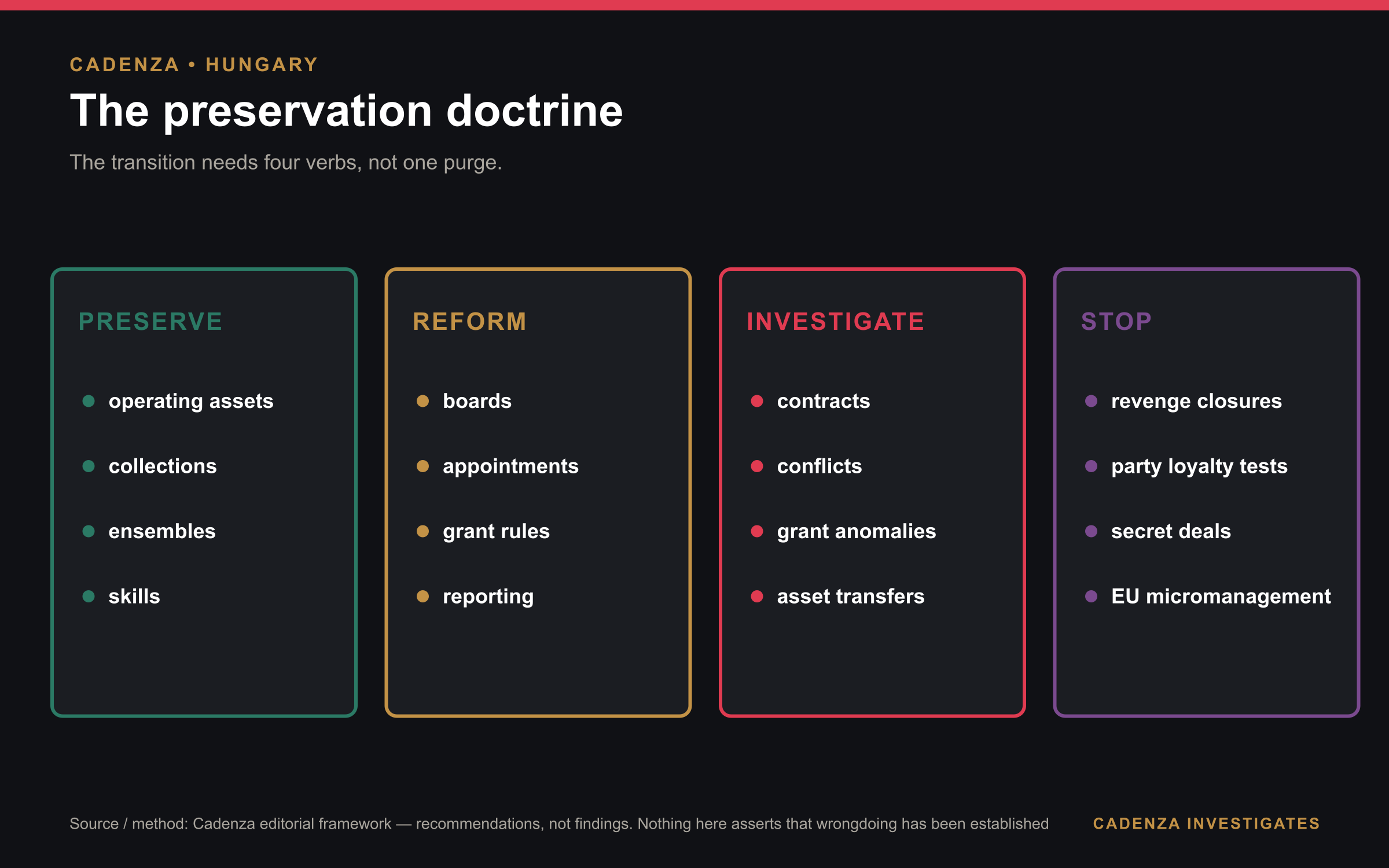
The preservation doctrine in four verbs. A Cadenza framework built on the evidence in this investigation, not a government programme.
Preserve
Preserve functioning assets, collections, orchestras, workshops, educational programmes and public access.
Reform
Reform boards, appointment rules, procurement, conflict safeguards, grant criteria and reporting.
Investigate
Investigate suspicious contracts, unexplained cost increases, manipulated grants, asset transfers and conflicts of interest.
Stop
Stop projects that remain financially irrational, duplicative or operationally unsupported—but only after publishing the evidence and the cost of cancellation.
This framework prevents two dishonest outcomes:
- declaring every completed project sacred;
- declaring every predecessor’s project corrupt.
23. The institution-by-institution test
Hungarian State Opera
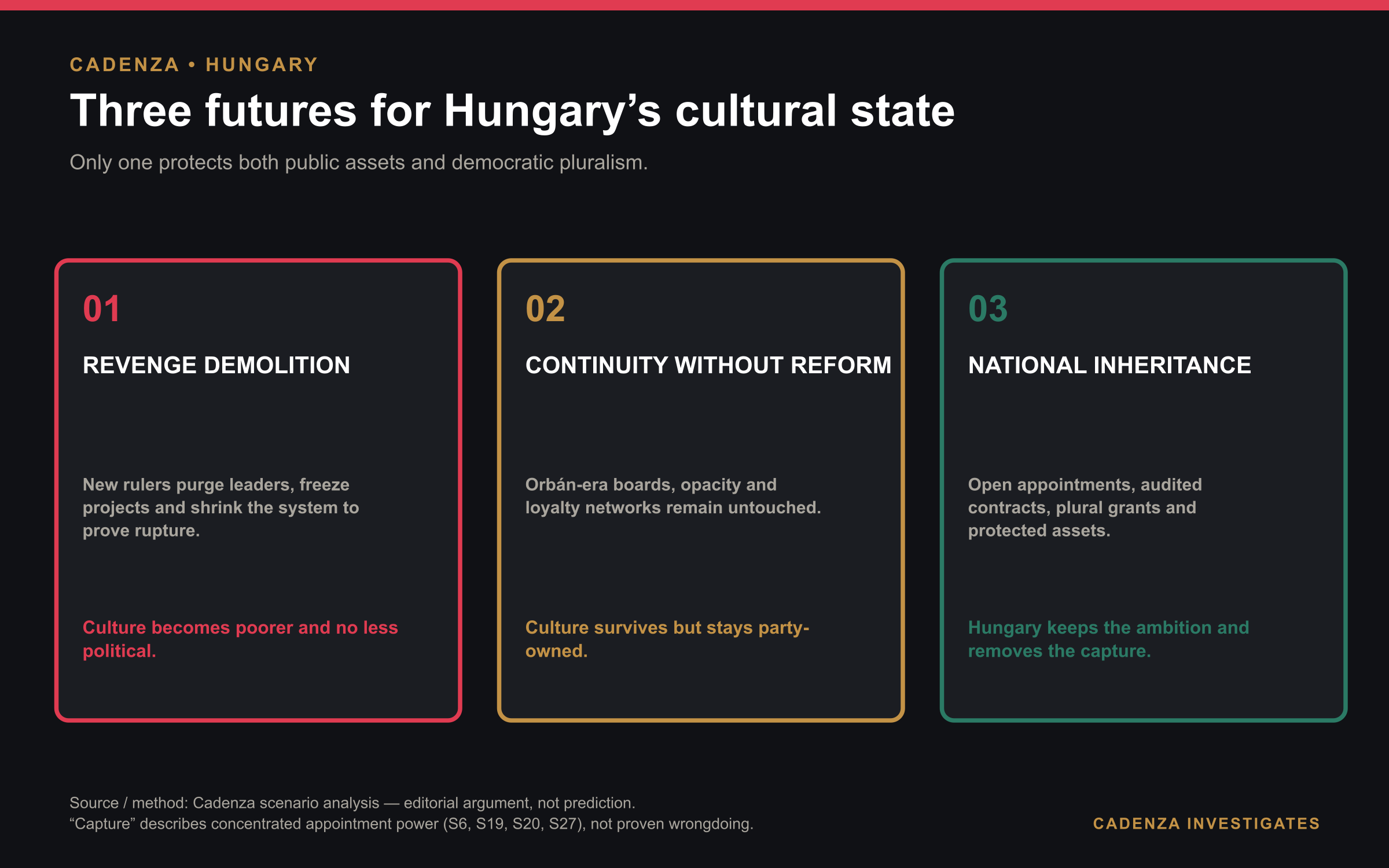
Three futures for Hungary’s cultural inheritance. Three scenarios, offered as analysis rather than prediction. No party or candidate is endorsed.
Preserve. Reform governance. Audit capital contracts.
The institution is active, revenue-generating and nationally important. Leadership succession should be open and professional. There is no case for weakening the company as political theatre.
Eiffel Art Studios
Preserve. Publish utilization and maintenance data. Expand service to the sector.
The complex should support regional companies, training and independent production where capacity permits.
House of Music Hungary
Preserve. Protect programming pluralism. Publish complete operating and capital data.
Millions of visitors make demolition or deliberate marginalization absurd.
Museum of Ethnography
Preserve. Guarantee scholarly independence. Audit procurement and collection governance.
A national museum should not become either Fidesz mythology or anti-Fidesz reeducation.
Public-interest-trust universities
Reform deeply. Do not merely recapture.
Boards must be opened, conflicts restricted and academic self-government restored.
National Cultural Fund
Rebuild controls. Protect legitimate grantees. Publish every award and score.
An alleged corruption network is not a reason to end cultural grants. It is a reason to make manipulation harder.
Budapest Festival Orchestra and independent institutions
Move to transparent multi-year support.
Excellence should not depend on last-minute political discretion.
Unfinished prestige projects
Pause only where necessary. Publish sunk cost, completion cost and operating case.
Cancellation can be more expensive than completion. Completion can also be irrational. The public needs both numbers.
PART VII — THREE FUTURES
24. Future one: revenge demolition
In the first future, Magyar’s government treats cultural institutions as captured territory.
Boards are replaced rapidly. Directors are removed without open competition. Projects are cancelled to signal rupture. Budgets are redirected toward politically friendly institutions. Orbán-era aesthetics become professionally suspect. Brussels praises reform while Hungarian cultural policy becomes dependent on external approval.
The slogans change. The structure does not.
This would be the worst outcome because it would validate the belief that public culture belongs to whoever controls parliament.
25. Future two: continuity without reform
In the second future, fear of destabilization becomes an excuse to leave everything untouched.
Opaque foundations remain opaque. Grant systems remain vulnerable. Long appointments become permanent. Independent artists continue to rely on discretion. Successful buildings mask governance failures.
This would preserve assets while allowing the old political operating system to survive.
It would also guarantee another crisis at the next transition.
26. Future three: the national inheritance settlement
The third future is harder and better.
Hungary formally declares major cultural assets a national inheritance independent of party authorship.
It adopts:
- open leadership searches;
- staggered board terms;
- transparent grants;
- protected professional autonomy;
- full procurement publication;
- multi-year operating contracts;
- regional access requirements;
- independent audit;
- judicial review;
- no retaliation for political expression;
- no ideological conditions imposed by foreign funders.
Orbán’s buildings survive.
Orbán’s party ownership does not.
Magyar’s government reforms the system.
Magyar’s party does not inherit it.
Brussels protects its money.
Brussels does not become curator.
That is the settlement Hungary needs.
PART VIII — THE VERDICT
27. Orbán built it. Hungary owns it.
The phrase “what Orbán built” must be used carefully.
He built a political system. He also presided over a period of extraordinary cultural construction. The two are intertwined, but they are not identical.
The political system belonged to Fidesz.
The cultural assets belong to Hungary.
That means Orbán cannot claim personal ownership of the achievement. It also means his opponents cannot erase it without damaging the country.
A restored opera house is not a ballot paper.
A museum is not a party manifesto.
A rehearsal studio is not a loyalty oath.
A public orchestra should not have to choose between national support and artistic freedom.
28. What the new government must prove
Péter Magyar must prove that democratic repair is not another form of conquest.
He must show that:
- investigations lead to evidence, not television spectacle;
- public assets remain public;
- competent professionals are not removed for association alone;
- independent institutions receive fair support;
- the opposition is allowed cultural space;
- Hungarian identity is not treated as an Orbán trademark;
- EU cooperation does not become cultural submission;
- Tisza’s supermajority is governed by rules stronger than its own confidence.
The transition will be judged not by how many Orbán appointees are humiliated, but by whether Hungarian institutions become freer, cleaner and more durable.
29. What Orbán’s movement must admit
Fidesz must also decide whether it loves Hungarian culture or merely wants credit for it.
If the inheritance is truly national, Orbán’s movement should support:
- transparent audits;
- open appointments;
- conflict rules;
- protection for critical artists;
- public access to contracts;
- governance reforms that prevent Tisza from doing what Fidesz did.
A party that resists every safeguard confirms the accusation that the institutions were built as instruments of control.
The best defense of Orbán’s cultural achievement is to make it impossible for any future government to own.
30. What Ursula von der Leyen must understand
The Commission has leverage. It also has limits.
It can demand that European money be protected. It can require milestones that Hungary accepted. It can verify procurement, judicial independence and conflict-of-interest reform.
It should not confuse compliance with cultural alignment.
Hungary is not an administrative province of Brussels. Its cultural institutions do not require ideological certification from the Commission.
Europe is strongest when national cultures remain distinct enough to disagree.
A Union that protects financial integrity while respecting cultural sovereignty is defensible.
A Union that uses money to make national culture politically uniform will produce backlash—and deserve it.
31. The line that should govern the transition
The country does not need to choose between corruption and destruction.
It can prosecute wrongdoing without closing institutions.
It can remove conflicts without removing ambition.
It can restore academic and artistic freedom without treating national tradition as suspect.
It can work with the European Union without outsourcing its cultural judgment.
It can acknowledge Orbán’s achievement without restoring Orbán’s power.
Do not destroy what Orbán built. Take it away from every party—including Orbán’s—and give it permanently to Hungary.
That is the line.
That is the test.
And that is how a cultural renaissance becomes a national inheritance rather than a ruler’s monument.
PART IX — THE MONEY AND THE WORKERS
32. Buildings are not culture without people
The Orbán-era cultural story is often photographed from the street: façades, plazas, foyers, opening ceremonies. The less visible achievement—and the less secure one—is the workforce inside.
An opera house is only as strong as its rehearsal pianists, librarians, dressers, wig makers, carpenters, stage managers, choristers, dancers, répétiteurs, administrators, cleaners and technicians. A museum depends on curators, registrars, conservators, educators, security staff and researchers. A regional cultural centre depends on people who know the community well enough to make the building matter.
From January 2026, a government decree embedded a 15 percent wage increase across organizations performing public cultural functions. Official and MTI-linked accounts said the measure covered roughly 41,000 workers across state, municipal, church and civil institutions. [S17][S18]
That policy should be preserved unless the new government can replace it with something demonstrably better.
The temptation under fiscal pressure will be to honor the headline increase while allowing vacancies, overtime, freelance fees and non-wage operating budgets to absorb the cost. A nominal raise can coexist with an institutional cut if the state does not fully fund the employer’s total payroll impact.
The new government should therefore publish:
- the gross cost of the wage measure;
- the amount transferred to each institution;
- the number of workers covered;
- vacancy and turnover rates;
- median pay by occupation;
- the share of institutions forced to reduce staff or programming after the increase;
- whether municipal and civil organizations received equal treatment.
This is where Orbán’s cultural legacy can be quietly dismantled without a single building closing.
A theatre that loses experienced technicians is damaged even if its façade remains illuminated.
33. The theatre network
The outgoing government also committed large-scale support to jointly operated theatres. A 2025 framework described at least HUF 25 billion annually, including roughly HUF 21.8 billion for operations and HUF 3.2 billion for wage support across 37 theatres. [S25]
That figure deserves the same treatment as every other government announcement: verification, distribution data and performance reporting.
But the structure is important. Hungary maintained a national theatre ecology in which municipal and state responsibility overlapped. The arrangement was politically vulnerable because agreements and allocations depended heavily on ministerial discretion.
Magyar’s government should not solve that problem by abandoning the co-funding model.
It should replace discretion with a formula combining:
- base institutional support;
- audience reach;
- children’s and educational programming;
- Hungarian-language repertory;
- touring and regional service;
- artistic risk;
- workforce obligations;
- independent peer assessment;
- protection for minority and experimental work.
No formula can remove politics entirely. It can make punishment more expensive and visible.
34. The fiscal trap
Magyar inherited a budget problem as well as a cultural inheritance.
Reuters reported in July that the new government expected the 2026 deficit to exceed 7 percent of GDP, potentially the largest in the European Union, and blamed pre-election spending under Orbán. [S26]
That creates a genuine constraint.
A government facing hospitals, schools, debt service and social need cannot treat every cultural budget as untouchable. Nor should culture demand exemption from efficiency.
But fiscal pressure makes prioritization more important, not less.
There are three bad ways to cut culture:
- across-the-board percentage reductions that punish efficient and inefficient institutions equally;
- politically selective cuts disguised as fiscal necessity;
- capital preservation combined with programme hollowing.
The better method is public triage.
For each major institution, the government should publish a five-year contract containing:
- guaranteed base support;
- required public outputs;
- own-revenue expectations appropriate to the art form;
- maintenance funding;
- workforce safeguards;
- audit rules;
- a contingency mechanism for fiscal emergencies.
A country with a seven-percent deficit may need restraint. It does not need vandalism.
35. The €10 billion temptation
The Council’s July 2026 decision approving a new Hungarian recovery plan could permit €10 billion in disbursements—€6.5 billion in grants and €3.5 billion in loans—if milestones are met. [S5]
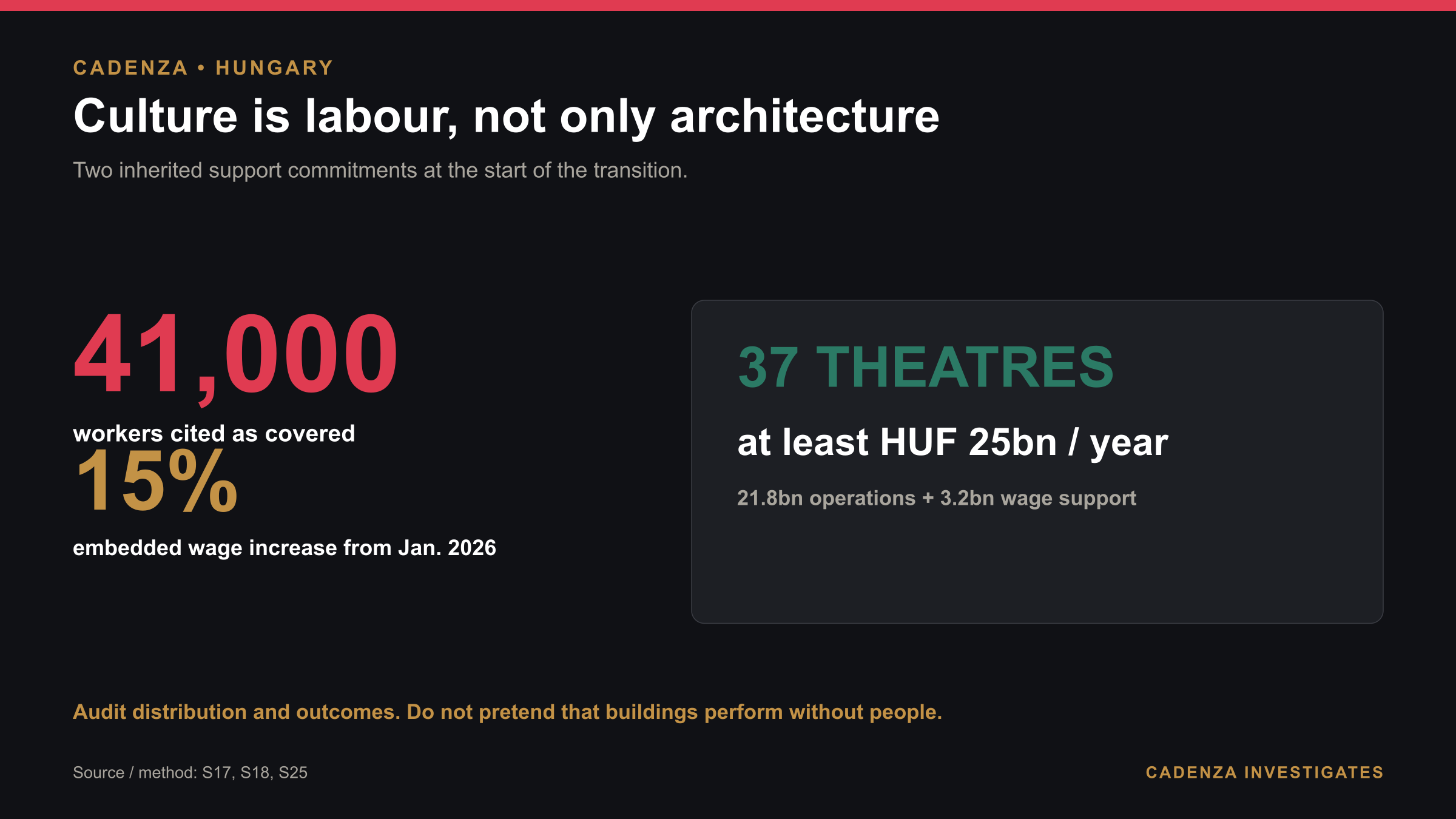
The cultural workforce and the theatre network. Two inherited support commitments at the start of the transition. Audit distribution and outcomes; do not assume buildings perform without people.
That sum is so large relative to annual cultural budgets that it can distort politics even when none of it is formally designated for opera or museums.
EU money can relieve fiscal pressure, support infrastructure and lower the temptation to cut culture. It can also create a political market in which every reform is sold as the price of “unlocking Brussels.”
The new government should publish a clear boundary document stating:
- which EU milestones directly affect cultural or educational institutions;
- which funds can finance culture-related infrastructure or digitization;
- which governance changes apply to universities, museums or foundations;
- which decisions remain exclusively national;
- what commitments were made in private negotiations.
The point is not to reject EU money.
The point is to prevent money from becoming a substitute for democratic explanation.
PART X — THE CULTURAL STATE AFTER ORBÁN
36. The problem of centralization
Orbán’s cultural policy often treated fragmentation as weakness.
Institutions were merged, coordinated or placed under broader centres. The logic was administrative efficiency and a unified national-cultural strategy. The risk was concentrated command.
The 2024 creation of a coordinated public-collection structure around the Hungarian National Museum and other institutions was presented as a way to express the unity of Hungarian culture. [S27]
Unity can be a curatorial idea.
It becomes a political danger when one leadership chain controls collections, appointments, budgets and historical interpretation across institutions that should be capable of disagreement.
The new government must decide whether to dismantle such structures, decentralize them or keep them with stronger safeguards.
The answer should depend on function.
Shared procurement, conservation laboratories, digitization, storage and security can produce real efficiencies.
Centralized historical interpretation does not.
Hungary should separate administrative cooperation from intellectual command.
37. Museums must be allowed to disagree with the government
A national museum has obligations to the nation, but the nation is not identical to the cabinet.
Curators should be able to present contested history, migration, religion, empire, communism, nationalism, minority experience and European integration without receiving partisan instructions from either Fidesz or Tisza.
The new government should establish museum charters guaranteeing:
- professional control of exhibitions;
- transparent director searches;
- scholarly advisory boards;
- publication of donor and sponsor influence;
- access to archives;
- protection against ministerial removal for curatorial disagreement;
- plural interpretation of contested periods.
This is how Hungary protects national culture from becoming either propaganda or imported orthodoxy.
38. The mistake of symbolic cleansing
Transitions love symbols because symbols move faster than systems.
Flags are returned. Names are changed. portraits are removed. Boards are dissolved. Opening ceremonies are reframed.
Some symbolic changes are necessary. Others become substitutes for governance.
A government can remove every Orbán plaque and leave procurement opaque.
It can rename a foundation and keep the same patronage logic.
It can install an EU flag and still centralize decisions through a two-thirds majority.
Hungary should judge reform by institutional behaviour, not iconography.
The most convincing proof of change would be for Magyar’s government to protect a conservative artist who attacks Magyar, while funding that artist through the same rules that protect a liberal artist who attacked Orbán.
That would demonstrate a new system.
39. The difference between continuity and surrender
Preserving the inheritance does not mean retaining every Orbán-era institution in its current form.
Some structures were created precisely to prevent electoral change from reaching public assets. Some appointments may be too long. Some boards may lack independence. Some operating models may be financially weak.
Continuity means preserving the public purpose while reforming the control system.
Surrender means allowing fear of disruption to block accountability.
The balance is difficult because every intervention creates operational risk.
That is why the government should stage reform:
First 100 days
- freeze new long-term asset transfers;
- secure records;
- publish board terms and compensation;
- protect ongoing seasons and exhibitions;
- appoint independent audit teams;
- guarantee staff pay and student programmes.
First year
- legislate appointment standards;
- redesign grant systems;
- review foundation governance;
- publish capital-project ledgers;
- negotiate multi-year institutional compacts;
- restore international educational access.
First parliamentary term
- entrench autonomy protections;
- create cross-party cultural oversight;
- complete necessary capital projects;
- measure regional access;
- publish a national cultural balance sheet.
This schedule separates emergency protection from permanent reform.
PART XI — WHAT WOULD DESTRUCTION LOOK LIKE?
40. The early-warning indicators
The article’s headline is deliberately confrontational because cultural destruction rarely arrives under that name.
It arrives as efficiency, modernization, depoliticization, Europeanization or temporary fiscal discipline.
Cadenza would treat the following as warning signs:
- cancelling a functioning institution without published financial analysis;
- removing artistic leaders before an open replacement process exists;
- cutting regional cultural support more sharply than central-government administration;
- replacing Fidesz-linked boards exclusively with Tisza-linked boards;
- tying grants to political declarations;
- allowing EU negotiations to determine programming or historical interpretation;
- selling cultural real estate to cover short-term deficits;
- converting permanent ensembles into project freelancers without artistic analysis;
- freezing grants so broadly that innocent organizations collapse;
- removing conservative or national programming merely because it was favored under Orbán;
- treating every Hungarian cultural claim as nationalist contamination;
- using anti-corruption rhetoric without publishing prosecutions, evidence and recovered sums.
These indicators should be tracked publicly.
41. What preservation does not mean
Preservation does not mean:
- paying unlimited operating deficits;
- completing every announced prestige project;
- protecting leaders from investigation;
- maintaining politically stacked boards;
- refusing EU audit rights over EU money;
- treating national identity as a single official doctrine;
- insulating institutions from audience and financial accountability.
A cultural inheritance is not a museum of administrative mistakes.
It is a duty to carry forward what remains valuable.
42. The independent audit Cadenza would publish
The most useful next step is not another speech. It is a public cultural audit with one row for every major institution and project.
The fields should include:
| Field | Question |
|---|---|
| Asset | What does the public own? |
| Capital cost | What was the final verified expenditure? |
| Contractor | Who was paid and who beneficially owned the company? |
| Operating subsidy | What does the institution receive annually? |
| Own revenue | What does it earn? |
| Public use | Who attends and who cannot? |
| Workforce | How many people and at what pay? |
| Governance | Who appoints the board and director? |
| Political risk | Can a government punish dissent? |
| EU exposure | Which funds or conditions apply? |
| Maintenance | What liabilities arrive in the next decade? |
| Recommendation | Preserve, reform, investigate, complete or stop? |
This would make cultural policy legible to citizens rather than only to ministries and contractors.
PART XII — A MESSAGE TO EUROPE
43. Hungary is not a cautionary exhibit
For years, European debate often treated Hungary as an object lesson: the country that departed from liberal consensus, the country whose elections and institutions became a referendum on the European project.
That framing can become condescending.
Hungary is not a political laboratory owned by Brussels, Washington or Moscow.
Its cultural institutions are not exhibits in a European morality play.
The House of Music should not be praised only when it represents cosmopolitan openness. The Museum of Ethnography should not be criticized merely for taking national culture seriously. The Opera should not be treated as politically suspect because Orbán valued it.
European pluralism means tolerating national confidence, not only national self-criticism.
44. The Commission’s strongest position is restraint
The European Commission gains credibility when it states exactly what it is protecting:
- the EU budget;
- fair procurement;
- judicial enforcement;
- academic freedom;
- conflict-of-interest standards.
It loses credibility when legal conditionality is rhetorically merged with a broader civilizational judgment about which Hungarian politics, identities or artistic values are acceptable.
Von der Leyen should welcome a Hungary that is both European and culturally self-confident.
The Union does not need another standardized capital. It needs Budapest to remain Budapest.
45. The European test
Europe should judge the Magyar government not by how enthusiastically it denounces Orbán, but by whether it builds institutions that would remain fair if Orbán returned.
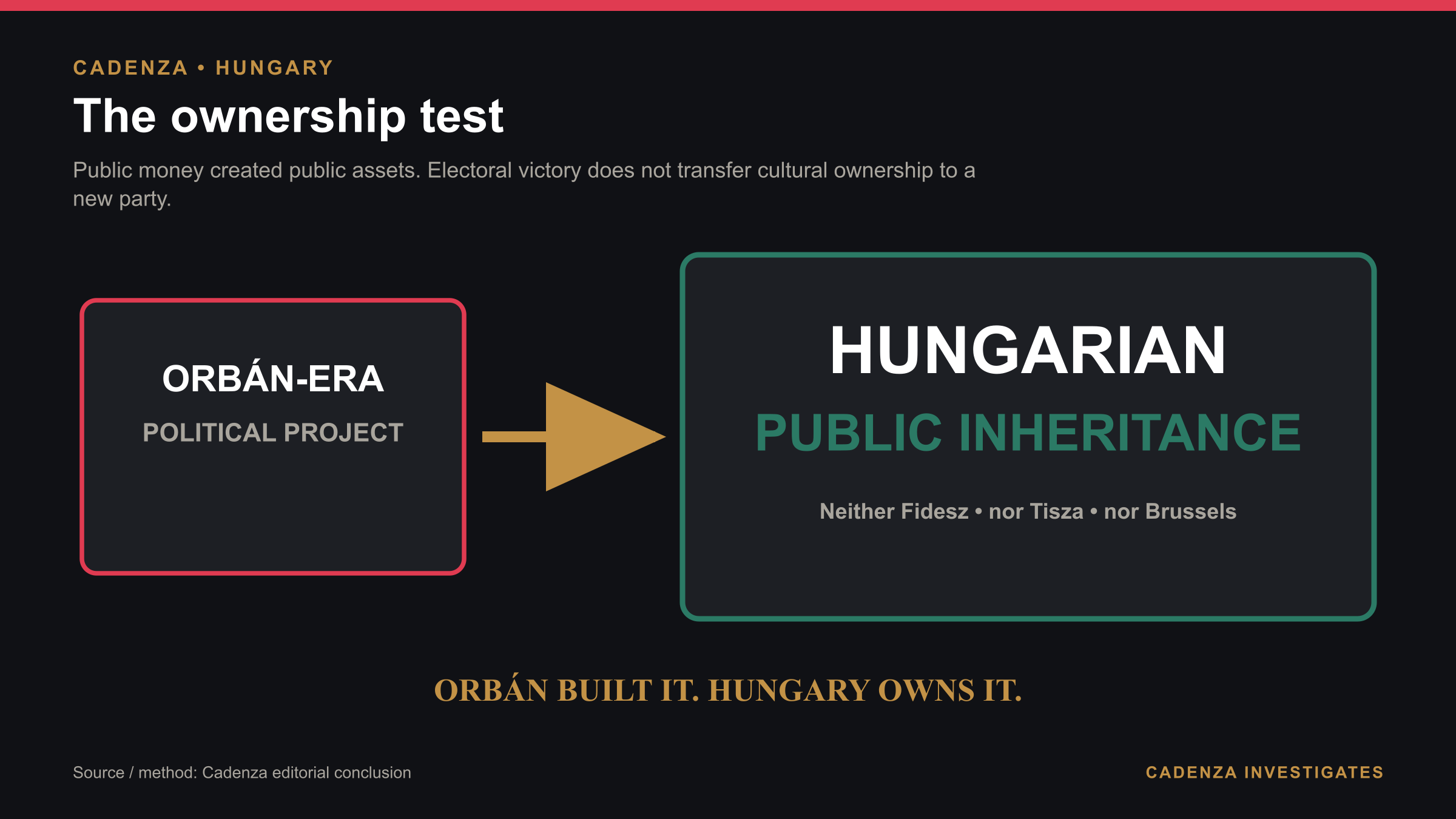
Who owns the inheritance. Cadenza's editorial conclusion. Public money created public assets; electoral victory does not transfer cultural ownership to a party.
That is the real test of reform.
A grant system is independent only if it protects artists the government dislikes.
A university is autonomous only if it can resist both Budapest and Brussels.
A museum is free only if it can present a story that irritates the governing coalition.
An opera house is national only if it belongs to citizens who voted for every party and none.
PART XIII — THE NATIONAL INHERITANCE COMPACT
46. Ten commitments
Hungary should adopt a National Cultural Inheritance Compact with ten commitments:
- No political demolition — no closure or cancellation without published evidence.
- No immunity — every contract and official remains subject to audit and law.
- Open appointments — public criteria, fixed terms and independent panels.
- Plural funding — no viewpoint test for grants.
- Regional guarantee — a defined share of national support outside Budapest.
- Workforce protection — transparent pay and long-term skills planning.
- Public data — annual financial and audience reporting in a common format.
- Asset protection — no transfer or sale without parliamentary disclosure and valuation.
- EU transparency — publish every milestone affecting culture or education.
- Cross-party ownership — major cultural assets formally declared national, not governmental.
47. Why Orbán’s supporters should sign
The compact would protect the projects they value from a hostile government.
It would prevent Tisza from filling boards through the same political logic.
It would preserve national-cultural programming.
It would make it harder for Brussels to influence institutions informally.
48. Why Orbán’s critics should sign
The same compact would expose procurement, limit patronage, protect critical artists, open appointments, restore academic autonomy and prevent public assets from being locked inside partisan foundations.
That is why the settlement can work.
It asks neither side to surrender its account of the past.
It asks both sides to surrender ownership of the future.
METHODOLOGY AND LIMITATIONS
This article distinguishes among official government claims, institutional self-reporting, independent reporting, criminal allegations and established legal findings.
The HUF 889.9 billion / 103-project figure is the Orbán government’s own expected-gross-value statement of February 2022, not a final audited expenditure total. [S7]
Visitor and revenue figures are reported by the institutions or through MTI and should be verified against audited annual accounts before publication where those accounts are available. [S8][S9][S12][S14]
Historical Liget cost estimates are snapshots from 2019–2020 and are used to demonstrate cost escalation and procurement concerns, not as final 2026 totals. [S15][S16]
The National Cultural Fund criminal case was ongoing at publication. Defendants and suspects are presumed innocent unless convicted. [S21][S22]
EU funding figures cover different instruments and should not be added casually. The 2022 €6.3 billion suspension, the May 2026 €16.4 billion release and the €10 billion recovery plan the Council approved on 10 July 2026 are separate decisions. They are also related, and must not be read as separate additional pots of money. A fourth figure belongs in the same caution: around €10.2 billion was released in 2023, before the change of government. The May 2026 release was reported as roughly €10 billion in recovery funds plus more than €6.3 billion in cohesion funds, and the recovery plan the Council formally approved on 10 July 2026 is worth the same €10 billion, split into around €6.5 billion in grants and €3.5 billion in loans. Cadenza has not been able to establish from the primary records whether the cohesion money released in May is the identical €6.3 billion suspended in December 2022, and does not assert it. [S4][S5][S6]
On 1 August 2026 Cadenza sent right-of-reply questions to fifteen institutional press offices: the ministry responsible for culture, the education ministry, the Prime Minister's Office, Fidesz, the European Commission, the Hungarian State Opera, Liget Budapest, the House of Music Hungary, the Museum of Ethnography, the Budapest Festival Orchestra, the National Cultural Fund, the Prosecution Service, the Hungarian National Museum and its public-collections centre, and Corvinus University. The full question sets are published alongside this investigation. Replies will be published in full or summarised accurately as they arrive, and this paragraph will record who responded. Two groups were deliberately not approached directly: the six officials charged in the National Cultural Fund case and the recipients of the two revoked awards. Cadenza contacts institutional press offices, not private individuals' personal addresses; both groups are reachable through legal representatives, and the six have denied wrongdoing, as reported by the Associated Press. [S21]
Images
- House of Hungarian Music, Budapest — Photograph: Veronika.szappanos, CC BY-SA 4.0, via Wikimedia Commons.
- The Hungarian State Opera House, Budapest — Photograph: Jeremy Oakley, CC BY 2.0, via Wikimedia Commons.
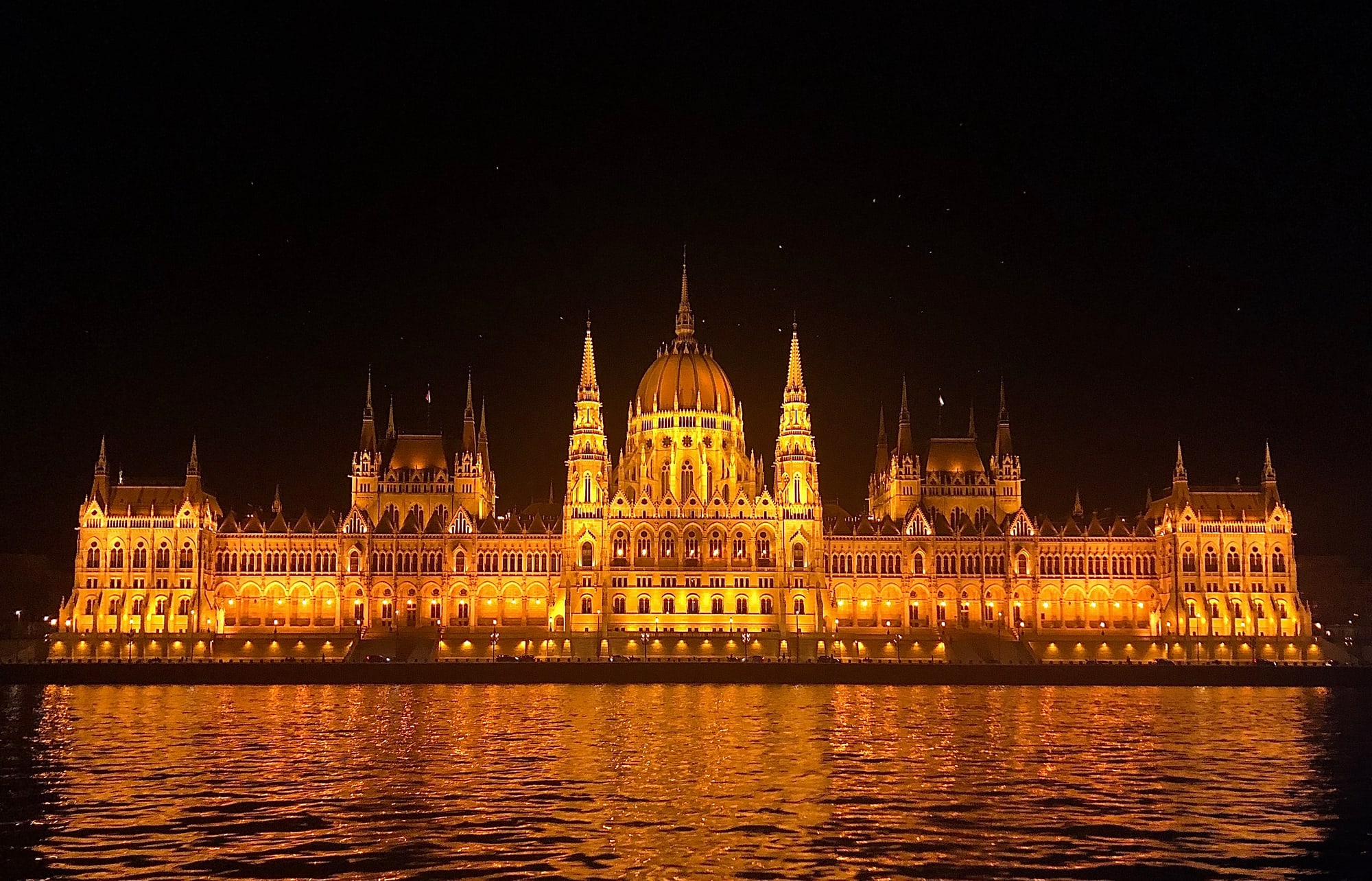
- The Hungarian Parliament at night — Photograph: Pythagoreio, CC BY-SA 4.0, via Wikimedia Commons.
- The Museum of Ethnography, Budapest — Photograph: Pasztilla aka Attila Terbócs, CC BY 4.0, via Wikimedia Commons.
Evidence graphics are original Cadenza analysis; each states its own source and method.
Methodology. This article compares capital-project claims, institutional operating figures, EU financial instruments and employment data — categories that are not equivalent and are not presented as equivalent. Capital costs from different projects and different years are never summed. The €6.3bn suspension, the €16.4bn release agreement and the €10bn recovery plan are separate EU instruments and separate decisions, and are not aggregated. Audience and revenue figures for the State Opera are institutional and MTI reporting rather than audited accounts, and are labelled as such wherever they appear.
Right of reply. Cadenza is seeking comment from the Government of Hungary, the Ministry responsible for culture, Fidesz, the European Commission, the Hungarian State Opera and its general director, Liget Budapest, the House of Music Hungary, the Museum of Ethnography, the Budapest Festival Orchestra, the National Cultural Fund, the Hungarian National Museum, the foundation-run universities and their boards of trustees, and — through their representatives — the six officials charged in the National Cultural Fund case and the recipients of the two revoked awards. Any person or institution named here may respond at any time and this article will be updated to carry the response in full. Corrections are welcomed at hello@cadenza.work.
Images. Hungarian Parliament at night — photograph: Pythagoreio, CC BY-SA 4.0. Hungarian State Opera House — photograph: Jeremy Oakley, CC BY 2.0. House of Hungarian Music — photograph: Veronika.szappanos, CC BY-SA 4.0. Museum of Ethnography — photograph: Pasztilla aka Attila Terbócs, CC BY-SA 4.0. All via Wikimedia Commons. Charts are original Cadenza analysis.*
Related Cadenza coverage.
- Who Really Pays the Musicians? — how public money reaches musicians across Europe, Russia, China, the Gulf and Singapore
- The Most Dangerous Conductor in the World — state power and the classical institution
- The Concert Hall Is Not Your Protest Rally
- Classical Music's Cancel Culture: 20 Years
Sources
Every figure and factual claim in this investigation is traceable to a numbered source below. Citation markers in the text — [S1], [S2] and so on — refer to these entries.
- S1: Hungary’s conservative icon Orbán defeated by centre-right opposition — Reuters · 2026-04-12. Open source ↗
- S2: Hungary parliament passes law to oust president in Magyar’s power shake-up — Reuters · 2026-07-13. Open source ↗
- S3: Hungary’s Magyar says he had successful talks on funds with EU’s von der Leyen — Reuters · 2026-04-29. Open source ↗
- S4: European Union unlocks billions in funding for Hungary after rapid reforms by new leader Magyar — Associated Press · 2026-05-29. Open source ↗
- S5: Recovery and resilience facility: Council greenlights new plan for Hungary — Council of the European Union · 2026-07-10. Open source ↗
- S6: Rule of law conditionality mechanism: Council decides to suspend €6.3 billion — Council of the European Union · 2022-12-12. Open source ↗
- S7: Since 2010, cultural investments worth HUF 890 billion have been launched — Government of Hungary · 2022-02-09. Open source ↗
- S8: Opera closes 2025 with record revenue and major in-house developments — Hungarian State Opera · 2026-01-12. Open source ↗
- S9: Opera House Ends the Year with Revenue of HUF 8 Billion — Hungary Today / MTI · 2026-01-02. Open source ↗
- S10: The Eiffel Art Studios has been officially opened — Hungarian State Opera · 2021-10-26. Open source ↗
- S11: The renovated Opera restored the old splendour for HUF55bn — HVG360 · 2022-03. Open source ↗
- S12: World-renowned Architect of House of Music Hungary Sou Fujimoto Gives Highly Successful Lecture at Expo 2025 Osaka — Liget Budapest · 2025-04-30. Open source ↗
- S13: The New Building of the Museum of Ethnography — Museum of Ethnography · undated institutional page, accessed 2026-08-01. Open source ↗
- S14: Hungarian museum wins iF Design Award for the first time — Museum of Ethnography · 2025. Open source ↗
- S15: City Park construction project cost €367m already; final price may reach €774m — Átlátszó · 2019-05-05. Open source ↗
- S16: House of Hungarian Music construction cost rises above HUF23bn — HVG · 2020-06-25. Open source ↗
- S17: Cultural wage support – KBFT15-E-26 — National Cultural Support Manager · 2025-12-30. Open source ↗
- S18: 15 Percent Wage Increase for the Cultural Sector — Hungary Today / MTI · 2025-11-27. Open source ↗
- S19: EU exclusion from Erasmus affects 21 Hungarian institutions — Telex English · 2023-01-09. Open source ↗
- S20: Hungary: explainer on frozen funds and public-interest trusts — Academic Cooperation Association · 2023. Open source ↗
- S21: Prosecutors raid Fidesz data centre in cultural-grant embezzlement probe — Associated Press · 2026-07-21. Open source ↗
- S22: Culture minister revokes disputed NKA grants — 24.hu · 2026-07-27. Open source ↗
- S23: Budapest Festival Orchestra warned of a HUF700m state-funding gap — Telex · 2025-03-31. Open source ↗
- S24: Opera and unions sign new collective agreement after strike — Hungarian State Opera / 24.hu · 2024. Open source ↗
- S25: Framework promises at least HUF25bn for 37 jointly operated theatres — HVG · 2025-04-09. Open source ↗
- S26: Hungary to launch school-start benefits as deficit exceeds 7% of GDP — Reuters · 2026-07-02. Open source ↗
- S27: Hungarian National Museum Public Collections Center formally established — International Alliance of Museums of the Silk Road / institutional source · 2024-07-26. Open source ↗ Documents consolidation of major national collections and stated cultural-identity mission.
Comments
Sign in to join the discussion.