This investigation compares how public money reaches working musicians in the European Union, in individual European states, and in Russia, China, the Gulf and Singapore. Every figure is traceable to the numbered source register at the foot of this article. The systems compared do not publish the same categories, in the same years, in the same currencies, and no single league table can hold them; where a comparison is imperfect, the article says so in the sentence that makes it. Characterisations of political control rest on documented governance structures, not inference. Right-of-reply questions were put to the institutions and ministries named here on the day of publication, and responses will be published in full as they arrive. Analytical judgements are labelled as Cadenza's own, including the artistic-freedom row of the comparative scorecard, which is editorial judgement and not derived from any source in the register.
Ask Brussels what it does for musicians and the answer arrives in the language of the European project: mobility, cooperation, networks, sustainability, inclusion, resilience, audience development and a portal through which an eligible organisation may submit an application.
Ask Berlin, Vienna or Helsinki and the answer is different. There is an opera subsidy, a municipal orchestra, a publicly financed conservatory, a collective agreement, a broadcasting ensemble, an unemployment system, a pension contribution and a rehearsal room somebody has already paid to heat.
Ask Moscow, Beijing, Riyadh or Abu Dhabi and the answer may be more visible still: a national theatre, a new concert hall, a state orchestra, a competition, a cultural district, a ministry strategy and a leader standing in the front row at the opening.
All three systems insist that they support culture. They are not doing the same thing.
The European Union is not Europe’s ministry of culture. It does not employ the Berlin Philharmonic, operate the Vienna State Opera or pay the salaries of France’s regional orchestras. The treaties deliberately leave culture largely with the member states. Brussels supplements, coordinates and encourages; it is explicitly barred from harmonising national cultural laws. [S1]
That legal distinction is the beginning of this investigation, not a technical footnote. It explains why the EU can be genuinely valuable to musicians while looking embarrassingly small beside the cultural machinery of a national government. It also explains how European politicians can claim continental leadership while the permanent musical institutions remain someone else’s responsibility.
Cadenza followed the money from the von der Leyen Commission’s flagship cultural programmes to Germany and Austria, then outward to Russia, China, Saudi Arabia, the United Arab Emirates, Qatar and Singapore. The comparison does not produce a clean ideological winner. It produces a more uncomfortable map.
Brussels is exceptionally good at helping a musician cross a border. European nations remain far better at giving that musician a job. Centralised states can build faster, employ visibly and turn culture into national spectacle. They can also make the artist dependent on political permission, hide the true cost and decide which voices count as culture at all.
Brussels finances movement. Europe’s nations finance music. Centralised states finance monuments—and sometimes expect obedience in return.
The facts at a glance
- Creative Europe has a seven-year budget of €2.44 billion for 2021–2027. At least 58 percent is reserved for MEDIA, at least 33 percent for Culture and up to 9 percent for cross-sectoral work. [S2][S3]
- Annualised, the entire programme is about €348.6 million. The minimum annualised Culture share is about €115 million for theatre, dance, music, literature, heritage, architecture, design, visual arts and other non-audiovisual fields combined.
- The EU’s adopted 2026 budget contains €192.8 billion in commitments. The annualised Creative Europe total is therefore roughly 0.18 percent of that one-year budget; the minimum annualised Culture share is roughly 0.06 percent. This is a scale comparison between a seven-year average and one annual budget, not identical accounting periods. [S4]
- Culture Moves Europe has €25 million for 2025–2028 and is expected to support around 7,000 artists, cultural professionals and host organisations across multiple cultural sectors. [S5]
- Erasmus+ has an estimated €26.2 billion for 2021–2027. It is not a music programme, but it may be the EU programme that matters most to young musicians because it opens study, teaching and institutional networks across borders. [S9]
- Recovery plans in eighteen member states earmarked about €11.7 billion for cultural and creative sectors. That money is national-plan investment under an EU facility, not a single Brussels artist fund. [S10]
- Germany’s public authorities spent roughly €14.9 billion on culture in 2021, with about €4.6 billion directed to theatre and music. The years and accounting categories differ from the EU figures, so the comparison shows scale rather than efficiency. [S16]
- Austria reported public culture spending equal to 0.74 percent of GDP in 2024 and more than five million visits to theatres and concert halls in the 2023–24 season. [S17][S18]
- Singapore’s grant architecture includes project support up to S$100,000, capability grants up to S$20,000 for individuals and S$75,000 for organisations, a S$100 audience credit and a new S$20 million multicultural arts programme. [S19][S20][S21][S22]
- China’s cultural and related industries generated 20.8254 trillion yuan in business revenue in 2025, while cultural enterprises above the designated size generated 15.2135 trillion yuan. Those figures include digital content, design, advertising, manufacturing and related businesses; they are not orchestra subsidies. [S23][S23a][S24]
- Russia planned about 14.9 trillion rubles in military spending for 2026 against roughly 279.4 billion rubles for the federal Development of Culture programme as enacted—a ratio of approximately 53 to 1. The comparison covers that one federal programme, not all cultural expenditure in Russia. [S30][S31]
These figures cannot be placed in one league table without qualification. They measure different things: programme budgets, national public expenditure, industry revenue, capital investment, military priorities, grants and audience incentives. The purpose of this investigation is not to flatten them. It is to show what each political system chooses to make visible—and what it leaves unsupported.
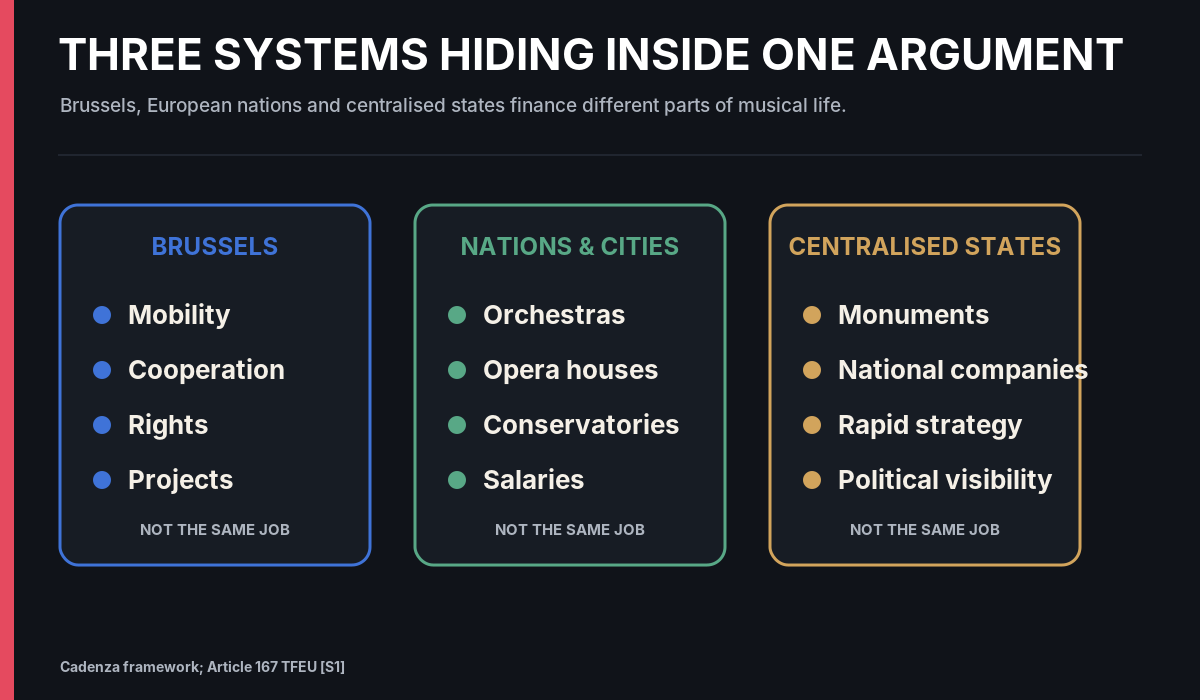
Three different governments fund culture in Europe. The comparison is of roles, not of totals — the EU, the member states and municipalities do not do the same job.
PART I — THE FALSE COMPARISON
1. Brussels is not Europe
The phrase “European cultural funding” hides at least three different governments.
The first is the European Union: treaties, programmes, cross-border calls, educational mobility, rights frameworks and shared regulation. Throughout this investigation, Brussels is shorthand for that layer — the European Union’s institutions, the Commission and its programmes. It never means the city or Belgium’s own national arts funding.
The second is the nation-state: culture ministries, public broadcasters, national theatres, conservatories, tax rules, social insurance and major capital projects.
The third is the region or city: municipal orchestras, opera houses, music schools, rehearsal infrastructure, festivals, libraries and local grants.
A fourth layer—foundations, churches, universities, donors and private sponsors—sits across all three.
When a German orchestra player receives a salary, Brussels is usually not the employer. When an Austrian conservatory maintains a building, the European Commission is not normally paying the electricity bill. When a French regional opera renews a contract, the decision belongs to a national or local structure. Yet all of these institutions are routinely presented abroad as evidence of a European cultural model.
They are European. They are not primarily EU creations.
Article 167 of the Treaty on the Functioning of the European Union is unusually clear. The Union contributes to the flowering of member-state cultures while respecting national and regional diversity. It encourages cooperation and may support or supplement state action. It may not harmonise member-state laws in the field. [S1]
That was not an accidental omission. Culture touches language, identity, education, memory, religion, broadcasting and constitutional traditions. Member states were never going to hand Brussels full authority over repertory, theatres, museums and schools.
The legal design protects pluralism. It also gives Brussels a convenient escape.
When European culture flourishes, the EU can present the continent as a shared civilisation. When an orchestra closes or a freelancer cannot pay rent, responsibility falls back to the member state, the city or the market.
The European Union therefore operates less like a culture ministry than like a railway network. It helps people and projects move. It standardises parts of the track. It connects stations built and financed by others. It can make an extraordinary journey possible. It does not guarantee there will be a job when the train arrives.
2. What does “support” actually mean?
Political systems use the word support because it avoids the harder question: support for whom?
A minister may call a new opera house support for musicians even if most of its budget went to construction companies and imported consultants. A foundation may call a conference support even if artists appear without meaningful fees. Brussels may call a consortium music-sector support even if the final grant pays primarily for administration, research and network coordination. A state orchestra may provide secure salaries while excluding politically unacceptable artists. A mobility grant may transform a young musician’s life while doing nothing about rent or health insurance.
For this investigation, Cadenza separates ten tests:
- Money reaching artists — salaries, fees, commissions, scholarships and direct grants.
- Permanent employment — stable jobs in orchestras, theatres, schools and public institutions.
- Infrastructure — halls, rehearsal rooms, workshops, instruments and production facilities.
- Education — accessible training, scholarships and routes from school to profession.
- Mobility — the ability to study, audition, tour and collaborate internationally.
- Freedom — the ability to create, criticise and refuse political loyalty without losing the profession.
- Accessibility — whether an ordinary musician can realistically reach the programme.
- Transparency — published criteria, awards, accounts, outcomes and conflicts of interest.
- Audience creation — whether policy creates listeners as well as projects.
- Durability — whether support survives elections, commodity cycles, sanctions, wars or the ruler’s change of taste.
No system dominates all ten.
A democratic European state may offer freedom and permanent institutions but bury young artists in gatekeeping and austerity. Brussels may offer transparent calls and mobility while paying few direct salaries. An authoritarian state may build astonishing infrastructure and employ large companies while making support inseparable from state objectives. A small centralised country may coordinate artists, schools and audiences more effectively than a continent—but lack the continental market the EU provides.
The honest comparison is multidimensional. Any article announcing one political winner from a single budget number is propaganda dressed as accounting.
3. The visibility trap
Authoritarian culture is photogenic.
A leader cuts a ribbon. A hall opens. A national orchestra appears beneath a flag. A new district rises from the desert. A gala is broadcast. The state can point to the building and ask critics where their building is.
European support is often less visible. A student spends a semester abroad. An independent ensemble finds partners in three countries. A translator, composer and theatre company share a project. A grant pays travel, accommodation and accessibility costs. Legal rights allow a musician to live and work across borders.
The visible system looks more ambitious because concrete photographs better than legal freedom.
But invisibility can become an excuse for weakness. Musicians cannot live inside a principle. They need money, rooms, contracts and audiences. If Brussels wishes to claim that mobility and networks are equivalent to institutions, it must show where the artist’s livelihood appears in the budget.
That is the central challenge of the EU model: its greatest cultural contribution may be the space in which culture moves, while its direct cultural spending remains too small to match its rhetoric.
PART II — FOLLOW THE BRUSSELS MONEY
4. The €2.44 billion headline
Creative Europe is the European Union’s flagship culture-and-media programme. Its 2021–2027 budget is €2.44 billion—substantially larger than the €1.47 billion assigned to the previous period. The increase deserves credit. Under Ursula von der Leyen’s Commission, Europe did not abolish cultural cooperation during a pandemic, an energy shock and a war. It expanded the programme. [S2]
The headline, however, is routinely misunderstood.
Creative Europe is not €2.44 billion for musicians. It is not €2.44 billion for live arts. It is not even €2.44 billion for non-film culture.
The programme architecture reserves at least 58 percent for MEDIA, at least 33 percent for Culture and up to 9 percent for cross-sectoral work. [S3]
That means the minimum Culture allocation is approximately €805 million across seven years, or about €115 million per year. Music must compete inside that share with theatre, dance, literature, architecture, cultural heritage, design, fashion, visual art, interdisciplinary work, networks and policy initiatives.
The entire programme averages approximately €348.6 million per year. The EU’s 2026 budget contains €192.8 billion in commitments. Put on the same page—not as identical accounting periods, but as a scale test—the whole annualised Creative Europe programme is about 0.18 percent of the annual EU budget. The minimum annualised Culture strand is about 0.06 percent. [S4]
For every €1,000 in the 2026 EU budget, the annualised Creative Europe total equals roughly €1.81. The minimum non-audiovisual Culture share equals roughly sixty cents.
That is not nothing. It is also not a continental cultural state.
{{PHOTO:BRUSSELS}}
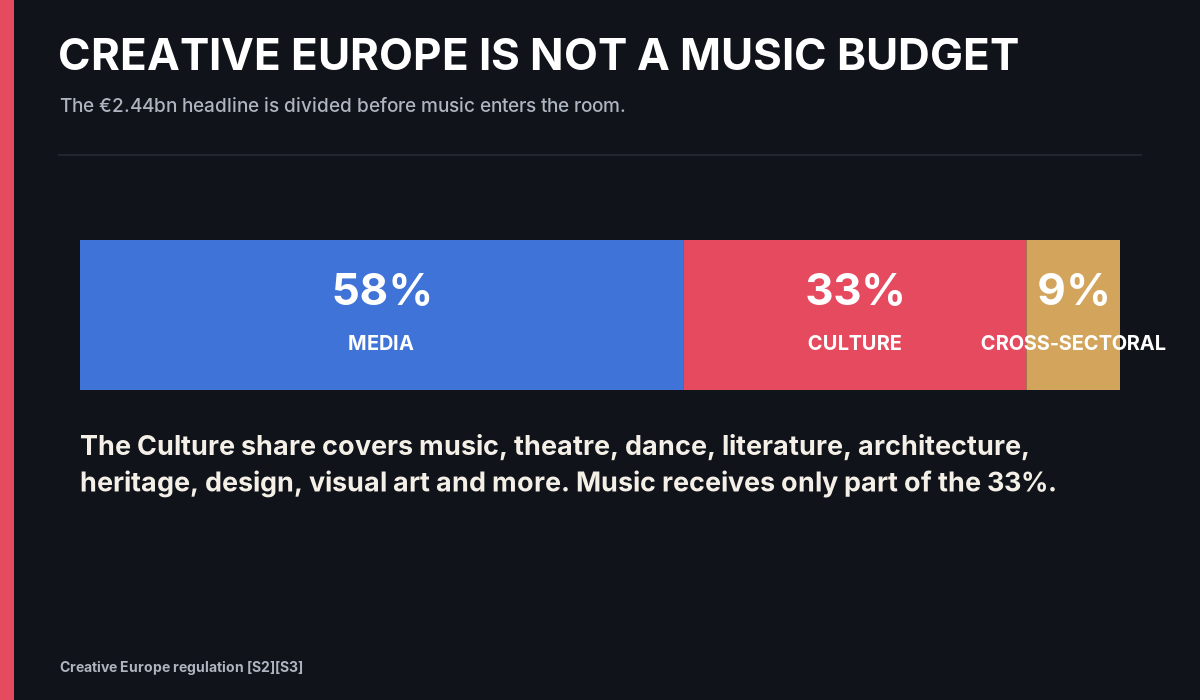
The 33% Culture-strand figure is a minimum for all non-audiovisual Culture activity across the programme. It is not a music allocation.
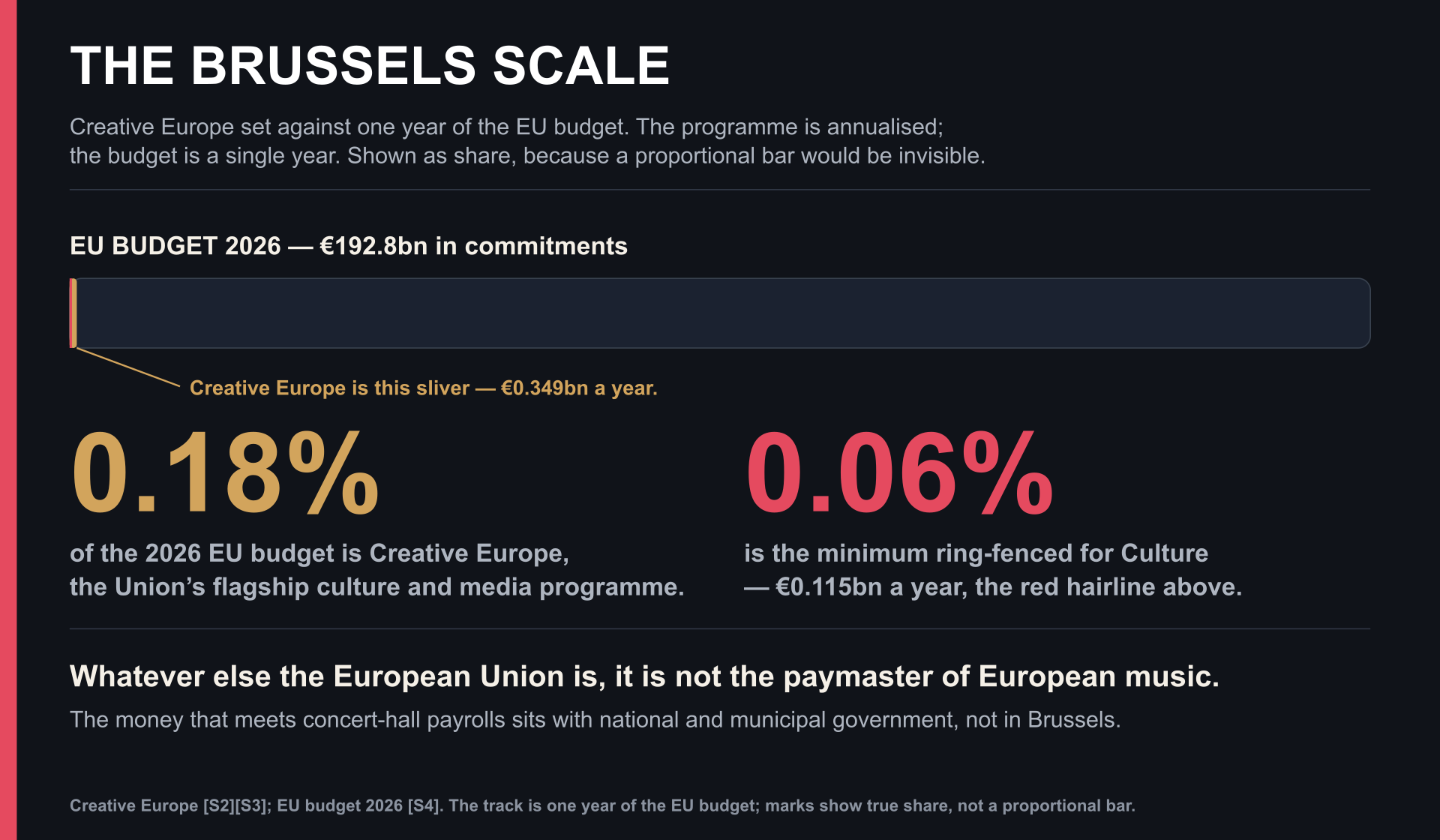
Annualised programme averages set against one year of the EU budget. These are different accounting periods, and the comparison illustrates order of magnitude only.
5. The consortium before the musician
The most influential Creative Europe grants are frequently designed for organisations working across borders. That structure is logical. A European programme should create European cooperation.
It also changes who can access the money.
A freelance violinist does not usually open the funding portal, request an orchestra salary and receive one. An eligible legal entity assembles partners, develops a concept, aligns it with call priorities, creates a work plan, identifies deliverables, estimates co-financing, manages contracts, documents participation and reports outcomes.
The work may be excellent. It may pay artists properly. It may create relationships no national system could create alone.
But the route to the musician passes through an institution.
In the 2024 European Cooperation Projects call, the Commission funded 160 projects with approximately €59.73 million. [S15] The selected projects span many sectors and countries. The number illustrates activity, but it does not tell a freelance musician what percentage of the budget became artist fees, what share paid administration, how many stable jobs were created or what happened after the grant period ended.
This is the project-grant paradox.
A programme can generate hundreds of partnerships and still fail to create a profession. It can map a sector without paying the people who constitute it. It can finance a sustainability framework for touring while the ensemble itself remains financially unsustainable.
The EU’s language often gives the game away: capacity-building, networking, innovation, transition, dissemination, audience development, knowledge exchange, data collection and good practice.
These functions matter. But musicians have heard the vocabulary for years while their work remains episodic.
A mature policy should be able to answer four brutally simple questions for every grant:
- How much reached artists as compensation?
- What was the median artist payment?
- How much was spent on administration and consultants?
- How many jobs or recurring engagements existed twelve months after the project ended?
At present, public reporting is usually better at describing activities than answering those questions.
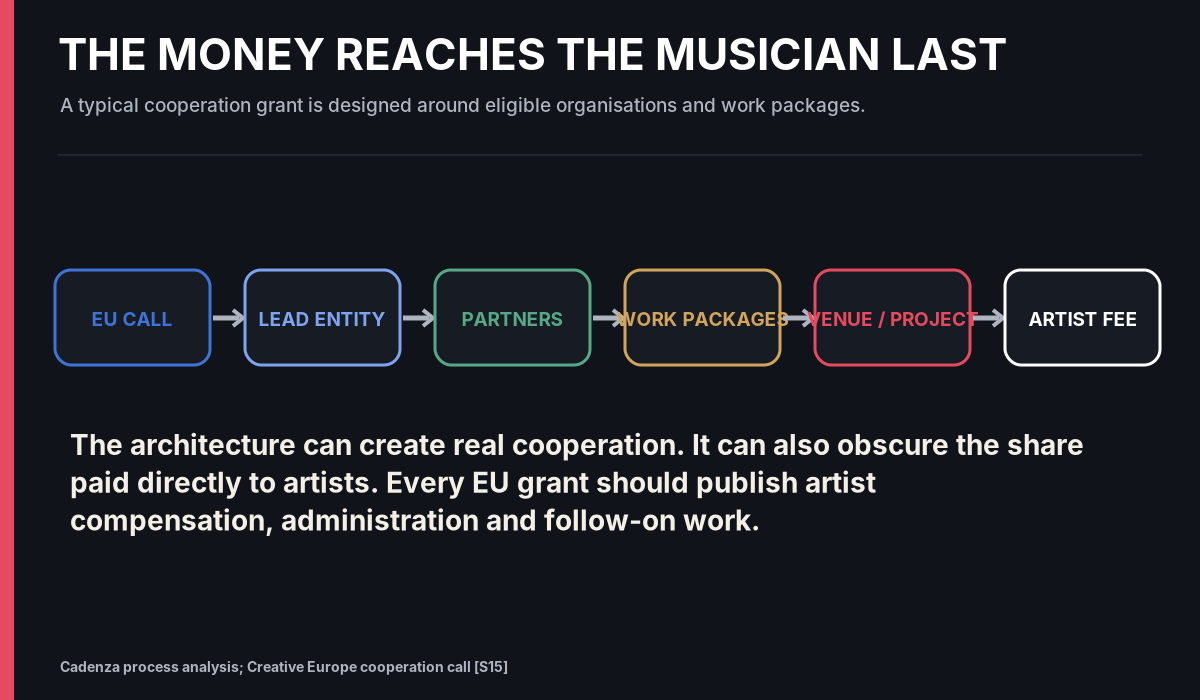
The route a consortium application travels. It shows process, not the share of money that reaches an individual musician — which the Commission does not publish.
6. Culture Moves Europe: useful because it is concrete
Culture Moves Europe is one of Brussels’ most intelligible cultural interventions because it answers a real cost.
A musician has an invitation, collaboration, residency or project in another eligible country. Travel and daily subsistence stand between the artist and the work. The programme can pay an €85 daily allowance, travel support of €400 for journeys under 5,000 kilometres or €800 for longer journeys, plus supplements for accessibility, family responsibilities, remote regions and greener travel under relevant calls. [S5]
For 2025–2028, the programme has €25 million and expects to support around 7,000 artists, cultural professionals and host organisations across architecture, heritage, design, literature, music, performing arts and visual arts. [S5]
The new cycle’s demand is substantial. The 2025–26 individual mobility call received thousands of applications, and the Commission reported 2,542 selected grantees by July 2026. The residency action also drew more than a thousand applications for 150 selected projects. [S6]
The first edition supported 7,274 artists and cultural professionals through thousands of mobility projects and hundreds of residencies. [S7]
This is meaningful. A grant can produce an audition, commission, tour, lesson, partnership or career-changing encounter.
It is not a livelihood system.
The entire 2025–2028 envelope is smaller than the annual operating budget of many major European cultural institutions. Its intended beneficiaries include multiple sectors and host organisations. It helps an artist move through the market; it does not ensure the market offers adequate fees, affordable housing, social protection or continued work.
Culture Moves Europe should be praised for solving the problem it actually addresses—and criticised when politicians use it as evidence that Brussels has solved the problems it does not address.
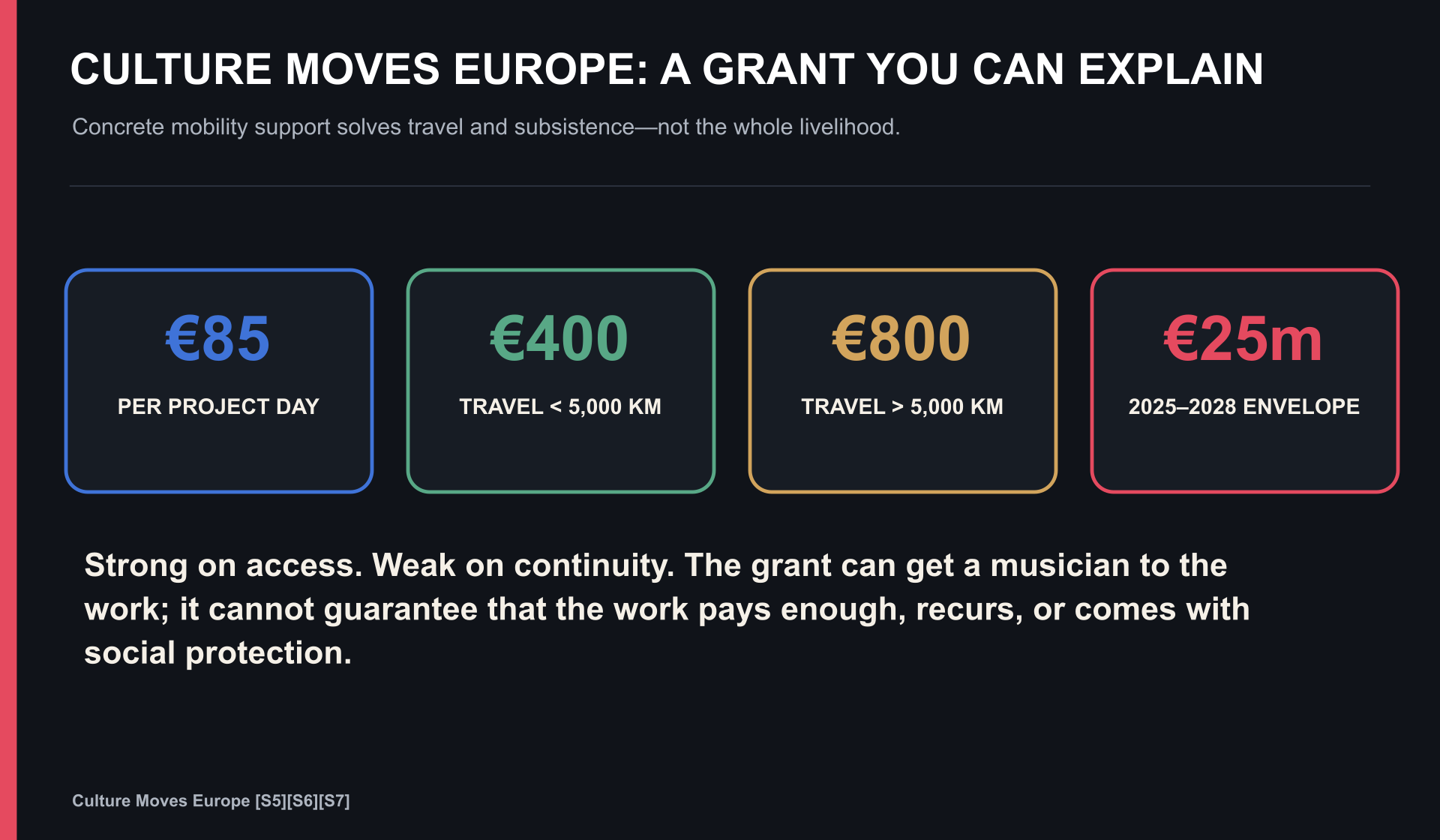
Culture Moves Europe is the clearest case of EU money reaching individuals. Its scale is small relative to national systems, which is the point rather than a criticism of the scheme.
7. Music Moves Europe: support around the music
Music Moves Europe is the Commission’s policy framework for the music ecosystem. It has supported cooperation projects, networks, studies, innovation, sustainability initiatives and sector development. The Commission reports more than 130 music projects supported with around €98 million in the previous programme period, alongside preparatory actions and current Creative Europe activity. [S8]
The policy’s stated objectives are sensible: promote diversity and creativity, help the sector adapt to digitisation, improve data, strengthen competitiveness and address working conditions.
The problem is not that these goals are wrong. The problem is that nearly every word lives one level above the musician’s bank account.
The European music sector needs data. It also needs a minimum fee.
It needs green touring models. It also needs touring income.
It needs a digital strategy. It also needs bargaining power against platforms.
It needs export networks. It also needs enough local work that international travel is a choice rather than an escape.
The Commission’s Culture Compass now acknowledges precarious working conditions and proposes an EU Artists Charter. That is a welcome shift from treating culture primarily as output toward treating artists as workers. [S12]
The test will be whether the Charter changes the economics of EU-funded projects. A principle that does not reach the grant contract is an aspiration. A requirement that every EU-funded cultural project publish artist compensation and meet a minimum-pay standard would be policy.
8. Erasmus+: the musician programme that does not call itself one
Erasmus+ may be Brussels’ most important programme for young musicians precisely because it is not designed around sector advocacy.
Its 2021–2027 budget is estimated at €26.2 billion. It supports education, training, youth and sport. Conservatories, universities, teachers and students can participate through the higher-education architecture. [S9]
For a music student, the consequences can be enormous.
A singer from Portugal can study in Vienna. A Latvian violinist can spend a semester in Berlin. A Finnish composer can join a programme in Paris. Teachers exchange methods. Institutions build joint degrees. Students create professional networks before entering a labour market that is already international.
The difference from a cultural project grant is structural. Erasmus is not asking every student to invent a new sectoral framework. It is financing a recurring route through established institutions.
That exposes one of the EU’s central lessons: large, dependable programmes often help musicians more than small programmes carrying the word music.
Erasmus also reveals the EU’s strongest advantage over authoritarian cultural states. A country can build a magnificent academy. It cannot easily reproduce a continent of institutions connected by a common mobility framework, mutual recognition and legal rights.
The European Union may not employ the orchestra, but it helps create the transnational labour market around the orchestra.
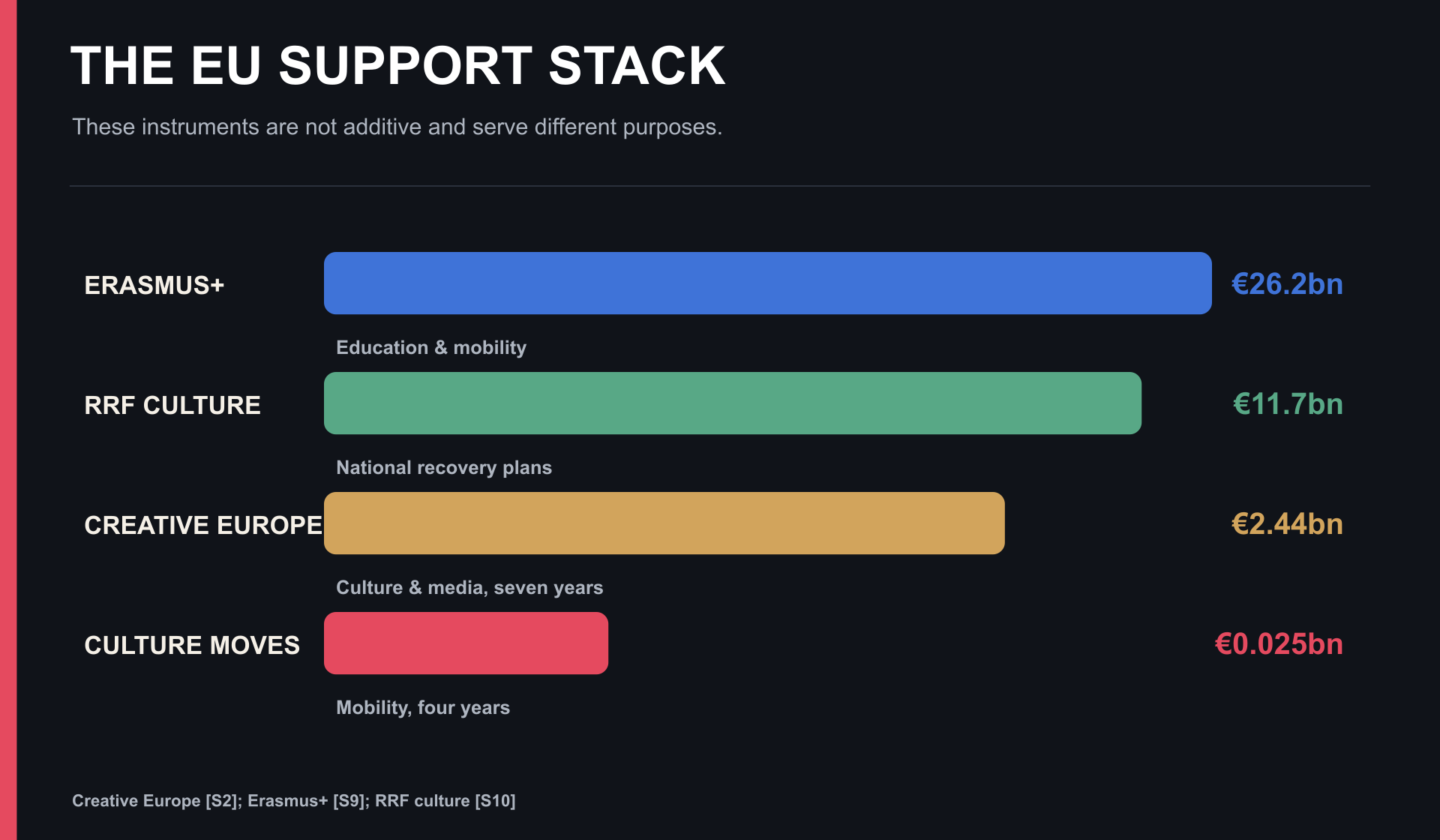
Erasmus+ is an education budget, not a music budget, and the Recovery and Resilience Facility is implemented through national plans. Neither is a direct Brussels artist fund.
9. Recovery money: Brussels’ hidden cultural scale
Any article that compares only Creative Europe with national cultural budgets understates the EU’s role.
The Recovery and Resilience Facility changed the scale after the pandemic. National recovery plans across eighteen member states earmarked approximately €11.7 billion for cultural and creative sectors. [S10]
That number is far larger than Creative Europe’s Culture strand.
It is also fundamentally different.
The money belongs to national recovery plans financed through an EU facility. It may support renovation, digitisation, heritage, cultural infrastructure, business resilience and national programmes. Brussels sets the framework and approves milestones; national governments design and implement the measures.
The distinction matters because both sides claim credit.
The Commission can say European recovery money supported culture. A national minister can open the building. A city can operate it. A musician may still receive no direct payment from the capital project.
This is the recurring European pattern:
- Brussels creates financial capacity.
- The member state chooses the cultural architecture.
- The local institution delivers it.
- The artist experiences the result through a job, a fee, a room—or not at all.
The proper question is therefore not whether Brussels spent €11.7 billion on culture. It is how much of the EU-financed national investment reached cultural labour, and whether the assets remain financially sustainable after the recovery grant ends.
10. The title is European; the cheque is local
European Capitals of Culture offer a smaller version of the same story.
The EU designation is prestigious. It can transform a city’s international profile, mobilise public investment and produce years of planning. The Melina Mercouri Prize is worth €1.5 million if the city meets the conditions. [S11]
But a serious Capital of Culture programme costs far more than €1.5 million.
Cities, regions, national governments, sponsors and institutions provide the larger budgets. Brussels supplies the title, selection architecture, European network and seed incentive. The local public sector pays for most of the year.
That is not a failure. It is the programme design.
The failure comes when European political language blurs the design and implies that Brussels built the culture it helped convene.
PART III — THE VON DER LEYEN RECORD
11. What the Commission deserves credit for
A fair investigation must acknowledge what changed under Ursula von der Leyen.
Creative Europe’s budget rose materially from the previous seven-year period. Culture Moves Europe became a permanent mobility instrument. Recovery funding protected and modernised cultural assets. Erasmus remained large. The Commission developed a Culture Compass, placed artist working conditions and artistic freedom more explicitly inside policy, and assigned Glenn Micallef a portfolio covering culture, youth, sport and intergenerational fairness. [S2][S5][S9][S12][S14]
This is not indifference.
The Commission also operates inside constraints imposed by the treaties and the member states. It cannot simply nationalise every orchestra or impose one cultural system on twenty-seven countries. A Brussels culture ministry with power to harmonise repertory, appointments and national subsidies would create a different danger.
The EU’s contribution to artistic freedom is also larger than its culture budget.
Freedom of movement, anti-discrimination rules, legal protections, open institutions, academic exchange and access to a large democratic market create conditions artists use every day. These are not line items labelled musician support, but they are forms of cultural infrastructure.
A Russian conductor who leaves state pressure, a Ukrainian musician rebuilding a career, an Iranian composer entering a European institution or a young EU citizen studying across borders benefits from a political order as well as a grant.
The mistake is not that the EU values mobility, rights and cooperation.
The mistake is allowing those achievements to conceal the economic weakness of the artist.
12. Culture remained peripheral to the grand strategy
Read the von der Leyen Commission’s grand narratives and the hierarchy is obvious.
Climate, digital power, industrial policy, security, migration, defence, energy, health, Ukraine, competitiveness and strategic autonomy occupy the centre. Culture appears as heritage, identity, inclusion, creativity, democracy or youth—not as a major economic and social system requiring permanent institutional finance.
That hierarchy is understandable in a crisis-filled decade. It is also a choice.
The Commission demonstrated that when a priority is considered strategic, Europe can mobilise hundreds of billions, rewrite rules, borrow collectively, create emergency mechanisms and demand national plans.
Culture received a larger Creative Europe programme, targeted mobility grants, a recovery share and policy language.
Musicians did not receive a European employment architecture.
The comparison does not mean the EU should spend as much on symphonies as on energy security. It means culture is routinely described as foundational to European identity while financed as a specialised programme.
Europe cannot invoke Beethoven as a civilisational symbol and then treat the people performing Beethoven as a project category.
13. The artist problem Brussels now admits
The European Parliament’s own record is severe.
Cultural employment represented about 7.7 million people in 2022. The sector had a far higher share of self-employment than the economy as a whole—31.7 percent compared with 13.8 percent—and the pandemic’s employment impact on cultural professionals was substantially worse than the broader economy. [S13]
This is the social structure behind the success stories.
The musician may appear internationally mobile because no institution will offer a permanent contract.
The composer may be described as entrepreneurial because every commission is temporary.
The ensemble may be celebrated as agile because it has no building, pension system or operating reserve.
The festival may be innovative because a permanent season is unaffordable.
The pandemic tested which of those descriptions was a strength and which was a euphemism.
A salaried musician in a state-financed institution continued to be paid when the hall shut. A self-employed musician did not, because a project grant pays for work that can no longer take place. That is why the sector’s employment losses ran ahead of the wider economy — not because culture was hit harder, but because nearly a third of it had no employer to be furloughed by. [S13]
The contrast at the far end of the spectrum is documented. The Bolshoi Theatre held full payroll for all 3,400 of its staff through the closure, with no missed payments. Brussels had no instrument capable of doing that for a single musician, and was never designed to have one.
Project funding can reward the very precarity policy documents claim to solve. A worker with a stable institutional job may not need to invent a transnational concept every eighteen months. A freelance artist must repeatedly translate survival into the vocabulary of innovation.
The EU Artists Charter will matter only if it changes procurement, grant agreements and evaluation. At minimum, every EU-funded cultural project should disclose:
- total artist compensation;
- median and lowest professional fee;
- unpaid participation;
- employment status;
- social contributions;
- administrative share;
- gender and disability pay data;
- whether work continued after the grant.
Without that information, Europe cannot know whether it funds artists or the organisations explaining artists.
14. The bureaucracy is not imaginary
EU cultural funding is often defended by pointing to transparent calls and published criteria. That is correct. It is also incomplete.
Transparency does not make a process accessible.
Large cooperation applications require legal entities, partners, budgets, work packages, compliance, reporting capacity, cash flow and staff time. The organisations best equipped to apply are frequently the organisations already equipped to operate without the grant.
Smaller bodies may depend on consultants. Independent artists may become named participants inside somebody else’s proposal. Co-financing requirements can favour institutions with reserves. Delayed payments can punish those unable to bridge costs.
This is not corruption. It is capacity bias.
The EU should publish a full application-cost analysis:
- estimated staff hours spent by all applicants;
- total unsuccessful application cost;
- external consultant spending;
- success rates by organisation size and country;
- administrative cost per euro reaching artists;
- payment delays;
- the proportion of beneficiaries receiving repeat awards.
A grant system can be procedurally fair and economically exclusionary at the same time.
PART IV — EUROPE’S REAL PAYMASTERS
15. Germany: the money underneath the European myth
Germany demonstrates why Brussels cannot be evaluated as though it were a nation-state.
German public authorities spent approximately €14.94 billion on culture in 2021. Roughly €4.61 billion—about 31 percent—went to theatre and music. The federal government, Länder and municipalities all participated, with most permanent cultural infrastructure financed below the EU level. [S16]
That is the system maintaining opera houses, public theatres, orchestras, festivals, museums, libraries and training institutions across a federal country.
The annualised minimum Creative Europe Culture allocation for the entire EU is approximately €115 million.
Germany’s theatre-and-music spending alone was therefore around forty times larger in the cited year.
The comparison is deliberately imperfect. Germany’s figure is 2021 public expenditure across a national federal system. The EU figure is a seven-year programme average. Germany’s spending includes institutions and operating costs that Creative Europe was never designed to cover.
That imperfection is the point.
When people praise “the European model” for sustaining opera and orchestras, they are praising national, regional and municipal government. Brussels deserves credit for the space connecting them—not for every salary inside them.
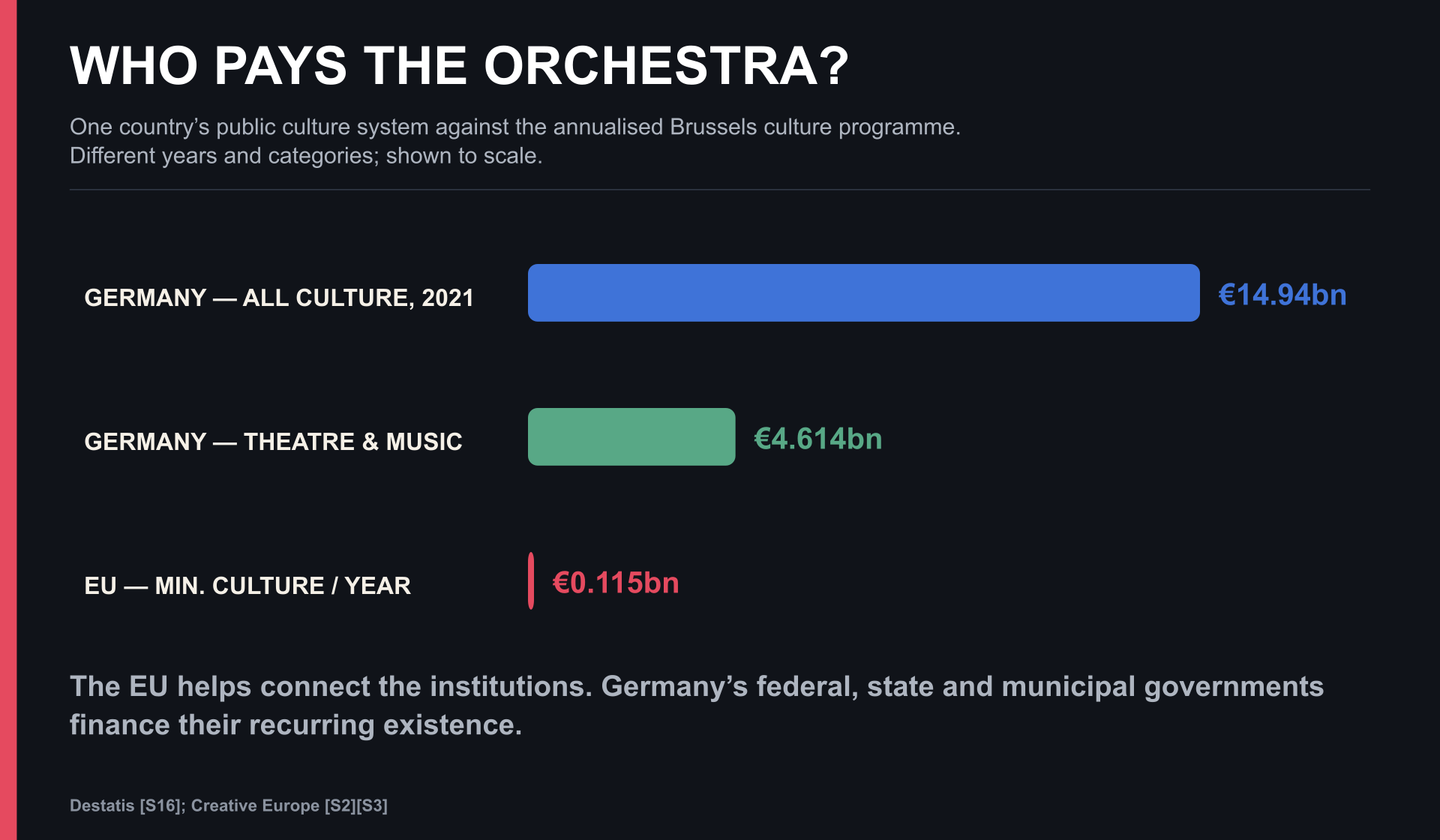
German national expenditure (2021) against EU programme averages (2021–27). Different categories and different years, displayed separately because they must not be added.
16. Austria: culture as a recurring public obligation
Austria offers a smaller but equally instructive model.
Public expenditure on culture reached 0.74 percent of GDP in 2024. Theatres and concert halls recorded more than five million visits in the 2023–24 season. [S17][S18]
Vienna’s musical life is not the product of a single EU call. It is the cumulative result of public institutions, historic assets, national and municipal finance, tourism, education, broadcasting, labour agreements and a population accustomed to subsidised high culture.
That system has its own gatekeeping, hierarchies and political arguments. It can be conservative, expensive and difficult for outsiders to enter.
But it demonstrates what project funding cannot replace: recurring obligation.
The budget returns every year. The building remains. The orchestra rehearses next week whether or not its programme can be described as a transnational innovation lab.
17. Hungary: national ambition inside the Union
Hungary complicates the assumption that cultural ambition belongs to Brussels.
During the Orbán era, the Hungarian state restored the Opera House, opened the Eiffel Art Studios, built the House of Music Hungary, expanded museum infrastructure and treated culture as national construction. Some projects involved EU resources; the political authorship and operating responsibility remained Hungarian.
Cadenza has argued elsewhere that the correct response to political change is to audit and de-partisanise the inheritance without destroying it.
The broader lesson is simple: a member state can be culturally ambitious inside the EU while remaining critical of Brussels. The European Union does not need to own the building to make cross-border use possible. But it should not claim the building merely because European money appeared somewhere in the finance stack.
18. The national systems have their own lie
Europe’s national governments are not innocent alternatives to Brussels bureaucracy.
They invoke permanent institutions while allowing freelance work to deteriorate. They protect prestigious flagships while regional ensembles struggle. They celebrate cultural diplomacy while musicians face unaffordable cities. They use heritage to attract tourists and then treat artistic labour as a cost.
A salaried orchestra system can also be closed, hierarchical and resistant to change. Public subsidy can become institutional entitlement without sufficient accountability. Conservatories can train far more musicians than the public labour market will employ.
The lesson is not that national funding is perfect.
It is that only national and local systems currently operate at the scale required to finance permanent musical life.
Brussels can improve the conditions. It cannot substitute for them under the present treaties and budgets.
PART V — THE CENTRALISED-STATE ADVANTAGE
19. Why strong governments build faster
Centralised systems possess an obvious advantage: once the leadership decides that a cultural project matters, fewer veto points stand between announcement and construction.
Land can be assigned. State companies can build. Ministries can coordinate. Public broadcasters can promote. Schools can be instructed to participate. A national company can be created by decree. International stars can be imported. The building can open on a politically useful date.
Democratic systems distribute power because concentrated power is dangerous. The cost is friction.
Authoritarian systems reduce friction by concentrating power. The cost is dependency.
The cultural result can be magnificent. The political bargain may remain invisible until an artist disagrees.
A comparison that counts halls but ignores freedom will always flatter the strongman. A comparison that counts only freedom and ignores jobs will always flatter the liberal state. Musicians live inside both realities at once.
20. Russia: the theatre survives because the state needs it
Russia is the clearest warning against equating visible culture with cultural health.
The Mariinsky and Bolshoi remain formidable. Russia maintains large companies, conservatories, competitions, touring networks and a deep public expectation that the state should finance classical institutions.
But culture exists inside a militarised political order.
Russia planned approximately 14.9 trillion rubles in military spending for 2026 against roughly 279.4 billion rubles for the federal Development of Culture programme in the budget as enacted (Federal Law No. 426-FZ of 28 November 2025). The ratio is approximately 53 to 1. That ratio sets planned military expenditure against one federal programme; it does not measure every cultural expenditure in Russia, which also flows through regional and municipal budgets and state institutions' own revenue. [S30][S31]
The instructive comparison is not Berlin but Brussels. Russia’s federal culture programme is worth roughly €3 billion a year at market exchange rates. Creative Europe, the European Union’s flagship culture and media programme, averages approximately €349 million a year for the entire Union. Per head of population that is a gap of more than twenty-five to one, and measured by what a ruble actually buys inside Russia it is wider still. The comparison is deliberately conservative: Russia’s figure is one federal programme, excluding regional and municipal budgets, while the Creative Europe figure is the whole Union’s. A state that spends fifty-three times more on war than on its federal culture line still funds culture at a scale the European Commission does not approach. [S2][S30][S31]
That money buys the thing Brussels has no instrument to buy. Cadenza’s investigation into Gergiev documented the scale: roughly 556 orchestral musicians across the two houses, more than 3,400 employees at the Bolshoi alone, and full payroll maintained for all of them through the pandemic with no missed payments. Nine American orchestras dissolved in fifteen years. Brussels employs none.
The bargain is equally documented. Within weeks of the invasion of Ukraine in 2022, Gergiev was removed from every Western post he held — Munich, the Metropolitan Opera, Vienna, Carnegie Hall, Lucerne, Verbier, Rotterdam — after declining to denounce the war. The musicians beneath him kept their salaries and lost the international careers those salaries used to open. That is the trade the funding figures cannot show.
That does not mean the Mariinsky is about to close. The opposite is more instructive.
Flagship culture is cheap enough relative to war to preserve as prestige, legitimacy and proof of civilisation. In December 2023 the Russian government appointed Valery Gergiev general director of the Bolshoi Theatre while he remained in charge of the Mariinsky — the first time one figure has led both houses since 1917. That is a documented governance structure, not an inference: cultural command over Russia’s two principal opera houses now rests with a single state appointee.
A musician inside the system may receive training, work, stages and status. The system may also punish dissent, restrict international mobility and turn institutional loyalty into political meaning.
Russia scores highly on visible institutional capacity and disastrously on the independence required to know whether support belongs to the artist or the state.
{{PHOTO:RUSSIA}}
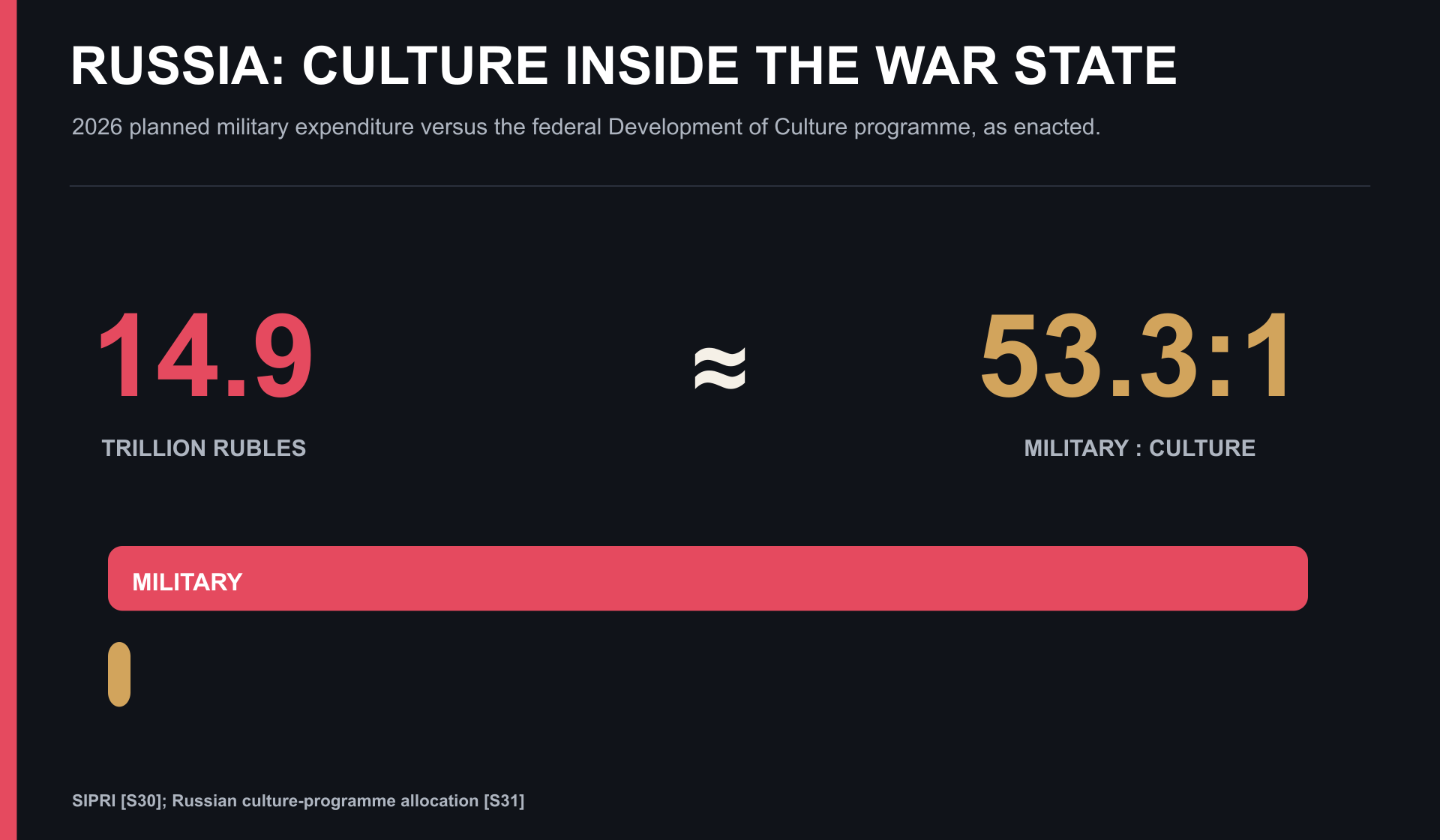
Planned military expenditure against one federal culture programme, as enacted. It does not measure every cultural expenditure in Russia, which also flows through regional and municipal budgets.
21. China: enormous culture numbers, limited musician-level clarity
China’s cultural economy is vast.
The National Bureau of Statistics reported 20.8254 trillion yuan in business revenue across cultural industries in 2025. Enterprises above the designated size generated 15.2135 trillion yuan. [S23a] The 2024 value added of culture and related industries was 6.2094 trillion yuan, or 4.61 percent of GDP. [S24]
These figures demonstrate scale. They do not answer the musician question.
The categories include news and information services, advertising, digital content, creative design, manufacturing, wholesale, cultural equipment, software, games and consumer products. A trillion-yuan cultural industry can coexist with low artist pay, opaque grant distribution or political restrictions.
China also maintains government-affiliated performing groups and extensive public cultural infrastructure. The Ministry of Culture and Tourism's statistical bulletin for 2025 counted 1,879 performing-arts companies attached to culture and tourism departments, employing about 102,000 people, which together gave 392,000 performances to domestic audiences of 310 million. Those are state-affiliated ensembles, and the bulletin reports activity rather than what individual musicians are paid. [S25]
The state can mobilise schools, venues, broadcasters and local governments in ways Brussels cannot.
But public data are much weaker at the level this investigation needs:
- median orchestral salary;
- independent composer grants;
- grant acceptance rates;
- politically excluded repertory;
- the career consequences of criticism;
- the share of cultural-industry revenue reaching performing artists.
China’s headline numbers prove the existence of a cultural economy. They do not prove an ordinary musician is secure or free.
{{PHOTO:CHINA}}
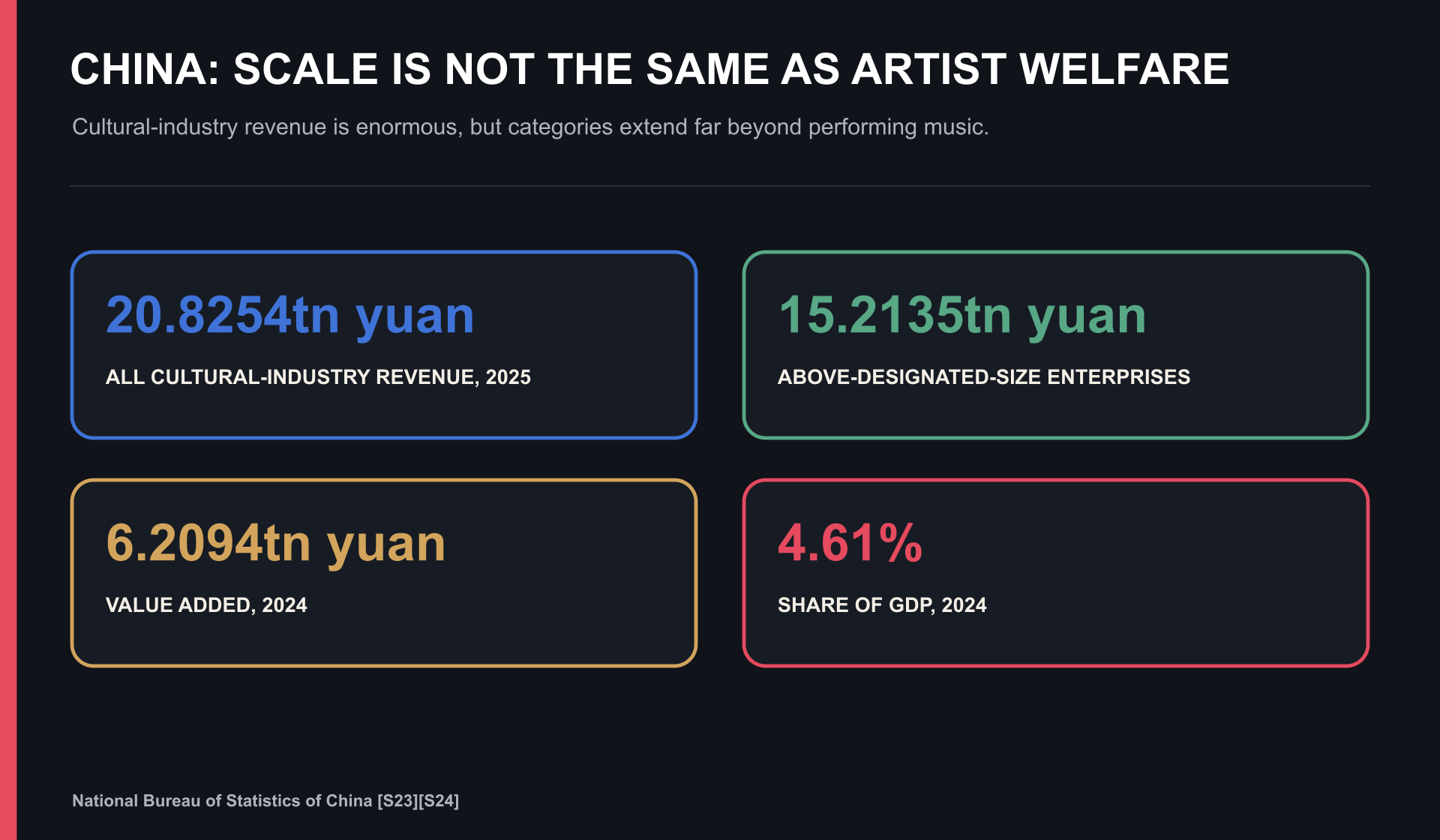
Industry revenue includes digital content, design, advertising and manufacturing. These totals are not public arts spending and are not orchestra subsidies.
22. Saudi Arabia: culture as sector creation
Saudi Arabia is attempting something different from preserving an inherited classical system. It is trying to create a modern music sector at speed.
The Music Commission’s strategy spans education, production, performance, distribution, licensing, advocacy and intellectual property. The Cultural Development Fund offers finance across sixteen cultural sectors. [S27][S28]
The ambition is real.
New festivals, institutions, training routes, entertainment venues and international partnerships can create work where little formal infrastructure existed before. A government with capital and strategic concentration can move more quickly than a fragmented European market.
The unresolved questions are musician-level and political:
- How much public money reaches individual musicians as grants rather than loans or event contracts?
- What is the median fee?
- How many permanent jobs exist after the festival?
- How many Saudi musicians, as opposed to imported performers and consultants, advance into sustained careers?
- Can a funded musician criticise government policy?
- Are selection criteria and unsuccessful applications published?
A strategy document can create a sector vocabulary. Only transparent outcomes can prove a musician economy.
23. The UAE: precise grant caps, narrow eligibility
The United Arab Emirates offers a more concrete grant architecture.
Its National Grant Programme for Culture and Creativity includes support for creation and production up to AED100,000, promotion and local participation up to AED80,000, capacity development up to AED50,000 and international travel and mobility up to AED50,000. [S26]
The programme is clear enough to compare with Brussels.
It is also restricted. Applicants must be UAE nationals and satisfy eligibility rules. Personal salary and compensation are generally not the purpose of the grant; the money is tied to eligible project costs. In 2025, the ministry announced forty-four recipients, only two of them in music. [S26]
That does not make the programme insignificant. It makes its limits visible.
The UAE can combine targeted national grants with spectacular infrastructure, imported institutions and international events. The model creates opportunity for selected citizens and global professionals while remaining highly curated by the state.
Brussels is broader geographically and more procedurally open to eligible organisations across many countries. The UAE can offer larger project caps to a much smaller eligible population.
Neither figure alone tells us who supports musicians better.
24. Qatar: institutions first, artist data later
Qatar’s cultural strategy is institution-heavy: museums, public art, creative hubs, major buildings, international partnerships and national programming. Qatar Museums reported hundreds of events and significant digital reach in 2025, alongside highly competitive artist programmes. [S29]
The model’s strength is long-term state capacity.
Its weakness for this comparison is transparency at the musician level. Museum and visual-arts infrastructure dominates the public record. A classical musician seeking a normal professional path needs different information:
- orchestra budgets;
- salary bands;
- teaching opportunities;
- local-versus-imported workforce;
- commissioning systems;
- independent application routes;
- artistic freedom.
The absence of public data is itself a result.
A state should not receive full credit for cultural support merely because outsiders cannot inspect the accounts.
25. Singapore: the strongest challenge to both sides
Singapore is the comparison that prevents this article from becoming lazy.
It is small, centralised and strategic, but it publishes detailed grant rules and actively intervenes on both the supply and demand sides of culture.
The Presentation and Participation Grant can provide up to S$100,000 per applicant per financial year and explicitly covers performances, recordings, festivals and other activity. The Capability Development Grant can provide up to S$20,000 for individuals and S$75,000 for organisations, with high support rates for self-employed artists and independent collectives. [S19][S20]
The SG Culture Pass gives eligible citizens S$100 in credits to spend on local arts and heritage programmes. As of 1 January 2026, more than 1.1 million Singaporeans had registered for the scheme and almost S$10 million in credits had been used. Of the 742 events listed under the scheme at that date, all but 33 had recorded at least one redemption. [S21]
A new S$20 million Multicultural Arts Programme adds production grants that can reach S$500,000. [S22]
This is not just artist subsidy. It is market design.
Singapore funds production, capability, institutions and audiences. It attempts to create the artist, the work and the ticket buyer inside one coordinated system.
The model still raises questions about regulation, licensing, speech and the limits of political criticism. Singapore should not be labelled a dictatorship in the same category as Russia or China. It is a distinct, highly centralised state with elections, strong administration and constrained political space.
But as cultural policy, it offers Brussels a useful humiliation: a small country can make grant amounts, audience incentives and capability support easier for an ordinary artist to understand than the European Union’s vast programme architecture.
{{PHOTO:SINGAPORE}}
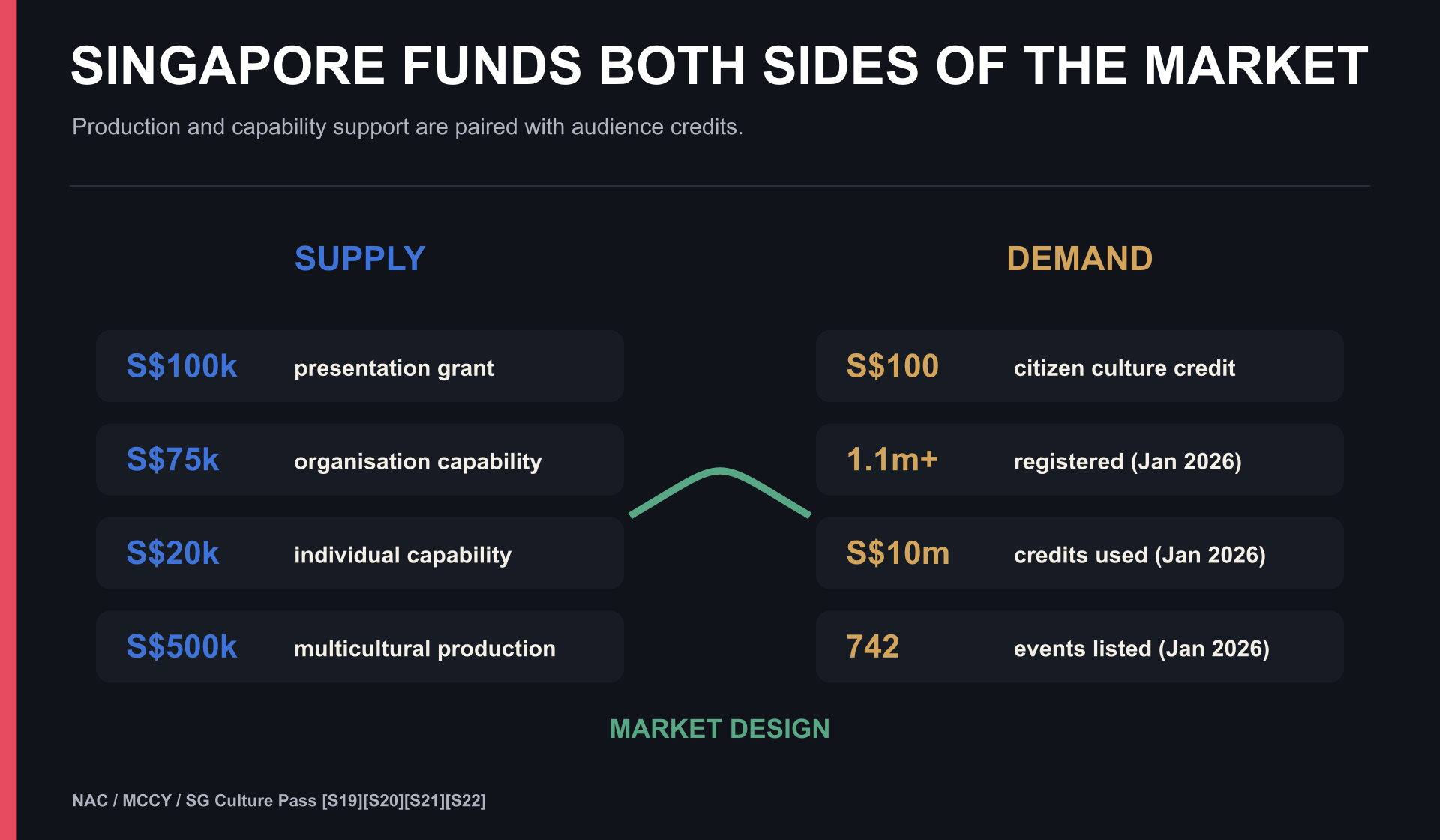
Supply-side grants and demand-side credits at the dates shown. Singapore is a distinct highly centralised state model and is not presented as equivalent to Russia, China or the Gulf monarchies.
PART VI — THE MUSICIAN TEST
26. The student
Imagine a twenty-one-year-old violinist in Tallinn.
She needs a semester with a teacher in Vienna, money for travel, recognition of studies, access to another institution and a professional network.
The European Union is difficult to beat.
Erasmus+ and free movement create a route larger than any national scholarship. A centralised state can offer an excellent academy, but it cannot easily reproduce a continent of connected schools and labour markets.
Brussels wins the student mobility test.
It does not necessarily win the living-cost test. Housing, instrument insurance, audition travel, health coverage and post-graduation work remain fragmented.
27. The orchestra musician
Imagine a thirty-four-year-old oboist seeking a permanent position.
The decisive question is not whether the EU has a music strategy. It is whether a funded orchestra has a vacancy, salary scale, pension contribution, collective agreement and season.
Germany, Austria, France, Finland and other national systems remain the relevant paymasters.
Brussels helps the oboist move to the audition and exercise labour rights. It does not usually create the chair.
A Russian or Chinese state company may provide a stable job, but the political environment and international mobility differ. A Gulf orchestra may offer a strong contract while relying on imported labour and a narrower local career ecosystem.
National Europe wins the permanent institutional job test—where the institutions remain funded.
28. The composer
Imagine a composer whose work criticises the government.
A large grant in a system requiring political alignment is not superior support.
The composer needs money and the right to displease the paymaster.
The EU’s greatest advantage appears here. Artistic freedom, plural institutions and cross-border exit options reduce the power of any one ministry. A rejected artist can apply elsewhere, move, collaborate or publish across a large legal space.
That freedom is uneven and never absolute. European institutions also exclude, politicise and conform. But no single government controls the full cultural market.
Liberal Europe wins the dissent test.
29. The freelancer
Imagine a freelance singer with irregular work, no permanent employer and a project in another country.
Culture Moves Europe may pay the journey. Creative Europe may support the presenting organisation. National social insurance rules determine whether illness becomes catastrophe. Local housing costs determine whether the singer can stay. The venue determines the fee.
The freelancer experiences every layer and belongs fully to none.
This is where Europe’s fragmentation becomes brutal. Mobility rights can make precarity portable.
Singapore’s smaller coordinated grants may feel clearer. The UAE’s project caps may look larger if the singer is an eligible citizen. A centralised state festival may pay well for one engagement. None guarantees continuity.
No system wins the freelance test.
30. The institution
Imagine an independent ensemble trying to build a five-year future.
Brussels can finance a transnational project. A national government can provide core support. A city can offer a home. A donor can supply risk capital. A centralised state can transform the ensemble into a national company—or replace it when policy changes.
The strongest model combines all four without making one source dominant.
The institution needs:
- multi-year operating support;
- earned income;
- diverse funders;
- transparent public subsidy;
- freedom over programming;
- cross-border access;
- reserves;
- labour standards;
- public accountability.
Europe possesses the pieces. It rarely aligns them.
PART VII — THE SCORECARD
31. No single winner
The visual below is Cadenza’s editorial synthesis, not an official index. It scores systems by the evidence examined in this article and deliberately avoids a total. One row needs a further caveat. The artistic-freedom row is not derived from the funding sources in our register, which contain no freedom, governance or rule-of-law data; it states Cadenza’s editorial judgement of the conditions described in Parts IV to VI. A zero there means either documented constraint or, in the Gulf’s case, an absence of public musician-level evidence — and those are not the same finding.
A high infrastructure score cannot cancel a low freedom score. A high mobility score cannot cancel weak permanent employment. The categories describe different forms of support.
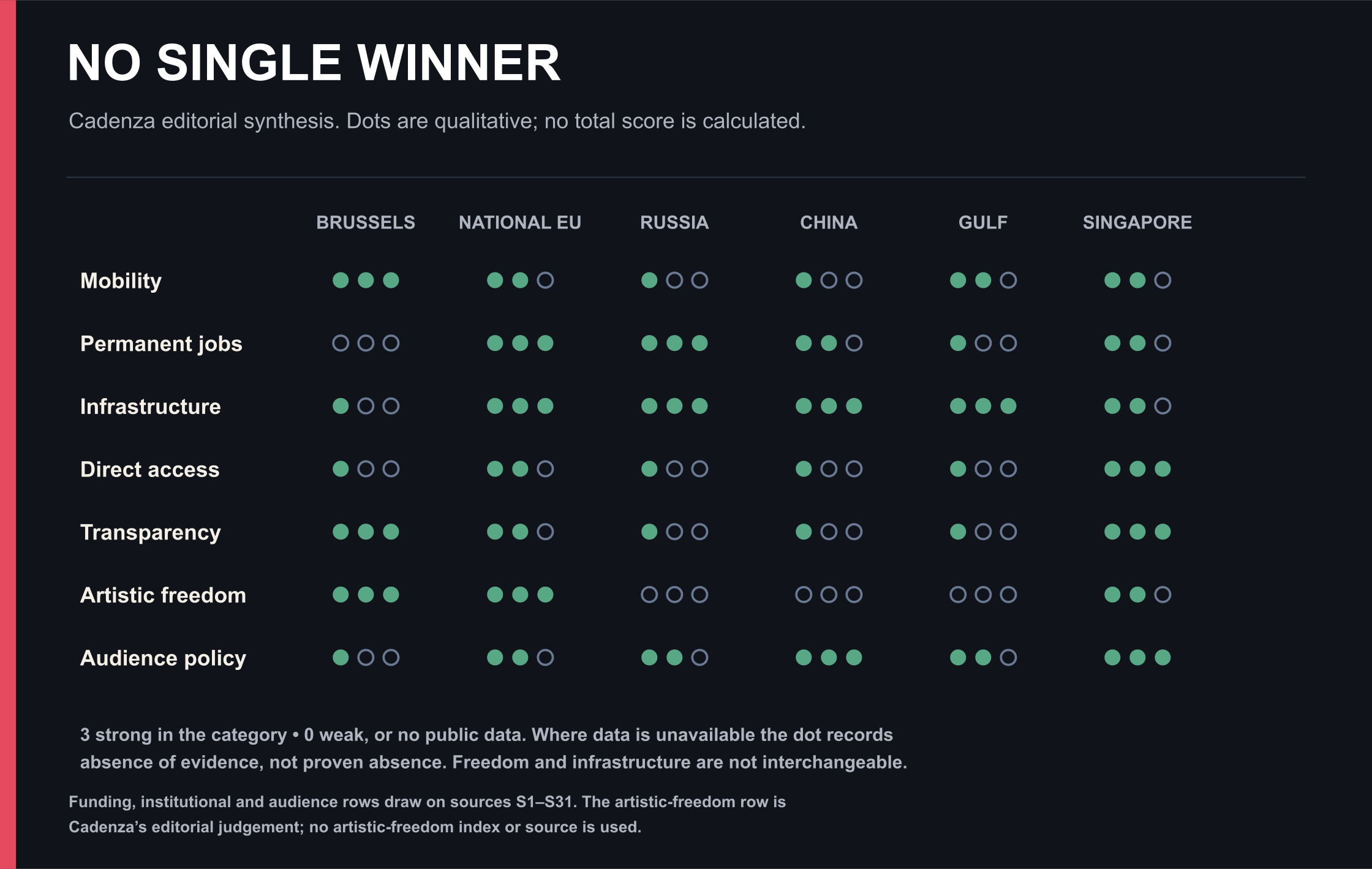
Cadenza's editorial synthesis, not an official index, and deliberately without a total. The funding, institutional and audience rows draw on the source register. The artistic-freedom row does not: no source here contains freedom, governance or rule-of-law data, so that row states Cadenza's judgement of the conditions described in Parts IV to VI. A zero means documented constraint or, in the Gulf's case, an absence of public musician-level evidence — and those are not the same finding.
| System | Strongest feature | Weakest feature | What the musician receives |
|---|---|---|---|
| Brussels / EU programmes | Mobility, cooperation, transparent cross-border frameworks | Direct permanent employment and simple access | Travel, partnership, study, project opportunity |
| Germany / Austria national model | Institutions, salaries, recurring public obligation | Gatekeeping, cost, exposure to austerity | Jobs, training, halls, social systems |
| Russia | Flagship institutions and state employment | Political control, war priorities, isolation | Work and prestige inside a commanded system |
| China | Scale, state capacity, cultural industry | Musician-level transparency and independent expression | Large market, institutions, selective state opportunity |
| Saudi / UAE / Qatar | Rapid construction and strategic investment | Eligibility, opacity, dependence on state priorities | Project finance, events, imported and national opportunities |
| Singapore | Coherent grants plus audience policy | Small market and regulated political environment | Clear grants, capability support, audience demand |
32. What every model lies about
Brussels says projects are support. Sometimes they are. Sometimes the artist is the smallest line in a project designed around the sector.
National Europe says institutions guarantee culture. They guarantee culture only while budgets, wages and access remain politically protected.
Russia says a full theatre proves civilisation. A state can preserve opera while destroying the freedom and international trust that made its culture universal.
China says cultural-industry growth measures cultural strength. Revenue from software, advertising, manufacturing and digital services does not reveal the life of a performing musician.
The Gulf says construction creates an ecosystem. A district is not an ecosystem until local artists can enter, earn, criticise, fail and continue.
Singapore says coordination solves fragmentation. Coordination can become control if policy leaves too little room for work that is inconvenient, unpopular or politically uncomfortable.
Every system selects the metric that flatters it.
The musician needs all the metrics at once.
PART VIII — THE VERDICT
33. Is the European Union good for musicians?
Yes—but not in the way its cultural branding suggests.
The EU is good for musicians as a space.
It opens borders, connects schools, funds travel, enables cooperation, protects rights, supports exchange and makes twenty-seven national cultural systems more accessible to one another.
It is much weaker as a paymaster.
Creative Europe is too small to function as a continental employment system. Its Culture strand is divided across many art forms. Its largest cooperation routes favour organisations with administrative capacity. Culture Moves Europe solves travel, not livelihood. Music Moves Europe improves the ecosystem around musicians more often than it pays musicians directly. The Commission now recognises precarity but has not built a European artist-welfare architecture.
The EU should not be mocked for failing to exercise powers the treaties do not give it.
It should be challenged for claiming civilisational credit without matching that rhetoric with sufficient money, enforceable labour standards and transparent artist-level outcomes.
The answer is therefore:
The European Union is an excellent cultural connector, a modest cultural funder and almost no cultural employer.
34. Was Ursula’s Commission good for musicians?
Better than indifference. Smaller than the moment required.
The von der Leyen era expanded Creative Europe, continued large educational mobility, created Culture Moves Europe, channelled recovery money into national cultural plans and developed a Culture Compass focused more clearly on artists’ conditions. Those are real achievements.
But the Commission’s strategic imagination remained elsewhere.
Europe could mobilise enormous resources for climate, pandemic recovery, energy, defence, industry and geopolitical resilience. Culture remained a programme, not a pillar.
That is the central criticism of Brussels under von der Leyen: not that it did nothing, but that it continued to describe culture as foundational while financing it as supplementary.
The next test is whether the EU Artists Charter becomes contractual and whether the next long-term budget gives artists direct, legible and enforceable support.
35. A Musician Compact for Brussels
The EU does not need to become a central culture ministry. It does need to stop treating artist precarity as an unfortunate characteristic of the sector.
Cadenza proposes twelve measures.
- A direct European artist fund. Small, fast grants available to individual professional artists without requiring a consortium.
- Mandatory minimum pay. Every EU-funded cultural project must meet published artist-fee floors adjusted by country and role.
- Artist-share disclosure. Grant recipients must publish the percentage of expenditure paid directly to artists and creative workers.
- Administrative caps. Large coordination and consultancy shares require explicit justification.
- Portable social protection. Build a practical cross-border mechanism for contributions, short engagements, illness and unemployment.
- Audition and instrument support. Fund travel, accommodation, instrument insurance and emergency repair for low-income musicians.
- Multi-year core support. Allow proven European ensembles to transition from repeated projects to operating grants.
- Housing reality. Mobility support should reflect actual housing costs in major cultural cities.
- Open beneficiary data. Publish award concentration, repeat recipients, organisation size, artist fees and geographic distribution.
- Freedom conditions. EU cultural finance to state institutions must include transparent artistic-freedom and non-retaliation standards.
- A European music labour observatory. Track salaries, vacancies, freelance rates, conservatory output, injuries, discrimination and career exit.
- Audience credits pilot. Test a Singapore-style cultural credit in selected regions, with strong safeguards against political curation.
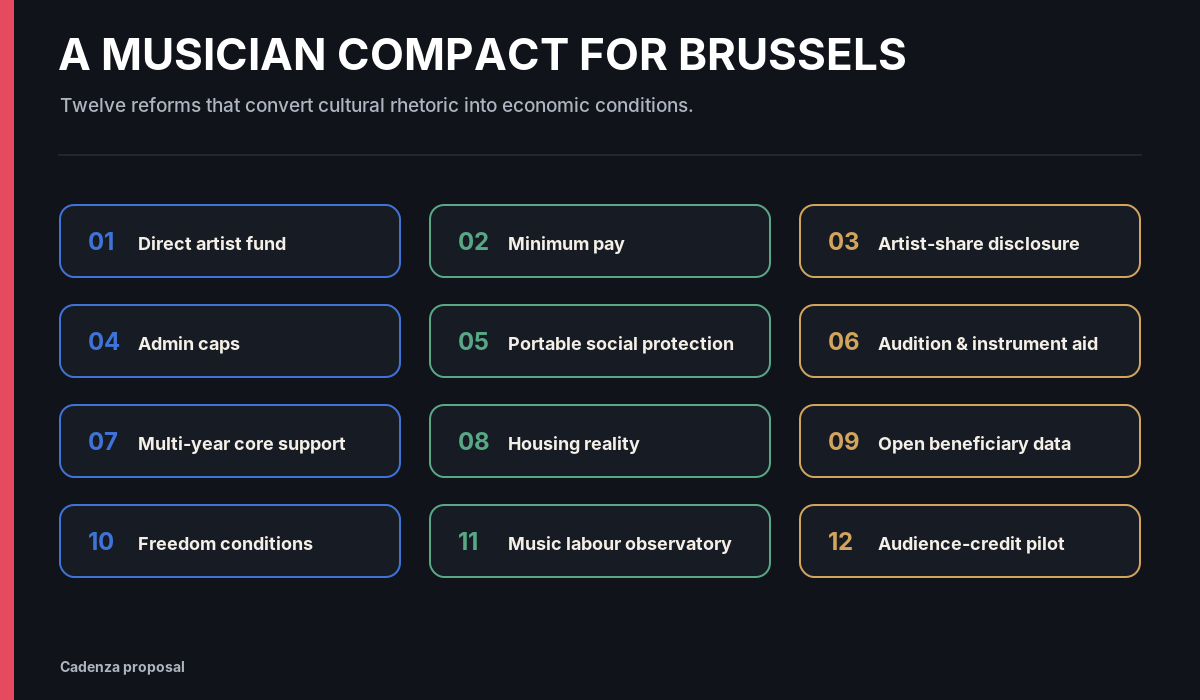
A proposed policy compact, not a description of existing EU commitments.
36. What Brussels should learn from the strongmen
Democratic Europe should not imitate political control.
It should imitate seriousness.
Centralised states understand that culture requires buildings, training pipelines, recurring finance, political attention and audiences. They understand that prestige must be produced, not merely celebrated. They are willing to plan beyond one grant cycle.
The EU can learn those lessons while rejecting censorship and loyalty.
Build durable cultural capacity. Pay people. Create audiences. Maintain institutions. Publish the accounts. Protect dissent. Connect the continent.
The choice is not bureaucracy or dictatorship.
The choice is whether democracy is capable of ambition.
37. Final movement
A young musician does not experience a political system as a theory.
She experiences it as the teacher she can afford, the border she can cross, the room she can rehearse in, the audition she can reach, the contract she can sign, the opinion she can express and the rent she can pay after the applause.
Brussels makes many of those journeys possible.
Berlin, Vienna, Budapest, Paris, Helsinki and other national systems still pay for much of the destination.
Moscow and Beijing demonstrate what scale can look like when the state commands the cultural machine.
Riyadh, Abu Dhabi and Doha demonstrate how quickly capital can create visibility.
Singapore demonstrates that a small state can design grants and audiences with unusual coherence.
None has solved the musician’s life.
The European Union should resist the theatrical temptation to measure itself against a new opera house in an authoritarian capital. A democratic union should offer something more difficult: institutions without obedience, mobility without destitution, public money without party ownership and artistic freedom that is economically usable.
At present, Europe possesses the freedom and the institutions—but they belong to different levels of government and rarely operate as one system.
That is why the answer to the title is not Brussels, Berlin or the strongman.
The musicians are paid by a patchwork.
The question is whether Europe can turn that patchwork into a promise.
Brussels finances movement. Nations finance music. Strongmen finance monuments. The best system would finance the musician—and leave the music free.
Methodology. This article compares programme budgets, national public expenditure, industry revenue and audience subsidy — categories that are not equivalent and are not presented as equivalent. Annualised figures are stated as annualised. Currency conversions use market exchange rates and are described as approximate; where purchasing-power adjustment would change the direction of a comparison, the comparison is not made. The Russia-versus-Creative-Europe figures compare one federal programme with one Union programme, and exclude regional and municipal spending on both sides. No total score is calculated anywhere in this investigation, and the comparative scorecard deliberately refuses one. One source is cited from the Internet Archive: the Saudi Music Commission's website has been unreachable since February 2026, so its description of the Commission's remit is cited from a dated capture.
Right of reply. On 1 August 2026 Cadenza put written questions to the European Commission, the German Federal Government Commissioner for Culture and the Media, the Austrian Federal Ministry for Housing, Arts, Culture, Media and Sport, Singapore's National Arts Council and Ministry of Culture, Community and Youth, the UAE Ministry of Culture, Qatar Museums, and the Mariinsky Theatre. Questions were also put to the Russian Ministry of Culture, the Bolshoi Theatre, the Saudi Music Commission, and — through the Chinese Foreign Ministry's International Press Center, the designated route for foreign-press enquiries, since the ministry itself publishes no press address — the Chinese Ministry of Culture and Tourism. No response had been received at the time of publication. Any institution named here may respond at any time and this article will be updated to carry it. Corrections are welcomed at hello@cadenza.work.
Related Cadenza coverage.
- The Most Dangerous Conductor in the World — how Valery Gergiev built a larger classical empire than the West
- "Nobody Cancelled Mahler," They Say. Their Own Numbers Say Otherwise.
- The Concert Hall Is Not Your Protest Rally
- Classical Music's Cancel Culture: 20 Years
- Meloni's Conductor Accused La Fenice of Nepotism
Sources
Every figure in this investigation is traceable to a numbered source below. Citation markers in the text — [S1], [S2] and so on — refer to these entries.
- S1: Consolidated version of the Treaty on the Functioning of the European Union — Article 167 — EUR-Lex. Open source ↗
- S2: About the Creative Europe programme — European Commission. Open source ↗
- S3: Creative Europe — programme summary — EUR-Lex. Open source ↗
- S4: EU annual budget for 2026 — Council of the European Union. Open source ↗
- S5: Culture Moves Europe — European Commission. Open source ↗
- S6: Culture Moves Europe — news and current results — European Commission. Open source ↗
- S7: Culture Moves Europe — facts and figures — European Commission. Open source ↗
- S8: Music Moves Europe — European Commission. Open source ↗
- S9: Erasmus+ programme funding — European Commission. Open source ↗
- S10: Recovery and Resilience Facility support for culture — European Commission. Open source ↗
- S11: European Capitals of Culture — European Commission. Open source ↗
- S12: Culture Compass for Europe — European Commission. Open source ↗
- S13: EU framework for the social and professional situation of artists and cultural workers — European Parliament. Open source ↗
- S14: Glenn Micallef — Commissioner for Intergenerational Fairness, Youth, Culture and Sport — European Commission. Open source ↗
- S15: 160 projects funded under the 2024 European Cooperation Projects call — European Commission. Open source ↗
- S16: Culture Finance Report 2024 / Public expenditure on culture — Federal Statistical Office of Germany. Open source ↗
- S17: Culture funding — Statistics Austria. Open source ↗
- S18: Theatre and music statistics — Statistics Austria. Open source ↗
- S19: Presentation and Participation Grant — National Arts Council Singapore. Open source ↗
- S20: Capability Development Grant — National Arts Council Singapore. Open source ↗
- S21: SG Culture Pass — Government of Singapore. Open source ↗
- S22: Multicultural Arts Programme — Ministry of Culture, Community and Youth Singapore. Open source ↗
- S23: Business revenue of culture and related industries in 2025 — National Bureau of Statistics of China. Open source ↗
- S23a: Business revenue of enterprises above the designated size, culture and related industries, 2025 — National Bureau of Statistics of China. Open source ↗
- S24: Value added of culture and related industries in 2024 (4.61% of GDP) — National Bureau of Statistics of China. Open source ↗
- S25: 2025 culture and tourism statistical bulletin — performing groups — Ministry of Culture and Tourism of China / Beijing News summary. Open source ↗
- S26: National Grant Programme for Culture and Creativity — UAE Ministry of Culture. Open source ↗
- S27: Music Commission strategy — Saudi Ministry of Culture. Open source ↗
- S28: Cultural Development Fund — Kingdom of Saudi Arabia. Open source ↗
- S29: Qatar Museums 2025 annual report — Qatar Museums. Open source ↗
- S30: Russia’s military expenditure in the 2026 federal budget — SIPRI. Open source ↗
- S31: Russian 2026 culture-programme allocation — Interfax Russia. Open source ↗
Comments
Sign in to join the discussion.