A festival director's last night can be a speech. Rudolf Buchbinder's was two Mozart piano concertos, played with the Orchestra Giovanile Luigi Cherubini, which is the way a pianist who has run a festival for twenty years would rather leave. With that, on Sunday evening 6 September, the twentieth Grafenegg Festival closed and Buchbinder's tenure as artistic director ended.
He is not leaving the place. He stays on as the festival's president, and the artistic direction passes on 1 October to Johannes Neubert, an arts manager. The 2027 festival will be the first Grafenegg that Buchbinder has not programmed since the Wolkenturm opened.
The reason to write it as a ledger rather than a tribute is that the numbers were published the same day, and they say something about the handover that the tribute does not.
The document
| Item | Detail | Source |
|---|---|---|
| Final concert | Sunday 6 September 2026, two Mozart piano concertos, Buchbinder with the Orchestra Giovanile Luigi Cherubini | noe.ORF.at, 7 Sept |
| Season | From mid-June 2026: 31 concerts, 23 in the festival itself and eight in the Sommerklänge series | noe.ORF.at |
| Attendance | About 48,000 counted across the summer season | noe.ORF.at |
| Departing | Rudolf Buchbinder, artistic director for 20 years; continues as president | noe.ORF.at |
| Arriving | Johannes Neubert, from 1 October 2026 | noe.ORF.at |
| Next | 2027 festival is the first under Neubert; composer in residence Steve Reich; programme published 4 November 2026 | noe.ORF.at |
| Broadcast | Numerous concerts recorded by ORF and carried on radio and television | noe.ORF.at |
Buchbinder's own words on the twenty years, given through the provincial press service, are the ones the festival chose to publish: the two decades were "ein großes Geschenk", a great gift, and "the enthusiasm of our audience, the many exceptional artists and the unique atmosphere of this place have made this time unforgettable. For that I feel great gratitude." The governor of Lower Austria, Johanna Mikl-Leitner, put the institutional version of the same thought: "For twenty years you have given Grafenegg everything: your passion, your love of music and your striving for the highest quality. You have brought the world to Grafenegg and carried Grafenegg into the world."
Three summers, counted
Grafenegg publishes an attendance figure at the end of every summer, and the provincial broadcaster reports it. Three consecutive years are therefore on the record.
| Summer | Visitors | Concerts | Note |
|---|---|---|---|
| 2024 | 44,000 | not published | The eighteenth festival, and the last under chief conductor Yutaka Sado |
| 2025 | 46,500 | 30, of which 21 in the festival | Buchbinder played the closing concerts himself after Zubin Mehta and then Daniel Barenboim withdrew |
| 2026 | about 48,000 | 31, of which 23 in the festival | The twentieth festival, and Buchbinder's last as director |
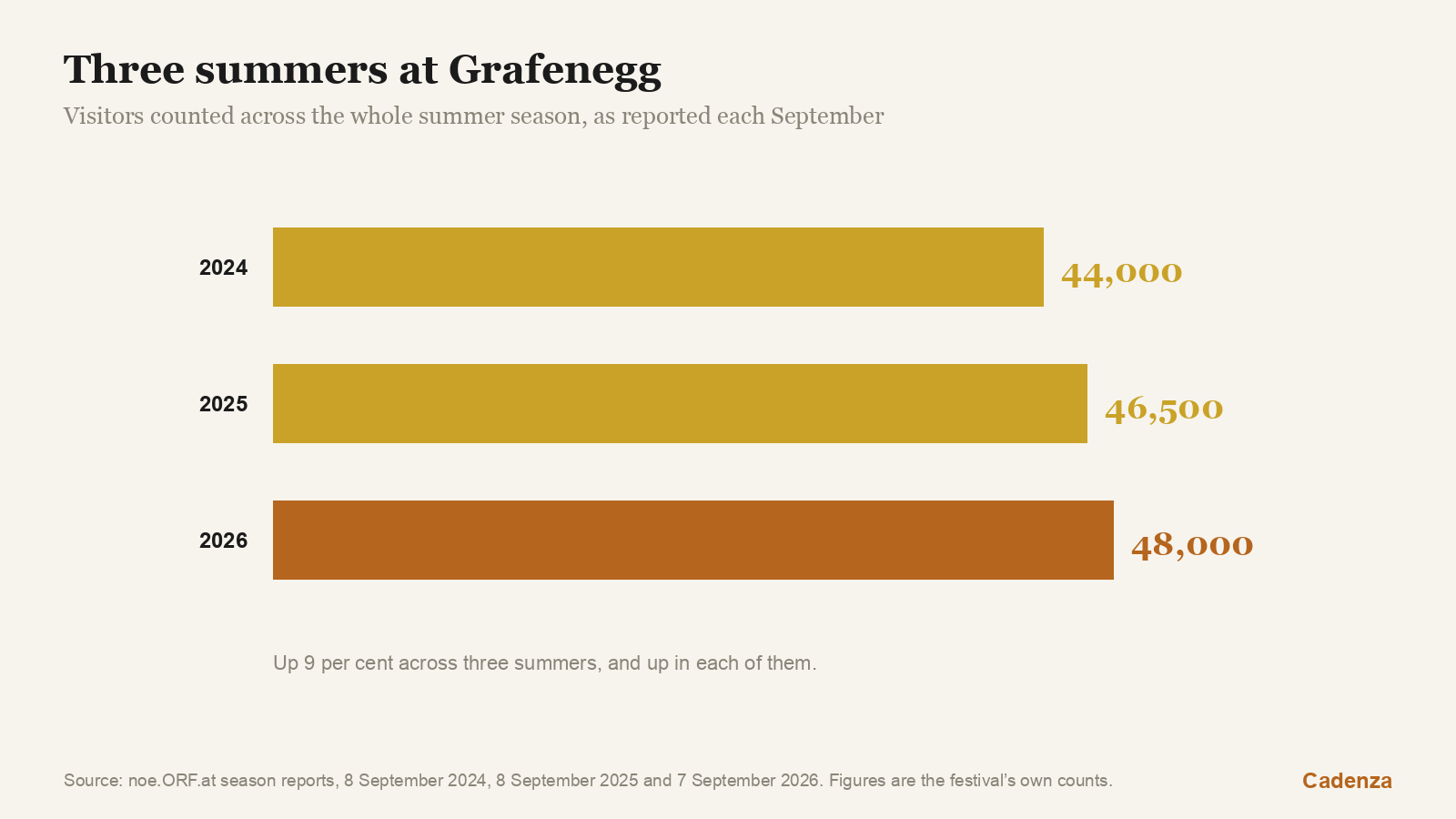
Up in each of three years, and up about nine per cent across them. In a season when a good many European festivals have been reporting flat or falling houses, three consecutive rises is the headline the festival is entitled to.
Where the growth actually came from
The second number is the more interesting one, and it is arithmetic rather than reporting.
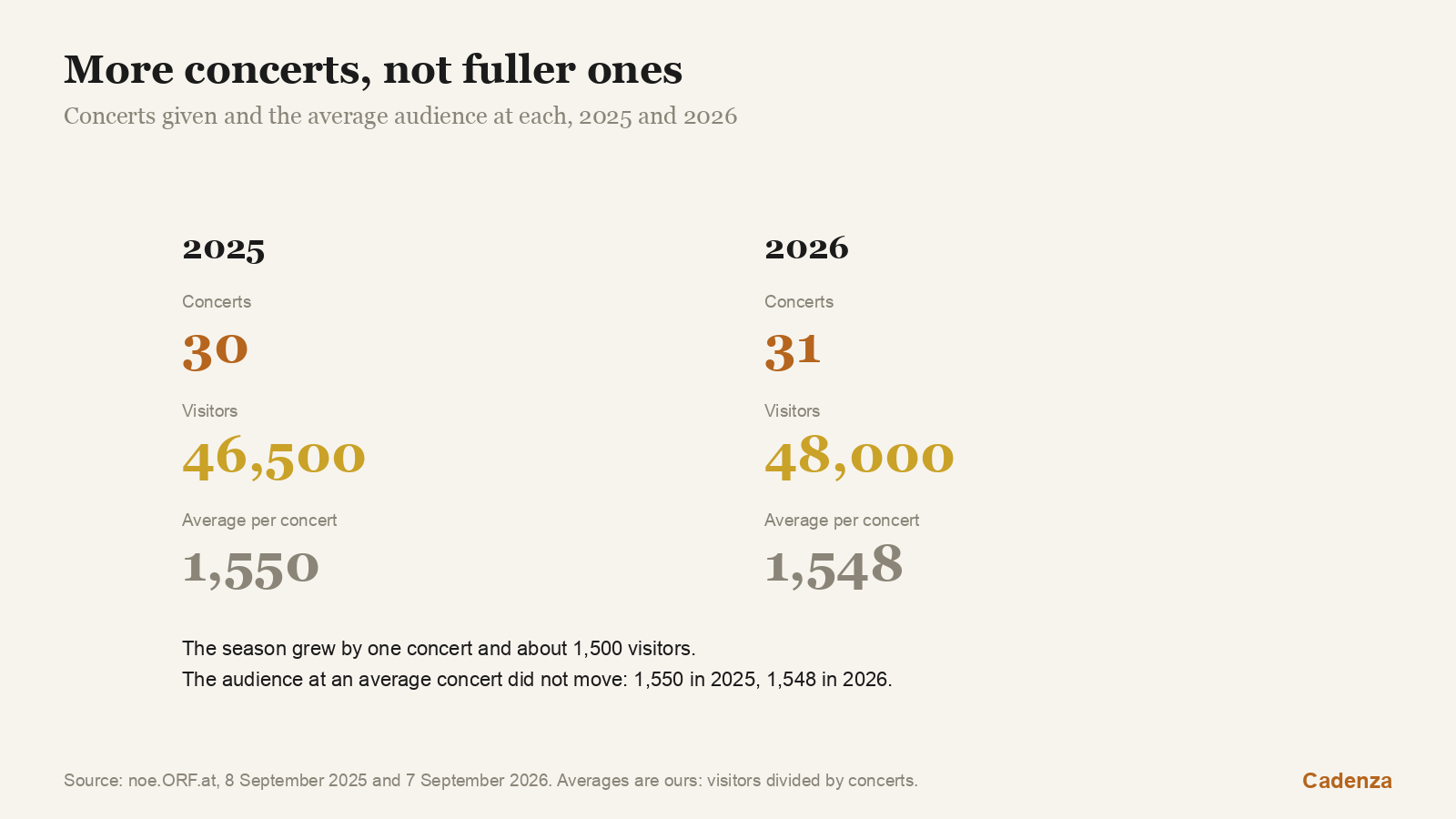
Divide the visitors by the concerts. In 2025, 46,500 across 30 concerts is an average of 1,550 people at each. In 2026, 48,000 across 31 concerts is 1,548. The season grew by one concert and about fifteen hundred visitors, and the audience at an average concert did not move at all.
That is not a criticism, and it is worth saying why. Grafenegg's main house is an open-air stage; a summer's attendance is decided partly by weather, and the festival does not publish an occupancy percentage, so nobody outside can say whether 1,550 is a full Wolkenturm or a half-empty one. What the arithmetic does establish is the shape of the growth. Grafenegg is not filling its existing concerts harder. It is putting on slightly more of them and holding the average. For an incoming director that is a useful thing to know, because the two situations call for different work: one is a marketing problem, the other is a programming and capacity question.
What the twentieth summer contained
The season opened in mid-June with the Sommernachtsgala, the soprano Angel Blue, the tenor Bogdan Volkov and the cellist Julia Hagen with the Tonkünstler-Orchester Niederösterreich under its chief conductor Fabien Gabel. The festival proper opened on 14 August with Beethoven's Choral Fantasy and Orff's Carmina Burana, played by the Philharmonia Orchestra of London under Cristian Măcelaru. Among the visiting orchestras across the summer were the Danish National Symphony Orchestra, the Rotterdam Philharmonic and the Bayreuth Festival Orchestra.
Two structural things also arrived this year. Olga Neuwirth was the composer in residence for the twentieth edition, and the Rudolf Buchbinder Hall, which was still a building site when the 2025 season closed, came into use. The festival says the chamber-music series in that hall will be expanded further under Neubert, which is the clearest signal so far of what the new direction intends to build on.
The Vienna Philharmonic came three days before the end
One concert in that final week is worth separating out, because it has been widely misread since.
On 3 September the Wiener Philharmoniker played the Wolkenturm under Tugan Sokhiev, with Mozart's Symphony No. 25 and Mahler's First. Several round-ups have since logged that evening as the Vienna Philharmonic's 2026-27 season opening. It was not. The orchestra's own calendar titles the date simply as a concert in Grafenegg, and reserves its numbering for the First Subscription Concert at the Musikverein on 26 September under Esa-Pekka Salonen. Walter Dobner made the same point in Die Presse, describing Grafenegg as the orchestra's customary stop between Salzburg and the Lucerne Festival, and headlining his review «ein unausgeglichener Tournee-Auftakt», an uneven start to the tour.
The notices were mixed. Dobner found the evening uneven. Herbert Hiess, writing in Klassik begeistert, credited Sokhiev with interpreting a great deal fantastically but wrote that «oft verhinderten unsichere Übergänge, dass das Werk zu einem harmonischen Ganzen wurde», uncertain transitions often kept the work from becoming a harmonious whole.
What matters for this ledger is not the verdict. It is that in the last week of his twentieth and final summer, Buchbinder still had the Vienna Philharmonic on his open-air stage, and that the concert counted toward the 48,000.
For musicians
Grafenegg's musician-facing work is not the festival programme, and it survives the handover.
- The Academy. Each summer the Grafenegg Academy brings together young professional musicians, orchestral players as mentors and an academy orchestra; the 2025 edition ran from 2 to 13 July under the artistic curator Jörg Widmann. The festival describes it as "a closely-knit community of exceptionally talented young professional musicians" formed each summer. Dates and the curator for 2027 are not yet published.
- Ink Still Wet. The composer-conductor workshop, led by the festival's composer in residence, exists to be, in the festival's own words, "a stepping stone for the next generation" of composers, with works read and performed rather than only discussed. With Steve Reich in residence for 2027, that is the year's most interesting place to be a young composer in Austria.
- The date to watch. The 2027 programme is published on 4 November 2026. That is when the Academy and workshop dates normally become bookable.
The case against this article
The attendance figures are the festival's own counts as reported by the provincial broadcaster each September; they are not audited, no occupancy percentage is published, and the 2026 figure is reported as "about" 48,000. The concert counts for 2025 and 2026 are the broadcaster's; no concert count was published for 2024, so the average-per-concert comparison covers two years only, and both averages are our arithmetic rather than a published figure. Whether an average of 1,550 represents a full house is not knowable from outside, because Grafenegg does not publish capacity or occupancy. Buchbinder's and Mikl-Leitner's remarks are translated from the German by us and were issued through the Lower Austrian press service rather than given to a reporter. The Academy details are taken from the festival's 2025 Academy page, since the 2027 page does not yet exist; the festival's site is heavily scripted and several of its pages could not be read directly. We have not asked the festival for a budget, a subsidy figure or an occupancy rate. The 3 September Vienna Philharmonic concert, its programme and its status as a tour date rather than a season opening come from the orchestra's own concert calendar; the two reviews of it were read in German in full.
The question
A twentieth anniversary, a third consecutive rise, a new hall and an orderly handover to a named successor is about as good a position as a summer festival hands over in. The number that will show whether it holds is not next year's attendance total, which one extra concert can lift. It is the average: whether Johannes Neubert's first summer puts more than 1,550 people in front of each concert, or simply adds another concert to the calendar. The festival has the occupancy figures and does not publish them. Publishing them would turn a good headline into a checkable one.
Related: why that Vienna Philharmonic date is not a season opening, the Gstaad Menuhin Festival's seventieth summer, Vienna's free open-air season opener and the summer festival ledger. Academies, courses and jobs are on cadenza.work/browse.
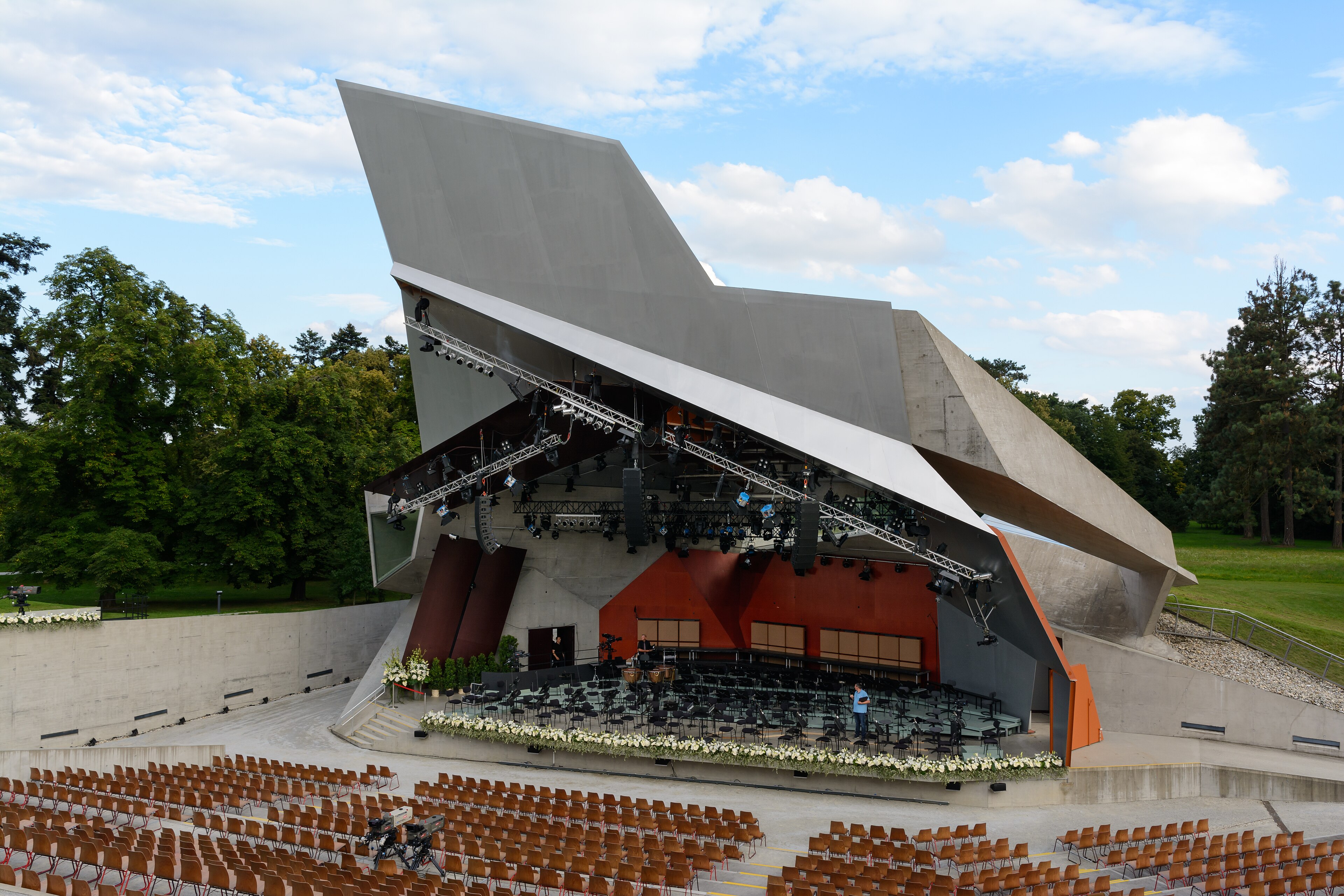
Cover photograph: The Wolkenturm, the open-air stage in the park at Schloss Grafenegg in Lower Austria, in August 2016. Photograph by Uoaei1, 19 August 2016, CC BY-SA 4.0 (creativecommons.org/licenses/by-sa/4.0), via Wikimedia Commons..
Comments
Sign in to join the discussion.