The Menuhin Festival Gstaad reported on Monday 7 September that its 70th edition, the first under the violinist Daniel Hope as intendant, ended on Saturday 5 September with Bach's Mass in B minor, played by Arcangelo under Jonathan Cohen, after "more than 100 concerts and events" and "close to 27,000" visitors over 52 festival days. More than a thousand artists came to the Saanenland, it says, under the season's motto "Family Matters". The festival Yehudi Menuhin founded in 1957 has published its numbers in that form, a total and a span, for years; the figure the release does not give is the comparison, and it exists.
Christoph Müller, Hope's predecessor, gave a farewell interview to Der Bund on 16 July 2025, two days before his 24th and last edition opened; the paper's summary records that under his direction attendance had grown from 14,000 to 26,000. His final summer then beat that: the festival's 2025 closing statement, as reported by Plattform J on 8 September 2025, put the 69th edition at 27,800 visitors over seven weeks, "an all-time record", from more than 60 concerts. "Close to 27,000" over 52 days in Hope's first summer is therefore roughly 800 below the record year on one more day, with a new intendant, a new motto, several new formats and, on the festival's own count, more than 100 events against more than 60. That is the sober version of the headline: a change of hands that held the audience Müller built, not yet one that grew it.
The document
| Item | Figure | Source |
|---|---|---|
| Edition | 70th, 16 July to 5 September 2026, 52 festival days | Festival release, 7 Sept 2026 (span and end date); start date from the festival's 11 August release and menuhin.ch |
| Attendance | "knapp 27'000", close to 27,000 | Release |
| Programme | "more than 100 concerts and events"; "over 1,000 artists" | Release |
| Closing concert | Bach, Mass in B minor, Arcangelo, Jonathan Cohen, 5 September | Release |
| Prior benchmark | 14,000 to 26,000 over Müller's 24 editions (Der Bund summary); 27,800 in 2025, "an all-time record", over seven weeks | Der Bund, 16 July 2025; festival statement via Plattform J, 8 Sept 2025 |
| Benefit | "Masters of Sound", David Garrett and the Del Gesù Club, 26 Guarneri del Gesù and Stradivari violins, Saanen church, sold out, for the String Academy; a reserved U25 allocation at CHF 30 | Release; festival release of 16 July |
| Prize | Fifth Olivier Berggruen Prize to the pianist Hayato Sumino, 10 August, after Pallavi Mahidhara (2022), Alexandra Dovgan (2023), Kate Liu (2024) and Yunchan Lim (2025) | Festival release, August 2026 |
| 2027 | 71st edition, "Passion", 16 July to 4 September 2027; programme in December; public sale from 15 December 2026 | Release |
The names the release leads with are the ones a festival of this size is measured by: Khatia Buniatishvili, Hayato Sumino, Steven Isserlis, Pinchas Zukerman, Sir András Schiff, Isata Kanneh-Mason, Nikolaj Szeps-Znaider and Behzod Abduraimov among soloists; the Budapest Festival Orchestra under Iván Fischer, the Royal Danish Orchestra under Marie Jacquot and the Royal Philharmonic under Vasily Petrenko among orchestras; the Gstaad Festival Orchestra under its chief conductor Jaap van Zweden, Alexander Shelley and Marco Armiliato, whose concert La bohème with Benjamin Bernheim and Carolina López Moreno sold out the tent and went on, "as is the tradition", to the Festspielhaus Baden-Baden. New this year were a Fiddlefest with Hope, a forum called The Summit at the Grand Chalet Balthus, President's Hikes and a film series on Menuhin at the Ciné Theatre Gstaad; all four return in 2027, when the confirmed names are Anne-Sophie Mutter, Ray Chen, Igor Levit, Daniil Trifonov, Avi Avital and Alice Sara Ott, who appears with the Wiener Symphoniker under Petr Popelka, Verdi's La traviata under Armiliato with Lisette Oropesa and Luca Salsi, and the Orchestra dell'Accademia Nazionale di Santa Cecilia under Daniel Harding in Mahler's Sixth, with Beethoven's works threaded through the programme for the 200th anniversary of his death.
Hope's own account of the summer, in the release: "Seventy years ago Yehudi Menuhin created here a place where the great artists of their time came together, and at the same time young talents were given the chance to learn, to grow and to find their own way. That connection between the generations is what I wanted to revive with 'Family Matters'." (Our translation.)
The four academies
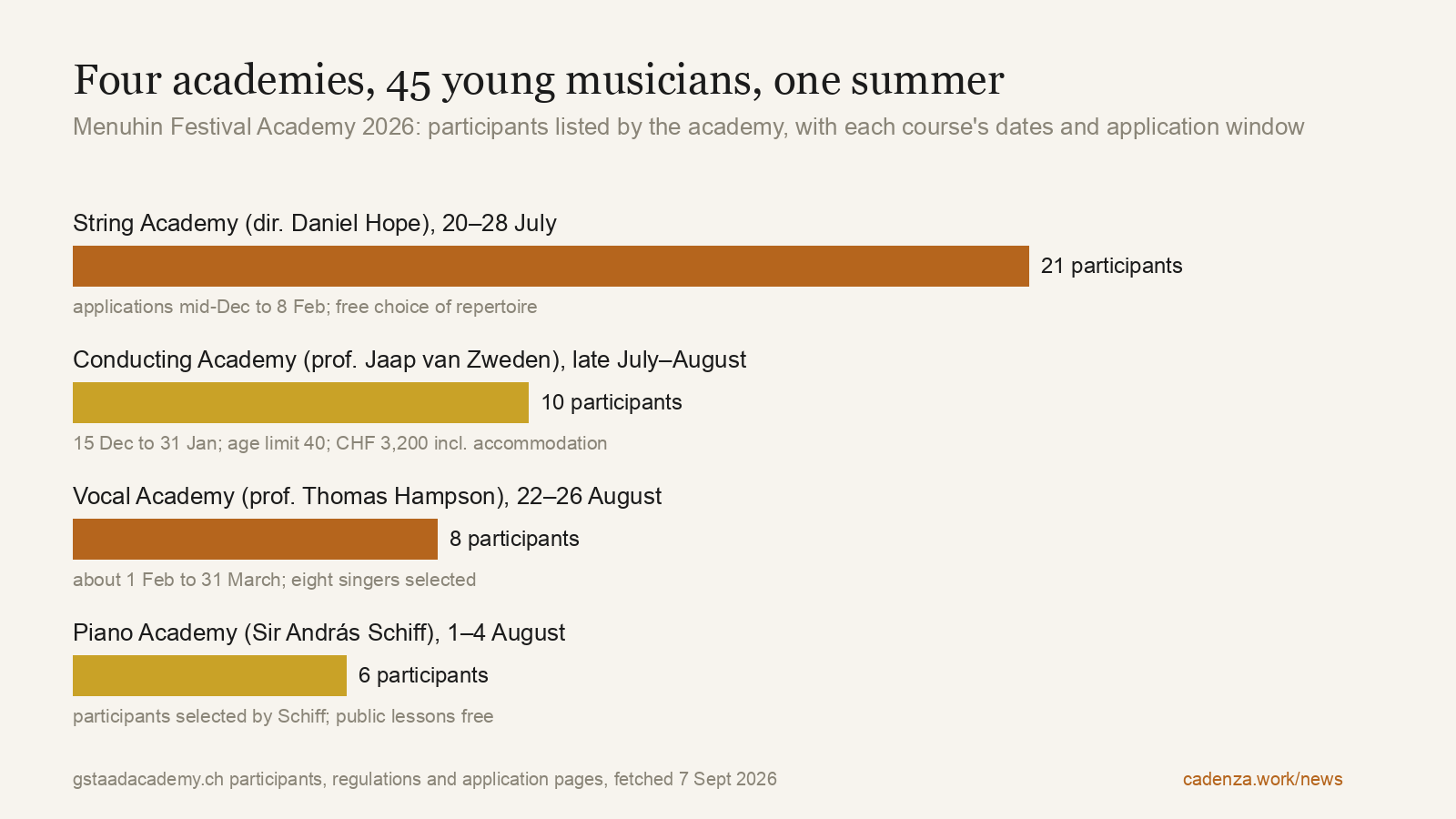
That second half of Hope's sentence is the part of the festival that the attendance figure does not count and that matters most to readers of this site. The Menuhin Festival Academy, established as a structure of its own in 2008, ran four courses this summer, and its website lists every participant by name, nationality, school and year of birth. We counted them.
| Academy | Director or professor, 2026 | Dates | Participants listed | How you get in |
|---|---|---|---|---|
| String Academy | Daniel Hope, artistic director; Daniel Geiss, academy management and cello; Tanja Sonc, violin; Adrien La Marca, viola; visiting professors Pinchas Zukerman, Josephine Knight, Amanda Forsyth | Lessons and masterclasses 20 to 28 July; concerts 23, 25 and 28 July | 7 violinists, 5 violists, 5 cellists and a string quartet: 21 | Application from mid-December to 8 February; CV, photograph, up to three diplomas, up to three video links of "free choice of pieces" in contrasting styles, a signed reference letter |
| Conducting Academy | Jaap van Zweden, professor, 2 to 9 August; Alexander Shelley, professor, 10 to 15 August; Johannes Schlaefli, head of teaching; Gstaad Festival Orchestra and a guest orchestra | 29 July to 15 August (arrival in Biel 28 July, departure 16 August); concert with the Sinfonieorchester Biel Solothurn on 1 August | 10 active participants, born 1992 to 2005, from ten countries | Registration about mid-December to 31 January; age limit 40; "around 10 active participants"; results in mid-March; course fee CHF 3,200 including accommodation, plus a CHF 100 deposit and a CHF 60 application fee; every participant is a candidate for the Menuhin Conducting Prize (the regulations still call it the Menuhin Festival Prize, "guest conducting positions with renowned Swiss orchestras for the 2027/28 season"; the prize page for 2026 lists a guest engagement with the Dresdner Philharmonie at the Frauenkirche Dresden in summer 2027, further engagements with partner orchestras and assisting Jaap van Zweden) |
| Vocal Academy | Thomas Hampson, professor; Abdiel Vázquez, head coach; Julia Okruashvili, pianist | 22 to 26 August, Kirchgemeindehaus Gstaad | "eight selected singers" | Applications to 29 March; next window about 1 February to 31 March 2027 |
| Piano Academy | Sir András Schiff, his seventh time leading it | 1 to 4 August; public lessons free, 45 minutes to an hour | 6 pianists, born 1995 to 2003 | Participants "selected by Sir András Schiff" |
The lists are worth reading for what they say about where young players now come from. The String Academy's 21 include students of the Reina Sofía school in Madrid (four), the Hanns Eisler school in Berlin, the Juilliard School, the Royal Academy of Music, the Queen Elisabeth Music Chapel, the Norwegian Academy of Music and the New England Conservatory; the youngest listed cellist was born in 2013, the oldest violinist in 1998. The six pianists Schiff chose came from the Barenboim-Said Akademie (three), the Kronberg Academy, the Queen Elisabeth Music Chapel and the Haute École de Musique de Genève. The ten conductors came from Geneva, Oslo, St Petersburg, Zurich (two), Bloomington, London (two), Helsinki and Stanford.
One of the ten was Michal Oren, listed as born in 1997, of the Royal Academy of Music, London. On 6 September, the day after the festival's closing concert, she won first prize and the orchestra's prize at the Svetlanov Competition in Birmingham, as we reported. The Gstaad regulations say each participant conducts the orchestra "during lessons, dress rehearsals and concerts" and that "nearly all rehearsals and concerts will be videotaped in professional quality" for the participants' own use, which is the kind of tape a competition application is made of. The academy's own prize, the Menuhin Conducting Prize, went on 13 August jointly to two others from the same ten, Leonhard Kreutzmann and Tess Jackson, with a first audience prize to Gonzalo Alarcón Burriel, as the Schweizer Musikzeitung reported; her name on the 2026 list is the reason to read the list.
What it costs, and who pays
The Conducting Academy is the only one of the four that charges: CHF 3,200 for the course including accommodation, plus a CHF 60 application fee. The other three are free. The String Academy's regulations say the master class "is free of charge and covers accommodation for active participants"; the Vocal and Piano pages say the same of their courses, with accommodation arranged on request; each asks a refundable CHF 100 deposit against the rooms. Active conducting and piano participants are entitled to free entry to festival concerts subject to availability; the String Academy page promises "the opportunity to attend" concerts on the same terms.
On the other side of the ledger is the benefit. The Garrett concert on 26 July, according to the festival's July release, was, in the festival's words, the club's first public concert of its kind, billed as a world premiere, assembling "some of the most precious and famous violins in the history of music" for the String Academy's benefit; by the time of the release the only remaining tickets were the U25 allocation at CHF 30, and the closing release calls the evening sold out. The festival does not say what it raised. Its own funding line is in Richard Müller's closing statement, as chairman of the board: thanks to "all sponsors, patrons, foundations and partners who make this festival possible".
If you go, or apply
- Apply. Conducting Academy registration for 2027 opens about mid-December 2026 and closes 31 January 2027 at gstaadacademy.ch; String Academy applications open in mid-December, with the 2026 deadline having been 8 February; Vocal Academy about 1 February to 31 March 2027. Piano Academy participants are chosen by Schiff. The calls will appear on cadenza.work/browse as they open.
- Gstaad, 16 July to 4 September 2027. The 71st festival, "Passion"; full programme in December; tickets from 15 December 2026 at menuhin.ch.
- Public lessons. The academies' lessons and masterclasses are open to the public during the festival, listed each year on the academy agenda; all four academies' lessons were free with a collection and no reservation; the concerts required booking.
The case against this article
The attendance figure is the festival's own, unaudited, and "knapp 27'000" is the release's wording; the 26,000 benchmark is Der Bund's summary of Müller's figure in July 2025, before that summer's final count; the 27,800 for 2025 is the festival's own closing figure as reported by Plattform J, and we have not seen the original release. 2025 ran 51 days, 2026 ran 52, and the festival counted "more than 60 concerts" in 2025 against "more than 100 concerts and events" in 2026, so the two totals are not strictly like-for-like. Participant counts are ours from the academy pages read on 7 September; one quartet member's details are blank on the page. The three free courses' terms are as printed on the regulations pages read on 7 September; we have not asked the festival who funds them. Hope's quotation is our translation from the German release. The Berggruen Prize's value is not stated in the festival's release. We have not seen the festival's accounts and do not know what the benefit raised.
The question
The festival counts its audience to the nearest thousand and its academy participants to the name. The one number that would tie the two together is how many of the 45 came back to Gstaad as artists, or went on, like one of this year's ten conductors, to win something the week after. The academy's participants page lists conductors back to 2014; a line beside each name saying where they are now would cost the festival an afternoon and would be the best advertisement it has.
Related: The Svetlanov ledger, The Side Door on what academies deliver, and The Odds. Academies, competitions and calls are on cadenza.work/browse.
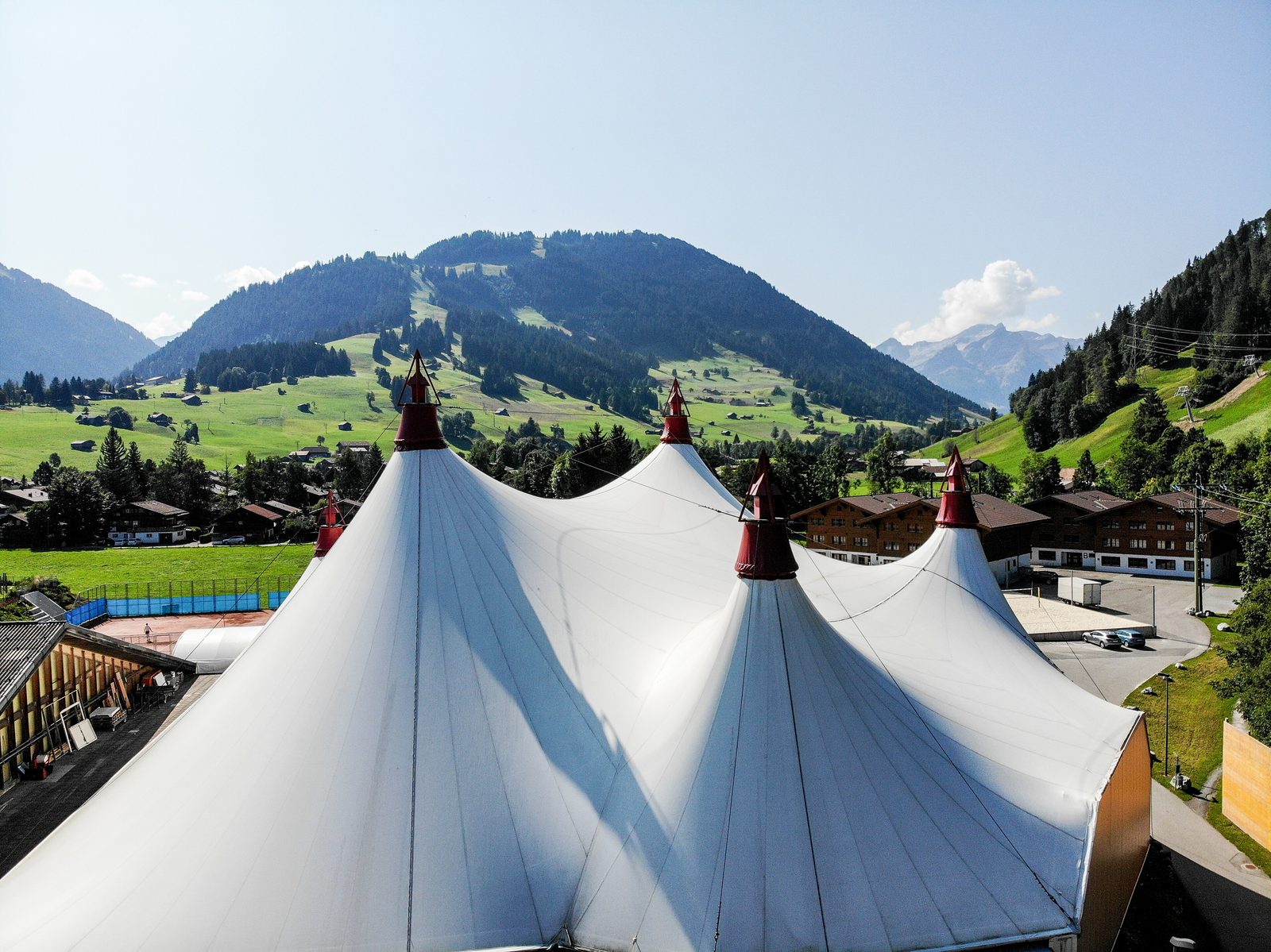
Cover photograph: The Menuhin Festival's tent at Gstaad, with the Wispile behind, in August 2019. Photograph by Kakue.gmf, CC BY-SA 4.0 (creativecommons.org/licenses/by-sa/4.0), via Wikimedia Commons..
Comments
Sign in to join the discussion.