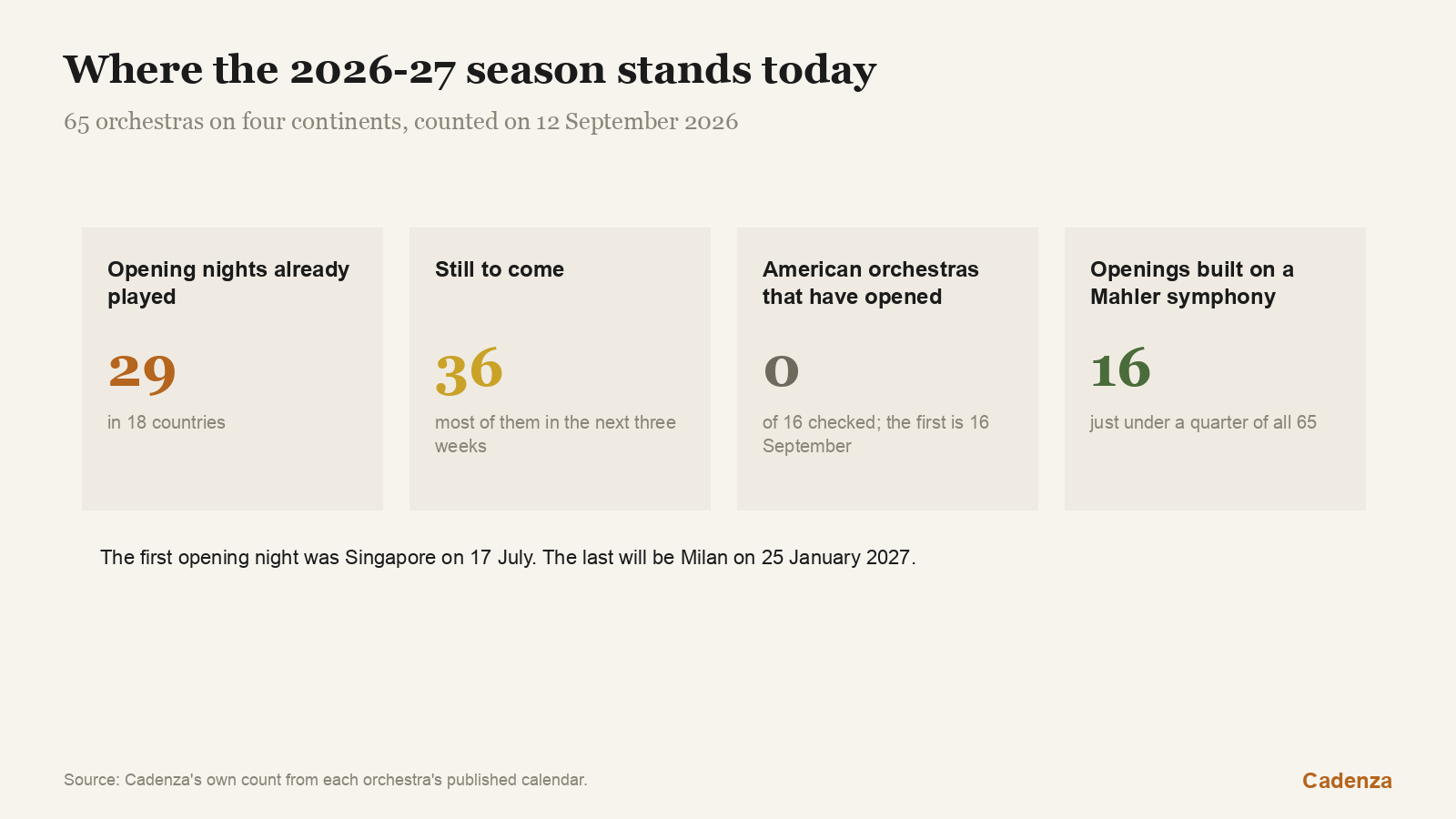
The 2026-27 orchestral season opened in Berlin on 21 August. In the United States it has not started.
Cadenza checked the opening-night programme of sixty-five orchestras across Europe, Asia, North America and the Pacific, taking every date, conductor, soloist and work from the orchestra's own published calendar. Twenty-eight of those concerts have been played. Thirty-seven have not.
The first was Singapore, on 17 July. The last will be Milan, on 25 January 2027. Between those two dates the season opens the way a tide comes in, and this piece is a ledger of how far it has reached.
Then there is the thing nobody appears to have counted. Of the twenty-eight openings already played, ten chose a Mahler symphony. Between them, those ten performances covered the First, the Second, the Third, the Fourth, the Fifth and the Sixth. There are no gaps in that run, and nothing later than the Sixth was chosen anywhere.
Six symphonies, ten cities, no gaps
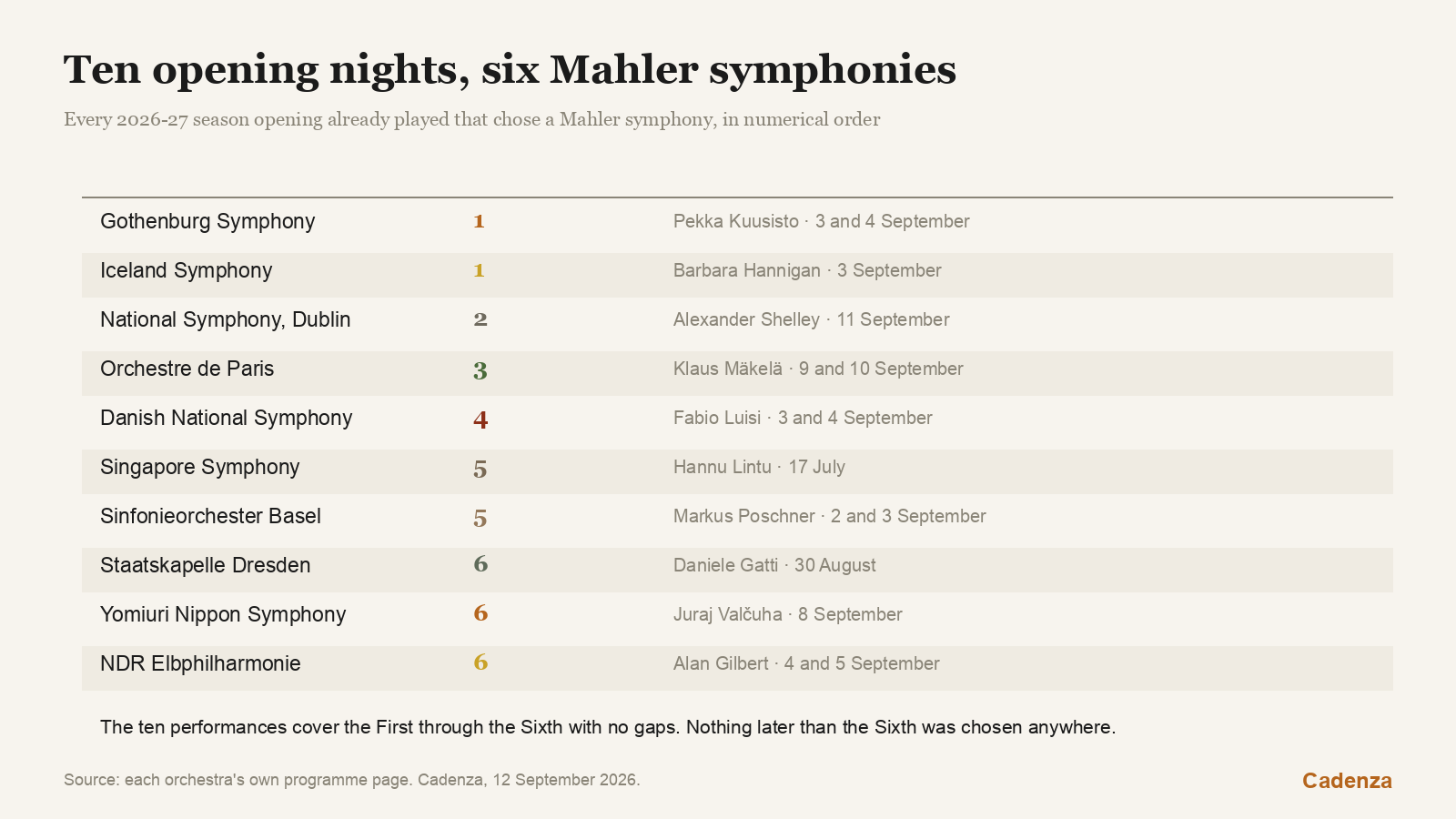
The Gothenburg Symphony and the Iceland Symphony both opened with the First, within hours of each other on 3 September. The National Symphony Orchestra Ireland took the Second in Dublin on 11 September. The Orchestre de Paris took the complete Third on 9 and 10 September. The Danish National Symphony took the Fourth in Copenhagen on 3 and 4 September. The Fifth went twice, to the Singapore Symphony on 17 July and the Sinfonieorchester Basel on 2 September. The Sixth went three times, to the Staatskapelle Dresden on 30 August, the NDR Elbphilharmonie Orchester in Hamburg on 4 September and the Yomiuri Nippon Symphony in Tokyo on 8 September.
Ten orchestras in ten cities, and the numbers they picked happen to form an unbroken sequence. Two of them are working through a Mahler cycle: Dresden is midway through the first complete one in its history, and Basel billed its Fifth as the second instalment of its own.
Widen the frame to all sixty-five orchestras and the pattern holds rather than dissolves. Another six of the openings still to come are also built on Mahler: the Second in Birmingham on 17 September and in Madrid on 18 September, the Sixth in Glasgow on 18 September and in Turin on 22 October, the Tenth in Ljubljana on 17 September, and in Montreal on 16 September a programme made entirely of Mahler songs and the early cantata.
Sixteen of sixty-five is just under a quarter. Close to one orchestra in four is opening its season with this composer, and none of them arranged it with the others.
There is a reason beyond fashion, and Dresden states it plainly on its own website. The Staatskapelle's Mahler Sixth was billed as the continuation of the first complete Mahler cycle in the orchestra's history, under the season title Abschied, or Farewell. The season also carries the Tenth in Deryck Cooke's performing version and Das Lied von der Erde, with the Ninth held back for autumn 2027. An orchestra reaching the first complete Mahler cycle in its own history is worth noticing on its own, and it explains why the Sixth came first.
The season does not open. It rolls
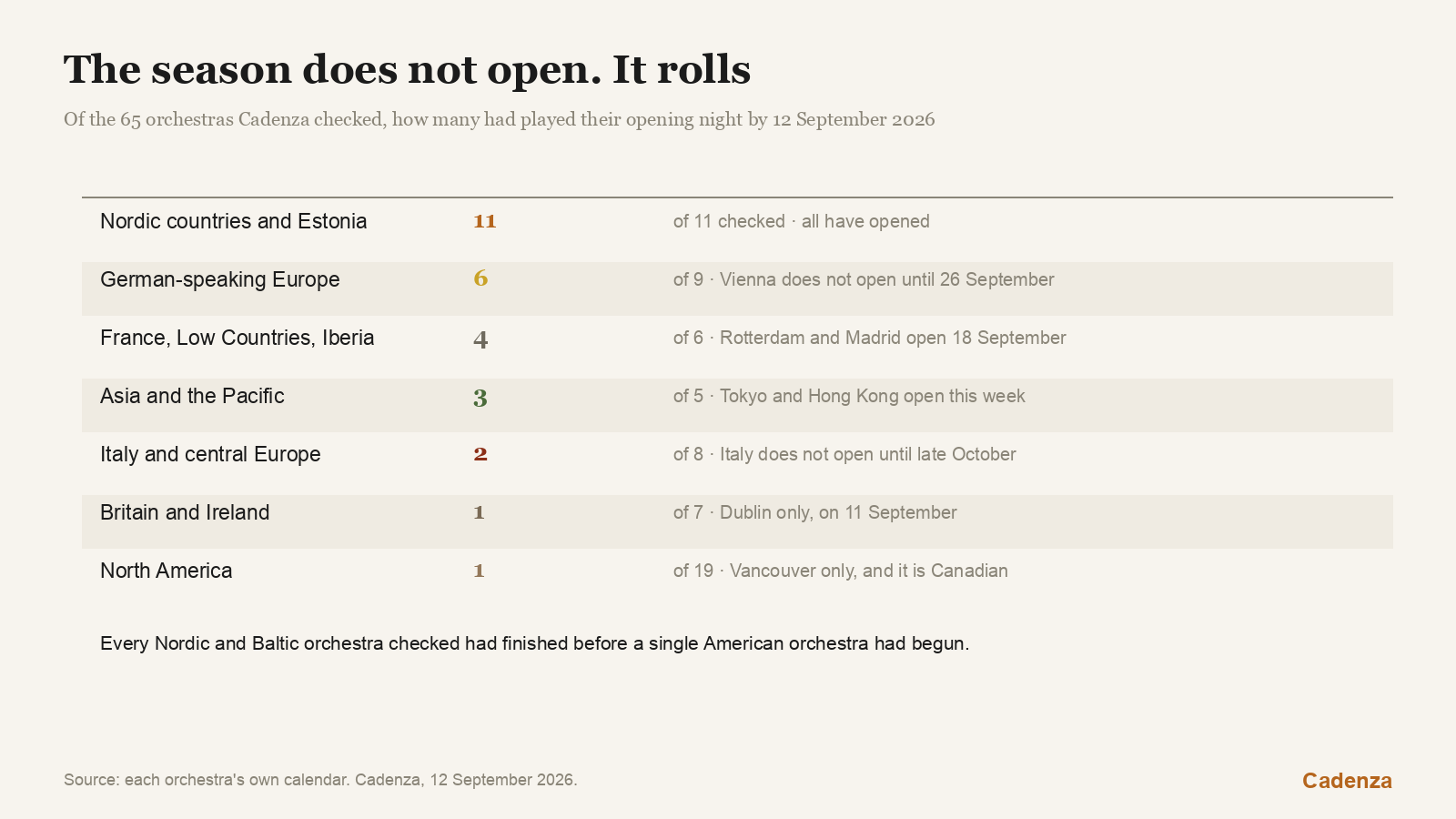
Ten of the eleven Nordic and Baltic orchestras Cadenza checked have finished their opening night, from Reykjavík and Trondheim to Malmö and Tallinn, and the eleventh opens tonight. So have seven of the nine in German-speaking Europe, four of the six in France, the Low Countries and Iberia, and three of the five in Asia and the Pacific.
Britain and Ireland have managed one of seven, and that one is Dublin. Italy and central Europe have managed two of eight, because Italy does not open until late October.
North America has managed one of nineteen. It is the Vancouver Symphony Orchestra, which opened at the Orpheum on 11 September under its music director Otto Tausk with the pianist Hayato Sumino in Chopin's First Concerto, and it is Canadian.
Sixteen American orchestras appear in this survey. Not one of them has played its opening night. The earliest is St Louis, which puts a free community concert on Art Hill in Forest Park on 16 September before its subscription weekend on the 26th.
One famous name is not in the played column either, and establishing that took some care. The Vienna Philharmonic appeared at Grafenegg on 3 September under Tugan Sokhiev with Mozart and Mahler's First, which looks like an opening night and is not one. The orchestra's own page calls that date simply a concert in Grafenegg, and Walter Dobner's review in Die Presse frames it as a tour stop between the Salzburg and Lucerne festivals, headlining it «ein unausgeglichener Tournee-Auftakt», an uneven start to the tour. The orchestra's own calendar reserves the label for its First Subscription Concert at the Musikverein on 26 September, when Esa-Pekka Salonen conducts Lutosławski's Fourth Symphony, Debussy's La Mer and Sibelius's Fifth.
This is not a judgment about anybody. It is a calendar fact, and the pattern in the data is plain enough to state: Labor Day fell on 7 September this year, and every single American opening in this survey comes after it. Several cities also put a fundraising gala before their first classical programme, which is why San Francisco's gala on 24 September sits a week after the orchestra's actual first subscription concert on the 18th.
What it does mean is that anyone reading only the American and British press has, on 12 September, read nothing about a season already well under way in eighteen countries.
Four first nights
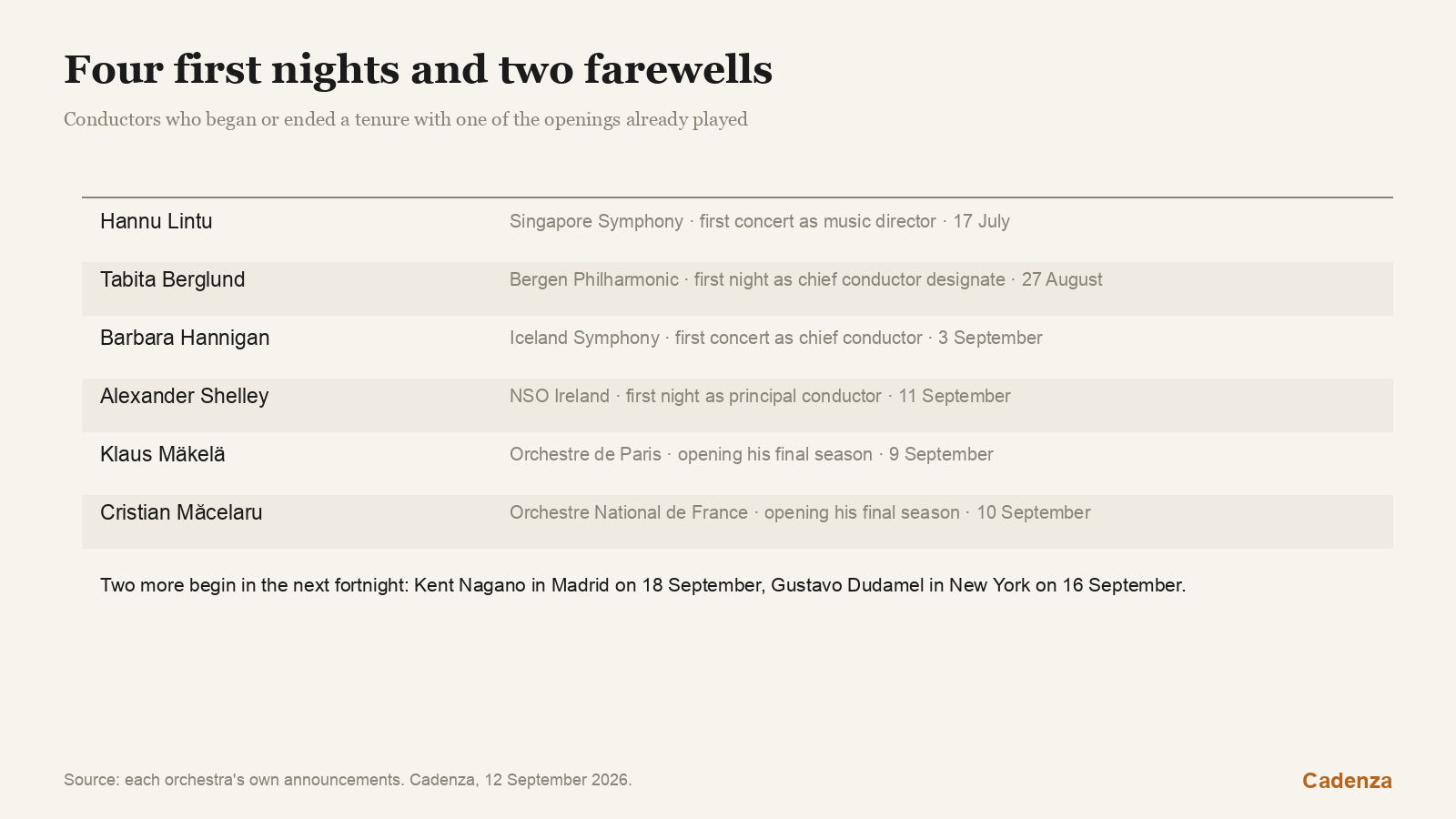
Four conductors used one of these concerts to begin a tenure.
Hannu Lintu opened the Singapore Symphony's season on 17 July as its new music director, with Gil Shaham in Mason Bates's Nomad Concerto, a new commission from Tan Chan Boon and Mahler's Fifth.
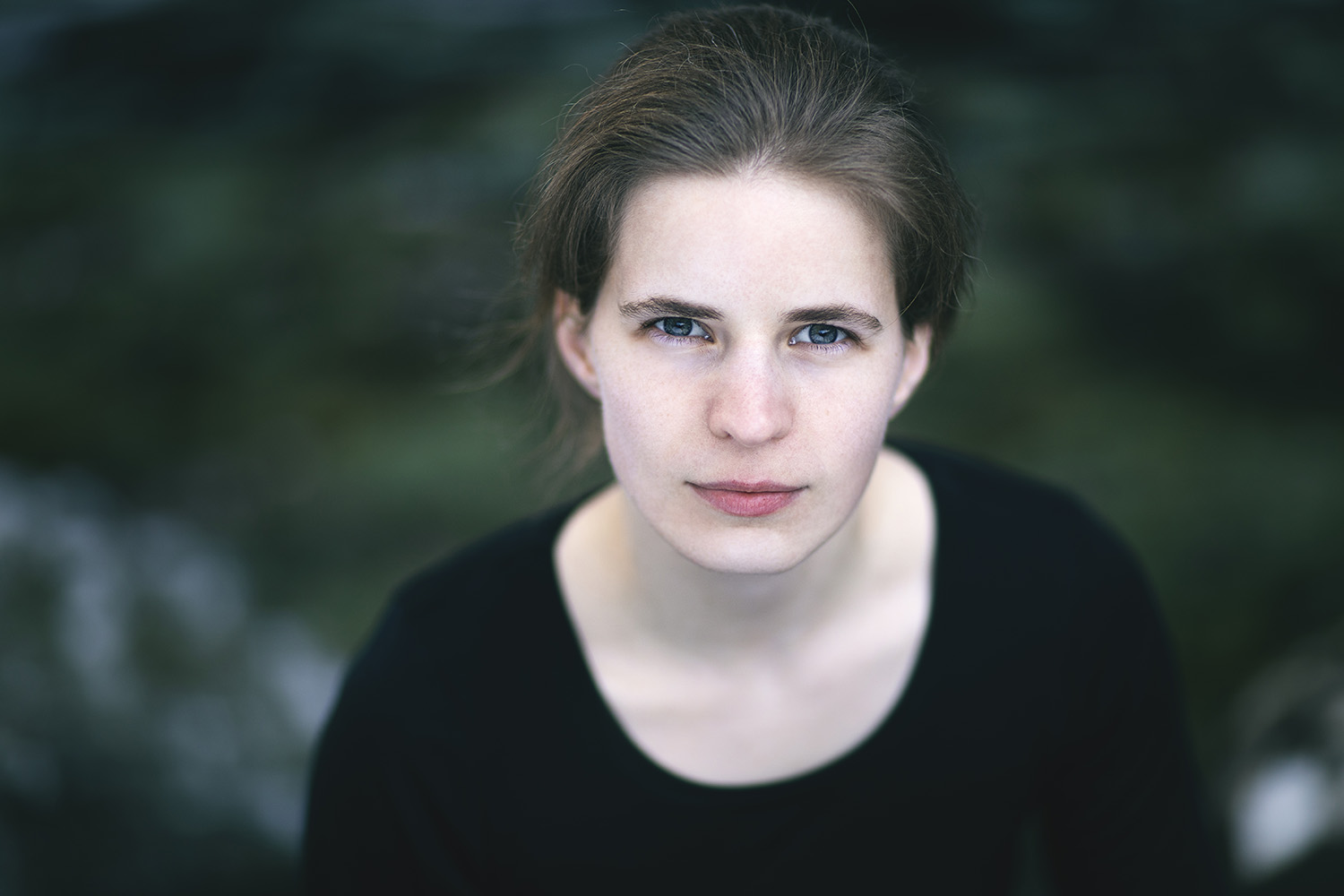
Tabita Berglund conducted the Bergen Philharmonic on 27 and 28 August as chief conductor designate, a year before she formally takes up the post. The orchestra's own site quotes her saying she is happy, proud and humbled to have been named its new chief conductor. Her programme ran Grieg's First Norwegian Dance, Pärt's Fratres in the version for cello ensemble, the world premiere of Ørjan Matre's Still, what remains… for percussion and orchestra with Hans-Kristian Kjos Sørensen as soloist, a selection from Tveitt's Hundred Hardanger Tunes, and the second suite from Ravel's Daphnis et Chloé.
The fourth was Barbara Hannigan, whose first concert as chief conductor and artistic director of the Iceland Symphony, on 3 September, ran Ives, a Hugi Guðmundsson world premiere, Cage and Mahler's First without a break.
Alexander Shelley opened as principal conductor of the National Symphony Orchestra Ireland on 11 September with Mahler's Second, the mezzo-sopranos Sarah Connolly and Tara Erraught, and the National Symphony Chorus Ireland. That was the night before this piece was written, and no review had appeared anywhere by the time of publication.
Two more first nights arrive within the week. Kent Nagano opens his first season as titular and artistic director of the Orquesta Nacional de España on 18 September, with Mahler's Second. Gustavo Dudamel plays his first subscription concert as music and artistic director of the New York Philharmonic on 16 September, with John Adams's On the Transmigration of Souls, a world premiere by Zosha Di Castri and Prokofiev's Fifth.
And two farewells
Two music directors used their opening night to start counting down.
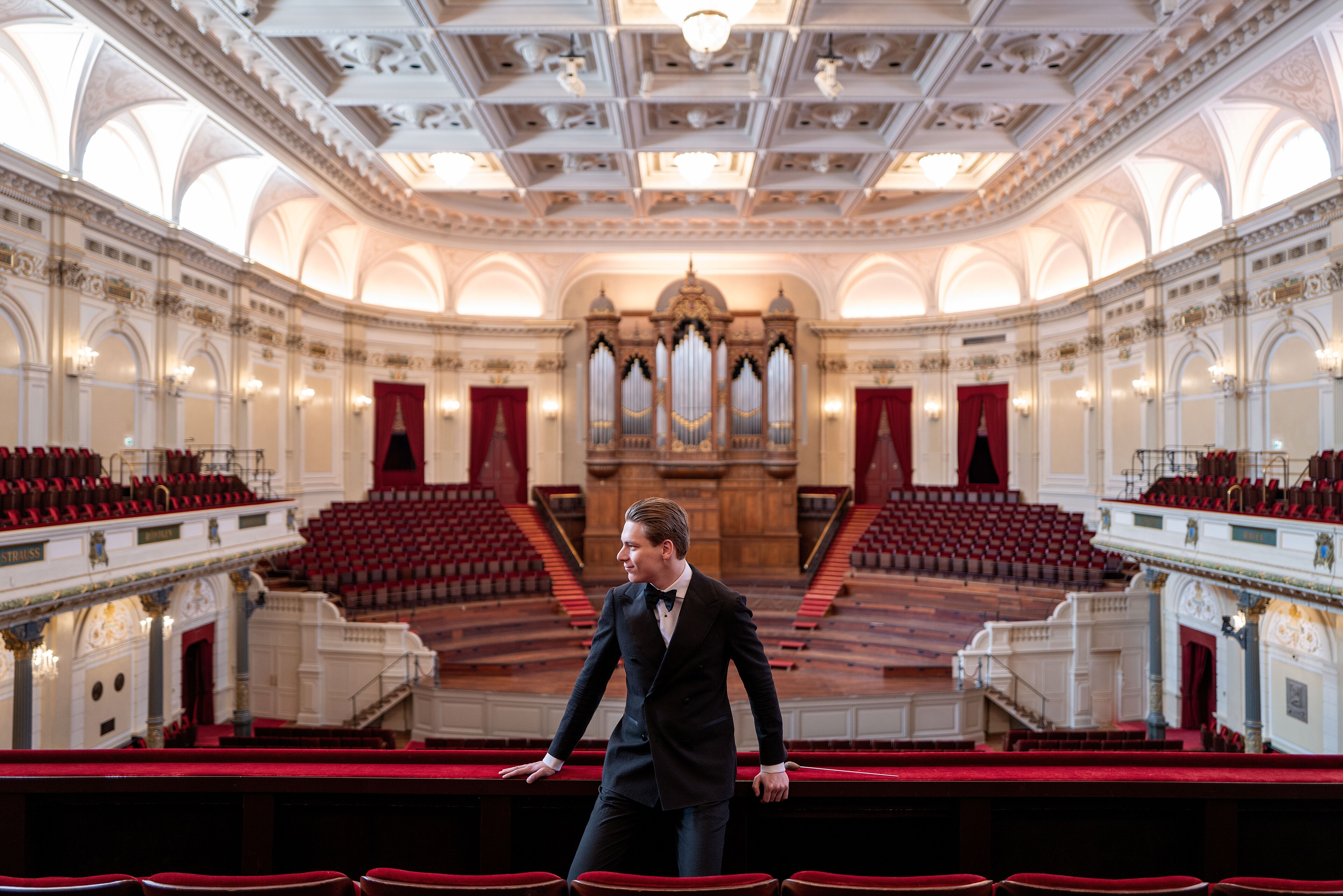
Klaus Mäkelä opened his final season at the Orchestre de Paris on 9 and 10 September with the complete Mahler Third, the singer Wiebke Lehmkuhl and the orchestra's women's, youth and children's choirs. Cristian Măcelaru opened his final season at the Orchestre National de France on 10 September, the same evening and the same city, with Bernstein's Chichester Psalms, Saint-Saëns's First Cello Concerto played by Nicolas Altstaedt, and Enescu's First Symphony.
Two Paris orchestras, two departing music directors, one night.
Five orchestras opened with music nobody had heard
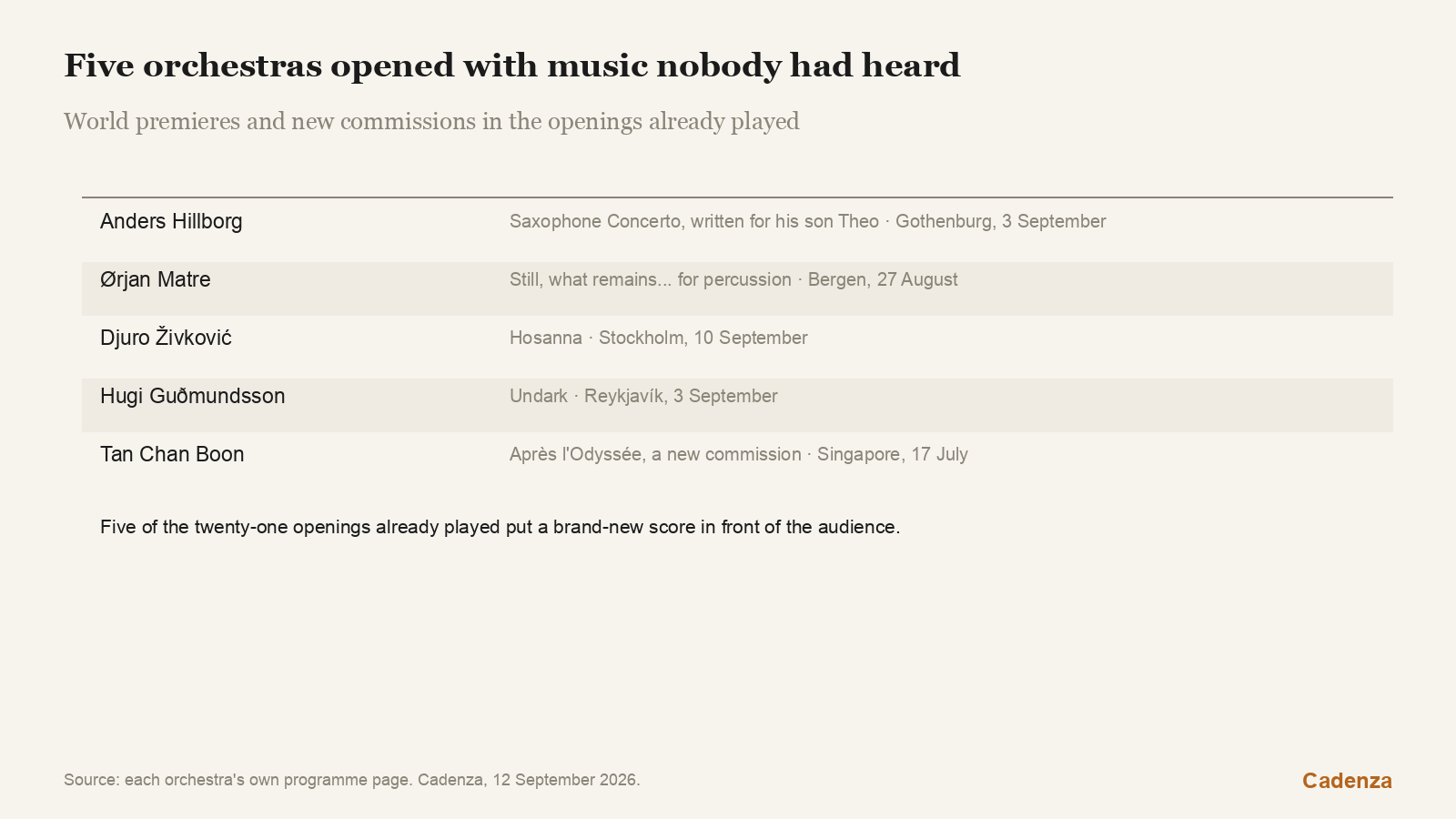
Five of the twenty-one openings already played put a brand-new score in front of an audience on the first night of the season, which is a braver piece of programming than it sounds. An opening concert is the one a board, a sponsor and a subscription base all turn up to.
The best of the five is in Gothenburg. Anders Hillborg wrote a saxophone concerto for his son, the saxophonist Theo Hillborg, and the Gothenburg Symphony commissioned it and gave the premiere on 3 September under Pekka Kuusisto. On the orchestra's own page the composer calls it a great privilege for both him and Theo that the premiere is being given by what he describes as the dream team of the Gothenburg Symphony and Kuusisto, and notes that while he has written for his son before, this is the first on a large scale, with full orchestra.
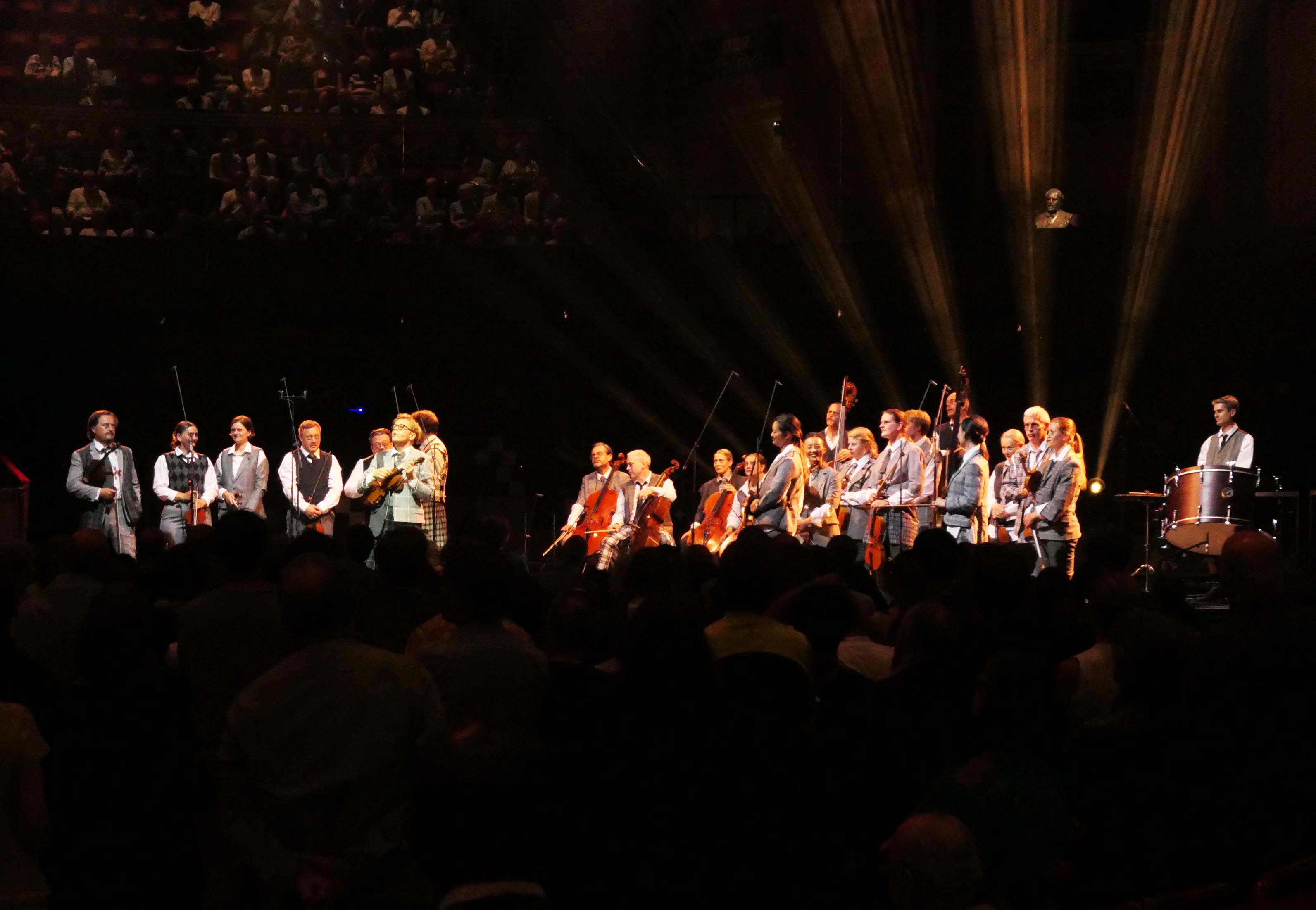
The same concert opened with the Sunrise suite by Ida Moberg, a Finland-Swedish composer who conducted the premiere of the work herself in Viborg in 1908, and who began as a singer and piano teacher before training as a composer and conductor. An opening night that begins with a woman who conducted her own premiere in 1908 and continues with a father's concerto for his son is a well-made evening before a note is played.
The other four are Matre's percussion concerto in Bergen, Djuro Živković's Hosanna in Stockholm, where he is the concert hall's composer of the season, Guðmundsson's Undark in Reykjavík, where he is the orchestra's composer-in-residence, and Tan Chan Boon's Après l'Odyssée in Singapore.
Leipzig opened with an argument
One orchestra did not open with a concert at all. It opened with a weekend.
The Gewandhausorchester began its 2026-27 season on 4 September with a Demokratie-Wochenende, a democracy weekend, running to the 6th under the motto Vorzeichen lesen. The phrase is a pun that does not survive translation: Vorzeichen are the accidentals at the head of a stave and also the portents of a situation, so the motto means both reading the key signature and reading the signs of the times.
As the German magazine concerti reported two days before it began, this was the fifth time the orchestra has paired its concerts with public discourse over a weekend, setting historical experience, scholarly analysis and artistic perspectives against each other to ask how the present should be read. The music inside it was Rachmaninov's Third Piano Concerto, played by Mao Fujita, who was born in Tokyo in 1998 and won the Clara Haskil Competition in 2017 while still a student, and Dvořák's Seventh, under Andris Nelsons.
An orchestra that opens its year by convening an argument, and has now done it five times, is doing something more interesting than a gala.
What the local critics actually wrote
This is the part of the story that only exists if somebody reads the local press, so Cadenza read it in eight languages.
Oslo went first among the Nordic orchestras, on 26 August, and Aksel Dalmo Tollåli reviewed it for Aftenposten under the headline Gir liv til musikken på en helt egen måte, gives the music life in an entirely distinctive way, over a standfirst reading simply Mye å glede seg over, much to be glad about. His assessment of the playing: «Til tross for store omveltninger er det konsentrasjon og fabelaktig musisering som preger Oslo-filharmoniens første konsert denne høsten.» Despite major upheavals, it is concentration and fabulous musicianship that mark the Oslo Philharmonic's first concert this autumn. The upheavals are real, and they are the reason that sentence carries weight: Klaus Mäkelä's six years as chief conductor ended in May, so the orchestra opened between tenures under a guest.
One oddity in that review Cadenza cannot resolve. Its deck also promises a barefoot violin soloist, and the orchestra's own programme page for 26 August lists two works, no soloist and a duration of eighty minutes. Three days later the same orchestra and the same conductor played the BBC Proms with Patricia Kopatchinskaja, who performs barefoot, in the Stravinsky Violin Concerto. The likeliest explanation is that Aftenposten covered both concerts in one piece, but the paywall closes before that can be checked, so the quotation above is used only for the sentence that names the concert itself.
The warmest notice went to Bergen. Writing in NRK, the critic Eystein Sandvik gave Berglund's first night five of six on the Norwegian dice scale under the headline Overbevisende fra ny sjefdirigent, or convincing from the new chief conductor. His verdict on Berglund herself: «Tabita Berglund står frem som en dirigent med sterk personlighet og tydelig musikalsk visjon.» That is, Tabita Berglund emerges as a conductor with a strong personality and a clear musical vision. He praised Kjos Sørensen in the Matre premiere, called the Ravel fantastic, and ended by writing that he thinks there is reason to look forward to what comes next.
Bergens Tidende sent Maja Sievers Skanding, and the headline the paper put on her review is the single best line to come out of any of these twenty-one concerts: «Hun er ingen opphøyd maestro, hun er en av musikerne.» She is no exalted maestro, she is one of the musicians.
Berlin went first of all the European orchestras, on 21 August, and split its critics. Kirill Petrenko conducted Elgar's Enigma Variations and Tchaikovsky's Fourth, a programme the orchestra then took to Salzburg and Lucerne. Peter Sommeregger reviewed it for klassik-begeistert under the headline Petrenko begeistert mit einer fulminanten Saisoneröffnung, Petrenko delights with a brilliant season opening, and wrote that after several years together the choice of Petrenko as chief conductor «erweist sich als fortdauernder Glücksgriff», proves a continuing stroke of luck. He also noticed something nobody else did: both works on the programme carry the opus number 36.
Kirsten Liese, in Das Opernmagazin the following day, heard the same concert differently. Her objection was specific and to the Tchaikovsky: «Das Finale spulte Petrenko definitiv zu schnell ab, das tönte zwar hoch virtuos, aber doch recht seelenlos.» Petrenko reeled off the finale too fast, she wrote, and it sounded highly virtuosic but rather soulless. Two named German critics, one concert, opposite conclusions about the same twenty minutes.
Sweden's two openings both got their notice. Göteborgs-Posten sent Magnus Haglund to the Hillborg premiere and headlined his review Glansfull öppning av säsongen med Göteborgssymfonikerna, a glittering opening of the season, with a summary line saying the soprano saxophonist Theo Hillborg impresses as soloist in his father's concerto. Haglund's own line in the paper's teaser is that bringing this into the light is an achievement. In Dagens Nyheter, Johanna Paulsson reviewed the Stockholm centenary opening and delivered a verdict: «En lyckad och väl sammansatt höststart.» A successful and well-assembled start to the autumn. The evening, her standfirst says, offered rich music, a restless orchestral fanfare and a welcome release from sentimentality. Both Swedish reviews sit behind subscription walls that serve only the headline and the standfirst, so what is quoted here is what each paper published in the open.
The best week anybody in this ledger had belongs to a violinist who was not supposed to be there. Karen Gomyo stepped into the Czech Philharmonic's opening concerts on 1, 2 and 3 September at short notice, when Janine Jansen withdrew on health grounds, and played Shostakovich's First Concerto under Semyon Bychkov in the Rudolfinum. Three Czech critics wrote about her, independently, and all three were admiring.
Jiří Slabihoudek, in Seznam Zprávy on 2 September: «Karen Gomyo tento nelehký úkol zvládla výborně a v naplněném sále to v průběhu tiché houslové litanie ani nedutalo.» Karen Gomyo handled this difficult task superbly, and in the packed hall you could have heard a pin drop during the quiet violin litany. Richard Hruban, in Novinky.cz on 4 September, marked the concert at ninety per cent and wrote that under Bychkov's baton the orchestra became her empathetic and precisely structured guide through the work. Josef Kratochvíl, in Opera Plus on 8 September: «Její výkon byl skutečně přesvědčivý s hlubokým porozuměním skladatelovy vize.» Her performance was genuinely convincing, with a deep understanding of the composer's vision.
Three critics, three outlets, one substitute soloist. That is what a good week looks like in print.
In Paris, Mäkelä's Mahler Third drew two favourable notices. Jean-Christophe Le Toquin wrote in ResMusica that «l'effet général obtenu, malgré une instrumentation pléthorique est celle d'une grande clarté, sans saturation ni confusion.» The overall effect, despite the abundant instrumentation, is one of great clarity, without saturation or confusion. He was less convinced by the third movement, and ended by calling the evening harmonious and in osmosis with its public. Jean-Pierre Rousseau, writing for Bachtrack's French edition, found that «l'orchestre répond au moindre frémissement, et cette économie de moyens engendre une lisibilité rare.» The orchestra responds to the slightest tremor, and this economy of means produces a rare legibility. The two words are not the same, but the thought behind them is: both critics heard a very large score made unusually easy to follow.
The season's very first opening night, back in July, got the season's crispest verdict. Chang Tou Liang reviewed Hannu Lintu's inaugural concert with the Singapore Symphony for Bachtrack and called the Mahler Fifth "a gripping performance that was long on drama but short on bombast". Mervin Beng, in The Straits Times, opened his review by writing that the concert had one unmistakable message, which was that change is coming.
In Tokyo, the critic Hasegawa Kyosuke reviewed the Yomiuri Nippon Symphony's Mahler Sixth for CLASSICNAVI, an outlet published by Mainichi Productions and unconnected to the Yomiuri Shimbun, which owns the orchestra. His verdict: 「ヴァルチュハと読響が総力を結集し、マーラーの音楽そのものに語らせた凄演であった。」 Valčuha and the Yomiuri Nippon pooled their full strength and let Mahler's own music speak, in a performance he calls overwhelming. The veteran critic Tōjō Hiroo, writing on his own long-running review diary rather than for a paper, admired the clarity Valčuha drew from the orchestra but felt the reading gave too little weight to the fatalism the symphony is usually built on.
Not every notice was favourable. Jónas Sen, writing in Vísir on 8 September, was unpersuaded by the Reykjavík Mahler, and his closing line separated the composer from the conductor: «Mahler slapp sem sagt sýknaður. Hannigan ekki.» Mahler, then, was acquitted. Hannigan was not.
Dresden drew the most attention of any concert in the survey, and the three critics who wrote about it did not agree either. Thomas Thielemann, in Der Opernfreund, singled out the slow movement: «Mit dem Vermeiden jeder Schwelgerei schufen Dirigent und Orchester ein Andante seltener Schönheit.» By avoiding any wallowing, conductor and orchestra created an Andante of rare beauty. Svenja Koch, reviewing for Bachtrack's German edition, found that some of it felt unformed in the moment and that some of it could have taken hold more directly. Martin Morgenstern, in Musik in Dresden, admired much of the playing but wrote that Gatti could not fully convince him and that in Sunday's performance he missed a clear concept.
Those are individual opinions about individual evenings, and other critics may hear those concerts differently. They belong in a ledger that claims to report what the local press said, because a round-up that printed only the good notices would not be worth reading.
Eight more openings, and the critics who turned up
Extending the census past the obvious names turned up seven further orchestras that have already opened, an eighth that opens tonight, and one famous name that turns out not to have opened at all. Every one of the seven was reviewed at home.
Hamburg belongs in the Mahler column. The NDR Elbphilharmonie Orchester opened on 4 and 5 September under its chief conductor Alan Gilbert, in a programme its own site headlined Pauken- und Hammerschlag zur Spielzeiteröffnung, timpani and hammer blow for the season opening. The timpanist Stephan Cürlis was the soloist in James Oliverio's Third Timpani Concerto, Legacy Ascendant, and then came Mahler's Sixth, whose hammer blows give the headline its pun. Joachim Mischke's notice in the Hamburger Abendblatt is walled after its teaser, and the teaser is a verdict in miniature: «Dann folgt Mahlers Sechste: brachial, aber nicht bis zum Ende.» Then comes Mahler's Sixth, brutal in force, but not all the way to the end.
Basel belongs there too, and got the warmest German-language notice in the whole survey. The Sinfonieorchester Basel opened on 2 and 3 September under Markus Poschner with Mahler's Fifth, billed on its own site as the Saisonauftakt and as the second instalment of its Mahler cycle. Marco Stücklin wrote in Das Opernmagazin: «Was das Sinfonieorchester Basel an diesem Abend erneut gezeigt hat, ist die höchste Qualität dieses Klangkörpers in perfekter Symbiose mit seinem Chefdirigenten Markus Poschner.» What the orchestra showed again that evening is the highest quality of this ensemble, in perfect symbiosis with its chief conductor. The two Basel newspapers were cooler. Lukas Nussbaumer headlined his Basler Zeitung review Mahlers Fünfte: Imposant, aber nicht makellos, imposing but not flawless, and Kathrin Signer in bz Basel found the performance most compelling precisely where it resisted the grand gesture.
Berlin's second orchestra opened eleven days after its first. The Staatskapelle Berlin played its Symphoniekonzert I on 8 September at the Philharmonie, repeated the next night at the Staatsoper, with Christian Thielemann conducting and Rudolf Buchbinder in Mozart's Twenty-First Concerto, followed by Bruckner's Fourth. Kirsten Liese, in Das Opernmagazin, called it a high point: «Dem Berliner Musikfest bescherte dieser hochemotionale packende Abend mit zwei so unterschiedlichen Darbietungen einen Höhepunkt.» This highly emotional, gripping evening, with two such different performances, gave the Berlin Musikfest a high point.
That is the same critic who, seventeen days earlier, had told the Berliner Philharmoniker their Tchaikovsky finale sounded soulless. One writer, two Berlin orchestras, two opposite verdicts inside three weeks, is a better argument for reading local critics than anything Cadenza could write.
Bern opened on 3 and 4 September with its 1. Symphoniekonzert, Krzysztof Urbański conducting Strauss's Also sprach Zarathustra and Brahms's Second Piano Concerto with Francesco Piemontesi. Michael Feller in Der Bund: «Das BSO startet mit Brahms und Strauss fulminant in die neue Saison.» The orchestra launches into the new season in blazing form.
Norway had a third opening nobody outside it covered. The Trondheim Symphony opened on 3 September at the Olavshallen under its chief conductor Adam Hickox, with the cellist Truls Mørk. Kai Kristiansen reviewed it for Adresseavisen under the headline Vi får aldri nok av Truls Mørk, we can never get enough of Truls Mørk, over the line For en pangstart på semesteret!, what a smashing start to the term. His assessment: «Solist Truls Mørk og sjefdirigent Adam Hickox viser hvilken musikalsk slagkraft Trondheim Symfoniorkester besitter akkurat nå.» Soloist and chief conductor show what musical power this orchestra possesses right now.
Sweden had a third as well. The Malmö Symphony opened on 3 September under Martyn Brabbins with the trumpeter Håkan Hardenberger in Karen Tanaka's Verse of Light, framed by Strauss's Don Juan and Prokofiev's Fifth. Tobias Lund's headline in Sydsvenskan is the whole review as far as a non-subscriber can see it: Svindlade höjder när Hardenberger briljerar, dizzying heights as Hardenberger dazzles.
And two openings carry an anniversary. The Estonian National Symphony Orchestra opened on 11 September at the Estonia Concert Hall in Tallinn under its chief conductor Olari Elts, with the pianist Yekwon Sunwoo, in a concert the orchestra titles the opening of its hundredth season. The Copenhagen Philharmonic opens tonight, 12 September, with Britten's War Requiem under Stefan Asbury, the soprano Sofie Elkjær Jensen and the Copenhagen Boys' Choir among four choirs.
Three institutions in this census are therefore marking a century at once: the Stockholm Konserthuset's hundredth anniversary season, the NHK Symphony's hundred-year programme, and the Estonian National Symphony's hundredth season. None of them planned that together either.
Two royal anthems, twelve days apart
The two most striking moments in this whole survey were both national anthems, played in two Nordic countries for opposite reasons, and neither has been reported outside its own language.
Two of these concerts happened inside the most difficult week Norwegian public life has had in thirty-five years, and the coincidence is worth setting down.
The Oslo Philharmonic opened its season on 26 August under the guest conductor Mirga Gražinytė-Tyla, with Øyvind Torvund's Forest Morning and excerpts from Prokofiev's Romeo and Juliet that Gražinytė-Tyla arranged herself. The orchestra had no chief conductor to open with: Klaus Mäkelä's six years in the post ended in May, as the orchestra's own announcement records, and it is opening this season between tenures.
King Harald V died two days later, on the morning of 28 August, aged 89. The Oslo Philharmonic published a statement the same day. It says that for thirty-five years he reminded the country of everything that unites rather than divides it, notes that Queen Sonja is the orchestra's royal patron, and adds that music has a unique ability to bring people together when words fall short, and that the orchestra would let it make space for grief, gratitude and cherished memories.
The next night, 29 August, the orchestra played its seventeenth BBC Proms concert at the Royal Albert Hall. It began with the Norwegian national anthem.
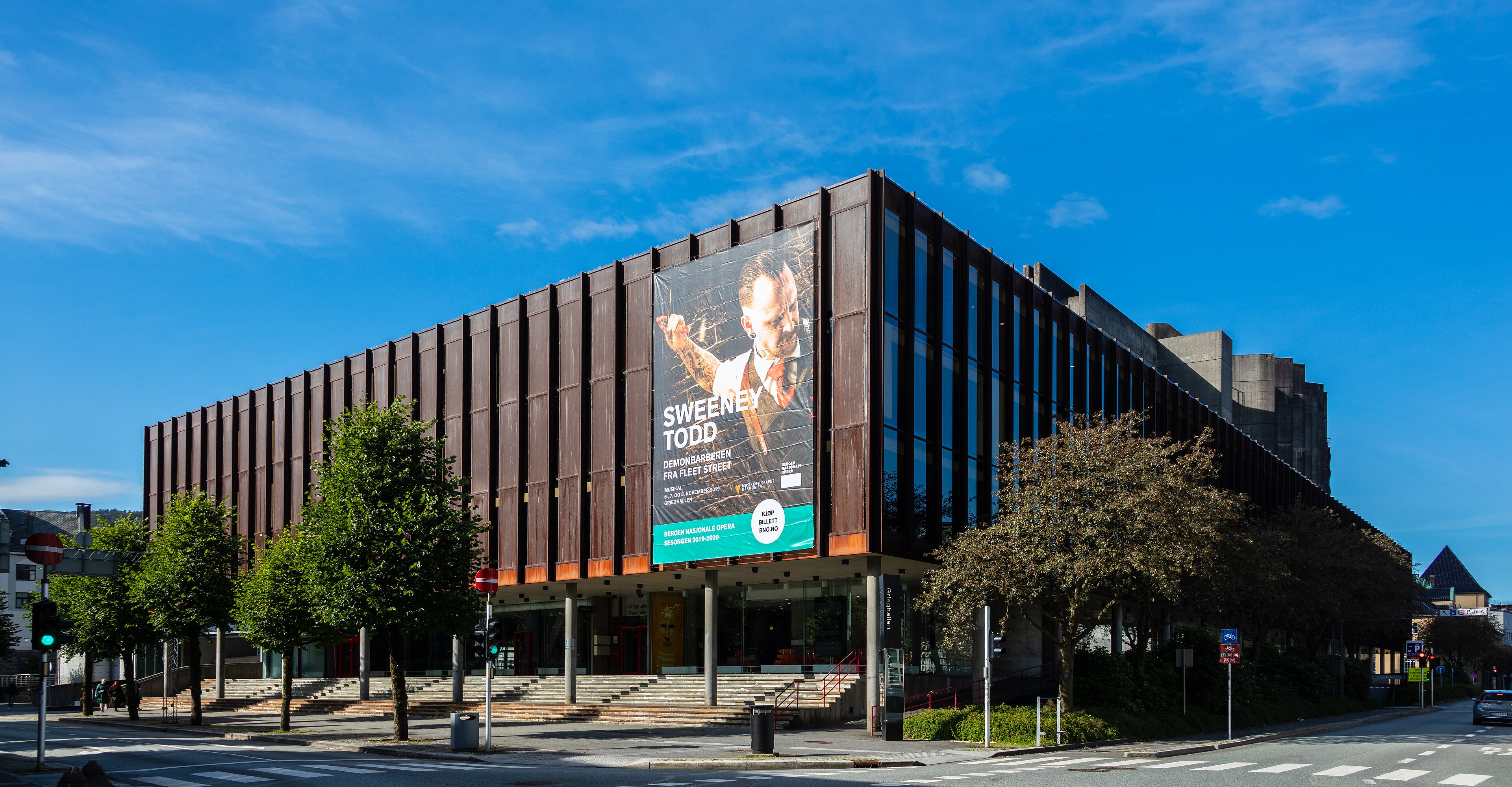
In Bergen, Berglund's first concerts as chief conductor designate fell on 27 and 28 August, either side of the king's death. Bergens Tidende described an evening marked by grief and by a change of direction, and its critic wrote that amid all the sorrow it did good to have a little laughter of the warm, dry sort. Pärt's Fratres had been in that programme since it was announced months earlier. It acquired a second meaning on the night.
Twelve days after the Royal Albert Hall, on 10 September, the Royal Stockholm Philharmonic opened its own season in the Stora salen of the Konserthuset, and the first item on the programme was Otto Lindblad's Kungssången, the Swedish royal anthem, two minutes long. The hall's own page for the concert asks the audience to be seated by 18.45 and notes that the King and Queen will attend.
That opening is also the inauguration of the hall's hundredth-anniversary season. Ryan Bancroft conducted; Vilde Frang played the Korngold Violin Concerto and encored a Montanari giga; Djuro Živković's Hosanna, a three-minute commission from the orchestra, had its world premiere after the interval as the opening gesture of his year as the hall's composer of the season; and the evening ended with Sibelius's Fifth. Tickets ran from 255 to 605 kronor, with half price for anyone up to 26.
Two Nordic orchestras, twelve days apart, both beginning with a royal anthem. One was played in London for a king who had died the previous morning. The other was played in Stockholm with the king and queen in the hall, to open a hundred years of a building. Nobody planned that pairing, and no wire service noticed it.
Five conductors are opening two seasons each
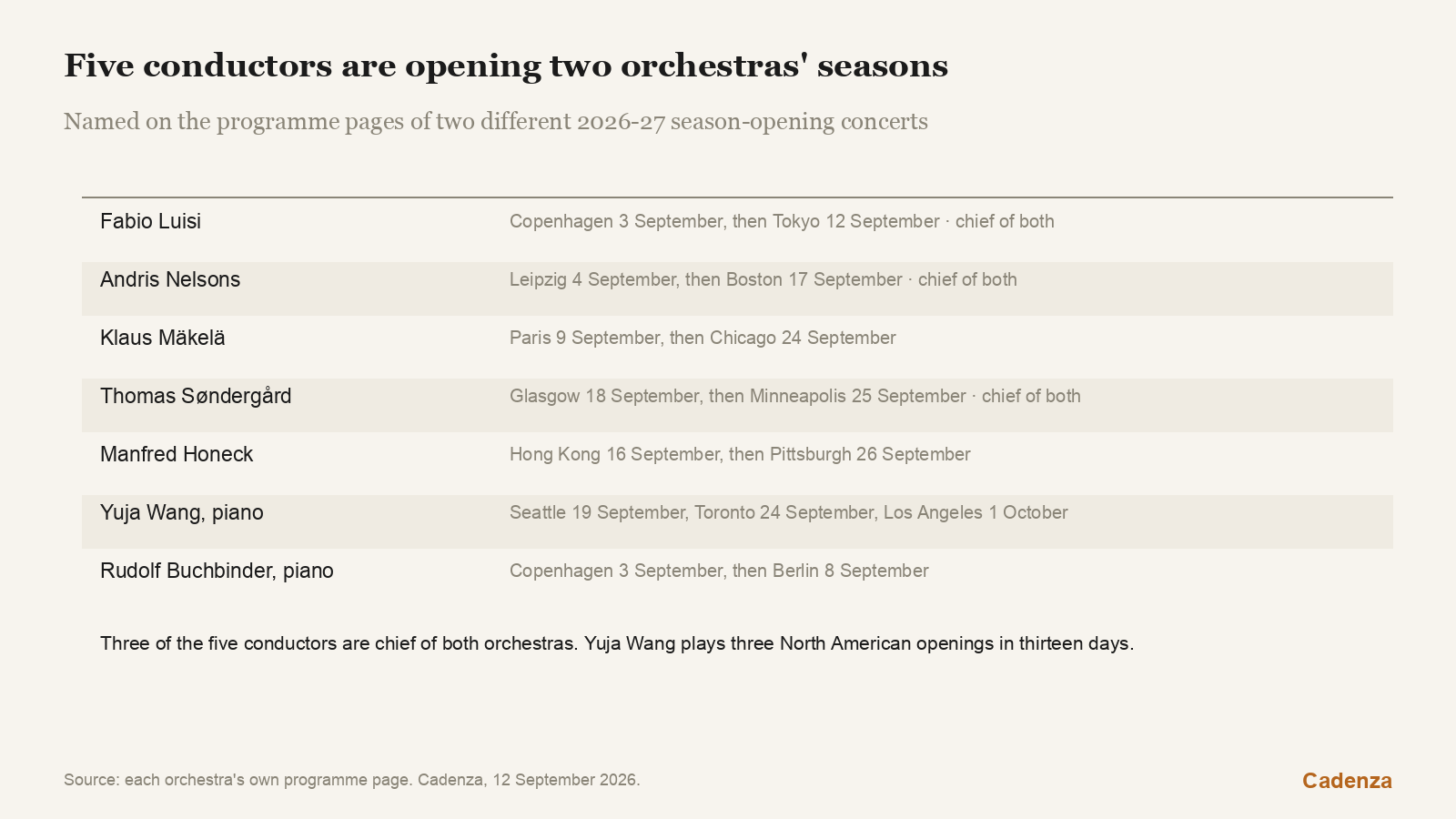
Cross-referencing all sixty-five programme pages turns up one more pattern. Five conductors appear on two season-opening programmes each, and three of the five are chief conductor of both orchestras.
Fabio Luisi is chief conductor of both the Danish National Symphony and the NHK Symphony, and he is opening both seasons: Copenhagen on 3 and 4 September, Tokyo on 12 and 13 September. Andris Nelsons is Gewandhauskapellmeister in Leipzig and music director in Boston, and he is opening both: Leipzig on 4 September with Mao Fujita in Rachmaninov's Third Concerto, Boston on 17 September with Yo-Yo Ma in the Elgar. Thomas Søndergård is doing the same for the Royal Scottish National Orchestra on 18 September and the Minnesota Orchestra on 25 September.
Klaus Mäkelä is opening two seasons on two continents in sixteen days: his last in Paris on 9 September, and the Chicago Symphony's first subscription concerts on 24 September as Zell music director designate. Manfred Honeck opens Hong Kong on 16 September and Pittsburgh on 26 September.
Rudolf Buchbinder played two of these openings as soloist, in Copenhagen on 3 September and in Berlin on 8 September, Beethoven in one city and Mozart in the other.
The busiest person in the whole survey is a pianist. Yuja Wang is the soloist at three separate North American season openings inside thirteen days: Seattle on 19 September, Toronto on 24 September and Los Angeles on 1 October.
A year ago it was a season brochure
Every concert in this ledger began as a line in a season announcement published months earlier, and in several cases as a vacancy. Berglund, Hannigan, Lintu, Shelley, Nagano and Dudamel are all working through posts that were advertised, auditioned or negotiated before any of this was printed.
Cadenza carries competitions, schemes and vacancies with open deadlines, free to musicians, on its competitions board and its jobs board. It has spent this fortnight counting what institutions actually hand players, from a four-year loan of a 1733 cello in Brussels and thirty-four historic string instruments in Lübeck to a recording contract at York and five thousand free tickets for under-25s at Wigmore Hall. The opening nights above are what all of that is for.
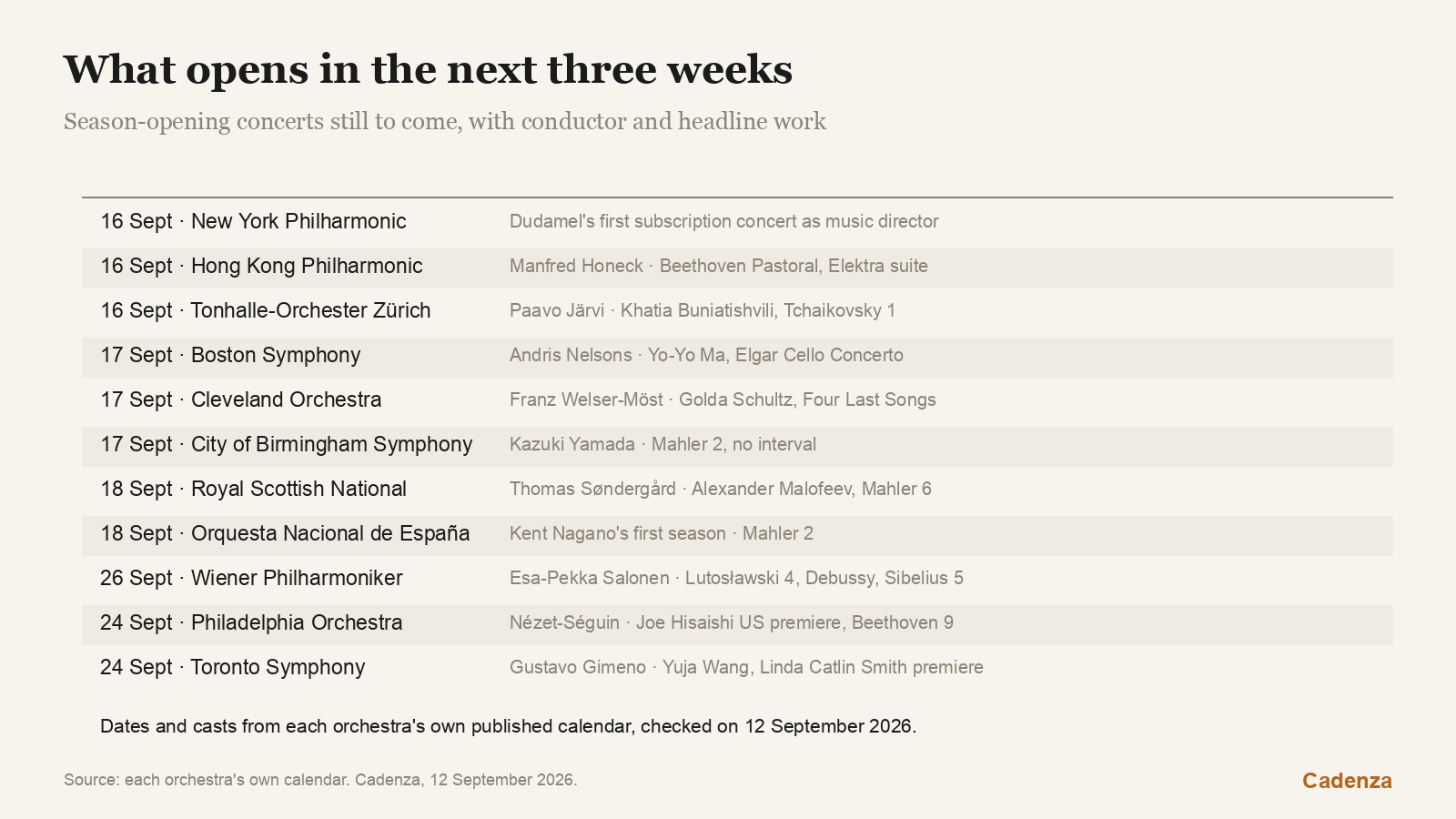
If you want to go, or to listen. Tonight, 12 September, the NHK Symphony opens in Tokyo under Fabio Luisi with Franz Schmidt's oratorio Das Buch mit sieben Siegeln, which the orchestra has never played before and which its own listing bills as part of a hundred-year anniversary programme. It repeats on the 13th. After that the next three weeks contain most of what is left. New York, Hong Kong, Zürich and Montreal open on 16 September; Boston, Cleveland, Birmingham and Liverpool on 17 September; Glasgow, Madrid and Rotterdam on 18 September; Seattle and Houston on 19 September; Philadelphia, Chicago, Toronto and San Francisco on 24 September; Pittsburgh, Washington, Minneapolis and St Louis in the week after; Los Angeles and Atlanta on 1 October. Rome opens with a staged Siegfried on 21 October and Milan's Filarmonica not until 25 January.
Several of the concerts already played can still be heard. The Gothenburg Symphony recorded its Thursday opening and streamed the Friday repeat on GSOplay. The Bergen Philharmonic runs its own streaming service. Tickets in Gothenburg were 405 to 565 kronor, and 203 to 283 kronor for students and anyone under 29, which is close to half price. In Oslo the season opener was 315 to 595 kroner, 160 to 265 for under-30s and 150 for a child.
The question this exercise raised is not about the orchestras. Sixty-five of them published a date, a conductor, a programme and a cast, and all of it was checkable in a day. Twenty-eight have now been played, and Cadenza found thirty-two reviews by named critics covering nineteen of those concerts, in eight languages. For the other nine, including the Danish National Symphony's Mahler Fourth with Rudolf Buchbinder and Iván Fischer's staged Magic Flute in Budapest, no review by a named critic could be found anywhere.
So the question goes to the people who commission criticism rather than to the orchestras. Nine season openings across three continents have so far gone unwritten about. Who is going to cover the other thirty-five?
Sources: the opening-night date, venue, conductor, soloists and programme of all fifty-six orchestras were taken from each orchestra's or hall's own published calendar or season announcement, checked on 12 September 2026. Where a specific concert page could not be reached, that is noted in the fact-check record for this article. The Mahler count, the regional counts, the count of American orchestras, the premiere count and the repeat-artist cross-reference are Cadenza's own arithmetic from those published programmes.
Reviews used, each read in the original language. Read in full: Eystein Sandvik in NRK, 31 August 2026, on the Bergen Philharmonic, rated five of six; Peter Sommeregger in klassik-begeistert, 22 August 2026, and Kirsten Liese in Das Opernmagazin, 23 August 2026, on the Berliner Philharmoniker; Jiří Slabihoudek in Seznam Zprávy, 2 September, Richard Hruban in Novinky.cz, 4 September, and Josef Kratochvíl in Opera Plus, 8 September, all on the Czech Philharmonic; Jean-Christophe Le Toquin in ResMusica, 10 September, on the Orchestre de Paris; Charlie Don in Classykéo, 11 September, on the Orchestre National de France; Martin Morgenstern in Musik in Dresden, 5 September, Svenja Koch in Bachtrack's German edition, 31 August, and Thomas Thielemann in Der Opernfreund, 31 August, on the Staatskapelle Dresden; Jónas Sen in Vísir, 8 September, on the Iceland Symphony; Hasegawa Kyosuke in CLASSICNAVI, 9 September, and Tōjō Hiroo on his own review diary, 8 September, on the Yomiuri Nippon Symphony; Chang Tou Liang in Bachtrack, 20 July 2026, on the Singapore Symphony; Marco Stücklin in Das Opernmagazin, 6 September, on the Sinfonieorchester Basel; and Kirsten Liese in Das Opernmagazin, 10 September, with Peter Sommeregger in Klassik begeistert, on the Staatskapelle Berlin.
Quoted from the headline, deck or teaser each outlet serves publicly, because the body is walled: Joachim Mischke in the Hamburger Abendblatt, 5 September, and Mengguang Huang in Bachtrack, both on the NDR Elbphilharmonie Orchester; Lukas Nussbaumer in the Basler Zeitung, 4 September, and Kathrin Signer in bz Basel, 3 September, on the Sinfonieorchester Basel; Michael Feller in Der Bund, 4 September, on the Berner Symphonieorchester; Kai Kristiansen in Adresseavisen, 4 September, on the Trondheim Symphony; and Tobias Lund in Sydsvenskan, 4 September, on the Malmö Symphony. Walter Dobner's review in Die Presse, 4 September, is quoted for its framing of the Vienna Philharmonic's Grafenegg date as a tour stop rather than a season opening.
The Vienna Philharmonic's exclusion from the played column rests on the orchestra's own calendar, which labels the 3 September Grafenegg concert simply as a concert in Grafenegg and reserves the numbering for its First Subscription Concert at the Musikverein on 26 September under Esa-Pekka Salonen. The eight further openings were sourced from the NDR, Sinfonieorchester Basel, Berner Symphonieorchester, Staatskapelle Berlin, Estonian National Symphony, Trondheim Symphony, Malmö Symphony and Copenhagen Philharmonic's own websites.
Quoted only from the headline and deck each paper serves publicly, because the body is behind a subscription wall: Maja Sievers Skanding in Bergens Tidende, 1 September; Magnus Haglund in Göteborgs-Posten, 4 September; Johanna Paulsson in Dagens Nyheter, 11 September; Mats Liljeroos in Hufvudstadsbladet, 4 September; Jean-Pierre Rousseau in Bachtrack's French edition, 9 September; and Mervin Beng in The Straits Times, 18 July. Also quoted from the portion served in the open: Aksel Dalmo Tollåli in Aftenposten, 31 August, on the Oslo Philharmonic. The quoted sentence sits inside that paper's free preview and was located there character by character; the wall closes immediately after it, so it is presented as a strongly positive opening assessment and not as the review's whole verdict. The unreconciled reference in its deck to a barefoot violin soloist is set out in the body. The Leipzig framing comes from a concerti preview by Johann Buddecke, 2 September 2026, which is a preview and not a review.
Institutional statements quoted: the Oslo Philharmonic's own tribute to King Harald V of 28 August 2026, its Proms announcement and its season-opening programme page; Anders Hillborg and Pekka Kuusisto on the Gothenburg Symphony's own concert page; Barbara Hannigan on the Iceland Symphony's own season announcement; Tabita Berglund on harmonien.no; the Stockholm Konserthuset's own season-opening page, which carries the full running order, the note that the King and Queen would attend and the ticket prices; and the Staatskapelle Dresden's own season-opening announcement of 10 July 2026. King Harald V's death at 06:35 on 28 August 2026 is a matter of public record.
Charts by Cadenza.
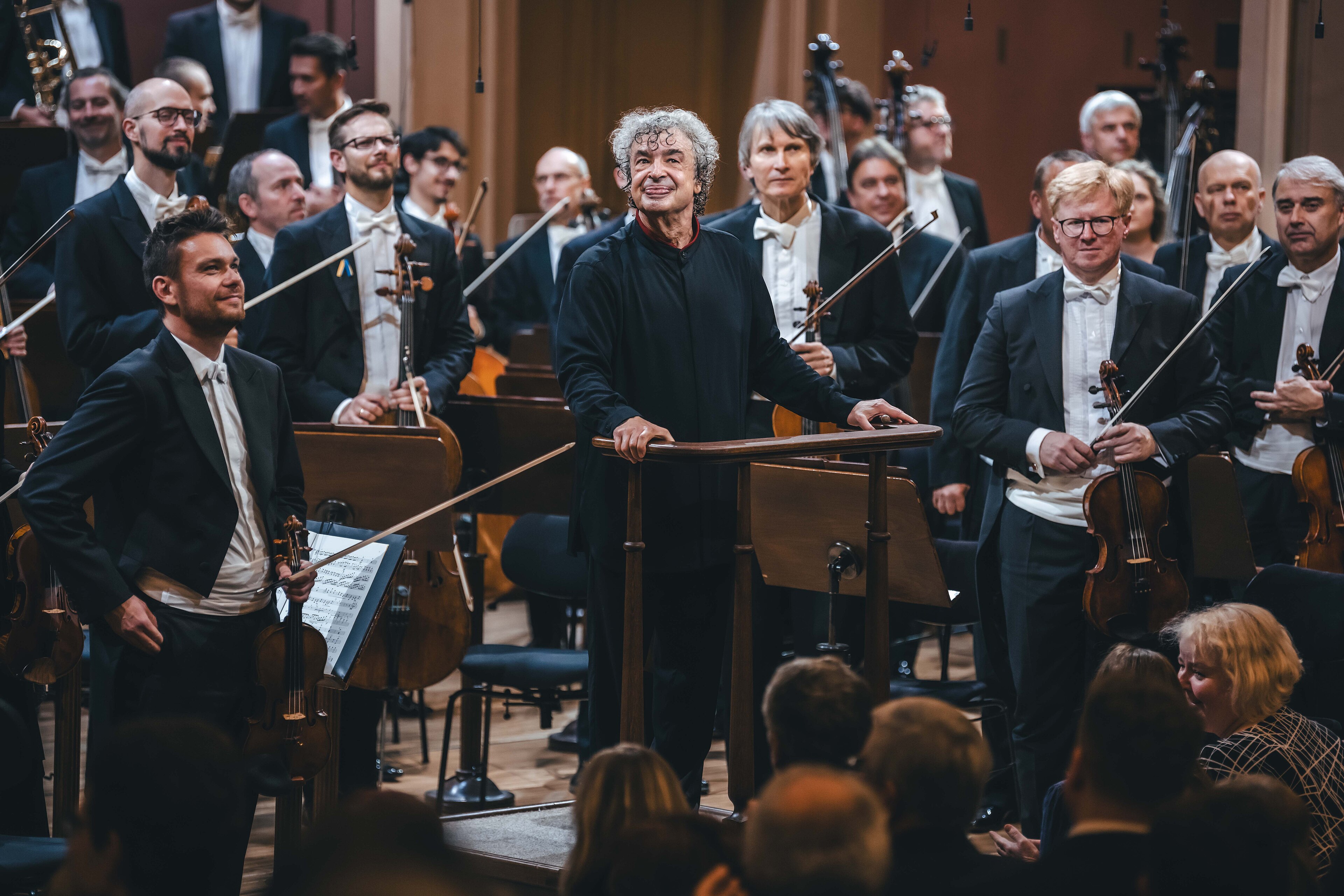
Cover photograph: Semyon Bychkov takes a bow with the Czech Philharmonic in the Rudolfinum, photographed by the orchestra in November 2024. On 1 September 2026 the same partnership opened the orchestra's season, with Karen Gomyo stepping in as soloist. Ceskafilharmonie, CC BY-SA 4.0, via Wikimedia Commons.
Comments
Sign in to join the discussion.