The Berliner Philharmoniker is, by common consent in the profession, among the hardest orchestras in the world to join. It also runs a school, and on the page describing what that school teaches, the orchestra states the outcome in one sentence: "Around a third of the Berliner Philharmoniker's musicians have emerged from the academy."
Read that again with an audition list in front of you. The orchestra that everyone treats as the summit of the profession fills roughly one chair in three from a two-year scholarship programme it runs itself, for which it pays €1,100 a month and asks the scholars to arrange their own health insurance.
That is the side door, and English-language coverage rarely treats it as a route running parallel to the open audition. The front door, the open audition, is the one the field talks about: the notices, the excerpt lists, the screen. The side door is the academy and fellowship system, and it is where a large share of orchestral careers actually begin.
So we went to find out how large. The American equivalent of the Karajan-Akademie publishes, season by season, every job its fellows and alumni have accepted. The orchestra keeps a running alumni total on the same page — "over 1,300 alumni making a difference in orchestras, ensembles and educational institutions in over 30 countries" — but it does not break the seasonal lists down. So we counted them.
The count nobody ran
The New World Symphony in Miami Beach was co-founded in 1987 by Michael Tilson Thomas with Lin and Ted Arison, and its artistic director is Stéphane Denève, who is also music director of the St. Louis Symphony. Fellows, the conducting fellowship aside, are invited season by season for up to three seasons, "at the sole discretion of NWS". They get furnished housing in Miami Beach, a living allowance while the orchestra is in session, and a one-time travel grant. A bachelor's degree must be finished before the fellowship starts.
Here is what its published lists contain, counted by us on 7 September 2026:
| Season | Posts listed |
|---|---|
| 2019–20 | 43 |
| 2020–21 | 36 |
| 2021–22 | 42 |
| 2022–23 | 72 |
| 2023–24 | 80 |
| 2024–25 | 67 |
| 2025–26 | 52 |
| Total | 392 |
Four things to hold on to before those numbers get quoted anywhere. The 392 are posts, not people: 291 distinct musicians appear, and 82 of them show up in more than one season, because a player who takes a one-year contract in 2022 and a tenured chair in 2024 is listed twice. Fourteen entries name more than one job at once, and one names three. The list is self-reported: the orchestra asks alumni to write in if their name has been left off, so the figure is a floor. But it is a soft ceiling too — five entries repeat word for word in consecutive seasons, and a renewed one-year contract is not demonstrably a second post.
Even read at its most conservative, that is roughly 56 posts a season, from an institution whose 2023 return, the most recent for which figures have been published, shows about $23.8 million of annual expenditure.
What the 392 posts actually are
A placement list is only interesting if the placements are real jobs. We sorted every entry:
| What the post is | Number | Share |
|---|---|---|
| Playing chair in an orchestra or opera house | 282 | 72% |
| Administrative or library | 42 | 11% |
| Teaching post | 37 | 9% |
| Military band | 13 | 3% |
| Conducting post | 9 | 2% |
| Other | 9 | 2% |
Those categories are read off the job title rather than the employer's name, with one stated exception: the thirteen military-band posts are identified by employer, because their job titles are ordinary instrument names. The distinction matters more than it sounds. "Principal Librarian, Austin Symphony" and "Annual Giving Manager, Oregon Symphony" are orchestra jobs, but they are not chairs, and counting by employer would file both under playing. So would "Gary Ginstling, Clarinet, Executive Director, New York Philharmonic", which is an executive directorship and not a chair — a row has to be tested for an administrative title in every field, not just the second.
Within the 282 playing chairs, 92 carry a principal title — though 38 of those are assistant, associate, acting or co-principal, leaving 54 outright principals — and eight are concertmaster posts, of which two are the concertmaster. Fifty of them, about one in six, are explicitly described as temporary: one-year, two-year, eight-month, six-month, acting, interim, partial-season or a trial. That last figure is the one a student should sit with. The academy system does not deliver a tenured chair to everyone who passes through it. It delivers, most often, a genuine orchestral job, and quite often a job with a fixed end date.
Where they actually go
This is the part that changes how the whole thing reads. The orchestras named most often in the lists are these:
| Orchestra | Times named |
|---|---|
| Cincinnati Symphony | 12 |
| Kansas City Symphony | 11 |
| Sarasota Orchestra | 11 |
| St. Louis Symphony | 9 |
| Baltimore Symphony, Jacksonville Symphony | 8 each |
| Louisville Orchestra, The Florida Orchestra | 7 each |
| Atlanta Symphony, Houston Symphony, Colorado Symphony, Naples Philharmonic, Louisiana Philharmonic, National Arts Centre Orchestra | 6 each |
Those are mentions of an orchestra inside a playing-chair entry, so a musician who names two orchestras in one line counts for both.
Now the comparison that gives the table its point. Add up every appearance of the seven American orchestras whose names a non-specialist would recognise — the New York Philharmonic, Chicago, Cleveland, Philadelphia, the Los Angeles Philharmonic, the San Francisco Symphony and the Metropolitan Opera — and you get 20 of the 282 playing chairs. Just over seven per cent, and two of those twenty are the same post listed in two consecutive seasons, so the distinct figure is eighteen. Cincinnati and Kansas City and Sarasota, between them, account for more.
That is not a lesser finding, it is the finding. The academies are not a conveyor belt to the famous orchestras. They are the mechanism by which the regional orchestras of North America are staffed, which is to say they are the mechanism by which most orchestral careers in North America exist at all.
And the names on that list should look familiar to anyone who read Cadenza last week. Houston, Jacksonville and The Florida Orchestra are all in this month's audition ledger, with chairs closing in the next fortnight. Louisville, which took seven of these musicians, is the orchestra whose record season we reported on 6 September. The St. Louis Symphony, which took nine of these posts, is led by Stéphane Denève, who also runs the academy that sent them. The pipeline and the vacancy list are the same institutions, viewed from two ends.
What the academies pay
The terms, from each institution's own pages:
| Programme | Length | What it pays | Eligibility | Next deadline |
|---|---|---|---|---|
| Karajan-Akademie, Berliner Philharmoniker | 2 years, first 6 months probationary, usually starting 1 September | €1,100 a month; scholars arrange their own health insurance | by audition | posted on the orchestra's vacancies page |
| New World Symphony, Miami Beach | up to 3 seasons, renewed season by season | furnished housing, a living allowance in session, one-time travel grant | bachelor's degree completed before starting | rolling |
| Orchesterakademie, Nürnberger Symphoniker | one season, 160 services | €1,150 a month gross plus occupational pension | by audition | 21 September 2026 |
| Verbier Festival Orchestra | 28 June to 2 August 2027 | tuition, lodging, lunches and dinners, and travel capped by region from CHF 100 to CHF 1,200; €75 application fee | 18 to 28 on 1 July 2027 | 14 December 2026 for live auditions, 11 January 2027 for video |
| Tanglewood Music Center | summer | no tuition; $75 application fee, plus a $250 registration fee on acceptance | by audition | 2027 dates not yet posted |
| Schleswig-Holstein Festival Orchestra | summer | travel, accommodation, meals and chamber-music coaching | maximum age 26 | auditions held in around 30 cities |
Two of those numbers are worth putting side by side. Berlin pays €1,100 a month and Nuremberg pays €1,150, and Nuremberg's academy asks for 160 services in a season. Neither is a living wage in the ordinary sense. Both are, on the evidence above, among the most reliable routes into a salaried chair that the profession has built.
What this does not prove
The Berlin figure is the orchestra's own, published on its own site, and we have not found an independent count. The New World lists are self-reported and incomplete by the orchestra's own admission, and they repeat some entries across seasons. New World does publish an intake ratio — its own about page says "more than 1,000 graduates of music schools and conservatories worldwide compete for approximately 30 available fellowships each year" — but neither orchestra tracks a cohort through to an outcome, so no completion rate can be stated: we can count who landed, not who did not. An academy place is itself won at audition, so the side door has a door of its own.
What the numbers do support is narrower and still worth saying plainly. Two of the most successful orchestral training programmes in the world both publish outcomes, and both sets of outcomes are dominated by real orchestral employment: a third of one of the great European orchestras, and 282 playing chairs in seven seasons on the American side. Our count, our classification, and the page and script are in the repository so anyone can check both.
If you are applying
- 21 September 2026: Orchesterakademie horn and violin, Nürnberger Symphoniker. Auditions 10 and 17 November.
- 14 December 2026: Verbier Festival Orchestra, live-audition applications. Video applications close 11 January 2027.
- Rolling: New World Symphony fellowships, Miami Beach. Finish the bachelor's degree first.
- Watch: the Karajan-Akademie posts its vacancies with the Berliner Philharmoniker's other openings, and the Lucerne Festival Academy has not yet opened its 2027 window.
Cadenza lists academies, festival orchestras and young-artist programmes alongside the salaried vacancies, free to musicians, on its jobs and programmes board.
The lists raise one question that neither orchestra answers, and it is the question a nineteen-year-old deciding whether to apply actually needs settled. Berlin will tell you that a third of its players came through the academy, and says nothing about how many apply. New World will tell you both where 291 of its alumni went and that about thirty places a year are contested by more than a thousand graduates. What neither will tell you is what happened to the ones who got in and are not on the list. Who publishes that first?
Sources: Berliner Philharmoniker, Karajan-Akademie and its education page; New World Symphony, Alumni and Fellowship Overview, lists counted 7 September 2026; New World Symphony filings, ProPublica Nonprofit Explorer; Nürnberger Symphoniker vacancies; Verbier Festival Orchestra guidelines; Tanglewood Music Center fees and requirements; Schleswig-Holstein Musik Festival Orchestra.
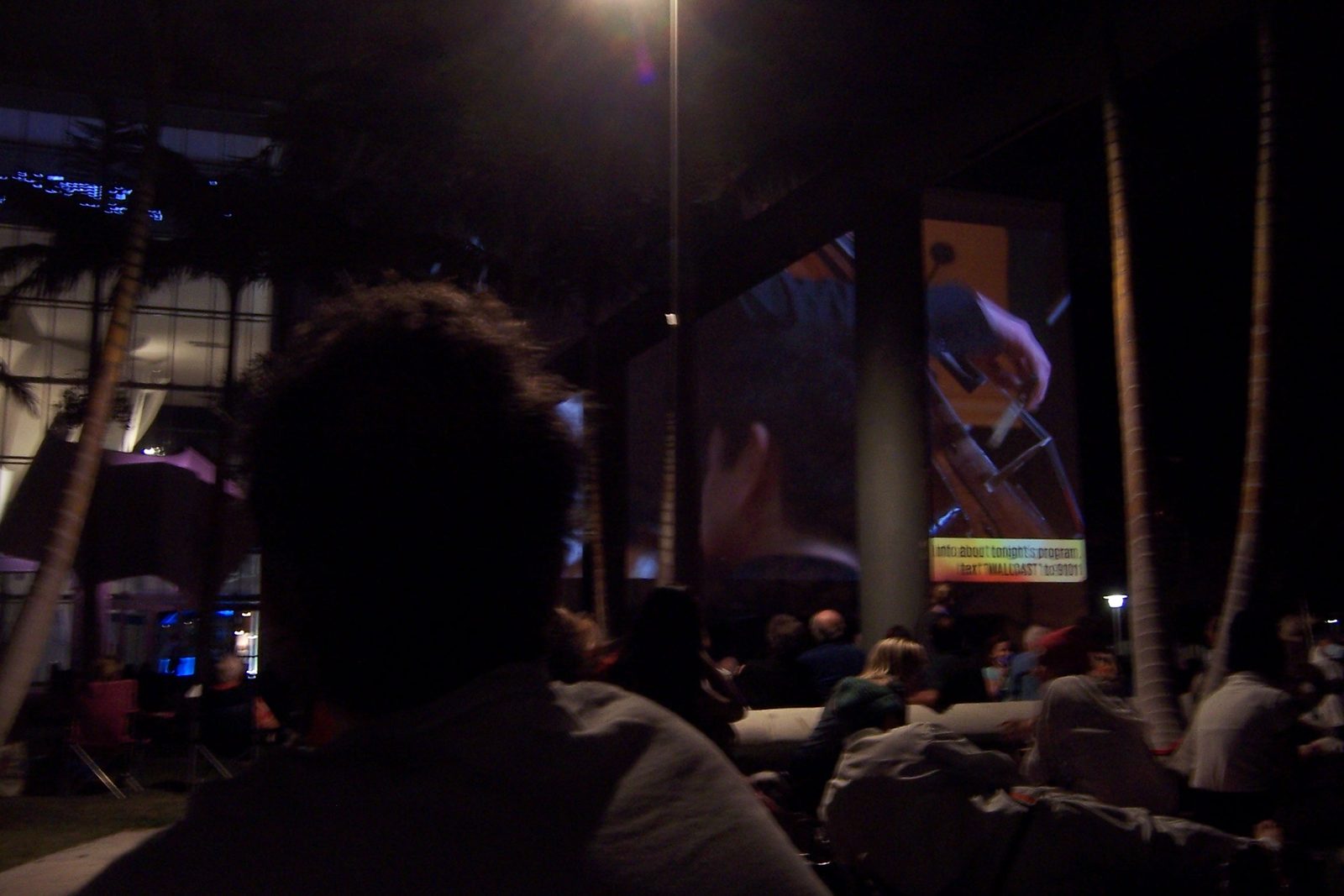
Cover photograph: An audience watching a free outdoor "wallcast" on the wall of the New World Center in Miami Beach, home of the New World Symphony, in 2011. Jonathan Schilling, CC BY-SA 3.0, via Wikimedia Commons.
Comments
Sign in to join the discussion.