Nobody publishes a total for what jazz funding is worth in a year. The schemes announce separately, in different countries and currencies, and then the announcements scroll away.
So Cadenza counted. Six American programmes announced in 2026 come to $3,558,582. A German city gave €200,000 and a British charity gave £10,000, and those are reported in their own currencies because converting them would invent precision that does not exist.
The striking thing is not the size. It is how much of it comes with no strings.
The count
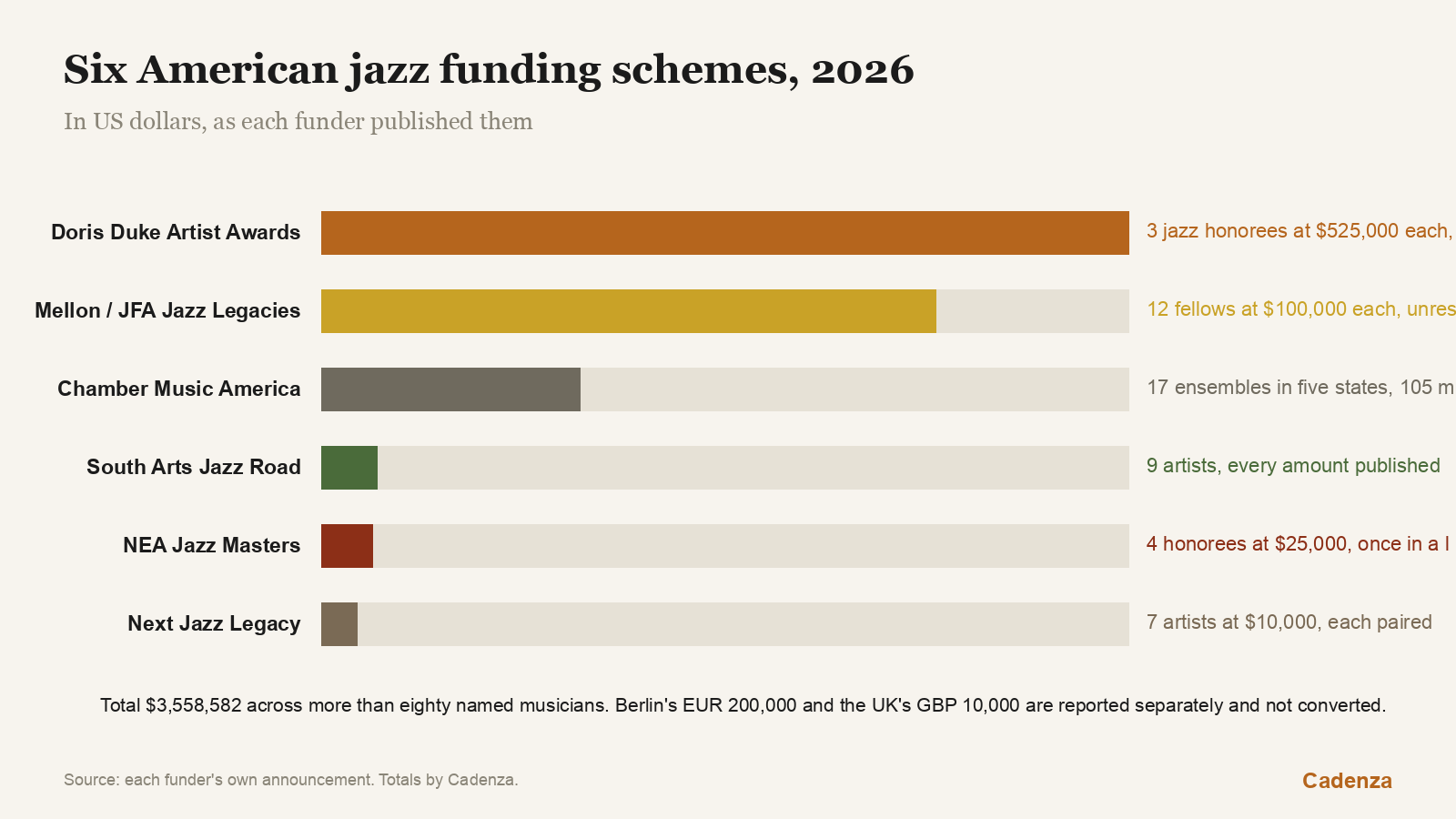
The largest single line is the Doris Duke Foundation. Its 2026 Artist Awards carry $525,000 each, paid unrestricted over seven years, with an optional further $25,000 retirement incentive. Three of the six 2026 honorees are jazz artists: Val Jeanty, who performs as Val-Inc, Makaya McCraven, and the cellist, composer, improviser and bandleader Tomeka Reid, whom the Foundation credits with redefining the role of the cello in contemporary jazz. Three awards at $525,000 is $1,575,000.
Chamber Music America distributed $504,682 through two programmes, its New Jazz Works commissioning scheme and the inaugural Thea Musgrave Performance Fund, announced on 16 June. That reached 17 ensembles in five states and 105 musicians, with New Jazz Works grants running from $30,000 to $36,000 per ensemble. The Thea Musgrave recipients were Brightwork Ensemble and New Downbeat.
South Arts announced its 2026 Jazz Road Tour grants on 23 April, and it publishes every figure. David Adewumi received $6,400, Galen Clark $8,000, Roxy Coss $15,000, Jason Hainsworth $15,000, Kelly McCarty $15,000, Policastro $10,000, Reichert $9,500, Scheinman $15,000 and de la Rosa $15,000. That is $108,900 across nine artists, and it sums exactly.
Next Jazz Legacy named its fifth cohort, seven artists at $10,000 each, which is $70,000.
Then the two Cadenza published earlier today. The Mellon Foundation and the Jazz Foundation of America gave twelve Jazz Legacies Fellows $100,000 each, and the National Endowment for the Arts gave four Jazz Masters $25,000 each. That is $1.3 million.
Six schemes. Three and a half million dollars. More than eighty named musicians.
How much of it is unrestricted
This is the part that distinguishes jazz funding from almost everything Cadenza has counted in classical music this week.
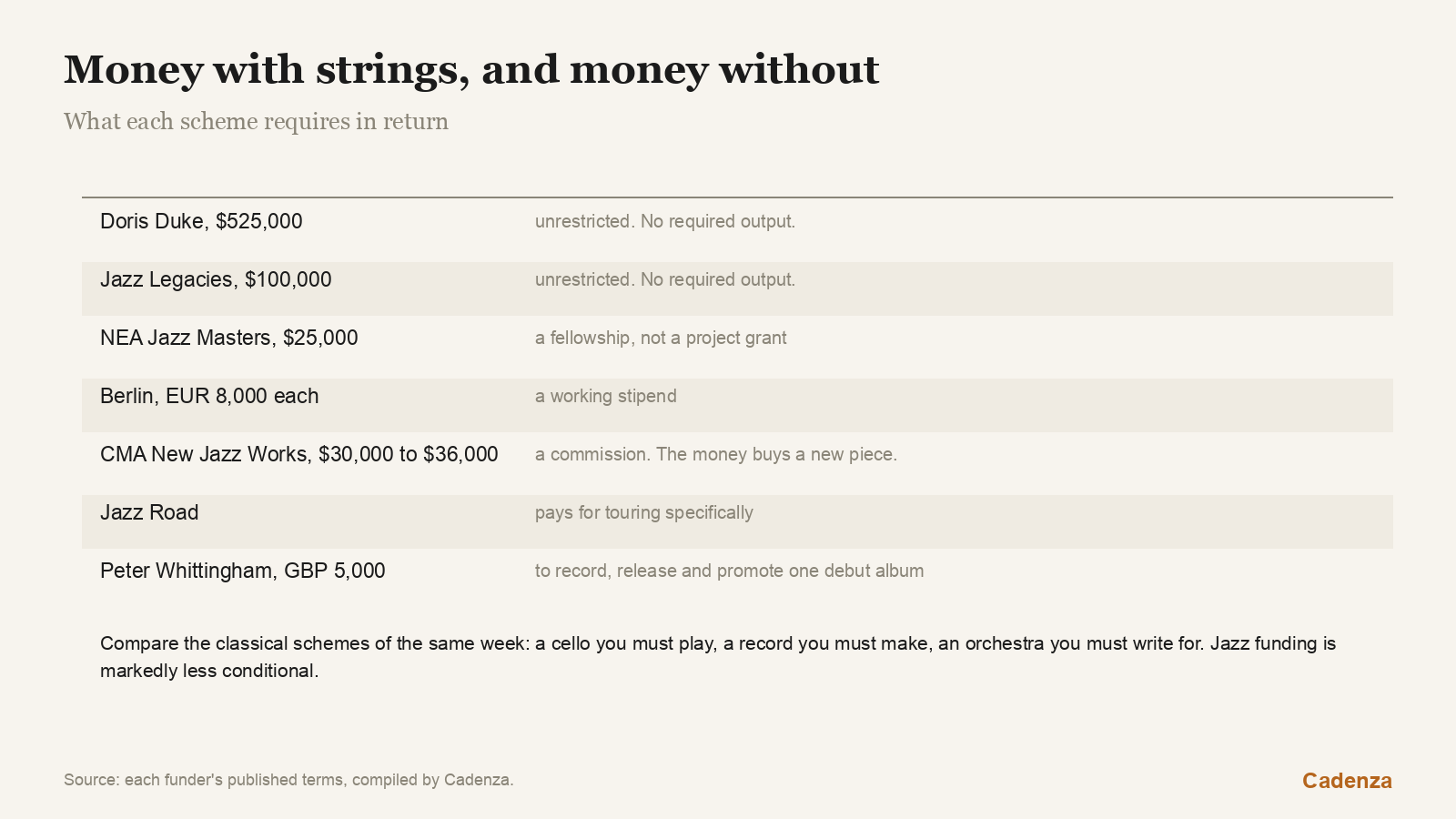
The Doris Duke award is unrestricted. The Jazz Legacies fellowship is unrestricted. The NEA fellowship is a fellowship rather than a project grant. Berlin's stipends are working stipends. Between them that is the overwhelming majority of the total, handed over without a required output.
Compare the classical schemes from the same two days. The Queen Elisabeth lends a cello you must play. York gives a record you must make. The Takemitsu award gives an orchestra you must write for. The German instrument fund lends an instrument and takes it back for re-audition.
Every one of those is valuable and every one of them is conditional. The Doris Duke Foundation's own stated reasoning is the opposite approach: its arts programme director says that when artists are given access to unrestricted financial resources, the barriers holding the artist community back come down.
Chamber Music America and Jazz Road are the exceptions in this list, and deliberately so. New Jazz Works is a commissioning programme, so the money buys new pieces. Jazz Road pays for touring, and its programme director's line about it is the best sentence in any of these releases: Jazz Road allows artists to tour on their own terms, and that is radical.
$525,000 over seven years is a salary
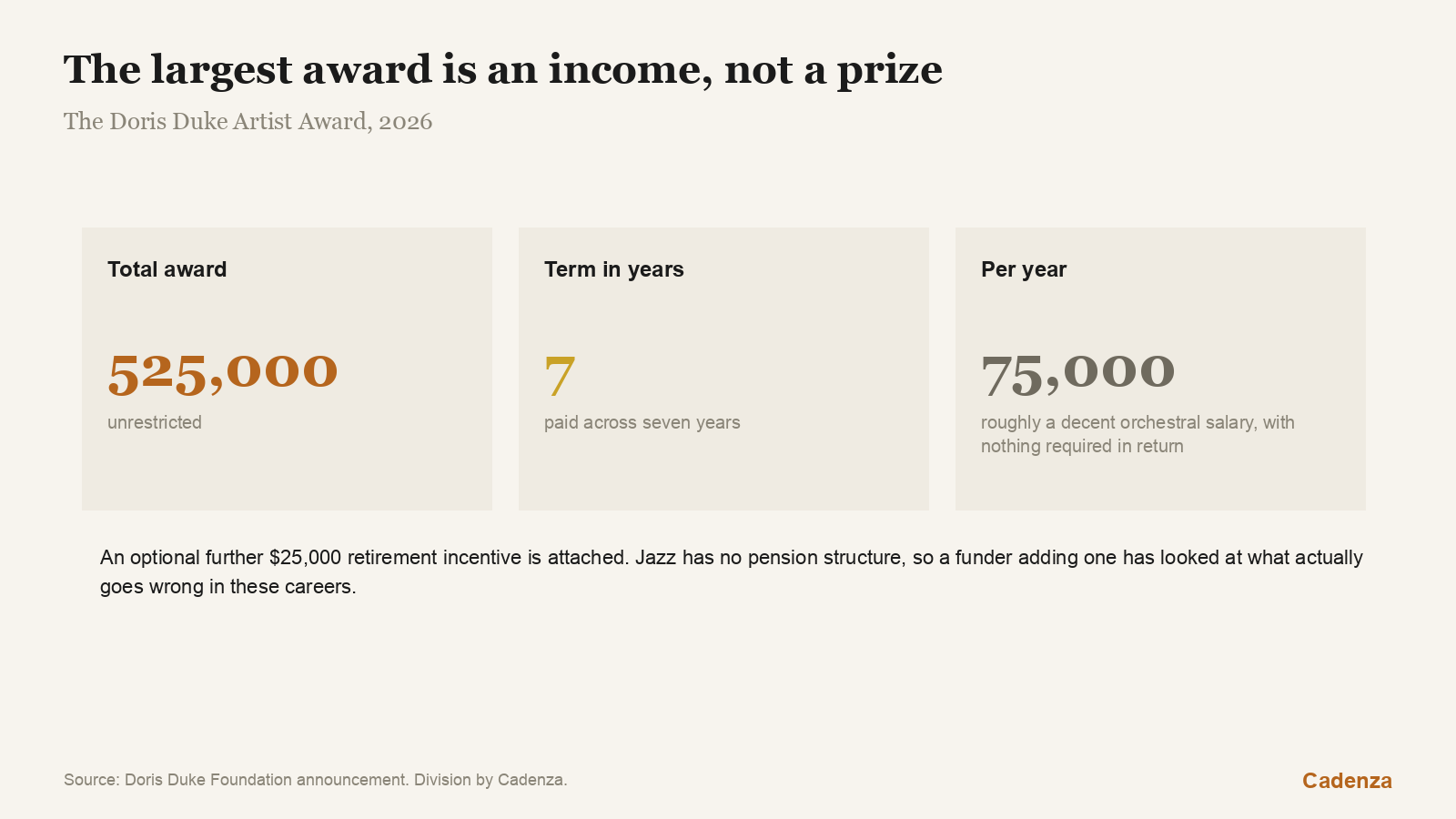
Divide the Doris Duke award by its term and it is $75,000 a year for seven years, unrestricted.
That is not a prize. It is an income, at roughly the level of a decent orchestral chair, for the better part of a decade, with no requirement to produce anything. For a working improviser whose earnings arrive in fees for gigs that may or may not happen, the change is not the amount so much as the predictability.
The optional $25,000 retirement incentive attached to it is the detail that gives away how carefully this was designed. Jazz has no pension structure. A funder that adds a retirement contribution to an artist award has looked at what actually goes wrong in these careers.
Berlin pays twenty-five people the same amount
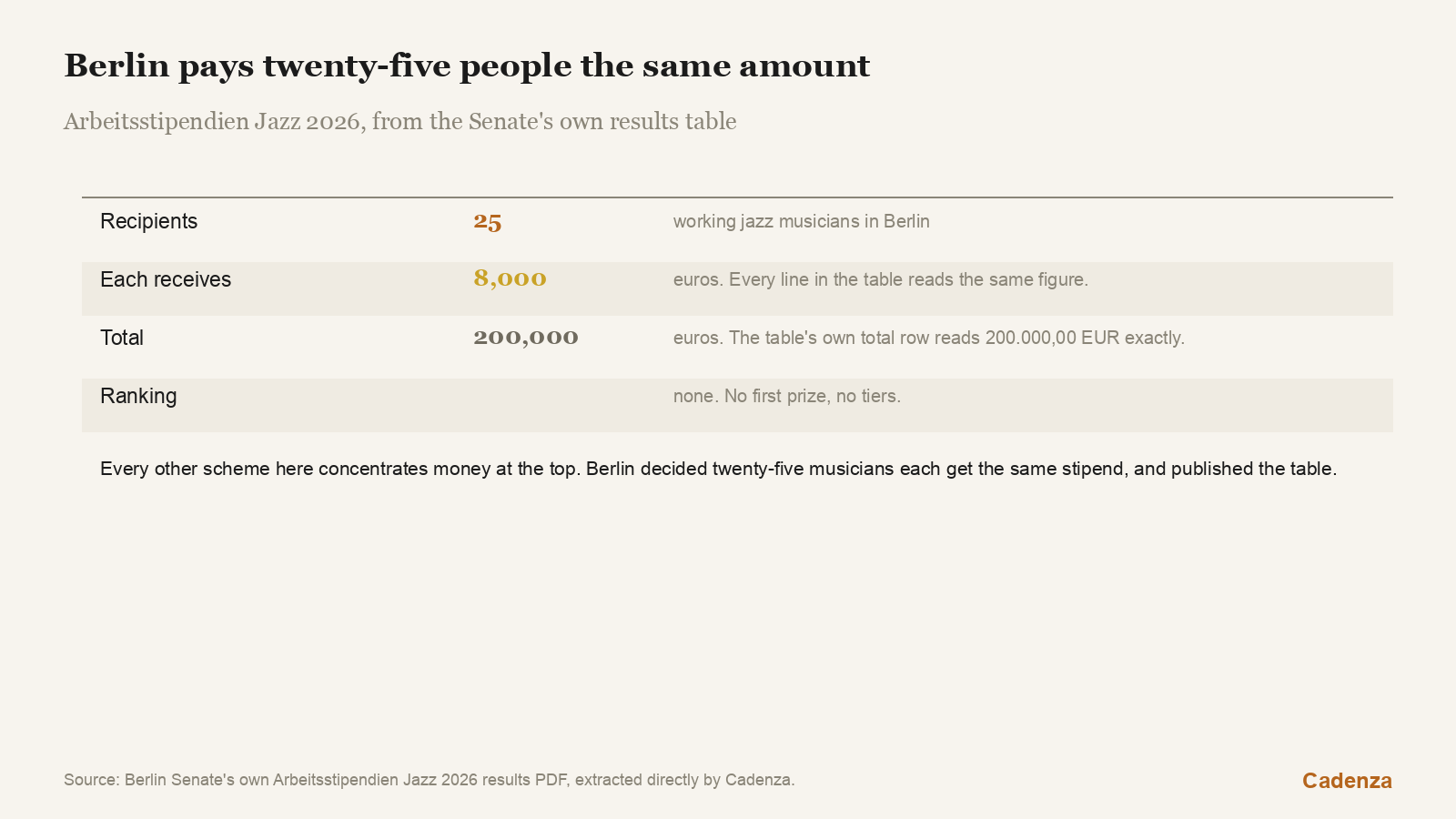
The Berlin Senate's Arbeitsstipendien Jazz for 2026 are the cleanest document in this whole count, and Cadenza verified them by extracting the Senate's own results PDF directly.
Twenty-five musicians each receive €8,000. Every line in the table reads the same figure, and the total row reads €200,000 exactly. There is no ranking, no first prize, no tiering.
That flatness is a choice and it is unusual. Every other scheme here concentrates money at the top, whether by ranking or by selecting very few people. Berlin has decided that twenty-five working jazz musicians in the city each get the same working stipend, and published the table.
Cadenza is not reporting the number of applications or the jury's composition, because the document it could reach was the results table rather than the process, and those details need their own source.
The British entry is small and worth a paragraph
Help Musicians' Peter Whittingham Award announced on 11 February: a £5,000 Main Award and a £5,000 Development Award shared between three musicians, so £10,000 in total.
The Main Award went to the London-based drummer and composer Miles Pillinger, who graduated from Leeds Conservatoire in 2023 and released an EP called Sunrise the same year. The award is specifically to let him record, release and promote a debut album called Belonging, and to perform more shows and collaborate more widely. He has played with the Olivia Cuttill Quintet, Mangorata, Tara Lily, the National Youth Jazz Orchestra and in Nikki Yeoh's Nucleus series at Ronnie Scott's.
Ten thousand pounds is the smallest number in this article and it is doing the most specific job: paying for one debut album by one drummer three years out of conservatoire. Cadenza wrote earlier today about a 23-year-old saxophonist funding his own debut with a $30 vinyl pre-order. The Whittingham is what it looks like when somebody else pays for that.
Mentorship counts as funding too
Next Jazz Legacy is the smallest American scheme in the count at $70,000, and the money is not the point of it.
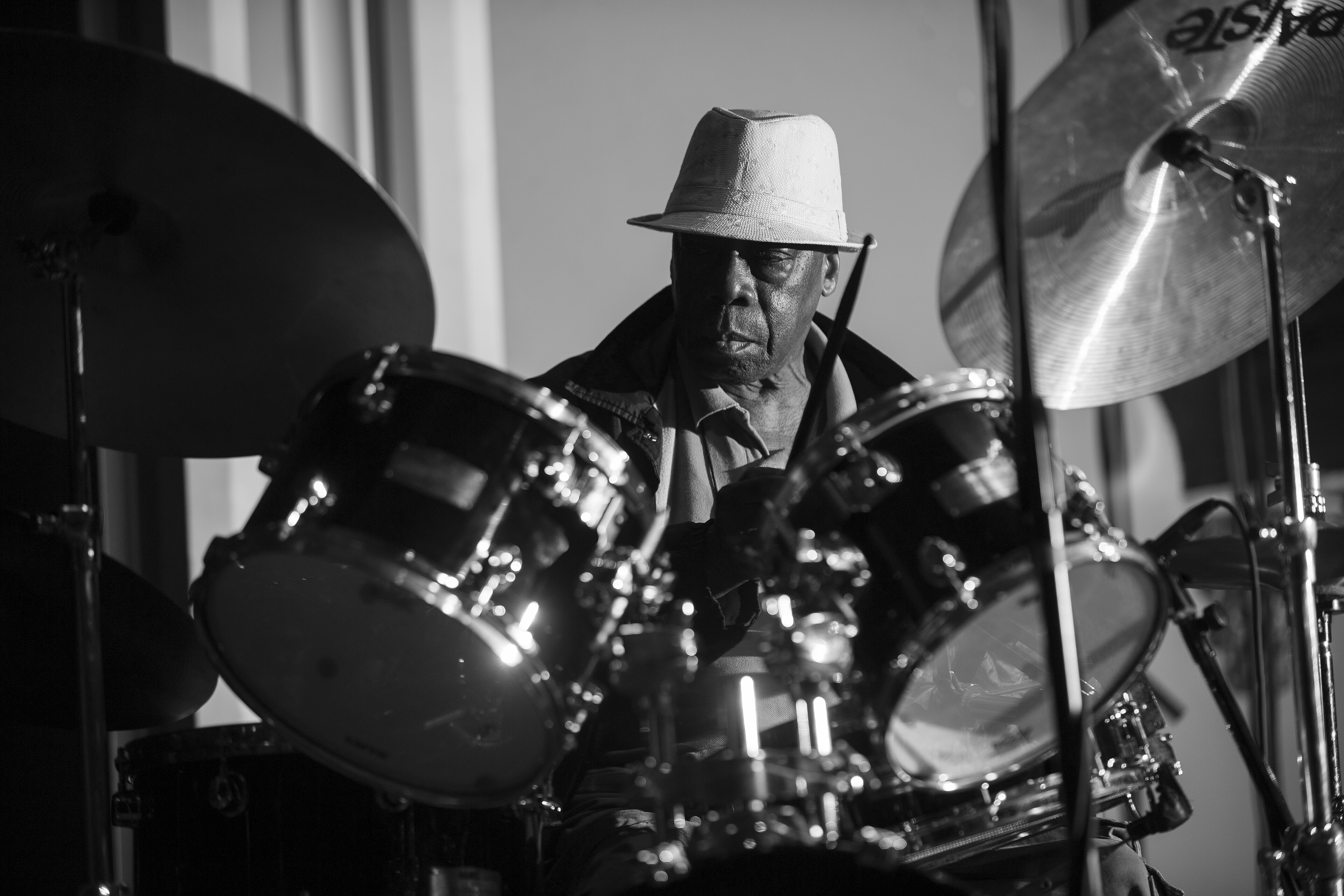
Each of the seven artists in the 2026 cohort is paired with a bandleader and a creative mentor. The pairings are published: Alden Hellmuth with Sylvie Courvoisier and Ingrid Laubrock, Allison Philips with Marcus Miller and Andrew Cyrille, and so on through the cohort.
Terri Lyne Carrington's comment on the programme explains the design. She says onstage apprenticeship was instrumental in her own artistic development, and that it is deeply meaningful to help provide these musicians with mentorship.
That is the thing money cannot buy directly and the reason this scheme is worth counting alongside the seven-figure ones. Thirty-six artists have been through five cohorts since the programme launched in 2022.
What the count is for
Cadenza published a census of 201 classical competition winners earlier today and found that only a third have a published age. This is the same exercise applied to money instead of people.
The value is in being able to compare. A musician deciding where to spend an application can now see that Doris Duke pays an income over seven years, that Chamber Music America pays for a commission, that Jazz Road pays for a tour, that Berlin pays a flat working stipend, and that the Whittingham pays for one record. Those are five different problems being solved, and the sector never lays them out together.
A year ago every one of these was an application
Each scheme here has published criteria and a deadline, and most run annually. The Berlin stipends publish their results as a table. South Arts publishes every individual grant amount. Chamber Music America publishes the range.
Cadenza carries competitions, grants and schemes with open deadlines, free to musicians, on its competitions board, and current vacancies on its jobs board.
If you are applying for jazz funding. Match the scheme to the problem rather than to the size of the cheque. If you need a record made, the Whittingham model is the fit. If you need to tour, Jazz Road pays for touring specifically and says so. If you need a new piece written and played, New Jazz Works commissions at $30,000 to $36,000 per ensemble. If you need to eat while you work, Berlin's flat stipend and the unrestricted American awards are the only ones that will cover it.
The question every one of these funders will be asked next is the one none of them answers. Six American schemes moved $3.5 million to jazz musicians this year, and not one of them publishes how many people applied. Without that, no musician can tell which of these is worth the week it takes to apply.
Sources: the Doris Duke Foundation's 2026 Artist Awards announcement, which carries the $525,000 unrestricted award over seven years, the optional $25,000 retirement incentive, the three jazz honorees and the quoted reasoning; Chamber Music America's release of 16 June 2026, whose headline states $504,682 and whose body confirms 17 ensembles in five states, 105 musicians and New Jazz Works grants of $30,000 to $36,000; South Arts' Jazz Road Tour grants announcement of 23 April 2026, which publishes every individual grant amount; New Music USA's announcement of the fifth Next Jazz Legacy cohort, its mentor pairings and the Terri Lyne Carrington quotation, together with its programme page giving five cohorts of 7, 7, 7, 8 and 7 artists since 2022; the Berlin Senate's own Arbeitsstipendien Jazz 2026 results PDF, extracted directly, in which all 25 lines read €8,000 and the total row reads €200,000; Help Musicians' Peter Whittingham Award page and UK Jazz News of 11 February 2026; and the Mellon Foundation and National Endowment for the Arts announcements covered separately by Cadenza. Cadenza has excluded an unverified Mellon renewal figure attached to Next Jazz Legacy, and the application count and jury composition for the Berlin stipends, because the documents it reached did not carry them. All totals, per-year and per-musician divisions are Cadenza's arithmetic, and no currency has been converted.
Photographs: Terri Lyne Carrington, July 2019, Schorle, CC BY-SA 4.0; and Andrew Cyrille in Buffalo, New York, 2023, Marek Lazarski, CC BY-SA 4.0. Both via Wikimedia Commons. Charts by Cadenza.
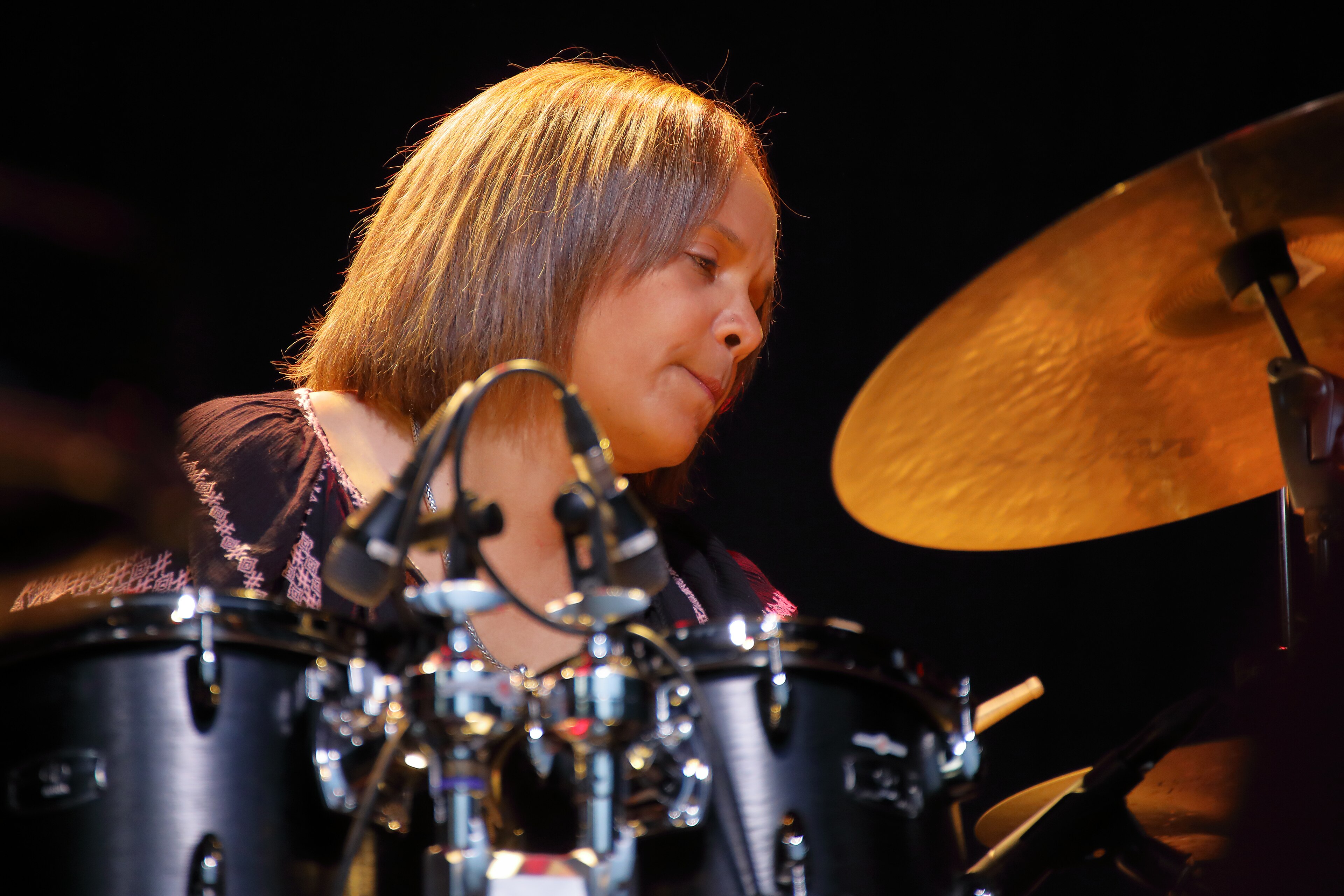
Cover photograph: Terri Lyne Carrington, whose remarks on onstage apprenticeship accompany the Next Jazz Legacy programme counted here, photographed in July 2019. Schorle, CC BY-SA 4.0, via Wikimedia Commons.
Comments
Sign in to join the discussion.