The Aida Stucki Prize is not an annual award, which is what makes it worth noticing when it is given. The Anne-Sophie Mutter Foundation's own page says so in one sentence: the award, "which carries a cash value of 10,000 Euros, is not bound to a fixed rotation, but is decided by the Foundation". It was given first on 3 April 2011, to the double bassist Roman Patkoló; the Foundation's page records the cellist Daniel Müller-Schott as the second recipient, in October 2013, and The Strad reports that nobody has received it since. On Thursday 3 September 2026, at the Lucerne Festival, Anne-Sophie Mutter gave it to the violinist Elias David Moncado, 25, after his debut recital there with the pianist Lauma Skride.
Mutter's own words, in an Instagram post that begins "Today" and is carried by The Violin Channel: "Today, I had the great joy of presenting the Aida Stucki Prize 2026 to @eliasdavidmoncado in recognition of his outstanding contribution to the canon of young violin soloists." The Foundation describes the award as an "encouragement award" for "outstanding, upcoming string soloists, who follow the strong traditional line of Aida Stucki and thus of the European tradition of playing and education".
The document
| Item | Detail | Source |
|---|---|---|
| Prize | Aida Stucki Prize, €10,000, "not bound to a fixed rotation" | Foundation page |
| 2026 recipient | Elias David Moncado, violin, 25 | The Strad, 4 Sept 2026 |
| Occasion | Debut recital at the Lucerne Festival, 3 September 2026, with Lauma Skride | The Strad; the festival's programme listing "Debut Elias David Moncado, 03.09.2026" |
| Previous recipients | Roman Patkoló, double bass, 3 April 2011; Daniel Müller-Schott, cello, 2013 | Foundation page; The Strad |
| Premieres at the same concert | Texu Kim, Jeogori for solo violin, played by Ye-Eun Choi; Kinderszenen for string quartet, played by Moncado, David Tobin, Hwayoon Lee and Lionel Martin, both commissioned by the Foundation | The Strad; The Violin Channel |
| Moncado's record | First prize and ten special prizes, 2019 Karol Lipiński Competition; first prizes, 2021 Valsesia Musica and Vladimir Spivakov competitions; debut CD on Avi-Music, 2022; studies with Latica Honda-Rosenberg, Zakhar Bron and Pierre Amoyal, now at the Kronberg Academy with Mihaela Martin; scholar of the Mutter Foundation since 2023 and of the Gautier Capuçon Foundation | The Strad; The Violin Channel; Foundation scholars page |
Aida Stucki, after whom the prize is named, was Mutter's teacher. The Winterthur city glossary records her as born in Cairo on 19 February 1921 to a Winterthur businessman, a pupil of Stefi Geyer in Zurich and of Carl Flesch in Lucerne, a soloist and quartet player who taught for 47 years at the Winterthur Conservatory, and it names Mutter as her most famous pupil. She died on 9 June 2011, two months after the first prize in her name was given.
The scholars, current and former
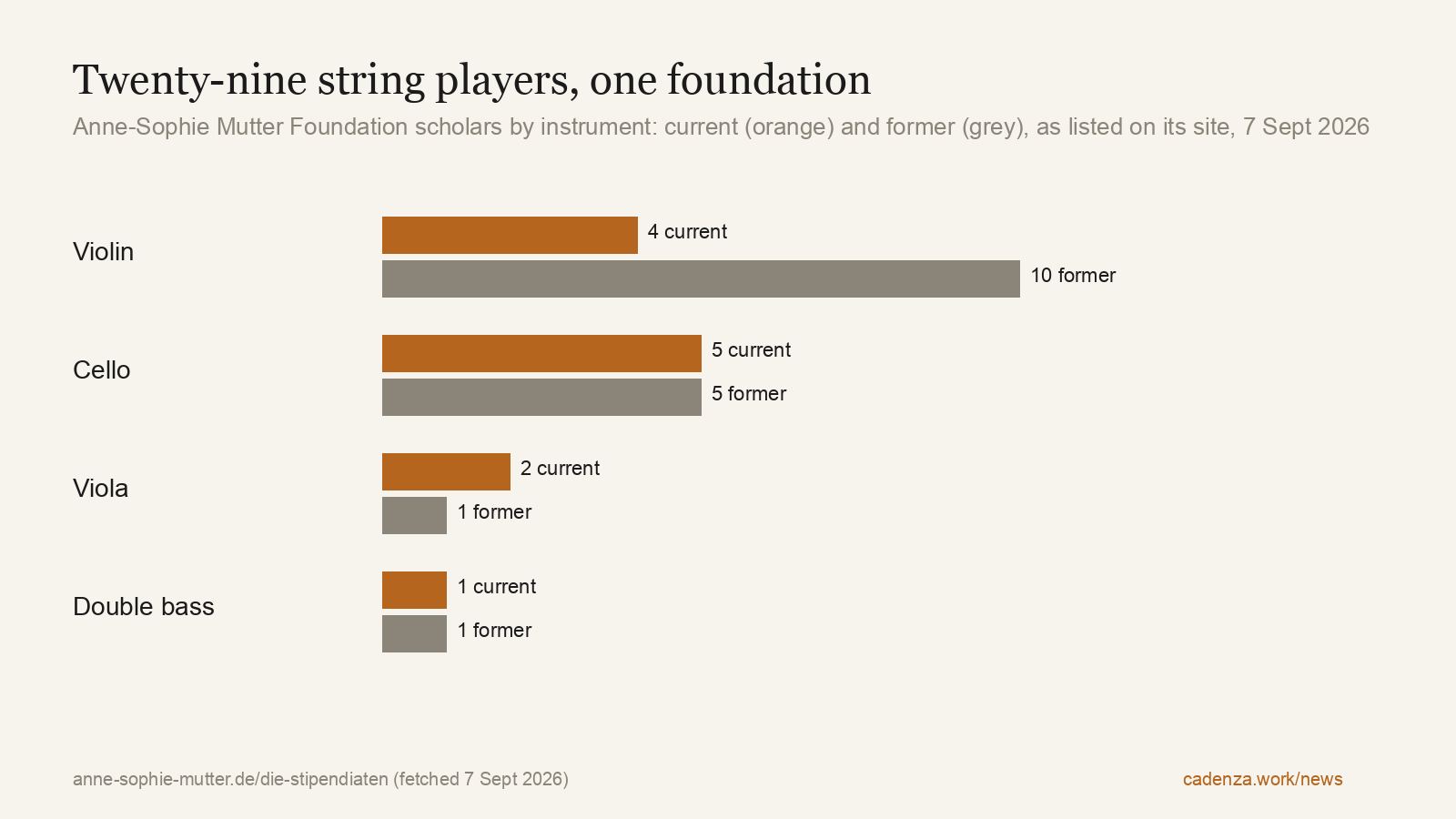
The prize is the visible tip of the Foundation's work, and the rest is on its scholars page, which lists every current scholar with the year support began and every former scholar with the years it ran. Mutter founded the circle of friends in autumn 1997 and the Foundation itself was set up beside it in 2008, its support page says, to support "highly gifted young soloists in the subjects violin, viola, cello and double bass worldwide". The page lists what the support consists of: string instruments and bows bought and lent, help choosing teachers and conservatoires, travel to play for conductors and agents, scholarships for masterclasses, sheet music, advice on buying instruments, the financing of CD productions, commissions to widen the repertoire, solo appearances with the ensemble Mutter's Virtuosi, and the Aida Stucki Prize.
| Current scholars (12) | Instrument | Supported since |
|---|---|---|
| Hwayoon Lee | Viola | 2011 |
| Dominik Wagner | Double bass | 2016 |
| Lionel Martin | Cello | 2017 |
| Pablo Ferrández | Cello | 2018 |
| Brannon Cho | Cello | 2020 |
| Mohamed Hiber | Violin | 2020 |
| Samuel Nebyu | Violin | 2022 |
| Elias David Moncado | Violin | 2023 |
| Muriel Razavi | Viola | 2024 |
| Sakura Toba | Cello | 2025 |
| Charlotte Melkonian | Cello | 2026 |
| Zofia Olesik | Violin | 2026 |
The former scholars are seventeen: the violinists Adrian Anantawan, Ye-Eun Choi, Vilde Frang, Sergey Khachatryan, Wei Lu, Mikhail Ovrutsky, Linus Roth, Arabella Steinbacher, Noa Wildschut and Nancy Zhou; the violist Vladimir Babeshko; the cellists Leonard Elschenbroich, Maximilian Hornung, Doo-Min Kim, Daniel Müller-Schott and Kian Soltani; and the double bassist Roman Patkoló. Both previous prize winners are on it, and so is the violinist who played the Texu Kim premiere at Moncado's presentation, Ye-Eun Choi; two of the quartet who played the other premiere, Hwayoon Lee and Lionel Martin, are current scholars. Four of the five string players in the two premieres, in other words, came from the Foundation's own list; the second violinist, David Tobin, and the pianist Lauma Skride did not.
Read as a ledger, the list says three things. The support is long: Hwayoon Lee has been a scholar for fifteen years, Wagner for ten, Martin for nine. The intake is small: two new names in 2026, one in each of 2025, 2024 and 2023. And the alumni are the argument: Frang, Steinbacher, Khachatryan, Soltani, Müller-Schott and Hornung are names any concert-goer knows, and each of them was once a young player on this list, Müller-Schott from 1997, Khachatryan from 2000, Steinbacher from 2001, Frang from 2003, Hornung from 2008, Soltani from 2014.
How the letter is sent
That address is on the Foundation's application page, and the terms are unusually plain. The Foundation supports "exclusively highly gifted young soloists in the subjects violin, viola, cello and double bass". Scholars "are each selected personally by Anne-Sophie Mutter"; "there is no selection procedure in the sense of a competition"; applications "are accepted all year round and processed promptly". An applicant must be aiming at a solo career and "not older than 21", and sends current recording links, "preferably with works by J.S. Bach, W. Mozart and L. v. Beethoven", an artistic CV, a current letter of recommendation from the teacher, a repertoire and concert list, and a personal letter explaining the concrete request, by post or email to the Foundation in Munich. On the basis of that material, the page says, Mutter decides personally whether to invite the candidate to play. Those accepted receive support "individually tailored to their needs"; the scholars page lists lessons with Mutter, help choosing and arranging the right teacher, the provision of instruments, contacts with leading soloists and their masterclasses, and auditions with conductors among the forms it takes. Mutter's own line on the page, in our translation: "Instead of setting up fixed rules, which make one inflexible, I want to give each person what he needs."
For a string player aged 21 or under, that is the whole procedure: no round, no deadline, no fee mentioned, one letter and, if it lands, an invitation to play.
If you follow this
- Apply. Violin, viola, cello or double bass; aged 21 or under; a solo career in view. Materials and the postal and email address are on the Foundation's application page; applications are accepted year-round.
- Hear the laureate. Moncado's debut CD is on Avi-Music (2022); his recent seasons, per The Violin Channel and his own biography, included a Carnegie Hall debut in 2025, a debut with the Museumsorchester Frankfurt at the Alte Oper in 2026, and the Théâtre des Champs-Élysées with the Orchestre National d'Île-de-France.
- The festival. The Lucerne Festival sells the programme booklet of the 3 September debut recital as a PDF through its shop for CHF 3.
The case against this article
The prize's history is taken from the Foundation's page, which details the 2011 award and the October 2013 award to Daniel Müller-Schott in Munich, and from The Strad for the thirteen-year gap; the Foundation's page lists no other recipient. Moncado's age and competition record are as reported by The Strad and The Violin Channel and match the Foundation's profile of him and his own website's biography; The Strad's report gives Ye-Eun Choi as the performer of Jeogori; the composer of Kinderszenen, Yie-Eun Chun, is named by The Violin Channel, by Mutter's own post and by the festival's list of the summer's world premieres, not by The Strad. The scholars page was read on 7 September and the counts are ours; the page gives start and end years for former scholars, and we have not checked them against the players' own biographies. The application terms are translated from the German page by us. We could not read the Lucerne Festival's event page, which has been taken down since the concert; the date comes from the festival's programme shop and press photographs. Whether the Foundation intends to award the prize more regularly is not stated anywhere.
The question
The Foundation has given its named prize three times in fifteen years and lists twenty-nine scholars across nearly three decades (Mutter's own post rounds it to thirty). Its own terms say the prize is decided case by case, and its list says the scholarships are long and few. The question the list raises is the one every young string player will ask of the application page: how many letters arrive in Munich each year, and how many of the twelve current scholars came in by writing one. The Foundation does not say, and it would be a small thing to say.
Related: The Odds, our investigation into orchestral jobs and graduates, and Prizes that fund a career. Scholarships, competitions and programmes are on cadenza.work/browse.
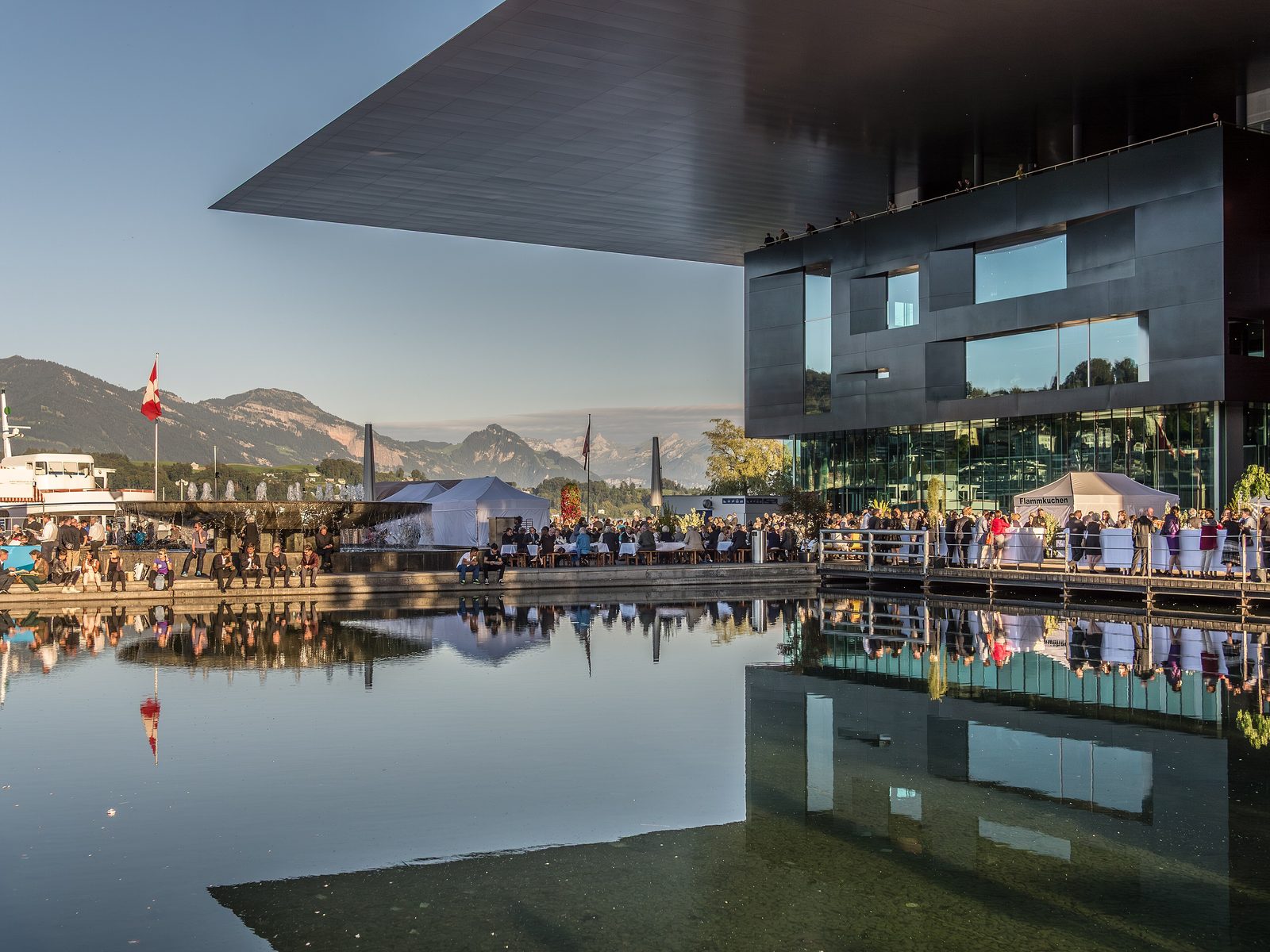
Cover photograph: The Culture and Congress Centre in Lucerne, the Lucerne Festival's main hall. Elias David Moncado's debut recital and the presentation of the 2026 Aida Stucki Prize took place on 3 September in the festival's Lukaskirche. Photograph by Reinhold Möller, 2 September 2013, CC BY-SA 4.0 (creativecommons.org/licenses/by-sa/4.0), via Wikimedia Commons..
Comments
Sign in to join the discussion.