On 11 September the New York Philharmonic played a memorial concert in Lower Manhattan, on the twenty-fifth anniversary of the attacks. It was called Sounds of Remembrance, Gustavo Dudamel conducted, and it was held at the Perelman Performing Arts Center a few hundred metres from the site.
It was also, quietly, the first concert the orchestra had played with a titled principal horn since 2017.
David Cooper was appointed on 30 May 2026 and has now passed his trial period. The New York Philharmonic spells his name David Cooper on its own artist page, which is worth saying because he signs some of his own posts David Alan Cooper and at least one trade outlet has taken that as the formal version. The orchestra's own spelling is the one this piece uses.
How long the chair was empty
Philip Myers held the principal horn chair from January 1980. He held it for about thirty-seven years.
Nobody ever announced that he had left. In September 2017 the specialist press noticed he was still listed on the orchestra's website but absent from a new promotional campaign, and then, on the night of 18 September 2017, he was removed from the website without any public statement or explanation. That deletion is the only dated marker of his departure that exists.
Take that date as the start and Cooper's first concert as the end.
| Myers removed from the orchestra's website | 18 September 2017 |
| Cooper's first concert as principal horn | 11 September 2026 |
| Elapsed | 8 years, 11 months, 24 days |
Nearly nine years. Not the round nine that is easy to write, and not the decade that has been guessed at in comment threads. Eight years, eleven months and twenty-four days, on the only two dates that are documented.
The gap had two halves, and they were different
This is the part that makes the number mean something.
Richard Deane has been the orchestra's associate principal horn since September 2014. From 2017 he was formally Acting Principal Horn, and he held that title until 2022. So for the first five of those nine years the chair had somebody in it with a title that said so, even if the title said acting.
The remaining four years had neither. No principal, no acting principal, just a section covering a first chair.
Five years of a stand-in with a name for the job, then four years of no name at all. That is a different thing from a vacancy, and it is a different thing again from a chair that is filled. An orchestra can run like that, and this one did, through the whole of Jaap van Zweden's tenure as music director and into Dudamel's.
What the job pays
The New York Philharmonic publishes the figure itself, on the audition page for this very position.
The base scale for principal horn is $190,698 for the 52-week 2025-26 season. That is the orchestra's own number, on its own site, and it is unusual to find it stated so plainly. Most orchestras advertising a principal chair say "competitive" and leave it there.
Set that against nine years. A chair paying a published $190,698 a year, in the orchestra that plays at Lincoln Center, went without a permanent holder for the better part of a decade. Auditions for principal brass at this level routinely draw well over a hundred candidates. The vacancy was not for want of applicants.
The audition that ended it, and the one detail that says most
The process that produced Cooper is dated and public, because the orchestra posted it.
| Applications closed | 5 January 2026 |
| Final auditions | 11 March 2026 |
| Appointment announced | 30 May 2026 |
| First concert | 11 September 2026 |
Five months from the closing date to the announcement, and another three before he played. As recently as October 2025 the principal horn chair was still being counted in published tallies of the orchestra's player vacancies, alongside six others.
Cooper arrives from the Los Angeles Philharmonic, where he was associate principal horn.
But the detail that says most about those nine years is a guest booking. In May 2023, with the chair still unfilled, the New York Philharmonic brought in Stefan Dohr to sit in it. Dohr is the principal horn of the Berlin Philharmonic. An orchestra that flies in the first horn of the Berlin Philharmonic to cover a vacancy is not an orchestra short of options. It is an orchestra that had not yet found the person it wanted to appoint permanently, which is a different problem and a more respectable one.
What is not known, and is not going in this piece
No institution and no individual has ever publicly stated why Philip Myers left, or on precisely what date.
The 2017 coverage carries unconfirmed chatter in its comment threads, disputed in the same threads, and none of it is going to be repeated here. A thirty-seven-year principal horn of the New York Philharmonic is entitled to have the reason for his departure remain his own business unless he or the orchestra chooses otherwise, and neither has. What is on the record is the website deletion, the date, and the silence.
That silence is itself part of the story. An orchestra that publishes its salary scale to the dollar did not publish a sentence about the departure of the man who had led its horn section since 1980.
Cooper's first fortnight
His own account of the 11 September concert, posted publicly, was short: "From the day I passed the trial period and my first concert! What an honor to be part of the amazing New York Philharmonic and appointed by the one and only Gustavo Dudamel."
Dudamel's own inaugural gala as the Oscar L. Tang and H.M. Agnes Hsu-Tang Music and Artistic Director, the title the orchestra gives him in full, had been the night before at Radio City Music Hall. Cooper's first night in the chair was the memorial concert the following afternoon.
Five days after that he was in David Geffen Hall for Dudamel's first subscription concerts, a programme of John Adams's On the Transmigration of Souls, the world premiere of Zosha Di Castri's Invisible House and Prokofiev's Fifth Symphony.
Reviewing that opening, David Wright wrote in New York Classical Review that the orchestra "exhibited courage and wide-ranging imagination in two complex new scores." No critic has yet written about Cooper's playing individually, which is normal at this stage and worth saying rather than implying otherwise.
A year ago it was an audition notice
Every orchestral chair begins as a posted vacancy with a date, a repertoire list and a fee. This one was posted with its salary attached, which is rarer than it should be, and Cadenza has argued before that publishing the number is the single most useful thing an orchestra can do for the players considering whether to fly across a continent and take the screen.
Cadenza carries auditions and vacancies with open deadlines, free to musicians, on its jobs board, and competitions on its competitions board. It has spent this month counting what orchestras actually pay and what they publish, from the San Francisco Opera settlement to the season that opened around the world.
If you go. The final performance of that Dudamel programme is tonight, Saturday 19 September, at 7:30pm in the Wu Tsai Theater at David Geffen Hall, 10 Lincoln Center Plaza. Details and tickets are on the orchestra's own site.
The question the orchestra will be asked next is not about the appointment, which looks like a good one. It is about the nine years. An orchestra that can tell a prospective candidate exactly what the job pays could also say how long it intends a first chair to stand empty, and what it will do differently next time.
Sources: the New York Philharmonic's own artist page for David Cooper, which is the authority for the spelling of his name; the orchestra's own principal horn audition page, which states the base scale of $190,698 for the 52-week 2025-26 season; the orchestra's own page for Richard Deane and his own site for the dates of his associate principal and acting principal roles; and the orchestra's own chronological season listing for the dates of the September 2026 concerts. Philip Myers's tenure from January 1980 and the removal of his profile from the orchestra's website on the night of 18 September 2017 are as reported at the time by the specialist press; no institutional statement about his departure has ever been issued and none of the unconfirmed explanations that circulated in 2017 is reported here. David Cooper's quotation is from his own public post as reproduced by Slipped Disc on 11 September 2026. David Wright's assessment is from his review in New York Classical Review. The interval of 8 years, 11 months and 24 days is Cadenza's arithmetic from the two dated events above.
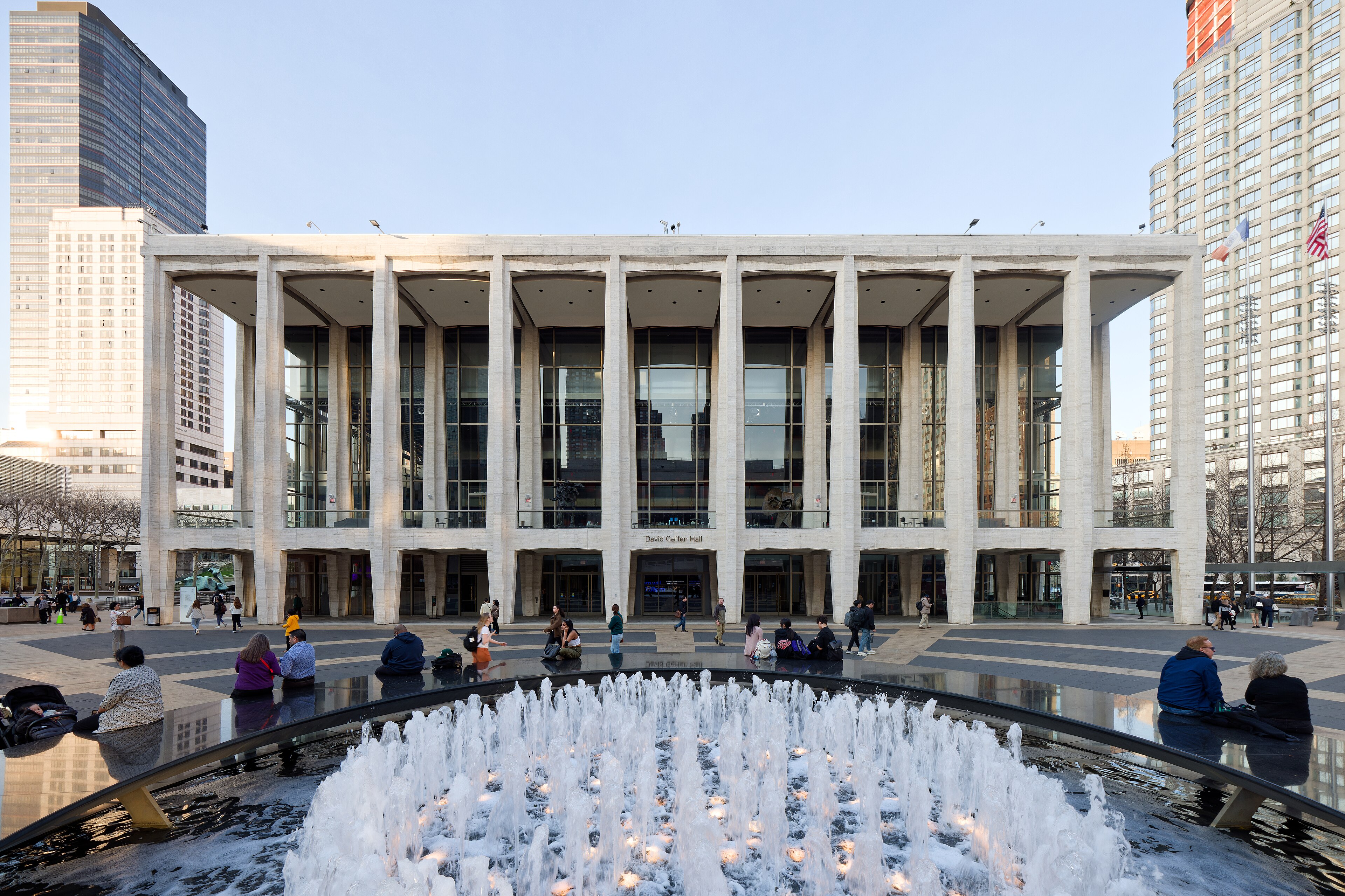
Cover photograph: David Geffen Hall, 14 March 2024, CC0, via Wikimedia Commons. No freely licensed photograph of David Cooper exists on Wikimedia Commons.
Cover photograph: David Geffen Hall at Lincoln Center, the New York Philharmonic's home. Photographed 14 March 2024, released under CC0, via Wikimedia Commons.
Comments
Sign in to join the discussion.